
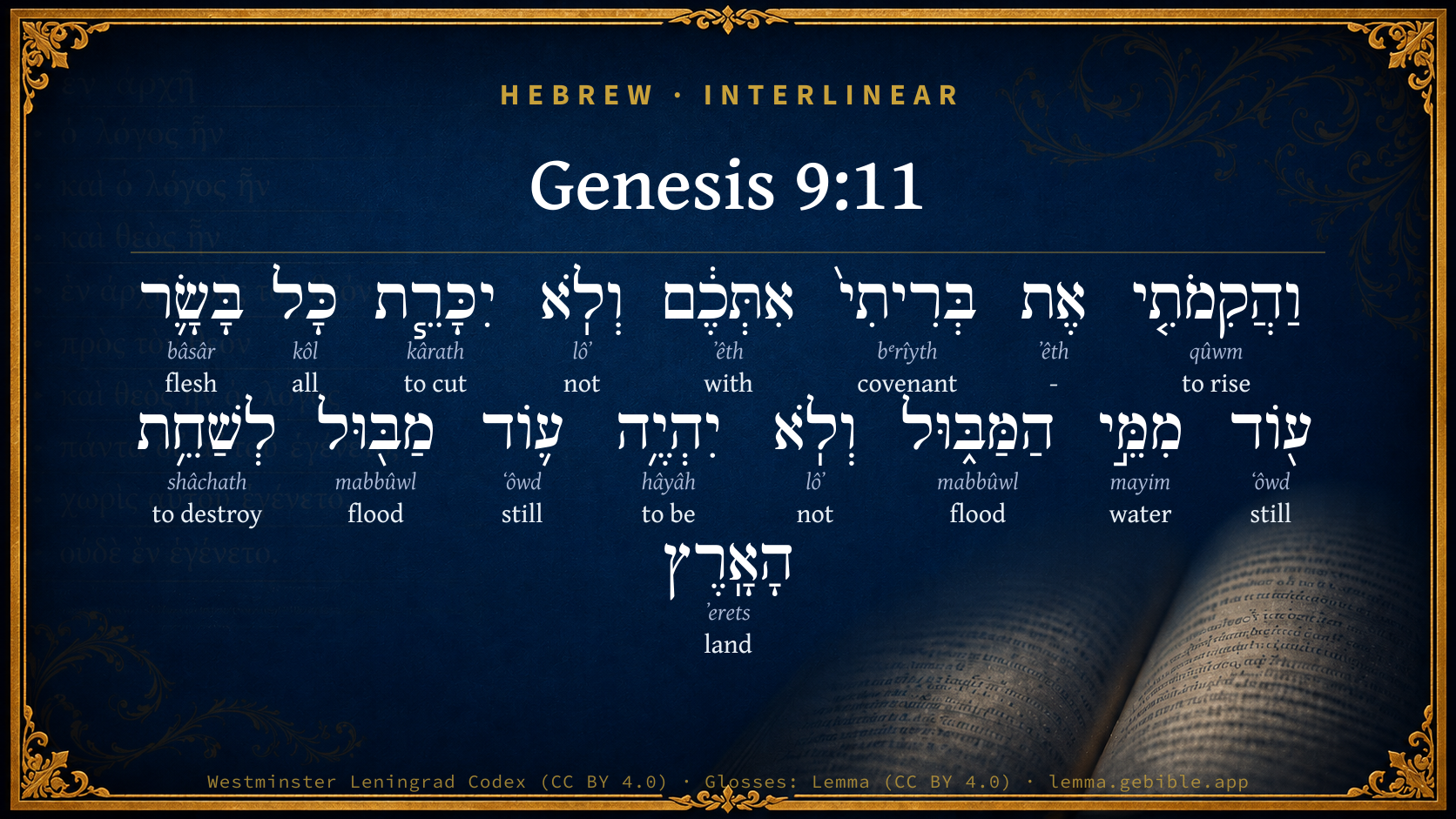
Genesis 9:11

Hebrew (Westminster Leningrad Codex) Genesis 9:11 appears in the Hebrew Old Testament. The text above is from the Westminster Leningrad Codex. Each word links to its Strong’s number, a concise gloss, and parsing drawn from the Open Scriptures Hebrew Bible morphology. Click any word for its full Brown-Driver-Briggs (BDB) entry.
Download image
Cite this verse

Genesis 9:11 (World English Bible). Public Domain. Lemma interlinear Bible study tool, https://lemma.gebible.app/v/genesis/9/11.

Show BibTeX & RIS
BibTeX
RIS
English Translation
I will establish my covenant with you; neither will all flesh be cut off any more by the waters of the flood; neither will there any more be a flood to destroy the earth."
World English Bible · Public Domain
Highlights
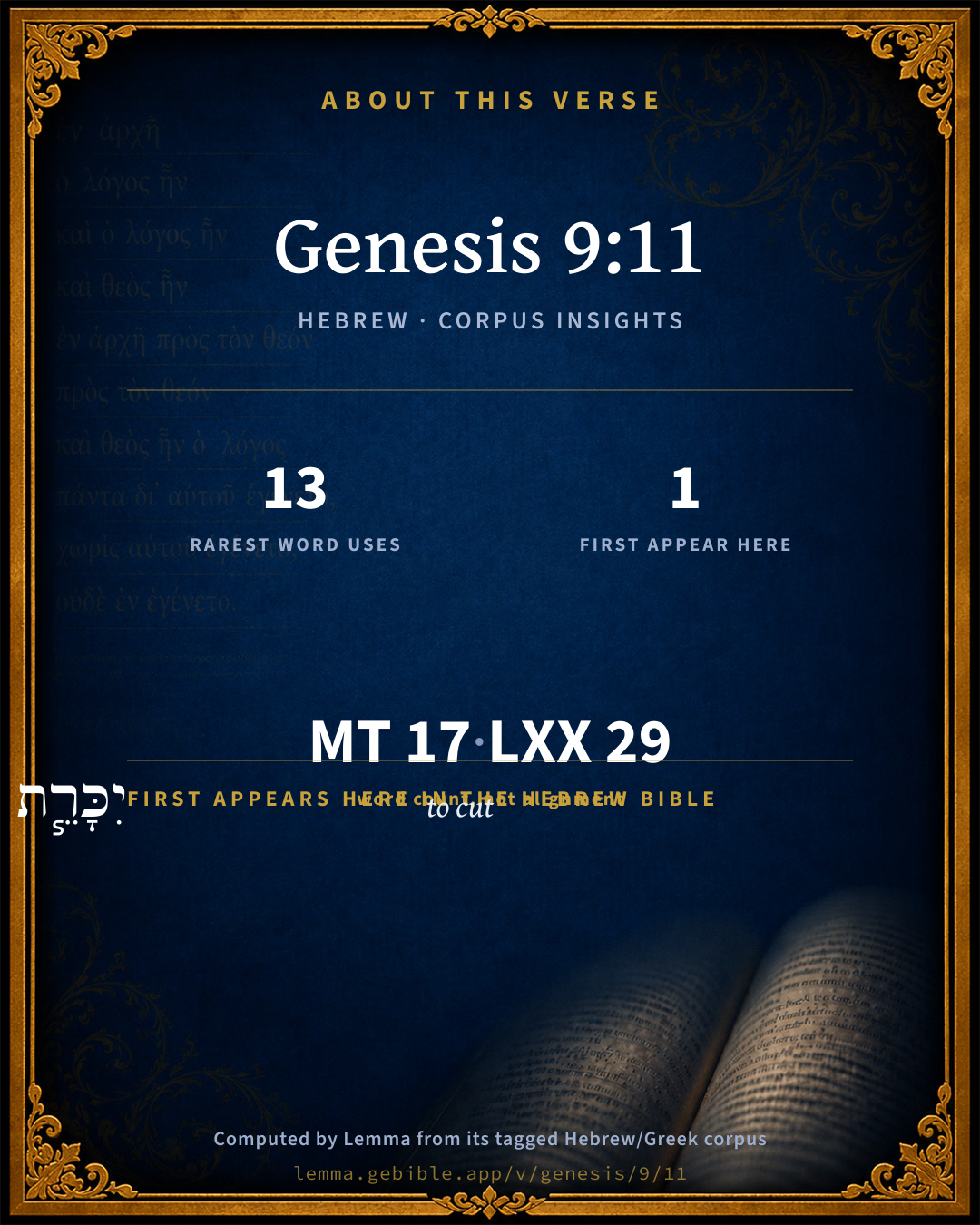
  • 1 first appearance in the Hebrew Bible
Full analysis ↓
Download a study sheet

One document with this verse’s original text, its word-by-word gloss line, the meaning frame, cross-references with their text, attributed commentary, and full source and license credits — printable, and it pastes into notes with its structure intact.

This verse Autodidact and up

Study sheet (.html) Plain text (.txt)

A passage Seminary Student

Up to 50 verses in one chapter. A passage sheet keeps up to 6 commentary sources and 12 cross-references per verse, in the order this page ranks them, and says so on the sheet whenever that leaves anything out. Ask for a single verse and you get the Autodidact verse sheet above.

Everything on this page stays free to read, with no account — the sheet is a download of what is already on screen, not access to it.

Want to remove ads? Support Godless Engineer
Compare translations 3

The same verse in 3 English versions, stacked beneath the original-language interlinear above. Click any original word for its lexicon entry.

Each is an independent rendering of the whole verse — the interlinear is not word-aligned to these translations.

Highlighted words mark where these versions differ — a whole-verse word diff, not a word-by-word alignment.

  • World English Bible Public Domain
    I will establish my covenant with you; neither will all flesh be cut off any more by the waters of the flood; neither will there any more be a flood to destroy the earth."
  • King James Version Public Domain
    And I will establish my covenant with you, neither shall all flesh be cut off any more by the waters of a flood; neither shall there any more be a flood to destroy the earth.
  • unfoldingWord Literal Text CC BY-SA 4.0
    And I am establishing my covenant with you that never again will all flesh be cut off by the waters of a flood, and never again will there be a flood to destroy the earth.”

unfoldingWord Literal Text — © unfoldingWord, licensed CC BY-SA 4.0. Word-aligned USFM3 via Door43 (git.door43.org/unfoldingWord/en_ult).

Versions to compare (up to 4)

3 of 4 selected

Show all 18 translations

Every available English version of this verse, each an independent rendering of the whole verse.

  • World English Bible Public Domain
    I will establish my covenant with you; neither will all flesh be cut off any more by the waters of the flood; neither will there any more be a flood to destroy the earth."
  • Berean Standard Bible Public Domain
    And I establish My covenant with you: Never again will all life be cut off by the waters of a flood; never again will there be a flood to destroy the earth.”
  • Majority Standard Bible Public Domain
    And I establish My covenant with you: Never again will all life be cut off by the waters of a flood; never again will there be a flood to destroy the earth.”
  • King James Version Public Domain
    And I will establish my covenant with you, neither shall all flesh be cut off any more by the waters of a flood; neither shall there any more be a flood to destroy the earth.
  • American Standard Version (1901) Public Domain
    And I will establish my covenant with you; neither shall all flesh be cut off any more by the waters of the flood; neither shall there any more be a flood to destroy the earth.
  • Revised Version (1885) Public Domain
    And I will establish my covenant with you; neither shall all flesh be cut off any more by the waters of the flood; neither shall there any more be a flood to destroy the earth.
  • Geneva Bible (1599) Public Domain
    And my couenant will I establish with you, that from henceforth all flesh shall not be rooted out by ye waters of the flood, neither shall there be a flood to destroy the earth any more.
  • Douay-Rheims (1899) Public Domain
    I will establish my covenant with you, and all flesh shall be no more destroyed with the waters of a flood, neither shall there be from henceforth a flood to waste the earth.
  • Young's Literal Translation Public Domain
    And I have established My covenant with you, and all flesh is not any more cut off by waters of a deluge, and there is not any more a deluge to destroy the earth.'
  • Literal Standard Version CC BY-SA 4.0
    And I have established My covenant with you, and all flesh is not cut off anymore by waters of a flood, and there is not a flood to destroy the earth anymore.”
  • Unlocked Literal Bible CC BY-SA 4.0
    I hereby confirm my covenant with you, that never again will all flesh be destroyed by the waters of a flood. Never again will there be a flood to destroy the earth.”
  • unfoldingWord Literal Text CC BY-SA 4.0
    And I am establishing my covenant with you that never again will all flesh be cut off by the waters of a flood, and never again will there be a flood to destroy the earth.”
  • Darby Bible Public Domain
    And I establish my covenant with you, neither shall all flesh be cut off any more by the waters of a flood, and henceforth there shall be no flood to destroy the earth.
  • World Messianic Bible Public Domain
    I will establish my covenant with you: All flesh will not be cut off any more by the waters of the flood. There will never again be a flood to destroy the earth.”
  • Webster's Bible Public Domain
    And I will establish my covenant with you; neither shall all flesh be cut off any more by the waters of a flood; neither shall there any more be a flood to destroy the earth.
  • Free Bible Version CC BY-SA 4.0
    In my agreement I'm promising you that I won't ever again destroy all life by means of a flood—there won't be a destructive flood like this again.”
  • Bible in Basic English Public Domain
    And I will make my agreement with you; never again will all flesh be cut off by the waters; never again will the waters come over all the earth for its destruction.
  • JPS Tanakh (1917) Public Domain
    And I will establish My covenant with you; neither shall all flesh be cut off any more by the waters of the flood; neither shall there any more be a flood to destroy the earth.'

Literal Standard Version (2020), Covenant Press — licensed CC BY-SA 4.0. Text via the HelloAO Bible API (eBible.org). Unlocked Literal Bible (unfoldingWord) — licensed CC BY-SA 4.0. Text via the HelloAO Bible API (eBible.org). unfoldingWord Literal Text — © unfoldingWord, licensed CC BY-SA 4.0. Word-aligned USFM3 via Door43 (git.door43.org/unfoldingWord/en_ult). Free Bible Version, Dr. Jonathan Gallagher — licensed CC BY-SA 4.0. Text via the HelloAO Bible API (eBible.org).

Word by word

More ways to search: Search by grammar → Find every occurrence → Compare this word →

Practice this passage: Drill this verse → Learn its vocabulary →

הַמַּבּ֑וּל
mabbûwl
H3999
“the · flood”
Particle, Definite Article + Noun, Common, Masculine, Singular, Absolute
Part of Speech
Particle + Noun
Type
Common
Gender
Masculine
Number
Singular
State
Absolute
Full BDB Definition

Origin: from H2986 in the sense of flowing

TWOT: 1142

flood, deluge. - Noah's flood that submerged the entire planet earth under water for about a year
  1. וַהֲקִמֹתִ֤י qûwm H6965 “and · to rise” Conjunction + Verb, Hiphil, Sequential Perfect, 1st Person, Common, Singular
  2. אֶת ʼêth H853 “-” Particle, Direct Object
  3. בְּרִיתִי֙ bᵉrîyth H1285 “covenant · my” Noun, Common, Feminine, Singular, Construct + Suffix, Personal, 1st Person, Common, Singular
  4. אִתְּכֶ֔ם ʼêth H854 “with · you” Preposition + Suffix, Personal, 2nd Person, Masculine, Plural
  5. וְלֹֽא lôʼ H3808 “and · not” Conjunction + Particle, Negative
  6. יִכָּרֵ֧ת kârath H3772 “to cut” Verb, Niphal, Imperfect, 3rd Person, Masculine, Singular
  7. כָּל kôl H3605 “all of” Noun, Common, Masculine, Singular, Construct
  8. בָּשָׂ֛ר bâsâr H1320 “flesh” Noun, Common, Masculine, Singular, Absolute
  9. ע֖וֹד ʻôwd H5750 “still” Adverb
  10. מִמֵּ֣י mayim H4325 “from · water(s) of” Preposition + Noun, Common, Masculine, Plural, Construct
  11. וְלֹֽא lôʼ H3808 “and · not” Conjunction + Particle, Negative
  12. יִהְיֶ֥ה hâyâh H1961 “to be” Verb, Qal, Imperfect, 3rd Person, Masculine, Singular
  13. ע֛וֹד ʻôwd H5750 “still” Adverb
  14. מַבּ֖וּל mabbûwl H3999 “flood” Noun, Common, Masculine, Singular, Absolute
  15. לְשַׁחֵ֥ת shâchath H7843 “to destroy” Preposition + Verb, Piel, Infinitive Construct
  16. הָאָֽרֶץ ʼerets H776 “the · land” Particle, Definite Article + Noun, Common, Both, Singular, Absolute

About this verse

These counts appear in no published source. They are computed here, from the morphology-tagged text and Lemma’s own curated glosses. What Lemma adds →

17
words
14
distinct lemmas
Pentateuch
section

Notable vocabulary

The rarest word here is הַמַּבּ֑וּל flood H3999 — appearing just 13 times in the whole Hebrew Bible.

First appearance in Scripture

This word makes its first canonical appearance in the Hebrew Bible here:

  • יִכָּרֵ֧ת to cut H3772

Shared distinctive vocabulary

הַמַּבּ֑וּל flood H3999 occurs in 12 verses of the Hebrew Bible. Also found in:

Grammatical profile

  • 4 verbs
  • 7 nouns
  • 1 preposition
  • 2 adverbs
  • 3 particles

Verb forms

  • וַהֲקִמֹתִ֤י Hiphil · Sequential Perfect
  • יִכָּרֵ֧ת Niphal · Imperfect
  • יִהְיֶ֥ה Qal · Imperfect
  • לְשַׁחֵ֥ת Piel · Infinitive Construct

Repetition

Words recur within this verse — often emphatic in Hebrew:

  • ע֖וֹד still H5750 ×2
  • הַמַּבּ֑וּל flood H3999 ×2
  • וְלֹֽא not H3808 ×2

Hebrew & Septuagint length

In English translation the verse runs 34 words from the Hebrew and 37 from the Septuagint (LXX English) — closely comparable.

A rough comparison of the two English renderings, which tokenize alike — not a word-level alignment.

Word counts can differ between the Hebrew and the Greek without any difference in meaning — e.g. the Hebrew direct-object marker אֵת has no separate Greek word, and Greek often adds the article ὁ.

In the original languages it is 17 Hebrew tokens and 29 Greek tokens — but the two are counted differently (Hebrew bundles its prefixes and suffixes into one token; the Greek is in lemma form), so that isn’t a like-for-like length.

Cross-references

5

Topical passages linked to Genesis 9:11 in the Treasury of Scripture Knowledge — connected by theme and wording, ordered by reader-vote popularity; previews shown in the World English Bible.

  • Isaiah 54:9 For this is [as] the waters of Noah to me; for as I have sworn that the waters of Noah shall no more go over the earth, so have I sworn that I will not be angry with you, nor rebuke you.
  • Genesis 8:21–22 Yahweh smelled the sweet savor. Yahweh said in his heart, "I will not again curse the ground any more for man's sake, because the imagination of man's heart is evil from his youth; neither will I ever again strike everything living, as I have done.
  • 2 Peter 3:7 But the heavens that now are, and the earth, by the same word have been stored up for fire, being reserved against the day of judgment and destruction of ungodly men.
  • Genesis 7:21–23 All flesh died that moved on the earth, including birds, cattle, animals, every creeping thing that creeps on the earth, and every man.
  • 2 Peter 3:11 Therefore since all these things are thus to be destroyed, what manner of persons ought you to be in holy living and godliness,

Cross-references courtesy of OpenBible.info (CC BY 4.0).

Hebrew and Greek witnesses Masoretic Hebrew ↔ Greek Septuagint

The same verse in the two great witnesses to the Old Testament, shown verse-for-verse.

These are two independent witnesses, not word-aligned to each other, and the Septuagint is shown in lemma (dictionary) form.

Hebrew Genesis 9:11 Masoretic · Westminster Leningrad Codex

וַהֲקִמֹתִ֤י אֶת בְּרִיתִי֙ אִתְּכֶ֔ם וְלֹֽא יִכָּרֵ֧ת כָּל בָּשָׂ֛ר ע֖וֹד מִמֵּ֣י הַמַּבּ֑וּל וְלֹֽא יִהְיֶ֥ה ע֛וֹד מַבּ֖וּל לְשַׁחֵ֥ת הָאָֽרֶץ

I will establish my covenant with you; neither will all flesh be cut off any more by the waters of the flood; neither will there any more be a flood to destroy the earth."

World English Bible · Public Domain

Greek LXX Genesis 9:11 Septuagint · lemma form

καί ἵστημι ὁ διαθήκη ἐγώ πρός σύ καί οὐ ἀποθνήσκω πᾶς σάρξ ἔτι ἀπό ὁ ὕδωρ ὁ κατακλυσμός καί οὐ εἰμί ἔτι κατακλυσμός ὕδωρ ὁ καταφθείρω πᾶς ὁ γῆ

And I will establish my covenant with you and all flesh shall not any more die by the water of the flood, and there shall no more be a flood of water to destroy all the earth.

LXX2012 (modern English Septuagint) · Public Domain

Hebrew: Westminster Leningrad Codex (CC BY 4.0). Greek: Septuagint (public domain); English from LXX2012 (modern English Septuagint) (Public Domain). How the Septuagint differs from the Hebrew →

Targum (Aramaic paraphrase)

2

The Targum is the ancient Jewish Aramaic paraphrase of the Hebrew Scriptures — an interpretive translation, not the Hebrew text itself. Onkelos (literal) and Pseudo-Jonathan (expansive) render the Torah, and Jonathan the Prophets. Coverage is partial: where no permissively-licensed English translation exists for a verse, only the Aramaic is shown. This is verse-level text, not a word-by-word alignment to the Hebrew.

  1. Targum Onkelos Torah (Genesis–Deuteronomy)
    וְאָקֵם יָת קְיָמִי עִמְּכוֹן וְלָא יִשְׁתֵּיצֵי כָל בִּשְׂרָא עוֹד מִמֵּי טוֹפָנָא וְלָא יְהֵי עוֹד טוֹפָנָא לְחַבָּלָא אַרְעָא

    And I will establish My covenant with you, and all flesh shall not again be consumed by the waters of a deluge, nor shall there be again a deluge to destroy the earth.

    Targum Onkelos — Aramaic: “Onkelos Genesis” (public domain); “Onkelos Exodus” (public domain); “Onkelos Leviticus” (public domain); “Onkelos Numbers” (public domain); “Onkelos Deuteronomy” (public domain). English: “Sefaria Community Translation” (CC0 1.0 (public-domain dedication)); “J.W. Etheridge. The Targums of Onkelos and Jonathan Ben Uzziel on the Pentateuch. London: Longmans, Green, 1862” (public domain). Text via Sefaria.

  2. Targum Pseudo-Jonathan Torah (Genesis–Deuteronomy)
    וַאֲקַיֵים יַת קְיָימַי עִמְכוֹן וְלָא יִשְׁתֵּצֵי כָּל בִּשְרָא עוֹד מִמוֹי דְטוּבְעָנָא וְלָא יְהִי עוֹד טוּבְעָנָא לְחַבָּלָא אַרְעָא

    And I will establish my covenant with you, and will not again cause all flesh to perish by the waters of a flood; and there shall not again be a flood to destroy the earth.

    Targum Pseudo-Jonathan — Aramaic: “Targum Jonathan on Genesis” (public domain); “Targum Jonathan on Exodus” (public domain); “Targum Jonathan on Leviticus” (public domain); “Targum Jonathan on Numbers” (public domain); “Targum Jonathan on Deuteronomy” (public domain). English: “The Targum of Jonathan ben Uzziel, trans. J. W. Etheridge, London, 1862” (public domain). Text via Sefaria.

Commentary

Notes on Genesis 9:11 from classic Christian and Jewish commentators (each source and its license shown beneath its notes). The classic Christian expositions comment on the surrounding passage and are grouped to its opening verse, so a note may address several verses; the Jewish commentaries on the Tanakh (Rashi and others) are per-verse, so they appear only where the commentator wrote on this verse.

Lemma curates 59 commentaries, every one of them public domain or Creative Commons licensed, each selected and text-cleaned for this edition rather than reprinted as found. About our sources →

Trapp's Complete Commentary

John Trapp

Gen 9:11 And I will establish my covenant with you; neither shall all flesh be cut off any more by the waters of a flood; neither shall there any more be a flood to destroy the earth.

Ver. 11. Neither shall all flesh be cut off.] {See Trapp on "Isa 54:9"} {See Trapp on "Isa 54:10"}

John Trapp, A Commentary or Exposition upon All the Books of the Old and New Testament (1647–1656) — public domain. Text from a community e-Sword module.

Joseph Benson's Commentary

Gen 9:11. There shall not any more be a flood — God had drowned the world once, and still it is as provoking as ever; yet he will never drown it any more, for he deals not with us according to our sins. This promise of God keeps the sea and clouds in their decreed places, and “sets them gates and bars: Hitherto they shall come,” Job 38:10-11. If the sea should flow but for a few days, as it doth twice every day for a few hours, what desolations would it make! So would the clouds, if such showers as we have sometimes seen, were continued long. But God, by flowing seas and sweeping rains, shows what he could do in wrath; and yet by preserving the earth from being deluged between both, shows what he can do in mercy, and will do in truth.

Joseph Benson's Commentary on the Old and New Testaments (1811–1818) — public domain. Text from a community e-Sword module.

Tyndale Open Study Notes

Tyndale Open Resources

9:11 This promise does not prohibit worldwide judgment, but it restricts the means by which God will do it (see 2 Pet 3:4-13).

Tyndale Open Study Notes — © Tyndale Open Resources, licensed CC BY-SA 4.0. Text via the HelloAO Bible API.

The Cambridge Bible for Schools and Colleges

gen. ed. J. J. S. Perowne

11. a flood to destroy the earth] The promise here given, that there shall never more be a flood, is appealed to by the prophet in Isa_54:9-10, “for this is as the waters of Noah unto me: for as I have sworn that the waters of Noah should no more go over the earth, so have I sworn that I would not be wroth with thee … for the mountains shall depart and the hills be removed; but my kindness shall not depart from thee, neither shall my covenant of peace be removed, saith the Lord that hath mercy on thee.”

The Cambridge Bible for Schools and Colleges (gen. ed. J. J. S. Perowne; Cambridge University Press, 1878–1918) — public domain. Text from a community e-Sword module.

John Gill's Exposition

And I will establish my covenant with you,.... This is repeated to denote the certainty of it, as well as to lead on to the particulars of it:

neither shall all flesh be cut off any more by the waters of a flood; neither man nor beast, at least not all of them, and especially by water:

neither shall there be any more a flood to destroy the earth; not a general deluge, otherwise notwithstanding this promise there might be, as there have been, particular inundations, which have overflowed particular countries and places, but not the whole earth; and this hinders not but that the whole earth may be destroyed by fire, as it will be at the last day, only not by water any more; and this is the sum and substance of the covenant with Noah, his sons, and all the creatures that have been, or shall be.

John Gill's Exposition of the Whole Bible (1746–1763) — public domain (CC PDM 1.0). Text via the HelloAO Bible API.

Matthew Poole's English Annotations

i.e. A universal deluge; for particular inundations there have been, whereby towns and countries have been overwhelmed with all their inhabitants.

Matthew Poole's English Annotations on the Holy Bible (1683–1685) — public domain. Text from a community e-Sword/MySword module.

The Pulpit Commentary

And I will establish my covenant with you. Not form it for the first time, as if no such covenant had existed in antediluvian times (Knobel); but cause it to stand or permanently establish it, so that it shall no more be-in danger of being overthrown, as it recently has been. The word "my" points to a covenant already in existence, though not formally mentioned until the time of Noah. (Gen_6:18) The promise of the woman"s seed, which formed the substance of the covenant during the interval from Adam to Noah, was from Noah"s time downwards to be enlarged by a specific pledge of the stability of the earth and the safety of man (cf. Gen_8:22) Neither shall all flesh including the human race and animal creation. Cf. rcBAlK mankind, (Gen_6:12) the lower creatures (Gen_7:21) be cut off any more by the waters of a flood. Literally, the flood just passed, which would no more return. Neither shall there any more be a flood (of any kind) to destroy the earth. Regions might be devastated and tribes of animals and men swept away, but never again would there be a universal destruction of the earth or of man.

The Pulpit Commentary (1880–1919), ed. H.D.M. Spence-Jones & Joseph S. Exell — public domain. Text from a community e-Sword module.

John Wesley's Explanatory Notes

There shall not any more be a flood - God had drowned the world once, and still it is as provoking as ever; yet he will never drown it any more, for he deals not with us according to our sins. This promise of God keeps the sea and clouds in their decreed place, and sets them gates and bars, Hitherto they shall come, Job xxxviii, 10, 11. If the sea should flow but for a few days, as it doth twice every day for a few hours, what desolations would it make? So would the clouds, if such showers as we have sometimes seen, were continued long. But God by flowing seas, and sweeping rains, shews what he could do in wrath; and yet by preserving the earth from being deluged between both, shews what he can do in mercy, and will do in truth.

John Wesley, Explanatory Notes Upon the Whole Bible (1754–1765) — public domain. Text via the GEBible commentary corpus.

unfoldingWord translationNotes

Door43 World Missions Community

General Information:

God continues speaking to Noah and his sons.

I hereby confirm my covenant with you

"By saying this, I make my covenant with you." See how similar words are translated in Genesis 6:18.

all flesh

Possible meanings for what "all flesh" represents are 1) all human beings or 2) all physical beings, including humans and animal. See how this is translated in Genesis 6:12. (See: Synecdoche)

Never again will there be a flood to destroy the earth

"There will never again be a flood that destroys the earth." There would be floods, but they would not destroy the whole earth.

sign

This means a reminder of something that was promised.

covenant ... for all future generations

The covenant applies to Noah and his family and also to all generations that follow.

translationWords

covenant

flesh

flood

generation

sign

unfoldingWord translationNotes — © Distant Shores Media and the Door43 World Missions Community, licensed CC BY-SA 4.0. Source: git.door43.org/Door43/en_tn.

Rashi

Rabbi Shlomo Yitzchaki (Rashi)

והקמתי AND I WILL ESTABLISH — I will give confirmation to my covenant; and in what consists this confirmation? “The sign of the rainbow”, as it goes on explaining at the end.

Rashi on the Tanakh — English translations: “The Judaica Press complete Tanach with Rashi, translated by A. J. Rosenberg” (CC BY 4.0); “Pentateuch with Rashi's commentary by M. Rosenbaum and A.M. Silbermann, 1929-1934” (public domain); “The Metsudah Tanach series, Lakewood, N.J” (CC BY 4.0); and “The Book of Joshua, Metsudah Publications, 1997” (CC BY 4.0). Text via Sefaria.

Radak

Rabbi David Kimhi (Radak)

והקימותי, earlier the formulation had been הנני מקים. At that time G’d had not mentioned the substance of the covenant. Now the Torah spells out what G’d had had in mind with the line (in verse 9) ואני הנני מקים את בריתי. The promise not to wipe out כל בשר is parallel to the promise not to flood the entire universe with water again. In both instances G’d reserves the right to flood part of the earth or to destroy part of mankind. The promise does include the assurance that rain of the dimensions and duration experienced during the deluge will not occur again, ever. The words לשחת את הארץ are an illustration of what would happen if G’d would bring on another deluge.

Radak on the Tanakh — English translations: “Sefaria Community Translation” (CC0 1.0 (public-domain dedication)); “Eliyahu Munk, HaChut Hameshulash” (CC BY 4.0); “Rabbi Mike Feuer, Jerusalem Anthology” (CC BY 4.0); and “R. David Kimhi on the first book of Psalms, Translated by R.G. Finch, London, 1919” (public domain). Text via Sefaria.

Lesson kit

Teaching starters — assembled from the data on this page, not authored interpretation. Every prompt links to the verse data it draws on. Edit before teaching.

Genesis, in the Pentateuch, opens this verse with 17 words (14 distinct Hebrew lemmas). Its most distinctive word is mabbûwl (“flood”). A historical commentator’s framing appears above. Read the whole chapter for the surrounding context.

Discussion questions

  1. How does “flood” (mabbûwl) shape what this verse is saying?
  2. This is the first place “to cut” appears in Scripture (first appears here). What does its debut here establish?
  3. How does Genesis 6:17, which shares the word «flood», read alongside this verse?
  4. What does the repetition of “still” (2× in this one verse) do in this verse?
  5. The translations on this page render this verse differently — a whole-verse word diff, not a word-by-word alignment. What might account for the different wordings?
  6. «וַהֲקִמֹתִ֤י» is a Hiphil Sequential Perfect verb. How does that grammatical form shape the action described?
  7. Compare how Trapp's Complete Commentary and Joseph Benson's Commentary read this verse. Where do they agree or differ?

Things to notice

Reading settings

Reading text

Shown beneath each verse's original-language words.

Old Testament
Old Testament edition

Read the OT as the Masoretic Hebrew (MT) or the Greek Septuagint (LXX).

English shown for the Greek Septuagint (in the Hebrew ↔ Greek comparison).

Comparing translations? Open the Compare panel on any verse page to stack up to four side by side.