Ezekiel 17:13

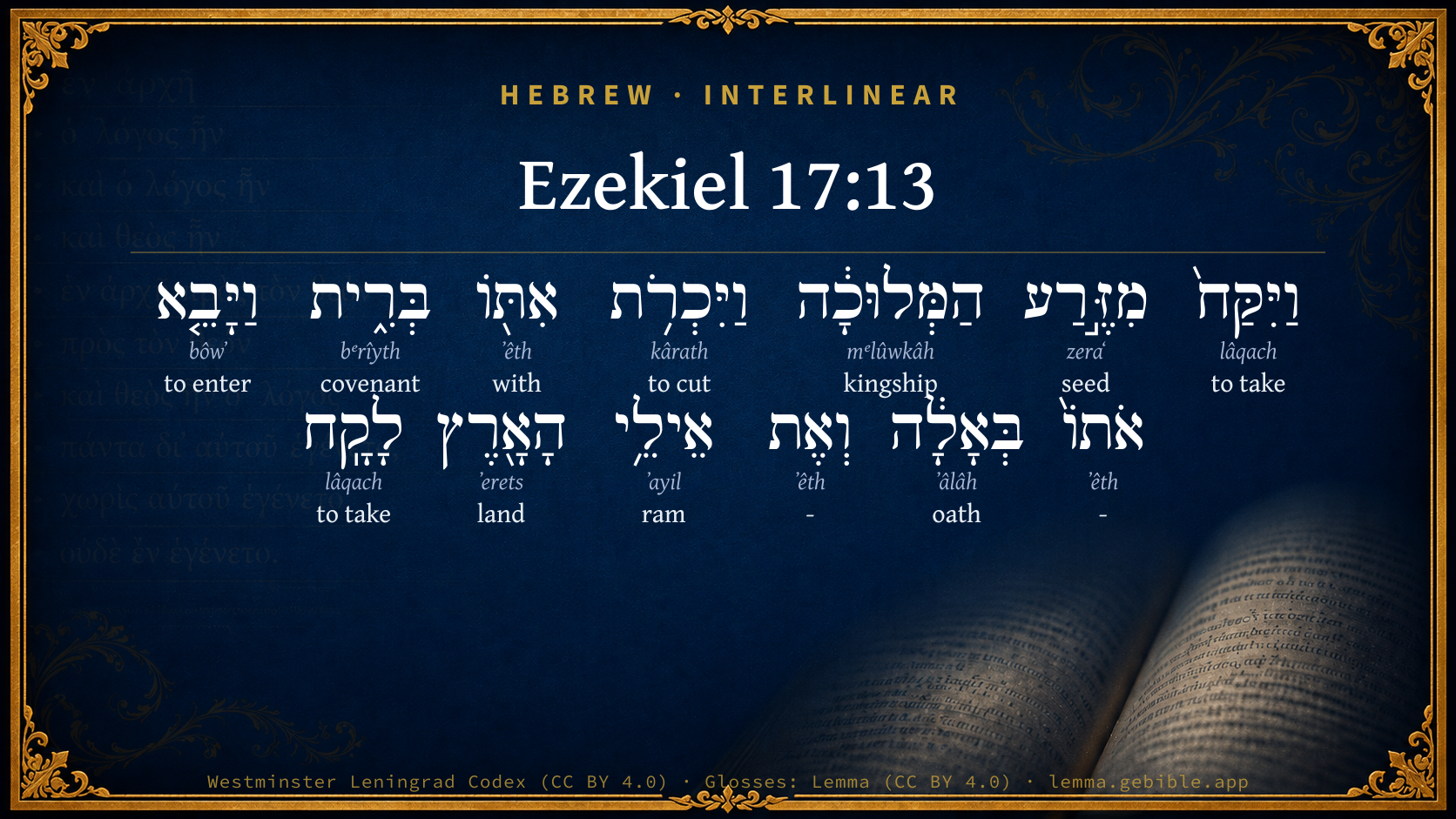
Hebrew (Westminster Leningrad Codex) Ezekiel 17:13 appears in the Hebrew Old Testament. The text above is from the Westminster Leningrad Codex. Each word links to its Strong’s number, a concise gloss, and parsing drawn from the Open Scriptures Hebrew Bible morphology. Click any word for its full Brown-Driver-Briggs (BDB) entry.
Download image
Cite this verse

Ezekiel 17:13 (World English Bible). Public Domain. Lemma interlinear Bible study tool, https://lemma.gebible.app/v/ezekiel/17/13.

Show BibTeX & RIS
BibTeX
RIS
English Translation
and he took of the seed royal, and made a covenant with him; he also brought him under an oath, and took away the mighty of the land;
World English Bible · Public Domain
Download a study sheet

One document with this verse’s original text, its word-by-word gloss line, the meaning frame, cross-references with their text, attributed commentary, and full source and license credits — printable, and it pastes into notes with its structure intact.

This verse Autodidact and up

Study sheet (.html) Plain text (.txt)

A passage Seminary Student

Up to 50 verses in one chapter. A passage sheet keeps up to 6 commentary sources and 12 cross-references per verse, in the order this page ranks them, and says so on the sheet whenever that leaves anything out. Ask for a single verse and you get the Autodidact verse sheet above.

Everything on this page stays free to read, with no account — the sheet is a download of what is already on screen, not access to it.

Want to remove ads? Support Godless Engineer
Compare translations 3

The same verse in 3 English versions, stacked beneath the original-language interlinear above. Click any original word for its lexicon entry.

Each is an independent rendering of the whole verse — the interlinear is not word-aligned to these translations.

Highlighted words mark where these versions differ — a whole-verse word diff, not a word-by-word alignment.

  • World English Bible Public Domain
    and he took of the seed royal, and made a covenant with him; he also brought him under an oath, and took away the mighty of the land;
  • King James Version Public Domain
    And hath taken of the king's seed, and made a covenant with him, and hath taken an oath of him: he hath also taken the mighty of the land:
  • unfoldingWord Literal Text CC BY-SA 4.0
    Then he took a royal descendant, made a covenant with him, and brought him under an oath. He took away the powerful people of the land,

unfoldingWord Literal Text — © unfoldingWord, licensed CC BY-SA 4.0. Word-aligned USFM3 via Door43 (git.door43.org/unfoldingWord/en_ult).

Versions to compare (up to 4)

3 of 4 selected

Show all 18 translations

Every available English version of this verse, each an independent rendering of the whole verse.

  • World English Bible Public Domain
    and he took of the seed royal, and made a covenant with him; he also brought him under an oath, and took away the mighty of the land;
  • Berean Standard Bible Public Domain
    He took a member of the royal family and made a covenant with him, putting him under oath. Then he carried away the leading men of the land,
  • Majority Standard Bible Public Domain
    He took a member of the royal family and made a covenant with him, putting him under oath. Then he carried away the leading men of the land,
  • King James Version Public Domain
    And hath taken of the king's seed, and made a covenant with him, and hath taken an oath of him: he hath also taken the mighty of the land:
  • American Standard Version (1901) Public Domain
    and he took of the seed royal, and made a covenant with him; he also brought him under an oath, and took away the mighty of the land;
  • Revised Version (1885) Public Domain
    and he took of the seed royal, and made a covenant with him; he also brought him under an oath, and took away the mighty of the land:
  • Geneva Bible (1599) Public Domain
    And hath taken one of the Kings seede, and made a couenant with him, and hath taken an othe of him: he hath also taken the princes of the land,
  • Douay-Rheims (1899) Public Domain
    And he shall take one of the king's seed, and make a covenant with him, and take an oath of him. Yea, and he shall take away the mighty men of the land,
  • Young's Literal Translation Public Domain
    And he taketh of the seed of the kingdom, And maketh with him a covenant, And bringeth him in to an oath, And the mighty of the land he hath taken,
  • Literal Standard Version CC BY-SA 4.0
    And he takes of the seed of the kingdom, || And makes a covenant with him, || And brings him into an oath, || And he has taken the mighty of the land,
  • Unlocked Literal Bible CC BY-SA 4.0
    Then he took a royal descendant, made a covenant with him, and brought him under an oath. He took away the powerful people of the land,
  • unfoldingWord Literal Text CC BY-SA 4.0
    Then he took a royal descendant, made a covenant with him, and brought him under an oath. He took away the powerful people of the land,
  • Darby Bible Public Domain
    And he took of the king's seed, and made a covenant with him, and brought him under an oath, and he took away the mighty of the land;
  • World Messianic Bible Public Domain
    He took one of the royal offspring, and made a covenant with him. He also brought him under an oath, and took away the mighty of the land,
  • Webster's Bible Public Domain
    And hath taken of the king's seed, and made a covenant with him, and hath taken an oath from him: he hath also taken the mighty of the land:
  • Free Bible Version CC BY-SA 4.0
    He made an agreement with one of the royal family and made him take an oath that he would be a loyal subject as king. Then he took into exile the country's leaders,
  • Bible in Basic English Public Domain
    And he took one of the sons of the king and made an agreement with him; and he put him under an oath, and took away the great men of the land:
  • JPS Tanakh (1917) Public Domain
    and he took of the seed royal, and made a covenant with him, and brought him under an oath, and the mighty of the land he took away;

Literal Standard Version (2020), Covenant Press — licensed CC BY-SA 4.0. Text via the HelloAO Bible API (eBible.org). Unlocked Literal Bible (unfoldingWord) — licensed CC BY-SA 4.0. Text via the HelloAO Bible API (eBible.org). unfoldingWord Literal Text — © unfoldingWord, licensed CC BY-SA 4.0. Word-aligned USFM3 via Door43 (git.door43.org/unfoldingWord/en_ult). Free Bible Version, Dr. Jonathan Gallagher — licensed CC BY-SA 4.0. Text via the HelloAO Bible API (eBible.org).

Word by word

More ways to search: Search by grammar → Find every occurrence → Compare this word →

Practice this passage: Drill this verse → Learn its vocabulary →

הַמְּלוּכָ֔ה
mᵉlûwkâh
H4410
“the · kingship”
Particle, Definite Article + Noun, Common, Feminine, Singular, Absolute
Part of Speech
Particle + Noun
Type
Common
Gender
Feminine
Number
Singular
State
Absolute
Full BDB Definition

Origin: pass. participle of H4427

TWOT: 1199d

kingship, royalty, kingly office
  1. וַיִּקַּח֙ lâqach H3947 “and · to take” Conjunction + Verb, Qal, Sequential Imperfect, 3rd Person, Masculine, Singular
  2. מִזֶּ֣רַע zeraʻ H2233 “from · seed of” Preposition + Noun, Common, Masculine, Singular, Construct
  3. וַיִּכְרֹ֥ת kârath H3772 “and · to cut” Conjunction + Verb, Qal, Sequential Imperfect, 3rd Person, Masculine, Singular
  4. אִתּ֖וֹ ʼêth H854 “with · him” Preposition + Suffix, Personal, 3rd Person, Masculine, Singular
  5. בְּרִ֑ית bᵉrîyth H1285 “covenant” Noun, Common, Feminine, Singular, Absolute
  6. וַיָּבֵ֤א bôwʼ H935 “and · to enter” Conjunction + Verb, Hiphil, Sequential Imperfect, 3rd Person, Masculine, Singular
  7. אֹתוֹ֙ ʼêth H853 “- · him” Particle, Direct Object + Suffix, Personal, 3rd Person, Masculine, Singular
  8. בְּאָלָ֔ה ʼâlâh H423 “in/at · oath” Preposition + Noun, Common, Feminine, Singular, Absolute
  9. וְאֶת ʼêth H853 “and · -” Conjunction + Particle, Direct Object
  10. אֵילֵ֥י ʼayil H352 “rams of” Noun, Common, Masculine, Plural, Construct
  11. הָאָ֖רֶץ ʼerets H776 “the · land” Particle, Definite Article + Noun, Common, Both, Singular, Absolute
  12. לָקָֽח lâqach H3947 “to take” Verb, Qal, Perfect, 3rd Person, Masculine, Singular

About this verse

These counts appear in no published source. They are computed here, from the morphology-tagged text and Lemma’s own curated glosses. What Lemma adds →

13
words
11
distinct lemmas
Prophets
section

Notable vocabulary

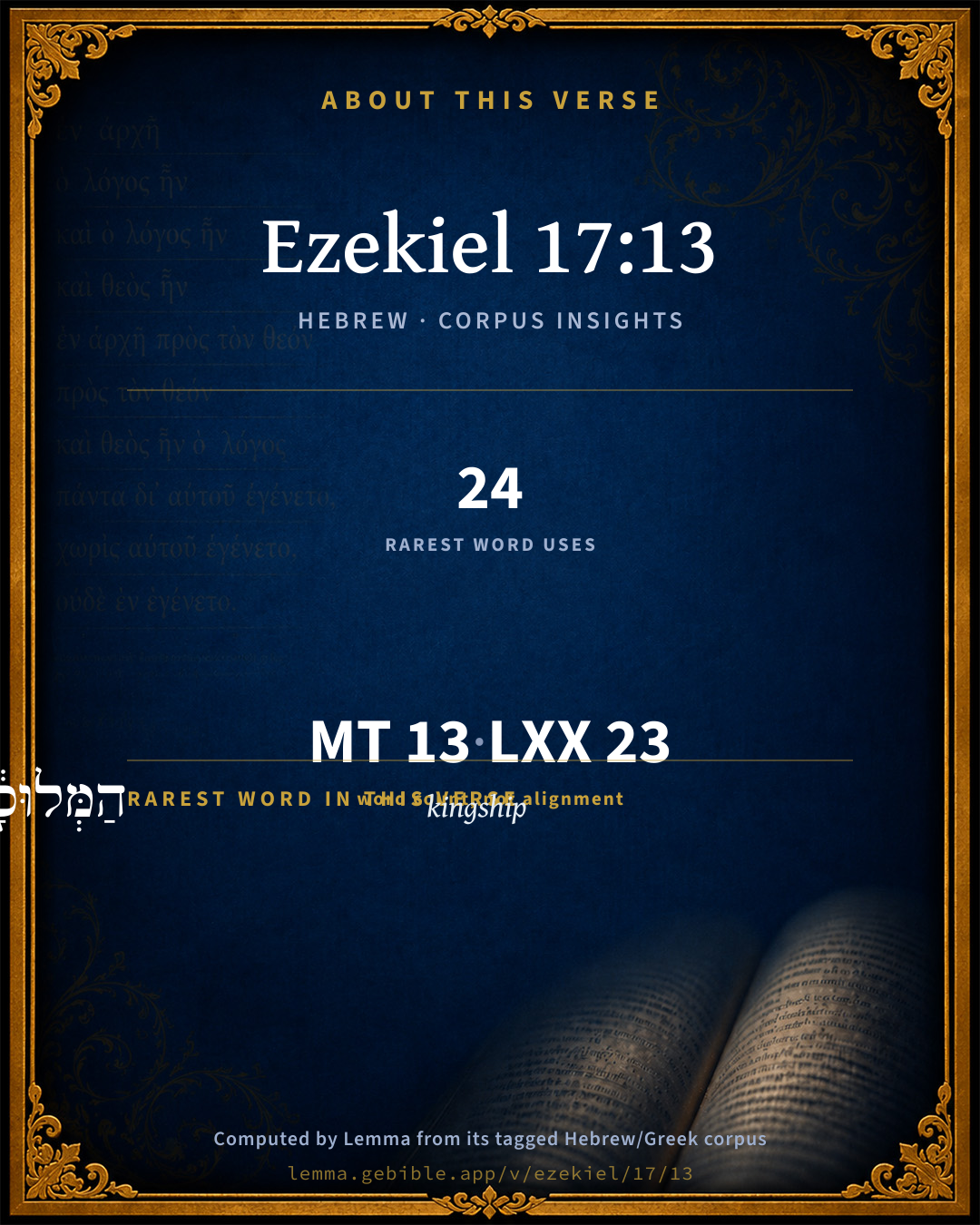
The rarest word here is הַמְּלוּכָ֔ה kingship H4410 — appearing just 24 times in the whole Hebrew Bible.

Shared distinctive vocabulary

הַמְּלוּכָ֔ה kingship H4410 occurs in 23 verses of the Hebrew Bible. Also found in:

Grammatical profile

  • 4 verbs
  • 6 nouns
  • 1 preposition
  • 2 particles

Verb forms

  • וַיִּקַּח֙ Qal · Sequential Imperfect
  • וַיִּכְרֹ֥ת Qal · Sequential Imperfect
  • וַיָּבֵ֤א Hiphil · Sequential Imperfect
  • לָקָֽח Qal · Perfect

Repetition

A word recurs within this verse — often emphatic in Hebrew:

  • וַיִּקַּח֙ to take H3947 ×2

Hebrew & Septuagint length

In English translation the verse runs 28 words from the Hebrew and 31 from the Septuagint (LXX English) — closely comparable.

A rough comparison of the two English renderings, which tokenize alike — not a word-level alignment.

Word counts can differ between the Hebrew and the Greek without any difference in meaning — e.g. the Hebrew direct-object marker אֵת has no separate Greek word, and Greek often adds the article ὁ.

In the original languages it is 13 Hebrew tokens and 23 Greek tokens — but the two are counted differently (Hebrew bundles its prefixes and suffixes into one token; the Greek is in lemma form), so that isn’t a like-for-like length.

Cross-references

7

Topical passages linked to Ezekiel 17:13 in the Treasury of Scripture Knowledge — connected by theme and wording, ordered by reader-vote popularity; previews shown in the World English Bible.

  • 2 Chronicles 36:13 He also rebelled against king Nebuchadnezzar, who had made him swear by God: but he stiffened his neck, and hardened his heart against turning to Yahweh, the God of Israel.
  • 2 Kings 24:15–17 He carried away Jehoiachin to Babylon; and the king's mother, and the king's wives, and his officers, and the chief men of the land, carried he into captivity from Jerusalem to Babylon.
  • Ezekiel 17:5 He took also of the seed of the land, and planted it in a fruitful soil; he placed it beside many waters; he set it as a willow tree.
  • Jeremiah 5:2 Though they say, As Yahweh lives; surely they swear falsely.
  • Jeremiah 24:1 Yahweh shown me, and, behold, two baskets of figs set before the temple of Yahweh, after that Nebuchadrezzar king of Babylon had carried away captive Jeconiah the son of Jehoiakim, king of Judah, and the princes of Judah, with the craftsmen and smiths, from Jerusalem, and had brought them to Babylon.
  • Jeremiah 29:2 (after that Jeconiah the king, and the queen-mother, and the eunuchs, [and] the princes of Judah and Jerusalem, and the craftsmen, and the smiths, were departed from Jerusalem),
  • Jeremiah 37:1 Zedekiah the son of Josiah reigned as king, instead of Coniah the son of Jehoiakim, whom Nebuchadrezzar king of Babylon made king in the land of Judah.

Cross-references courtesy of OpenBible.info (CC BY 4.0).

Hebrew and Greek witnesses Masoretic Hebrew ↔ Greek Septuagint

The same verse in the two great witnesses to the Old Testament, shown verse-for-verse.

These are two independent witnesses, not word-aligned to each other, and the Septuagint is shown in lemma (dictionary) form.

Hebrew Ezekiel 17:13 Masoretic · Westminster Leningrad Codex

וַיִּקַּח֙ מִזֶּ֣רַע הַמְּלוּכָ֔ה וַיִּכְרֹ֥ת אִתּ֖וֹ בְּרִ֑ית וַיָּבֵ֤א אֹתוֹ֙ בְּאָלָ֔ה וְאֶת אֵילֵ֥י הָאָ֖רֶץ לָקָֽח

and he took of the seed royal, and made a covenant with him; he also brought him under an oath, and took away the mighty of the land;

World English Bible · Public Domain

Greek LXX Ezekiel 17:13 Septuagint · lemma form

καί λαμβάνω ἐκ ὁ σπέρμα ὁ βασιλεία καί διατίθημι πρός αὐτός διαθήκη καί εἰςἄγω αὐτός ἐν ἀρά καί ὁ ἡγέομαι ὁ γῆ λαμβάνω

And he shall take of the seed royal, and shall make a covenant with him, and shall bind him with an oath: and he shall take the princes of the land:

LXX2012 (modern English Septuagint) · Public Domain

Hebrew: Westminster Leningrad Codex (CC BY 4.0). Greek: Septuagint (public domain); English from LXX2012 (modern English Septuagint) (Public Domain). How the Septuagint differs from the Hebrew →

Targum (Aramaic paraphrase)

1

The Targum is the ancient Jewish Aramaic paraphrase of the Hebrew Scriptures — an interpretive translation, not the Hebrew text itself. Onkelos (literal) and Pseudo-Jonathan (expansive) render the Torah, and Jonathan the Prophets. Coverage is partial: where no permissively-licensed English translation exists for a verse, only the Aramaic is shown. This is verse-level text, not a word-by-word alignment to the Hebrew.

  1. Targum Jonathan Prophets (Joshua–Malachi)
    וּדְבַר מִזַרְעָא דְמַלְכוּתָא וּגְזַר עִמֵהּ קְיַם וְאָעֵיל יָתֵהּ בְּמוֹמֵי וְיַת רַבְרְבֵי אַרְעָא דְבַר:

    (no public-domain English translation for this verse)

    Targum Jonathan — Aramaic: “Mikraot Gedolot” (public domain). English: “Sefaria Community Translation” (CC0 1.0 (public-domain dedication)); “London "Chaldee Paraphrase," 1871” (public domain). Text via Sefaria.

Commentary

Notes on Ezekiel 17:13 from classic Christian and Jewish commentators (each source and its license shown beneath its notes). The classic Christian expositions comment on the surrounding passage and are grouped to its opening verse, so a note may address several verses; the Jewish commentaries on the Tanakh (Rashi and others) are per-verse, so they appear only where the commentator wrote on this verse.

Lemma curates 59 commentaries, every one of them public domain or Creative Commons licensed, each selected and text-cleaned for this edition rather than reprinted as found. About our sources →

Trapp's Complete Commentary

John Trapp

Eze 17:13 And hath taken of the king’s seed, and made a covenant with him, and hath taken an oath of him: he hath also taken the mighty of the land:

Ver. 13. And hath taken an oath of him.] An oath of allegiance. Heb., Hath brought him into an execration, or an oath with cursing, that he shall be true and loyal to him, and hold his kingdom of him as his liege lord, and pay him tribute. This, though we find not in the book of Kings, yet from what we here find, we are sure it was so.

John Trapp, A Commentary or Exposition upon All the Books of the Old and New Testament (1647–1656) — public domain. Text from a community e-Sword module.

Geneva Bible (1599)

Geneva Bible translators

For his subjection and obedience.

Geneva Bible (1599) marginal notes — public domain. Text via Bolls.life.

Jamieson, Fausset & Brown

Robert Jamieson, A. R. Fausset & David Brown

the king's seed--Zedekiah, Jeconiah's uncle.

taken . . . oath of him--swearing fealty as a vassal to Nebuchadnezzar (Ch2 36:13).

also taken the mighty--as hostages for the fulfilment of the covenant; whom, therefore, Zedekiah exposed to death by his treason.

Jamieson, Fausset & Brown — Commentary Critical and Explanatory on the Whole Bible (1871) — public domain (CC PDM 1.0). Text via the HelloAO Bible API.

The Cambridge Bible for Schools and Colleges

gen. ed. J. J. S. Perowne

13. the king’s seed] the royal seed, lit. seed of the kingdom. See on Eze_17:5; cf. 2Ki_24:17; Jer_37:1.

an oath of him] Cf. 2Ch_36:13.

he hath also taken] he took also. On “mighty of the land,” cf. Eze_17:12. Probably the more influential classes are included, those who if left might be uneasy under the yoke and likely to stir up revolt; cf. 2Ki_24:14-15; Jer_29:1-2.

The Cambridge Bible for Schools and Colleges (gen. ed. J. J. S. Perowne; Cambridge University Press, 1878–1918) — public domain. Text from a community e-Sword module.

John Gill's Exposition

But he rebelled against him,.... Zedekiah rebelled against the king of Babylon, broke the covenant he entered into, and violated his oath:

in sending his ambassadors into Egypt; to form an alliance with the king of it, and obtain help from him to break off the Babylonian yoke; this is signified by the vine "bending its roots, and shooting forth its branches towards another great eagle", the king of Egypt, Eze 17:7;

that they might give him horses and much people; with both which Egypt abounded, Kg1 10:28; but in Judea there was a scarcity, as of horses, so of men, by means of the multitude of captives which the king of Babylon had carried away; wherefore Zedekiah sent to Egypt for both, for recruits of men; and for horses to form a cavalry, to free himself from the king of Babylon, and defend himself and people against him:

shall he prosper? shall he escape that doeth such things? that is guilty of breaking an express law of God, which forbids the kings of Israel multiplying horses, and sending to Egypt for them, Deu 17:16; and placing confidence in an arm of flesh, Isa 31:1; and of such base ingratitude to the king of Babylon, who had set him upon the throne, and put him in a comfortable and flourishing condition:

or shall he break the covenant, and be delivered? shall one guilty, as of the other crimes, so of breach of covenant, and of perjury, escape the vengeance of God and man? he shall not.

John Gill's Exposition of the Whole Bible (1746–1763) — public domain (CC PDM 1.0). Text via the HelloAO Bible API.

Matthew Poole's English Annotations

Hath taken of the king’s seed; first taken Jehoiachin and his princes captives, and next taken out from amidst the royal seed Mattaniah, and advanced him to the throne in Jerusalem.

Made a covenant with him, by solemn agreement, and on terms approved and accepted by Mattaniah, for performance of which terms he hath obliged himself by public promise.

An oath; because Nebuchadnezzar would be secure, he made Mattaniah enter into an oath, changed his name into Zedekiah, as a fit memorial who should avenge the crime, if this captive restored should perjure himself.

The mighty; the rich, honourable, valiant, wise, and who might (if rebellion ever arose among the Jews) be able to make head and do mischief against the Babylonian king.

Of the land; of Judea.

Matthew Poole's English Annotations on the Holy Bible (1683–1685) — public domain. Text from a community e-Sword/MySword module.

Whedon's Commentary on the Bible

Daniel D. Whedon

13. Hath also — Literally, took also.

Taken an oath — See 2Ch_36:18.

King’s seed,… the mighty of the lands — 2Ki_24:11, etc.; Jer_24:1-2.

Daniel D. Whedon (gen. ed.), Commentary on the Old and New Testaments (1874–1909) — public domain. Text from a community e-Sword module.

unfoldingWord translationNotes

Door43 World Missions Community

brought him under an oath

"made him swear an oath"

so the kingdom might become lowly and not lift itself up

The kingdom being small and weak is spoken of as if it were lowly and being large and powerful as if it lifted itself up. AT: "so the kingdom might remain small and not become great" (See: Metaphor)

the land will survive

Here the word "land" represents the kingdom of Judah and the people in it. AT: "the kingdom will continue to exist" (See: Metonymy)

translationWords

royal

descend

covenant

oath

power

kingdom

lowly

unfoldingWord translationNotes — © Distant Shores Media and the Door43 World Missions Community, licensed CC BY-SA 4.0. Source: git.door43.org/Door43/en_tn.

Rashi

Rabbi Shlomo Yitzchaki (Rashi)

of the royal seed Zedekiah.

the mighty of the land The princes of the land.

Rashi on the Tanakh — English translations: “The Judaica Press complete Tanach with Rashi, translated by A. J. Rosenberg” (CC BY 4.0); “Pentateuch with Rashi's commentary by M. Rosenbaum and A.M. Silbermann, 1929-1934” (public domain); “The Metsudah Tanach series, Lakewood, N.J” (CC BY 4.0); and “The Book of Joshua, Metsudah Publications, 1997” (CC BY 4.0). Text via Sefaria.

Lesson kit

Teaching starters — assembled from the data on this page, not authored interpretation. Every prompt links to the verse data it draws on. Edit before teaching.

Ezekiel, in the Prophets, opens this verse with 13 words (11 distinct Hebrew lemmas). Its most distinctive word is mᵉlûwkâh (“kingship”). A historical commentator’s framing appears above. Read the whole chapter for the surrounding context.

Discussion questions

  1. The word mᵉlûwkâh carries the sense “kingship.” How does it shape the verse?
  2. How does 1 Samuel 10:16, which shares the word «kingship», read alongside this verse?
  3. What does the repetition of “to take” (2× in this one verse) do in this verse?
  4. The translations on this page render this verse differently — a whole-verse word diff, not a word-by-word alignment. What might account for the different wordings?
  5. «וַיִּקַּח֙» is a Qal Sequential Imperfect verb. How does that grammatical form shape the action described?
  6. Compare how Trapp's Complete Commentary and Geneva Bible (1599) read this verse. Where do they agree or differ?

Things to notice

Reading settings

Reading text

Shown beneath each verse's original-language words.

Old Testament
Old Testament edition

Read the OT as the Masoretic Hebrew (MT) or the Greek Septuagint (LXX).

English shown for the Greek Septuagint (in the Hebrew ↔ Greek comparison).

Comparing translations? Open the Compare panel on any verse page to stack up to four side by side.