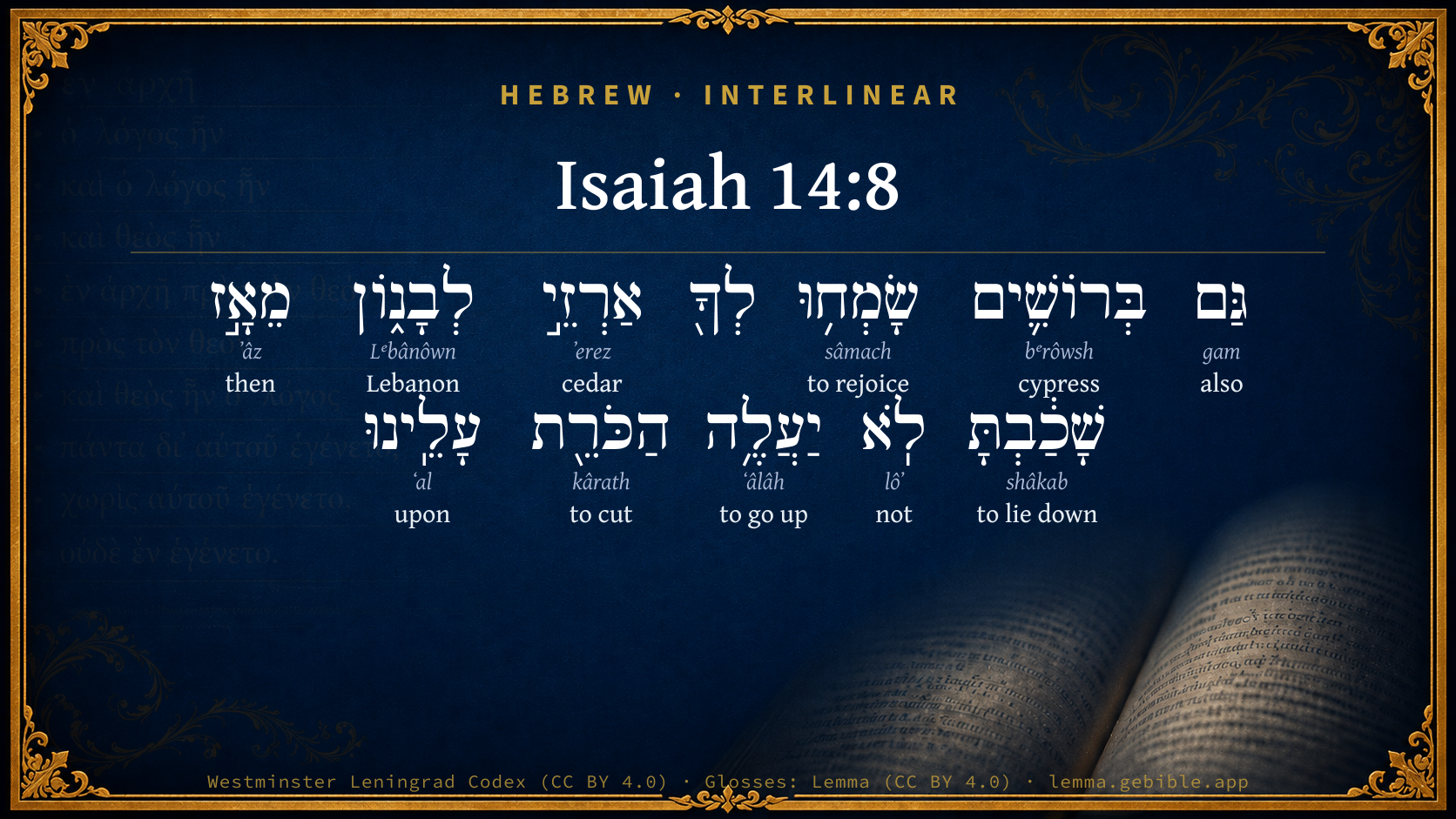
Isaiah 14:8

Hebrew (Westminster Leningrad Codex) Isaiah 14:8 appears in the Hebrew Old Testament. The text above is from the Westminster Leningrad Codex. Each word links to its Strong’s number, a concise gloss, and parsing drawn from the Open Scriptures Hebrew Bible morphology. Click any word for its full Brown-Driver-Briggs (BDB) entry.
Download image
Cite this verse

Isaiah 14:8 (World English Bible). Public Domain. Lemma interlinear Bible study tool, https://lemma.gebible.app/v/isaiah/14/8.

Show BibTeX & RIS
BibTeX
RIS
English Translation
Yes, the fir trees rejoice at you, [and] the cedars of Lebanon, [saying], Since you are laid low, no lumberjack is come up against us.
World English Bible · Public Domain
Download a study sheet

One document with this verse’s original text, its word-by-word gloss line, the meaning frame, cross-references with their text, attributed commentary, and full source and license credits — printable, and it pastes into notes with its structure intact.

This verse Autodidact and up

Study sheet (.html) Plain text (.txt)

A passage Seminary Student

Up to 50 verses in one chapter. A passage sheet keeps up to 6 commentary sources and 12 cross-references per verse, in the order this page ranks them, and says so on the sheet whenever that leaves anything out. Ask for a single verse and you get the Autodidact verse sheet above.

Everything on this page stays free to read, with no account — the sheet is a download of what is already on screen, not access to it.

Want to remove ads? Support Godless Engineer
Compare translations 3

The same verse in 3 English versions, stacked beneath the original-language interlinear above. Click any original word for its lexicon entry.

Each is an independent rendering of the whole verse — the interlinear is not word-aligned to these translations.

Highlighted words mark where these versions differ — a whole-verse word diff, not a word-by-word alignment.

  • World English Bible Public Domain
    Yes, the fir trees rejoice at you, [and] the cedars of Lebanon, [saying], Since you are laid low, no lumberjack is come up against us.
  • King James Version Public Domain
    Yea, the fir trees rejoice at thee, and the cedars of Lebanon, saying, Since thou art laid down, no feller is come up against us.
  • unfoldingWord Literal Text CC BY-SA 4.0
    Even the cypresses exult over you, the cedars of Lebanon: ‘Since you have lain down, the cutter does not come up against us.’

unfoldingWord Literal Text — © unfoldingWord, licensed CC BY-SA 4.0. Word-aligned USFM3 via Door43 (git.door43.org/unfoldingWord/en_ult).

Versions to compare (up to 4)

3 of 4 selected

Show all 18 translations

Every available English version of this verse, each an independent rendering of the whole verse.

  • World English Bible Public Domain
    Yes, the fir trees rejoice at you, [and] the cedars of Lebanon, [saying], Since you are laid low, no lumberjack is come up against us.
  • Berean Standard Bible Public Domain
    Even the cypresses and cedars of Lebanon exult over you: “Since you have been laid low, no woodcutter comes against us.”
  • Majority Standard Bible Public Domain
    Even the cypresses and cedars of Lebanon exult over you: “Since you have been laid low, no woodcutter comes against us.”
  • King James Version Public Domain
    Yea, the fir trees rejoice at thee, and the cedars of Lebanon, saying, Since thou art laid down, no feller is come up against us.
  • American Standard Version (1901) Public Domain
    Yea, the fir-trees rejoice at thee, `and' the cedars of Lebanon, `saying', Since thou art laid low, no hewer is come up against us.
  • Revised Version (1885) Public Domain
    Yea, the fir trees rejoice at thee, and the cedars of Lebanon, saying, Since thou art laid down, no feller is come up against us.
  • Geneva Bible (1599) Public Domain
    Also the firre trees reioyced of thee, and the cedars of Lebanon, saying, Since thou art laid downe, no hewer came vp against vs.
  • Douay-Rheims (1899) Public Domain
    The fir trees also have rejoiced over thee, and the cedars of Libanus, saying: Since thou hast slept, there hath none come up to cut us down.
  • Young's Literal Translation Public Domain
    Even firs have rejoiced over thee, Cedars of Lebanon -- `saying': Since thou hast lain down, The hewer cometh not up against us.
  • Literal Standard Version CC BY-SA 4.0
    Even firs have rejoiced over you, || Cedars of Lebanon, [saying], Since you have lain down, || The hewer does not come up against us.
  • Unlocked Literal Bible CC BY-SA 4.0
    Even the cypress trees rejoice over you with the cedars of Lebanon; they say, 'Since you are laid low, no woodcutter comes up to cut us down.'
  • unfoldingWord Literal Text CC BY-SA 4.0
    Even the cypresses exult over you, the cedars of Lebanon: ‘Since you have lain down, the cutter does not come up against us.’
  • Darby Bible Public Domain
    Even the cypresses rejoice at thee, the cedars of Lebanon, [saying,] Since thou art laid down, no feller is come up against us.
  • World Messianic Bible Public Domain
    Yes, the cypress trees rejoice with you, with the cedars of Lebanon, saying, “Since you are humbled, no lumberjack has come up against us.”
  • Webster's Bible Public Domain
    Yes, the fir-trees rejoice at thee, and the cedars of Lebanon, saying, Since thou art laid down, no feller is come up against us.
  • Free Bible Version CC BY-SA 4.0
    The cypress and cedar trees are glad you're gone. They sing, ‘Since you were cut down no woodcutters are coming to cut us down!’
  • Bible in Basic English Public Domain
    Even the trees of the wood are glad over you, the trees of Lebanon, saying, From the time of your fall no wood-cutter has come up against us with an axe.
  • JPS Tanakh (1917) Public Domain
    Yea, the cypresses rejoice at thee, and the cedars of Lebanon: 'Since thou art laid down, no feller is come up against us.'

Literal Standard Version (2020), Covenant Press — licensed CC BY-SA 4.0. Text via the HelloAO Bible API (eBible.org). Unlocked Literal Bible (unfoldingWord) — licensed CC BY-SA 4.0. Text via the HelloAO Bible API (eBible.org). unfoldingWord Literal Text — © unfoldingWord, licensed CC BY-SA 4.0. Word-aligned USFM3 via Door43 (git.door43.org/unfoldingWord/en_ult). Free Bible Version, Dr. Jonathan Gallagher — licensed CC BY-SA 4.0. Text via the HelloAO Bible API (eBible.org).

Word by word

More ways to search: Search by grammar → Find every occurrence → Compare this word →

Practice this passage: Drill this verse → Learn its vocabulary →

בְּרוֹשִׁ֛ים
bᵉrôwsh
H1265
“cypresses”
Noun, Common, Masculine, Plural, Absolute
Part of Speech
Noun
Type
Common
Gender
Masculine
Number
Plural
State
Absolute
Full BDB Definition

Origin: of uncertain derivation

TWOT: 289a

cypress, fir, juniper, pine - a noble tree (literally) - of stateliness (figuratively) - material for temple
  1. גַּם gam H1571 “also” Particle, Accusative
  2. שָׂמְח֥וּ sâmach H8055 “to rejoice” Verb, Qal, Perfect, 3rd Person, Common, Plural
  3. אַרְזֵ֣י ʼerez H730 “cedars of” Noun, Common, Masculine, Plural, Construct
  4. לְבָנ֑וֹן Lᵉbânôwn H3844 “Lebanon” Noun, Proper
  5. מֵאָ֣ז ʼâz H227 “from · then” Preposition + Adverb
  6. שָׁכַ֔בְתָּ shâkab H7901 “to lie down” Verb, Qal, Perfect, 2nd Person, Masculine, Singular
  7. לֹֽא lôʼ H3808 “not” Particle, Negative
  8. יַעֲלֶ֥ה ʻâlâh H5927 “to go up” Verb, Qal, Imperfect, 3rd Person, Masculine, Singular
  9. הַכֹּרֵ֖ת kârath H3772 “the · cutting” Particle, Definite Article + Verb, Qal, Participle Active, Masculine, Singular, Absolute
  10. עָלֵֽינוּ ʻal H5921 “upon · us” Preposition + Suffix, Personal, 1st Person, Common, Plural

About this verse

These counts appear in no published source. They are computed here, from the morphology-tagged text and Lemma’s own curated glosses. What Lemma adds →

12
words
11
distinct lemmas
Prophets
section

Notable vocabulary

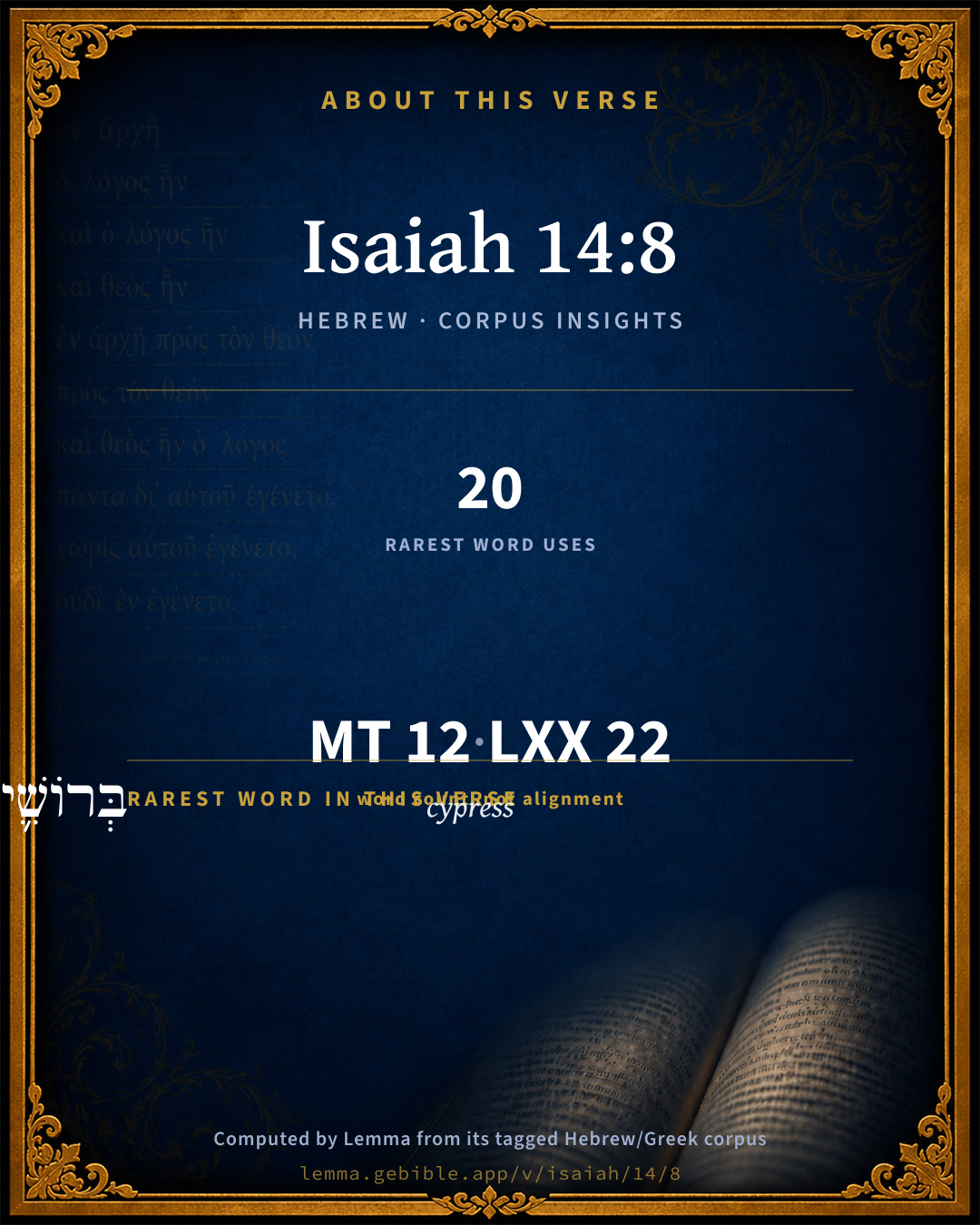
The rarest word here is בְּרוֹשִׁ֛ים cypress H1265 — appearing just 20 times in the whole Hebrew Bible.

Shared distinctive vocabulary

בְּרוֹשִׁ֛ים cypress H1265 occurs in 20 verses of the Hebrew Bible. Also found in:

Grammatical profile

  • 4 verbs
  • 3 nouns
  • 2 prepositions
  • 1 adverb
  • 2 particles

Verb forms

  • שָׂמְח֥וּ Qal · Perfect
  • שָׁכַ֔בְתָּ Qal · Perfect
  • יַעֲלֶ֥ה Qal · Imperfect
  • הַכֹּרֵ֖ת Qal · Participle Active

Hebrew & Septuagint length

In English translation the verse runs 25 words from the Hebrew and 32 from the Septuagint (LXX English) — closely comparable.

A rough comparison of the two English renderings, which tokenize alike — not a word-level alignment.

Word counts can differ between the Hebrew and the Greek without any difference in meaning — e.g. the Hebrew direct-object marker אֵת has no separate Greek word, and Greek often adds the article ὁ.

In the original languages it is 12 Hebrew tokens and 22 Greek tokens — but the two are counted differently (Hebrew bundles its prefixes and suffixes into one token; the Greek is in lemma form), so that isn’t a like-for-like length.

Cross-references

3

Topical passages linked to Isaiah 14:8 in the Treasury of Scripture Knowledge — connected by theme and wording, ordered by reader-vote popularity; previews shown in the World English Bible.

  • Ezekiel 31:16 I made the nations to shake at the sound of his fall, when I cast him down to Sheol with those who descend into the pit; and all the trees of Eden, the choice and best of Lebanon, all that drink water, were comforted in the lower parts of the earth.
  • Isaiah 55:12–13 For you shall go out with joy, and be led forth with peace: the mountains and the hills shall break forth before you into singing; and all the trees of the fields shall clap their hands.
  • Zechariah 11:2 Wail, fir tree, for the cedar has fallen, Because the stately ones are destroyed. Wail, you oaks of Bashan, For the strong forest has come down.

Cross-references courtesy of OpenBible.info (CC BY 4.0).

Hebrew and Greek witnesses Masoretic Hebrew ↔ Greek Septuagint

The same verse in the two great witnesses to the Old Testament, shown verse-for-verse.

These are two independent witnesses, not word-aligned to each other, and the Septuagint is shown in lemma (dictionary) form.

Hebrew Isaiah 14:8 Masoretic · Westminster Leningrad Codex

גַּם בְּרוֹשִׁ֛ים שָׂמְח֥וּ לְךָ֖ אַרְזֵ֣י לְבָנ֑וֹן מֵאָ֣ז שָׁכַ֔בְתָּ לֹֽא יַעֲלֶ֥ה הַכֹּרֵ֖ת עָלֵֽינוּ

Yes, the fir trees rejoice at you, [and] the cedars of Lebanon, [saying], Since you are laid low, no lumberjack is come up against us.

World English Bible · Public Domain

Greek LXX Isaiah 14:8 Septuagint · lemma form

καί ὁ ξύλον ὁ λίβανος εὐφραίνω ἐπί σύ καί ὁ κέδρος ὁ λίβανος ἀπό ὅς σύ κοιμάω οὐ ἀναβαίνω ὁ κόπτω ἐγώ

the trees also of Libanus rejoice against you, and the cedar of Libanus, saying, From the time that you have been laid low, no one has come up to cut us down.

LXX2012 (modern English Septuagint) · Public Domain

On this verse, Ellicott's Commentary for English Readers discusses the Septuagint’s reading. Read the note in Commentary ↓

Hebrew: Westminster Leningrad Codex (CC BY 4.0). Greek: Septuagint (public domain); English from LXX2012 (modern English Septuagint) (Public Domain). How the Septuagint differs from the Hebrew →

Targum (Aramaic paraphrase)

1

The Targum is the ancient Jewish Aramaic paraphrase of the Hebrew Scriptures — an interpretive translation, not the Hebrew text itself. Onkelos (literal) and Pseudo-Jonathan (expansive) render the Torah, and Jonathan the Prophets. Coverage is partial: where no permissively-licensed English translation exists for a verse, only the Aramaic is shown. This is verse-level text, not a word-by-word alignment to the Hebrew.

  1. Targum Jonathan Prophets (Joshua–Malachi)
    אַף שִׁלְטוֹנִין חֲדִיאוּ עֲלָךְ עַתִּירֵי נִכְסַיָא אָמְרִין מֵעִידַן דִשְׁכֵיבְתָּא לָא סְלִיק מְחַבְּלָא עֲלָנָא:

    Rulers also rejoiced over thee; the rich in treasures said, Since thou art laid down, the destroyer is not come up upon us.

    Targum Jonathan — Aramaic: “Mikraot Gedolot” (public domain). English: “Sefaria Community Translation” (CC0 1.0 (public-domain dedication)); “London "Chaldee Paraphrase," 1871” (public domain). Text via Sefaria.

Commentary

Notes on Isaiah 14:8 from classic Christian and Jewish commentators (each source and its license shown beneath its notes). The classic Christian expositions comment on the surrounding passage and are grouped to its opening verse, so a note may address several verses; the Jewish commentaries on the Tanakh (Rashi and others) are per-verse, so they appear only where the commentator wrote on this verse.

Lemma curates 59 commentaries, every one of them public domain or Creative Commons licensed, each selected and text-cleaned for this edition rather than reprinted as found. About our sources →

Trapp's Complete Commentary

John Trapp

Isa 14:8 Yea, the fir trees rejoice at thee, [and] the cedars of Lebanon, [saying], Since thou art laid down, no feller is come up against us.

Ver. 8. Yea, the fir trees rejoice at thee.] A notable metaphor, whereby sense and speech is attributed to senseless creatures; the trees once afraid to be felled are now freed from that fear. This tyrant was the terror of things on earth, and things under earth. Hence men and trees are said to rejoice, hell to be in a hurry, &c.

No feller is come up against us.] As was wont to do, for thy shipping, buildings, warlike engines, &c.

John Trapp, A Commentary or Exposition upon All the Books of the Old and New Testament (1647–1656) — public domain. Text from a community e-Sword module.

Jamieson, Fausset & Brown

Robert Jamieson, A. R. Fausset & David Brown

the fir trees--now left undisturbed. Probably a kind of evergreen.

rejoice at thee-- (Psa 96:12). At thy fall (Psa 35:19, Psa 35:24).

no feller--as formerly, when thou wast in power (Isa 10:34; Isa 37:24).

Hades (the Amenthes of Egypt), the unseen abode of the departed; some of its tenants, once mighty monarchs, are represented by a bold personification as rising from their seats in astonishment at the descent among them of the humbled king of Babylon. This proves, in opposition to WARBURTON [The Divine Legation], that the belief existed among the Jews that there was a Sheol or Hades, in which the "Rephaim" or manes of the departed abode.

Jamieson, Fausset & Brown — Commentary Critical and Explanatory on the Whole Bible (1871) — public domain (CC PDM 1.0). Text via the HelloAO Bible API.

Ellicott's Commentary for English Readers

(8) Yea, the fir trees rejoice at thee.—The tree has been identified (Carruthers, in Bible Educator, 4, 359) with the Aleppo pine (Pinus halepensis), which grows abundantly on the Lebanon range above the zone of the evergreen oaks. The LXX. often translates it by “cypress,” the Vulgate and Authorised version commonly by “fir tree.” Its wood was largely used in house and ship-building, but was less precious than the cedar (1Ki_5:10; 1Ki_6:15; 1Ki_6:34; Isa_41:19; Eze_27:5).

No feller is come up against us—The literal and figurative senses melt into each other, the former perhaps being the more prominent. It was the boast of Assurbanipal and other Assyrian kings that wherever they conquered they cut down forests and left the land bare. (Comp. Isa_37:24 : Records of the Past, i. 86.) As the fir tree, the cedar, and the oak were the natural symbols of kingly rule (Jer_22:7; Eze_17:3; Eze_31:3), this devastation represented the triumph of the Chaldæan king over other princes. On his downfall, the trees on the mountain, the kings and chieftains in their palaces, would alike rejoice.

A Bible Commentary for English Readers, edited by Charles John Ellicott (1878–1897) — public domain. Text from a community e-Sword module.

The Cambridge Bible for Schools and Colleges

gen. ed. J. J. S. Perowne

8. the fir trees] Some render “cypresses.”

no feller is come up] Assyrian kings frequently mention among their exploits the cutting of trees in Lebanon and Amanus. Nebuchadnezzar, whose inscriptions have been found on Lebanon, doubtless did the same thing.

The Cambridge Bible for Schools and Colleges (gen. ed. J. J. S. Perowne; Cambridge University Press, 1878–1918) — public domain. Text from a community e-Sword module.

John Gill's Exposition

Yea, the fir trees rejoice at thee, and the cedars of Lebanon,.... Which by, a prosopopoeia are represented as singing and rejoicing, as inanimate creatures often are in Scripture, these being now in no danger of being cut down, to make way for his armies; see Isa 37:34 or to furnish him with timber for shipping, or building of houses: or else these words are to be understood metaphorically of kings and princes of the earth, comparable to such trees, for their height, strength, and substance; see Zac 11:2 who would now be no longer in fear of him, or in subjection to him. So the Targum,

"the rulers also rejoiced over thee, the rich in substance said;''

not only the common people, the inhabitants of the earth, as before, but the princes of it rejoiced at his ruin; and so will the kings of the earth rejoice at the destruction of the whore of Rome, when they shall hate her, eat her flesh, and burn her with fire; though others, that have committed fornication with her, will lament her case, Rev 17:16,

saying, since thou art, laid down; or "art asleep" (a); that is, dead; it being usual in the eastern nations to express death by sleep:

no feller is come up against us; or "cutter of wood", to whom the king of Babylon is compared, for cutting down nations, and bringing them into subjection to him, in whose heart it was to destroy and cut off nations, not a few; being as an axe in the hand of the Lord, whereby trees, large and high, were cut down; see Isa 10:5 but now, since this feller of wood was gone, the axe was laid aside, and broke to pieces, there was none to give the nations any disturbance; and so it will be when antichrist is destroyed, there will be no more persecution of the church and people of God.

(a) "dormisti", Pagninus.

John Gill's Exposition of the Whole Bible (1746–1763) — public domain (CC PDM 1.0). Text via the HelloAO Bible API.

Albert Barnes' Notes on the Bible

Yea, the fir trees rejoice at thee - They join with the inhabitants of the nations in rejoicing at thy downfall - for they now, like those inhabitants, are suffered to remain undisturbed. (On the word rendered “fir trees,” see the notes at Isa 1:29.) It is evident that a species of evergreen is meant; and probably some species that grew in Syria or Palestine. The idea is plain. The very forest is represented as rejoicing. It would be safe from the king of Babylon. He could no longer cut it down to build his palaces, or to construct his implements of war. This figure of representing the hills and groves, the trees, the mountains, and the earth, as exulting, or as breaking forth into joy, is common in the Scriptures:

Let the heavens rejoice, and let the earth be glad;

Let the sea roar, and the fulness thereof.

Let the field be joyful, and all that is therein:

Then shall all the trees of the wood rejoice

Before the Lord.

Psa 96:11-13.

Let the floods clap their hands.

Let the hills be joyful together

Before the Lord.

Psa 98:8-9.

Praise the Lord from the earth,

Ye dragons and all deeps;

Fire and hail; snow and vapor;

Stormy wind fulfilling his word:

Mountains and all hills;

Fruitful trees and all cedars.

Psa 148:7-12.

(Compare 1Ch 16:31; Hab 3:10-11.)

The cedars of Lebanon - (note, Isa 10:34). The cedars of Lebanon were much celebrated for building; and it is not impossible that the king of Babylon had obtained timber from that mountain with which to construct his palaces at Babylon. They are now represented as rejoicing that he is fallen, since they would be safe and undisturbed. A similar figure of speech occurs in Virgil, “Ecl.” v. 68:

Peace, peace, mild Daphnis loves; with joyous cry.

The untill’d mountains strike the echoing sky;

And rocks and towers the triumph spread abroad -

‘A god! Menalcas! Daphnis is a god!’

Wrangham

It is a beautiful figure; and is a fine specimen of the poetry of the Hebrews, where everything is animated, and full of life.

Since thou art laid down - Since thou art dead.

No feller - No one to cut us down. Jowett (“Chris. Res.”) makes the following remarks on this passage on his visit to Lebanon: ‘As we passed through the extensive forest of fir trees situated between Deir-el-Karat and Ainep, we had already heard, at some distance, the stroke of one solitary axe, resounding from hill to hill. On reaching the spot, we found a peasant, whose labor had been so far successful, that he had felled his tree and lopped his branches. He was now hewing it in the middle, so as to balance the two halves upon his camel, which stood patiently by him waiting for his load. In the days of Hiram, king of Tyre, and subsequently under the kings of Babylon, this romantic solitude was not so peaceful; that most poetic image in Isaiah, who makes these very trees vocal, exulting in the downfall of the destroyer of nations, seems now to be almost realized anew - “Yea, the fir trees rejoice at thee, and the cedars of Lebanon, saying, Since thou art laid down, no feller is come up against us.”’

Albert Barnes' Notes on the Bible (1834–1885) — public domain. Text from a community e-Sword/MySword module.

Matthew Poole's English Annotations

The cedars of Lebanon, which were felled down for the service of her pride and luxury, but now are suffered to stand and flourish. It is a figure usual in sacred and profane writers, called prosopopaeia.

Matthew Poole's English Annotations on the Holy Bible (1683–1685) — public domain. Text from a community e-Sword/MySword module.

The Pulpit Commentary

Fir trees...cedars. We may detect a double meaning here one literal, the other metaphorical. Literally, the trees of Lebanon and the other mountain ranges would be spared, since, while both the Assyrian and Babylonian kings cut timber in the Syrian forests for building purposes, the Persians had no such practice; metaphorically, the firs and cedars are the kings and nobles of the countries, (comp. Eze_31:16) who likewise had a respite. Since thou art laid down; rather, since thou liest low. The first stanza here ends, and the second begins with the next verse.

The Pulpit Commentary (1880–1919), ed. H.D.M. Spence-Jones & Joseph S. Exell — public domain. Text from a community e-Sword module.

John Wesley's Explanatory Notes

The trees - Which were felled for the service of her pride and luxury, but now are suffered to stand.

John Wesley, Explanatory Notes Upon the Whole Bible (1754–1765) — public domain. Text via the GEBible commentary corpus.

J. A. Alexander on Isaiah

Joseph Addison Alexander

Not only the earth and its inhabitants take part in this triumphant song or shout, but the trees of the forest. “Also (or even) the cypresses rejoice with respect to thee, the cedars of Lebanon (saying) now that thou art fallen (literally lain down), the feller (or woodman, literally the cutter) shall not come up against us.” Now that we are safe from thee, we fear no other enemy. As to the meaning of the figures in this verse, there are various opinions; but the only one that seems consistent with a pure taste, is that which supposes this to be merely a part of one great picture, representing universal nature as rejoicing. Both here and elsewhere in the sacred books, inanimate nature is personified, and speaks herself instead of being merely spoken of. Ipsi laetitia voces ad sidera jactant Intonsi montes; ipsae jam carmina rupes, Ipsa sonant arbusta.

Joseph Addison Alexander, The Prophecies of Isaiah (1846–1847; New York: Scribner, 1870–1878) — public domain. Text from a community e-Sword module.

Rashi

Rabbi Shlomo Yitzchaki (Rashi)

Box trees, too, rejoiced Rulers, too, rejoiced [from Jonathan]; i.e., they rejoiced at your downfall.

Rashi on the Tanakh — English translations: “The Judaica Press complete Tanach with Rashi, translated by A. J. Rosenberg” (CC BY 4.0); “Pentateuch with Rashi's commentary by M. Rosenbaum and A.M. Silbermann, 1929-1934” (public domain); “The Metsudah Tanach series, Lakewood, N.J” (CC BY 4.0); and “The Book of Joshua, Metsudah Publications, 1997” (CC BY 4.0). Text via Sefaria.

Ibn Ezra

Rabbi Abraham ibn Ezra

Yea, the fir trees, etc. For he had caused the fir trees and the cedars to be hewn down, to build with them fortresses and ramparts.

Ibn Ezra on the Tanakh — English translations: “Sefaria Community Translation” (CC0 1.0 (public-domain dedication)); “Yalkut, Sifsei Chachomim Chumash, Metsudah Publications, 2009” (CC BY 4.0); and “Commentary of Ibn Ezra on Isaiah - trans. by M. Friedlander, 1873” (public domain). Text via Sefaria.

Lesson kit

Teaching starters — assembled from the data on this page, not authored interpretation. Every prompt links to the verse data it draws on. Edit before teaching.

Isaiah, in the Prophets, opens this verse with 12 words (11 distinct Hebrew lemmas). Its most distinctive word is bᵉrôwsh (“cypress”). A historical commentator’s framing appears above. Read the whole chapter for the surrounding context.

Discussion questions

  1. The word bᵉrôwsh carries the sense “cypress.” How does it shape the verse?
  2. 2 Samuel 6:5 shares the word «cypress» with this verse. How do the two illuminate each other?
  3. These translations render this verse differently; the difference is in the English rendering, not the original. What questions does that raise?
  4. The verb «שָׂמְח֥וּ» is Qal Perfect. How does its form color the action?
  5. Reading how Trapp's Complete Commentary and Jamieson, Fausset & Brown read this verse, where do the two commentators agree and where do they part?

Things to notice

Reading settings

Reading text

Shown beneath each verse's original-language words.

Old Testament
Old Testament edition

Read the OT as the Masoretic Hebrew (MT) or the Greek Septuagint (LXX).

English shown for the Greek Septuagint (in the Hebrew ↔ Greek comparison).

Comparing translations? Open the Compare panel on any verse page to stack up to four side by side.