
Deuteronomy 19:5

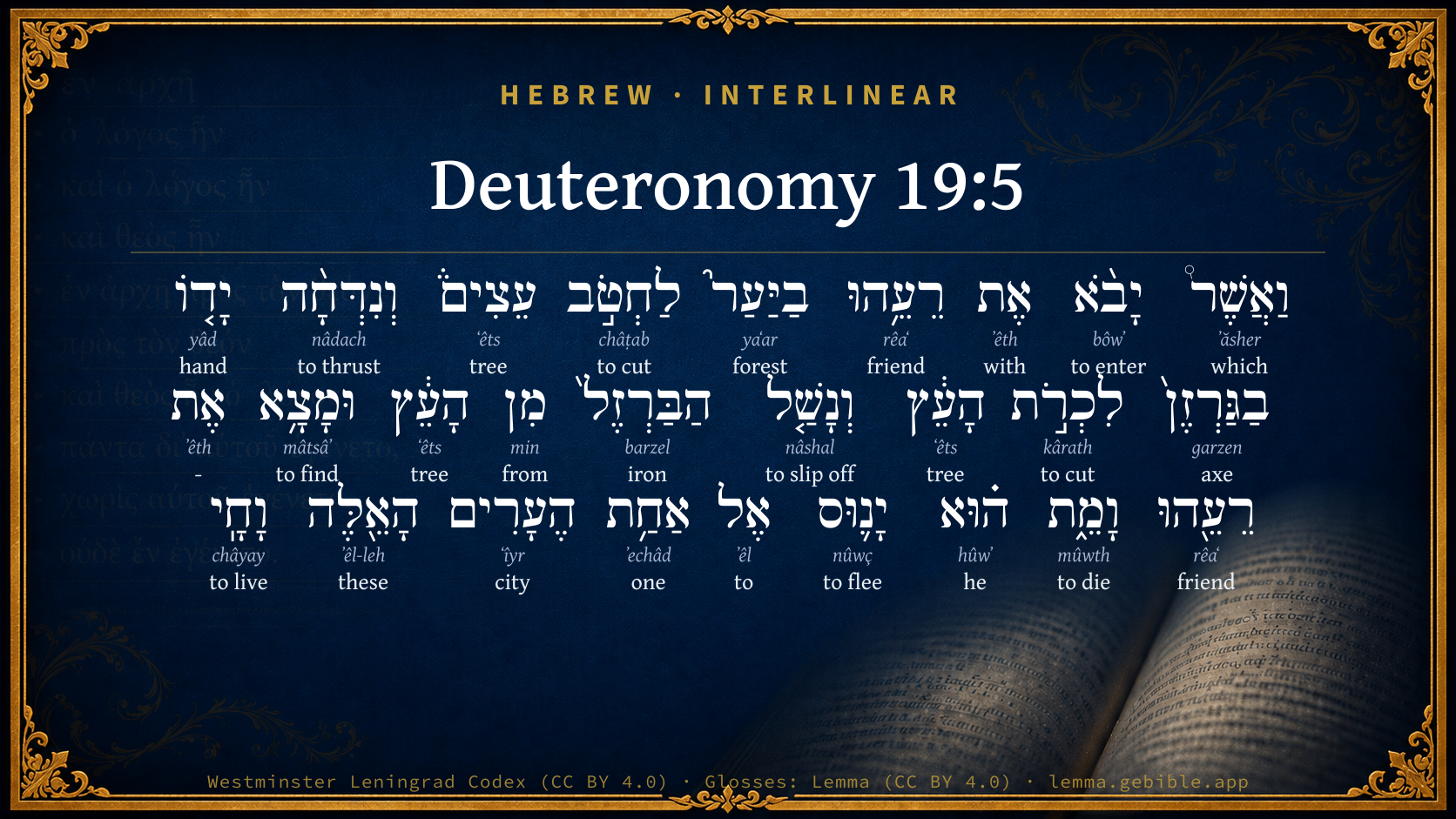
Hebrew (Westminster Leningrad Codex) Deuteronomy 19:5 appears in the Hebrew Old Testament. The text above is from the Westminster Leningrad Codex. Each word links to its Strong’s number, a concise gloss, and parsing drawn from the Open Scriptures Hebrew Bible morphology. Click any word for its full Brown-Driver-Briggs (BDB) entry.
Download image
Cite this verse

Deuteronomy 19:5 (World English Bible). Public Domain. Lemma interlinear Bible study tool, https://lemma.gebible.app/v/deuteronomy/19/5.

Show BibTeX & RIS
BibTeX
RIS
English Translation
as when a man goes into the forest with his neighbor to hew wood, and his hand fetches a stroke with the axe to cut down the tree, and the head slips from the handle, and lights on his neighbor, so that he dies; he shall flee to one of these cities and live:
World English Bible · Public Domain
Highlights
  • 3 first appearances in the Hebrew Bible
Full analysis ↓
Download a study sheet

One document with this verse’s original text, its word-by-word gloss line, the meaning frame, cross-references with their text, attributed commentary, and full source and license credits — printable, and it pastes into notes with its structure intact.

This verse Autodidact and up

Study sheet (.html) Plain text (.txt)

A passage Seminary Student

Up to 50 verses in one chapter. A passage sheet keeps up to 6 commentary sources and 12 cross-references per verse, in the order this page ranks them, and says so on the sheet whenever that leaves anything out. Ask for a single verse and you get the Autodidact verse sheet above.

Everything on this page stays free to read, with no account — the sheet is a download of what is already on screen, not access to it.

Want to remove ads? Support Godless Engineer
Compare translations 3

The same verse in 3 English versions, stacked beneath the original-language interlinear above. Click any original word for its lexicon entry.

Each is an independent rendering of the whole verse — the interlinear is not word-aligned to these translations.

Highlighted words mark where these versions differ — a whole-verse word diff, not a word-by-word alignment.

  • World English Bible Public Domain
    as when a man goes into the forest with his neighbor to hew wood, and his hand fetches a stroke with the axe to cut down the tree, and the head slips from the handle, and lights on his neighbor, so that he dies; he shall flee to one of these cities and live:
  • King James Version Public Domain
    As when a man goeth into the wood with his neighbor to hew wood, and his hand fetcheth a stroke with the axe to cut down the tree, and the head slippeth from the helve, and lighteth upon his neighbor, that he die; he shall flee unto one of those cities, and live:
  • unfoldingWord Literal Text CC BY-SA 4.0
    and who goes into the forest his neighbor to chop wood and his hand swings with the ax to cut the wood, and the iron detaches from the wood and finds his neighbor, and he dies), he shall flee to one of these cities and live.

unfoldingWord Literal Text — © unfoldingWord, licensed CC BY-SA 4.0. Word-aligned USFM3 via Door43 (git.door43.org/unfoldingWord/en_ult).

Versions to compare (up to 4)

3 of 4 selected

Show all 18 translations

Every available English version of this verse, each an independent rendering of the whole verse.

  • World English Bible Public Domain
    as when a man goes into the forest with his neighbor to hew wood, and his hand fetches a stroke with the axe to cut down the tree, and the head slips from the handle, and lights on his neighbor, so that he dies; he shall flee to one of these cities and live:
  • Berean Standard Bible Public Domain
    If he goes into the forest with his neighbor to cut timber and swings his axe to chop down a tree, but the blade flies off the handle and strikes and kills his neighbor, he may flee to one of these cities to save his life.
  • Majority Standard Bible Public Domain
    If he goes into the forest with his neighbor to cut timber and swings his axe to chop down a tree, but the blade flies off the handle and strikes and kills his neighbor, he may flee to one of these cities to save his life.
  • King James Version Public Domain
    As when a man goeth into the wood with his neighbor to hew wood, and his hand fetcheth a stroke with the axe to cut down the tree, and the head slippeth from the helve, and lighteth upon his neighbor, that he die; he shall flee unto one of those cities, and live:
  • American Standard Version (1901) Public Domain
    as when a man goeth into the forest with his neighbor to hew wood, and his hand fetcheth a stroke with the axe to cut down the tree, and the head slippeth from the helve, and lighteth upon his neighbor, so that he dieth; he shall flee unto one of these cities and live:
  • Revised Version (1885) Public Domain
    as when a man goeth into the forest with his neighbour to hew wood, and his hand fetcheth a stroke with the axe to cut down the tree, and the head slippeth from the helve, and lighteth upon his neighbour, that he die; he shall flee unto one of these cities and live:
  • Geneva Bible (1599) Public Domain
    As hee that goeth vnto the wood with his neighbor to hew wood, and his hand striketh with the axe to cut downe the tree, if the head slip from the helue, and hit his neighbour that he dieth, the same shall flee vnto one of the cities, and liue,
  • Douay-Rheims (1899) Public Domain
    But to have gone with him to the wood to hew wood, and in cutting down the tree the axe slipped out of his hand, and the iron slipping from the handle struck his friend, and killed him: he shall flee to one of the cities aforesaid, and live:
  • Young's Literal Translation Public Domain
    even he who cometh in with his neighbour into a forest to hew wood, and his hand hath driven with an axe to cut the tree, and the iron hath slipped from the wood, and hath met his neighbour, and he hath died -- he doth flee unto one of these cities, and hath lived,
  • Literal Standard Version CC BY-SA 4.0
    even he who comes into a forest with his neighbor to hew wood, and his hand has driven with an axe to cut the tree, and the iron has slipped from the wood, and has met his neighbor, and he has died—he flees to one of these cities, and has lived,
  • Unlocked Literal Bible CC BY-SA 4.0
    For example, if a man goes into the forest with his neighbor to cut wood, and his chops with the ax to cut down a tree, and the ax head slips off of the handle and strikes his neighbor and kills him—then that man must flee to one of these cities and save his life.
  • unfoldingWord Literal Text CC BY-SA 4.0
    and who goes into the forest his neighbor to chop wood and his hand swings with the ax to cut the wood, and the iron detaches from the wood and finds his neighbor, and he dies), he shall flee to one of these cities and live.
  • Darby Bible Public Domain
    as when he goeth into the wood with his neighbour to hew wood, and his hand fetcheth a stroke with the axe to cut down the tree, and the iron slippeth from the handle, and lighteth upon his neighbour, that he die; such an one shall flee unto one of these cities, and live;
  • World Messianic Bible Public Domain
    as when a man goes into the forest with his neighbor to chop wood and his hand swings the ax to cut down the tree, and the head slips from the handle and hits his neighbor so that he dies—he shall flee to one of these cities and live.
  • Webster's Bible Public Domain
    As when a man goeth into the wood with his neighbor to hew wood, and his hand maketh a stroke with the ax to cut down the tree, and the head slippeth from the helve, and falleth upon his neighbor, that he dieth: he shall flee to one of these cities, and live:
  • Free Bible Version CC BY-SA 4.0
    For example, if a man goes to cut wood in the forest with his friend and swings his axe to chop down a tree, but the head flies off the handle and hits and kills his friend, he may run to one of these towns to save his life.
  • Bible in Basic English Public Domain
    For example, if a man goes into the woods with his neighbour for the purpose of cutting down trees, and when he takes his axe to give a blow to the tree, the head of the axe comes off, and falling on to his neighbour gives him a wound causing his death; then the man may go in flight to one of these towns and be safe:
  • JPS Tanakh (1917) Public Domain
    as when a man goeth into the forest with his neighbour to hew wood, and his hand fetcheth a stroke with the axe to cut down the tree, and the head slippeth from the helve, and lighteth upon his neighbour, that he die; he shall flee unto one of these cities and live;

Literal Standard Version (2020), Covenant Press — licensed CC BY-SA 4.0. Text via the HelloAO Bible API (eBible.org). Unlocked Literal Bible (unfoldingWord) — licensed CC BY-SA 4.0. Text via the HelloAO Bible API (eBible.org). unfoldingWord Literal Text — © unfoldingWord, licensed CC BY-SA 4.0. Word-aligned USFM3 via Door43 (git.door43.org/unfoldingWord/en_ult). Free Bible Version, Dr. Jonathan Gallagher — licensed CC BY-SA 4.0. Text via the HelloAO Bible API (eBible.org).

Word by word

More ways to search: Search by grammar → Find every occurrence → Compare this word →

Practice this passage: Drill this verse → Learn its vocabulary →

בַגַּרְזֶן֙
garzen
H1631
“in/at the · axe”
Preposition, Determined + Noun, Common, Masculine, Singular, Absolute
Part of Speech
Preposition + Noun
Type
Common
Gender
Masculine
Number
Singular
State
Absolute
Full BDB Definition

Origin: from H1629

TWOT: 379a

axe
  1. וַאֲשֶׁר֩ ʼăsher H834 “and · which” Conjunction + Particle, Relative
  2. יָבֹ֨א bôwʼ H935 “to enter” Verb, Qal, Imperfect, 3rd Person, Masculine, Singular
  3. אֶת ʼêth H854 “with” Preposition
  4. רֵעֵ֥הוּ rêaʻ H7453 “friend · his” Noun, Common, Masculine, Singular, Construct + Suffix, Personal, 3rd Person, Masculine, Singular
  5. בַיַּעַר֮ yaʻar H3293 “in/at the · forest” Preposition, Determined + Noun, Common, Masculine, Singular, Absolute
  6. לַחְטֹ֣ב châṭab H2404 “to cut” Preposition + Verb, Qal, Infinitive Construct
  7. עֵצִים֒ ʻêts H6086 “trees” Noun, Common, Masculine, Plural, Absolute
  8. וְנִדְּחָ֨ה nâdach H5080 “and · to thrust” Conjunction + Verb, Niphal, Sequential Perfect, 3rd Person, Feminine, Singular
  9. יָד֤וֹ yâd H3027 “hand · his” Noun, Common, Both, Singular, Construct + Suffix, Personal, 3rd Person, Masculine, Singular
  10. לִכְרֹ֣ת kârath H3772 “to cut” Preposition + Verb, Qal, Infinitive Construct
  11. הָעֵ֔ץ ʻêts H6086 “the · tree” Particle, Definite Article + Noun, Common, Masculine, Singular, Absolute
  12. וְנָשַׁ֤ל nâshal H5394 “and · to slip off” Conjunction + Verb, Qal, Sequential Perfect, 3rd Person, Masculine, Singular
  13. הַבַּרְזֶל֙ barzel H1270 “the · iron” Particle, Definite Article + Noun, Common, Masculine, Singular, Absolute
  14. מִן min H4480 “from” Preposition
  15. הָעֵ֔ץ ʻêts H6086 “the · tree” Particle, Definite Article + Noun, Common, Masculine, Singular, Absolute
  16. וּמָצָ֥א mâtsâʼ H4672 “and · to find” Conjunction + Verb, Qal, Sequential Perfect, 3rd Person, Masculine, Singular
  17. אֶת ʼêth H853 “-” Particle, Direct Object
  18. רֵעֵ֖הוּ rêaʻ H7453 “friend · his” Noun, Common, Masculine, Singular, Construct + Suffix, Personal, 3rd Person, Masculine, Singular
  19. וָמֵ֑ת mûwth H4191 “and · to die” Conjunction + Verb, Qal, Sequential Perfect, 3rd Person, Masculine, Singular
  20. ה֗וּא hûwʼ H1931 “he” Pronoun, Personal, 3rd Person, Masculine, Singular
  21. יָנ֛וּס nûwç H5127 “to flee” Verb, Qal, Imperfect, 3rd Person, Masculine, Singular
  22. אֶל ʼêl H413 “to” Preposition
  23. אַחַ֥ת ʼechâd H259 “one” Adjective, Cardinal number, Feminine, Singular, Absolute
  24. הֶעָרִים ʻîyr H5892 “the · cities” Particle, Definite Article + Noun, Common, Feminine, Plural, Absolute
  25. הָאֵ֖לֶּה ʼêl-leh H428 “the · these” Particle, Definite Article + Pronoun, Demonstrative, Common, Plural
  26. וָחָֽי châyay H2425 “and · to live” Conjunction + Verb, Qal, Sequential Perfect, 3rd Person, Masculine, Singular

About this verse

These counts appear in no published source. They are computed here, from the morphology-tagged text and Lemma’s own curated glosses. What Lemma adds →

27
words
24
distinct lemmas
Pentateuch
section

Notable vocabulary

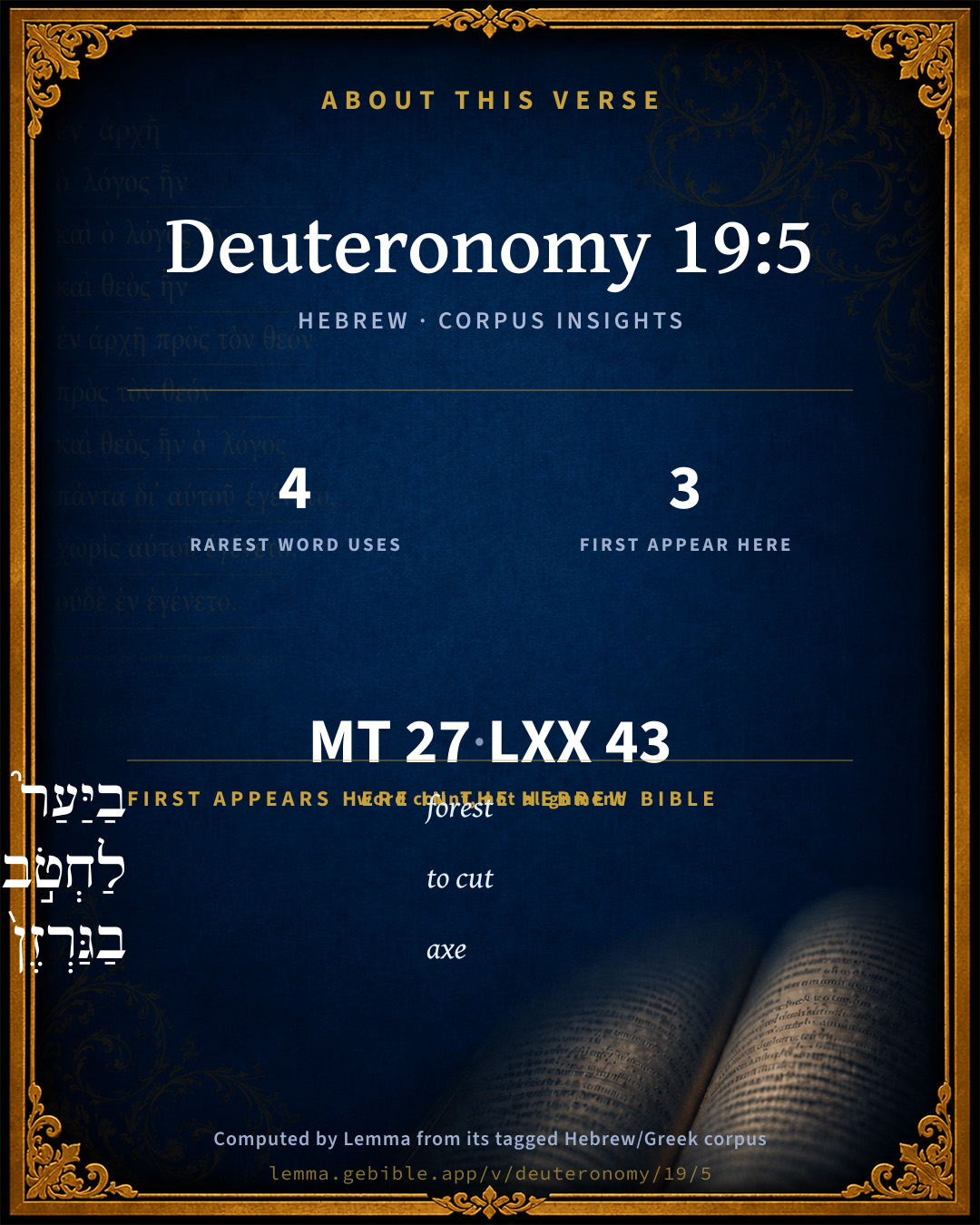
The rarest word here is בַגַּרְזֶן֙ axe H1631 — appearing just 4 times in the whole Hebrew Bible.

First appearance in Scripture

These words make their first canonical appearance in the Hebrew Bible here:

  • בַיַּעַר֮ forest H3293
  • לַחְטֹ֣ב to cut H2404
  • בַגַּרְזֶן֙ axe H1631

Shared distinctive vocabulary

בַגַּרְזֶן֙ axe H1631 occurs in 4 verses of the Hebrew Bible. Also found in:

Grammatical profile

  • 9 verbs
  • 10 nouns
  • 1 adjective
  • 2 pronouns
  • 3 prepositions
  • 2 particles

Verb forms

  • יָבֹ֨א Qal · Imperfect
  • לַחְטֹ֣ב Qal · Infinitive Construct
  • וְנִדְּחָ֨ה Niphal · Sequential Perfect
  • לִכְרֹ֣ת Qal · Infinitive Construct
  • וְנָשַׁ֤ל Qal · Sequential Perfect
  • וּמָצָ֥א Qal · Sequential Perfect
  • וָמֵ֑ת Qal · Sequential Perfect
  • יָנ֛וּס Qal · Imperfect
  • וָחָֽי Qal · Sequential Perfect

Repetition

Words recur within this verse — often emphatic in Hebrew:

  • עֵצִים֒ tree H6086 ×3
  • רֵעֵ֥הוּ friend H7453 ×2

Hebrew & Septuagint length

In English translation the verse runs 54 words from the Hebrew and 56 from the Septuagint (LXX English) — closely comparable.

A rough comparison of the two English renderings, which tokenize alike — not a word-level alignment.

Word counts can differ between the Hebrew and the Greek without any difference in meaning — e.g. the Hebrew direct-object marker אֵת has no separate Greek word, and Greek often adds the article ὁ.

In the original languages it is 27 Hebrew tokens and 43 Greek tokens — but the two are counted differently (Hebrew bundles its prefixes and suffixes into one token; the Greek is in lemma form), so that isn’t a like-for-like length.

Cross-references

4

Topical passages linked to Deuteronomy 19:5 in the Treasury of Scripture Knowledge — connected by theme and wording, ordered by reader-vote popularity; previews shown in the World English Bible.

  • Numbers 35:25 and the congregation shall deliver the manslayer out of the hand of the avenger of blood, and the congregation shall restore him to his city of refuge, where he was fled: and he shall dwell therein until the death of the high priest, who was anointed with the holy oil.
  • 2 Kings 6:5–7 But as one was felling a beam, the axe head fell into the water; and he cried, and said, Alas, my master! for it was borrowed.
  • Proverbs 27:12 A prudent man sees danger and takes refuge; But the simple pass on, and suffer for it:
  • Isaiah 32:2 A man shall be as a hiding-place from the wind, and a covert from the tempest, as streams of water in a dry place, as the shade of a great rock in a weary land.

Cross-references courtesy of OpenBible.info (CC BY 4.0).

Hebrew and Greek witnesses Masoretic Hebrew ↔ Greek Septuagint

The same verse in the two great witnesses to the Old Testament, shown verse-for-verse.

These are two independent witnesses, not word-aligned to each other, and the Septuagint is shown in lemma (dictionary) form.

Hebrew Deuteronomy 19:5 Masoretic · Westminster Leningrad Codex

וַאֲשֶׁר֩ יָבֹ֨א אֶת רֵעֵ֥הוּ בַיַּעַר֮ לַחְטֹ֣ב עֵצִים֒ וְנִדְּחָ֨ה יָד֤וֹ בַגַּרְזֶן֙ לִכְרֹ֣ת הָעֵ֔ץ וְנָשַׁ֤ל הַבַּרְזֶל֙ מִן הָעֵ֔ץ וּמָצָ֥א אֶת רֵעֵ֖הוּ וָמֵ֑ת ה֗וּא יָנ֛וּס אֶל אַחַ֥ת הֶעָרִים הָאֵ֖לֶּה וָחָֽי

as when a man goes into the forest with his neighbor to hew wood, and his hand fetches a stroke with the axe to cut down the tree, and the head slips from the handle, and lights on his neighbor, so that he dies; he shall flee to one of these cities and live:

World English Bible · Public Domain

Greek LXX Deuteronomy 19:5 Septuagint · lemma form

καί ὅς ἄν εἰςἔρχομαι μετά ὁ πλησίον εἰς ὁ δρυμός συνἄγω ξύλον καί ἐκκρούω ὁ χείρ αὐτός ὁ ἀξίνη κόπτω ὁ ξύλον καί ἐκπίπτω ὁ σιδήριον ἀπό ὁ ξύλον τύχη ὁ πλησίον καί ἀποθνήσκω οὗτος καταφεύγω εἰς εἷς ὁ πόλις οὗτος καί ζάω

And whoever shall enter with his neighbor into the thicket, to gather wood, if the hand of him that cuts wood with the axe should be violently shaken, and the axe head falling off from the handle should light on his neighbor, and he should die, he shall flee to one of these cities, and live.

LXX2012 (modern English Septuagint) · Public Domain

On this verse, The Cambridge Bible for Schools and Colleges discusses the Septuagint’s reading. Read the note in Commentary ↓

Hebrew: Westminster Leningrad Codex (CC BY 4.0). Greek: Septuagint (public domain); English from LXX2012 (modern English Septuagint) (Public Domain). How the Septuagint differs from the Hebrew →

Targum (Aramaic paraphrase)

2

The Targum is the ancient Jewish Aramaic paraphrase of the Hebrew Scriptures — an interpretive translation, not the Hebrew text itself. Onkelos (literal) and Pseudo-Jonathan (expansive) render the Torah, and Jonathan the Prophets. Coverage is partial: where no permissively-licensed English translation exists for a verse, only the Aramaic is shown. This is verse-level text, not a word-by-word alignment to the Hebrew.

  1. Targum Onkelos Torah (Genesis–Deuteronomy)
    וְדִי יֵעוֹל עִם חַבְרֵהּ בְּחֻרְשָׁא לְמִקַץ אָעִין וְתִתְמְרֵיג יְדֵהּ בְּפַרְזְלָא לְמִקַץ אָעָא וְיִשְׁתְּלֵף פַּרְזְלָא מִן אָעָא וְיַשְׁכַּח יָת חַבְרֵהּ וִימוּת הוּא יֵעִרוֹק לַחֲדָא מִן קִרְוַיָא הָאִלֵין וְיִתְקַיַם

    (no public-domain English translation for this verse)

    Targum Onkelos — Aramaic: “Onkelos Genesis” (public domain); “Onkelos Exodus” (public domain); “Onkelos Leviticus” (public domain); “Onkelos Numbers” (public domain); “Onkelos Deuteronomy” (public domain). English: “Sefaria Community Translation” (CC0 1.0 (public-domain dedication)); “J.W. Etheridge. The Targums of Onkelos and Jonathan Ben Uzziel on the Pentateuch. London: Longmans, Green, 1862” (public domain). Text via Sefaria.

  2. Targum Pseudo-Jonathan Torah (Genesis–Deuteronomy)
    וּמַאן דְּעָלֵיל עִם חַבְרֵיהּ בְּחֻרְשָׁא לְמִקְטַע קִיסִין וְתִדְחַף אִידֵיהּ בְּסִיקוֹרְיָא לְמִקְטַע קִיסָא וְיִשְׁמוֹט פַּרְזְלָא מִן קַתָּא וְיַשְׁכַּח יַת חַבְרֵיהּ וִימוּת הוּא יַעֲרוֹק לַחֲדָא מִן קִירְוַיָא מְזַמְנַיָיא הָאִלֵּין וְיֵיחֵי

    (as for example) if any one goeth with his neighbour into the thicket to cut wood, and he driveth his hand with the axe to cut wood, and the iron flieth apart from the haft and lighteth on his neighbour that be die, he may flee to one of those appointed cities, and. save his life.

    Targum Pseudo-Jonathan — Aramaic: “Targum Jonathan on Genesis” (public domain); “Targum Jonathan on Exodus” (public domain); “Targum Jonathan on Leviticus” (public domain); “Targum Jonathan on Numbers” (public domain); “Targum Jonathan on Deuteronomy” (public domain). English: “The Targum of Jonathan ben Uzziel, trans. J. W. Etheridge, London, 1862” (public domain). Text via Sefaria.

Commentary

Notes on Deuteronomy 19:5 from classic Christian and Jewish commentators (each source and its license shown beneath its notes). The classic Christian expositions comment on the surrounding passage and are grouped to its opening verse, so a note may address several verses; the Jewish commentaries on the Tanakh (Rashi and others) are per-verse, so they appear only where the commentator wrote on this verse.

Lemma curates 59 commentaries, every one of them public domain or Creative Commons licensed, each selected and text-cleaned for this edition rather than reprinted as found. About our sources →

Trapp's Complete Commentary

John Trapp

Deu 19:5 As when a man goeth into the wood with his neighbour to hew wood, and his hand fetcheth a stroke with the axe to cut down the tree, and the head slippeth from the helve, and lighteth upon his neighbour, that he die; he shall flee unto one of those cities, and live:

Ver. 5. And live.] So he keep within his city of refuge till the death of the high priest. {See Trapp on "Num 35:25"}

John Trapp, A Commentary or Exposition upon All the Books of the Old and New Testament (1647–1656) — public domain. Text from a community e-Sword module.

Geneva Bible (1599)

Geneva Bible translators

That murder be not committed upon murder.

Geneva Bible (1599) marginal notes — public domain. Text via Bolls.life.

The Cambridge Bible for Schools and Colleges

gen. ed. J. J. S. Perowne

5. as when a man goeth] Heb. and who goeth, continuing the construction of the previous clause; but EVV.’s rendering is possible by a slight emendation of the Heb.

forest] As in most instances in which forest is used by EVV., the term misleads. Heb. ya‘ar was one antithesis to fertile or cultivated land (Isa_29:7) and, as evident from the conditions of Palestine today as well as those reflected in the O.T. (HGHL, 80 f., Jerus. i. 78, 305), must usually have meant copse or jungle or, at the most, woodland. The Ar. wa‘ar is ‘rocky ground,’ whether with or without bush.

and his hand fetcheth a stroke] Heb. is driven, or lets drive, with the axe.

helve] R.V. marg., tree; which offers the alternative meaning, that the edge of the axe slipped aside from the tree which it struck. But Heb. ’çṣ, which = both tree (as in the previous clause) and piece of wood, means here the latter, and the vb is to be translated slippeth off from (Exo_3:5, Jos_5:15 of the sandal from the foot; cp. Deu_7:1; Deu_7:22; Deu_28:40). LXX falleth off (probably reading naphal for nashal, cp. 2Ki_6:5). ‘One sees exactly how the law grows out of the actual relations of everyday life’ (Berth.).

he shall flee unto one of these cities and live] Jos_20:4 (a deuteron. addition to P’s law) says that he shall first, at the gate, state his case to the elders.

The Cambridge Bible for Schools and Colleges (gen. ed. J. J. S. Perowne; Cambridge University Press, 1878–1918) — public domain. Text from a community e-Sword module.

John Gill's Exposition

As when a man goeth into the wood with his neighbour to hew wood,.... A wood is a place common to men, and cutting down wood a business which any man might do; whereas a private place, where a man had no right to be, and doing what he had no business with, rendered a case suspicious, and such a man was liable to be taken up when any affair happened of the kind here spoken of; so the Jewish writers observe (t),"a wood is a public place for him that hurts and him that is hurt to enter there;''both had a right to go thither, the one as well as the other, he to whom the accident came, and he by whom it came; but they say, a court that belongs to a master of a house (a private court) is excepted, where there is no power or liberty for him that hurts or for him that is hurt to enter. Abba Saul says, What is hewing wood? It is what a man has a right to do, or is in his power; it is what is public and common, and not peculiar to any:

and his hand fetcheth a stroke with the axe to cut down the tree; lifts up the axe and is about to strike with it, in order to cut down the tree pitched upon by him or by his neighbour, or both:

and the head slippeth from the halve; the head of the axe from the handle of it:

or the iron from the wood (u); the iron part of the axe, which is properly the head, from the wooden part, which is laid hold on by the hand; and this not being well fastened, slips and falls off as the blow is fetching, or the stroke just ready to be given:

and lighteth upon his neighbour, that he die; hits him in some part as he stands by him, which proves fatal:

he shall flee unto one of these cities, and live; be safe and secure from the avenger of blood; such an one might have the benefit of one of these cities, for, for such they were designed: the rule with the Jews is, what is done by way of descent (i.e. which comes down and lights upon a man, and is not levelled against him, or thrown up at him) he is to be exiled (or to have the benefit of a city of refuge), but what is not by way of descent, he is not to have it. Some think this is spoken of the wood which is cleaved, and not of the wood in which the iron is fixed; but the wise men say it is to be so understood (x); in which they are right.

(t) Misn. Maccot, c. 2. sect. 2. (u) "ferrum e ligno", Pagninus, Montanus. (x) Misn. Maccot, c. 2. sect. 1. Maimon. & Bartenora in ib.

John Gill's Exposition of the Whole Bible (1746–1763) — public domain (CC PDM 1.0). Text via the HelloAO Bible API.

Rashi

Rabbi Shlomo Yitzchaki (Rashi)

ונדחה ידו AND HIS HAND MOVED (SLIPPED) when he was about to let the axe fall upon the tree. The Targum rendering is ותתמריג ידה, the meaning being, “his hand moved itself to let the stroke of the axe fall upon the tree”. The words (II Samuel 6:6) כי שמטו הבקר are rendered in Targum Jonathan on by: ארי מרגוהי תוריא “for the oxen moved it (the Ark)”

ונשל הברזל מן העץ — Some of our Rabbis say that this means that the iron (axe) flew off from its handle (העץ); but some of them say that it means that the iron made a splinter of wood fall off from the tree which was being chopped, and it sprang off and killed him (according to this explanation the word העץ in both cases refers to the tree) (Makkot 7b).

Rashi on the Tanakh — English translations: “The Judaica Press complete Tanach with Rashi, translated by A. J. Rosenberg” (CC BY 4.0); “Pentateuch with Rashi's commentary by M. Rosenbaum and A.M. Silbermann, 1929-1934” (public domain); “The Metsudah Tanach series, Lakewood, N.J” (CC BY 4.0); and “The Book of Joshua, Metsudah Publications, 1997” (CC BY 4.0). Text via Sefaria.

Lesson kit

Teaching starters — assembled from the data on this page, not authored interpretation. Every prompt links to the verse data it draws on. Edit before teaching.

Deuteronomy, in the Pentateuch, opens this verse with 27 words (24 distinct Hebrew lemmas). Its most distinctive word is garzen (“axe”). A historical commentator’s framing appears above. Read the whole chapter for the surrounding context.

Discussion questions

  1. What does “axe” (garzen) contribute to the verse as a whole?
  2. 3 words here appear for the first time in Scripture. What is being introduced at this debut?
  3. Deuteronomy 20:19 shares the word «axe» with this verse. How do the two illuminate each other?
  4. “tree” occurs 3× in this one verse. What is the effect of the repetition?
  5. These translations render this verse differently; the difference is in the English rendering, not the original. What questions does that raise?
  6. The verb «יָבֹ֨א» is Qal Imperfect. How does its form color the action?
  7. Reading how Trapp's Complete Commentary and Geneva Bible (1599) read this verse, where do the two commentators agree and where do they part?

Things to notice

Reading settings

Reading text

Shown beneath each verse's original-language words.

Old Testament
Old Testament edition

Read the OT as the Masoretic Hebrew (MT) or the Greek Septuagint (LXX).

English shown for the Greek Septuagint (in the Hebrew ↔ Greek comparison).

Comparing translations? Open the Compare panel on any verse page to stack up to four side by side.