
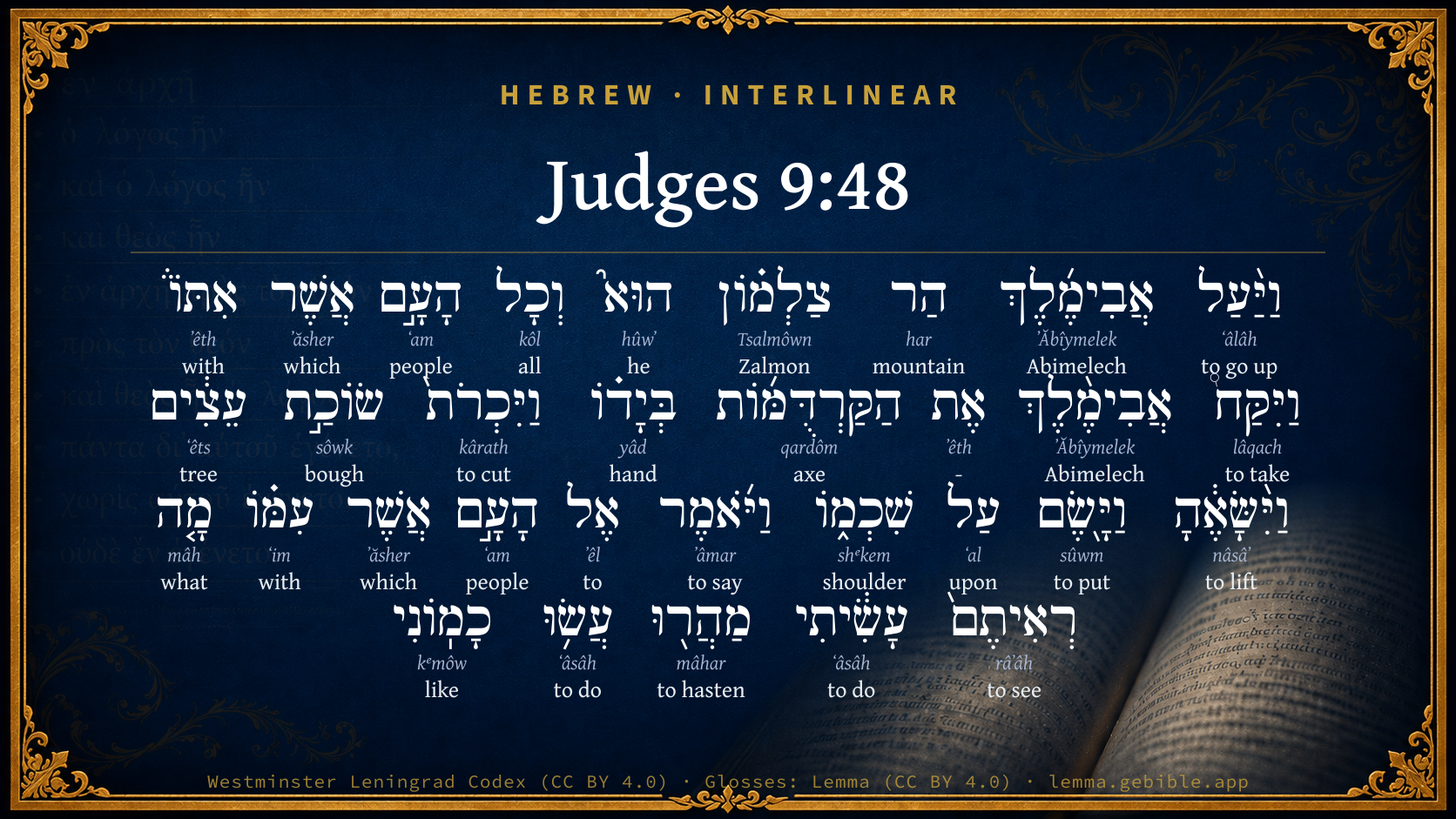
Judges 9:48

Hebrew (Westminster Leningrad Codex) Judges 9:48 appears in the Hebrew Old Testament. The text above is from the Westminster Leningrad Codex. Each word links to its Strong’s number, a concise gloss, and parsing drawn from the Open Scriptures Hebrew Bible morphology. Click any word for its full Brown-Driver-Briggs (BDB) entry.
Download image
Cite this verse

Judges 9:48 (World English Bible). Public Domain. Lemma interlinear Bible study tool, https://lemma.gebible.app/v/judges/9/48.

Show BibTeX & RIS
BibTeX
RIS
English Translation
Abimelech got him up to Mount Zalmon, he and all the people who were with him; and Abimelech took an axe in his hand, and cut down a bough from the trees, and took it up, and laid it on his shoulder: and he said to the people who were with him, What you have seen me do, make haste, and do as I have done.
World English Bible · Public Domain
Highlights
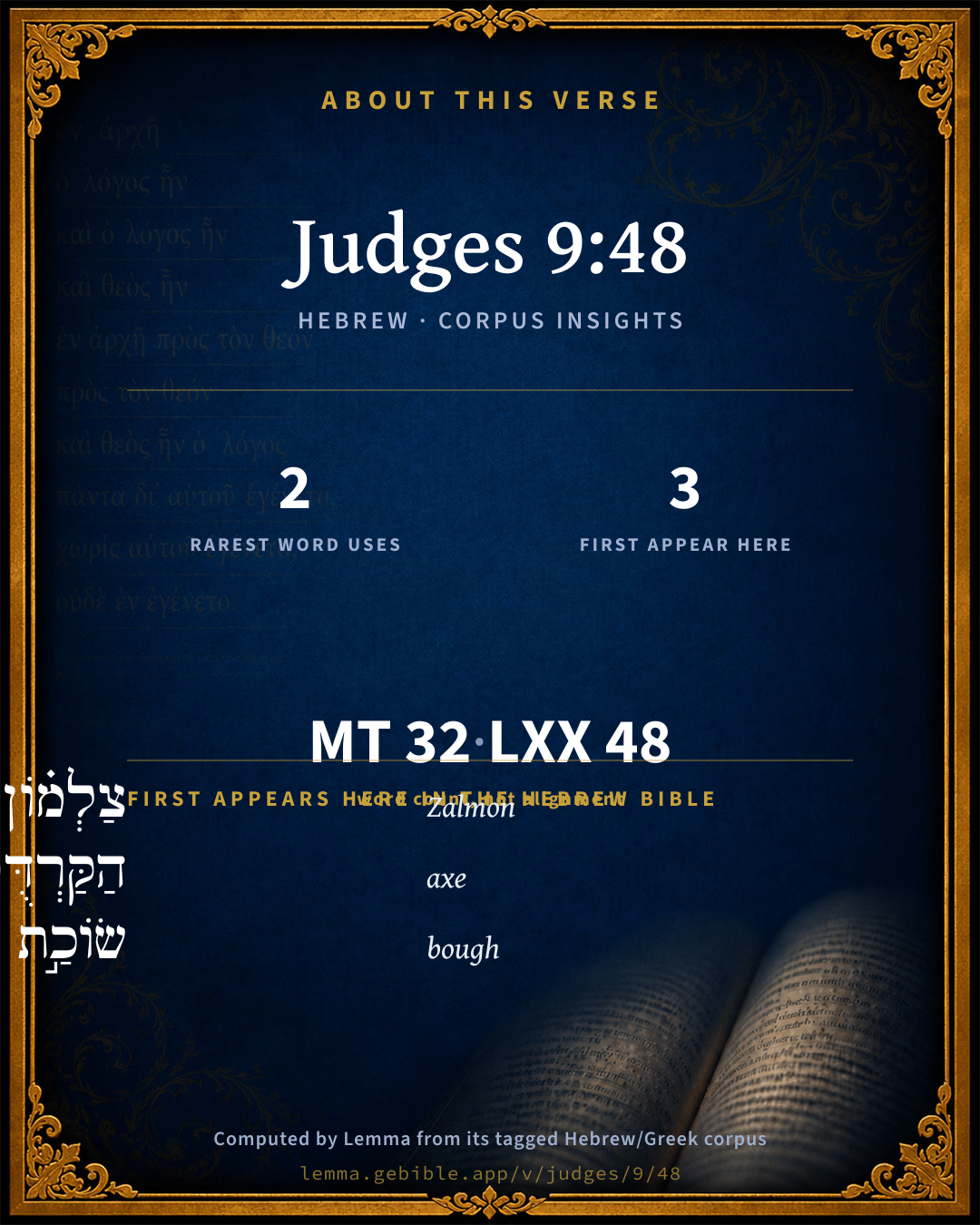
  • 3 first appearances in the Hebrew Bible
Full analysis ↓
Download a study sheet

One document with this verse’s original text, its word-by-word gloss line, the meaning frame, cross-references with their text, attributed commentary, and full source and license credits — printable, and it pastes into notes with its structure intact.

This verse Autodidact and up

Study sheet (.html) Plain text (.txt)

A passage Seminary Student

Up to 50 verses in one chapter. A passage sheet keeps up to 6 commentary sources and 12 cross-references per verse, in the order this page ranks them, and says so on the sheet whenever that leaves anything out. Ask for a single verse and you get the Autodidact verse sheet above.

Everything on this page stays free to read, with no account — the sheet is a download of what is already on screen, not access to it.

Want to remove ads? Support Godless Engineer
Compare translations 3

The same verse in 3 English versions, stacked beneath the original-language interlinear above. Click any original word for its lexicon entry.

Each is an independent rendering of the whole verse — the interlinear is not word-aligned to these translations.

Highlighted words mark where these versions differ — a whole-verse word diff, not a word-by-word alignment.

  • World English Bible Public Domain
    Abimelech got him up to Mount Zalmon, he and all the people who were with him; and Abimelech took an axe in his hand, and cut down a bough from the trees, and took it up, and laid it on his shoulder: and he said to the people who were with him, What you have seen me do, make haste, and do as I have done.
  • King James Version Public Domain
    And Abimelech gat him up to mount Zalmon, he and all the people that were with him; and Abimelech took an axe in his hand, and cut down a bough from the trees, and took it, and laid it on his shoulder, and said unto the people that were with him, What ye have seen me do, make haste, and do as I have done.
  • unfoldingWord Literal Text CC BY-SA 4.0
    So Abimelech went up Mount Zalmon, he and all of the people who with him, and Abimelech took axes in his hand. And he cut a branch of the trees and lifted it and set on his shoulder and said to the people who with him, “What you have seen I have done, hurry, do like me.”

unfoldingWord Literal Text — © unfoldingWord, licensed CC BY-SA 4.0. Word-aligned USFM3 via Door43 (git.door43.org/unfoldingWord/en_ult).

Versions to compare (up to 4)

3 of 4 selected

Show all 18 translations

Every available English version of this verse, each an independent rendering of the whole verse.

  • World English Bible Public Domain
    Abimelech got him up to Mount Zalmon, he and all the people who were with him; and Abimelech took an axe in his hand, and cut down a bough from the trees, and took it up, and laid it on his shoulder: and he said to the people who were with him, What you have seen me do, make haste, and do as I have done.
  • Berean Standard Bible Public Domain
    he and all his men went up to Mount Zalmon. Abimelech took his axe in his hand and cut a branch from the trees, which he lifted to his shoulder, saying to his men, “Hurry and do what you have seen me do.”
  • Majority Standard Bible Public Domain
    he and all his men went up to Mount Zalmon. Abimelech took his axe in his hand and cut a branch from the trees, which he lifted to his shoulder, saying to his men, “Hurry and do what you have seen me do.”
  • King James Version Public Domain
    And Abimelech gat him up to mount Zalmon, he and all the people that were with him; and Abimelech took an axe in his hand, and cut down a bough from the trees, and took it, and laid it on his shoulder, and said unto the people that were with him, What ye have seen me do, make haste, and do as I have done.
  • American Standard Version (1901) Public Domain
    And Abimelech gat him up to mount Zalmon, he and all the people that were with him; and Abimelech took an axe in his hand, and cut down a bough from the trees, and took it up, and laid it on his shoulder: and he said unto the people that were with him, What ye have seen me do, make haste, and do as I have done.
  • Revised Version (1885) Public Domain
    And Abimelech gat him up to mount Zalmon, he and all the people that were with him; and Abimelech took an axe in his hand, and cut down a bough from the trees, and took it up, and laid it on his shoulder: and he said unto the people that were with him, What ye have seen me do, make haste, and do as I have done.
  • Geneva Bible (1599) Public Domain
    And Abimelech gate him vp to mounte Zalmon, hee and all the people that were with him: and Abimelech tooke axes with him, and cut downe boughes of trees, and tooke them, and bare them on his shoulder, and sayde vnto the folke that were with him, What ye haue seene me doe, make haste, and doe like me.
  • Douay-Rheims (1899) Public Domain
    Went up into mount Selmon he and all his people with him: and taking an axe, he cut down the bough of a tree, and laying it on his shoulder and carrying it, he said to his companions: What you see me do, do you out of hand.
  • Young's Literal Translation Public Domain
    and Abimelech goeth up to mount Zalmon, he and all the people who `are' with him, and Abimelech taketh the great axe in his hand, and cutteth off a bough of the trees, and lifteth it up, and setteth `it' on his shoulder, and saith unto the people who `are' with him, `What ye have seen I have done -- haste, do ye like it.'
  • Literal Standard Version CC BY-SA 4.0
    and Abimelech goes up to Mount Zalmon, he and all the people who [are] with him, and Abimelech takes the great axe in his hand, and cuts off a bough of the trees, and lifts it up, and sets [it] on his shoulder, and says to the people who [are] with him, “What you have seen me do—hurry, do as I [have done].”
  • Unlocked Literal Bible CC BY-SA 4.0
    Abimelech went up to Mount Zalmon, he and all the men who were with him. Abimelech took an ax and cut off branches. He put it on his shoulder and ordered the men with him, “What you have seen me do, hurry and do as I have done.”
  • unfoldingWord Literal Text CC BY-SA 4.0
    So Abimelech went up Mount Zalmon, he and all of the people who with him, and Abimelech took axes in his hand. And he cut a branch of the trees and lifted it and set on his shoulder and said to the people who with him, “What you have seen I have done, hurry, do like me.”
  • Darby Bible Public Domain
    And Abim'elech went up to Mount Zalmon, he and all the men that were with him; and Abim'elech took an axe in his hand, and cut down a bundle of brushwood, and took it up and laid it on his shoulder. And he said to the men that were with him, "What you have seen me do, make haste to do, as I have done."
  • World Messianic Bible Public Domain
    Abimelech went up to Mount Zalmon, he and all the people who were with him; and Abimelech took an ax in his hand, and cut down a bough from the trees, and took it up, and laid it on his shoulder. Then he said to the people who were with him, “What you have seen me do, make haste, and do as I have done!”
  • Webster's Bible Public Domain
    And Abimelech ascended mount Zalmon, he and all the people that were with him; and Abimelech took an ax in his hand, and cut down a bough from the trees, and took it, and laid it on his shoulder, and said to the people that were with him, What ye have seen me do, make haste, and do as I have done.
  • Free Bible Version CC BY-SA 4.0
    he and all the men with him went up Mount Zalmon. Abimelech grabbed hold of an ax and cut a branch from the trees. He lifted it onto his shoulder, and told his men, “Quick! You saw what I did. Do the same!”
  • Bible in Basic English Public Domain
    Then Abimelech went up to Mount Zalmon, with all his people; and Abimelech took an axe in his hand and, cutting down branches of trees, took them and put them on his back. And he said to the people who were with him, Be quick and do as you have seen me do.
  • JPS Tanakh (1917) Public Domain
    And Abimelech got him up to mount Zalmon, he and all the people that were with him; and Abimelech took an axe in his hand, and cut down a bough from the trees, and took it up, and laid it on his shoulder; and he said unto the people that were with him: 'What ye have seen me do, make haste, and do as I have done.'

Literal Standard Version (2020), Covenant Press — licensed CC BY-SA 4.0. Text via the HelloAO Bible API (eBible.org). Unlocked Literal Bible (unfoldingWord) — licensed CC BY-SA 4.0. Text via the HelloAO Bible API (eBible.org). unfoldingWord Literal Text — © unfoldingWord, licensed CC BY-SA 4.0. Word-aligned USFM3 via Door43 (git.door43.org/unfoldingWord/en_ult). Free Bible Version, Dr. Jonathan Gallagher — licensed CC BY-SA 4.0. Text via the HelloAO Bible API (eBible.org).

Word by word

More ways to search: Search by grammar → Find every occurrence → Compare this word →

Practice this passage: Drill this verse → Learn its vocabulary →

שׂוֹכַ֣ת
sôwk
H7754
“bough of”
Noun, Common, Feminine, Singular, Construct
Part of Speech
Noun
Type
Common
Gender
Feminine
Number
Singular
State
Construct
Full BDB Definition

Origin: from H7753

TWOT: 2242a , 2242b

branch, brushwood, bough
  1. וַיַּ֨עַל ʻâlâh H5927 “and · to go up” Conjunction + Verb, Qal, Sequential Imperfect, 3rd Person, Masculine, Singular
  2. אֲבִימֶ֜לֶךְ ʼĂbîymelek H40 “Abimelech” Noun, Proper
  3. הַר har H2022 “mountain of” Noun, Common, Masculine, Singular, Construct
  4. צַלְמ֗וֹן Tsalmôwn H6756 “Zalmon” Noun, Proper
  5. הוּא֮ hûwʼ H1931 “he” Pronoun, Personal, 3rd Person, Masculine, Singular
  6. וְכָל kôl H3605 “and · all of” Conjunction + Noun, Common, Masculine, Singular, Construct
  7. הָעָ֣ם ʻam H5971 “the · people” Particle, Definite Article + Noun, Common, Masculine, Singular, Absolute
  8. אֲשֶׁר ʼăsher H834 “which” Particle, Relative
  9. אִתּוֹ֒ ʼêth H854 “with · him” Preposition + Suffix, Personal, 3rd Person, Masculine, Singular
  10. וַיִּקַּח֩ lâqach H3947 “and · to take” Conjunction + Verb, Qal, Sequential Imperfect, 3rd Person, Masculine, Singular
  11. אֲבִימֶ֨לֶךְ ʼĂbîymelek H40 “Abimelech” Noun, Proper
  12. אֶת ʼêth H853 “-” Particle, Direct Object
  13. הַקַּרְדֻּמּ֜וֹת qardôm H7134 “the · axes” Particle, Definite Article + Noun, Common, Both, Plural, Absolute
  14. בְּיָד֗וֹ yâd H3027 “in/at · hand · his” Preposition + Noun, Common, Both, Singular, Construct + Suffix, Personal, 3rd Person, Masculine, Singular
  15. וַיִּכְרֹת֙ kârath H3772 “and · to cut” Conjunction + Verb, Qal, Sequential Imperfect, 3rd Person, Masculine, Singular
  16. עֵצִ֔ים ʻêts H6086 “trees” Noun, Common, Masculine, Plural, Absolute
  17. וַיִּ֨שָּׂאֶ֔הָ nâsâʼ H5375 “and · to lift · her” Conjunction + Verb, Qal, Sequential Imperfect, 3rd Person, Masculine, Singular + Suffix, Personal, 3rd Person, Feminine, Singular
  18. וַיָּ֖שֶׂם sûwm H7760 “and · to put” Conjunction + Verb, Qal, Sequential Imperfect, 3rd Person, Masculine, Singular
  19. עַל ʻal H5921 “upon” Preposition
  20. שִׁכְמ֑וֹ shᵉkem H7926 “shoulder · his” Noun, Common, Masculine, Singular, Construct + Suffix, Personal, 3rd Person, Masculine, Singular
  21. וַיֹּ֜אמֶר ʼâmar H559 “and · to say” Conjunction + Verb, Qal, Sequential Imperfect, 3rd Person, Masculine, Singular
  22. אֶל ʼêl H413 “to” Preposition
  23. הָעָ֣ם ʻam H5971 “the · people” Particle, Definite Article + Noun, Common, Masculine, Singular, Absolute
  24. אֲשֶׁר ʼăsher H834 “which” Particle, Relative
  25. עִמּ֗וֹ ʻim H5973 “with · him” Preposition + Suffix, Personal, 3rd Person, Masculine, Singular
  26. מָ֤ה mâh H4100 “what” Particle, Interrogative
  27. רְאִיתֶם֙ râʼâh H7200 “to see” Verb, Qal, Perfect, 2nd Person, Masculine, Plural
  28. עָשִׂ֔יתִי ʻâsâh H6213 “to do” Verb, Qal, Perfect, 1st Person, Common, Singular
  29. מַהֲר֖וּ mâhar H4116 “hasten” Verb, Piel, Imperative, 2nd Person, Masculine, Plural
  30. עֲשׂ֥וּ ʻâsâh H6213 “do” Verb, Qal, Imperative, 2nd Person, Masculine, Plural
  31. כָמֽוֹנִי kᵉmôw H3644 “like · me” Preposition + Suffix, Personal, 1st Person, Common, Singular

About this verse

These counts appear in no published source. They are computed here, from the morphology-tagged text and Lemma’s own curated glosses. What Lemma adds →

32
words
28
distinct lemmas
Historical
section

Notable vocabulary

The rarest word here is שׂוֹכַ֣ת bough H7754 — appearing just 2 times in the whole Hebrew Bible.

First appearance in Scripture

These words make their first canonical appearance in the Hebrew Bible here:

  • צַלְמ֗וֹן Zalmon H6756
  • הַקַּרְדֻּמּ֜וֹת axe H7134
  • שׂוֹכַ֣ת bough H7754

Shared distinctive vocabulary

שׂוֹכַ֣ת bough H7754 occurs in 2 verses of the Hebrew Bible. Also found in:

Grammatical profile

  • 10 verbs
  • 12 nouns
  • 1 pronoun
  • 5 prepositions
  • 4 particles

Verb forms

  • וַיַּ֨עַל Qal · Sequential Imperfect
  • וַיִּקַּח֩ Qal · Sequential Imperfect
  • וַיִּכְרֹת֙ Qal · Sequential Imperfect
  • וַיִּ֨שָּׂאֶ֔הָ Qal · Sequential Imperfect
  • וַיָּ֖שֶׂם Qal · Sequential Imperfect
  • וַיֹּ֜אמֶר Qal · Sequential Imperfect
  • רְאִיתֶם֙ Qal · Perfect
  • עָשִׂ֔יתִי Qal · Perfect
  • מַהֲר֖וּ Piel · Imperative
  • עֲשׂ֥וּ Qal · Imperative

Repetition

Words recur within this verse — often emphatic in Hebrew:

  • אֲבִימֶ֜לֶךְ Abimelech H40 ×2
  • הָעָ֣ם people H5971 ×2
  • עָשִׂ֔יתִי to do H6213 ×2
  • אֲשֶׁר which H834 ×2

Hebrew & Septuagint length

In English translation the verse runs 66 words from the Hebrew and 60 from the Septuagint (LXX English) — closely comparable.

A rough comparison of the two English renderings, which tokenize alike — not a word-level alignment.

Word counts can differ between the Hebrew and the Greek without any difference in meaning — e.g. the Hebrew direct-object marker אֵת has no separate Greek word, and Greek often adds the article ὁ.

In the original languages it is 32 Hebrew tokens and 48 Greek tokens — but the two are counted differently (Hebrew bundles its prefixes and suffixes into one token; the Greek is in lemma form), so that isn’t a like-for-like length.

Cross-references

3

Topical passages linked to Judges 9:48 in the Treasury of Scripture Knowledge — connected by theme and wording, ordered by reader-vote popularity; previews shown in the World English Bible.

  • Psalms 68:14 When the Almighty scattered kings in her, It snowed on Zalmon.
  • Judges 7:17–18 He said to them, Look on me, and do likewise: and, behold, when I come to the outermost part of the camp, it shall be that, as I do, so shall you do.
  • Proverbs 1:11–12 If they say, "Come with us, Let's lay in wait for blood; Let's lurk secretly for the innocent without cause;

Cross-references courtesy of OpenBible.info (CC BY 4.0).

Hebrew and Greek witnesses Masoretic Hebrew ↔ Greek Septuagint

The same verse in the two great witnesses to the Old Testament, shown verse-for-verse.

These are two independent witnesses, not word-aligned to each other, and the Septuagint is shown in lemma (dictionary) form.

Hebrew Judges 9:48 Masoretic · Westminster Leningrad Codex

וַיַּ֨עַל אֲבִימֶ֜לֶךְ הַר צַלְמ֗וֹן הוּא֮ וְכָל הָעָ֣ם אֲשֶׁר אִתּוֹ֒ וַיִּקַּח֩ אֲבִימֶ֨לֶךְ אֶת הַקַּרְדֻּמּ֜וֹת בְּיָד֗וֹ וַיִּכְרֹת֙ שׂוֹכַ֣ת עֵצִ֔ים וַיִּ֨שָּׂאֶ֔הָ וַיָּ֖שֶׂם עַל שִׁכְמ֑וֹ וַיֹּ֜אמֶר אֶל הָעָ֣ם אֲשֶׁר עִמּ֗וֹ מָ֤ה רְאִיתֶם֙ עָשִׂ֔יתִי מַהֲר֖וּ עֲשׂ֥וּ כָמֽוֹנִי

Abimelech got him up to Mount Zalmon, he and all the people who were with him; and Abimelech took an axe in his hand, and cut down a bough from the trees, and took it up, and laid it on his shoulder: and he said to the people who were with him, What you have seen me do, make haste, and do as I have done.

World English Bible · Public Domain

Greek LXX Judges 9:48 Septuagint · lemma form

καί ἀναβαίνω αβιμελεχ εἰς ὄρος ερμων καί πᾶς ὁ λαός ὁ μετά αὐτός καί λαμβάνω αβιμελεχ ὁ ἀξίνη ἐν ὁ χείρ αὐτός καί κόπτω κλάδος ξύλον καί αἴρω καί τίθημι ἐπί ὦμος αὐτός καί εἶπον ὁ λαός ὁ μετά αὐτός ὅς ὁράω ἐγώ ποιέω ταχέως ποιέω ὡς ἐγώ

And Abimelech went up to the mount of Selmon, and all the people that were with him; and Abimelech took an axe in his hand, and cut down a branch of a tree, and took it, and laid it on his shoulders; and said to the people that were with him, What you⌃ see me doing, do quickly as I.

LXX2012 (modern English Septuagint) · Public Domain

On this verse, Ellicott's Commentary for English Readers discusses the Septuagint’s reading. Read the note in Commentary ↓

Hebrew: Westminster Leningrad Codex (CC BY 4.0). Greek: Septuagint (public domain); English from LXX2012 (modern English Septuagint) (Public Domain). How the Septuagint differs from the Hebrew →

Targum (Aramaic paraphrase)

1

The Targum is the ancient Jewish Aramaic paraphrase of the Hebrew Scriptures — an interpretive translation, not the Hebrew text itself. Onkelos (literal) and Pseudo-Jonathan (expansive) render the Torah, and Jonathan the Prophets. Coverage is partial: where no permissively-licensed English translation exists for a verse, only the Aramaic is shown. This is verse-level text, not a word-by-word alignment to the Hebrew.

  1. Targum Jonathan Prophets (Joshua–Malachi)
    וּסְלֵיק אֲבִימֶלֶךְ לְטוּרָא דְצַלְמוֹן הוּא וְכָל עַמָא דִי עִמֵיהּ וּנְסֵיב אֲבִימֶלֶךְ יַת כּוּלְבַיָא בִּידֵיהּ וְקָץ סוֹכַת אָעִין וּנְטָלָהּ וְשַׁוֵי עַל כִּתְפוֹהִי וַאֲמַר לְעַמָא דִי עִמֵיהּ מַה חֲזֵיתוּן עַבָדִית אוֹחוּ עֲבִידוּ כְּוָתִי:

    (no public-domain English translation for this verse)

    Targum Jonathan — Aramaic: “Mikraot Gedolot” (public domain). English: “Sefaria Community Translation” (CC0 1.0 (public-domain dedication)); “London "Chaldee Paraphrase," 1871” (public domain). Text via Sefaria.

Commentary

Notes on Judges 9:48 from classic Christian and Jewish commentators (each source and its license shown beneath its notes). The classic Christian expositions comment on the surrounding passage and are grouped to its opening verse, so a note may address several verses; the Jewish commentaries on the Tanakh (Rashi and others) are per-verse, so they appear only where the commentator wrote on this verse.

Lemma curates 59 commentaries, every one of them public domain or Creative Commons licensed, each selected and text-cleaned for this edition rather than reprinted as found. About our sources →

Trapp's Complete Commentary

John Trapp

Jdg 9:48 And Abimelech gat him up to mount Zalmon, he and all the people that [were] with him; and Abimelech took an axe in his hand, and cut down a bough from the trees, and took it, and laid [it] on his shoulder, and said unto the people that [were] with him, What ye have seen me do, make haste, [and] do as I [have done].

Ver. 48. To mount Zalmon.] Which had its name from the shadiness, by reason of the many trees there growing.

What ye have seen me do, make haste, and do.] Princeps imperio maximus, exemplo maior, as Paterculus {a} saith of Tiberius; Princes are easily imitated. Vespasian undertaking to repair the decayed capitol, first with his own hands shovelled up the rubbish, and carried it forth on his shoulders. {b}

{a} Paterc., lib. ii.

{b} Sueton., in Vesp., cap. 8.

John Trapp, A Commentary or Exposition upon All the Books of the Old and New Testament (1647–1656) — public domain. Text from a community e-Sword module.

The Biblical Illustrator

Joseph S. Exell

Jdg_9:48-49

And Abimelech took an axe in his hand.

The storming of the temple of Berith

1. I learn first from this subject, the folly of depending upon any one form of tactics in anything we have to do for this world or for God. Look over the weaponry of olden times--javelins, battle-axes, habergeons--and show me a single weapon with which Abimelech and his men could have gained such complete triumph. It is no easy thing to take a temple thus armed. Yet here Abimelech and his army come up, they surround this temple, and they capture it without the loss of a single man on the part of Abimelech, although I suppose some of the old Israelitish heroes told Abimelech: You are only going up there to be cut to pieces. Yet you are willing to testify to-day that by no other mode--certainly not by ordinary modes--could that temple so easily, so thoroughly, have been taken. What the Church most wants to learn, this day, is that any plan is right, is lawful, is best, which helps to overthrow the temple of sin, and capture this world for God. We are very apt to stick to the old modes of attack. We come up with the sharp, keen, glittering steel spear of argument, expecting in that way to take the castle; but they have a thousand spears where we have ten. And so the castle of sin stands, I propose a different style of tactics. Let each one go to the forest of Gods promise and invitation, and hew down a branch, and put it on his shoulder, and let us all come around these obstinate iniquities, and then, with this pile, kindled by the fires of a holy zeal and the flames of a consecrated life, we will burn them out. What steel cannot do, fire may. We want more heart in our song, more heart in our almsgiving, more heart in our prayers, more heart in our preaching. Oh, for less of Abimelechs sword and more of Abimeleehs conflagration! The gospel is not a syllogism; it is not casuistry; it is not polemics, or the science of squabble. It is blood-red fact; it is warm-hearted invitation; it is leaping, bounding, flying good news; it is efflorescent with all light; it is rubescent with all summery glow; it is arborescent with all sweet shade.

2. Still further, I learn from this subject the power of example. If Abimelech had sat down on the grass, and told his men to go and get the boughs, and go out to the battle, they would never have gone at all, or if they had, it would have been without any spirit or effective result; but when Abimelech goes with his own axe and hews down a branch, and with Abimelechs arm puts it on Abimelechs shoulder, and marches on, then, my text says, all the people did the same. How natural that was! What made Garibaldi and Stonewall Jackson the most magnetic commanders of this century? They always rode ahead. Oh, the overwhelming power of example! Oh, start out for heaven to-day, and your family will come after you, and your business associates will come after you, and your social friends will join you. With one branch of the tree of life for a baton, marshal just as many as you can gather. Oh, the infinite, the semi-omnipotent power of a good or a bad example!

3. Still further, I learn from this subject the advantage of concerted action. If Abimelech had merely gone out with a tree-branch, the work would not have been accomplished, or if ten, twenty, or thirty men had gone; but when all the axes are lifted, and all the sharp edges fall, and all these men carry each his tree-branch down and throw it about the temple, the victory is gained--the temple falls. Where there is one man in the Church of God at this day shouldering his whole duty, there are a great many who never lift an axe or swing a bough. It seems to me as if there were ten drones in every hive to one busy bee. What broken bone of sorrow have you ever set? Are you doing nothing? Is it possible that a man or woman sworn to be a follower of the Lord Jesus Christ is doing nothing?

4. Still further, I learn from this subject the danger of false refuges. As soon as these Sheehemites got into the temple, they thought they were safe. They said: Berith will take care of us. Abimelech may batter down everything else; he cannot batter down this temple where we are now hid. But very soon they heard the timbers crackling, and they were smothered with smoke, and they miserably died. And you and I are just as much tempted to false refuges. The mirror this morning may have persuaded you that you have a comely cheek; Satan may have told you that you are all right; but bear with me if I tell you that, if unpardoned, you are all wrong. I suppose every man is stepping into some kind of refuge. Here you step into the tower of good works. You say, I shall be safe here in this refuge. The battlements are adorned; the steps are varnished; on the wall are pictures of all the suffering you have alleviated, and all the schools you have established, and all the fine things you have ever done. Up in that tower you feel you are safe. But hear you not the tramp of your unpardoned sins all around the tower? They each have a match. You are kindling the combustible material. You feel the heat and the suffocation. Oh! may you leap in time, the gospel declaring, By the deeds of the law shall no flesh living be justified. Well, you say, I have been driven out of that tower; where shall I go? Step into this tower of indifference. You say, If this tower is attacked, it will be a great while before it is taken. You feel at ease. But there is an Abimelech, with ruthless assault, coming on. Death and his forces are gathering around. But, says some one, you are engaged in a very mean business, driving us from tower to tower. Oh no! I want to tell you of a Gibraltar that never has been and never will be taken; of a bulwark that the judgment earthquakes cannot budge. The Bible refers to it when it says: In God is thy refuge, and underneath thee are the everlasting arms. Oh! fling yourself into it, (T. De Witt Talmage.)

.

The Biblical Illustrator, edited by Joseph S. Exell (c. 1880s–1900s) — public domain. Text from a community e-Sword module.

Joseph Benson's Commentary

Jdg 9:48-51. Zalmon — A place so called from its shadiness. Thebez — Another town near Shechem; and, as it seems, within its territory. Thither fled all the men and women — All that were not slain in the taking of the town. And gat them up to the top of the tower — Which was flat and plain, after their manner of building.

Joseph Benson's Commentary on the Old and New Testaments (1811–1818) — public domain. Text from a community e-Sword module.

Ellicott's Commentary for English Readers

(48) To mount Zalmon.—Evidently the nearest spot where he could get wood for his hideous design. Zalmon means shady. In Psa_68:14 we find “as white as snow in Zalmon,” but whether the same mountain is referred to we cannot tell. It may be any of the hills near Gerizim.

An axe.—Literally, the axes—i.e., he took axes for himself and his army.

Cut down a bough.—The word for “a bough” is socath, which does not mean “a bundle of logs,” as the LXX. render it. Every one will recall the scene in Macbeth where Malcolm says:—

“Let every soldier hew him down a bough,

And bear’t before him; thereby shall we shadow

The numbers of our host, and make discovery

Err in report of us.”—Acts 5, sc. 4.

But Abimelech merely wanted combustible materials.

What ye have seen me do.—Comp. what Gideon says in Jdg_7:17.

A Bible Commentary for English Readers, edited by Charles John Ellicott (1878–1897) — public domain. Text from a community e-Sword module.

The Cambridge Bible for Schools and Colleges

gen. ed. J. J. S. Perowne

48. mount Zalmon] An unknown hill hard by; in Psa_68:14 it is the name of a hill on the E. of the Jordan.

an axe] The Hebr. has the axes; the plur. cannot be explained (note in his hand), and must be corrected to the sing., LXX. cod. A, Vulgate; read his axe.

The Cambridge Bible for Schools and Colleges (gen. ed. J. J. S. Perowne; Cambridge University Press, 1878–1918) — public domain. Text from a community e-Sword module.

John Gill's Exposition

And all the people likewise cut down every man his bough, and followed Abimelech,.... With their boughs on their shoulders, so that they were men that seemed to be as trees walking:

and put them to the hold, and set the hold on fire upon them; upon the men in it, or with them, the boughs of trees; it is probable the hold was made of wood, and so could the more easily be set on fire. Jarchi says it was a wood or forest, where they bent the trees, and divided them round about, and made a fence of them; but they would scarcely have left the tower for such a shelter:

so that all the men of the tower of Shechem died also; fire being put to the hold, and they burnt in it; the Vulgate Latin version adds, with fire and smoke; for they being boughs of trees just cut down, with which they set fire to the hold, they would not burn easily and clearly, but make a prodigious smoke, with which many might be suffocated, as others burnt with fire; and it is unaccountable that Josephus (o) should say that faggots of dry wood were taken, and with them fire set to the hold, when the text is so express for it that they were boughs of green trees just cut off:

about a thousand men and women; but the above historian makes them to be many more; he says the men were about 1500, and the rest a great multitude; this literally fulfilled Jotham's curse.

(o) Antiqu. l. 5. c. 7. sect. 4.

John Gill's Exposition of the Whole Bible (1746–1763) — public domain (CC PDM 1.0). Text via the HelloAO Bible API.

Albert Barnes' Notes on the Bible

Zalmon - A lofty and thickly-wooded hill, as the etymology of the name (“shady”) implies, in the immediate neighborhood of Shechem: perhaps the same as Ebal. The setting fire to the hold, where the men of Shechem were all crowded together, with their wives and children, was the literal fulfillment of Jotham’s curse in Jdg 9:20.

Albert Barnes' Notes on the Bible (1834–1885) — public domain. Text from a community e-Sword/MySword module.

Haydock's Catholic Bible Commentary

Selmon. This mountain lay towards the Jordan, and was covered with trees and snow, Psalm lxvii. 16. (Menochius) --- Bough. Septuagint, "a burden or faggot of sticks." Josephus observes that they were dry. (Calmet)

George Leo Haydock (1774–1849), Haydock's Catholic Family Bible and Commentary, 1859 edition — public domain. Excludes Psalms (Douay-Rheims chapter numbering differs from Protestant) and Deuterocanonical books (Catholic canon only).

Matthew Poole's English Annotations

Zalmon; a place so called from its shadiness, because there were many trees there.

Matthew Poole's English Annotations on the Holy Bible (1683–1685) — public domain. Text from a community e-Sword/MySword module.

Whedon's Commentary on the Bible

Daniel D. Whedon

48. Mount Zalmon — A wooded hill near Shechem, but now unknown. Many suppose it referred to again in the much disputed passage, Psa_68:14, where it is wrongly spelled Salmon.

Took an axe — Literally, took the axes; but the allusion is to the axes which the people also took, after the example of their leader.

Daniel D. Whedon (gen. ed.), Commentary on the Old and New Testaments (1874–1909) — public domain. Text from a community e-Sword module.

The Pulpit Commentary

Mount Zalmon, i.e. the shady mount, so called from the thick wood which grows upon it. It was in the neighbourhood of Shechem, and is perhaps the same as that mentioned in Psa_68:14 as famous for its snow-storms. An axe. The Hebrew has axes. If this is right, the phrase in his hand must be rendered with him, as 1Sa_14:34: Each one his ox in his hand, i.e. with him; Jer_38:10: Take thirty men in thy hand, i.e. with thee; and elsewhere.

The Pulpit Commentary (1880–1919), ed. H.D.M. Spence-Jones & Joseph S. Exell — public domain. Text from a community e-Sword module.

John Wesley's Explanatory Notes

Zalmon - A place so called from its shadiness.

John Wesley, Explanatory Notes Upon the Whole Bible (1754–1765) — public domain. Text via the GEBible commentary corpus.

unfoldingWord translationNotes

Door43 World Missions Community

Mount Zalmon

This is the name of a mountain. (See: How to Translate Names)

piled

This means to stack the branches into a large heap.

about a thousand men

"about 1,000" (See: Numbers)

translationWords

Abimelech

ax

watchtower

Shechem

unfoldingWord translationNotes — © Distant Shores Media and the Door43 World Missions Community, licensed CC BY-SA 4.0. Source: git.door43.org/Door43/en_tn.

Rashi

Rabbi Shlomo Yitzchaki (Rashi)

The overhang of a tree. The branch of a tree.

Rashi on the Tanakh — English translations: “The Judaica Press complete Tanach with Rashi, translated by A. J. Rosenberg” (CC BY 4.0); “Pentateuch with Rashi's commentary by M. Rosenbaum and A.M. Silbermann, 1929-1934” (public domain); “The Metsudah Tanach series, Lakewood, N.J” (CC BY 4.0); and “The Book of Joshua, Metsudah Publications, 1997” (CC BY 4.0). Text via Sefaria.

Lesson kit

Teaching starters — assembled from the data on this page, not authored interpretation. Every prompt links to the verse data it draws on. Edit before teaching.

Judges, in the Historical, opens this verse with 32 words (28 distinct Hebrew lemmas). Its most distinctive word is sôwk (“bough”). A historical commentator’s framing appears above. Read the whole chapter for the surrounding context.

Discussion questions

  1. What does “bough” (sôwk) contribute to the verse as a whole?
  2. 3 words make their first appearance in Scripture here. What does this debut establish?
  3. How does Judges 9:49, which shares the word «bough», read alongside this verse?
  4. What does the repetition of “Abimelech” (2× in this one verse) do in this verse?
  5. The translations on this page render this verse differently — a whole-verse word diff, not a word-by-word alignment. What might account for the different wordings?
  6. «וַיַּ֨עַל» is a Qal Sequential Imperfect verb. How does that grammatical form shape the action described?
  7. Compare how Trapp's Complete Commentary and The Biblical Illustrator read this verse. Where do they agree or differ?

Things to notice

Reading settings

Reading text

Shown beneath each verse's original-language words.

Old Testament
Old Testament edition

Read the OT as the Masoretic Hebrew (MT) or the Greek Septuagint (LXX).

English shown for the Greek Septuagint (in the Hebrew ↔ Greek comparison).

Comparing translations? Open the Compare panel on any verse page to stack up to four side by side.