Leviticus 19:8

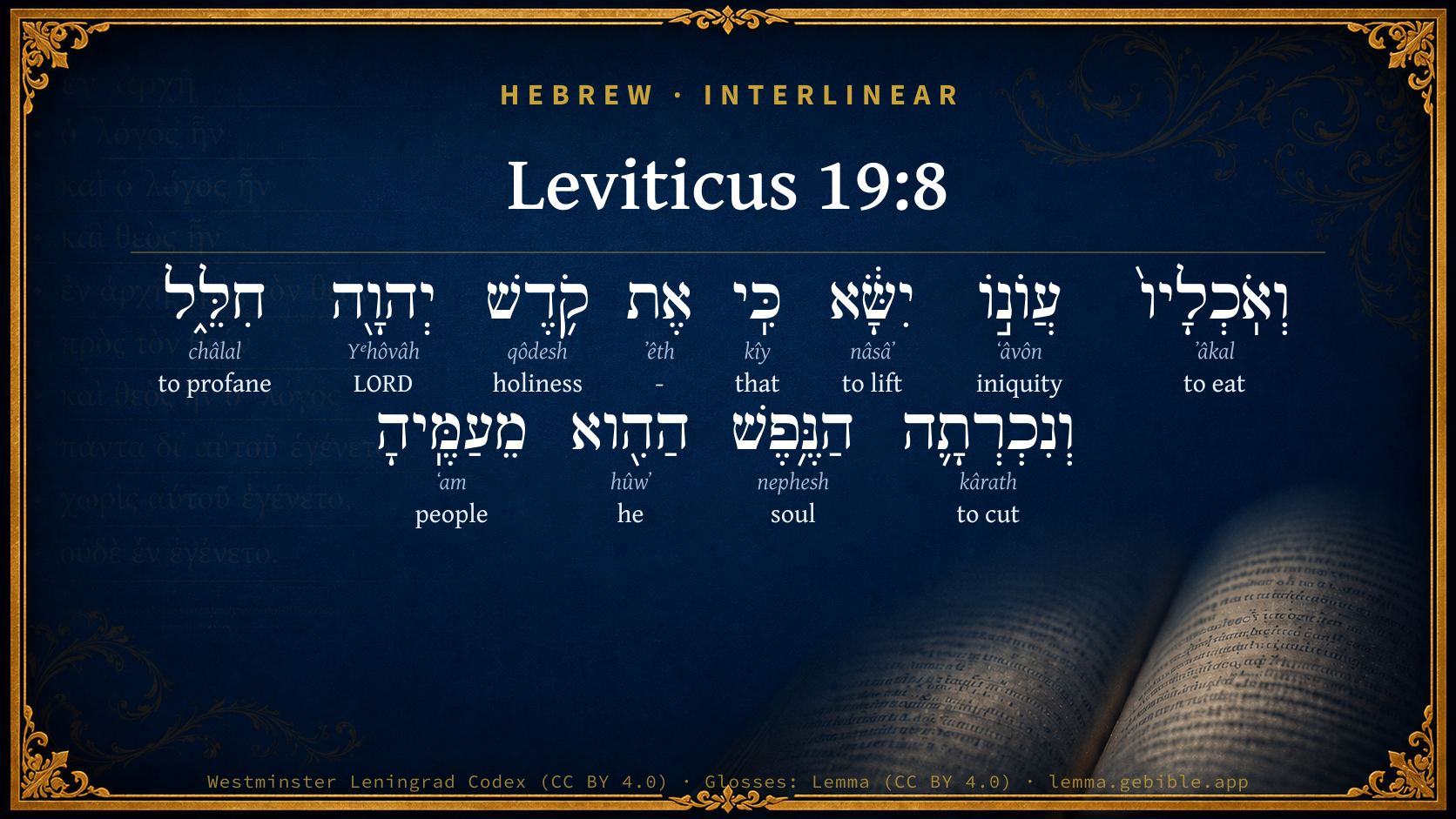
Hebrew (Westminster Leningrad Codex) Leviticus 19:8 appears in the Hebrew Old Testament. The text above is from the Westminster Leningrad Codex. Each word links to its Strong’s number, a concise gloss, and parsing drawn from the Open Scriptures Hebrew Bible morphology. Click any word for its full Brown-Driver-Briggs (BDB) entry.
Download image
Cite this verse

Leviticus 19:8 (World English Bible). Public Domain. Lemma interlinear Bible study tool, https://lemma.gebible.app/v/leviticus/19/8.

Show BibTeX & RIS
BibTeX
RIS
English Translation
but everyone who eats it shall bear his iniquity, because he has profaned the holy thing of Yahweh, and that soul shall be cut off from his people.
World English Bible · Public Domain
Download a study sheet

One document with this verse’s original text, its word-by-word gloss line, the meaning frame, cross-references with their text, attributed commentary, and full source and license credits — printable, and it pastes into notes with its structure intact.

This verse Autodidact and up

Study sheet (.html) Plain text (.txt)

A passage Seminary Student

Up to 50 verses in one chapter. A passage sheet keeps up to 6 commentary sources and 12 cross-references per verse, in the order this page ranks them, and says so on the sheet whenever that leaves anything out. Ask for a single verse and you get the Autodidact verse sheet above.

Everything on this page stays free to read, with no account — the sheet is a download of what is already on screen, not access to it.

Want to remove ads? Support Godless Engineer
Compare translations 3

The same verse in 3 English versions, stacked beneath the original-language interlinear above. Click any original word for its lexicon entry.

Each is an independent rendering of the whole verse — the interlinear is not word-aligned to these translations.

Highlighted words mark where these versions differ — a whole-verse word diff, not a word-by-word alignment.

  • World English Bible Public Domain
    but everyone who eats it shall bear his iniquity, because he has profaned the holy thing of Yahweh, and that soul shall be cut off from his people.
  • King James Version Public Domain
    Therefore every one that eateth it shall bear his iniquity, because he hath profaned the hallowed thing of the LORD: and that soul shall be cut off from among his people.
  • unfoldingWord Literal Text CC BY-SA 4.0
    And the person eating it shall bear his iniquity because he profaned the holiness of Yahweh. And that person shall be cut off from his people.

unfoldingWord Literal Text — © unfoldingWord, licensed CC BY-SA 4.0. Word-aligned USFM3 via Door43 (git.door43.org/unfoldingWord/en_ult).

Versions to compare (up to 4)

3 of 4 selected

Show all 18 translations

Every available English version of this verse, each an independent rendering of the whole verse.

  • World English Bible Public Domain
    but everyone who eats it shall bear his iniquity, because he has profaned the holy thing of Yahweh, and that soul shall be cut off from his people.
  • Berean Standard Bible Public Domain
    Whoever eats it will bear his iniquity, for he has profaned what is holy to the LORD. That person must be cut off from his people.
  • Majority Standard Bible Public Domain
    Whoever eats it will bear his iniquity, for he has profaned what is holy to the LORD. That person must be cut off from his people.
  • King James Version Public Domain
    Therefore every one that eateth it shall bear his iniquity, because he hath profaned the hallowed thing of the LORD: and that soul shall be cut off from among his people.
  • American Standard Version (1901) Public Domain
    but every one that eateth it shall bear his iniquity, because he hath profaned the holy thing of Jehovah: and that soul shall be cut off from his people.
  • Revised Version (1885) Public Domain
    but every one that eateth it shall bear his iniquity, because he hath profaned the holy thing of the LORD: and that soul shall be cut off from his people.
  • Geneva Bible (1599) Public Domain
    Therefore he that eateth it, shall beare his iniquitie, because he hath defiled the halowed thing of the Lord, and that person shalbe cut off from his people.
  • Douay-Rheims (1899) Public Domain
    And shall bear his iniquity, because he hath defiled the holy thing of the Lord, and that soul shall perish from among his people.
  • Young's Literal Translation Public Domain
    and he who is eating it his iniquity doth bear, for the holy thing of Jehovah he hath polluted, and that person hath been cut off from his people.
  • Literal Standard Version CC BY-SA 4.0
    and he who is eating it bears his iniquity, for he has defiled the holy thing of YHWH, and that person has been cut off from his people.
  • Unlocked Literal Bible CC BY-SA 4.0
    and everyone who eats it must carry his own guilt because he has defiled what is holy to Yahweh, and that person must be cut off from his people.
  • unfoldingWord Literal Text CC BY-SA 4.0
    And the person eating it shall bear his iniquity because he profaned the holiness of Yahweh. And that person shall be cut off from his people.
  • Darby Bible Public Domain
    And he that eateth it shall bear his iniquity; for he hath profaned the hallowed thing of Jehovah; and that soul shall be cut off from among his peoples.
  • World Messianic Bible Public Domain
    but everyone who eats it shall bear his iniquity, because he has profaned the holy thing of the LORD, and that soul shall be cut off from his people.
  • Webster's Bible Public Domain
    Therefore every one that eateth it shall bear his iniquity, because he hath profaned the hallowed thing of the LORD; and that soul shall be cut off from among his people.
  • Free Bible Version CC BY-SA 4.0
    Anyone who eats it will bear responsibility for their guilt, for they have made unclean what is holy to the Lord. They must be expelled from their people.
  • Bible in Basic English Public Domain
    And as for anyone who takes it for food, his sin will be on him, for he has put shame on the holy thing of the Lord: he will be cut off from his people.
  • JPS Tanakh (1917) Public Domain
    But every one that eateth it shall bear his iniquity, because he hath profaned the holy thing of the LORD; and that soul shall be cut off from his people.

Literal Standard Version (2020), Covenant Press — licensed CC BY-SA 4.0. Text via the HelloAO Bible API (eBible.org). Unlocked Literal Bible (unfoldingWord) — licensed CC BY-SA 4.0. Text via the HelloAO Bible API (eBible.org). unfoldingWord Literal Text — © unfoldingWord, licensed CC BY-SA 4.0. Word-aligned USFM3 via Door43 (git.door43.org/unfoldingWord/en_ult). Free Bible Version, Dr. Jonathan Gallagher — licensed CC BY-SA 4.0. Text via the HelloAO Bible API (eBible.org).

Word by word

More ways to search: Search by grammar → Find every occurrence → Compare this word →

Practice this passage: Drill this verse → Learn its vocabulary →

חִלֵּ֑ל
châlal
H2490
“to profane”
Verb, Piel, Perfect, 3rd Person, Masculine, Singular
Part of Speech
Verb
Stem
Piel
Form
Perfect
Person
3rd Person
Gender
Masculine
Number
Singular
Full BDB Definition

Origin: a primitive root [compare H2470 ]

TWOT: 660 , 661

to profane, defile, pollute, desecrate, begin - (Niphal) - to profane oneself, defile oneself, pollute oneself - ritually - sexually - to be polluted, be defiled - (Piel) - to profane, make common, defile, pollute - to violate the honour of, dishonour - to violate (a covenant) - to treat as common - (Pual) to profane (name of God) - (Hiphil) - to let be profaned - to begin - (Hophal) to be begun - to wound (fatally), bore through, pierce, bore - (Qal) to pierce - (Pual) to be slain - (Poel) to wound, pierce - (Poal) to be wounded - (Piel) to play the flute or pipe

  1. וְאֹֽכְלָיו֙ ʼâkal H398 “and · eating · him” Conjunction + Verb, Qal, Participle Active, Masculine, Plural, Construct + Suffix, Personal, 3rd Person, Masculine, Singular
  2. עֲוֺנ֣וֹ ʻâvôn H5771 “iniquity · his” Noun, Common, Both, Singular, Construct + Suffix, Personal, 3rd Person, Masculine, Singular
  3. יִשָּׂ֔א nâsâʼ H5375 “to lift” Verb, Qal, Imperfect, 3rd Person, Masculine, Singular
  4. כִּֽי kîy H3588 “that” Conjunction
  5. אֶת ʼêth H853 “-” Particle, Direct Object
  6. קֹ֥דֶשׁ qôdesh H6944 “holiness of” Noun, Common, Masculine, Singular, Construct
  7. יְהוָ֖ה Yᵉhôvâh H3068 “LORD” Noun, Proper
  8. וְנִכְרְתָ֛ה kârath H3772 “and · to cut” Conjunction + Verb, Niphal, Sequential Perfect, 3rd Person, Feminine, Singular
  9. הַנֶּ֥פֶשׁ nephesh H5315 “the · soul” Particle, Definite Article + Noun, Common, Both, Singular, Absolute
  10. הַהִ֖וא hûwʼ H1931 “the · he” Particle, Definite Article + Pronoun, Personal, 3rd Person, Feminine, Singular
  11. מֵעַמֶּֽיהָ ʻam H5971 “from · peoples · her” Preposition + Noun, Common, Masculine, Plural, Construct + Suffix, Personal, 3rd Person, Feminine, Singular

About this verse

These counts appear in no published source. They are computed here, from the morphology-tagged text and Lemma’s own curated glosses. What Lemma adds →

12
words
12
distinct lemmas
Pentateuch
section

Grammatical profile

  • 4 verbs
  • 5 nouns
  • 1 pronoun
  • 1 conjunction
  • 1 particle

Verb forms

  • וְאֹֽכְלָיו֙ Qal · Participle Active
  • יִשָּׂ֔א Qal · Imperfect
  • חִלֵּ֑ל Piel · Perfect
  • וְנִכְרְתָ֛ה Niphal · Sequential Perfect

Hebrew & Septuagint length

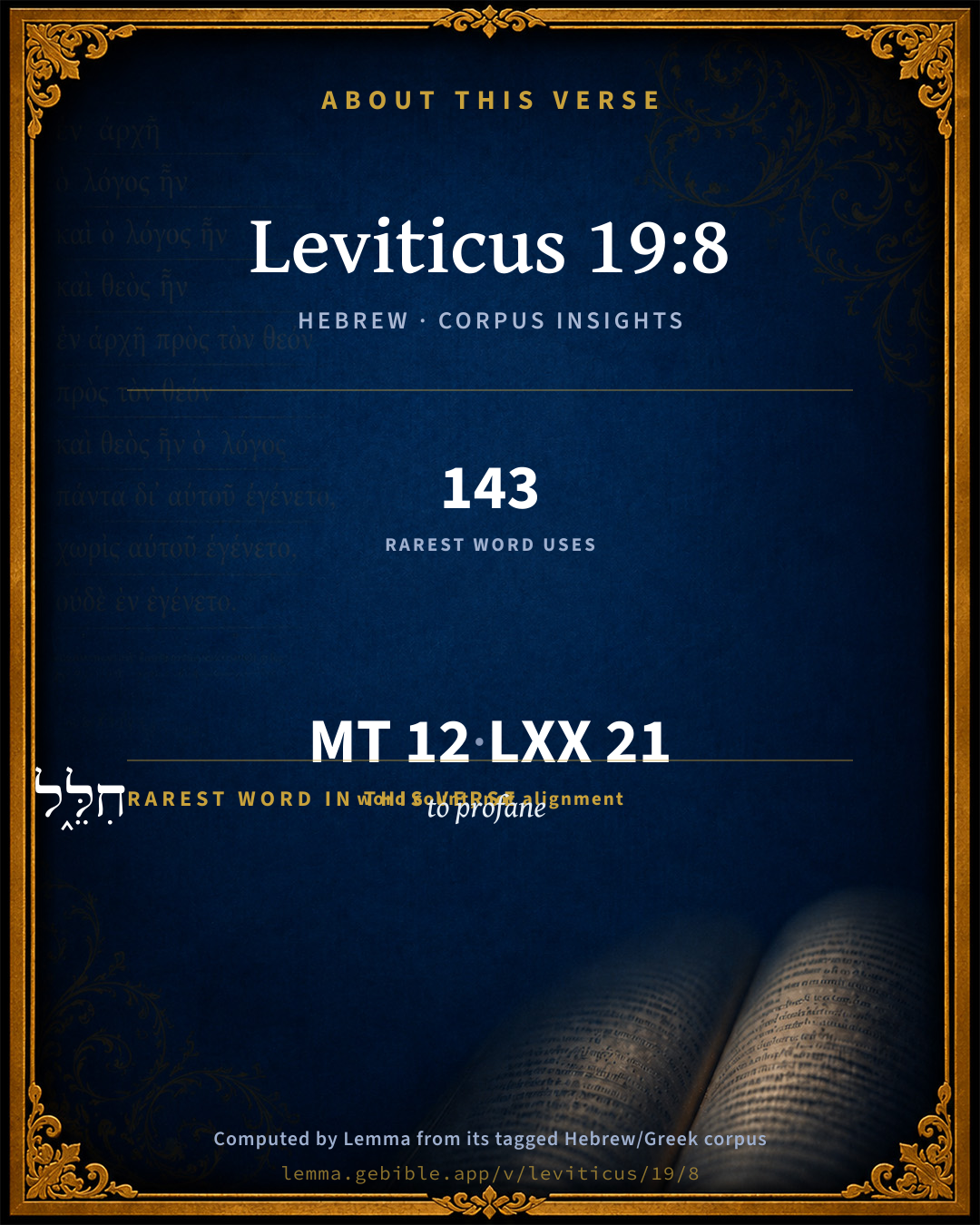
In English translation the verse runs 28 words from the Hebrew and 32 from the Septuagint (LXX English) — closely comparable.

A rough comparison of the two English renderings, which tokenize alike — not a word-level alignment.

Word counts can differ between the Hebrew and the Greek without any difference in meaning — e.g. the Hebrew direct-object marker אֵת has no separate Greek word, and Greek often adds the article ὁ.

In the original languages it is 12 Hebrew tokens and 21 Greek tokens — but the two are counted differently (Hebrew bundles its prefixes and suffixes into one token; the Greek is in lemma form), so that isn’t a like-for-like length.

Cross-references

2

Topical passages linked to Leviticus 19:8 in the Treasury of Scripture Knowledge — connected by theme and wording, ordered by reader-vote popularity; previews shown in the World English Bible.

  • Leviticus 22:15 The priests shall not profane the holy things of the children of Israel, which they offer to Yahweh,
  • Leviticus 5:1 "'If anyone sins, in that he hears the voice of adjuration, he being a witness, whether he has seen or known, if he doesn't report it, then he shall bear his iniquity.

Cross-references courtesy of OpenBible.info (CC BY 4.0).

Hebrew and Greek witnesses Masoretic Hebrew ↔ Greek Septuagint

The same verse in the two great witnesses to the Old Testament, shown verse-for-verse.

These are two independent witnesses, not word-aligned to each other, and the Septuagint is shown in lemma (dictionary) form.

Hebrew Leviticus 19:8 Masoretic · Westminster Leningrad Codex

וְאֹֽכְלָיו֙ עֲוֺנ֣וֹ יִשָּׂ֔א כִּֽי אֶת קֹ֥דֶשׁ יְהוָ֖ה חִלֵּ֑ל וְנִכְרְתָ֛ה הַנֶּ֥פֶשׁ הַהִ֖וא מֵעַמֶּֽיהָ

but everyone who eats it shall bear his iniquity, because he has profaned the holy thing of Yahweh, and that soul shall be cut off from his people.

World English Bible · Public Domain

Greek LXX Leviticus 19:8 Septuagint · lemma form

ὁ δέ ἐσθίω αὐτός ἁμαρτία λαμβάνω ὅτι ὁ ἅγιος κύριος βεβηλόω καί ἐκὀλεθρεύω ὁ ψυχή ὁ ἐσθίω ἐκ ὁ λαός αὐτός

And he that eats it shall bear his iniquity, because he has profaned the holy things of the Lord; and the souls that eat it shall be destroyed from among their people.

LXX2012 (modern English Septuagint) · Public Domain

Hebrew: Westminster Leningrad Codex (CC BY 4.0). Greek: Septuagint (public domain); English from LXX2012 (modern English Septuagint) (Public Domain). How the Septuagint differs from the Hebrew →

Targum (Aramaic paraphrase)

2

The Targum is the ancient Jewish Aramaic paraphrase of the Hebrew Scriptures — an interpretive translation, not the Hebrew text itself. Onkelos (literal) and Pseudo-Jonathan (expansive) render the Torah, and Jonathan the Prophets. Coverage is partial: where no permissively-licensed English translation exists for a verse, only the Aramaic is shown. This is verse-level text, not a word-by-word alignment to the Hebrew.

  1. Targum Onkelos Torah (Genesis–Deuteronomy)
    וּדְיֵיכְלִנֵהּ חוֹבֵהּ יְקַבֵּל אֲרֵי יָת קוּדְשָׁא דַיְיָ אַחֵל וְיִשְׁתֵּיצֵי אֲנָשָׁא הַהוּא מֵעַמֵהּ

    (no public-domain English translation for this verse)

    Targum Onkelos — Aramaic: “Onkelos Genesis” (public domain); “Onkelos Exodus” (public domain); “Onkelos Leviticus” (public domain); “Onkelos Numbers” (public domain); “Onkelos Deuteronomy” (public domain). English: “Sefaria Community Translation” (CC0 1.0 (public-domain dedication)); “J.W. Etheridge. The Targums of Onkelos and Jonathan Ben Uzziel on the Pentateuch. London: Longmans, Green, 1862” (public domain). Text via Sefaria.

  2. Targum Pseudo-Jonathan Torah (Genesis–Deuteronomy)
    וּדְיֵיכְלִינֵיהּ חוֹבֵיהּ יְקַבֵּיל אֲרוּם יַת קוּדְשָׁא דַיְיָ אָפִיס וְיִשְׁתֵּיצֵי בַּר נְשָׁא הַהוּא מִגוֹ עַמֵיהּ

    And he who eateth it shall receive (the penalty of) his sin; for he hath profaned the holy of the Lord, and that man shall be destroyed from among his people.

    Targum Pseudo-Jonathan — Aramaic: “Targum Jonathan on Genesis” (public domain); “Targum Jonathan on Exodus” (public domain); “Targum Jonathan on Leviticus” (public domain); “Targum Jonathan on Numbers” (public domain); “Targum Jonathan on Deuteronomy” (public domain). English: “The Targum of Jonathan ben Uzziel, trans. J. W. Etheridge, London, 1862” (public domain). Text via Sefaria.

Commentary

Notes on Leviticus 19:8 from classic Christian and Jewish commentators (each source and its license shown beneath its notes). The classic Christian expositions comment on the surrounding passage and are grouped to its opening verse, so a note may address several verses; the Jewish commentaries on the Tanakh (Rashi and others) are per-verse, so they appear only where the commentator wrote on this verse.

Lemma curates 59 commentaries, every one of them public domain or Creative Commons licensed, each selected and text-cleaned for this edition rather than reprinted as found. About our sources →

Trapp's Complete Commentary

John Trapp

Lev 19:8 Therefore [every one] that eateth it shall bear his iniquity, because he hath profaned the hallowed thing of the LORD: and that soul shall be cut off from among his people.

Ver. 8. Shall bear his iniquity.] See on Lev 17:16.

John Trapp, A Commentary or Exposition upon All the Books of the Old and New Testament (1647–1656) — public domain. Text from a community e-Sword module.

Ellicott's Commentary for English Readers

(8) Therefore every one that eateth it.—See Lev_7:18-20.

That soul shall be cut off from among his people.—Better, That soul shall be cut off from his people, as the Authorised Version renders it in four out of the six instances (see Lev_7:20-21; Lev_7:25; Lev_7:27) in which this phrase occurs in the Book of Leviticus. When so important a legal formula, threatening death by excision, is used in a limited number of cases, it is most important that it should be rendered uniformly in a translation. (See Note on Lev_22:3.)

A Bible Commentary for English Readers, edited by Charles John Ellicott (1878–1897) — public domain. Text from a community e-Sword module.

John Gill's Exposition

Therefore everyone that eateth it shall bear his iniquity,.... Be chargeable with sin, be pronounced guilty, and endure the punishment, which is cutting off, Lev 7:20,

because he hath profaned the hallowed thing of the Lord; the flesh of the peace offerings, by keeping it longer than the fixed time for it, when it was liable to corruption and putrefaction; for after the inwards and the fat of them were offered, as Aben Ezra says, the flesh was holy, and to be eaten as an holy thing, and within the time the law required, or otherwise it was profaned and polluted:

and that soul shall be cut off from among his people; be deprived of his civil and religious privileges, or be punished by the hand of the civil magistrate, or else by the immediate hand of God.

John Gill's Exposition of the Whole Bible (1746–1763) — public domain (CC PDM 1.0). Text via the HelloAO Bible API.

Matthew Poole's English Annotations

His iniquity, i.e. the punishment of his iniquity; instead of acceptation he shall receive punishment.

Matthew Poole's English Annotations on the Holy Bible (1683–1685) — public domain. Text from a community e-Sword/MySword module.

Whedon's Commentary on the Bible

Daniel D. Whedon

8. Shall bear his iniquity — See Lev_10:17; Lev_17:16; Num_9:13, notes.

That soul shall be cut off — Capital punishment is to be inflicted. See Lev_7:20.

Daniel D. Whedon (gen. ed.), Commentary on the Old and New Testaments (1874–1909) — public domain. Text from a community e-Sword module.

Rashi

Rabbi Shlomo Yitzchaki (Rashi)

ואכליו עונו ישא THEREFORE EVERYONE THAT EATETH IT SHALL BEAR HIS INIQUITY — Scripture is speaking here of flesh actually left unburnt on the third day (so that this verse must be connected with v. 6, and not with v. 7) since one is not liable to excision for eating that which was slaughtered with the intention to eat its flesh outside the prescribed place (of which v. 7 is speaking), because Scripture has already excluded such a case from the penalty of excision (cf. Rashi v. 7). This verse must therefore be speaking of actual נותר. In Treatise Keritot 5a they (our Rabbis) derived it (the fact that v. 8 refers back to נותר in 5:6) from a verbal analogy.

Rashi on the Tanakh — English translations: “The Judaica Press complete Tanach with Rashi, translated by A. J. Rosenberg” (CC BY 4.0); “Pentateuch with Rashi's commentary by M. Rosenbaum and A.M. Silbermann, 1929-1934” (public domain); “The Metsudah Tanach series, Lakewood, N.J” (CC BY 4.0); and “The Book of Joshua, Metsudah Publications, 1997” (CC BY 4.0). Text via Sefaria.

Lesson kit

Teaching starters — assembled from the data on this page, not authored interpretation. Every prompt links to the verse data it draws on. Edit before teaching.

Leviticus, in the Pentateuch, opens this verse with 12 words (12 distinct Hebrew lemmas). Its most distinctive word is châlal (“to profane”). A historical commentator’s framing appears above. Read the whole chapter for the surrounding context.

Discussion questions

  1. How does “to profane” (châlal) shape what this verse is saying?
  2. Leviticus 22:15 shares this passage’s theme. How do the two illuminate each other?
  3. The translations on this page render this verse differently — a whole-verse word diff, not a word-by-word alignment. What might account for the different wordings?
  4. The verb «וְאֹֽכְלָיו֙» is Qal Participle Active. How does its form color the action?
  5. Reading how Trapp's Complete Commentary and Ellicott's Commentary for English Readers read this verse, where do the two commentators agree and where do they part?

Things to notice

Reading settings

Reading text

Shown beneath each verse's original-language words.

Old Testament
Old Testament edition

Read the OT as the Masoretic Hebrew (MT) or the Greek Septuagint (LXX).

English shown for the Greek Septuagint (in the Hebrew ↔ Greek comparison).

Comparing translations? Open the Compare panel on any verse page to stack up to four side by side.