
Psalms 105:9

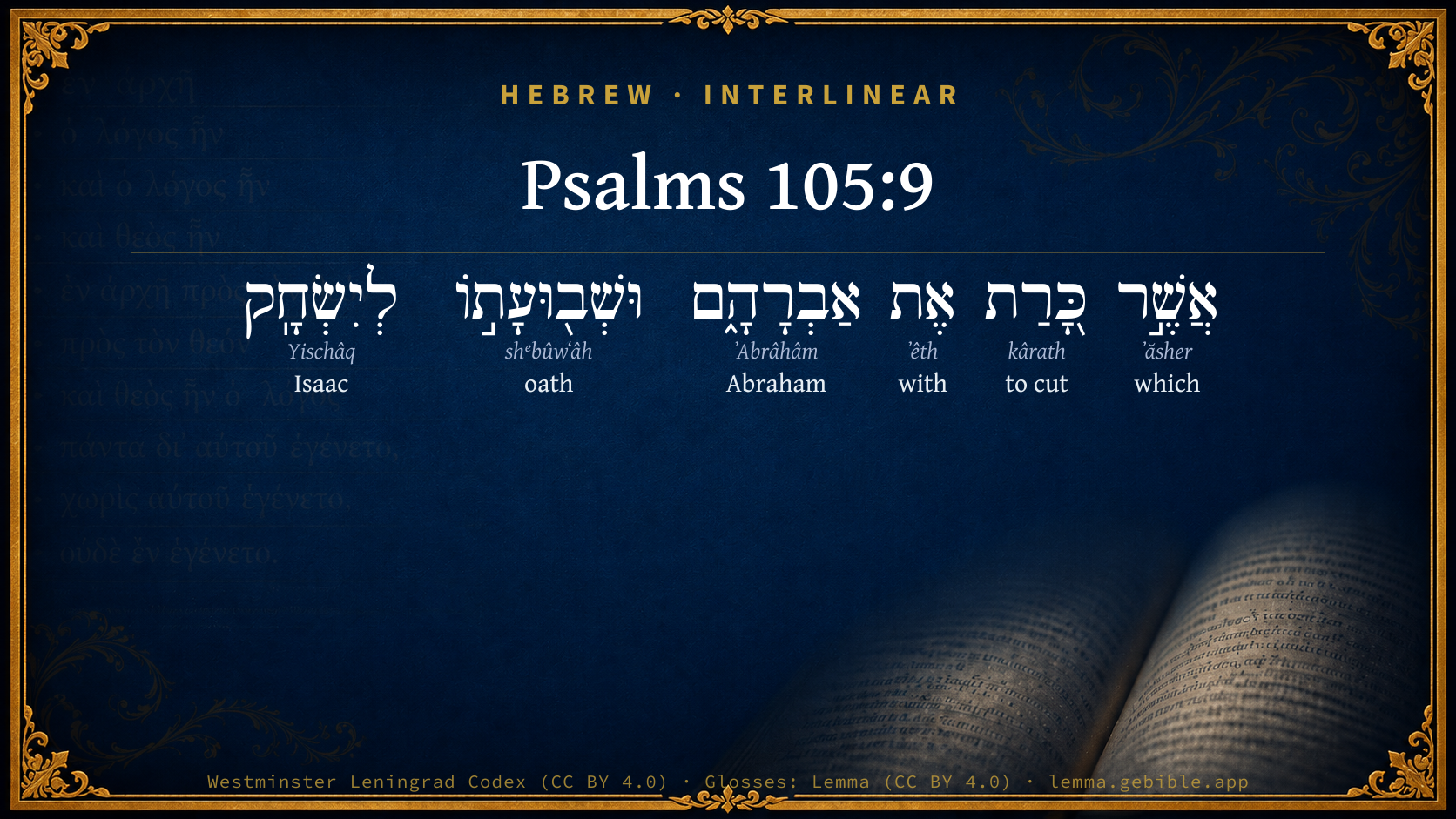
Hebrew (Westminster Leningrad Codex) Psalms 105:9 appears in the Hebrew Old Testament. The text above is from the Westminster Leningrad Codex. Each word links to its Strong’s number, a concise gloss, and parsing drawn from the Open Scriptures Hebrew Bible morphology. Click any word for its full Brown-Driver-Briggs (BDB) entry.
Download image
Cite this verse

Psalms 105:9 (World English Bible). Public Domain. Lemma interlinear Bible study tool, https://lemma.gebible.app/v/psalms/105/9.

Show BibTeX & RIS
BibTeX
RIS
English Translation
The covenant which he made with Abraham, His oath to Isaac,
World English Bible · Public Domain
Highlights
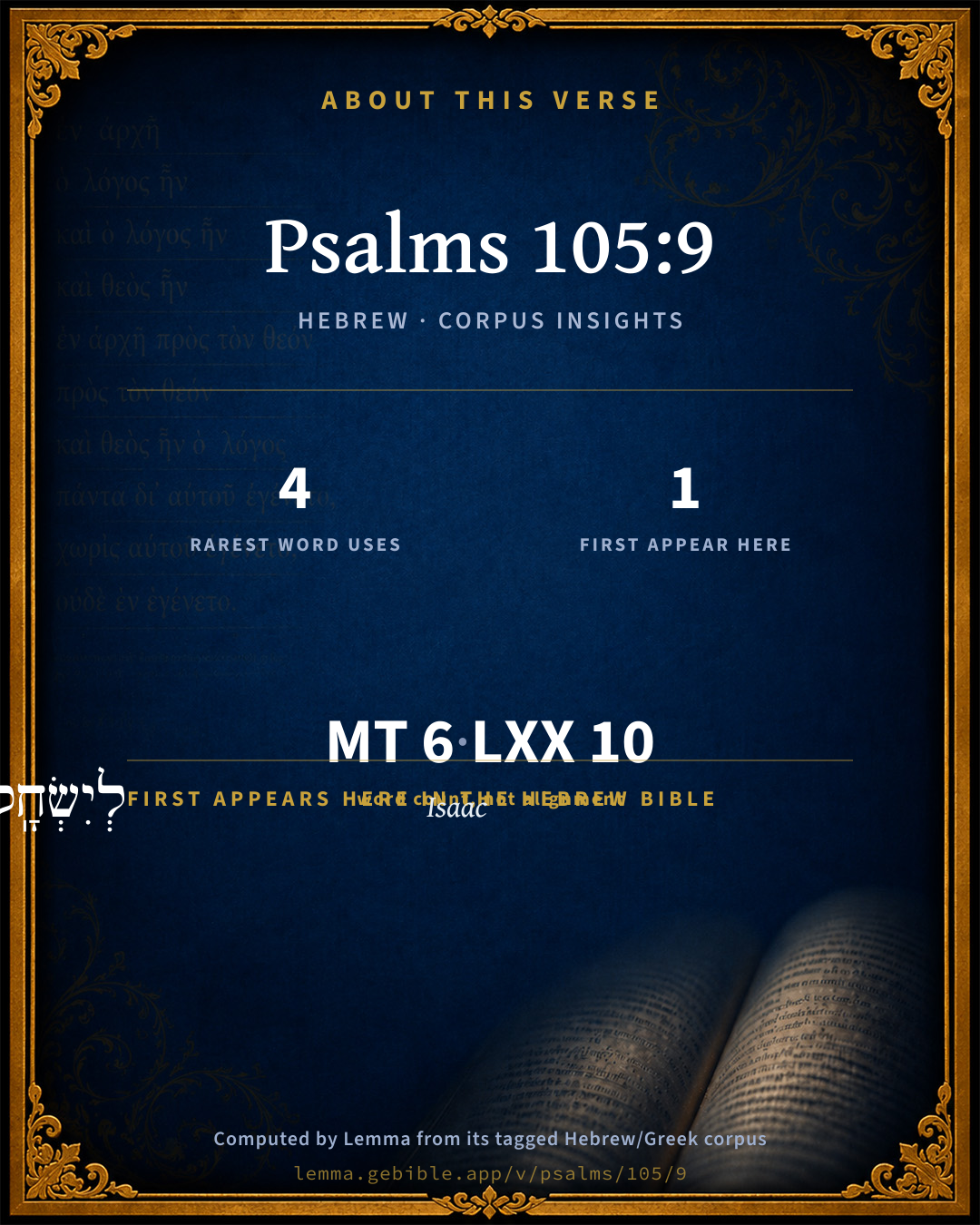
  • 1 first appearance in the Hebrew Bible
Full analysis ↓
Download a study sheet

One document with this verse’s original text, its word-by-word gloss line, the meaning frame, cross-references with their text, attributed commentary, and full source and license credits — printable, and it pastes into notes with its structure intact.

This verse Autodidact and up

Study sheet (.html) Plain text (.txt)

A passage Seminary Student

Up to 50 verses in one chapter. A passage sheet keeps up to 6 commentary sources and 12 cross-references per verse, in the order this page ranks them, and says so on the sheet whenever that leaves anything out. Ask for a single verse and you get the Autodidact verse sheet above.

Everything on this page stays free to read, with no account — the sheet is a download of what is already on screen, not access to it.

Want to remove ads? Support Godless Engineer
Compare translations 3

The same verse in 3 English versions, stacked beneath the original-language interlinear above. Click any original word for its lexicon entry.

Each is an independent rendering of the whole verse — the interlinear is not word-aligned to these translations.

Highlighted words mark where these versions differ — a whole-verse word diff, not a word-by-word alignment.

  • World English Bible Public Domain
    The covenant which he made with Abraham, His oath to Isaac,
  • King James Version Public Domain
    Which covenant he made with Abraham, and his oath unto Isaac;
  • unfoldingWord Literal Text CC BY-SA 4.0
    that he cut with Abraham and his oath to Isaac.

unfoldingWord Literal Text — © unfoldingWord, licensed CC BY-SA 4.0. Word-aligned USFM3 via Door43 (git.door43.org/unfoldingWord/en_ult).

Versions to compare (up to 4)

3 of 4 selected

Show all 18 translations

Every available English version of this verse, each an independent rendering of the whole verse.

  • World English Bible Public Domain
    The covenant which he made with Abraham, His oath to Isaac,
  • Berean Standard Bible Public Domain
    the covenant He made with Abraham, and the oath He swore to Isaac.
  • Majority Standard Bible Public Domain
    the covenant He made with Abraham, and the oath He swore to Isaac.
  • King James Version Public Domain
    Which covenant he made with Abraham, and his oath unto Isaac;
  • American Standard Version (1901) Public Domain
    `The covenant' which he made with Abraham, And his oath unto Isaac,
  • Revised Version (1885) Public Domain
    The covenant which he made with Abraham, and his oath unto Isaac;
  • Geneva Bible (1599) Public Domain
    Euen that which he made with Abraham, and his othe vnto Izhak:
  • Douay-Rheims (1899) Public Domain
    Which he made to Abraham; and his oath to Isaac:
  • Young's Literal Translation Public Domain
    That He hath made with Abraham, And His oath to Isaac,
  • Literal Standard Version CC BY-SA 4.0
    That He has made with Abraham, || And His oath to Isaac,
  • Unlocked Literal Bible CC BY-SA 4.0
    He calls to mind the covenant that he made with Abraham and his oath to Isaac.
  • unfoldingWord Literal Text CC BY-SA 4.0
    that he cut with Abraham and his oath to Isaac.
  • Darby Bible Public Domain
    Which he made with Abraham, and of his oath unto Isaac;
  • World Messianic Bible Public Domain
    the covenant which he made with Abraham, his oath to Isaac,
  • Webster's Bible Public Domain
    Which covenant he made with Abraham, and his oath to Isaac;
  • Free Bible Version CC BY-SA 4.0
    the agreement he made with Abraham, the vow he gave to Isaac.
  • Bible in Basic English Public Domain
    The agreement which he made with Abraham, and his oath to Isaac;
  • JPS Tanakh (1917) Public Domain
    The covenant which He made with Abraham, and His oath unto Isaac;

Literal Standard Version (2020), Covenant Press — licensed CC BY-SA 4.0. Text via the HelloAO Bible API (eBible.org). Unlocked Literal Bible (unfoldingWord) — licensed CC BY-SA 4.0. Text via the HelloAO Bible API (eBible.org). unfoldingWord Literal Text — © unfoldingWord, licensed CC BY-SA 4.0. Word-aligned USFM3 via Door43 (git.door43.org/unfoldingWord/en_ult). Free Bible Version, Dr. Jonathan Gallagher — licensed CC BY-SA 4.0. Text via the HelloAO Bible API (eBible.org).

Word by word

More ways to search: Search by grammar → Find every occurrence → Compare this word →

Practice this passage: Drill this verse → Learn its vocabulary →

About this verse

These counts appear in no published source. They are computed here, from the morphology-tagged text and Lemma’s own curated glosses. What Lemma adds →

6
words
6
distinct lemmas
Wisdom
section

Notable vocabulary

The rarest word here is לְיִשְׂחָֽק Isaac H3446 — appearing just 4 times in the whole Hebrew Bible.

First appearance in Scripture

This word makes its first canonical appearance in the Hebrew Bible here:

  • לְיִשְׂחָֽק Isaac H3446

Shared distinctive vocabulary

לְיִשְׂחָֽק Isaac H3446 occurs in 4 verses of the Hebrew Bible. Also found in:

Grammatical profile

  • 1 verb
  • 3 nouns
  • 1 preposition
  • 1 particle

Verb forms

  • כָּ֭רַת Qal · Perfect

Hebrew & Septuagint length

In English translation the verse runs 11 words from the Hebrew and 15 from the Septuagint (LXX English) — closely comparable.

A rough comparison of the two English renderings, which tokenize alike — not a word-level alignment.

Word counts can differ between the Hebrew and the Greek without any difference in meaning — e.g. the Hebrew direct-object marker אֵת has no separate Greek word, and Greek often adds the article ὁ.

In the original languages it is 6 Hebrew tokens and 10 Greek tokens — but the two are counted differently (Hebrew bundles its prefixes and suffixes into one token; the Greek is in lemma form), so that isn’t a like-for-like length.

Cross-references

10

Topical passages linked to Psalms 105:9 in the Treasury of Scripture Knowledge — connected by theme and wording, ordered by reader-vote popularity; previews shown in the World English Bible.

  • Genesis 17:2 I will make my covenant between me and you, and will multiply you exceedingly."
  • Genesis 22:16–18 and said, "I have sworn by myself, says Yahweh, because you have done this thing, and have not withheld your son, your only son,
  • Genesis 26:3 Sojourn in this land, and I will be with you, and will bless you. For to you, and to your seed, I will give all these lands, and I will establish the oath which I swore to Abraham your father.
  • Hebrews 6:17 In this way God, being determined to show more abundantly to the heirs of the promise the immutability of his counsel, interposed with an oath;
  • Acts 7:8 He gave him the covenant of circumcision. So Abraham became the father of Isaac, and circumcised him the eighth day. Isaac became the father of Jacob, and Jacob became the father of the twelve patriarchs.
  • Galatians 3:17 Now I say this. A covenant confirmed beforehand by God in Christ, the law, which came four hundred thirty years after, does not annul, so as to make the promise of no effect.
  • Genesis 12:7 Yahweh appeared to Abram, and said, "I will give this land to your seed." He built an altar there to Yahweh, who appeared to him.
  • Genesis 28:13 Behold, Yahweh stood above it, and said, "I am Yahweh, the God of Abraham your father, and the God of Isaac. The land whereon you lie, to you will I give it, and to your seed.
  • Genesis 35:11 God said to him, "I am God Almighty. Be fruitful and multiply. A nation and a company of nations will be from you, and kings will come out of your loins.
  • Nehemiah 9:8 and found his heart faithful before you, and made a covenant with him to give the land of the Canaanite, the Hittite, the Amorite, and the Perizzite, and the Jebusite, and the Girgashite, to give it to his seed, and have performed your words; for you are righteous.

Cross-references courtesy of OpenBible.info (CC BY 4.0).

Hebrew and Greek witnesses Masoretic Hebrew ↔ Greek Septuagint

The same verse in the two great witnesses to the Old Testament, shown verse-for-verse.

You’re reading Greek Psalm 104 (Hebrew Psalm 105). The Septuagint counts the superscription, so verse numbers can differ from the Hebrew — chapter-level alignment, not verse-by-verse. Numbering follows Rahlfs.

These are two independent witnesses, not word-aligned to each other, and the Septuagint is shown in lemma (dictionary) form.

Hebrew Psalms 105:9 Masoretic · Westminster Leningrad Codex

אֲשֶׁ֣ר כָּ֭רַת אֶת אַבְרָהָ֑ם וּשְׁב֖וּעָת֣וֹ לְיִשְׂחָֽק

The covenant which he made with Abraham, His oath to Isaac,

World English Bible · Public Domain

Greek LXX Greek Psalm 104:9 Septuagint · lemma form

ὅς διατίθημι ὁ ἀβραάμ καί ὁ ὅρκος αὐτός ὁ ισαακ

which he established as a covenant to Abraam, and he remembered his oath to Isaac.

LXX2012 (modern English Septuagint) · Public Domain

Hebrew: Westminster Leningrad Codex (CC BY 4.0). Greek: Septuagint (public domain); English from LXX2012 (modern English Septuagint) (Public Domain). How the Septuagint differs from the Hebrew →

Commentary

Notes on Psalms 105:9 from classic Christian and Jewish commentators (each source and its license shown beneath its notes). The classic Christian expositions comment on the surrounding passage and are grouped to its opening verse, so a note may address several verses; the Jewish commentaries on the Tanakh (Rashi and others) are per-verse, so they appear only where the commentator wrote on this verse.

Lemma curates 59 commentaries, every one of them public domain or Creative Commons licensed, each selected and text-cleaned for this edition rather than reprinted as found. About our sources →

Trapp's Complete Commentary

John Trapp

Psa 105:9 Which [covenant] he made with Abraham, and his oath unto Isaac;

Ver. 9. Which covenant he made with Abraham, &c.] Whom he found an idolater, Jos 24:2. He justified the ungodly, Rom 4:5.

And his oath] "That by two immutable things," &c., Heb 6:18

John Trapp, A Commentary or Exposition upon All the Books of the Old and New Testament (1647–1656) — public domain. Text from a community e-Sword module.

J. A. Alexander on Psalms

Joseph Addison Alexander

9. (Psa 105:9) Which he ratified with Abraham, and his oath to Isaac. The sentence is continued from the foregoing verse. Ratified, literally cut; see above, on Psa 1:5 (50:5). His oath (which he sware) to Isaac, or, his oath for (the benefit of) Isaac. The distinction, if any be intended, is that the covenant was formally made only with Abraham, and merely sanctioned or confirmed by oath to his successors. See Gen 15:18; Gen 26:3; Gen 28:13. His oath is governed by remembered in ver. 8 (Psa 105:8). Compare Psa 89:27; Psa 89:33).

Joseph Addison Alexander, The Psalms Translated and Explained (1850) — public domain. Text from a community e-Sword module.

Geneva Bible (1599)

Geneva Bible translators

The promise which God made to Abraham to be his God, and the God of his seed after him, he renewed and repeated it again to his seed after him.

Geneva Bible (1599) marginal notes — public domain. Text via Bolls.life.

John Calvin's Commentaries

As Abraham was the first who was called when he was mingled with idolaters, the prophet begins with him. He, however, afterwards declares that the covenant was also confirmed in the hand of his son and his son’s son. God then deposited his covenant with Abraham, and by solemn oath engaged to be the God of his seed. But to give greater assurance of the truth of his promise, he was graciously pleased to renew it to Isaac and Jacob. The effect of such an extension of it is, that his faithfulness takes deeper hold on the hearts of men; and, besides, his grace, when it is thus testified on frequent recurring occasions, becomes better known and more illustrious among men. Accordingly, it is here declared by gradation how steadfast and immovable this covenant is; for what is affirmed concerning each of the patriarchs belongs equally to them all. It is said that God swore to Isaac. But had he not sworn to Abraham before? Undoubtedly he had. It is also said that it was established to Jacob for a law, and for an everlasting covenant Does this mean that the covenant was previously only temporal and transitory, and that then it had changed its nature? Such an idea is altogether at variance with the meaning of the sacred writer. By these different forms of expression he asserts that the covenant was fully and perfectly confirmed, so that, if perhaps the calling was obscure in one man, it might be more evident, by God’s having transmitted the testimony of it to posterity; for by this means the truth of it was the better manifested. Here again we must remember that God with great kindness considers our weakness when, both by his oath, and by frequently repeating his word, he ratifies what he has once promised to us. Our ingratitude then appears the fouler in disbelieving him when he not only speaks but also swears.

John Calvin's Commentaries (1540-1563) — public domain. Text from the Calvin Translation Society English edition (1840s-50s) via the Christian Classics Ethereal Library (ccel.org). Calvin's coverage is partial (roughly two-thirds of the Bible); uncommented books and verses are honest gaps, never fabricated. The 19th-century editor's footnotes and remarks are omitted so the notes are faithfully Calvin's own voice.

Ellicott's Commentary for English Readers

(9) Made.—Literally, cut; the usual word for making a covenant (icere fœdus). The word is therefore here a synonym for “league,” as in Hag_2:5.

A Bible Commentary for English Readers, edited by Charles John Ellicott (1878–1897) — public domain. Text from a community e-Sword module.

The Cambridge Bible for Schools and Colleges

gen. ed. J. J. S. Perowne

9, 10. For the covenant with Abraham see Gen_17:2 ff; Gen_15:18; and cp. the promises, Gen_12:7; Gen_13:14 ff. The oath sworn to Abraham (Gen_22:16) was confirmed to Isaac (Gen_26:3), and to Jacob at Bethel when he was on his way to Paddan-aram (Gen_28:13 ff.), and again in the same place on his return, after his name had been changed to Israel (Psa_35:9 ff.). The promise made to Abraham was renewed to Isaac and Jacob, because in their persons it was limited to a particular branch of Abraham’s descendants.

for a law] For a statute, or, decree, as in Psa_2:7.

The Cambridge Bible for Schools and Colleges (gen. ed. J. J. S. Perowne; Cambridge University Press, 1878–1918) — public domain. Text from a community e-Sword module.

John Gill's Exposition

Which covenant he made with Abraham,.... Or made it known unto him, and showed him his particular interest in it; promised that he would be his God, that he would bless him; and that in his seed, the Messiah, that should spring from him, all nations of the earth should be blessed, Gen 12:2, compare with this Luk 1:72.

And his oath unto Isaac: he made known to Isaac the oath which he swore to Abraham, and promised to perform it, Gen 26:3, or concerning Isaac (a); in whom his seed was to be called, and in whose line from him the Messiah was to come, the grand article of this covenant.

(a) de Isahac, Vatablus.

John Gill's Exposition of the Whole Bible (1746–1763) — public domain (CC PDM 1.0). Text via the HelloAO Bible API.

Albert Barnes' Notes on the Bible

Which covenant he made with Abraham - Which he “ratified” with Abraham. Literally, “which he cut with Abraham.” Gen 17:2-14. Compare the notes at Psa 50:5.

And his oath unto Isaac - Confirming the promise made to Abraham. See Gen 26:2-5.

Albert Barnes' Notes on the Bible (1834–1885) — public domain. Text from a community e-Sword/MySword module.

Matthew Poole's English Annotations

Wherewith he ratified the covenant with Isaac, Gen 26:3.

Matthew Poole's English Annotations on the Holy Bible (1683–1685) — public domain. Text from a community e-Sword/MySword module.

The Treasury of David

Charles H. Spurgeon

Ver. 9. Which covenant he made with Abraham. When the victims were divided and the burning lamp passed between the pieces (Gen. 15.) then the Lord made, or ratified, the covenant with the patriarch. This was a solemn deed, performed not without blood, and the cutting in pieces of the sacrifice; it points us to the greater covenant which in Christ Jesus is signed, sealed, and ratified, that it may stand fast for ever and ever.

And his oath unto Isaac. Isaac did not in vision see the solemn making of the covenant, but the Lord renewed unto him his oath (Ge 26:2-5). This was enough for him, and must have established his faith in the Most High. We have the privilege of seeing in our Lord Jesus both the sacrificial seal, and the eternal oath of God, by which every promise of the covenant is made yea and amen to all the chosen seed.

Ver. 9. The making, swearing, and confirming of the covenant. See our comment on these verses with the passages referred to.

Psalms 105:10*

Charles H. Spurgeon's The Treasury of David (1869–1885) — public domain. Psalms only. Text from a community e-Sword/MySword module.

Whedon's Commentary on the Bible

Daniel D. Whedon

9. Oath—See Gen_22:16; Heb_6:13-18; Deu_29:12

Daniel D. Whedon (gen. ed.), Commentary on the Old and New Testaments (1874–1909) — public domain. Text from a community e-Sword module.

The Pulpit Commentary

Which covenant he made with Abraham. (see Gen_15:18) A promise was given even earlier; (Gen_12:14, Gen_12:15) but it is not spoken of as a "covenant." And his oath unto Isaac . The "oath" was originally sworn to Abraham; (Gen_22:16) but a further promise to "perform the oath" was given to Isaac. (Gen_26:3)

The Pulpit Commentary (1880–1919), ed. H.D.M. Spence-Jones & Joseph S. Exell — public domain. Text from a community e-Sword module.

John Wesley's Explanatory Notes

Oath - Wherewith he ratified the covenant with Isaac, Gen. xxvi, 3.

John Wesley, Explanatory Notes Upon the Whole Bible (1754–1765) — public domain. Text via the GEBible commentary corpus.

unfoldingWord translationNotes

Door43 World Missions Community

He calls to mind

The phrase "call to mind" means to remember something. AT: "he remembers" (See: Idiom)

the covenant that he made with Abraham ... his oath to Isaac

Both of these phrases "the covenant" and "the oath" refer to the same promise that Yahweh made to his people. (See: Parallelism)

his oath to Isaac

The words "that he made" are undestood from the previous phrase. They can be repeated. AT: "his oath that he made to Isaac" or "his oath that he gave to Isaac" (See: Ellipsis)

translationWords

oath

Isaac

confirm

statute

Jacob

Israel

eternity

Canaan

inherit

unfoldingWord translationNotes — © Distant Shores Media and the Door43 World Missions Community, licensed CC BY-SA 4.0. Source: git.door43.org/Door43/en_tn.

Lesson kit

Teaching starters — assembled from the data on this page, not authored interpretation. Every prompt links to the verse data it draws on. Edit before teaching.

Psalms, in the Wisdom, opens this verse with 6 words (6 distinct Hebrew lemmas). Its most distinctive word is Yischâq (“Isaac”). A historical commentator’s framing appears above. Read the whole chapter for the surrounding context.

Discussion questions

  1. The word Yischâq carries the sense “Isaac.” How does it shape the verse?
  2. This is the first place “Isaac” appears in Scripture (first appears here). What does its debut here establish?
  3. How does Jeremiah 33:26, which shares the word «Isaac», read alongside this verse?
  4. These translations render this verse differently; the difference is in the English rendering, not the original. What questions does that raise?
  5. «כָּ֭רַת» is a Qal Perfect verb. How does that grammatical form shape the action described?
  6. Compare how Trapp's Complete Commentary and J. A. Alexander on Psalms read this verse. Where do they agree or differ?

Things to notice

Reading settings

Reading text

Shown beneath each verse's original-language words.

Old Testament
Old Testament edition

Read the OT as the Masoretic Hebrew (MT) or the Greek Septuagint (LXX).

English shown for the Greek Septuagint (in the Hebrew ↔ Greek comparison).

Comparing translations? Open the Compare panel on any verse page to stack up to four side by side.