
2 Chronicles 6:16

Hebrew (Westminster Leningrad Codex) 2 Chronicles 6:16 appears in the Hebrew Old Testament. The text above is from the Westminster Leningrad Codex. Each word links to its Strong’s number, a concise gloss, and parsing drawn from the Open Scriptures Hebrew Bible morphology. Click any word for its full Brown-Driver-Briggs (BDB) entry.
Download image
Cite this verse

2 Chronicles 6:16 (World English Bible). Public Domain. Lemma interlinear Bible study tool, https://lemma.gebible.app/v/2-chronicles/6/16.

Show BibTeX & RIS
BibTeX
RIS
English Translation
Now therefore, Yahweh, the God of Israel, keep with your servant David my father that which you have promised him, saying, There shall not fail you a man in my sight to sit on the throne of Israel, if only your children take heed to their way, to walk in my law as you have walked before me.
World English Bible · Public Domain
Download a study sheet

One document with this verse’s original text, its word-by-word gloss line, the meaning frame, cross-references with their text, attributed commentary, and full source and license credits — printable, and it pastes into notes with its structure intact.

This verse Autodidact and up

Study sheet (.html) Plain text (.txt)

A passage Seminary Student

Up to 50 verses in one chapter. A passage sheet keeps up to 6 commentary sources and 12 cross-references per verse, in the order this page ranks them, and says so on the sheet whenever that leaves anything out. Ask for a single verse and you get the Autodidact verse sheet above.

Everything on this page stays free to read, with no account — the sheet is a download of what is already on screen, not access to it.

Want to remove ads? Support Godless Engineer
Compare translations 3

The same verse in 3 English versions, stacked beneath the original-language interlinear above. Click any original word for its lexicon entry.

Each is an independent rendering of the whole verse — the interlinear is not word-aligned to these translations.

Highlighted words mark where these versions differ — a whole-verse word diff, not a word-by-word alignment.

  • World English Bible Public Domain
    Now therefore, Yahweh, the God of Israel, keep with your servant David my father that which you have promised him, saying, There shall not fail you a man in my sight to sit on the throne of Israel, if only your children take heed to their way, to walk in my law as you have walked before me.
  • King James Version Public Domain
    Now therefore, O LORD God of Israel, keep with thy servant David my father that which thou hast promised him, saying, There shall not fail thee a man in my sight to sit upon the throne of Israel; yet so that thy children take heed to their way to walk in my law, as thou hast walked before me.
  • unfoldingWord Literal Text CC BY-SA 4.0
    And now, Yahweh, God of Israel, keep for your servant David my father that which you spoke to him saying, ‘There will not be cut off for you a man from before me, sitting on the throne of Israel, only if your sons keep their ways to walk in my law, just as you walked before me.’

unfoldingWord Literal Text — © unfoldingWord, licensed CC BY-SA 4.0. Word-aligned USFM3 via Door43 (git.door43.org/unfoldingWord/en_ult).

Versions to compare (up to 4)

3 of 4 selected

Show all 18 translations

Every available English version of this verse, each an independent rendering of the whole verse.

  • World English Bible Public Domain
    Now therefore, Yahweh, the God of Israel, keep with your servant David my father that which you have promised him, saying, There shall not fail you a man in my sight to sit on the throne of Israel, if only your children take heed to their way, to walk in my law as you have walked before me.
  • Berean Standard Bible Public Domain
    Therefore now, O LORD, God of Israel, keep for Your servant, my father David, what You promised when You said: ‘You will never fail to have a man to sit before Me on the throne of Israel, if only your descendants guard their way to walk in My law as you have walked before Me.’
  • Majority Standard Bible Public Domain
    Therefore now, O LORD, God of Israel, keep for Your servant, my father David, what You promised when You said: ‘You will never fail to have a man to sit before Me on the throne of Israel, if only your descendants guard their way to walk in My law as you have walked before Me.’
  • King James Version Public Domain
    Now therefore, O LORD God of Israel, keep with thy servant David my father that which thou hast promised him, saying, There shall not fail thee a man in my sight to sit upon the throne of Israel; yet so that thy children take heed to their way to walk in my law, as thou hast walked before me.
  • American Standard Version (1901) Public Domain
    Now therefore, O Jehovah, the God of Israel, keep with thy servant David my father that which thou hast promised him, saying, There shall not fail thee a man in my sight to sit on the throne of Israel, if only thy children take heed to their way, to walk in my law as thou hast walked before me.
  • Revised Version (1885) Public Domain
    Now therefore, O LORD, the God of Israel, keep with thy servant David my father that which thou hast promised him, saying, There shall not fail thee a man in my sight to sit on the throne of Israel; if only thy children take heed to their way, to walk in my law as thou hast walked before me.
  • Geneva Bible (1599) Public Domain
    Therefore now Lord God of Israel, keepe with thy seruant Dauid my father, that thou hast promised him, saying, Thou shalt not want a man in my sight, that shall sit vpon the throne of Israel: so that thy sonnes take heede to their wayes, to walke in my Lawe, as thou hast walked before me.
  • Douay-Rheims (1899) Public Domain
    Now then, O Lord God of Israel, fulfil to thy servant David my father, whatsoever thou hast promised him, saying: There shall not fail thee a man in my sight, to sit upon the throne of Israel: yet so that thy children take heed to their ways, and walk in my law, as thou hast walked before me.
  • Young's Literal Translation Public Domain
    `And now, O Jehovah, God of Israel, keep for Thy servant David my father that which Thou didst speak to him, saying, There is not cut off to thee a man from before Me, sitting on the throne of Israel, only, if thy sons watch their way to walk in My law, as thou hast walked before Me.
  • Literal Standard Version CC BY-SA 4.0
    And now, O YHWH, God of Israel, keep for Your servant, my father David, that which You spoke to him, saying, A man of yours is never cut off from before My face, sitting on the throne of Israel—only, if your sons watch their way to walk in My law, as you have walked before Me.
  • Unlocked Literal Bible CC BY-SA 4.0
    Now then, Yahweh, God of Israel, carry out what you have promised to your servant David my father, when you said, 'You will not fail to have a man in my sight to sit on the throne of Israel, if only your descendants are careful to walk in my law, as you have walked before me.'
  • unfoldingWord Literal Text CC BY-SA 4.0
    And now, Yahweh, God of Israel, keep for your servant David my father that which you spoke to him saying, ‘There will not be cut off for you a man from before me, sitting on the throne of Israel, only if your sons keep their ways to walk in my law, just as you walked before me.’
  • Darby Bible Public Domain
    And now, Jehovah, God of Israel, keep with thy servant David my father that which thou hast promised him saying, There shall not fail thee a man in my sight to sit on the throne of Israel, if only thy sons take heed to their way to walk in my law, as thou hast walked before me.
  • World Messianic Bible Public Domain
    “Now therefore, LORD, the God of Israel, keep with your servant David my father that which you have promised him, saying, ‘There shall not fail you a man in my sight to sit on the throne of Israel, if only your children take heed to their way, to walk in my law as you have walked before me.’
  • Webster's Bible Public Domain
    Now therefore, O LORD God of Israel, keep with thy servant David my father that which thou hast promised him, saying, There shall not fail thee a man in my sight to sit upon the throne of Israel; provided thy children take heed to their way to walk in my law, as thou hast walked before me.
  • Free Bible Version CC BY-SA 4.0
    So now, Lord God of Israel, please keep the promise you made to your servant David, my father, when you told him, ‘If your descendants pay close attention to follow my way, and to keep my law as you have done, you will never fail to have one of them to sit on the throne of Israel.’
  • Bible in Basic English Public Domain
    So now, O Lord, the God of Israel, let your word to your servant David, my father, come true, when you said, You will never be without a man to take his place before me on the seat of the kingdom of Israel; if only your children give attention to their ways, walking in my law, as you have done before me.
  • JPS Tanakh (1917) Public Domain
    Now therefore, O LORD, the God of Israel, keep with Thy servant David my father that which Thou hast promised him, saying: There shall not fail thee a man in My sight to sit on the throne of Israel; if only thy children take heed to their way, to walk in My law as thou hast walked before Me.

Literal Standard Version (2020), Covenant Press — licensed CC BY-SA 4.0. Text via the HelloAO Bible API (eBible.org). Unlocked Literal Bible (unfoldingWord) — licensed CC BY-SA 4.0. Text via the HelloAO Bible API (eBible.org). unfoldingWord Literal Text — © unfoldingWord, licensed CC BY-SA 4.0. Word-aligned USFM3 via Door43 (git.door43.org/unfoldingWord/en_ult). Free Bible Version, Dr. Jonathan Gallagher — licensed CC BY-SA 4.0. Text via the HelloAO Bible API (eBible.org).

Word by word

More ways to search: Search by grammar → Find every occurrence → Compare this word →

Practice this passage: Drill this verse → Learn its vocabulary →

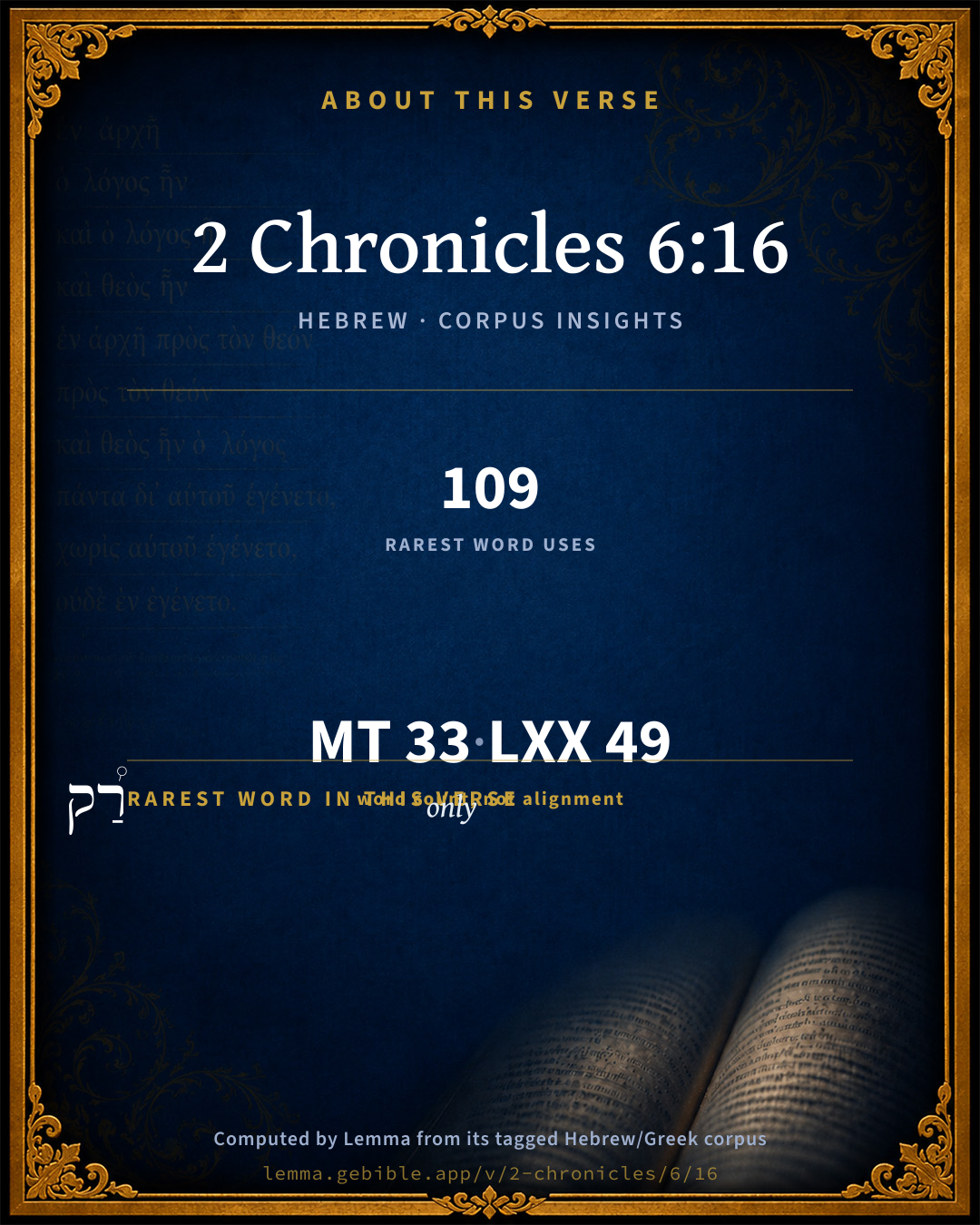
רַ֠ק
raq
H7535
“only”
Particle, Accusative
Part of Speech
Particle
Type
Accusative
Full BDB Definition

Origin: the same as H7534 as a noun

TWOT: 2218a

only, altogether, surely - only - only, nought but, altogether (in limitation) - save, except (after a negative) - only, altogether, surely (with an affirmative) - if only, provided only (prefixed for emphasis) - only, exclusively (for emphasis)
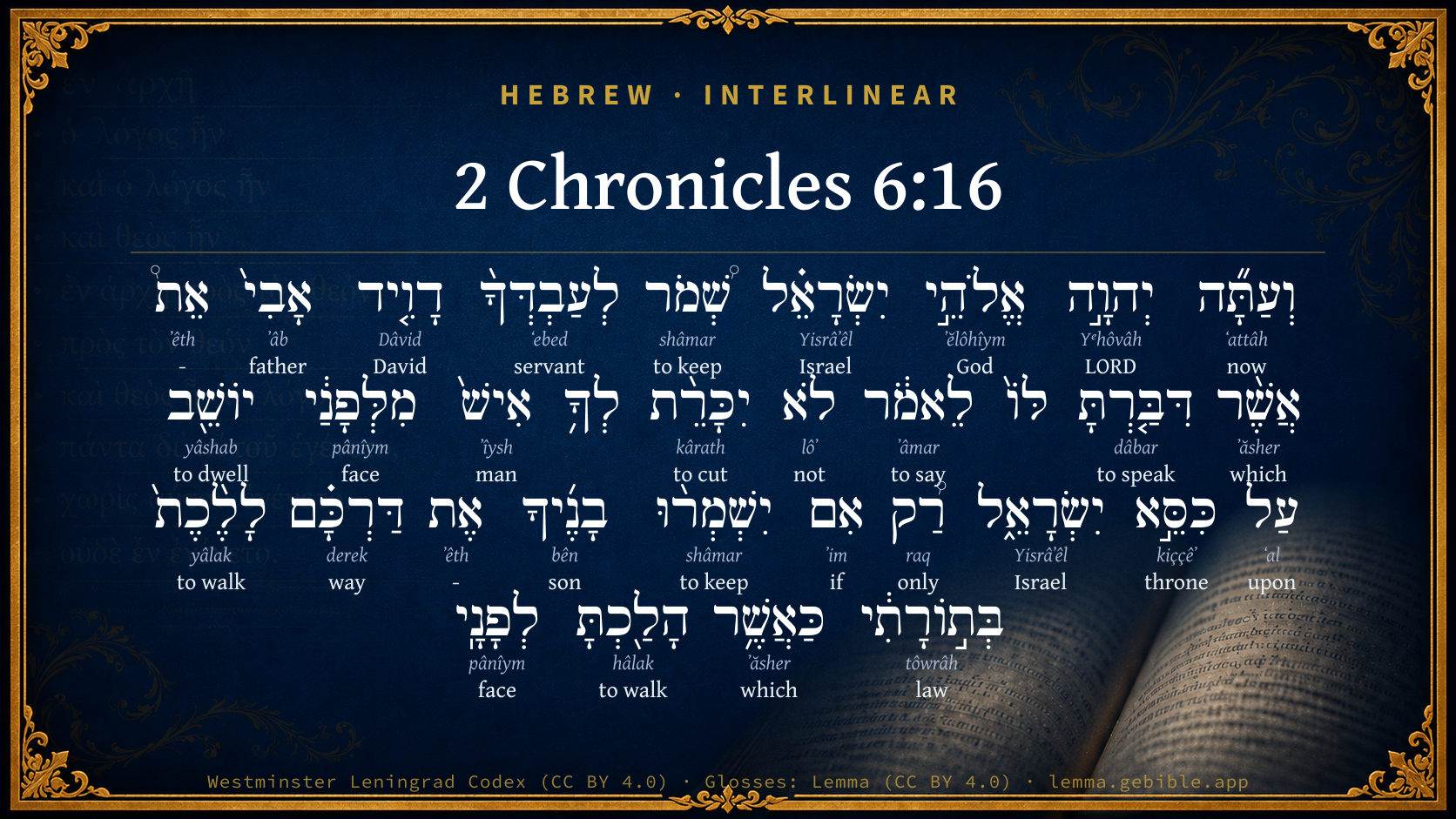
  1. וְעַתָּ֞ה ʻattâh H6258 “and · now” Conjunction + Adverb
  2. יְהוָ֣ה Yᵉhôvâh H3068 “LORD” Noun, Proper
  3. אֱלֹהֵ֣י ʼĕlôhîym H430 “God(s) of” Noun, Common, Masculine, Plural, Construct
  4. יִשְׂרָאֵ֗ל Yisrâʼêl H3478 “Israel” Noun, Proper
  5. שְׁ֠מֹר shâmar H8104 “keep” Verb, Qal, Imperative, 2nd Person, Masculine, Singular
  6. לְעַבְדְּךָ֨ ʻebed H5650 “to/for · servant · your” Preposition + Noun, Common, Masculine, Singular, Construct + Suffix, Personal, 2nd Person, Masculine, Singular
  7. דָוִ֤יד Dâvid H1732 “David” Noun, Proper
  8. אָבִי֙ ʼâb H1 “father · my” Noun, Common, Masculine, Singular, Construct + Suffix, Personal, 1st Person, Common, Singular
  9. אֵת֩ ʼêth H853 “-” Particle, Direct Object
  10. אֲשֶׁ֨ר ʼăsher H834 “which” Particle, Relative
  11. דִּבַּ֤רְתָּ dâbar H1696 “to speak” Verb, Piel, Perfect, 2nd Person, Masculine, Singular
  12. לֵאמֹ֔ר ʼâmar H559 “to say” Preposition + Verb, Qal, Infinitive Construct
  13. לֹא lôʼ H3808 “not” Particle, Negative
  14. יִכָּרֵ֨ת kârath H3772 “to cut” Verb, Niphal, Imperfect, 3rd Person, Masculine, Singular
  15. אִישׁ֙ ʼîysh H376 “man” Noun, Common, Masculine, Singular, Absolute
  16. מִלְּפָנַ֔י pânîym H6440 “from · to/for · face(s) · my” Preposition + Preposition + Noun, Common, Both, Plural, Construct + Suffix, Personal, 1st Person, Common, Singular
  17. יוֹשֵׁ֖ב yâshab H3427 “dwelling” Verb, Qal, Participle Active, Masculine, Singular, Absolute
  18. עַל ʻal H5921 “upon” Preposition
  19. כִּסֵּ֣א kiççêʼ H3678 “throne of” Noun, Common, Masculine, Singular, Construct
  20. יִשְׂרָאֵ֑ל Yisrâʼêl H3478 “Israel” Noun, Proper
  21. אִם ʼim H518 “if” Conjunction
  22. יִשְׁמְר֨וּ shâmar H8104 “to keep” Verb, Qal, Imperfect, 3rd Person, Masculine, Plural
  23. בָנֶ֜יךָ bên H1121 “sons · your” Noun, Common, Masculine, Plural, Construct + Suffix, Personal, 2nd Person, Masculine, Singular
  24. אֶת ʼêth H853 “-” Particle, Direct Object
  25. דַּרְכָּ֗ם derek H1870 “way · their” Noun, Common, Both, Singular, Construct + Suffix, Personal, 3rd Person, Masculine, Plural
  26. לָלֶ֨כֶת֙ yâlak H3212 “to walk” Preposition + Verb, Qal, Infinitive Construct
  27. בְּת֣וֹרָתִ֔י tôwrâh H8451 “in/at · law · my” Preposition + Noun, Common, Feminine, Singular, Construct + Suffix, Personal, 1st Person, Common, Singular
  28. כַּאֲשֶׁ֥ר ʼăsher H834 “like/as · which” Preposition + Particle, Relative
  29. הָלַ֖כְתָּ hâlak H1980 “to walk” Verb, Qal, Perfect, 2nd Person, Masculine, Singular
  30. לְפָנָֽי pânîym H6440 “to/for · face(s) · my” Preposition + Noun, Common, Both, Plural, Construct + Suffix, Personal, 1st Person, Common, Singular

About this verse

These counts appear in no published source. They are computed here, from the morphology-tagged text and Lemma’s own curated glosses. What Lemma adds →

33
words
26
distinct lemmas
Historical
section

Grammatical profile

  • 8 verbs
  • 14 nouns
  • 3 prepositions
  • 1 conjunction
  • 1 adverb
  • 6 particles

Verb forms

  • שְׁ֠מֹר Qal · Imperative
  • דִּבַּ֤רְתָּ Piel · Perfect
  • לֵאמֹ֔ר Qal · Infinitive Construct
  • יִכָּרֵ֨ת Niphal · Imperfect
  • יוֹשֵׁ֖ב Qal · Participle Active
  • יִשְׁמְר֨וּ Qal · Imperfect
  • לָלֶ֨כֶת֙ Qal · Infinitive Construct
  • הָלַ֖כְתָּ Qal · Perfect

Repetition

Words recur within this verse — often emphatic in Hebrew:

  • יִשְׂרָאֵ֗ל Israel H3478 ×2
  • שְׁ֠מֹר to keep H8104 ×2
  • מִלְּפָנַ֔י face H6440 ×2
  • אֲשֶׁ֨ר which H834 ×2

Hebrew & Septuagint length

In English translation the verse runs 58 words from the Hebrew and 57 from the Septuagint (LXX English) — closely comparable.

A rough comparison of the two English renderings, which tokenize alike — not a word-level alignment.

Word counts can differ between the Hebrew and the Greek without any difference in meaning — e.g. the Hebrew direct-object marker אֵת has no separate Greek word, and Greek often adds the article ὁ.

In the original languages it is 33 Hebrew tokens and 49 Greek tokens — but the two are counted differently (Hebrew bundles its prefixes and suffixes into one token; the Greek is in lemma form), so that isn’t a like-for-like length.

Cross-references

7

Topical passages linked to 2 Chronicles 6:16 in the Treasury of Scripture Knowledge — connected by theme and wording, ordered by reader-vote popularity; previews shown in the World English Bible.

  • 1 Kings 2:4 That Yahweh may establish his word which he spoke concerning me, saying, If your children take heed to their way, to walk before me in truth with all their heart and with all their soul, there shall not fail you (said he) a man on the throne of Israel.
  • 2 Chronicles 7:18 then I will establish the throne of your kingdom, according as I covenanted with David your father, saying, There shall not fail you a man to be ruler in Israel.
  • Psalms 132:12 If your children will keep my covenant, My testimony that I will teach them, Their children also will sit on your throne forevermore."
  • John 15:14–15 You are my friends, if you do whatever I command you.
  • 2 Samuel 7:12–16 When your days are fulfilled, and you shall sleep with your fathers, I will set up your seed after you, who shall proceed out of your bowels, and I will establish his kingdom.
  • Psalms 119:1 Blessed are those whose ways are blameless, Who walk according to Yahweh's law.
  • Ezekiel 36:37 Thus says the Lord Yahweh: For this, moreover, will I be inquired of by the house of Israel, to do it for them: I will increase them with men like a flock.

Cross-references courtesy of OpenBible.info (CC BY 4.0).

Hebrew and Greek witnesses Masoretic Hebrew ↔ Greek Septuagint

The same verse in the two great witnesses to the Old Testament, shown verse-for-verse.

These are two independent witnesses, not word-aligned to each other, and the Septuagint is shown in lemma (dictionary) form.

Hebrew 2 Chronicles 6:16 Masoretic · Westminster Leningrad Codex

וְעַתָּ֞ה יְהוָ֣ה אֱלֹהֵ֣י יִשְׂרָאֵ֗ל שְׁ֠מֹר לְעַבְדְּךָ֨ דָוִ֤יד אָבִי֙ אֵת֩ אֲשֶׁ֨ר דִּבַּ֤רְתָּ לּוֹ֙ לֵאמֹ֔ר לֹא יִכָּרֵ֨ת לְךָ֥ אִישׁ֙ מִלְּפָנַ֔י יוֹשֵׁ֖ב עַל כִּסֵּ֣א יִשְׂרָאֵ֑ל רַ֠ק אִם יִשְׁמְר֨וּ בָנֶ֜יךָ אֶת דַּרְכָּ֗ם לָלֶ֨כֶת֙ בְּת֣וֹרָתִ֔י כַּאֲשֶׁ֥ר הָלַ֖כְתָּ לְפָנָֽי

Now therefore, Yahweh, the God of Israel, keep with your servant David my father that which you have promised him, saying, There shall not fail you a man in my sight to sit on the throne of Israel, if only your children take heed to their way, to walk in my law as you have walked before me.

World English Bible · Public Domain

Greek LXX 2 Chronicles 6:16 Septuagint · lemma form

καί νῦν κύριος ὁ θεός ἰσραήλ φυλάσσω ὁ παῖς σύ ὁ δαυίδ ὁ πατήρ ἐγώ ὅς λαλέω αὐτός λέγω οὐ ἐκλείπω σύ ἀνήρ ἀπό πρόσωπον ἐγώ καταἧμαι ἐπί θρόνος ἰσραήλ πλήν ἐάν φυλάσσω ὁ υἱός σύ ὁ ὁδός αὐτός ὁ πορεύομαι ἐν ὁ νόμος ἐγώ ὡς πορεύομαι ἐναντίον ἐγώ

and now, Lord God of Israel, keep with your servant David my father the things which you spoke to him, saying, There shall not fail you a man before me sitting on the throne of Israel, if only your sons will take heed to their way to walk in my law, as you did walk before me.

LXX2012 (modern English Septuagint) · Public Domain

On this verse, Ellicott's Commentary for English Readers discusses the Septuagint’s reading. Read the note in Commentary ↓

Hebrew: Westminster Leningrad Codex (CC BY 4.0). Greek: Septuagint (public domain); English from LXX2012 (modern English Septuagint) (Public Domain). How the Septuagint differs from the Hebrew →

Commentary

Notes on 2 Chronicles 6:16 from classic Christian and Jewish commentators (each source and its license shown beneath its notes). The classic Christian expositions comment on the surrounding passage and are grouped to its opening verse, so a note may address several verses; the Jewish commentaries on the Tanakh (Rashi and others) are per-verse, so they appear only where the commentator wrote on this verse.

Lemma curates 59 commentaries, every one of them public domain or Creative Commons licensed, each selected and text-cleaned for this edition rather than reprinted as found. About our sources →

Geneva Bible (1599)

Geneva Bible translators

Hebrew, a man shall not be cut off.

Geneva Bible (1599) marginal notes — public domain. Text via Bolls.life.

Ellicott's Commentary for English Readers

(16) Now therefore.—And now. So in 2Ch_6:17.

Keep that which thou hast promised—i.e., Thy further promise. See the fulfilment of the former promise, as described in 2Ch_6:10, supr.

There shall not fail thee.—See margin. Authorised Version follows LXX., Οὐκ ἐκλείψει σοι; and Vulg., “non deficiet ex te.”

To sit.—Heb., sitting; LXX., καθήμενος.

Yet so that.—Only if; assigning a single condition; provided that. . . . LXX., πλὴν ἐὰν φυλάξωσιν; Vulg., “ita tamen si custodierint.”

Take heed to.—Heb., keep (2Ch_6:14-16).

In my law.—The only variant from 1Ki_8:25. The chronicler has avoided a seeming tautology, as elsewhere. Syriac, “before me in the Law.”

A Bible Commentary for English Readers, edited by Charles John Ellicott (1878–1897) — public domain. Text from a community e-Sword module.

The Cambridge Bible for Schools and Colleges

gen. ed. J. J. S. Perowne

16. yet so that] R.V. if only.

walk in my law] In 1Ki_8:25, walk before me. The Chronicler characteristically introduces a reference to the Law of the Lord (the tôrah). In Samuel and Kings neither David nor Solomon ever mentions this.

The Cambridge Bible for Schools and Colleges (gen. ed. J. J. S. Perowne; Cambridge University Press, 1878–1918) — public domain. Text from a community e-Sword module.

The Pulpit Commentary

There shall not fail thee, etc. (so 2Sa_7:12; 1Ki_2:4 1Ki_6:12) Yet so that thy children, etc.. (so Psa_132:12)

The Pulpit Commentary (1880–1919), ed. H.D.M. Spence-Jones & Joseph S. Exell — public domain. Text from a community e-Sword module.

unfoldingWord translationNotes

Door43 World Missions Community

Connecting Statement:

King Solomon continues praying.

carry out what you have promised

This is a request. To carry out what one has said is an idiom meaning to do what one has said. AT: "please do what you have promised" (See: Idiom)

You will not fail to have a man

God speaking in terms of David having a man implies that the man would be a descendant of David. This can be stated positively. AT: "you will always have a descendant" (See: Assumed Knowledge and Implicit Information and Double Negatives)

a man in my sight to sit on the throne of Israel

The phrase "in my sight" here implies that God would choose the man and the man would want to obey God. (See: Assumed Knowledge and Implicit Information)

to sit on the throne of Israel

The throne is a metonym for the activity of the one who sits on the throne. AT: "to rule over Israel" (See: Metonymy)

to walk in my law, as you have walked before me

The way a person behaves is spoken of as if that person were walking on a path. AT: "to obey my law, as you have obeyed me" or "to be faithful to my law as you have been faithful to me" (See: Metaphor)

let your word be confirmed, which you have spoken to your servant David

"I want you to make come true the word that you have spoken to your servant David"

let your word be confirmed

This can be translated in active form. AT: "confirm your word" or "make your word come true"

your word

"your promise"

translationWords

Israel

descend

law

pray

true

unfoldingWord translationNotes — © Distant Shores Media and the Door43 World Missions Community, licensed CC BY-SA 4.0. Source: git.door43.org/Door43/en_tn.

Lesson kit

Teaching starters — assembled from the data on this page, not authored interpretation. Every prompt links to the verse data it draws on. Edit before teaching.

2 Chronicles, in the Historical, opens this verse with 33 words (26 distinct Hebrew lemmas). Its most distinctive word is raq (“only”). A historical commentator’s framing appears above. Read the whole chapter for the surrounding context.

Discussion questions

  1. The word raq carries the sense “only.” How does it shape the verse?
  2. How does 1 Kings 2:4, which shares this passage’s theme, read alongside this verse?
  3. What does the repetition of “Israel” (2× in this one verse) do in this verse?
  4. The translations on this page render this verse differently — a whole-verse word diff, not a word-by-word alignment. What might account for the different wordings?
  5. «שְׁ֠מֹר» is a Qal Imperative verb. How does that grammatical form shape the action described?
  6. Compare how Geneva Bible (1599) and Ellicott's Commentary for English Readers read this verse. Where do they agree or differ?

Things to notice

Reading settings

Reading text

Shown beneath each verse's original-language words.

Old Testament
Old Testament edition

Read the OT as the Masoretic Hebrew (MT) or the Greek Septuagint (LXX).

English shown for the Greek Septuagint (in the Hebrew ↔ Greek comparison).

Comparing translations? Open the Compare panel on any verse page to stack up to four side by side.