
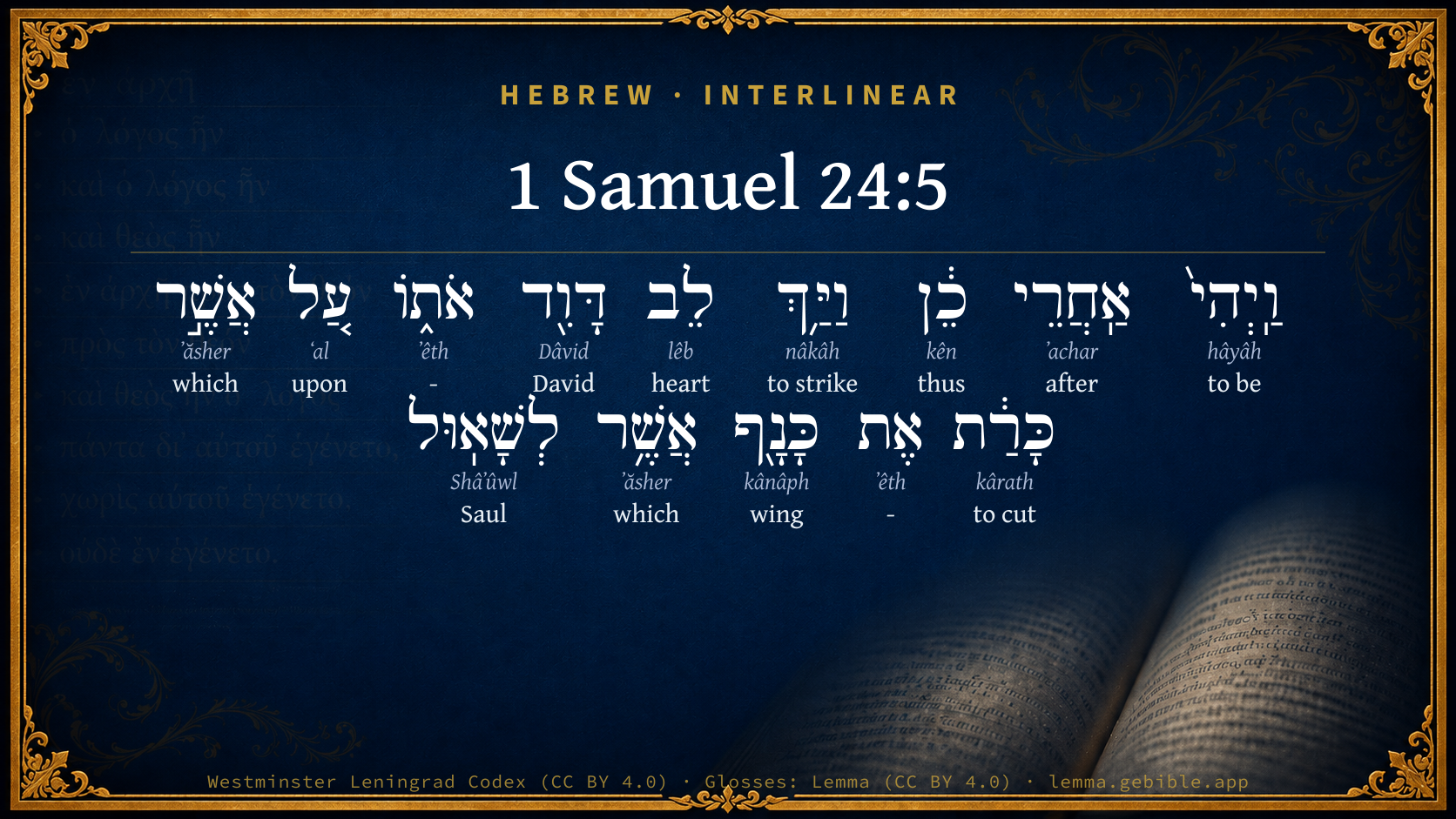
1 Samuel 24:5

Hebrew (Westminster Leningrad Codex) 1 Samuel 24:5 appears in the Hebrew Old Testament. The text above is from the Westminster Leningrad Codex. Each word links to its Strong’s number, a concise gloss, and parsing drawn from the Open Scriptures Hebrew Bible morphology. Click any word for its full Brown-Driver-Briggs (BDB) entry.
Download image
Cite this verse

1 Samuel 24:5 (World English Bible). Public Domain. Lemma interlinear Bible study tool, https://lemma.gebible.app/v/1-samuel/24/5.

Show BibTeX & RIS
BibTeX
RIS
English Translation
It happened afterward, that David's heart struck him, because he had cut off Saul's skirt.
World English Bible · Public Domain
Download a study sheet

One document with this verse’s original text, its word-by-word gloss line, the meaning frame, cross-references with their text, attributed commentary, and full source and license credits — printable, and it pastes into notes with its structure intact.

This verse Autodidact and up

Study sheet (.html) Plain text (.txt)

A passage Seminary Student

Up to 50 verses in one chapter. A passage sheet keeps up to 6 commentary sources and 12 cross-references per verse, in the order this page ranks them, and says so on the sheet whenever that leaves anything out. Ask for a single verse and you get the Autodidact verse sheet above.

Everything on this page stays free to read, with no account — the sheet is a download of what is already on screen, not access to it.

Want to remove ads? Support Godless Engineer
Compare translations 3

The same verse in 3 English versions, stacked beneath the original-language interlinear above. Click any original word for its lexicon entry.

Each is an independent rendering of the whole verse — the interlinear is not word-aligned to these translations.

Highlighted words mark where these versions differ — a whole-verse word diff, not a word-by-word alignment.

  • World English Bible Public Domain
    It happened afterward, that David's heart struck him, because he had cut off Saul's skirt.
  • King James Version Public Domain
    And it came to pass afterward, that David's heart smote him, because he had cut off Saul's skirt.
  • unfoldingWord Literal Text CC BY-SA 4.0
    And it happened after this that the heart of David struck him because he had cut off the edge that to Saul.

unfoldingWord Literal Text — © unfoldingWord, licensed CC BY-SA 4.0. Word-aligned USFM3 via Door43 (git.door43.org/unfoldingWord/en_ult).

Versions to compare (up to 4)

3 of 4 selected

Show all 18 translations

Every available English version of this verse, each an independent rendering of the whole verse.

  • World English Bible Public Domain
    It happened afterward, that David's heart struck him, because he had cut off Saul's skirt.
  • Berean Standard Bible Public Domain
    Afterward, David’s conscience was stricken because he had cut off the corner of Saul’s robe.
  • Majority Standard Bible Public Domain
    Afterward, David’s conscience was stricken because he had cut off the corner of Saul’s robe.
  • King James Version Public Domain
    And it came to pass afterward, that David's heart smote him, because he had cut off Saul's skirt.
  • American Standard Version (1901) Public Domain
    And it came to pass afterward, that David's heart smote him, because he had cut off Saul's skirt.
  • Revised Version (1885) Public Domain
    And it came to pass afterward, that David’s heart smote him because he had cut off Saul’s skirt.
  • Geneva Bible (1599) Public Domain
    And the men of Dauid said vnto him, See, the day is come, whereof the Lord sayde vnto thee, Beholde, I will deliuer thine enemie into thine hande, and thou shalt doe to him as it shall seeme good to thee. Then Dauid arose and cut off the lap of Sauls garment priuily.
  • Douay-Rheims (1899) Public Domain
    And the servants of David said to him: Behold the day, of which the Lord said to thee: I will deliver thy enemy unto thee, that thou mayest do to him as it shall seem good in thy eyes. Then David arose, and secretly cut off the hem of Saul's robe.
  • Young's Literal Translation Public Domain
    And it cometh to pass afterwards that the heart of David smiteth him, because that he hath cut off the skirt which `is' on Saul,
  • Literal Standard Version CC BY-SA 4.0
    And it comes to pass afterward that the heart of David strikes him, because that he has cut off the skirt which [is] on Saul,
  • Unlocked Literal Bible CC BY-SA 4.0
    Afterward David's heart afflicted him because he had cut a corner off Saul's robe.
  • unfoldingWord Literal Text CC BY-SA 4.0
    And it happened after this that the heart of David struck him because he had cut off the edge that to Saul.
  • Darby Bible Public Domain
    And it came to pass afterwards that David's heart smote him, because he had cut off Saul's skirt.
  • World Messianic Bible Public Domain
    Afterward, David’s heart struck him because he had cut off Saul’s skirt.
  • Webster's Bible Public Domain
    \\24:4\\And the men of David said to him, Behold the day of which the LORD said to thee, Behold, I will deliver thy enemy into thy hand, that thou mayest do to him as it shall seem good to thee. Then David arose, and privately cut off the skirt of Saul's robe.
  • Free Bible Version CC BY-SA 4.0
    But afterwards David felt really bad because he'd cut off a piece of Saul's robe.
  • Bible in Basic English Public Domain
    And David's men said to him, Now is the time when the Lord says to you, I will give up your hater into your hands to do with him whatever seems good to you. Then David, getting up, took the skirt of Saul's robe in his hand, cutting off the end of it without his knowledge.
  • JPS Tanakh (1917) Public Domain
    (24-6) And it came to pass afterward, that David's heart smote him, because he had cut off Saul's skirt.

Literal Standard Version (2020), Covenant Press — licensed CC BY-SA 4.0. Text via the HelloAO Bible API (eBible.org). Unlocked Literal Bible (unfoldingWord) — licensed CC BY-SA 4.0. Text via the HelloAO Bible API (eBible.org). unfoldingWord Literal Text — © unfoldingWord, licensed CC BY-SA 4.0. Word-aligned USFM3 via Door43 (git.door43.org/unfoldingWord/en_ult). Free Bible Version, Dr. Jonathan Gallagher — licensed CC BY-SA 4.0. Text via the HelloAO Bible API (eBible.org).

Word by word

More ways to search: Search by grammar → Find every occurrence → Compare this word →

Practice this passage: Drill this verse → Learn its vocabulary →

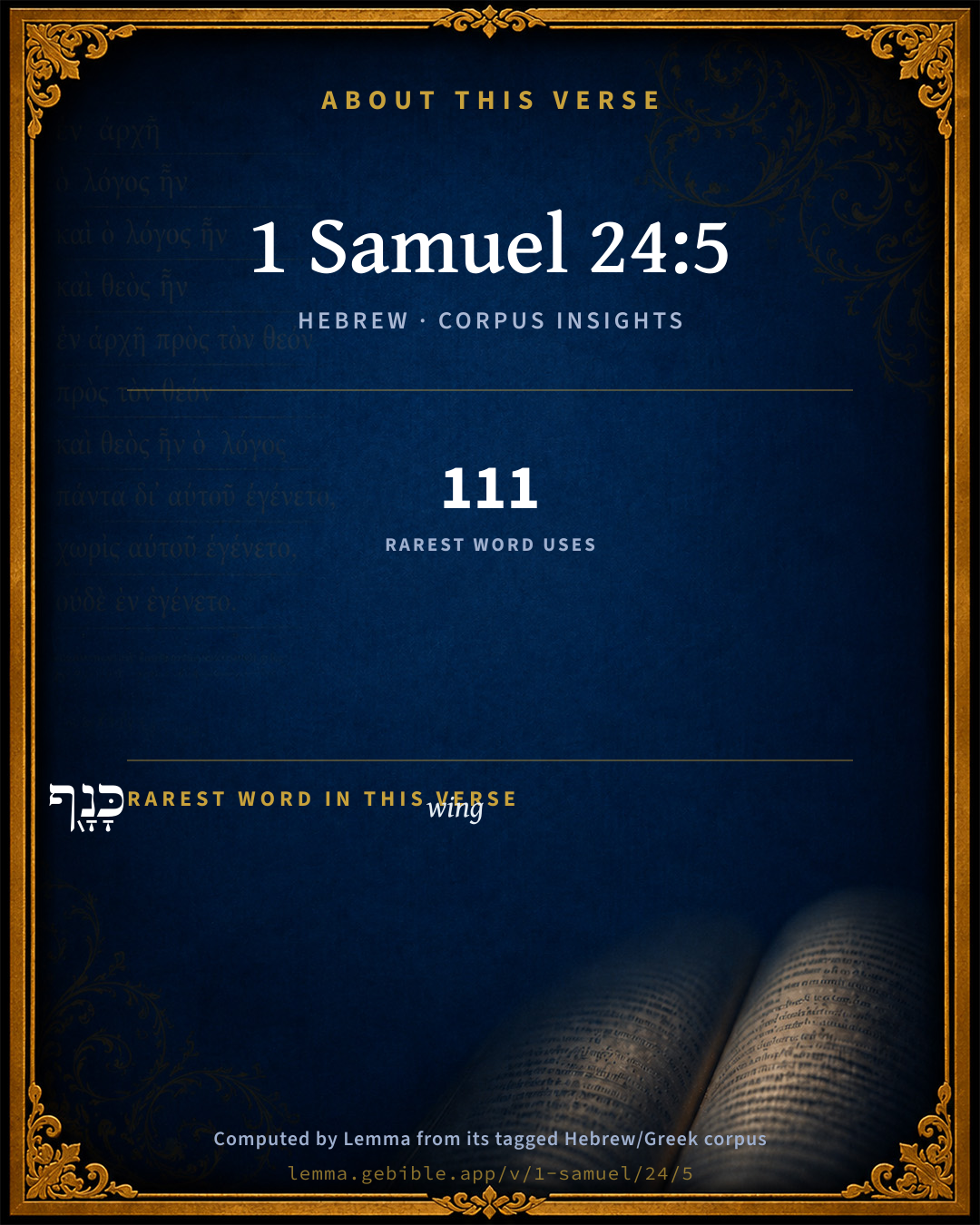
כָּנָ֖ף
kânâph
H3671
“wing”
Noun, Common, Feminine, Singular, Absolute
Part of Speech
Noun
Type
Common
Gender
Feminine
Number
Singular
State
Absolute
Full BDB Definition

Origin: from H3670

TWOT: 1003a

wing, extremity, edge, winged, border, corner, shirt - wing - extremity - skirt, corner (of garment)
  1. וַֽיְהִי֙ hâyâh H1961 “and · to be” Conjunction + Verb, Qal, Sequential Imperfect, 3rd Person, Masculine, Singular
  2. אַֽחֲרֵי ʼachar H310 “after” Preposition
  3. כֵ֔ן kên H3651 “thus” Adverb
  4. וַיַּ֥ךְ nâkâh H5221 “and · to strike” Conjunction + Verb, Hiphil, Sequential Imperfect, 3rd Person, Masculine, Singular
  5. לֵב lêb H3820 “heart of” Noun, Common, Masculine, Singular, Construct
  6. דָּוִ֖ד Dâvid H1732 “David” Noun, Proper
  7. אֹת֑וֹ ʼêth H853 “- · him” Particle, Direct Object + Suffix, Personal, 3rd Person, Masculine, Singular
  8. עַ֚ל ʻal H5921 “upon” Preposition
  9. אֲשֶׁ֣ר ʼăsher H834 “which” Particle, Relative
  10. כָּרַ֔ת kârath H3772 “to cut” Verb, Qal, Perfect, 3rd Person, Masculine, Singular
  11. אֶת ʼêth H853 “-” Particle, Direct Object
  12. אֲשֶׁ֥ר ʼăsher H834 “which” Particle, Relative
  13. לְשָׁאֽוּל Shâʼûwl H7586 “to/for · Saul” Preposition + Noun, Proper

About this verse

These counts appear in no published source. They are computed here, from the morphology-tagged text and Lemma’s own curated glosses. What Lemma adds →

14
words
12
distinct lemmas
Historical
section

Grammatical profile

  • 3 verbs
  • 4 nouns
  • 2 prepositions
  • 1 adverb
  • 4 particles

Verb forms

  • וַֽיְהִי֙ Qal · Sequential Imperfect
  • וַיַּ֥ךְ Hiphil · Sequential Imperfect
  • כָּרַ֔ת Qal · Perfect

Repetition

A word recurs within this verse — often emphatic in Hebrew:

  • אֲשֶׁ֣ר which H834 ×2

Hebrew & Septuagint length

In English translation the verse runs 15 words from the Hebrew and 54 from the Septuagint (LXX English) — the Septuagint runs noticeably longer here. See the side-by-side →

A rough comparison of the two English renderings, which tokenize alike — not a word-level alignment.

Word counts can differ between the Hebrew and the Greek without any difference in meaning — e.g. the Hebrew direct-object marker אֵת has no separate Greek word, and Greek often adds the article ὁ.

Cross-references

4

Topical passages linked to 1 Samuel 24:5 in the Treasury of Scripture Knowledge — connected by theme and wording, ordered by reader-vote popularity; previews shown in the World English Bible.

  • 2 Samuel 24:10 David's heart struck him after that he had numbered the people. David said to Yahweh, I have sinned greatly in that which I have done: but now, Yahweh, put away, I beg you, the iniquity of your servant; for I have done very foolishly.
  • 2 Samuel 12:9 Why have you despised the word of Yahweh, to do that which is evil in his sight? You have struck Uriah the Hittite with the sword, and have taken his wife to be your wife, and have slain him with the sword of the children of Ammon.
  • 2 Kings 22:19 because your heart was tender, and you did humble yourself before Yahweh, when you heard what I spoke against this place, and against the inhabitants of it, that they should become a desolation and a curse, and have torn your clothes, and wept before me; I also have heard you, says Yahweh.
  • 1 John 3:20–21 because if our heart condemns us, God is greater than our heart, and knows all things.

Cross-references courtesy of OpenBible.info (CC BY 4.0).

Hebrew and Greek witnesses Masoretic Hebrew ↔ Greek Septuagint

The same verse in the two great witnesses to the Old Testament, shown verse-for-verse.

Here the Septuagint runs noticeably longer than the Hebrew — LXX2012 (modern English Septuagint) 54 words vs World English Bible 15. A rough length comparison of the two English translations, not a word-level alignment — read both below.

These are two independent witnesses, not word-aligned to each other, and the Septuagint is shown in lemma (dictionary) form.

Hebrew 1 Samuel 24:5 Masoretic · Westminster Leningrad Codex

וַֽיְהִי֙ אַֽחֲרֵי כֵ֔ן וַיַּ֥ךְ לֵב דָּוִ֖ד אֹת֑וֹ עַ֚ל אֲשֶׁ֣ר כָּרַ֔ת אֶת כָּנָ֖ף אֲשֶׁ֥ר לְשָׁאֽוּל

It happened afterward, that David's heart struck him, because he had cut off Saul's skirt.

World English Bible · Public Domain

Greek LXX 1 Samuel 24:5 Septuagint · lemma form

καί εἶπον ὁ ἀνήρ δαυίδ πρός αὐτός ἰδού ὁ ἡμέρα οὗτος ὅς εἶπον κύριος πρός σύ παραδίδωμι ὁ ἐχθρός σύ εἰς ὁ χείρ σύ καί ποιέω αὐτός ὡς ἀγαθός ἐν ὀφθαλμός σύ καί ἀναἵστημι δαυίδ καί ἀποαἱρέω ὁ πτερυγίον ὁ διπλοΐς ὁ σαούλ λαθραίως

And the men of David said to him, Behold, this is the day of which the Lord spoke to you, that he would deliver your enemy into your hands; and you shall do to him as it is good in your sight. So David arose and cut off the skirt of Saul's garment secretly.

LXX2012 (modern English Septuagint) · Public Domain

Hebrew: Westminster Leningrad Codex (CC BY 4.0). Greek: Septuagint (public domain); English from LXX2012 (modern English Septuagint) (Public Domain). How the Septuagint differs from the Hebrew →

Targum (Aramaic paraphrase)

1

The Targum is the ancient Jewish Aramaic paraphrase of the Hebrew Scriptures — an interpretive translation, not the Hebrew text itself. Onkelos (literal) and Pseudo-Jonathan (expansive) render the Torah, and Jonathan the Prophets. Coverage is partial: where no permissively-licensed English translation exists for a verse, only the Aramaic is shown. This is verse-level text, not a word-by-word alignment to the Hebrew.

  1. Targum Jonathan Prophets (Joshua–Malachi)
    וַאֲמַרוּ גַבְרֵי דָוִד לֵיהּ הָא יוֹמָא דַאֲמַר יְיָ לָךְ הָא אֲנָא מְסַר יַת בְּעֵיל דְבָבָךְ בִּידָךְ וְתַעֲבֵּיד לֵיהּ כְּמָא דְתַקֵן בְּעֵינָךְ וְקָם דָוִד וּפְסַק יַת כְּנַף מְעִילָא דִלְשָׁאוּל בְּרָז:

    (no public-domain English translation for this verse)

    Targum Jonathan — Aramaic: “Mikraot Gedolot” (public domain). English: “Sefaria Community Translation” (CC0 1.0 (public-domain dedication)); “London "Chaldee Paraphrase," 1871” (public domain). Text via Sefaria.

Commentary

Notes on 1 Samuel 24:5 from classic Christian and Jewish commentators (each source and its license shown beneath its notes). The classic Christian expositions comment on the surrounding passage and are grouped to its opening verse, so a note may address several verses; the Jewish commentaries on the Tanakh (Rashi and others) are per-verse, so they appear only where the commentator wrote on this verse.

Lemma curates 59 commentaries, every one of them public domain or Creative Commons licensed, each selected and text-cleaned for this edition rather than reprinted as found. About our sources →

Trapp's Complete Commentary

John Trapp

1Sa 24:5 And it came to pass afterward, that David’s heart smote him, because he had cut off Saul’s skirt.

Ver. 5. David’s heart smote,] i.e., His conscience, which keeps court in every faculty of the soul, checked him: such was his tenderness then. Bee masters tell us that those are the best hives that make the greatest noise; so is that the best conscience that checketh for smallest sins. David feared that what he had done to the king might be taken for an ignominy and an injury: he is therefore pricked inwardly. Bonorum enim mentium est culpam agnoscere ubi culpa non est, saith Bernard. Good men are afraid of the least show of sin, being jealous over themselves with a godly jealousy.

John Trapp, A Commentary or Exposition upon All the Books of the Old and New Testament (1647–1656) — public domain. Text from a community e-Sword module.

Joseph Benson's Commentary

1Sa 24:5-6. David’s heart smote him — His intention in cutting off Saul’s skirt was only to give certain proof that he did not seek his life, in that he had spared it when it was wholly in his power; yet no sooner had he done it, but the consideration how Saul might be affected by it, whether it might not enrage him the more, and how the action might be esteemed by others, troubled him greatly. And he said to his men — When he returned to them, and they again pressed him, as is probable, to kill Saul; The Lord forbid, &c. — He considers Saul now, not as his enemy, and the only person that stood in the way of his preferment, (for then he would have been induced to hearken to the temptation,) but as his master, to whom he was obliged to be faithful, and as the Lord’s anointed, whom God had appointed to reign as long as he lived, and who, as such, was under the particular protection of the divine law.

Joseph Benson's Commentary on the Old and New Testaments (1811–1818) — public domain. Text from a community e-Sword module.

Tyndale Open Study Notes

Tyndale Open Resources

24:5 David’s conscience began bothering him because he had dishonored God’s anointed king.

Tyndale Open Study Notes — © Tyndale Open Resources, licensed CC BY-SA 4.0. Text via the HelloAO Bible API.

Geneva Bible (1599)

Geneva Bible translators

Here we see how ready we are to hasten God’s promise, if the occasion serve never so little.

Geneva Bible (1599) marginal notes — public domain. Text via Bolls.life.

Ellicott's Commentary for English Readers

(5) David’s heart smote him.—Not for what he had done to Saul, but his conscience smote him for the momentary thought that had stained his soul of slaying the Lord’s Anointed. This is better than with Clericus to say, “David was afraid that Saul would take this, though a clear sign of his [David’s] magnanimity, in bad part, and regard it as a violation of his royal majesty.” There is no sign at all of David’s even regretting he had cut off the fringe of the king’s garment. It was the far more terrible thought of slaying the God-anointed king which troubled David. The words of the next verse show us clearly what was passing in his mind when he gravely rebuked his men, and evidently restrained them, with some little trouble, from rushing upon Saul, even after he had left the sleeping form, with the piece of the mantle in his hand. The Hebrew word rendered “stayed” is a forcible one, and, literally, would be crushed down. There is a curious Note, however, in the Babylonian Talmud on this passage in the Book of Samuel which tells how David cut off a piece of Saul’s robe, in which the act is evidently very strongly condemned. Rabbi Yosi ben Rabbi chanîna on the words, “Then David arose, and cut off the skirt of Saul’s robe privily,” said, “Whoever treats clothes slightingly will at last derive no benefit from them, for it is said (1Ki_1:1), ‘And they covered him [David] with clothes, but he gat no heat.’”—Treatise Berachoth, fol. 62, Colossians 2.

This is evidently one of the “cryptographs,” of which there are such innumerable instances in the Talmud. The lesson intended to be taught by the famous Rabbi was probably intense reverence for the teachers and guides of Israel, here represented by Saul; any act of disrespect shown to one of these, even by injuring the clothes they wore, would be punished by God sooner or later.

A Bible Commentary for English Readers, edited by Charles John Ellicott (1878–1897) — public domain. Text from a community e-Sword module.

The Cambridge Bible for Schools and Colleges

gen. ed. J. J. S. Perowne

5. David’s heart smote him] David’s conscience reproached him for offering even so slight an indignity to the king.

The Cambridge Bible for Schools and Colleges (gen. ed. J. J. S. Perowne; Cambridge University Press, 1878–1918) — public domain. Text from a community e-Sword module.

John Gill's Exposition

And it came to pass afterward, that David's heart smote him,.... His conscience accused him, and he repented of what he had done:

because he had cut off Saul's skirt; which though less than what his servants put him upon, and he might have thoughts of doing, yet was considered by him as a great indignity to his sovereign, and therefore sat uneasy on his mind.

John Gill's Exposition of the Whole Bible (1746–1763) — public domain (CC PDM 1.0). Text via the HelloAO Bible API.

Albert Barnes' Notes on the Bible

David’s heart smote him - He thought the action inconsistent with the respect which he owed to the king.

Albert Barnes' Notes on the Bible (1834–1885) — public domain. Text from a community e-Sword/MySword module.

Haydock's Catholic Bible Commentary

Eyes. This might have been spoken by Gad, or Samuel; (Menochius) or they only mean that this is a most favourable opportunity. Some think that David ought to have embraced it, and put an end to these troubles, by the death of the usurper. But this was not the opinion of David; and God, who had promised him the throne, had not authorized him to lay violent hands on Saul. He might act on the defensive, but not be the aggressor. (Tirinus) --- Arose, with an intention to kill his unjust persecutor, ver. 11. --- Robe, to convince him how easily he might have taken away his life. (St. Augustine, de C. [City of God?] xii. 6.) --- The noise of Saul’s attendants hindered him from being perceived. Perhaps Saul might have put off his robe. (Menochius) --- St. Chrysostom observes, the David obtained more glory by sparing Saul than by killing Goliath. (Tirinus) --- Clemency makes a man like God. (Cicero)

George Leo Haydock (1774–1849), Haydock's Catholic Family Bible and Commentary, 1859 edition — public domain. Excludes Psalms (Douay-Rheims chapter numbering differs from Protestant) and Deuterocanonical books (Catholic canon only).

Matthew Poole's English Annotations

Not only because it was injurious, and reproachful, and dangerous to the king; but possibly because he had some secret thought of doing more to him, though he suppressed and overcame it; for he attempted this in pursuance of his soldiers’ suggestion, 1Sa 24:4 which if followed would have carried him to further action.

Matthew Poole's English Annotations on the Holy Bible (1683–1685) — public domain. Text from a community e-Sword/MySword module.

Whedon's Commentary on the Bible

Daniel D. Whedon

5. David’s heart smote him — He felt that even the rending of Saul’s garment was going too far against the Lord’s anointed. Clarke supposes that David arose with the purpose of killing Saul, but was prevented by the remonstrance of God in his conscience; but we see no sufficient evidence of such purpose.

Daniel D. Whedon (gen. ed.), Commentary on the Old and New Testaments (1874–1909) — public domain. Text from a community e-Sword module.

unfoldingWord translationNotes

Door43 World Missions Community

David's heart afflicted him

This is an idiom. AT: "David was sad because he had done something wrong" (See: Idiom)

Yahweh's anointed

"the one whom Yahweh has chosen to lead his people" or "the one Yahweh has made king"

to put out my hand against him

The hand is a metonym for the ability to cause harm. AT: "to harm him in any way" (See: Metonymy)

translationWords

David

heart

afflicted

Saul (OT)

robe

Yahweh

lord

anoint

hand

rebuke

word

unfoldingWord translationNotes — © Distant Shores Media and the Door43 World Missions Community, licensed CC BY-SA 4.0. Source: git.door43.org/Door43/en_tn.

Lesson kit

Teaching starters — assembled from the data on this page, not authored interpretation. Every prompt links to the verse data it draws on. Edit before teaching.

1 Samuel, in the Historical, opens this verse with 14 words (12 distinct Hebrew lemmas). Its most distinctive word is kânâph (“wing”). The Greek Septuagint runs longer here. A historical commentator’s framing appears above. Read the whole chapter for the surrounding context.

Discussion questions

  1. What does “wing” (kânâph) contribute to the verse as a whole?
  2. How does 2 Samuel 24:10, which shares this passage’s theme, read alongside this verse?
  3. What does the repetition of “which” (2× in this one verse) do in this verse?
  4. The Septuagint runs longer here than the Hebrew. What might account for the difference?
  5. The translations on this page render this verse differently — a whole-verse word diff, not a word-by-word alignment. What might account for the different wordings?
  6. «וַֽיְהִי֙» is a Qal Sequential Imperfect verb. How does that grammatical form shape the action described?
  7. Compare how Trapp's Complete Commentary and Joseph Benson's Commentary read this verse. Where do they agree or differ?

Things to notice

Reading settings

Reading text

Shown beneath each verse's original-language words.

Old Testament
Old Testament edition

Read the OT as the Masoretic Hebrew (MT) or the Greek Septuagint (LXX).

English shown for the Greek Septuagint (in the Hebrew ↔ Greek comparison).

Comparing translations? Open the Compare panel on any verse page to stack up to four side by side.