2 Chronicles 29:10

Hebrew (Westminster Leningrad Codex) 2 Chronicles 29:10 appears in the Hebrew Old Testament. The text above is from the Westminster Leningrad Codex. Each word links to its Strong’s number, a concise gloss, and parsing drawn from the Open Scriptures Hebrew Bible morphology. Click any word for its full Brown-Driver-Briggs (BDB) entry.
Download image
Cite this verse

2 Chronicles 29:10 (World English Bible). Public Domain. Lemma interlinear Bible study tool, https://lemma.gebible.app/v/2-chronicles/29/10.

Show BibTeX & RIS
BibTeX
RIS
English Translation
Now it is in my heart to make a covenant with Yahweh, the God of Israel, that his fierce anger may turn away from us.
World English Bible · Public Domain
Download a study sheet

One document with this verse’s original text, its word-by-word gloss line, the meaning frame, cross-references with their text, attributed commentary, and full source and license credits — printable, and it pastes into notes with its structure intact.

This verse Autodidact and up

Study sheet (.html) Plain text (.txt)

A passage Seminary Student

Up to 50 verses in one chapter. A passage sheet keeps up to 6 commentary sources and 12 cross-references per verse, in the order this page ranks them, and says so on the sheet whenever that leaves anything out. Ask for a single verse and you get the Autodidact verse sheet above.

Everything on this page stays free to read, with no account — the sheet is a download of what is already on screen, not access to it.

Want to remove ads? Support Godless Engineer
Compare translations 3

The same verse in 3 English versions, stacked beneath the original-language interlinear above. Click any original word for its lexicon entry.

Each is an independent rendering of the whole verse — the interlinear is not word-aligned to these translations.

Highlighted words mark where these versions differ — a whole-verse word diff, not a word-by-word alignment.

  • World English Bible Public Domain
    Now it is in my heart to make a covenant with Yahweh, the God of Israel, that his fierce anger may turn away from us.
  • King James Version Public Domain
    Now it is in mine heart to make a covenant with the LORD God of Israel, that his fierce wrath may turn away from us.
  • unfoldingWord Literal Text CC BY-SA 4.0
    Now with my heart to cut a covenant with Yahweh, the God of Israel, so that his burning anger may turn from us.

unfoldingWord Literal Text — © unfoldingWord, licensed CC BY-SA 4.0. Word-aligned USFM3 via Door43 (git.door43.org/unfoldingWord/en_ult).

Versions to compare (up to 4)

3 of 4 selected

Show all 18 translations

Every available English version of this verse, each an independent rendering of the whole verse.

  • World English Bible Public Domain
    Now it is in my heart to make a covenant with Yahweh, the God of Israel, that his fierce anger may turn away from us.
  • Berean Standard Bible Public Domain
    Now it is in my heart to make a covenant with the LORD, the God of Israel, so that His fierce anger will turn away from us.
  • Majority Standard Bible Public Domain
    Now it is in my heart to make a covenant with the LORD, the God of Israel, so that His fierce anger will turn away from us.
  • King James Version Public Domain
    Now it is in mine heart to make a covenant with the LORD God of Israel, that his fierce wrath may turn away from us.
  • American Standard Version (1901) Public Domain
    Now it is in my heart to make a covenant with Jehovah, the God of Israel, that his fierce anger may turn away from us.
  • Revised Version (1885) Public Domain
    Now it is in mine heart to make a covenant with the LORD, the God of Israel, that his fierce anger may turn away from us.
  • Geneva Bible (1599) Public Domain
    Now I purpose to make a couenant with the Lord God of Israel, that he may turne away his fierce wrath from vs.
  • Douay-Rheims (1899) Public Domain
    Now therefore I have a mind that we make a covenant with the Lord the God of Israel, and he will turn away the wrath of his indignation from us.
  • Young's Literal Translation Public Domain
    `Now -- with my heart -- to make a covenant before Jehovah, God of Israel, and the fierceness of His anger doth turn back from us.
  • Literal Standard Version CC BY-SA 4.0
    Now [it is] with my heart to make a covenant before YHWH, God of Israel, and the fierceness of His anger turns back from us.
  • Unlocked Literal Bible CC BY-SA 4.0
    Now it is in my heart to make a covenant with Yahweh, the God of Israel, so that his fierce anger may turn away from us.
  • unfoldingWord Literal Text CC BY-SA 4.0
    Now with my heart to cut a covenant with Yahweh, the God of Israel, so that his burning anger may turn from us.
  • Darby Bible Public Domain
    Now it is in my heart to make a covenant with Jehovah the God of Israel, that his fierce anger may turn away from us.
  • World Messianic Bible Public Domain
    Now it is in my heart to make a covenant with the LORD, the God of Israel, that his fierce anger may turn away from us.
  • Webster's Bible Public Domain
    Now it is in my heart to make a covenant with the LORD God of Israel, that his fierce wrath may turn away from us.
  • Free Bible Version CC BY-SA 4.0
    But now I'm going to make an agreement with the Lord, the God of Israel, so that his fierce anger will no longer fall on us.
  • Bible in Basic English Public Domain
    Now it is my purpose to make an agreement with the Lord, the God of Israel, so that the heat of his wrath may be turned away from us.
  • JPS Tanakh (1917) Public Domain
    Now it is in my heart to make a covenant with the LORD, the God of Israel, that His fierce anger may turn away from us.

Literal Standard Version (2020), Covenant Press — licensed CC BY-SA 4.0. Text via the HelloAO Bible API (eBible.org). Unlocked Literal Bible (unfoldingWord) — licensed CC BY-SA 4.0. Text via the HelloAO Bible API (eBible.org). unfoldingWord Literal Text — © unfoldingWord, licensed CC BY-SA 4.0. Word-aligned USFM3 via Door43 (git.door43.org/unfoldingWord/en_ult). Free Bible Version, Dr. Jonathan Gallagher — licensed CC BY-SA 4.0. Text via the HelloAO Bible API (eBible.org).

Word by word

More ways to search: Search by grammar → Find every occurrence → Compare this word →

Practice this passage: Drill this verse → Learn its vocabulary →

חֲר֥וֹן
chârôwn
H2740
“anger of”
Noun, Common, Masculine, Singular, Construct
Part of Speech
Noun
Type
Common
Gender
Masculine
Number
Singular
State
Construct
Full BDB Definition

Origin: from H2734

TWOT: 736a

anger, heat, burning (of anger) - always used of God's anger
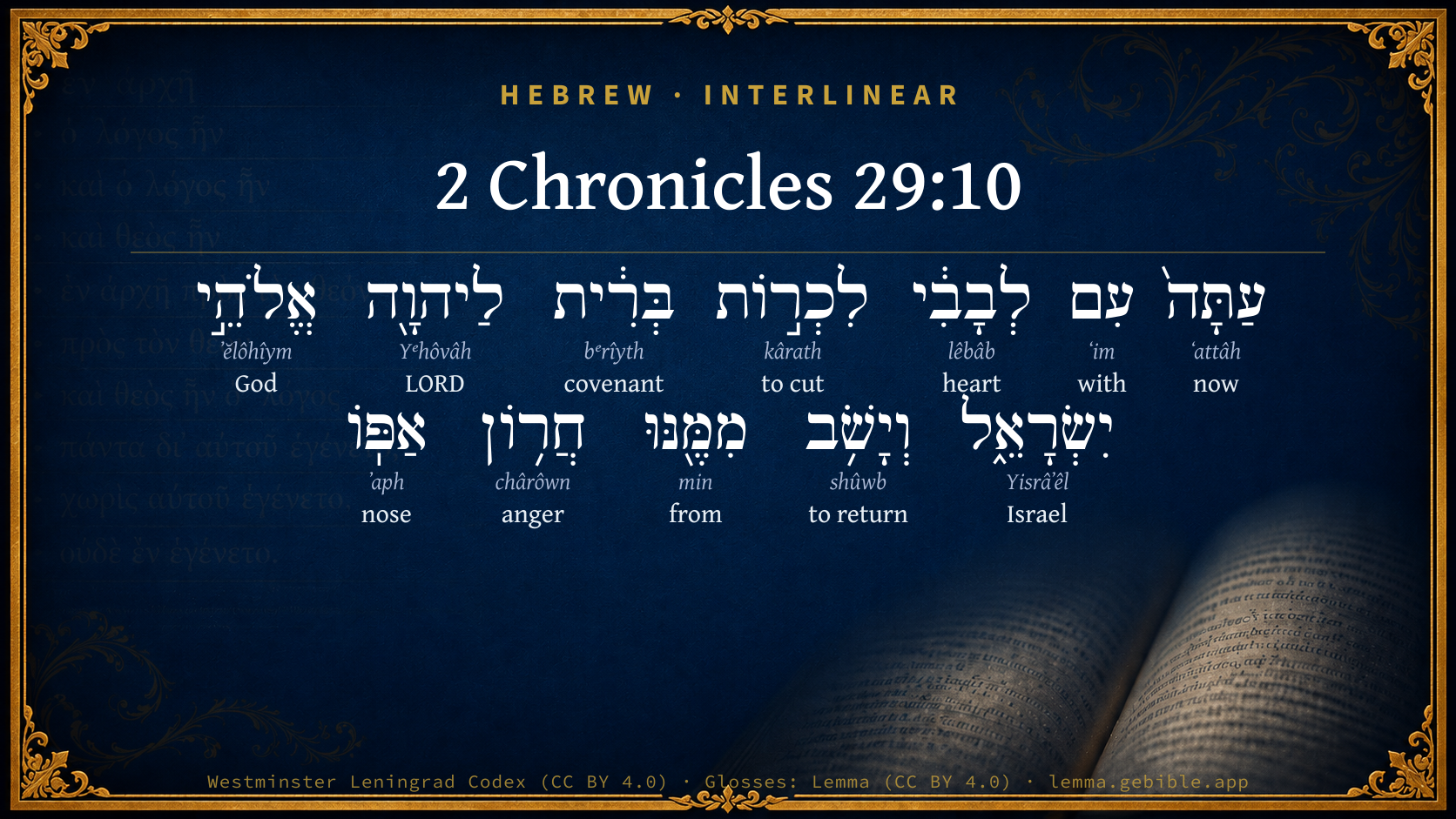
  1. עַתָּה֙ ʻattâh H6258 “now” Adverb
  2. עִם ʻim H5973 “with” Preposition
  3. לְבָבִ֔י lêbâb H3824 “heart · my” Noun, Common, Masculine, Singular, Construct + Suffix, Personal, 1st Person, Common, Singular
  4. לִכְר֣וֹת kârath H3772 “to cut” Preposition + Verb, Qal, Infinitive Construct
  5. בְּרִ֔ית bᵉrîyth H1285 “covenant” Noun, Common, Feminine, Singular, Absolute
  6. לַיהוָ֖ה Yᵉhôvâh H3068 “to/for · LORD” Preposition + Noun, Proper
  7. אֱלֹהֵ֣י ʼĕlôhîym H430 “God(s) of” Noun, Common, Masculine, Plural, Construct
  8. יִשְׂרָאֵ֑ל Yisrâʼêl H3478 “Israel” Noun, Proper
  9. וְיָשֹׁ֥ב shûwb H7725 “and · to return” Conjunction + Verb, Qal, Jussive, 3rd Person, Masculine, Singular
  10. מִמֶּ֖נּוּ min H4480 “from · us” Preposition + Suffix, Personal, 1st Person, Common, Plural
  11. אַפּֽוֹ ʼaph H639 “nose · his” Noun, Common, Masculine, Singular, Construct + Suffix, Personal, 3rd Person, Masculine, Singular

About this verse

These counts appear in no published source. They are computed here, from the morphology-tagged text and Lemma’s own curated glosses. What Lemma adds →

12
words
12
distinct lemmas
Historical
section

Shared distinctive vocabulary

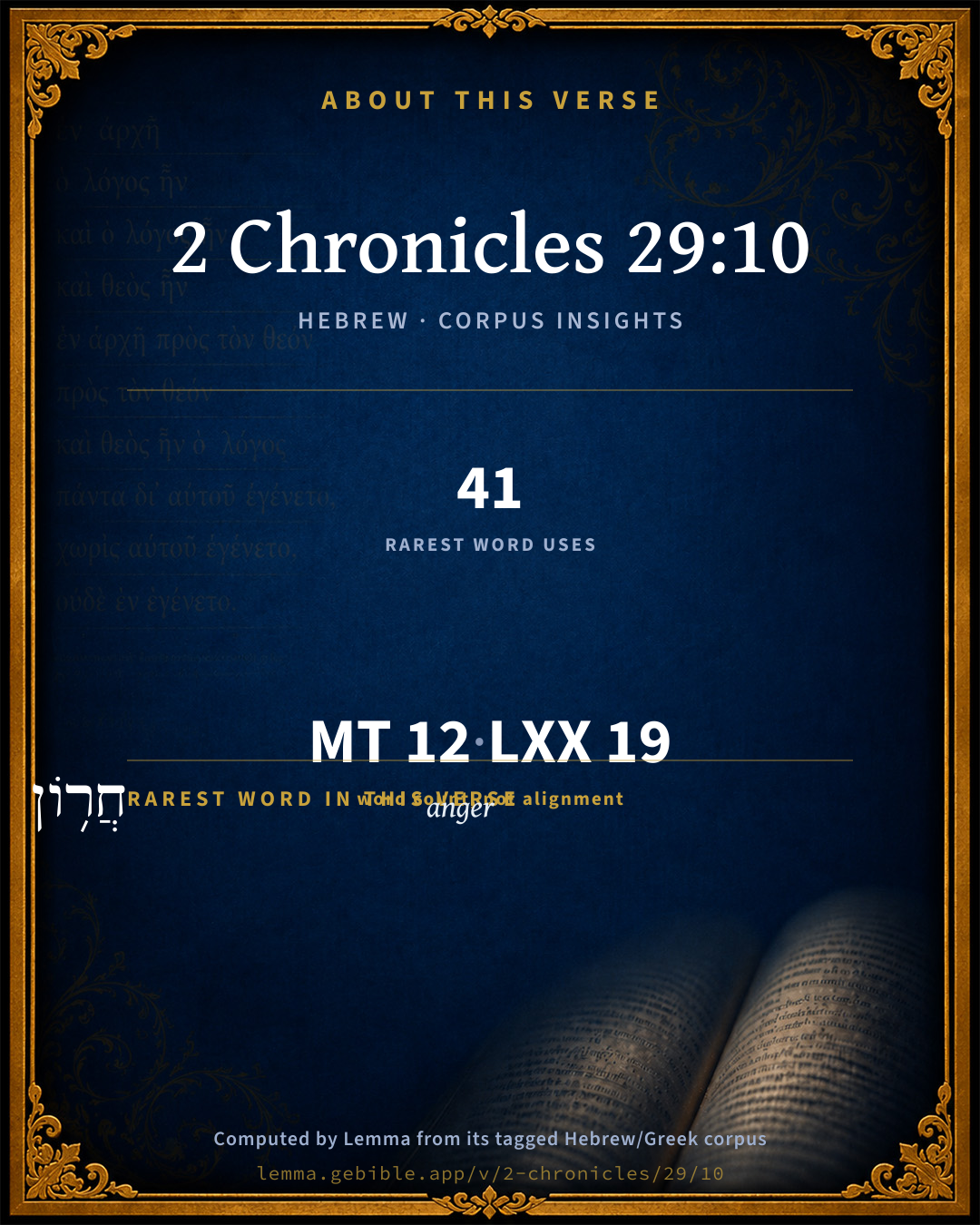
חֲר֥וֹן anger H2740 occurs in 40 verses of the Hebrew Bible. Also found in:

Grammatical profile

  • 2 verbs
  • 7 nouns
  • 2 prepositions
  • 1 adverb

Verb forms

  • לִכְר֣וֹת Qal · Infinitive Construct
  • וְיָשֹׁ֥ב Qal · Jussive

Hebrew & Septuagint length

In English translation the verse runs 25 words from the Hebrew and 29 from the Septuagint (LXX English) — closely comparable.

A rough comparison of the two English renderings, which tokenize alike — not a word-level alignment.

Word counts can differ between the Hebrew and the Greek without any difference in meaning — e.g. the Hebrew direct-object marker אֵת has no separate Greek word, and Greek often adds the article ὁ.

In the original languages it is 12 Hebrew tokens and 19 Greek tokens — but the two are counted differently (Hebrew bundles its prefixes and suffixes into one token; the Greek is in lemma form), so that isn’t a like-for-like length.

Cross-references

12

Topical passages linked to 2 Chronicles 29:10 in the Treasury of Scripture Knowledge — connected by theme and wording, ordered by reader-vote popularity; previews shown in the World English Bible.

  • Jeremiah 50:5 They shall inquire concerning Zion with their faces turned toward it, [saying], Come you, and join yourselves to Yahweh in an everlasting covenant that shall not be forgotten.
  • 2 Chronicles 23:16 Jehoiada made a covenant between himself, and all the people, and the king, that they should be Yahweh's people.
  • Ezra 10:3 Now therefore let us make a covenant with our God to put away all the wives, and such as are born of them, according to the counsel of my lord, and of those who tremble at the commandment of our God; and let it be done according to the law.
  • 2 Kings 23:3 The king stood by the pillar, and made a covenant before Yahweh, to walk after Yahweh, and to keep his commandments, and his testimonies, and his statutes, with all [his] heart, and all [his] soul, to confirm the words of this covenant that were written in this book: and all the people stood to the covenant.
  • 2 Kings 23:26 Notwithstanding, Yahweh didn't turn from the fierceness of his great wrath, with which his anger was kindled against Judah, because of all the provocation with which Manasseh had provoked him.
  • 2 Chronicles 6:7–8 Now it was in the heart of David my father to build a house for the name of Yahweh, the God of Israel.
  • 2 Chronicles 15:12–13 They entered into the covenant to seek Yahweh, the God of their fathers, with all their heart and with all their soul;
  • 2 Chronicles 34:30–32 The king went up to the house of Yahweh, and all the men of Judah and the inhabitants of Jerusalem, and the priests, and the Levites, and all the people, both great and small: and he read in their ears all the words of the book of the covenant that was found in the house of Yahweh.
  • Nehemiah 9:38–10:39 Yet for all this we make a sure covenant, and write it; and our princes, our Levites, [and] our priests, seal to it.
  • Jeremiah 34:15 You were now turned, and had done that which is right in my eyes, in proclaiming liberty every man to his neighbor; and you had made a covenant before me in the house which is called by my name:
  • 2 Corinthians 8:5 This was not as we had hoped, but first they gave their own selves to the Lord, and to us through the will of God.
  • Jeremiah 34:18 I will give the men who have transgressed my covenant, who have not performed the words of the covenant which they made before me, when they cut the calf in two and passed between the parts of it;

Cross-references courtesy of OpenBible.info (CC BY 4.0).

Hebrew and Greek witnesses Masoretic Hebrew ↔ Greek Septuagint

The same verse in the two great witnesses to the Old Testament, shown verse-for-verse.

These are two independent witnesses, not word-aligned to each other, and the Septuagint is shown in lemma (dictionary) form.

Hebrew 2 Chronicles 29:10 Masoretic · Westminster Leningrad Codex

עַתָּה֙ עִם לְבָבִ֔י לִכְר֣וֹת בְּרִ֔ית לַיהוָ֖ה אֱלֹהֵ֣י יִשְׂרָאֵ֑ל וְיָשֹׁ֥ב מִמֶּ֖נּוּ חֲר֥וֹן אַפּֽוֹ

Now it is in my heart to make a covenant with Yahweh, the God of Israel, that his fierce anger may turn away from us.

World English Bible · Public Domain

Greek LXX 2 Chronicles 29:10 Septuagint · lemma form

ἐπί οὗτος νῦν εἰμί ἐπί καρδία διατίθημι διαθήκη κύριος θεός ἰσραήλ καί ἀποστρέφω ὁ ὀργή θυμός αὐτός ἀπό ἐγώ

Therefore it is now in my heart to make a covenant, a covenant with the Lord God of Israel, that he may turn away his fierce wrath from us.

LXX2012 (modern English Septuagint) · Public Domain

Hebrew: Westminster Leningrad Codex (CC BY 4.0). Greek: Septuagint (public domain); English from LXX2012 (modern English Septuagint) (Public Domain). How the Septuagint differs from the Hebrew →

Commentary

Notes on 2 Chronicles 29:10 from classic Christian and Jewish commentators (each source and its license shown beneath its notes). The classic Christian expositions comment on the surrounding passage and are grouped to its opening verse, so a note may address several verses; the Jewish commentaries on the Tanakh (Rashi and others) are per-verse, so they appear only where the commentator wrote on this verse.

Lemma curates 59 commentaries, every one of them public domain or Creative Commons licensed, each selected and text-cleaned for this edition rather than reprinted as found. About our sources →

The Biblical Illustrator

Joseph S. Exell

2Ch_29:10

Now it is in mine heart to make a covenant with the Lord God of Israel.

The best covenant

I. What is meant by making a covenant with the Lord In our days it means that gracious engagement on Gods part to bestow on man the very favour which he supremely needs, and on terms of Gods own ordering; and on the part of man, his acceptance of these terms, according to apostolic exhortation--Be ye reconciled to God. There is implied on mans part--

1. The conviction of

(1) the fact,

(2) the folly, and

(3) the sin of his being out of covenant with God.

2. The willing and entire abandonment of every other covenant under which the soul has been enslaved.

3. A hearty reception of the terms on which a covenant with God can be made.

II. What counsel and direction can we offer to those who have it in their heart to make a covenant with the Lord?

1. Be not satisfied with only having it in your heart to do so.

2. Let the past mistakes which you have made through trusting to your own hearts set you upon your guard against trusting them in future.

3. If you make a covenant with the Lord, resolve that it shall be a perpetual one. (John Lewis.)

The use of covenanting with God

A truly pious man will not be satisfied with serving God in his closet. He will exert his influence to bring others also to a sense of their duty. We have a noble example set before us in the conduct of Hezekiah.

I. Show when we have reason to apprehend that Gods anger is waxed hot against us.

1. When our sins are multiplied against Him.

2. When His judgments are multiplied upon us.

II. Point out the best means of averting His wrath.

1. Repentance and faith.

2. Devoting ourselves to God in s perpetual covenant.

3. Under the Old Testament dispensation, covenants were judged acceptable to God. (Asa, 2Ch_15:12-15; Josiah, 2Ki_23:3.)

4. Isaiah and Jeremiah speak of the making of such covenants as characteristic of the gospel times (Isa_44:5; Jer_1:4-5).

5. Paul commends the Macedonians (2Co_8:5); and recommends s similar practice to all Christians (Rom_12:1).

6. Hezekiah manifestly supposed that God would accept him in this duty.

III. Urge upon you the adoption of them.

1. There is no time for delay.

2. If we neglect this duty we cannot hope to escape the wrath of God.

3. If we heartily engage in this duty, we have nothing to fear. (Skeletons of Sermons.)

The Biblical Illustrator, edited by Joseph S. Exell (c. 1880s–1900s) — public domain. Text from a community e-Sword module.

Joseph Benson's Commentary

2Ch 29:10-11. It is in my heart to make a covenant with the Lord, &c. — To engage by solemn vows and promises to worship him only, and in that way which he hath appointed: for I am sure that his fierce anger will not otherwise be turned away from us. This covenant he would not only make for himself, but bring his people also into the bond of it. My sons — So he calls them, though many of them were elder than himself, because he was by his tender love and affection, as he was by his office, obliged to be a nursing father to them. Be not now negligent — In sanctifying yourselves and the temple, (2Ch 29:5,) and in quickening and preparing yourselves and the people for God’s service.

Joseph Benson's Commentary on the Old and New Testaments (1811–1818) — public domain. Text from a community e-Sword module.

Geneva Bible (1599)

Geneva Bible translators

He proveth by the judgments of God upon those that have contemned his word, that there is no way to avoid his plagues, but by conforming themselves to his will.

Hebrew, it is in mine heart.

Geneva Bible (1599) marginal notes — public domain. Text via Bolls.life.

Jamieson, Fausset & Brown

Robert Jamieson, A. R. Fausset & David Brown

Now it is in mine heart to make a covenant with the Lord God--Convinced of the sin and bitter fruits of idolatry, Hezekiah intended to reverse the policy of his father, and to restore, in all its ancient purity and glory, the worship of the true God. His commencement of this resolution at the beginning of his reign attests his sincere piety. It also proves the strength of his conviction that righteousness exalteth a nation; for, instead of waiting till his throne was consolidated, he devised measures of national reformation at the beginning of his reign and vigorously faced all the difficulties which, in such a course, he had to encounter, after the people's habits had so long been moulded to idolatry. His intentions were first disclosed to this meeting of the priests and Levites--for the agency of these officials was to be employed in carrying them into effect.

Jamieson, Fausset & Brown — Commentary Critical and Explanatory on the Whole Bible (1871) — public domain (CC PDM 1.0). Text via the HelloAO Bible API.

Adam Clarke's Commentary

Verse 10. To make a covenant] To renew the covenant under which the whole people were constantly considered, and of which circumcision was the sign; and the spirit of which was, I will be your God: Ye shall be my people.

Adam Clarke's Commentary on the Bible (1810–1826) — public domain. Text from a community e-Sword/MySword module.

Ellicott's Commentary for English Readers

(10) Now it is in mine heart.—See for this phrase and construction 1Ch_22:7; 1Ch_28:2; 2Ch_6:7.

To make a covenant with.—The preposition is for. (See Note on 2Ch_21:7.)

Turn away.—Literally, return (Isa_5:25). “That his fierce wrath may turn away from Israel” (Num_25:4).

A Bible Commentary for English Readers, edited by Charles John Ellicott (1878–1897) — public domain. Text from a community e-Sword module.

The Cambridge Bible for Schools and Colleges

gen. ed. J. J. S. Perowne

10. a covenant] Cp. 2Ch_15:12.

his fierce wrath] R.V. his fierce anger.

The Cambridge Bible for Schools and Colleges (gen. ed. J. J. S. Perowne; Cambridge University Press, 1878–1918) — public domain. Text from a community e-Sword module.

John Gill's Exposition

My sons,.... So, as the father of his people, he speaks of them in the most tender and affectionate manner:

be not now negligent; backward to this good work, slothful, sluggish, and remiss in it; according to Jarchi and Kimchi, the word has the signification of error, and the sense may be, do not continue in the error in which you have been, in neglecting the service of God:

for the Lord hath chosen you to stand before him, to serve him, and that ye should minister unto him, and burn incense; on the altar of incense, which was the work of the priests, and for which they were selected from the rest of their brethren; and Hezekiah's discourse was directed to them, as well as to the Levites, Ch2 29:4.

John Gill's Exposition of the Whole Bible (1746–1763) — public domain (CC PDM 1.0). Text via the HelloAO Bible API.

Haydock's Catholic Bible Commentary

Covenant, swearing to observe the law given by Moses. M.

George Leo Haydock (1774–1849), Haydock's Catholic Family Bible and Commentary, 1859 edition — public domain. Excludes Psalms (Douay-Rheims chapter numbering differs from Protestant) and Deuterocanonical books (Catholic canon only).

The Pulpit Commentary

To make a covenant; Hebrew, tyrB twOrkli. (see 2Ch_15:12, and our note there)

The Pulpit Commentary (1880–1919), ed. H.D.M. Spence-Jones & Joseph S. Exell — public domain. Text from a community e-Sword module.

unfoldingWord translationNotes

Door43 World Missions Community

it is in my heart

Here the word "heart" represents the thoughts and intentions. Hezekiah speaks of deciding to do something as if that thing were in his heart. AT: "it is my intention" or "I have decided" (See: Metonymy and Metaphor)

his fierce anger may turn away from us

Hezekiah speaks of Yahweh no longer being angry with them as if Yahweh's anger were a person who turns away from them AT: "he may no longer be angry with us" (See: Metaphor and Personification)

to stand before him

Possible meanings are 1) "to stand in his presence" or 2) this is an idiom that means to serve a person of high rank. AT: "to serve him" (See: Idiom)

translationWords

heart

covenant

worship

servant

unfoldingWord translationNotes — © Distant Shores Media and the Door43 World Missions Community, licensed CC BY-SA 4.0. Source: git.door43.org/Door43/en_tn.

Lesson kit

Teaching starters — assembled from the data on this page, not authored interpretation. Every prompt links to the verse data it draws on. Edit before teaching.

2 Chronicles, in the Historical, opens this verse with 12 words (12 distinct Hebrew lemmas). Its most distinctive word is chârôwn (“anger”). A historical commentator’s framing appears above. Read the whole chapter for the surrounding context.

Discussion questions

  1. What does “anger” (chârôwn) contribute to the verse as a whole?
  2. Exodus 15:7 shares the word «anger» with this verse. How do the two illuminate each other?
  3. The translations on this page render this verse differently — a whole-verse word diff, not a word-by-word alignment. What might account for the different wordings?
  4. The verb «לִכְר֣וֹת» is Qal Infinitive Construct. How does its form color the action?
  5. Reading how The Biblical Illustrator and Joseph Benson's Commentary read this verse, where do the two commentators agree and where do they part?

Things to notice

Reading settings

Reading text

Shown beneath each verse's original-language words.

Old Testament
Old Testament edition

Read the OT as the Masoretic Hebrew (MT) or the Greek Septuagint (LXX).

English shown for the Greek Septuagint (in the Hebrew ↔ Greek comparison).

Comparing translations? Open the Compare panel on any verse page to stack up to four side by side.