
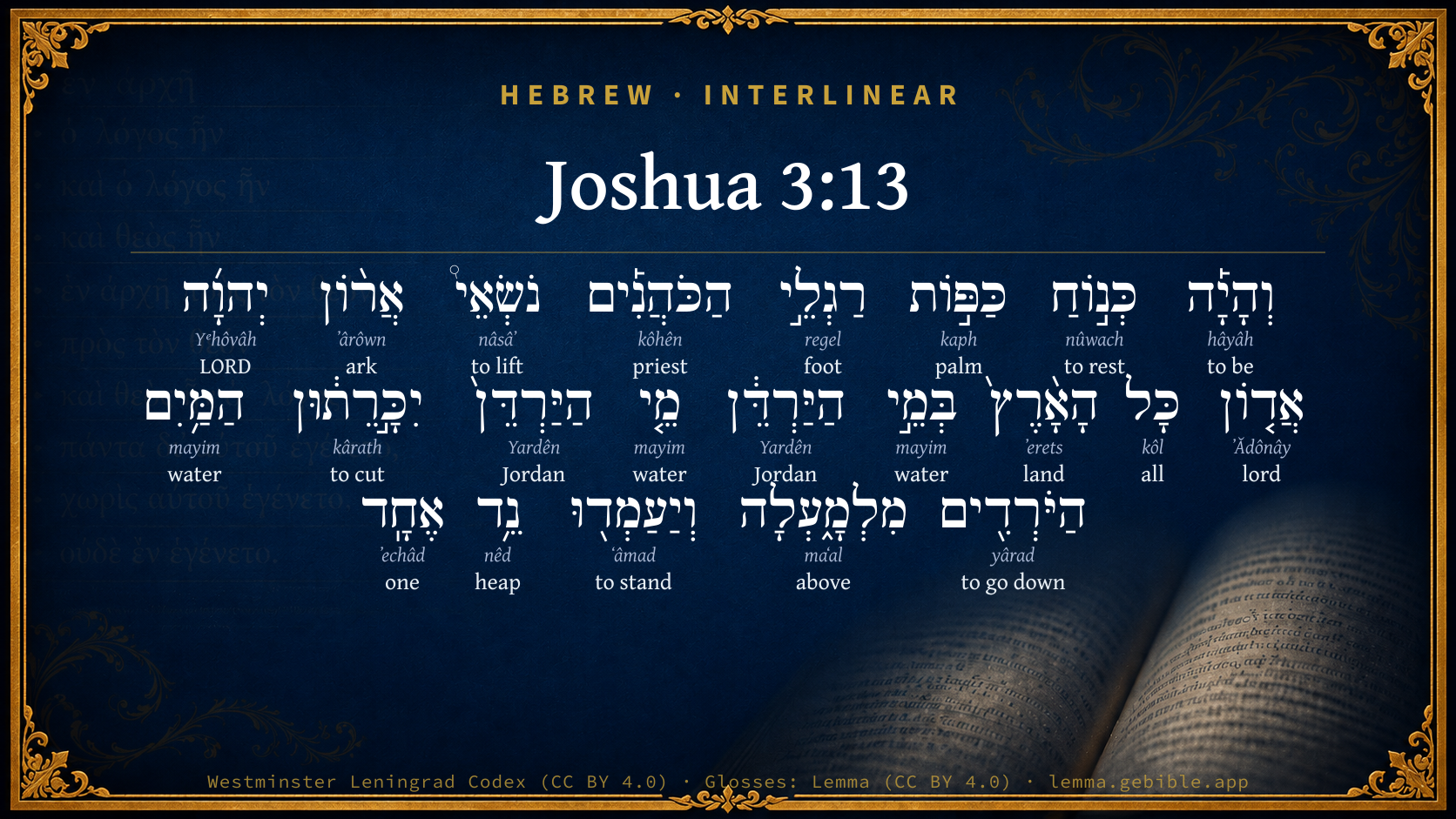
Joshua 3:13

Hebrew (Westminster Leningrad Codex) Joshua 3:13 appears in the Hebrew Old Testament. The text above is from the Westminster Leningrad Codex. Each word links to its Strong’s number, a concise gloss, and parsing drawn from the Open Scriptures Hebrew Bible morphology. Click any word for its full Brown-Driver-Briggs (BDB) entry.
Download image
Cite this verse

Joshua 3:13 (World English Bible). Public Domain. Lemma interlinear Bible study tool, https://lemma.gebible.app/v/joshua/3/13.

Show BibTeX & RIS
BibTeX
RIS
English Translation
It shall come to pass, when the soles of the feet of the priests who bear the ark of Yahweh, the Lord of all the earth, shall rest in the waters of the Jordan, that the waters of the Jordan shall be cut off, even the waters that come down from above; and they shall stand in one heap.
World English Bible · Public Domain
Download a study sheet

One document with this verse’s original text, its word-by-word gloss line, the meaning frame, cross-references with their text, attributed commentary, and full source and license credits — printable, and it pastes into notes with its structure intact.

This verse Autodidact and up

Study sheet (.html) Plain text (.txt)

A passage Seminary Student

Up to 50 verses in one chapter. A passage sheet keeps up to 6 commentary sources and 12 cross-references per verse, in the order this page ranks them, and says so on the sheet whenever that leaves anything out. Ask for a single verse and you get the Autodidact verse sheet above.

Everything on this page stays free to read, with no account — the sheet is a download of what is already on screen, not access to it.

Want to remove ads? Support Godless Engineer
Compare translations 3

The same verse in 3 English versions, stacked beneath the original-language interlinear above. Click any original word for its lexicon entry.

Each is an independent rendering of the whole verse — the interlinear is not word-aligned to these translations.

Highlighted words mark where these versions differ — a whole-verse word diff, not a word-by-word alignment.

  • World English Bible Public Domain
    It shall come to pass, when the soles of the feet of the priests who bear the ark of Yahweh, the Lord of all the earth, shall rest in the waters of the Jordan, that the waters of the Jordan shall be cut off, even the waters that come down from above; and they shall stand in one heap.
  • King James Version Public Domain
    And it shall come to pass, as soon as the soles of the feet of the priests that bear the ark of the LORD, the LORD of all the earth, shall rest in the waters of Jordan, that the waters of Jordan shall be cut off from the waters that come down from above; and they shall stand upon an heap.
  • unfoldingWord Literal Text CC BY-SA 4.0
    And it will happen as soon as the soles of the feet of the priests, the carriers of the Box of Yahweh, the Lord of all of the earth, rest in the waters of the Jordan, the waters of the Jordan will be cut off, the waters coming down from above. And they will stand, one heap.”

unfoldingWord Literal Text — © unfoldingWord, licensed CC BY-SA 4.0. Word-aligned USFM3 via Door43 (git.door43.org/unfoldingWord/en_ult).

Versions to compare (up to 4)

3 of 4 selected

Show all 18 translations

Every available English version of this verse, each an independent rendering of the whole verse.

  • World English Bible Public Domain
    It shall come to pass, when the soles of the feet of the priests who bear the ark of Yahweh, the Lord of all the earth, shall rest in the waters of the Jordan, that the waters of the Jordan shall be cut off, even the waters that come down from above; and they shall stand in one heap.
  • Berean Standard Bible Public Domain
    When the feet of the priests who carry the ark of the LORD—the Lord of all the earth—touch down in the waters of the Jordan, its flowing waters will be cut off and will stand up in a heap.”
  • Majority Standard Bible Public Domain
    When the feet of the priests who carry the ark of the LORD—the Lord of all the earth—touch down in the waters of the Jordan, its flowing waters will be cut off and will stand up in a heap.”
  • King James Version Public Domain
    And it shall come to pass, as soon as the soles of the feet of the priests that bear the ark of the LORD, the LORD of all the earth, shall rest in the waters of Jordan, that the waters of Jordan shall be cut off from the waters that come down from above; and they shall stand upon an heap.
  • American Standard Version (1901) Public Domain
    And it shall come to pass, when the soles of the feet of the priests that bear the ark of Jehovah, the Lord of all the earth, shall rest in the waters of the Jordan, that the waters of the Jordan shall be cut off, even the waters that come down from above; and they shall stand in one heap.
  • Revised Version (1885) Public Domain
    And it shall come to pass, when the soles of the feet of the priests that bear the ark of the LORD, the Lord of all the earth, shall rest in the waters of Jordan, that the waters of Jordan shall be cut off, even the waters that come down from above; and they shall stand in one heap.
  • Geneva Bible (1599) Public Domain
    And assoone as the soles of the feete of the Priestes (that beare the Arke of the Lord God the Lord of all the worlde) shall stay in the waters of Iorden, the waters of Iorden shall be cut off: for the waters that come from aboue, shall stande still vpon an heape.
  • Douay-Rheims (1899) Public Domain
    And when the priests, that carry the ark of the Lord the God of the whole earth, shall set the soles of their feet in the waters of the Jordan, the waters that are beneath shall run down and go off: and those that come from above, shall stand together upon a heap.
  • Young's Literal Translation Public Domain
    and it hath been, at the resting of the soles of the feet of the priests bearing the ark of Jehovah, Lord of all the earth, in the waters of the Jordan, the waters of the Jordan are cut off -- the waters which are coming down from above -- and they stand -- one heap.'
  • Literal Standard Version CC BY-SA 4.0
    and it has been, at the resting of the soles of the feet of the priests carrying the Ark of YHWH, Lord of all the earth, in the waters of the Jordan, the waters of the Jordan are cut off—the waters which are coming down from above—and they stand—one heap.”
  • Unlocked Literal Bible CC BY-SA 4.0
    When the soles of the feet of the priests that carry the ark of Yahweh, the Lord of all the earth, touch the waters of the Jordan, the waters of the Jordan will be cut off, and even the waters that flow down from upstream will stop flowing and they will stand in one heap.”
  • unfoldingWord Literal Text CC BY-SA 4.0
    And it will happen as soon as the soles of the feet of the priests, the carriers of the Box of Yahweh, the Lord of all of the earth, rest in the waters of the Jordan, the waters of the Jordan will be cut off, the waters coming down from above. And they will stand, one heap.”
  • Darby Bible Public Domain
    And it shall come to pass, when the soles of the feet of the priests who bear the ark of Jehovah, the Lord of all the earth, rest in the waters of the Jordan, the waters of the Jordan, the waters flowing down from above, shall be cut off, and shall stand up in a heap.
  • World Messianic Bible Public Domain
    It shall be that when the soles of the feet of the priests who bear the ark of GOD, the Lord of all the earth, rest in the waters of the Jordan, that the waters of the Jordan will be cut off. The waters that come down from above shall stand in one heap.”
  • Webster's Bible Public Domain
    And it shall come to pass, as soon as the soles of the feet of the priests that bear the ark of the LORD, the Lord of all the earth, shall rest in the waters of Jordan, that the waters of Jordan shall be cut off from the waters that come down from above; and they shall stand in a heap.
  • Free Bible Version CC BY-SA 4.0
    The moment the priests carrying the Ark step into the water the river will stop flowing and the water will pile up.”
  • Bible in Basic English Public Domain
    And when the feet of the priests who take up the ark of the Lord, the Lord of all the earth, come to rest in the waters of Jordan, the waters of Jordan will be cut off, all the waters flowing down from higher up, and will come together in a mass.
  • JPS Tanakh (1917) Public Domain
    And it shall come to pass, when the soles of the feet of the priests that bear the ark of the LORD, the Lord of all the earth, shall rest in the waters of the Jordan, that the waters of the Jordan shall be cut off, even the waters that come down from above; and they shall stand in one heap.'

Literal Standard Version (2020), Covenant Press — licensed CC BY-SA 4.0. Text via the HelloAO Bible API (eBible.org). Unlocked Literal Bible (unfoldingWord) — licensed CC BY-SA 4.0. Text via the HelloAO Bible API (eBible.org). unfoldingWord Literal Text — © unfoldingWord, licensed CC BY-SA 4.0. Word-aligned USFM3 via Door43 (git.door43.org/unfoldingWord/en_ult). Free Bible Version, Dr. Jonathan Gallagher — licensed CC BY-SA 4.0. Text via the HelloAO Bible API (eBible.org).

Word by word

More ways to search: Search by grammar → Find every occurrence → Compare this word →

Practice this passage: Drill this verse → Learn its vocabulary →

נֵ֥ד
nêd
H5067
“heap”
Noun, Common, Masculine, Singular, Absolute
Part of Speech
Noun
Type
Common
Gender
Masculine
Number
Singular
State
Absolute
Full BDB Definition

Origin: from H5110 in the sense of piling up

TWOT: 1301a

heap
  1. וְהָיָ֡ה hâyâh H1961 “and · to be” Conjunction + Verb, Qal, Sequential Perfect, 3rd Person, Masculine, Singular
  2. כְּנ֣וֹחַ nûwach H5117 “like/as · to rest” Preposition + Verb, Qal, Infinitive Construct
  3. כַּפּ֣וֹת kaph H3709 “palms of” Noun, Common, Feminine, Plural, Construct
  4. רַגְלֵ֣י regel H7272 “feet of” Noun, Common, Feminine, Dual, Construct
  5. הַכֹּהֲנִ֡ים kôhên H3548 “the · priests” Particle, Definite Article + Noun, Common, Masculine, Plural, Absolute
  6. נֹשְׂאֵי֩ nâsâʼ H5375 “lifting” Verb, Qal, Participle Active, Masculine, Plural, Construct
  7. אֲר֨וֹן ʼârôwn H727 “ark of” Noun, Common, Both, Singular, Construct
  8. יְהוָ֜ה Yᵉhôvâh H3068 “LORD” Noun, Proper
  9. אֲד֤וֹן ʼĂdônây H136 “lord of” Noun, Common, Masculine, Singular, Construct
  10. כָּל kôl H3605 “all of” Noun, Common, Masculine, Singular, Construct
  11. הָאָ֨רֶץ֙ ʼerets H776 “the · land” Particle, Definite Article + Noun, Common, Both, Singular, Absolute
  12. בְּמֵ֣י mayim H4325 “in/at · water(s) of” Preposition + Noun, Common, Masculine, Plural, Construct
  13. הַיַּרְדֵּ֔ן Yardên H3383 “the · Jordan” Particle, Definite Article + Noun, Proper
  14. מֵ֤י mayim H4325 “water(s) of” Noun, Common, Masculine, Plural, Construct
  15. הַיַּרְדֵּן֙ Yardên H3383 “the · Jordan” Particle, Definite Article + Noun, Proper
  16. יִכָּ֣רֵת֔וּן kârath H3772 “to cut” Verb, Niphal, Imperfect, 3rd Person, Masculine, Plural + Suffix, n
  17. הַמַּ֥יִם mayim H4325 “the · water(s)” Particle, Definite Article + Noun, Common, Masculine, Plural, Absolute
  18. הַיֹּרְדִ֖ים yârad H3381 “the · going down” Particle, Definite Article + Verb, Qal, Participle Active, Masculine, Plural, Absolute
  19. מִלְמָ֑עְלָה maʻal H4605 “from · to/for · above · toward” Preposition + Preposition + Adverb + Suffix, Demonstrative
  20. וְיַעַמְד֖וּ ʻâmad H5975 “and · to stand” Conjunction + Verb, Qal, Imperfect, 3rd Person, Masculine, Plural
  21. אֶחָֽד ʼechâd H259 “one” Adjective, Cardinal number, Masculine, Singular, Absolute

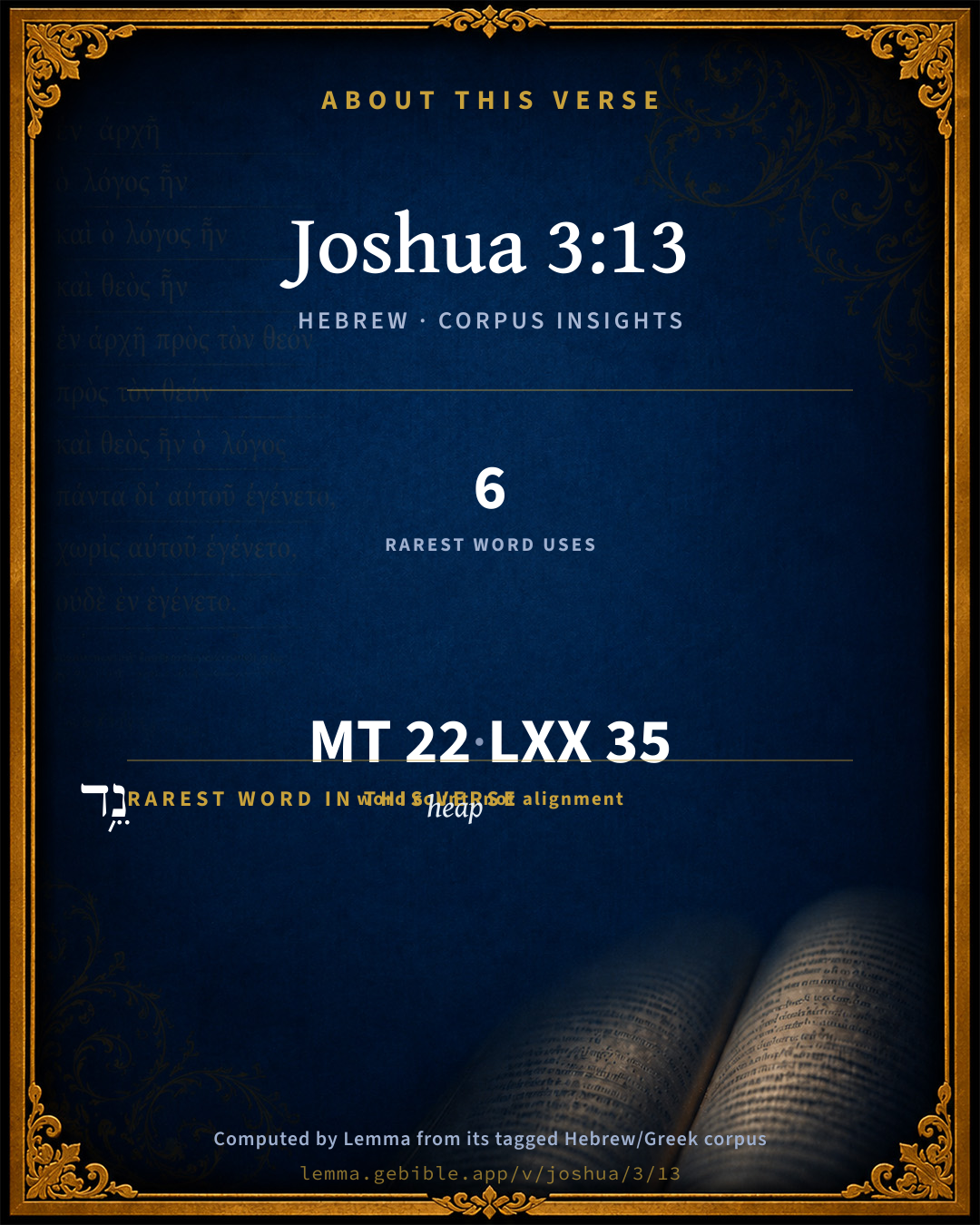
About this verse

These counts appear in no published source. They are computed here, from the morphology-tagged text and Lemma’s own curated glosses. What Lemma adds →

22
words
19
distinct lemmas
Historical
section

Notable vocabulary

The rarest word here is נֵ֥ד heap H5067 — appearing just 6 times in the whole Hebrew Bible.

Shared distinctive vocabulary

נֵ֥ד heap H5067 occurs in 6 verses of the Hebrew Bible. Also found in:

Grammatical profile

  • 6 verbs
  • 14 nouns
  • 1 adjective
  • 1 adverb

Verb forms

  • וְהָיָ֡ה Qal · Sequential Perfect
  • כְּנ֣וֹחַ Qal · Infinitive Construct
  • נֹשְׂאֵי֩ Qal · Participle Active
  • יִכָּ֣רֵת֔וּן Niphal · Imperfect
  • הַיֹּרְדִ֖ים Qal · Participle Active
  • וְיַעַמְד֖וּ Qal · Imperfect

Repetition

Words recur within this verse — often emphatic in Hebrew:

  • בְּמֵ֣י water H4325 ×3
  • הַיַּרְדֵּ֔ן Jordan H3383 ×2

Hebrew & Septuagint length

In English translation the verse runs 59 words from the Hebrew and 48 from the Septuagint (LXX English) — closely comparable.

A rough comparison of the two English renderings, which tokenize alike — not a word-level alignment.

Word counts can differ between the Hebrew and the Greek without any difference in meaning — e.g. the Hebrew direct-object marker אֵת has no separate Greek word, and Greek often adds the article ὁ.

In the original languages it is 22 Hebrew tokens and 35 Greek tokens — but the two are counted differently (Hebrew bundles its prefixes and suffixes into one token; the Greek is in lemma form), so that isn’t a like-for-like length.

Cross-references

8

Topical passages linked to Joshua 3:13 in the Treasury of Scripture Knowledge — connected by theme and wording, ordered by reader-vote popularity; previews shown in the World English Bible.

  • Exodus 15:8 With the blast of your nostrils the waters were piled up. The floods stood upright as a heap. The deeps were congealed in the heart of the sea.
  • Psalms 78:13 He split the sea, and caused them to pass through; He made the waters stand as a heap.
  • Joshua 3:11 Behold, the ark of the covenant of the Lord of all the earth passes over before you into the Jordan.
  • Joshua 3:15–16 and when those who bore the ark were come to the Jordan, and the feet of the priests who bore the ark were dipped in the brink of the water (for the Jordan overflows all its banks all the time of harvest),
  • Exodus 14:19–22 The angel of God, who went before the camp of Israel, moved and went behind them; and the pillar of cloud moved from before them, and stood behind them.
  • Psalms 33:7 He gathers the waters of the sea together as a heap. He lays up the deeps in storehouses.
  • Psalms 114:3–5 The sea saw it, and fled. The Jordan was driven back.
  • Habakkuk 3:15 You trampled the sea with your horses, Churning mighty waters.

Cross-references courtesy of OpenBible.info (CC BY 4.0).

Hebrew and Greek witnesses Masoretic Hebrew ↔ Greek Septuagint

The same verse in the two great witnesses to the Old Testament, shown verse-for-verse.

These are two independent witnesses, not word-aligned to each other, and the Septuagint is shown in lemma (dictionary) form.

Hebrew Joshua 3:13 Masoretic · Westminster Leningrad Codex

וְהָיָ֡ה כְּנ֣וֹחַ כַּפּ֣וֹת רַגְלֵ֣י הַכֹּהֲנִ֡ים נֹשְׂאֵי֩ אֲר֨וֹן יְהוָ֜ה אֲד֤וֹן כָּל הָאָ֨רֶץ֙ בְּמֵ֣י הַיַּרְדֵּ֔ן מֵ֤י הַיַּרְדֵּן֙ יִכָּ֣רֵת֔וּן הַמַּ֥יִם הַיֹּרְדִ֖ים מִלְמָ֑עְלָה וְיַעַמְד֖וּ נֵ֥ד אֶחָֽד

It shall come to pass, when the soles of the feet of the priests who bear the ark of Yahweh, the Lord of all the earth, shall rest in the waters of the Jordan, that the waters of the Jordan shall be cut off, even the waters that come down from above; and they shall stand in one heap.

World English Bible · Public Domain

Greek LXX Joshua 3:13 Septuagint · lemma form

καί εἰμί ὡς ἄν καταπαύω ὁ πούς ὁ ἱερεύς ὁ αἴρω ὁ κιβωτός ὁ διαθήκη κύριος πᾶς ὁ γῆ ἐν ὁ ὕδωρ ὁ ἰορδάνης ὁ ὕδωρ ὁ ἰορδάνης ἐκλείπω ὁ δέ ὕδωρ ὁ καταβαίνω ἵστημι

And it shall come to pass, when the feet of the priests that bear the ark of the covenant of the Lord of the whole earth rest in the water of Jordan, the water of Jordan below shall fail, and the water coming down from above shall stop.

LXX2012 (modern English Septuagint) · Public Domain

On this verse, The Pulpit Commentary discusses the Septuagint’s reading. Read the note in Commentary ↓

Hebrew: Westminster Leningrad Codex (CC BY 4.0). Greek: Septuagint (public domain); English from LXX2012 (modern English Septuagint) (Public Domain). How the Septuagint differs from the Hebrew →

Targum (Aramaic paraphrase)

1

The Targum is the ancient Jewish Aramaic paraphrase of the Hebrew Scriptures — an interpretive translation, not the Hebrew text itself. Onkelos (literal) and Pseudo-Jonathan (expansive) render the Torah, and Jonathan the Prophets. Coverage is partial: where no permissively-licensed English translation exists for a verse, only the Aramaic is shown. This is verse-level text, not a word-by-word alignment to the Hebrew.

  1. Targum Jonathan Prophets (Joshua–Malachi)
    וִיהֵי כִּמְנָח פַּרְסַת רִגְלֵי כַהֲנַיָא נַטְלֵי אֲרוֹנָא דַייָ רִבּוֹן כָּל אַרְעָא בְּמֵי יַרְדְנָא מֵי יַרְדְנָא יִפְסְקוּן מַיָא דְנַחֲתִין מִלְעֵילָא וִיקוּמוּן רוּקְבָא חָד:

    (no public-domain English translation for this verse)

    Targum Jonathan — Aramaic: “Mikraot Gedolot” (public domain). English: “Sefaria Community Translation” (CC0 1.0 (public-domain dedication)); “London "Chaldee Paraphrase," 1871” (public domain). Text via Sefaria.

Commentary

Notes on Joshua 3:13 from classic Christian and Jewish commentators (each source and its license shown beneath its notes). The classic Christian expositions comment on the surrounding passage and are grouped to its opening verse, so a note may address several verses; the Jewish commentaries on the Tanakh (Rashi and others) are per-verse, so they appear only where the commentator wrote on this verse.

Lemma curates 59 commentaries, every one of them public domain or Creative Commons licensed, each selected and text-cleaned for this edition rather than reprinted as found. About our sources →

Trapp's Complete Commentary

John Trapp

Jos 3:13 And it shall come to pass, as soon as the soles of the feet of the priests that bear the ark of the LORD, the Lord of all the earth, shall rest in the waters of Jordan, [that] the waters of Jordan shall be cut off [from] the waters that come down from above; and they shall stand upon an heap.

Ver. 13. That the waters of Jordan shall be cut off.] A wonderful work of God, and much admired by the psalmist; {Psa 114:3; Psa 114:5} as was that - and worthily if it were true - by the philosopher, when from the hill Etna there ran down a torrent of fire that consumed all the houses thereabout; in the midst of those fearful flames, God’s special care of the godly, saith he, shined most brightly: ο γαρ πυρος ποταμος εξεχισθη, for the river of fire was divided, and a kind of lane made for those who ventured to rescue their aged parents, and pluck them out of the jaws of death. {a}

{a} Aristot., De Mundo, cap. vi.

John Trapp, A Commentary or Exposition upon All the Books of the Old and New Testament (1647–1656) — public domain. Text from a community e-Sword module.

Tyndale Open Study Notes

Tyndale Open Resources

3:13 Even though the Jordan was in its spring flood stage, the water stopped abruptly, an obvious miracle.

Tyndale Open Study Notes — © Tyndale Open Resources, licensed CC BY-SA 4.0. Text via the HelloAO Bible API.

Ellicott's Commentary for English Readers

(13) The soles of the feet of the priests.—Observe that the priests, the ark-bearers, did not stand in the middle of the bed of the river, but at the edge of the flood. They had no need to advance further. As soon as their feet “rested” in the overflow, “Jordan was driven back.” The waters descending from the north as it were recoiled and shrank away, and stood up in “one heap.”

A Bible Commentary for English Readers, edited by Charles John Ellicott (1878–1897) — public domain. Text from a community e-Sword module.

The Cambridge Bible for Schools and Colleges

gen. ed. J. J. S. Perowne

13. shall be cut off] See below, Jos_3:16.

The Cambridge Bible for Schools and Colleges (gen. ed. J. J. S. Perowne; Cambridge University Press, 1878–1918) — public domain. Text from a community e-Sword module.

John Gill's Exposition

And it shall come to pass, as soon as the soles of the feet of the priests that bear the ark of the Lord,.... Which they were bid to take up and carry, Jos 3:6,

the Lord of all the earth; this shows that not the ark, but the Lord, is called "the Lord of all the earth"; see Gill on Jos 3:11,

shall rest in the waters of Jordan; the meaning is, as soon as their feet should touch them, or they should set their feet in them, when they came to the brink of them:

that the waters of Jordan shall be cut off from the waters that come down from above; from above the place where the priests came, and the children of Israel after passed over:

and they shall stand upon an heap; or one heap; stop and rise up high, as if piled up one upon another, and stand unmoved. This had been made known to Joshua by divine revelation, and is what he hints at, Jos 3:5; and now plainly speaks out, and foretells before it came to pass; and which must serve to magnify Joshua, as in Jos 3:7; and give him great credit and honour among the people.

John Gill's Exposition of the Whole Bible (1746–1763) — public domain (CC PDM 1.0). Text via the HelloAO Bible API.

Haydock's Catholic Bible Commentary

Heap. Hebrew, "the waters of the Jordan shall be cut off: the waters that come down from above, even they shall stand as upon a heap," like mountains of ice. The Vulgate informs us what became of the waters (Haydock) below this division. Where it took place we do not find recorded, so that we cannot know exactly how large a space would be left dry. Calmet allows, "near six leagues," ver. 4, and 16. But here, supposing that the Jordan was divided over-against Jericho, he says, that "the waters running off into the Dead Sea, would, in all probability, leave not less than two or three thousand paces of the channel dry." Interruptus aquis fluxit prior amnis in æquor;

Ad molem stetit unda fluens. -----Lucan, Phar. ii.

George Leo Haydock (1774–1849), Haydock's Catholic Family Bible and Commentary, 1859 edition — public domain. Excludes Psalms (Douay-Rheims chapter numbering differs from Protestant) and Deuterocanonical books (Catholic canon only).

Matthew Poole's English Annotations

As soon as the soles of the feet of the priests shall rest in the waters of Jordan; that so it may appear that this is the Lord’s doing, and that in pursuance and for the accomplishment of his covenant made with Israel.

The Lord of all the earth; the Lord of all this terrestial globe made of earth and water, who therefore can dispose of this river and the adjoining land as he pleaseth.

The waters which now are united shall be divided, and part shall flow down the channel towards the Dead Sea, and the other part, that is nearer the spring or rise of the river, and flows down from it, shall stand still. They shall stand upon an heap, being as it were congealed, as the Red Sea was, Exo 15:8, and so kept from overflowing all the country.

Matthew Poole's English Annotations on the Holy Bible (1683–1685) — public domain. Text from a community e-Sword/MySword module.

Whedon's Commentary on the Bible

Daniel D. Whedon

13. The Lord — Hebrews, Jehovah.

The Lord of all the earth — The efficient cause of the miracle.

Shall rest in the waters — The Jordan had two, and in some places three, banks. See cut and note Mat_3:6. At its flood it over-flowed the first and second banks, and covered the whole space between the terraces formed by the second and third banks. The waters on each side would be comparatively shallow. Here the priests were to stand or rest in the shoal water on the eastern bank until the waves receded, and the river’s channel was made bare; then they advanced into the midst of the channel of the Jordan, and there stood until all the people had crossed. Jos_3:17.

The waters of Jordan shall be cut off from the waters that come down — Grammatically, waters that come down is in apposition with waters of Jordan, and the word from, supplied in our English version, is incorrect and misleading. It is better to omit from, and substitute namely, and render, The waters of Jordan shall be cut off, namely, the waters that come down from above.

And they shall stand upon a heap — Or, stand up, one mass. The word for heap is best understood by referring to its use in the description of the division of the Red Sea in Exo_15:8, and in Psa_78:13. By comparing these passages with Exo_14:22, where it is said, “The waters were a wall unto them on their right hand and on their left,” we arrive at the conclusion that the phenomenon presented by the word heap was that of an upright mass of water held back by Omnipotence. {We take the meaning to be that just above the crossing the waters were “congealed,” or solidified, as if dammed up by an invisible perpendicular wall across the channel, causing the waters above to overflow all the banks. Below the miraculous dam the channel ran dry to the Dead Sea.} Compare note on Jos_3:16. No natural agent was employed in the working of this miracle. In the division of the Red Sea the Lord caused a strong east wind to blow all night, when Moses stretched out his hand over the sea. Exo_14:21. But in the passage of the Jordan “there was neither wind nor tide, to the agency of which the effect could be attributed; and if the river way actually passed, at a high stage of its waters, without boats or bridges, the evidence of the miracle was irresistible — the current must have been suspended by supernatural power.” In the most degenerate periods of Jewish history this great miracle was never once questioned. So far as we know even the skeptical and materialistic Sadducees, who sifted the traditions of the elders with a destructiveness rivaling the German rationalists, never assailed this manifest token of supernatural power in their nation’s induction into the Land of Promise.

Daniel D. Whedon (gen. ed.), Commentary on the Old and New Testaments (1874–1909) — public domain. Text from a community e-Sword module.

The Pulpit Commentary

The Lord, the Lord of all the earth. The original is, Jehovah, the Lord of all the earth. That the waters of Jordan shall be cut off. The construction here seems to have perplexed the LXX, Vulgate, and English translators. The former have given the sense, but have changed the construction. The second have supposed WtreKyi to mean fail, and to refer to the waters below the place of crossing. The third have interpolated the word "from." The words "the waters descending from above" are in apposition to, and explanatory of, the words "the waters" above. If for "from" in our version we substitute "namely," we shall express the meaning of the original. The Masorites point thus, dividing the verb from what follows by Zakeph Katon. A heap. (cf. Psa_38:7) The original is picturesque, "and they shall stand, one heap."

The Pulpit Commentary (1880–1919), ed. H.D.M. Spence-Jones & Joseph S. Exell — public domain. Text from a community e-Sword module.

John Wesley's Explanatory Notes

The ark of the Lord - That so it may appear this is the Lord's doing, and that in pursuance of his covenant made with Israel. Of all the earth - The Lord of all this globe of earth and water, who therefore can dispose of this river and the adjoining land as he pleaseth. Cut off - The waters which now are united now shall be divided, and part shall flow down the channel towards the dead sea, and the other part that is nearer the spring of the river, and flows down from it, shall stand still. An heap - Being as it were congealed, as the Red-Sea was, Exod. xv, 8, and so kept from overflowing the country.

John Wesley, Explanatory Notes Upon the Whole Bible (1754–1765) — public domain. Text via the GEBible commentary corpus.

Rashi

Rabbi Shlomo Yitzchaki (Rashi)

The waters that descend from above. Coming down from the heights which is the way of all flowing rivers.

And will stand in one massive mound. As the water flows down to the place where it will be cut off, it will be unable to flow further downstream, but will be gathered and piled up, and grow higher, layer upon layer.

Mound. Similar to: ‘He gathers like a mound,’ ‘a mound of harvest.’ These are expressions of height, and so did Menachem connect them.

Rashi on the Tanakh — English translations: “The Judaica Press complete Tanach with Rashi, translated by A. J. Rosenberg” (CC BY 4.0); “Pentateuch with Rashi's commentary by M. Rosenbaum and A.M. Silbermann, 1929-1934” (public domain); “The Metsudah Tanach series, Lakewood, N.J” (CC BY 4.0); and “The Book of Joshua, Metsudah Publications, 1997” (CC BY 4.0). Text via Sefaria.

Lesson kit

Teaching starters — assembled from the data on this page, not authored interpretation. Every prompt links to the verse data it draws on. Edit before teaching.

Joshua, in the Historical, opens this verse with 22 words (19 distinct Hebrew lemmas). Its most distinctive word is nêd (“heap”). A historical commentator’s framing appears above. Read the whole chapter for the surrounding context.

Discussion questions

  1. How does “heap” (nêd) shape what this verse is saying?
  2. How does Exodus 15:8, which shares the word «heap», read alongside this verse?
  3. What does the repetition of “water” (3× in this one verse) do in this verse?
  4. These translations render this verse differently. What is at stake in choosing one wording over another?
  5. «וְהָיָ֡ה» is a Qal Sequential Perfect verb. How does that grammatical form shape the action described?
  6. Compare how Trapp's Complete Commentary and Tyndale Open Study Notes read this verse. Where do they agree or differ?

Things to notice

Reading settings

Reading text

Shown beneath each verse's original-language words.

Old Testament
Old Testament edition

Read the OT as the Masoretic Hebrew (MT) or the Greek Septuagint (LXX).

English shown for the Greek Septuagint (in the Hebrew ↔ Greek comparison).

Comparing translations? Open the Compare panel on any verse page to stack up to four side by side.