Joshua 24:25

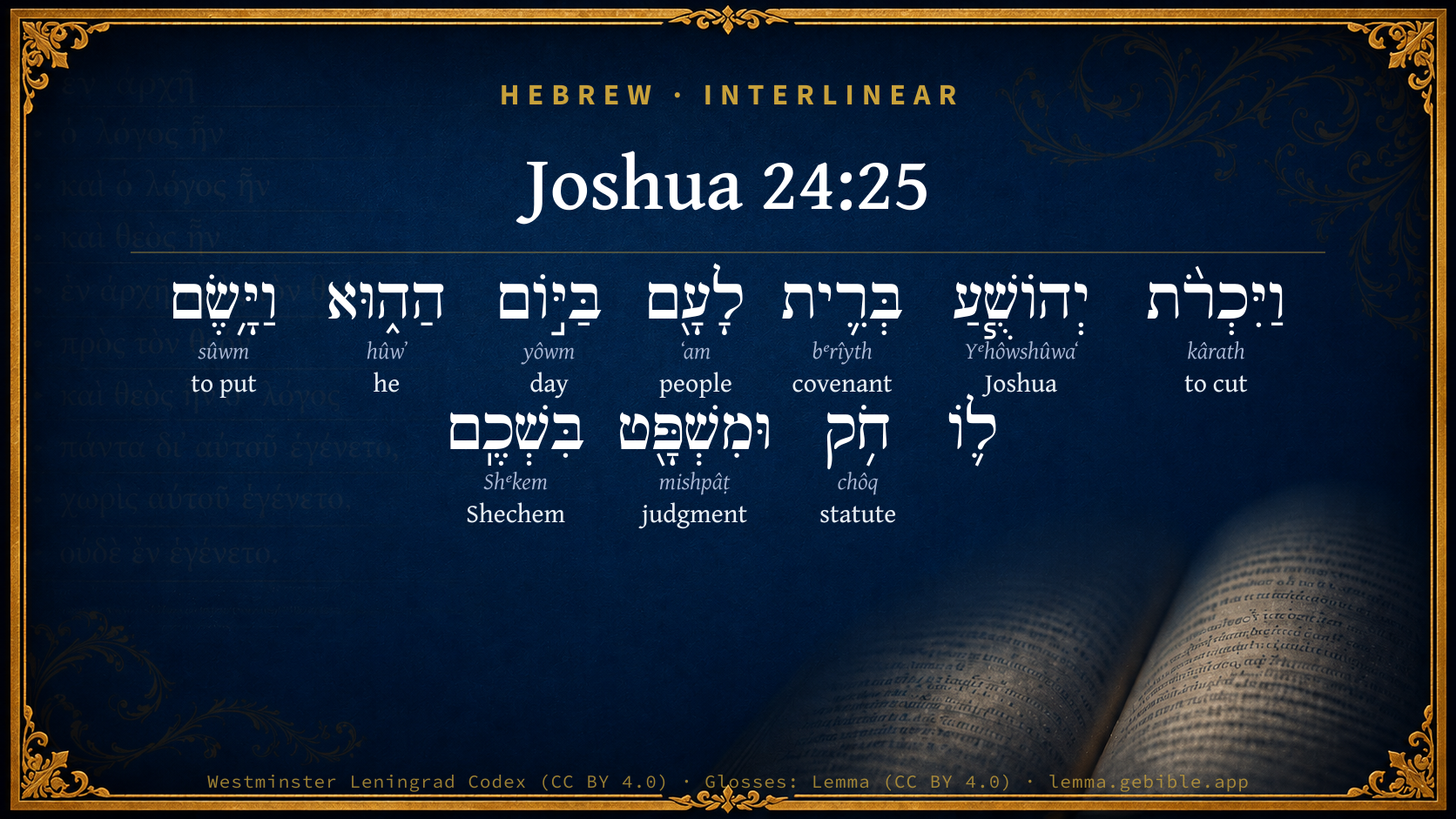
Hebrew (Westminster Leningrad Codex) Joshua 24:25 appears in the Hebrew Old Testament. The text above is from the Westminster Leningrad Codex. Each word links to its Strong’s number, a concise gloss, and parsing drawn from the Open Scriptures Hebrew Bible morphology. Click any word for its full Brown-Driver-Briggs (BDB) entry.
Download image
Cite this verse

Joshua 24:25 (World English Bible). Public Domain. Lemma interlinear Bible study tool, https://lemma.gebible.app/v/joshua/24/25.

Show BibTeX & RIS
BibTeX
RIS
English Translation
So Joshua made a covenant with the people that day, and set them a statute and an ordinance in Shechem.
World English Bible · Public Domain
Download a study sheet

One document with this verse’s original text, its word-by-word gloss line, the meaning frame, cross-references with their text, attributed commentary, and full source and license credits — printable, and it pastes into notes with its structure intact.

This verse Autodidact and up

Study sheet (.html) Plain text (.txt)

A passage Seminary Student

Up to 50 verses in one chapter. A passage sheet keeps up to 6 commentary sources and 12 cross-references per verse, in the order this page ranks them, and says so on the sheet whenever that leaves anything out. Ask for a single verse and you get the Autodidact verse sheet above.

Everything on this page stays free to read, with no account — the sheet is a download of what is already on screen, not access to it.

Want to remove ads? Support Godless Engineer
Compare translations 3

The same verse in 3 English versions, stacked beneath the original-language interlinear above. Click any original word for its lexicon entry.

Each is an independent rendering of the whole verse — the interlinear is not word-aligned to these translations.

Highlighted words mark where these versions differ — a whole-verse word diff, not a word-by-word alignment.

  • World English Bible Public Domain
    So Joshua made a covenant with the people that day, and set them a statute and an ordinance in Shechem.
  • King James Version Public Domain
    So Joshua made a covenant with the people that day, and set them a statute and an ordinance in Shechem.
  • unfoldingWord Literal Text CC BY-SA 4.0
    And Joshua cut a covenant for the people on that day. And he set for them a statute and a judgment in Shechem.

unfoldingWord Literal Text — © unfoldingWord, licensed CC BY-SA 4.0. Word-aligned USFM3 via Door43 (git.door43.org/unfoldingWord/en_ult).

Versions to compare (up to 4)

3 of 4 selected

Show all 18 translations

Every available English version of this verse, each an independent rendering of the whole verse.

  • World English Bible Public Domain
    So Joshua made a covenant with the people that day, and set them a statute and an ordinance in Shechem.
  • Berean Standard Bible Public Domain
    On that day Joshua made a covenant for the people, and there at Shechem he established for them a statute and ordinance.
  • Majority Standard Bible Public Domain
    On that day Joshua made a covenant for the people, and there at Shechem he established for them a statute and ordinance.
  • King James Version Public Domain
    So Joshua made a covenant with the people that day, and set them a statute and an ordinance in Shechem.
  • American Standard Version (1901) Public Domain
    So Joshua made a covenant with the people that day, and set them a statute and an ordinance in Shechem.
  • Revised Version (1885) Public Domain
    So Joshua made a covenant with the people that day, and set them a statute and an ordinance in Shechem.
  • Geneva Bible (1599) Public Domain
    So Ioshua made a couenant with the people the same day, and gaue them an ordinance and lawe in Shechem.
  • Douay-Rheims (1899) Public Domain
    Josue therefore on that day made a covenant, and set before the people commandments and judgments in Sichem.
  • Young's Literal Translation Public Domain
    And Joshua maketh a covenant with the people on that day, and layeth on it a statute and an ordinance, in Shechem.
  • Literal Standard Version CC BY-SA 4.0
    And Joshua makes a covenant with the people on that day, and lays a statute and an ordinance on it, in Shechem.
  • Unlocked Literal Bible CC BY-SA 4.0
    Joshua made a covenant with the people that day. He put in place decrees and laws at Shechem.
  • unfoldingWord Literal Text CC BY-SA 4.0
    And Joshua cut a covenant for the people on that day. And he set for them a statute and a judgment in Shechem.
  • Darby Bible Public Domain
    So Joshua made a covenant with the people that day, and set them a statute and an ordinance in Shechem.
  • World Messianic Bible Public Domain
    So Joshua made a covenant with the people that day, and made for them a statute and an ordinance in Shechem.
  • Webster's Bible Public Domain
    So Joshua made a covenant with the people that day, and set them a statute and an ordinance in Shechem.
  • Free Bible Version CC BY-SA 4.0
    So Joshua made a solemn agreement between the people and the Lord that day in Shechem, obligating them to follow all the Lord's laws and instructions.
  • Bible in Basic English Public Domain
    So Joshua made an agreement with the people that day, and gave them a rule and a law in Shechem.
  • JPS Tanakh (1917) Public Domain
    So Joshua made a covenant with the people that day, and set them a statute and an ordinance in Shechem.

Literal Standard Version (2020), Covenant Press — licensed CC BY-SA 4.0. Text via the HelloAO Bible API (eBible.org). Unlocked Literal Bible (unfoldingWord) — licensed CC BY-SA 4.0. Text via the HelloAO Bible API (eBible.org). unfoldingWord Literal Text — © unfoldingWord, licensed CC BY-SA 4.0. Word-aligned USFM3 via Door43 (git.door43.org/unfoldingWord/en_ult). Free Bible Version, Dr. Jonathan Gallagher — licensed CC BY-SA 4.0. Text via the HelloAO Bible API (eBible.org).

Word by word

More ways to search: Search by grammar → Find every occurrence → Compare this word →

Practice this passage: Drill this verse → Learn its vocabulary →

בִּשְׁכֶֽם
Shᵉkem
H7927
“in/at · Shechem”
Preposition + Noun, Proper
Part of Speech
Preposition + Noun
Type
Proper
Full BDB Definition

Origin: the same as H7926

TWOT: 2386b

Shechem = "back" or " shoulder" - son of Hamor, the chieftain of the Hivites at Shechem at the time of Jacob's arrival (noun proper masculine) - a city in Manasseh; located in a valley between Mount Ebal and Mount Gerizim, 34 miles (54 kilometers) north of Jerusalem and 7 miles (noun proper locative)
  1. וַיִּכְרֹ֨ת kârath H3772 “and · to cut” Conjunction + Verb, Qal, Sequential Imperfect, 3rd Person, Masculine, Singular
  2. יְהוֹשֻׁ֧עַ Yᵉhôwshûwaʻ H3091 “Joshua” Noun, Proper
  3. בְּרִ֛ית bᵉrîyth H1285 “covenant” Noun, Common, Feminine, Singular, Absolute
  4. לָעָ֖ם ʻam H5971 “to/for the · people” Preposition, Determined + Noun, Common, Masculine, Singular, Absolute
  5. בַּיּ֣וֹם yôwm H3117 “in/at the · day” Preposition, Determined + Noun, Common, Masculine, Singular, Absolute
  6. הַה֑וּא hûwʼ H1931 “the · he” Particle, Definite Article + Pronoun, Personal, 3rd Person, Masculine, Singular
  7. וַיָּ֥שֶׂם sûwm H7760 “and · to put” Conjunction + Verb, Qal, Sequential Imperfect, 3rd Person, Masculine, Singular
  8. חֹ֥ק chôq H2706 “statute” Noun, Common, Masculine, Singular, Absolute
  9. וּמִשְׁפָּ֖ט mishpâṭ H4941 “and · judgment” Conjunction + Noun, Common, Masculine, Singular, Absolute

About this verse

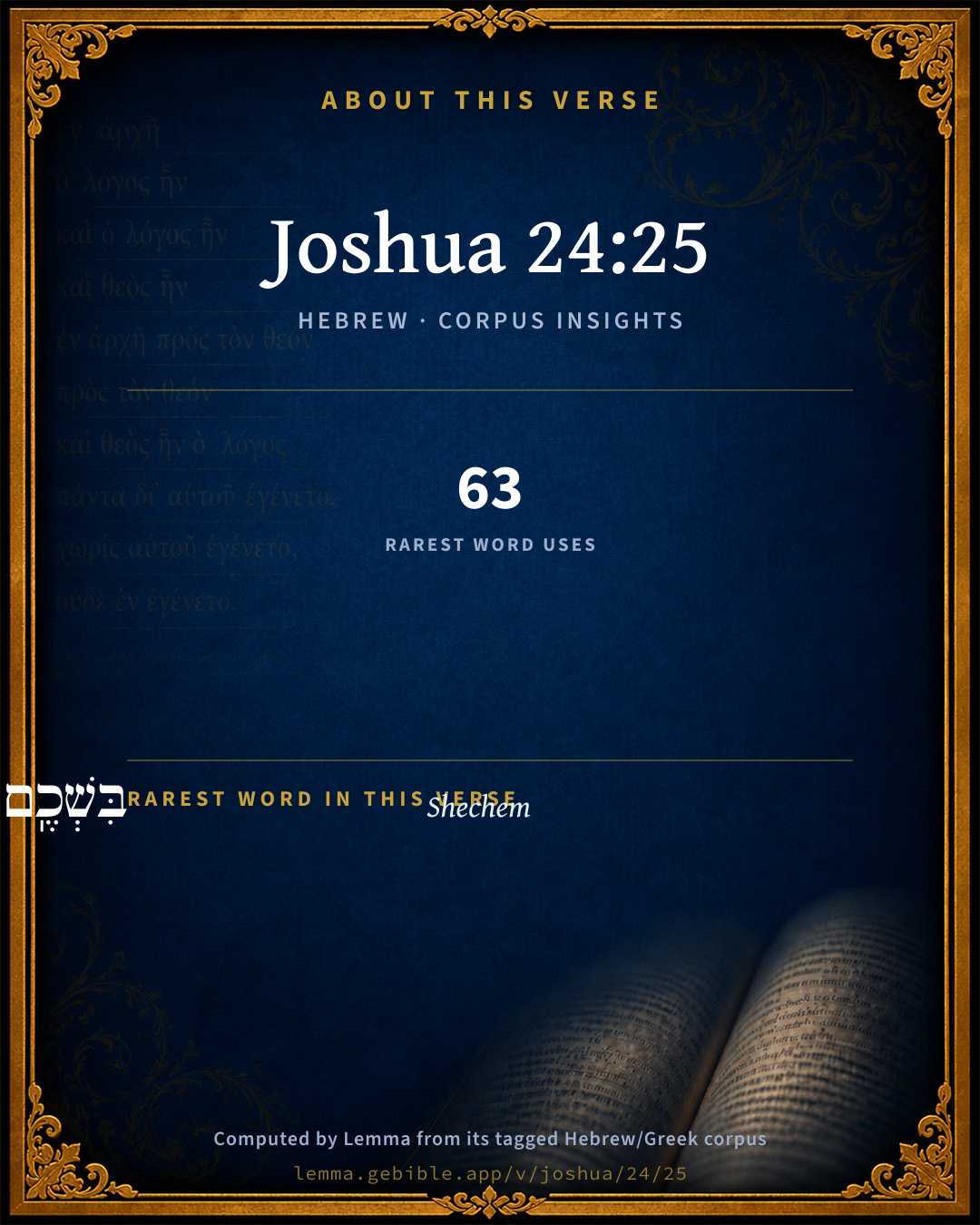
These counts appear in no published source. They are computed here, from the morphology-tagged text and Lemma’s own curated glosses. What Lemma adds →

11
words
10
distinct lemmas
Historical
section

Grammatical profile

  • 2 verbs
  • 7 nouns
  • 1 pronoun
  • 1 preposition

Verb forms

  • וַיִּכְרֹ֨ת Qal · Sequential Imperfect
  • וַיָּ֥שֶׂם Qal · Sequential Imperfect

Hebrew & Septuagint length

In English translation the verse runs 20 words from the Hebrew and 29 from the Septuagint (LXX English) — the Septuagint runs noticeably longer here. See the side-by-side →

A rough comparison of the two English renderings, which tokenize alike — not a word-level alignment.

Word counts can differ between the Hebrew and the Greek without any difference in meaning — e.g. the Hebrew direct-object marker אֵת has no separate Greek word, and Greek often adds the article ὁ.

Cross-references

16

Topical passages linked to Joshua 24:25 in the Treasury of Scripture Knowledge — connected by theme and wording, ordered by reader-vote popularity; previews shown in the World English Bible.

  • Exodus 15:25 Then he cried to Yahweh. Yahweh shown him a tree, and he threw it into the waters, and the waters were made sweet. There he made a statute and an ordinance for them, and there he tested them;
  • 2 Chronicles 23:16 Jehoiada made a covenant between himself, and all the people, and the king, that they should be Yahweh's people.
  • Nehemiah 9:38 Yet for all this we make a sure covenant, and write it; and our princes, our Levites, [and] our priests, seal to it.
  • 2 Kings 11:17 Jehoiada made a covenant between Yahweh and the king and the people, that they should be Yahweh's people; between the king also and the people.
  • Exodus 24:3 Moses came and told the people all the words of Yahweh, and all the ordinances; and all the people answered with one voice, and said, "All the words which Yahweh has spoken will we do."
  • Exodus 24:7–8 He took the book of the covenant and read it in the hearing of the people, and they said, "All that Yahweh has spoken will we do, and be obedient."
  • Deuteronomy 5:2–3 Yahweh our God made a covenant with us in Horeb.
  • Deuteronomy 29:1 These are the words of the covenant which Yahweh commanded Moses to make with the children of Israel in the land of Moab, besides the covenant which he made with them in Horeb.
  • Deuteronomy 29:10–15 You stand this day all of you before Yahweh your God; your heads, your tribes, your elders, and your officers, even all the men of Israel,
  • Joshua 24:1 Joshua gathered all the tribes of Israel to Shechem, and called for the elders of Israel, and for their heads, and for their judges, and for their officers; and they presented themselves before God.
  • Joshua 24:26 Joshua wrote these words in the book of the law of God; and he took a great stone, and set it up there under the oak that was by the sanctuary of Yahweh.
  • 2 Chronicles 15:12 They entered into the covenant to seek Yahweh, the God of their fathers, with all their heart and with all their soul;
  • 2 Chronicles 15:15 All Judah rejoiced at the oath; for they had sworn with all their heart, and sought him with their whole desire; and he was found of them: and Yahweh gave them rest round about.
  • 2 Chronicles 29:10 Now it is in my heart to make a covenant with Yahweh, the God of Israel, that his fierce anger may turn away from us.
  • 2 Chronicles 34:29–32 Then the king sent and gathered together all the elders of Judah and Jerusalem.
  • Nehemiah 10:28–29 The rest of the people, the priests, the Levites, the porters, the singers, the Nethinim, and all those who had separated themselves from the peoples of the lands to the law of God, their wives, their sons, and their daughters, everyone who had knowledge, and understanding;

Cross-references courtesy of OpenBible.info (CC BY 4.0).

Hebrew and Greek witnesses Masoretic Hebrew ↔ Greek Septuagint

The same verse in the two great witnesses to the Old Testament, shown verse-for-verse.

Here the Septuagint runs noticeably longer than the Hebrew — LXX2012 (modern English Septuagint) 29 words vs World English Bible 20. A rough length comparison of the two English translations, not a word-level alignment — read both below.

These are two independent witnesses, not word-aligned to each other, and the Septuagint is shown in lemma (dictionary) form.

Hebrew Joshua 24:25 Masoretic · Westminster Leningrad Codex

וַיִּכְרֹ֨ת יְהוֹשֻׁ֧עַ בְּרִ֛ית לָעָ֖ם בַּיּ֣וֹם הַה֑וּא וַיָּ֥שֶׂם ל֛וֹ חֹ֥ק וּמִשְׁפָּ֖ט בִּשְׁכֶֽם

So Joshua made a covenant with the people that day, and set them a statute and an ordinance in Shechem.

World English Bible · Public Domain

Greek LXX Joshua 24:25 Septuagint · lemma form

καί διατίθημι ἰησοῦς διαθήκη πρός ὁ λαός ἐν ὁ ἡμέρα ἐκεῖνος καί δίδωμι αὐτός νόμος καί κρίσις ἐν σηλω ἐνώπιον ὁ σκηνή ὁ θεός ἰσραήλ

So Joshua made a covenant with the people on that day, and gave them a law and an ordinance in Selo before the tabernacle of the God of Israel.

LXX2012 (modern English Septuagint) · Public Domain

Hebrew: Westminster Leningrad Codex (CC BY 4.0). Greek: Septuagint (public domain); English from LXX2012 (modern English Septuagint) (Public Domain). How the Septuagint differs from the Hebrew →

Targum (Aramaic paraphrase)

1

The Targum is the ancient Jewish Aramaic paraphrase of the Hebrew Scriptures — an interpretive translation, not the Hebrew text itself. Onkelos (literal) and Pseudo-Jonathan (expansive) render the Torah, and Jonathan the Prophets. Coverage is partial: where no permissively-licensed English translation exists for a verse, only the Aramaic is shown. This is verse-level text, not a word-by-word alignment to the Hebrew.

  1. Targum Jonathan Prophets (Joshua–Malachi)
    וּגְזַר יְהוֹשֻׁעַ קְיָם לְעַמָא בְּיוֹמָא הַהוּא וְשַׁוִי לֵיהּ קְיָם וְדִין בִּשְׁכֶם:

    (no public-domain English translation for this verse)

    Targum Jonathan — Aramaic: “Mikraot Gedolot” (public domain). English: “Sefaria Community Translation” (CC0 1.0 (public-domain dedication)); “London "Chaldee Paraphrase," 1871” (public domain). Text via Sefaria.

Commentary

Notes on Joshua 24:25 from classic Christian and Jewish commentators (each source and its license shown beneath its notes). The classic Christian expositions comment on the surrounding passage and are grouped to its opening verse, so a note may address several verses; the Jewish commentaries on the Tanakh (Rashi and others) are per-verse, so they appear only where the commentator wrote on this verse.

Lemma curates 59 commentaries, every one of them public domain or Creative Commons licensed, each selected and text-cleaned for this edition rather than reprinted as found. About our sources →

Trapp's Complete Commentary

John Trapp

Jos 24:25 So Joshua made a covenant with the people that day, and set them a statute and an ordinance in Shechem.

Ver. 25. And set there a statute and an ordinance.] Capita faederis ex Deuteronomio praelegit, saith one; he read them the Articles of the Covenant out of Deuteronomy.

John Trapp, A Commentary or Exposition upon All the Books of the Old and New Testament (1647–1656) — public domain. Text from a community e-Sword module.

The Biblical Illustrator

Joseph S. Exell

Jos_24:25

Joshua made a covenant.

The covenant of Joshua

That day was a very notable day in the annals of the children of Israel; its transactions might well be recorded in the volume of the book and engraven on the monumental stone. All the favours which God had promised to their fathers while yet they languished in bondage in Egypt had been now fulfilled; the promised land was theirs. God had given them rest in all their borders. In the meantime their captain, who had so often led them to victory, waxed helpless and old; he felt that there gathered around him the mists and crept over him the shadow of the coming change. He summoned the tribes of Israel, therefore, to meet him in Shechem; and they muster largely, for they feel it to be a great day, and suspect they are about to listen to their leaders parting charge. He recounts Gods providential dealings with them, and seeks by the memory of the past to inspire their vows of fidelity and allegiance. The warrior heart is still in the old man eloquent, but he wars not now against advancing hosts, but against rebellious minds. There is yet fire in his battle-cry, but it summons to self-conquest. There is glory yet upon his brow, but it is not the lustre of his former achievements, but the radiance of the nearing heaven already gathering to crown its hero. He has often led the people to victory; he will confirm them in piety now, that he may but briefly precede them into the recompense of the reward. He knew full well that their only danger sprang from themselves, that there was no danger to them, if they were but obedient and faithful, from the shock even of an embattled world; and with earnest love to God, and with deep knowledge of the human heart, he delivers his final and his impressive appeal. He warns them to count the cost, in order that there may be a more solemn and decided consecration of themselves to God. Then, receiving their reiterated vows, he makes a covenant with them, and stamps it with a sacramental and with an authoritative value, and sets it up for a statute and for an ordinance in Shechem. This seems to have been the last public act of his life, and then, weary for the rest of which Canaan was but the significant shadow, he went serenely into heaven. First, as to the nature of this covenant. I need not remind you that the Israelites were the chosen people of God--chosen to be the recipients of His bounty--chosen to be the witnesses of His unity--chosen to enter solemn protests against the abominable idolatries of the nations around. For the fulfilment of these ends Jehovah had interposed for His Israel in many signal deliverances and blessings. They were not a people, and tie had given them a great name; lie had broken for them the yoke of the oppressor; He had made them heir to an inheritance which they knew not, neither did their fathers know; He made the ocean a pavement for them, the heavens a storehouse, and the rock a fountain of waters; He had successively overthrown all their enemies in their sight, and by many a convincing illustration had stamped the seal of faithfulness upon every promise He had made. And yet they had very frequently rebelled. When trials came they turned recreant from faith and hope; when they were summoned to hazardous duty they shrank, like cowards, from its discharge; and they even formed unholy leagues with the people whom they were sent to overthrow, and adopted their idolatries with an enthusiasm the more reckless because of its perversion from a purer faith and worship. There was need, therefore, that they should be reminded of their duty, and that they should be urged, by all the solemnity of statute and of ordinance, to give themselves afresh unto God. Are not their circumstances yours? The burden of the summons which Joshua made unto the people was that they should serve the Lord. This was also the essence of the covenant, that they should serve the Lord. And, allowing for the differences of mission and local circumstances, there is an identity in the covenant which I want to make with you to-day. I just mention two points. In the first place, then, Joshua could not have served the Lord if he had neglected the Divinely-appointed institution of sacrifice. Although the Mosaic and the Christian economy differ in many things, they are alike in this, that the foundation of each of them is a recognition of sin. The only other part of the covenant which it is necessary for me to bring before you is that Joshua could not have served the Lord, nor any Israelite in the camp, if he had not strictly obeyed the ten commandments of the law. The great principles of morality are the same in every age, and these precepts of the former time, with a new spirit put into them by the exposition of Jesus on the mount, are binding on our consciences to-day. In entire union with Christ I have obtained power to obey--that is the first thing. We cannot obey until we have got a new heart put into us; we have no strength in human natures old heart to obey the commandments of God; but having by our union with Christ obtained power to obey, that obedience should be sincerely and heartily rendered. A sincere seeker after the will of God will not choose among the commandments, will not obey them just so far as they chime in with corrupt desire and contravene no darling and yet vicious inclination of the soul; he will seek to obey them in the universality of their behests, in the breadth and grandeur of their deep design. I do not think it necessary to go further. If these points of the covenant are granted me, that is all I ask. Come to Christ, and keep His law, and you will be Christians fit for earth, and Christians fit for heaven. I cannot at large mention the arguments by which this covenant was commended. I rather, therefore, prefer to confine my thoughts to the faculty to which the minister makes his appeal. Joshua evidently regarded every man among the Israelites around him as invested with the royal attribute of personal freedom. Beneath each kindling eye and swarthy brow he sees an active reason and a manly soul. He speaks not to those who are of necessity impelled--who are circumscribed by a despotism of surroundings--from whose shackles there is no liberation; he speaks to men, to freemen, to freemen with power to choose the right--with power to prefer the wrong: Choose you this day. You can choose your service. Oh! I would remind you of the many blessings which God has heaped upon you from the beginning--how your life has sparkled in the light of His loving-kindness. It was He who kindled for you all the endearments of affection and lit up all the joyfulness of home; it was He that warded off peril and environed you with the restraints that have preserved you from the grosser vices and inspired you with the impulse of every good desire. His Son died to redeem you, and fives to intercede that the benefits of His redemption may be yours. His Spirit fans the faint impression and kindles the holy desire, and takes of the precious things of Christ--those precious, those holy motives, and inspiring hopes--and shows them unto you. There is not a temporal mercy, there is not an intellectual enjoyment, there is not a spiritual mercy, for which you are not indebted to Him. And even now He comes, not forcing you to love Him, but inviting, entreating, imploring, adjuring, My son, My daughter, give Me thy heart. (W. M. Punshon, D. D.)

The Biblical Illustrator, edited by Joseph S. Exell (c. 1880s–1900s) — public domain. Text from a community e-Sword module.

Joseph Benson's Commentary

Jos 24:25. So Joshua made a covenant with the people that day — Engaged them to make good this solemn profession, by renewing the covenant they had formerly entered into, both in the days of Moses and in his time, wherein they promised to worship God alone, and be obedient to him. Some think this covenant was now established by sacrifice, as it was when they came out of Egypt, (Exo 24:4-5,) and when they came into Canaan, Jos 8:31. But as there is no mention of an altar or any offering, so it is not likely that Joshua would offer any sacrifice but in the place which God had chosen, which was Shiloh.

Joseph Benson's Commentary on the Old and New Testaments (1811–1818) — public domain. Text from a community e-Sword module.

Whedon's Commentary on the Bible

Daniel D. Whedon

THE GREAT STONE OF WITNESS, Jos_24:25-28.

25. A statute and an ordinance — This was the renewal of the law given on Sinai, imposing no new obligations.

Daniel D. Whedon (gen. ed.), Commentary on the Old and New Testaments (1874–1909) — public domain. Text from a community e-Sword module.

Tyndale Open Study Notes

Tyndale Open Resources

24:25 made a covenant: Literally cut a covenant (see study note on 9:15).

Tyndale Open Study Notes — © Tyndale Open Resources, licensed CC BY-SA 4.0. Text via the HelloAO Bible API.

Geneva Bible (1599)

Geneva Bible translators

By joining God and the people together: also he repeated the promises and threatenings out of the Law.

Geneva Bible (1599) marginal notes — public domain. Text via Bolls.life.

Adam Clarke's Commentary

Verse 25. Joshua made a covenant] Literally, Joshua cut the covenant, alluding to the sacrifice offered on the occasion.

And set then a statute and an ordinance] He made a solemn and public act of the whole, which was signed and witnessed by himself and the people, in the presence of Jehovah; and having done so, he wrote the words of the covenant in the book of the law of God, probably in some part of the skin constituting the great roll, on which the laws of God were written, and of which there were some blank columns to spare. Having done this, he took a great stone and set it up under an oak-that this might be ed or witness that, at such a time and place, this covenant was made, the terms of which might be found written in the book of the law, which was laid up beside the ark. See De 31:26.

Adam Clarke's Commentary on the Bible (1810–1826) — public domain. Text from a community e-Sword/MySword module.

John Calvin's Commentaries

25. So Joshua made a covenant, etc This passage demonstrates the end for which the meeting had been called, namely, to bind the people more completely and more solemnly to God, by the renewal of the covenant. Therefore, in this agreement, Joshua acted as if he had been appointed on the part of God to receive in his name the homage and obedience promised by the people. It is accordingly added, exegetically, in the second clause, that he set before them precept and judgment. For the meaning is corrupted and wrested by some expositors, who explain it is referring to some new speech of Joshua, whereas it ought properly to be understood of the Law of Moses, as if it had been said that Joshua made no other paction than that they should remain steadfast in observing the Law, and that no other heads of the covenant were brought forward; they were only confirmed in that doctrine which they had formerly embraced and professed. In the same way, Malachi, to keep them under the yoke of God, demands nothing more than that they should remember the Law of Moses. (Malachi 4:4)

John Calvin's Commentaries (1540-1563) — public domain. Text from the Calvin Translation Society English edition (1840s-50s) via the Christian Classics Ethereal Library (ccel.org). Calvin's coverage is partial (roughly two-thirds of the Bible); uncommented books and verses are honest gaps, never fabricated. The 19th-century editor's footnotes and remarks are omitted so the notes are faithfully Calvin's own voice.

Ellicott's Commentary for English Readers

(25) So Joshua made a covenant—i.e., a covenant that idolatry should not be tolerated in Israel, or suffered to exist. We read of similar covenants in the reign of Asa (2Ch_15:12-13), in the reign of Joash, by Jehoiada (2Ch_23:16), and of Josiah (2Ch_34:31-32).

A Bible Commentary for English Readers, edited by Charles John Ellicott (1878–1897) — public domain. Text from a community e-Sword module.

The Cambridge Bible for Schools and Colleges

gen. ed. J. J. S. Perowne

25–28. Solemn Renewal of the Covenant

25. So Joshua made a covenant] “Percussit ergo Josue in die illo fœdus,” Vulgate. “Thanne Josue smoot a boond of pees,” Wyclif. A covenant had been concluded by God on Sinai with Israel (Exo_19:20) and solemnly ratified with

(a) burnt-offerings and peace-offerings at the foot of the mount;

(b) the reading of every word of the Law in the ears of the people;

(c) the sprinkling of one half of the blood of the victims on the altars and the roll containing the covenant conditions, and the other half on the people (Exo_24:3-8; Heb_9:19-20).

This covenant Moses had renewed in “the field” of Moab (Deu_29:1), with

(a) a transcription of the blessings and curses of the Law;

(b) a solemn delivery of it to the priests, to be placed beside the Ark in the Holy of Holies, and to be read, in the hearing of all the people, once every seven years, at the Feast of Tabernacles (Deu_31:9-11; Deu_31:25-26).

Joshua, who had been present at the ratification of both the previous covenants, renews it now, and doubtless with august ceremonial.

and set them a statute] “And settide forth to çe puple comaundementis and domes in Sichen,” Wyclif. Comp. Exo_15:25. He determined and established “what in matters of religion should be with Israel law and right.”

The Cambridge Bible for Schools and Colleges (gen. ed. J. J. S. Perowne; Cambridge University Press, 1878–1918) — public domain. Text from a community e-Sword module.

John Gill's Exposition

So Joshua made a covenant with the people that day,.... Proposing to them what was most eligible, and their duty to do, and they agreeing to it, this formally constituted a covenant, of which they selves were both parties and witnesses:

and set statute and an ordinance in Shechem; either made this covenant to have the nature of a statute and ordinance binding upon them, or repeated and renewed the laws of Moses, both moral and ceremonial, which had been delivered at Mount Sinai, and now, upon this repetition in Shechem, might be called a statute and ordinance there.

John Gill's Exposition of the Whole Bible (1746–1763) — public domain (CC PDM 1.0). Text via the HelloAO Bible API.

Albert Barnes' Notes on the Bible

Made a covenant with the people - i. e. he solemnly ratified and renewed the covenant of Sinai, as Moses had done before him Deu 29:1. As no new or different covenant was made, no sacrifices were necessary.

Albert Barnes' Notes on the Bible (1834–1885) — public domain. Text from a community e-Sword/MySword module.

Haydock's Catholic Bible Commentary

Covenant. He renewed the one that had been formerly made, stipulating, on the part of God, that the people should serve Him alone, ver. 23. After which he probably read some of the most striking passages of Deuteronomy, (Calmet) particularly the Decalogue, or ten commandments, with the blessings and curses which enforced the observance of them, Deuteronomy v., and xxvii., and xxviii., and xxix., and xxx. (Haydock) --- Then the people swore that they would observe the law, the customary sacrifices were offered, and a record of the whole was subjoined by Josue to that of Moses, in order that it might be deposited in or near the ark, Deuteronomy xxxi. 26. (Calmet) --- This renewal of the covenant prefigured the law of grace. (St. Augustine, q. 30.) (Worthington)

George Leo Haydock (1774–1849), Haydock's Catholic Family Bible and Commentary, 1859 edition — public domain. Excludes Psalms (Douay-Rheims chapter numbering differs from Protestant) and Deuterocanonical books (Catholic canon only).

Matthew Poole's English Annotations

Either,

1. He set, or propounded, or declared unto them the statute and ordinance, i.e. the sum of the statutes and ordinances of God, which their covenant obliged them to Or,

2. He set or established it, to wit, that covenant, with them, i.e. the people for a statute or an ordinance, to bind themselves and their posterity unto God for ever, as a statute and ordinance of God doth.

Matthew Poole's English Annotations on the Holy Bible (1683–1685) — public domain. Text from a community e-Sword/MySword module.

The Pulpit Commentary

So Joshua made a covenant. Literally, cut a covenant, a phrase common to the Hebrew, Greek, and Latin tongues, and derived from the custom of sacrifice, in which the victims were cut in pieces and offered to the deity invoked in ratification of the engagement. The word used for covenant, berith, is derived from another word having the same meaning. This appears more probable than the suggestion of some, that the berith is derived from the practice of ratifying an agreement by a social meal. And set them a statute and ordinance. Or, appointed them a statute and a judgment. The word translated "statute" is derived from the same root as our word hack, signifying to cut, and hence to engrave in indelible characters. The practice of engraving inscriptions, proclamations, and the like, on tablets was extremely common in the East. We have instances of it in the two tables of the law, and in the copy of the law engraven in stones on Mount Ebal. The Moabite stone is another instance. And the Egyptian, Assyrian, and Babylonian monarchs seem to have written much of their history in this way. (see note on Jos_8:32) The word rendered "ordinance" is far more frequently rendered "judgment" in our version, and seems to have the original signification of a thing set upright, as a pillar on a secure foundation. In Shechem (see note on ver. 1).

The Pulpit Commentary (1880–1919), ed. H.D.M. Spence-Jones & Joseph S. Exell — public domain. Text from a community e-Sword module.

John Wesley's Explanatory Notes

A statute - He set or established that covenant with them, that is, the people, for a statute or an ordinance, to bind themselves and their posterity unto God forever.

John Wesley, Explanatory Notes Upon the Whole Bible (1754–1765) — public domain. Text via the GEBible commentary corpus.

Rashi

Rabbi Shlomo Yitzchaki (Rashi)

And he established it as a statute and an ordinance at Shechem. He set in order for them there the statutes of the Torah and they accepted them upon themselves.

Rashi on the Tanakh — English translations: “The Judaica Press complete Tanach with Rashi, translated by A. J. Rosenberg” (CC BY 4.0); “Pentateuch with Rashi's commentary by M. Rosenbaum and A.M. Silbermann, 1929-1934” (public domain); “The Metsudah Tanach series, Lakewood, N.J” (CC BY 4.0); and “The Book of Joshua, Metsudah Publications, 1997” (CC BY 4.0). Text via Sefaria.

Lesson kit

Teaching starters — assembled from the data on this page, not authored interpretation. Every prompt links to the verse data it draws on. Edit before teaching.

Joshua, in the Historical, opens this verse with 11 words (10 distinct Hebrew lemmas). Its most distinctive word is Shᵉkem (“Shechem”). The Greek Septuagint runs longer here. A historical commentator’s framing appears above. Read the whole chapter for the surrounding context.

Discussion questions

  1. The word Shᵉkem carries the sense “Shechem.” How does it shape the verse?
  2. How does Exodus 15:25, which shares this passage’s theme, read alongside this verse?
  3. The Septuagint runs longer here than the Hebrew. What might account for the difference?
  4. These translations render this verse differently. What is at stake in choosing one wording over another?
  5. «וַיִּכְרֹ֨ת» is a Qal Sequential Imperfect verb. How does that grammatical form shape the action described?
  6. Compare how Trapp's Complete Commentary and The Biblical Illustrator read this verse. Where do they agree or differ?

Things to notice

Reading settings

Reading text

Shown beneath each verse's original-language words.

Old Testament
Old Testament edition

Read the OT as the Masoretic Hebrew (MT) or the Greek Septuagint (LXX).

English shown for the Greek Septuagint (in the Hebrew ↔ Greek comparison).

Comparing translations? Open the Compare panel on any verse page to stack up to four side by side.