Numbers 13:24

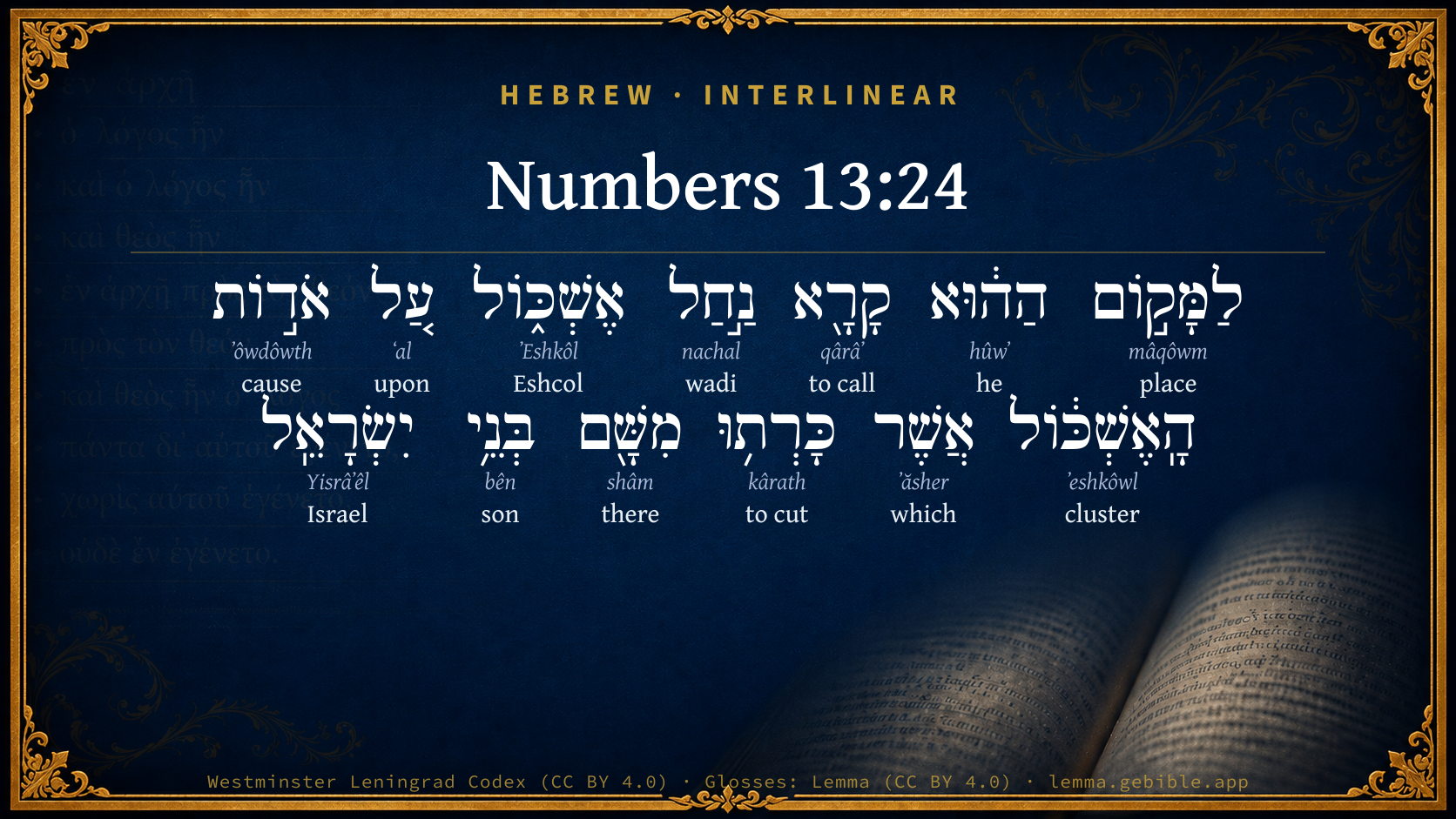
Hebrew (Westminster Leningrad Codex) Numbers 13:24 appears in the Hebrew Old Testament. The text above is from the Westminster Leningrad Codex. Each word links to its Strong’s number, a concise gloss, and parsing drawn from the Open Scriptures Hebrew Bible morphology. Click any word for its full Brown-Driver-Briggs (BDB) entry.
Download image
Cite this verse

Numbers 13:24 (World English Bible). Public Domain. Lemma interlinear Bible study tool, https://lemma.gebible.app/v/numbers/13/24.

Show BibTeX & RIS
BibTeX
RIS
English Translation
That place was called the valley of Eshcol, because of the cluster which the children of Israel cut down from there.
World English Bible · Public Domain
Download a study sheet

One document with this verse’s original text, its word-by-word gloss line, the meaning frame, cross-references with their text, attributed commentary, and full source and license credits — printable, and it pastes into notes with its structure intact.

This verse Autodidact and up

Study sheet (.html) Plain text (.txt)

A passage Seminary Student

Up to 50 verses in one chapter. A passage sheet keeps up to 6 commentary sources and 12 cross-references per verse, in the order this page ranks them, and says so on the sheet whenever that leaves anything out. Ask for a single verse and you get the Autodidact verse sheet above.

Everything on this page stays free to read, with no account — the sheet is a download of what is already on screen, not access to it.

Want to remove ads? Support Godless Engineer
Compare translations 3

The same verse in 3 English versions, stacked beneath the original-language interlinear above. Click any original word for its lexicon entry.

Each is an independent rendering of the whole verse — the interlinear is not word-aligned to these translations.

Highlighted words mark where these versions differ — a whole-verse word diff, not a word-by-word alignment.

  • World English Bible Public Domain
    That place was called the valley of Eshcol, because of the cluster which the children of Israel cut down from there.
  • King James Version Public Domain
    The place was called the brook Eshcol, because of the cluster of grapes which the children of Israel cut down from thence.
  • unfoldingWord Literal Text CC BY-SA 4.0
    He called that place Wadi Eshkol on account of the cluster that the sons of Israel cut from there.

unfoldingWord Literal Text — © unfoldingWord, licensed CC BY-SA 4.0. Word-aligned USFM3 via Door43 (git.door43.org/unfoldingWord/en_ult).

Versions to compare (up to 4)

3 of 4 selected

Show all 18 translations

Every available English version of this verse, each an independent rendering of the whole verse.

  • World English Bible Public Domain
    That place was called the valley of Eshcol, because of the cluster which the children of Israel cut down from there.
  • Berean Standard Bible Public Domain
    Because of the cluster of grapes the Israelites cut there, that place was called the Valley of Eshcol.
  • Majority Standard Bible Public Domain
    Because of the cluster of grapes the Israelites cut there, that place was called the Valley of Eshcol.
  • King James Version Public Domain
    The place was called the brook Eshcol, because of the cluster of grapes which the children of Israel cut down from thence.
  • American Standard Version (1901) Public Domain
    That place was called the valley of Eshcol, because of the cluster which the children of Israel cut down from thence.
  • Revised Version (1885) Public Domain
    That place was called the valley of Eshcol, because of the cluster which the children of Israel cut down from thence.
  • Geneva Bible (1599) Public Domain
    Then they came to the riuer of Eshcol, and cut downe thence a branch with one cluster of grapes, and they bare it vpon a barre betweene two, and brought of the pomegranates and of the figges.
  • Douay-Rheims (1899) Public Domain
    And going forward as far as the torrent of the cluster of grapes, they cut off a branch with its cluster of grapes, which two men carried upon a lever. They took also of the pomegranates and of the figs of that place:
  • Young's Literal Translation Public Domain
    That place hath `one' called Brook of Eshcol, because of the cluster which the sons of Israel cut from thence.
  • Literal Standard Version CC BY-SA 4.0
    That place has been called the Brook of Eshcol, because of the cluster which the sons of Israel cut from there.
  • Unlocked Literal Bible CC BY-SA 4.0
    That place was named the Valley of Eshkol, because of the grape cluster that the people of Israel cut down there.
  • unfoldingWord Literal Text CC BY-SA 4.0
    He called that place Wadi Eshkol on account of the cluster that the sons of Israel cut from there.
  • Darby Bible Public Domain
    That place was called the valley of Eshcol, because of the grapes which the children of Israel had cut down there.
  • World Messianic Bible Public Domain
    That place was called the valley of Eshcol, because of the cluster which the children of Israel cut down from there.
  • Webster's Bible Public Domain
    The place was called the brook Eshcol, because of the cluster of grapes which the children of Israel cut down from thence.
  • Free Bible Version CC BY-SA 4.0
    (The place was named the Valley of Eshcol because of the bunch of grapes they took from there.)
  • Bible in Basic English Public Domain
    That place was named the valley of Eshcol because of the grapes which the children of Israel took from there.
  • JPS Tanakh (1917) Public Domain
    That place was called the valley of Eshcol, because of the cluster which the children of Israel cut down from thence. —

Literal Standard Version (2020), Covenant Press — licensed CC BY-SA 4.0. Text via the HelloAO Bible API (eBible.org). Unlocked Literal Bible (unfoldingWord) — licensed CC BY-SA 4.0. Text via the HelloAO Bible API (eBible.org). unfoldingWord Literal Text — © unfoldingWord, licensed CC BY-SA 4.0. Word-aligned USFM3 via Door43 (git.door43.org/unfoldingWord/en_ult). Free Bible Version, Dr. Jonathan Gallagher — licensed CC BY-SA 4.0. Text via the HelloAO Bible API (eBible.org).

Word by word

More ways to search: Search by grammar → Find every occurrence → Compare this word →

Practice this passage: Drill this verse → Learn its vocabulary →

אֶשְׁכּ֑וֹל
ʼEshkôl
H812
“Eshcol”
Noun, Proper
Part of Speech
Noun
Type
Proper
Full BDB Definition

Origin: the same as H811

TWOT: None

Eshcol = "cluster" - an area of Hebron, the valley of Eshcol - an Amorite, the brother of Mamre, dwelling in Hebron
  1. לַמָּק֣וֹם mâqôwm H4725 “to/for the · place” Preposition, Determined + Noun, Common, Masculine, Singular, Absolute
  2. הַה֔וּא hûwʼ H1931 “the · he” Particle, Definite Article + Pronoun, Personal, 3rd Person, Masculine, Singular
  3. קָרָ֖א qârâʼ H7121 “to call” Verb, Qal, Perfect, 3rd Person, Masculine, Singular
  4. נַ֣חַל nachal H5158 “wadi of” Noun, Common, Masculine, Singular, Construct
  5. עַ֚ל ʻal H5921 “upon” Preposition
  6. אֹד֣וֹת ʼôwdôwth H182 “cause of” Noun, Common, Feminine, Plural, Construct
  7. הָֽאֶשְׁכּ֔וֹל ʼeshkôwl H811 “the · cluster” Particle, Definite Article + Noun, Common, Masculine, Singular, Absolute
  8. אֲשֶׁר ʼăsher H834 “which” Particle, Relative
  9. כָּרְת֥וּ kârath H3772 “to cut” Verb, Qal, Perfect, 3rd Person, Common, Plural
  10. מִשָּׁ֖ם shâm H8033 “from · there” Preposition + Adverb
  11. בְּנֵ֥י bên H1121 “sons of” Noun, Common, Masculine, Plural, Construct
  12. יִשְׂרָאֵֽל Yisrâʼêl H3478 “Israel” Noun, Proper

About this verse

These counts appear in no published source. They are computed here, from the morphology-tagged text and Lemma’s own curated glosses. What Lemma adds →

13
words
13
distinct lemmas
Pentateuch
section

Notable vocabulary

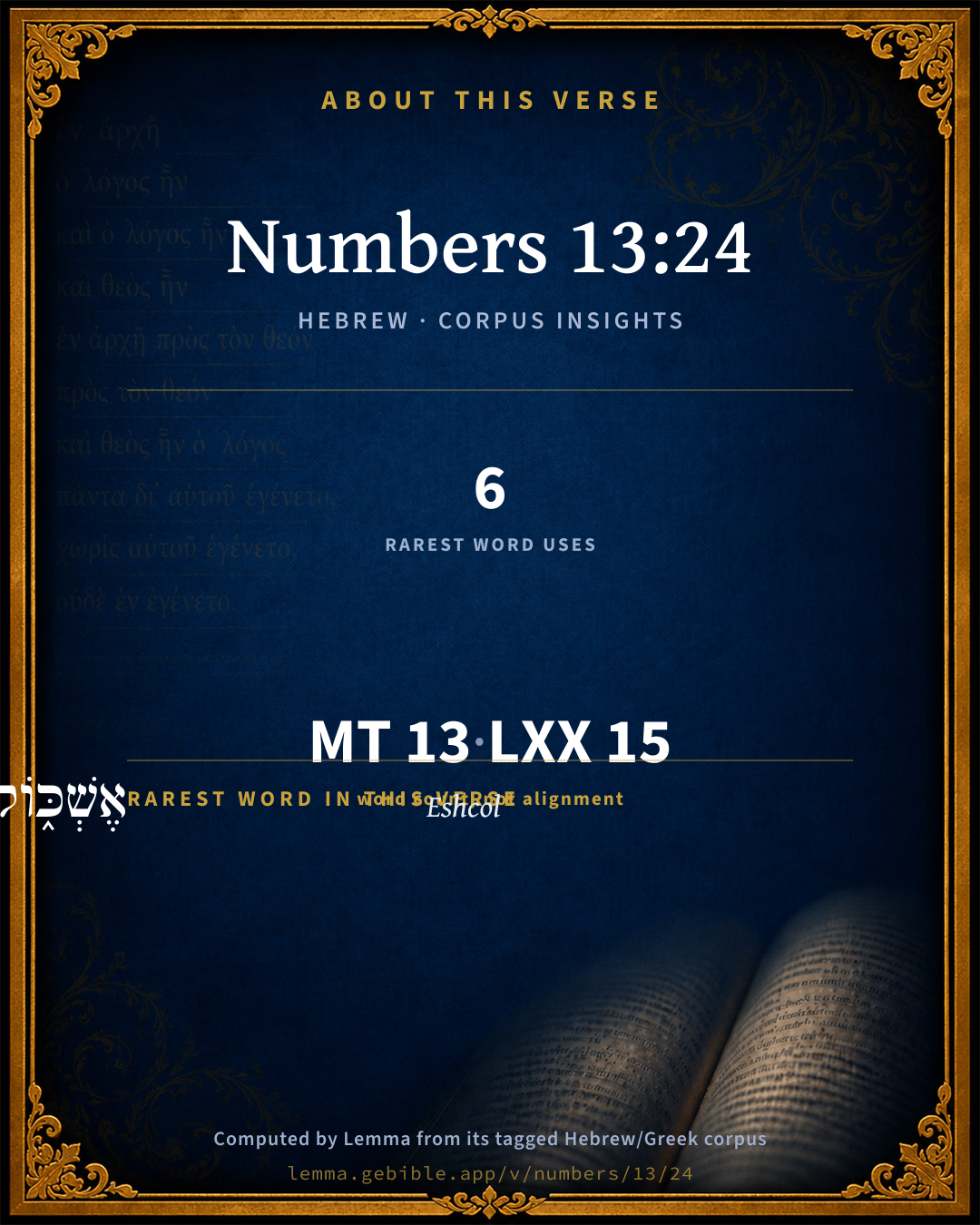
The rarest word here is אֶשְׁכּ֑וֹל Eshcol H812 — appearing just 6 times in the whole Hebrew Bible.

Shared distinctive vocabulary

אֶשְׁכּ֑וֹל Eshcol H812 occurs in 6 verses of the Hebrew Bible. Also found in:

Grammatical profile

  • 2 verbs
  • 7 nouns
  • 1 pronoun
  • 1 preposition
  • 1 adverb
  • 1 particle

Verb forms

  • קָרָ֖א Qal · Perfect
  • כָּרְת֥וּ Qal · Perfect

Hebrew & Septuagint length

In English translation the verse runs 21 words from the Hebrew and 40 from the Septuagint (LXX English) — the Septuagint runs noticeably longer here. See the side-by-side →

A rough comparison of the two English renderings, which tokenize alike — not a word-level alignment.

Word counts can differ between the Hebrew and the Greek without any difference in meaning — e.g. the Hebrew direct-object marker אֵת has no separate Greek word, and Greek often adds the article ὁ.

In the original languages it is 13 Hebrew tokens and 15 Greek tokens — but the two are counted differently (Hebrew bundles its prefixes and suffixes into one token; the Greek is in lemma form), so that isn’t a like-for-like length.

Hebrew and Greek witnesses Masoretic Hebrew ↔ Greek Septuagint

The same verse in the two great witnesses to the Old Testament, shown verse-for-verse.

Here the Septuagint runs noticeably longer than the Hebrew — LXX2012 (modern English Septuagint) 40 words vs World English Bible 21. A rough length comparison of the two English translations, not a word-level alignment — read both below.

These are two independent witnesses, not word-aligned to each other, and the Septuagint is shown in lemma (dictionary) form.

Hebrew Numbers 13:24 Masoretic · Westminster Leningrad Codex

לַמָּק֣וֹם הַה֔וּא קָרָ֖א נַ֣חַל אֶשְׁכּ֑וֹל עַ֚ל אֹד֣וֹת הָֽאֶשְׁכּ֔וֹל אֲשֶׁר כָּרְת֥וּ מִשָּׁ֖ם בְּנֵ֥י יִשְׂרָאֵֽל

That place was called the valley of Eshcol, because of the cluster which the children of Israel cut down from there.

World English Bible · Public Domain

Greek LXX Numbers 13:24 Septuagint · lemma form

ὁ τόπος ἐκεῖνος ἐπιὀνομάζω φάραγξ βότρυς διά ὁ βότρυς ὅς κόπτω ἐκεῖθεν ὁ υἱός ἰσραήλ

And they came to the valley of the cluster and surveyed it; and they cut down thence a bough and one cluster of grapes upon it, and bore it on staves, and they took of the pomegranates and the figs.

LXX2012 (modern English Septuagint) · Public Domain

On this verse, Haydock's Catholic Bible Commentary discusses the Septuagint’s reading. Read the note in Commentary ↓

Hebrew: Westminster Leningrad Codex (CC BY 4.0). Greek: Septuagint (public domain); English from LXX2012 (modern English Septuagint) (Public Domain). How the Septuagint differs from the Hebrew →

Targum (Aramaic paraphrase)

2

The Targum is the ancient Jewish Aramaic paraphrase of the Hebrew Scriptures — an interpretive translation, not the Hebrew text itself. Onkelos (literal) and Pseudo-Jonathan (expansive) render the Torah, and Jonathan the Prophets. Coverage is partial: where no permissively-licensed English translation exists for a verse, only the Aramaic is shown. This is verse-level text, not a word-by-word alignment to the Hebrew.

  1. Targum Onkelos Torah (Genesis–Deuteronomy)
    לְאַתְרָא הַהוּא קְרָא נַחְלָא דְאִתְכָּלָא עַל עֵסַק אִתְכָּלָא דִקְצוֹ מִתַּמָן בְּנֵי יִשְׂרָאֵל

    (no public-domain English translation for this verse)

    Targum Onkelos — Aramaic: “Onkelos Genesis” (public domain); “Onkelos Exodus” (public domain); “Onkelos Leviticus” (public domain); “Onkelos Numbers” (public domain); “Onkelos Deuteronomy” (public domain). English: “Sefaria Community Translation” (CC0 1.0 (public-domain dedication)); “J.W. Etheridge. The Targums of Onkelos and Jonathan Ben Uzziel on the Pentateuch. London: Longmans, Green, 1862” (public domain). Text via Sefaria.

  2. Targum Pseudo-Jonathan Torah (Genesis–Deuteronomy)
    לְאַתְרָא הַהוּא קָרוּ נַחְלָא דְאַתְכְּלָא עַל עֵיסַק עוֹבַרְתָּא דְקָצִיצוּ מִתַּמָן בְנֵי יִשְרָאֵל וַהֲוָה חַמְרָא נָטֵיף מִנֵיהּ כְּנַחְלָא

    Now that place they call the stream of the cluster, from the branch which the sons of Israel cut down there; and wine was dropping from it like a stream.

    Targum Pseudo-Jonathan — Aramaic: “Targum Jonathan on Genesis” (public domain); “Targum Jonathan on Exodus” (public domain); “Targum Jonathan on Leviticus” (public domain); “Targum Jonathan on Numbers” (public domain); “Targum Jonathan on Deuteronomy” (public domain). English: “The Targum of Jonathan ben Uzziel, trans. J. W. Etheridge, London, 1862” (public domain). Text via Sefaria.

Commentary

Notes on Numbers 13:24 from classic Christian and Jewish commentators (each source and its license shown beneath its notes). The classic Christian expositions comment on the surrounding passage and are grouped to its opening verse, so a note may address several verses; the Jewish commentaries on the Tanakh (Rashi and others) are per-verse, so they appear only where the commentator wrote on this verse.

Lemma curates 59 commentaries, every one of them public domain or Creative Commons licensed, each selected and text-cleaned for this edition rather than reprinted as found. About our sources →

Ellicott's Commentary for English Readers

(24) The place was called . . . —This verse states the reason why the valley was so called by the Israelites, but does not determine the question whether it originally derived its name from Eshcol or not.

A Bible Commentary for English Readers, edited by Charles John Ellicott (1878–1897) — public domain. Text from a community e-Sword module.

The Cambridge Bible for Schools and Colleges

gen. ed. J. J. S. Perowne

24. Eshcol] ‘a cluster’ (R.V. marg.). The writer explains the name by the incident.

The Cambridge Bible for Schools and Colleges (gen. ed. J. J. S. Perowne; Cambridge University Press, 1878–1918) — public domain. Text from a community e-Sword module.

John Gill's Exposition

And Caleb stilled the people before Moses,.... In his presence, they standing before him; or "unto Moses" (n), as they were coming to him with open mouth against him; for upon the above report of the spies they began to murmur and mutiny, and to speak against Moses for bringing them out of Egypt into a wilderness, feeding them with vain hopes of a country which they were never likely to enjoy; and in their wrath they might be making up to him, threatening to pull him to pieces, but were restrained by Caleb, who signified he had something to say to them, to which they attended, he being one of the spies, and for their principal tribe, the tribe of Judah, that went foremost; the Targum of Jonathan is,"Caleb silenced the people, and they attended to Moses;''or hearkened to him, to what he said, which though not here related, is in Deu 1:29; which yet they did not give credit to, though they heard what he had to say:

and said, let us go up at once and possess it; without any delay, there is nothing more to be done than to enter and take possession; this he said, trusting to the promise of God, who is faithful, and to his power who is able to perform:

for we are well able to overcome it; especially having God on their side, who had promised to bring them into it, and put them in the possession of it; and indeed, humanly speaking, they seemed quite sufficient for such an undertaking, being upwards of six hundred thousand men fit for war, Num 1:46, marshalled under their proper standards, with captains over each tribe, and having such brave, wise, and courageous commanders and generals, Moses and Joshua, who had given signal instances of their prudence and bravery already. What is it such an army, under proper directions, might not undertake? One would think, in all human probability, they were able to conquer a much greater country than the land of Canaan.

(n) "ad Moseh", Montanus; "venientem ad Mosem", Junius & Tremellius, Drusius.

John Gill's Exposition of the Whole Bible (1746–1763) — public domain (CC PDM 1.0). Text via the HelloAO Bible API.

Haydock's Catholic Bible Commentary

Torrent. Septuagint, "vale." --- Its. Hebrew, "one cluster." --- Two men, Josue and Caleb; (St. Maximus) though the Rabbins say they carried nothing. --- Lever, or staff, suspending it thus, in order that it might not be crushed. In that valley, Doubdan (i. 21,) was assured by the religious, that clusters, weighing twelve pounds, might still be found. Pliny (Natural History? xiv. 1,) says, there are some in Africa, larger than a male infant. Strabo (xi.) describes some in Carmania, two cubits high. Forster saw a religious man at Nurenberg, who had lived eight years in Palestine, and assured him that two men could hardly carry a bunch of grapes, such as grew in the vale of Hebron: (Calmet) but this may seem to be an hyperbole. (Haydock) --- Lucas (T. i. p. 310,) assures us, that he had seen a bunch at Damascus, weighing above forty pounds. The Fathers here contemplate Jesus Christ, suspended between the two testaments, the synagogue and the Church: the juice, or blood of the grape, (Genesis xlix. 2., and Deuteronomy xxii. 14,) denotes his passion. (St. Jerome, ep. ad Fab.; St. Bernard in Cant. ser. 44.) (Calmet)

George Leo Haydock (1774–1849), Haydock's Catholic Family Bible and Commentary, 1859 edition — public domain. Excludes Psalms (Douay-Rheims chapter numbering differs from Protestant) and Deuterocanonical books (Catholic canon only).

The Pulpit Commentary

The place was called the brook Eshcol, because of the cluster. It is very probable that it was already known as the valley of Eshcol, from the friend of Abraham, who bore that name and lived in that neighbourhood. (Gen_14:13, Gen_14:24) If so it is an admirable instance of the loose way in which etymologies are treated in the Old Testament: what the place really received was not a new name, but a new signification to the old name; but this appeared all one in the eyes of the sacred writer.

The Pulpit Commentary (1880–1919), ed. H.D.M. Spence-Jones & Joseph S. Exell — public domain. Text from a community e-Sword module.

John Wesley's Explanatory Notes

Eschol - That is, a cluster of grapes.

John Wesley, Explanatory Notes Upon the Whole Bible (1754–1765) — public domain. Text via the GEBible commentary corpus.

Lesson kit

Teaching starters — assembled from the data on this page, not authored interpretation. Every prompt links to the verse data it draws on. Edit before teaching.

Numbers, in the Pentateuch, opens this verse with 13 words (13 distinct Hebrew lemmas). Its most distinctive word is ʼEshkôl (“Eshcol”). The Greek Septuagint runs longer here. A historical commentator’s framing appears above. Read the whole chapter for the surrounding context.

Discussion questions

  1. How does “Eshcol” (ʼEshkôl) shape what this verse is saying?
  2. Genesis 14:13 shares the word «Eshcol» with this verse. How do the two illuminate each other?
  3. Compared with the Hebrew, the Septuagint runs longer here. What questions does that raise?
  4. The translations on this page render this verse differently — a whole-verse word diff, not a word-by-word alignment. What might account for the different wordings?
  5. The verb «קָרָ֖א» is Qal Perfect. How does its form color the action?
  6. Reading how Ellicott's Commentary for English Readers and The Cambridge Bible for Schools and Colleges read this verse, where do the two commentators agree and where do they part?

Things to notice

Reading settings

Reading text

Shown beneath each verse's original-language words.

Old Testament
Old Testament edition

Read the OT as the Masoretic Hebrew (MT) or the Greek Septuagint (LXX).

English shown for the Greek Septuagint (in the Hebrew ↔ Greek comparison).

Comparing translations? Open the Compare panel on any verse page to stack up to four side by side.