
2 Samuel 5:3

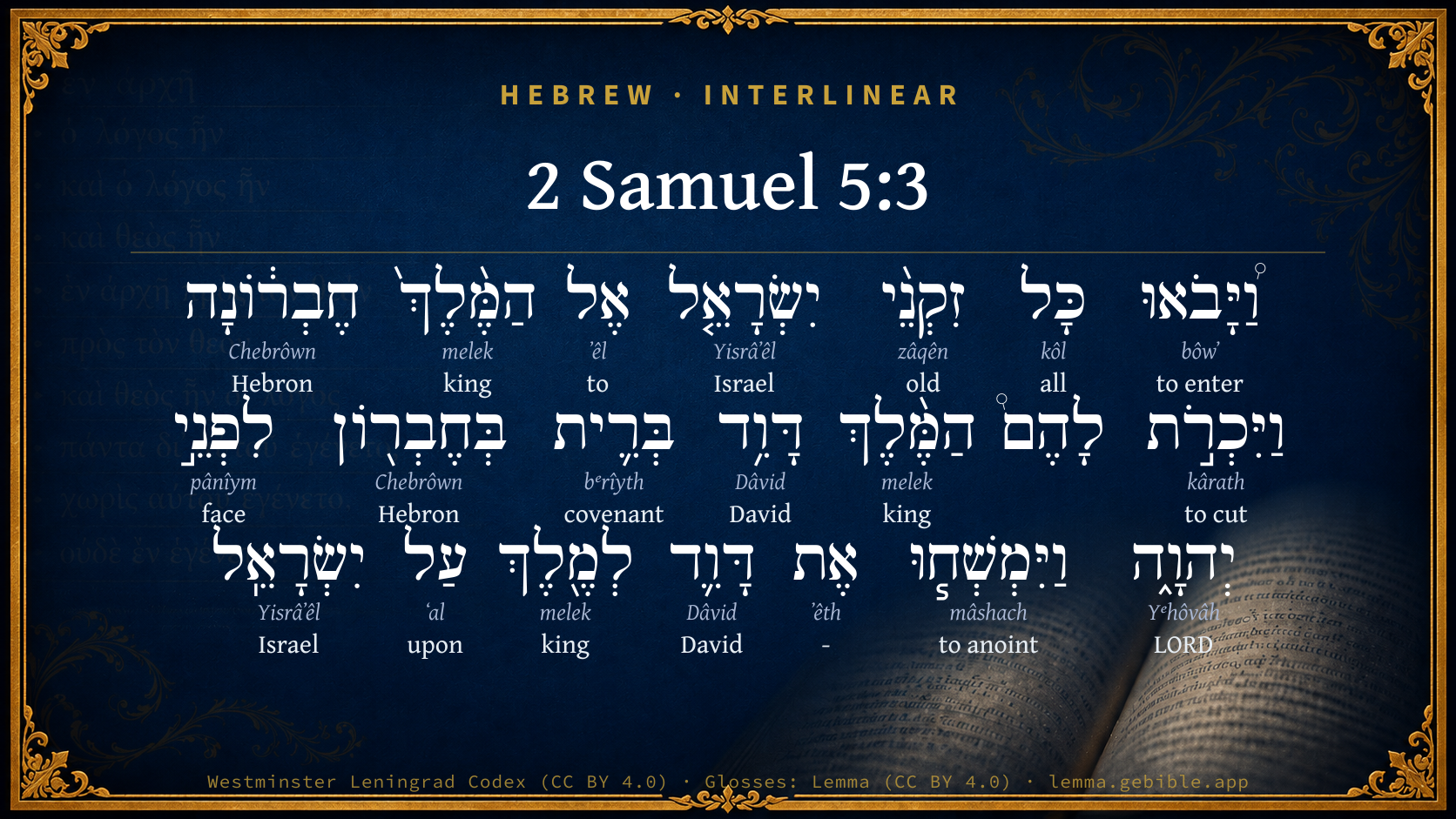
Hebrew (Westminster Leningrad Codex) 2 Samuel 5:3 appears in the Hebrew Old Testament. The text above is from the Westminster Leningrad Codex. Each word links to its Strong’s number, a concise gloss, and parsing drawn from the Open Scriptures Hebrew Bible morphology. Click any word for its full Brown-Driver-Briggs (BDB) entry.
Download image
Cite this verse

2 Samuel 5:3 (World English Bible). Public Domain. Lemma interlinear Bible study tool, https://lemma.gebible.app/v/2-samuel/5/3.

Show BibTeX & RIS
BibTeX
RIS
English Translation
So all the elders of Israel came to the king to Hebron; and king David made a covenant with them in Hebron before Yahweh: and they anointed David king over Israel.
World English Bible · Public Domain
Download a study sheet

One document with this verse’s original text, its word-by-word gloss line, the meaning frame, cross-references with their text, attributed commentary, and full source and license credits — printable, and it pastes into notes with its structure intact.

This verse Autodidact and up

Study sheet (.html) Plain text (.txt)

A passage Seminary Student

Up to 50 verses in one chapter. A passage sheet keeps up to 6 commentary sources and 12 cross-references per verse, in the order this page ranks them, and says so on the sheet whenever that leaves anything out. Ask for a single verse and you get the Autodidact verse sheet above.

Everything on this page stays free to read, with no account — the sheet is a download of what is already on screen, not access to it.

Want to remove ads? Support Godless Engineer
Compare translations 3

The same verse in 3 English versions, stacked beneath the original-language interlinear above. Click any original word for its lexicon entry.

Each is an independent rendering of the whole verse — the interlinear is not word-aligned to these translations.

Highlighted words mark where these versions differ — a whole-verse word diff, not a word-by-word alignment.

  • World English Bible Public Domain
    So all the elders of Israel came to the king to Hebron; and king David made a covenant with them in Hebron before Yahweh: and they anointed David king over Israel.
  • King James Version Public Domain
    So all the elders of Israel came to the king to Hebron; and king David made a league with them in Hebron before the LORD: and they anointed David king over Israel.
  • unfoldingWord Literal Text CC BY-SA 4.0
    Then all of the elders of Israel came to the king at Hebron, and King David cut for them a covenant in Hebron to the face of Yahweh. And they anointed David as king over Israel.

unfoldingWord Literal Text — © unfoldingWord, licensed CC BY-SA 4.0. Word-aligned USFM3 via Door43 (git.door43.org/unfoldingWord/en_ult).

Versions to compare (up to 4)

3 of 4 selected

Show all 17 translations

Every available English version of this verse, each an independent rendering of the whole verse.

  • World English Bible Public Domain
    So all the elders of Israel came to the king to Hebron; and king David made a covenant with them in Hebron before Yahweh: and they anointed David king over Israel.
  • Berean Standard Bible Public Domain
    So all the elders of Israel came to the king at Hebron, where King David made with them a covenant before the LORD. And they anointed him king over Israel.
  • Majority Standard Bible Public Domain
    So all the elders of Israel came to the king at Hebron, where King David made with them a covenant before the LORD. And they anointed him king over Israel.
  • King James Version Public Domain
    So all the elders of Israel came to the king to Hebron; and king David made a league with them in Hebron before the LORD: and they anointed David king over Israel.
  • American Standard Version (1901) Public Domain
    So all the elders of Israel came to the king to Hebron; and king David made a covenant with them in Hebron before Jehovah: and they anointed David king over Israel.
  • Revised Version (1885) Public Domain
    So all the elders of Israel came to the king to Hebron; and king David made a covenant with them in Hebron before the LORD: and they anointed David king over Israel.
  • Geneva Bible (1599) Public Domain
    So all the Elders of Israel came to the King to Hebron: and King Dauid made a couenant with them in Hebron before the Lord: and they anoynted Dauid King ouer Israel.
  • Young's Literal Translation Public Domain
    And all the elders of Israel come unto the king, to Hebron, and king David maketh with them a covenant in Hebron before Jehovah, and they anoint David for king over Israel.
  • Literal Standard Version CC BY-SA 4.0
    And all [the] elderly of Israel come to the king, to Hebron, and King David makes a covenant with them in Hebron before YHWH, and they anoint David for king over Israel.
  • Unlocked Literal Bible CC BY-SA 4.0
    So all the elders of Israel came to the king at Hebron, and King David made a covenant with them before Yahweh. They anointed David king over Israel.
  • unfoldingWord Literal Text CC BY-SA 4.0
    Then all of the elders of Israel came to the king at Hebron, and King David cut for them a covenant in Hebron to the face of Yahweh. And they anointed David as king over Israel.
  • Darby Bible Public Domain
    And all the elders of Israel came to the king to Hebron; and king David made a covenant with them in Hebron before Jehovah; and they anointed David king over Israel.
  • World Messianic Bible Public Domain
    So all the elders of Israel came to the king to Hebron, and King David made a covenant with them in Hebron before the LORD; and they anointed David king over Israel.
  • Webster's Bible Public Domain
    So all the elders of Israel came to the king to Hebron; and king David made a league with them in Hebron before the LORD: and they anointed David king over Israel.
  • Free Bible Version CC BY-SA 4.0
    All the elders of Israel came to the king at Hebron, where King David made an agreement with them in the Lord's presence. Then they anointed him king of Israel.
  • Bible in Basic English Public Domain
    So all the responsible men of Israel came to the king at Hebron; and King David made an agreement with them in Hebron before the Lord: and they put the holy oil on David and made him king over Israel.
  • JPS Tanakh (1917) Public Domain
    So all the elders of Israel came to the king to Hebron; and king David made a covenant with them in Hebron before the LORD; and they anointed David king over Israel.

Literal Standard Version (2020), Covenant Press — licensed CC BY-SA 4.0. Text via the HelloAO Bible API (eBible.org). Unlocked Literal Bible (unfoldingWord) — licensed CC BY-SA 4.0. Text via the HelloAO Bible API (eBible.org). unfoldingWord Literal Text — © unfoldingWord, licensed CC BY-SA 4.0. Word-aligned USFM3 via Door43 (git.door43.org/unfoldingWord/en_ult). Free Bible Version, Dr. Jonathan Gallagher — licensed CC BY-SA 4.0. Text via the HelloAO Bible API (eBible.org).

Word by word

More ways to search: Search by grammar → Find every occurrence → Compare this word →

Practice this passage: Drill this verse → Learn its vocabulary →

וַיִּמְשְׁח֧וּ
mâshach
H4886
“and · to anoint”
Conjunction + Verb, Qal, Sequential Imperfect, 3rd Person, Masculine, Plural
Part of Speech
Conjunction + Verb
Stem
Qal
Form
Sequential Imperfect
Person
3rd Person
Gender
Masculine
Number
Plural
Full BDB Definition

Origin: a primitive root

TWOT: 1255

to smear, anoint, spread a liquid - (Qal) - to smear - to anoint (as consecration) - to anoint, consecrate - (Niphal) to be anointed
  1. וַ֠יָּבֹאוּ bôwʼ H935 “and · to enter” Conjunction + Verb, Qal, Sequential Imperfect, 3rd Person, Masculine, Plural
  2. כָּל kôl H3605 “all of” Noun, Common, Masculine, Singular, Construct
  3. זִקְנֵ֨י zâqên H2205 “old of” Adjective, Adjective, Masculine, Plural, Construct
  4. יִשְׂרָאֵ֤ל Yisrâʼêl H3478 “Israel” Noun, Proper
  5. אֶל ʼêl H413 “to” Preposition
  6. הַמֶּ֨לֶךְ֙ melek H4428 “the · king” Particle, Definite Article + Noun, Common, Masculine, Singular, Absolute
  7. חֶבְר֔וֹנָה Chebrôwn H2275 “Hebron · toward” Noun, Proper + Suffix, Demonstrative
  8. וַיִּכְרֹ֣ת kârath H3772 “and · to cut” Conjunction + Verb, Qal, Sequential Imperfect, 3rd Person, Masculine, Singular
  9. הַמֶּ֨לֶךְ melek H4428 “the · king” Particle, Definite Article + Noun, Common, Masculine, Singular, Absolute
  10. דָּוִ֥ד Dâvid H1732 “David” Noun, Proper
  11. בְּרִ֛ית bᵉrîyth H1285 “covenant” Noun, Common, Feminine, Singular, Absolute
  12. בְּחֶבְר֖וֹן Chebrôwn H2275 “in/at · Hebron” Preposition + Noun, Proper
  13. לִפְנֵ֣י pânîym H6440 “to/for · face(s) of” Preposition + Noun, Common, Both, Plural, Construct
  14. יְהוָ֑ה Yᵉhôvâh H3068 “LORD” Noun, Proper
  15. אֶת ʼêth H853 “-” Particle, Direct Object
  16. דָּוִ֛ד Dâvid H1732 “David” Noun, Proper
  17. לְמֶ֖לֶךְ melek H4428 “to/for · king” Preposition + Noun, Common, Masculine, Singular, Absolute
  18. עַל ʻal H5921 “upon” Preposition
  19. יִשְׂרָאֵֽל Yisrâʼêl H3478 “Israel” Noun, Proper

About this verse

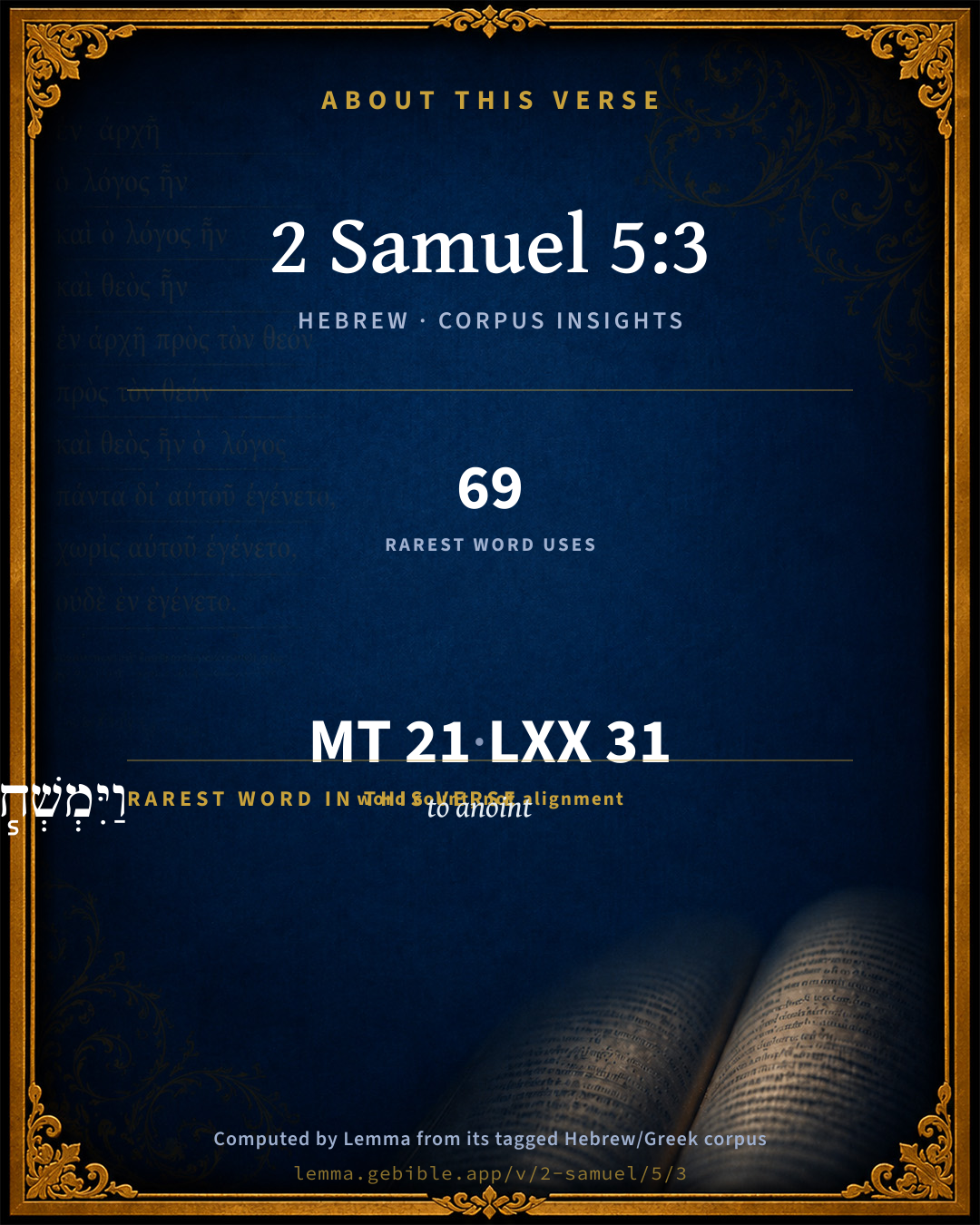
These counts appear in no published source. They are computed here, from the morphology-tagged text and Lemma’s own curated glosses. What Lemma adds →

21
words
15
distinct lemmas
Historical
section

Grammatical profile

  • 3 verbs
  • 13 nouns
  • 1 adjective
  • 3 prepositions
  • 1 particle

Verb forms

  • וַ֠יָּבֹאוּ Qal · Sequential Imperfect
  • וַיִּכְרֹ֣ת Qal · Sequential Imperfect
  • וַיִּמְשְׁח֧וּ Qal · Sequential Imperfect

Repetition

Words recur within this verse — often emphatic in Hebrew:

  • הַמֶּ֨לֶךְ֙ king H4428 ×3
  • יִשְׂרָאֵ֤ל Israel H3478 ×2
  • חֶבְר֔וֹנָה Hebron H2275 ×2
  • דָּוִ֥ד David H1732 ×2

Hebrew & Septuagint length

In English translation the verse runs 31 words from the Hebrew and 33 from the Septuagint (LXX English) — closely comparable.

A rough comparison of the two English renderings, which tokenize alike — not a word-level alignment.

Word counts can differ between the Hebrew and the Greek without any difference in meaning — e.g. the Hebrew direct-object marker אֵת has no separate Greek word, and Greek often adds the article ὁ.

In the original languages it is 21 Hebrew tokens and 31 Greek tokens — but the two are counted differently (Hebrew bundles its prefixes and suffixes into one token; the Greek is in lemma form), so that isn’t a like-for-like length.

Cross-references

11

Topical passages linked to 2 Samuel 5:3 in the Treasury of Scripture Knowledge — connected by theme and wording, ordered by reader-vote popularity; previews shown in the World English Bible.

  • 2 Samuel 2:4 The men of Judah came, and there they anointed David king over the house of Judah. They told David, saying, The men of Jabesh Gilead were those who buried Saul.
  • 1 Samuel 16:13 Then Samuel took the horn of oil, and anointed him in the midst of his brothers: and the Spirit of Yahweh came mightily on David from that day forward. So Samuel rose up, and went to Ramah.
  • 1 Samuel 23:18 They two made a covenant before Yahweh: and David abode in the wood, and Jonathan went to his house.
  • Judges 11:11 Then Jephthah went with the elders of Gilead, and the people made him head and chief over them: and Jephthah spoke all his words before Yahweh in Mizpah.
  • 2 Samuel 3:21 Abner said to David, I will arise and go, and will gather all Israel to my lord the king, that they may make a covenant with you, and that you may reign over all that your soul desires. David sent Abner away; and he went in peace.
  • 2 Kings 11:17 Jehoiada made a covenant between Yahweh and the king and the people, that they should be Yahweh's people; between the king also and the people.
  • Exodus 3:16 Go, and gather the elders of Israel together, and tell them, 'Yahweh, the God of your fathers, the God of Abraham, of Isaac, and of Jacob, has appeared to me, saying, "I have surely visited you, and seen that which is done to you in Egypt;
  • 1 Samuel 11:15 All the people went to Gilgal; and there they made Saul king before Yahweh in Gilgal; and there they offered sacrifices of peace-offerings before Yahweh; and there Saul and all the men of Israel rejoiced greatly.
  • 1 Chronicles 11:3 So all the elders of Israel came to the king to Hebron; and David made a covenant with them in Hebron before Yahweh; and they anointed David king over Israel, according to the word of Yahweh by Samuel.
  • 2 Chronicles 23:16 Jehoiada made a covenant between himself, and all the people, and the king, that they should be Yahweh's people.
  • Nehemiah 9:38 Yet for all this we make a sure covenant, and write it; and our princes, our Levites, [and] our priests, seal to it.

Cross-references courtesy of OpenBible.info (CC BY 4.0).

Hebrew and Greek witnesses Masoretic Hebrew ↔ Greek Septuagint

The same verse in the two great witnesses to the Old Testament, shown verse-for-verse.

These are two independent witnesses, not word-aligned to each other, and the Septuagint is shown in lemma (dictionary) form.

Hebrew 2 Samuel 5:3 Masoretic · Westminster Leningrad Codex

וַ֠יָּבֹאוּ כָּל זִקְנֵ֨י יִשְׂרָאֵ֤ל אֶל הַמֶּ֨לֶךְ֙ חֶבְר֔וֹנָה וַיִּכְרֹ֣ת לָהֶם֩ הַמֶּ֨לֶךְ דָּוִ֥ד בְּרִ֛ית בְּחֶבְר֖וֹן לִפְנֵ֣י יְהוָ֑ה וַיִּמְשְׁח֧וּ אֶת דָּוִ֛ד לְמֶ֖לֶךְ עַל יִשְׂרָאֵֽל

So all the elders of Israel came to the king to Hebron; and king David made a covenant with them in Hebron before Yahweh: and they anointed David king over Israel.

World English Bible · Public Domain

Greek LXX 2 Samuel 5:3 Septuagint · lemma form

καί ἔρχομαι πᾶς ὁ πρεσβύτερος ἰσραήλ πρός ὁ βασιλεύς εἰς χεβρων καί διατίθημι αὐτός ὁ βασιλεύς δαυίδ διαθήκη ἐν χεβρων ἐνώπιον κύριος καί χρίω ὁ δαυίδ εἰς βασιλεύς ἐπί πᾶς ἰσραήλ

And all the elders of Israel come to the king to Chebron; and king David made a covenant with them in Chebron before the Lord; and they anoint David king over all Israel.

LXX2012 (modern English Septuagint) · Public Domain

Hebrew: Westminster Leningrad Codex (CC BY 4.0). Greek: Septuagint (public domain); English from LXX2012 (modern English Septuagint) (Public Domain). How the Septuagint differs from the Hebrew →

Targum (Aramaic paraphrase)

1

The Targum is the ancient Jewish Aramaic paraphrase of the Hebrew Scriptures — an interpretive translation, not the Hebrew text itself. Onkelos (literal) and Pseudo-Jonathan (expansive) render the Torah, and Jonathan the Prophets. Coverage is partial: where no permissively-licensed English translation exists for a verse, only the Aramaic is shown. This is verse-level text, not a word-by-word alignment to the Hebrew.

  1. Targum Jonathan Prophets (Joshua–Malachi)
    וַאֲתוֹ כָּל סָבֵי יִשְׂרָאֵל לְוַת מַלְכָּא בְּחֶבְרוֹן וּגְזַר לְהוֹן מַלְכָּא דָוִד קְיָם בְּחֶבְרוֹן קֳדָם יְיָ וּמְשָׁחוּ יַת דָוִד לְמֶהֱוֵי מַלְכָּא עַל יִשְׂרָאֵל:

    (no public-domain English translation for this verse)

    Targum Jonathan — Aramaic: “Mikraot Gedolot” (public domain). English: “Sefaria Community Translation” (CC0 1.0 (public-domain dedication)); “London "Chaldee Paraphrase," 1871” (public domain). Text via Sefaria.

Commentary

Notes on 2 Samuel 5:3 from classic Christian and Jewish commentators (each source and its license shown beneath its notes). The classic Christian expositions comment on the surrounding passage and are grouped to its opening verse, so a note may address several verses; the Jewish commentaries on the Tanakh (Rashi and others) are per-verse, so they appear only where the commentator wrote on this verse.

Lemma curates 59 commentaries, every one of them public domain or Creative Commons licensed, each selected and text-cleaned for this edition rather than reprinted as found. About our sources →

Trapp's Complete Commentary

John Trapp

2Sa 5:3 So all the elders of Israel came to the king to Hebron; and king David made a league with them in Hebron before the LORD: and they anointed David king over Israel.

Ver. 3. And king David made a league with them,] sc., That he would be their liege-lord, as they would be his liege-people; that is, as the word signifieth, mutually bound each to other.

In Hebron.] Where, haply, Abraham’s altar still continued. Compare 1Sa 15:7.

And they anointed David king.] As other nations crowned their kings, so the Israelites anointed them as types of the Messiah, who was "anointed with the oil of gladness above his fellows," and for them also.

John Trapp, A Commentary or Exposition upon All the Books of the Old and New Testament (1647–1656) — public domain. Text from a community e-Sword module.

The Biblical Illustrator

Joseph S. Exell

2Sa_5:3

And King David made a league with them.

Making a league

For one born into the family, no formal covenant is necessary, in order to bind to his support all who are of the same blood with himself. But when one is taken in from outside, to be closer than a brother, or when a number of persons who are not of one blood would bind themselves together in mutual fellowship, a specific league must be made in ratification of the new relation. The form of the league is different in different cases. The simplest form, and one which has always had a binding force in the East, is that of eating together, of breaking bread in common, in token of mutual fidelity. Dr. Cyrus Hamlin, in his Among the Turks, gives various illustrations of this truth. As he sat on the floor, at dinner, in a Turkish governors residence, the boy gave him in his fingers a piece of roast mutton, to be taken by the guests fingers and then eaten. Now, do you know what I have done? asked the boy. Perfectly well, answered Dr. Hamlin. You have given me a delicious piece of roast meat, and I have eaten it. You have gone far from it, responded the boy. By that act, I have pledged you every drop of my blood, that while you are in my territory no evil shall come to you. For that space of time we are brothers. Coming from Smyrna, at one time, Dr. Hamlin was on a vessel containing a large number of raw recruits for the Turkish army. Just before reaching port, some fifteen or so of these recruits threw off their look of stolid resignation, cleared a place on the deck, as I supposed, for a country dance; and I looked on with interest. I could see, by their costumes, that they were all from the same village, or villages closely associated . . . They stood in a ring, each mans right hand upon his neighbours left shoulder. Soon one came to take a vacant place, with a semeet, a ring of bread, in his hand. He broke it into bits, and they all ate of it, saying a few words of prayer, probably the first chapter of the Koran. It was a religious act, plainly. About to separate, and be dispersed into the army, they bound themselves to be faithful in memory, and in aid, should it ever become possible. It was to them a kind of sacrament, an oath of brotherhood. And so they made a league with one another. (The Sunday School Times.)

The Biblical Illustrator, edited by Joseph S. Exell (c. 1880s–1900s) — public domain. Text from a community e-Sword module.

Joseph Benson's Commentary

2Sa 5:3. King David made a league with them — It is not said what the contents of this league or covenant were. The Jews think it was an act of oblivion and indemnity for all injuries done on either side, whether of Judah against the other tribes, or of all the other tribes against Judah. But in that case the league would rather have been between the tribes than with the king. It is therefore probable that it included a great deal more, and that David obliged himself to rule them according to God’s laws, and that the people promised obedience to him agreeably to the same; and that both the king and the people ratified their engagements by solemn sacrifices, and appeals to God for the sincere performance of them. All this, being done as in the presence of Him who fills heaven and earth, and to whose all-seeing eye the hearts and ways of mankind are without a covering, is properly said to have been before the Lord, although it was not before the ark, that symbol of the divine presence, for that certainly was not now at Hebron. They anointed David king over Israel — That is, they desired the high- priest to anoint him, whose office it was; and thereby expressed their consent that he should reign over them. David was anointed in all three times; first by Samuel in his father’s house, 1Sa 16:13; then when the tribe of Judah owned him for their king, 2Sa 2:4; and now, when all Israel did the same.

Joseph Benson's Commentary on the Old and New Testaments (1811–1818) — public domain. Text from a community e-Sword module.

Tyndale Open Study Notes

Tyndale Open Resources

5:3 King David made a covenant that demanded the people’s loyalty, yet allowed them to maintain a sense of tribal privilege and individual dignity. It served as a constitution, containing stipulations obligating both the king and the people. • they anointed him king: While David had already been anointed by Samuel (1 Sam 16:13), this public ceremony demonstrated the people’s acceptance of David as king.

Tyndale Open Study Notes — © Tyndale Open Resources, licensed CC BY-SA 4.0. Text via the HelloAO Bible API.

Geneva Bible (1599)

Geneva Bible translators

That is, taking the Lord to witness: for the Ark was as yet in Abinadab’s house.

Geneva Bible (1599) marginal notes — public domain. Text via Bolls.life.

Jamieson, Fausset & Brown

Robert Jamieson, A. R. Fausset & David Brown

King David made a league with them in Hebron before the Lord--(see on Sa1 10:17). This formal declaration of the constitution was chiefly made at the commencement of a new dynasty, or at the restoration of the royal family after a usurpation (Kg2 11:17), though circumstances sometimes led to its being renewed on the accession of any new sovereign (Kg1 12:4). It seems to have been accompanied by religious solemnities.

Jamieson, Fausset & Brown — Commentary Critical and Explanatory on the Whole Bible (1871) — public domain (CC PDM 1.0). Text via the HelloAO Bible API.

Adam Clarke's Commentary

Verse 3. They anointed David king] This was the third time that David was anointed, having now taken possession of the whole kingdom.

Adam Clarke's Commentary on the Bible (1810–1826) — public domain. Text from a community e-Sword/MySword module.

Ellicott's Commentary for English Readers

(3) Made a league with them.—It would be an anachronism to understand this of the establishment of a constitutional monarchy, but the “league” may have had reference to certain special matters, such as leading them against their enemies, not destroying the remnant of the house of Saul or its late adherents, and not showing partiality (as Saul had done) to the members of his own tribe.

A Bible Commentary for English Readers, edited by Charles John Ellicott (1878–1897) — public domain. Text from a community e-Sword module.

The Cambridge Bible for Schools and Colleges

gen. ed. J. J. S. Perowne

3. all the elders of Israel] From 2Sa_5:1 and 1Ch_12:23-40 it is evident that a general assembly of the nation, and not merely a few delegates, met at Hebron: here the elders are particularly specified because they acted as the representatives of the people in negotiating with David. See note on 1Sa_8:4, and cp. ch. 2Sa_3:17.

made a league with them] Cp. ch. 2Sa_3:21. This ‘league’ was probably a solemn contract in which the king on the one hand engaged to rule according to the laws, and the people on the other hand promised him their allegiance. Some kind of a charter, defining the king’s rights, was in existence (1Sa_10:25): and later on we find the people demanding some limitation of these rights (1Ki_12:3 ff). The Israelite monarchy was not an absolute and irresponsible despotism.

before the Lord] The covenant was made as a solemn religious ceremony, in the presence of the supreme King of Israel, whose vicegerent David was. Cp. 1Sa_11:15.

they anointed David king] For the third time. See note on ch. 2Sa_2:4. In Chronicles is added “according to the word of the Lord by Samuel.”

The book of Chronicles contains further interesting details about this assembly at Hebron (1Ch_12:23-40). The numbers of fighting men sent by each tribe are preserved, amounting to a total of nearly 350,000. Stress is laid on the unanimity of feeling, and the general rejoicing with which David’s anointing was celebrated in a three days’ festival.

The Cambridge Bible for Schools and Colleges (gen. ed. J. J. S. Perowne; Cambridge University Press, 1878–1918) — public domain. Text from a community e-Sword module.

John Gill's Exposition

So all the elders of Israel came to the king to Hebron,.... Which either explains what is meant by the tribes coming to him, Sa2 5:1; namely, coming by their elders as their representatives; or else the meaning is, that the messengers the tribes sent, when they returned and reported the favourable reception they had met with from David; the elders of the several tribes, the princes or principal men met, and came together to David in Hebron:

and King David made a league with them before the Lord; the states of the nation; he entered into a covenant with them; he on his part promising to rule them in justice and judgment according to the laws, and they promising to yield a cheerful obedience to him in all things just and lawful: and this was done "before the Lord"; either before the ark of the Lord, as Abarbinel; but that was in Kirjathjearim, from whence it was after this brought by David to this city; rather, as Kimchi observes, wherever all Israel, or the greater part of them, were assembled, there the divine Shechinah or Majesty dwelt; so that what was done in a public assembly was reckoned as done before the Lord, and in his presence; or this covenant was made before the Lord, and each party appealed to him as witness of it, so that it was a very solemn one:

and they anointed David king over Israel; that is, over all Israel, which was the third time of his being anointed; the first was by Samuel, pointing out the person the Lord chose and appointed king; the second was by the tribe of Judah, when they invested him with the office of a king over them; and now by all the tribes, when he was inaugurated into the whole kingdom of Israel; and not only the elders came at this time, but great numbers of the people from the several tribes, and continued with David some days, eating, drinking and rejoicing, see Ch1 12:1.

John Gill's Exposition of the Whole Bible (1746–1763) — public domain (CC PDM 1.0). Text via the HelloAO Bible API.

Albert Barnes' Notes on the Bible

Before the Lord - Abiathar and Zadok the priests were both with David, and the tabernacle and altar may have been at Hebron, though the ark was at Kirjath-jearim.

Albert Barnes' Notes on the Bible (1834–1885) — public domain. Text from a community e-Sword/MySword module.

Haydock's Catholic Bible Commentary

Ancients; princes of the tribes, and officers, (Calmet) with all the chief magistrates. (Haydock) --- The high priest, Abiathar, received the oaths of allegiance from the people, and of the king, who promised to govern according to the laws of God. The ark was probably present, and innumerable sacrifices offered on this solemn occasion, as was usual, 1 Paralipomenon xii. 26. Hebron continued to be a place of sacrifices, chap xv. 7. (Calmet) --- David had erected here a temporary altar and tabernacle, where Abiathar officiated in his pontifical robes, as it was not safe for the people to go into the dominions of Isboseth, either to Gabaon or to Cariathiarim. (Tostat) --- Israel, acknowledging the right which David had to the throne, by God’s appointment. (Haydock; Worthington)

George Leo Haydock (1774–1849), Haydock's Catholic Family Bible and Commentary, 1859 edition — public domain. Excludes Psalms (Douay-Rheims chapter numbering differs from Protestant) and Deuterocanonical books (Catholic canon only).

Matthew Poole's English Annotations

King David made a league with them; whereby he obliged himself to rule them according to God’s laws; and the people promised fidelity and obedience to him.

Before the Lord; either,

1. Before the ark, which might be here, though that be not mentioned in this place. Or,

2. Before the priest clothed with the ephod; whereby he was in a manner put into God’s presence. Or rather,

3. In the congregation of the mighty, or magistrates, where God used to be present, Psa 82:1; in the public assembly now met together in God’s name and fear, and as in his presence, to call upon him, to appeal to him as the witness and judge of their transactions. Compare Jdg 11:11; 1Sa 23:18. They anointed David; either by a prophet, or the priest, to whom this office belonged. See 2Sa 2:4.

Matthew Poole's English Annotations on the Holy Bible (1683–1685) — public domain. Text from a community e-Sword/MySword module.

Whedon's Commentary on the Bible

Daniel D. Whedon

3. A league — Consisting of solemn stipulations on both sides.

Before the Lord — This phrase is to be understood here as at Jdg_11:11, where see note.

Anointed David king over Israel — On the anointing of kings see note on 1Sa_10:1. This was the third time that David was anointed. 2Sa_2:4; 1Sa_16:13.

Daniel D. Whedon (gen. ed.), Commentary on the Old and New Testaments (1874–1909) — public domain. Text from a community e-Sword module.

The Pulpit Commentary

A league. The early kings of Israel were not invested with despotic power. Thus, on Saul"s appointment, "Samuel wrote in a book the manner of the kingdom". 1Sa_10:25, made most emphatic in the Revised Version by the note in the margin, that the Hebrew is "the book The revolt against Rehoboam was the result of the too great extension of the royal power in the days of Solomon. (1Ki_12:4) Though subsequently the kings seemed to have retained their supremacy, yet when the good and patriotic Jehoiada restored the family of David to the throne, he reverted to the old ways, and "made a covenant between the king and the people". (2Ki_11:17) Besides personal rights, the tribes, accustomed to their own leaders, and unused to yield obedience to a central authority, would certainly stipulate for a large measure of tribal independence, and the management of local matters by themselves. They anointed David king. This was the public ratification of Samuel"s anointing, and by it David became de facto, as well as de jure, king. The prophets could not give any right over the people without the consent of the people themselves. But all religious men would see in the Divine command an obligation upon their conscience to accept as their king the man whom the prophet had anointed; and Saul acted in an irreligious manner in seeking to frustrate God"s will. And this impiety culminated in his murder of the priests at Nob, which was the open avowal that he would trample all scruples of conscience underfoot.

The Pulpit Commentary (1880–1919), ed. H.D.M. Spence-Jones & Joseph S. Exell — public domain. Text from a community e-Sword module.

John Wesley's Explanatory Notes

A league - Whereby David obliged himself to rule them according to God's laws; and the people promised obedience to him.

John Wesley, Explanatory Notes Upon the Whole Bible (1754–1765) — public domain. Text via the GEBible commentary corpus.

unfoldingWord translationNotes

Door43 World Missions Community

They anointed David king over Israel

To "anoint" is a symbolic act to show that they recognized that God had chosen David as king. (See: Symbolic Action)

translationWords

elder

king

David

covenant

Yahweh

anoint

Israel

reign

Hebron

Judah

Jerusalem

unfoldingWord translationNotes — © Distant Shores Media and the Door43 World Missions Community, licensed CC BY-SA 4.0. Source: git.door43.org/Door43/en_tn.

Lesson kit

Teaching starters — assembled from the data on this page, not authored interpretation. Every prompt links to the verse data it draws on. Edit before teaching.

2 Samuel, in the Historical, opens this verse with 21 words (15 distinct Hebrew lemmas). Its most distinctive word is mâshach (“to anoint”). A historical commentator’s framing appears above. Read the whole chapter for the surrounding context.

Discussion questions

  1. What does “to anoint” (mâshach) contribute to the verse as a whole?
  2. How does 2 Samuel 2:4, which shares this passage’s theme, read alongside this verse?
  3. What does the repetition of “king” (3× in this one verse) do in this verse?
  4. The translations on this page render this verse differently — a whole-verse word diff, not a word-by-word alignment. What might account for the different wordings?
  5. «וַ֠יָּבֹאוּ» is a Qal Sequential Imperfect verb. How does that grammatical form shape the action described?
  6. Compare how Trapp's Complete Commentary and The Biblical Illustrator read this verse. Where do they agree or differ?

Things to notice

Reading settings

Reading text

Shown beneath each verse's original-language words.

Old Testament
Old Testament edition

Read the OT as the Masoretic Hebrew (MT) or the Greek Septuagint (LXX).

English shown for the Greek Septuagint (in the Hebrew ↔ Greek comparison).

Comparing translations? Open the Compare panel on any verse page to stack up to four side by side.