Joel 1:9

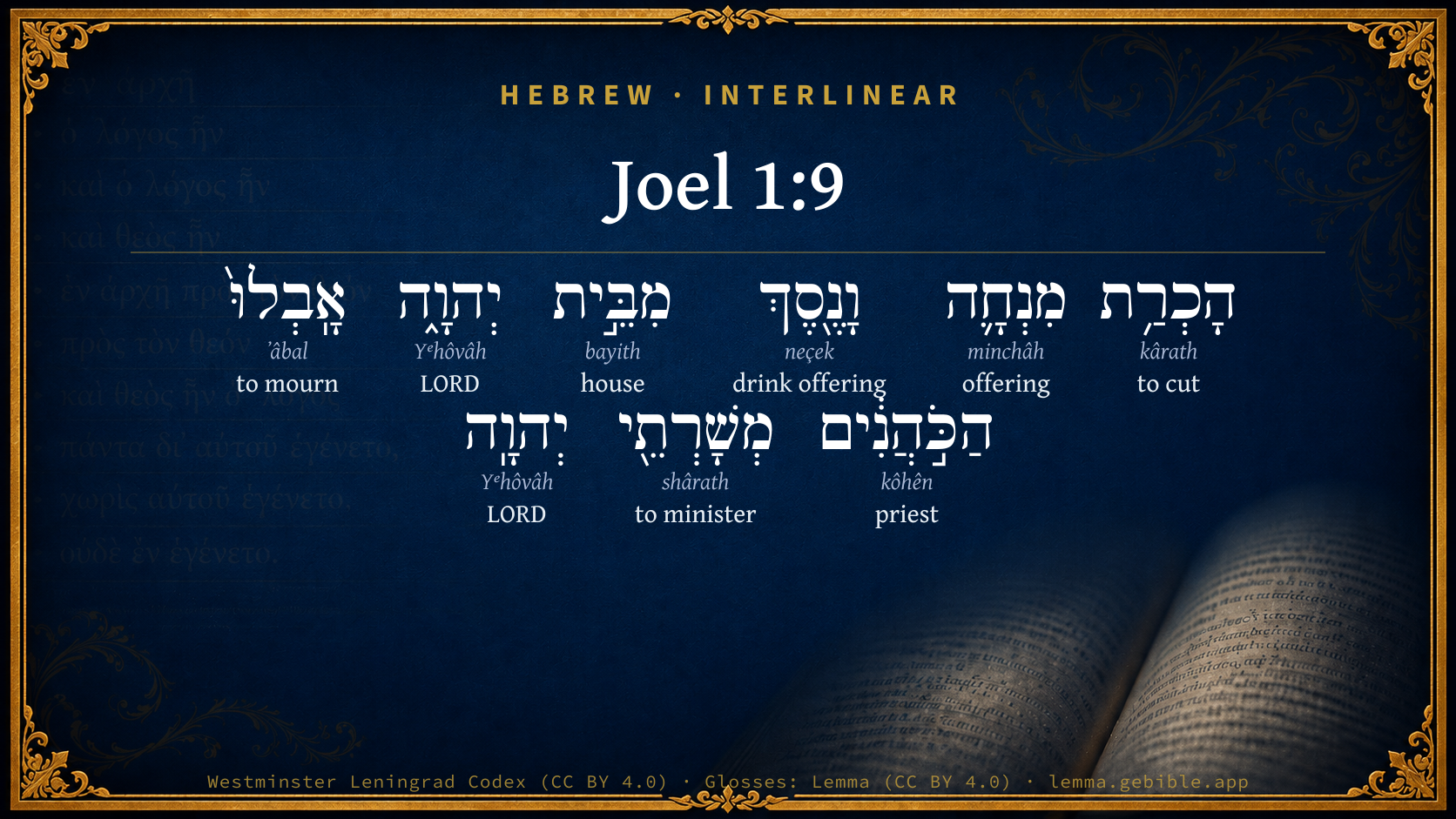
Hebrew (Westminster Leningrad Codex) Joel 1:9 appears in the Hebrew Old Testament. The text above is from the Westminster Leningrad Codex. Each word links to its Strong’s number, a concise gloss, and parsing drawn from the Open Scriptures Hebrew Bible morphology. Click any word for its full Brown-Driver-Briggs (BDB) entry.
Download image
Cite this verse

Joel 1:9 (World English Bible). Public Domain. Lemma interlinear Bible study tool, https://lemma.gebible.app/v/joel/1/9.

Show BibTeX & RIS
BibTeX
RIS
English Translation
The meal offering and the drink offering are cut off from Yahweh's house. The priests, Yahweh's ministers, mourn.
World English Bible · Public Domain
Download a study sheet

One document with this verse’s original text, its word-by-word gloss line, the meaning frame, cross-references with their text, attributed commentary, and full source and license credits — printable, and it pastes into notes with its structure intact.

This verse Autodidact and up

Study sheet (.html) Plain text (.txt)

A passage Seminary Student

Up to 50 verses in one chapter. A passage sheet keeps up to 6 commentary sources and 12 cross-references per verse, in the order this page ranks them, and says so on the sheet whenever that leaves anything out. Ask for a single verse and you get the Autodidact verse sheet above.

Everything on this page stays free to read, with no account — the sheet is a download of what is already on screen, not access to it.

Want to remove ads? Support Godless Engineer
Compare translations 3

The same verse in 3 English versions, stacked beneath the original-language interlinear above. Click any original word for its lexicon entry.

Each is an independent rendering of the whole verse — the interlinear is not word-aligned to these translations.

Highlighted words mark where these versions differ — a whole-verse word diff, not a word-by-word alignment.

  • World English Bible Public Domain
    The meal offering and the drink offering are cut off from Yahweh's house. The priests, Yahweh's ministers, mourn.
  • King James Version Public Domain
    The meat offering and the drink offering is cut off from the house of the LORD; the priests, the LORD's ministers, mourn.
  • unfoldingWord Literal Text CC BY-SA 4.0
    The grain offering and the drink offering have been cut off from the house of Yahweh. The priests mourn, the servants of Yahweh.

unfoldingWord Literal Text — © unfoldingWord, licensed CC BY-SA 4.0. Word-aligned USFM3 via Door43 (git.door43.org/unfoldingWord/en_ult).

Versions to compare (up to 4)

3 of 4 selected

Show all 18 translations

Every available English version of this verse, each an independent rendering of the whole verse.

  • World English Bible Public Domain
    The meal offering and the drink offering are cut off from Yahweh's house. The priests, Yahweh's ministers, mourn.
  • Berean Standard Bible Public Domain
    Grain and drink offerings have been cut off from the house of the LORD; the priests are in mourning, those who minister before the LORD.
  • Majority Standard Bible Public Domain
    Grain and drink offerings have been cut off from the house of the LORD; the priests are in mourning, those who minister before the LORD.
  • King James Version Public Domain
    The meat offering and the drink offering is cut off from the house of the LORD; the priests, the LORD's ministers, mourn.
  • American Standard Version (1901) Public Domain
    The meal-offering and the drink-offering are cut off from the house of Jehovah; the priests, Jehovah's ministers, mourn.
  • Revised Version (1885) Public Domain
    The meal offering and the drink offering is cut off from the house of the LORD; the priests, the LORD’S ministers, mourn.
  • Geneva Bible (1599) Public Domain
    The meate offring, and the drinke offring is cut off from the House of the Lord: the Priests the Lords ministers mourne.
  • Douay-Rheims (1899) Public Domain
    Sacrifice and libation is cut off from the house of the Lord: the priests, the Lord's ministers, have mourned:
  • Young's Literal Translation Public Domain
    Cut off hath been present and libation from the house of Jehovah, Mourned have the priests, ministrants of Jehovah.
  • Literal Standard Version CC BY-SA 4.0
    Present and drink-offering have been cut off from the house of YHWH, || The priests have mourned, servants of YHWH.
  • Unlocked Literal Bible CC BY-SA 4.0
    The grain offering and the drink offering have been cut off from Yahweh's house. The priests, Yahweh's servants, mourn.
  • unfoldingWord Literal Text CC BY-SA 4.0
    The grain offering and the drink offering have been cut off from the house of Yahweh. The priests mourn, the servants of Yahweh.
  • Darby Bible Public Domain
    The oblation and the drink-offering are cut off from the house of Jehovah; the priests, Jehovah's ministers, mourn.
  • World Messianic Bible Public Domain
    The meal offering and the drink offering are cut off from the LORD’s house. The priests, the LORD’s ministers, mourn.
  • Webster's Bible Public Domain
    The meat-offering and the drink-offering is cut off from the house of the LORD; the priests, the LORD'S ministers, mourn.
  • Free Bible Version CC BY-SA 4.0
    Grain and wine offerings have stopped in the Temple. The priests who minister before the Lord are in mourning.
  • Bible in Basic English Public Domain
    The meal offering and the drink offering have been cut off from the house of the Lord; the priests, the Lord's servants, are sorrowing.
  • JPS Tanakh (1917) Public Domain
    The meal-offering and the drink-offering is cut off from the house of the LORD; the priests mourn, even the LORD'S ministers.

Literal Standard Version (2020), Covenant Press — licensed CC BY-SA 4.0. Text via the HelloAO Bible API (eBible.org). Unlocked Literal Bible (unfoldingWord) — licensed CC BY-SA 4.0. Text via the HelloAO Bible API (eBible.org). unfoldingWord Literal Text — © unfoldingWord, licensed CC BY-SA 4.0. Word-aligned USFM3 via Door43 (git.door43.org/unfoldingWord/en_ult). Free Bible Version, Dr. Jonathan Gallagher — licensed CC BY-SA 4.0. Text via the HelloAO Bible API (eBible.org).

Word by word

More ways to search: Search by grammar → Find every occurrence → Compare this word →

Practice this passage: Drill this verse → Learn its vocabulary →

אָֽבְלוּ֙
ʼâbal
H56
“to mourn”
Verb, Qal, Perfect, 3rd Person, Common, Plural
Part of Speech
Verb
Stem
Qal
Form
Perfect
Person
3rd Person
Gender
Common
Number
Plural
Full BDB Definition

Origin: a primitive root

TWOT: 6

to mourn, lament - (Qal) to mourn, lament - of humans - of inanimate objects (figuratively) - of gates - of land - (Hiphil) - to mourn, cause to mourn (figuratively) - (Hithpael) - to mourn - play the mourner
  1. הָכְרַ֥ת kârath H3772 “to cut” Verb, Hophal, Perfect, 3rd Person, Masculine, Singular
  2. מִנְחָ֛ה minchâh H4503 “offering” Noun, Common, Feminine, Singular, Absolute
  3. וָנֶ֖סֶךְ neçek H5262 “and · drink offering” Conjunction + Noun, Common, Masculine, Singular, Absolute
  4. מִבֵּ֣ית bayith H1004 “from · house of” Preposition + Noun, Common, Masculine, Singular, Construct
  5. יְהוָ֑ה Yᵉhôvâh H3068 “LORD” Noun, Proper
  6. הַכֹּ֣הֲנִ֔ים kôhên H3548 “the · priests” Particle, Definite Article + Noun, Common, Masculine, Plural, Absolute
  7. מְשָׁרְתֵ֖י shârath H8334 “ministering” Verb, Piel, Participle Active, Masculine, Plural, Construct
  8. יְהוָֽה Yᵉhôvâh H3068 “LORD” Noun, Proper

About this verse

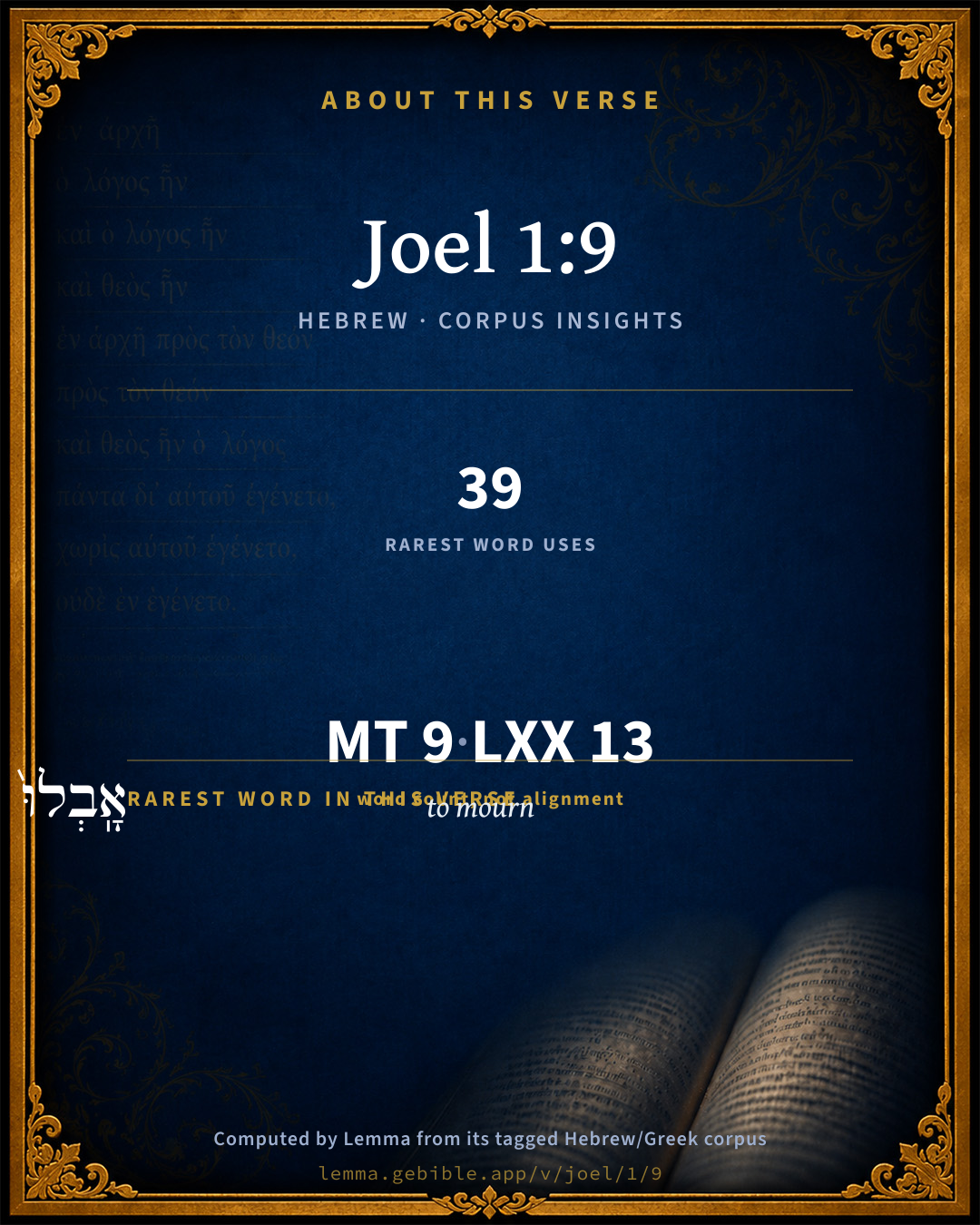
These counts appear in no published source. They are computed here, from the morphology-tagged text and Lemma’s own curated glosses. What Lemma adds →

9
words
8
distinct lemmas
Prophets
section

Shared distinctive vocabulary

אָֽבְלוּ֙ to mourn H56 occurs in 38 verses of the Hebrew Bible. Also found in:

Grammatical profile

  • 3 verbs
  • 6 nouns

Verb forms

  • הָכְרַ֥ת Hophal · Perfect
  • אָֽבְלוּ֙ Qal · Perfect
  • מְשָׁרְתֵ֖י Piel · Participle Active

Repetition

A word recurs within this verse — often emphatic in Hebrew:

  • יְהוָ֑ה LORD H3068 ×2

Hebrew & Septuagint length

In English translation the verse runs 18 words from the Hebrew and 23 from the Septuagint (LXX English) — closely comparable.

A rough comparison of the two English renderings, which tokenize alike — not a word-level alignment.

Word counts can differ between the Hebrew and the Greek without any difference in meaning — e.g. the Hebrew direct-object marker אֵת has no separate Greek word, and Greek often adds the article ὁ.

In the original languages it is 9 Hebrew tokens and 13 Greek tokens — but the two are counted differently (Hebrew bundles its prefixes and suffixes into one token; the Greek is in lemma form), so that isn’t a like-for-like length.

Cross-references

10

Topical passages linked to Joel 1:9 in the Treasury of Scripture Knowledge — connected by theme and wording, ordered by reader-vote popularity; previews shown in the World English Bible.

  • Joel 2:14 Who knows? He may turn and relent, And leave a blessing behind him, Even a meal offering and a drink offering to Yahweh, your God.
  • Joel 2:17 Let the priests, the ministers of Yahweh, weep between the porch and the altar, And let them say, "Spare your people, Yahweh, And don't give your heritage to reproach, That the nations should rule over them. Why should they say among the peoples, 'Where is their God?'"
  • Hosea 9:4 They won't pour out wine offerings to Yahweh, Neither will they be pleasing to him. Their sacrifices will be to them like the bread of mourners; All who eat of it will be polluted; For their bread will be for their appetite. It will not come into the house of Yahweh.
  • Joel 1:13 Put on sackcloth and mourn, you priests! Wail, you ministers of the altar. Come, lie all night in sackcloth, you ministers of my God, For the meal offering and the drink offering are withheld from your God's house.
  • Isaiah 61:6 But you shall be named the priests of Yahweh; men shall call you the ministers of our God: you shall eat the wealth of the nations, and in their glory shall you boast yourselves.
  • Lamentations 1:16 For these things I weep; my eye, my eye runs down with water; Because the comforter who should refresh my soul is far from me: My children are desolate, because the enemy has prevailed.
  • 2 Chronicles 13:10 But as for us, Yahweh is our God, and we have not forsaken him; and [we have] priests ministering to Yahweh, the sons of Aaron, and the Levites in their work:
  • Lamentations 1:4 The ways of Zion do mourn, because none come to the solemn assembly; All her gates are desolate, her priests do sigh: Her virgins are afflicted, and she herself is in bitterness.
  • Joel 1:16 Isn't the food cut off before our eyes; Joy and gladness from the house of our God?
  • Exodus 28:1 "Bring Aaron your brother, and his sons with him, near to you from among the children of Israel, that he may minister to me in the priest's office, even Aaron, Nadab and Abihu, Eleazar and Ithamar, Aaron's sons.

Cross-references courtesy of OpenBible.info (CC BY 4.0).

Hebrew and Greek witnesses Masoretic Hebrew ↔ Greek Septuagint

The same verse in the two great witnesses to the Old Testament, shown verse-for-verse.

These are two independent witnesses, not word-aligned to each other, and the Septuagint is shown in lemma (dictionary) form.

Hebrew Joel 1:9 Masoretic · Westminster Leningrad Codex

הָכְרַ֥ת מִנְחָ֛ה וָנֶ֖סֶךְ מִבֵּ֣ית יְהוָ֑ה אָֽבְלוּ֙ הַכֹּ֣הֲנִ֔ים מְשָׁרְתֵ֖י יְהוָֽה

The meal offering and the drink offering are cut off from Yahweh's house. The priests, Yahweh's ministers, mourn.

World English Bible · Public Domain

Greek LXX Joel 1:9 Septuagint · lemma form

ἐκαἴρω θυσία καί σπονδή ἐκ οἶκος κύριος πενθέω ὁ ἱερεύς ὁ λειτουργέω θυσιαστήριον

The meat-offering and drink-offering are removed from the house of the Lord: mourn, you⌃ priests that serve at the altar of the Lord.

LXX2012 (modern English Septuagint) · Public Domain

Hebrew: Westminster Leningrad Codex (CC BY 4.0). Greek: Septuagint (public domain); English from LXX2012 (modern English Septuagint) (Public Domain). How the Septuagint differs from the Hebrew →

Targum (Aramaic paraphrase)

1

The Targum is the ancient Jewish Aramaic paraphrase of the Hebrew Scriptures — an interpretive translation, not the Hebrew text itself. Onkelos (literal) and Pseudo-Jonathan (expansive) render the Torah, and Jonathan the Prophets. Coverage is partial: where no permissively-licensed English translation exists for a verse, only the Aramaic is shown. This is verse-level text, not a word-by-word alignment to the Hebrew.

  1. Targum Jonathan Prophets (Joshua–Malachi)
    פְּסֵקוּ קָרְבָּנִין וְנִכְסִין מִבֵּית מַקְדְשָׁא דַייָ אִתְאַבַּלוּ כַּהֲנַיָא דִמְשַׁמְשִׁין בְּבֵית מַקְדְשָׁא דַיָי:

    (no public-domain English translation for this verse)

    Targum Jonathan — Aramaic: “Mikraot Gedolot” (public domain). English: “Sefaria Community Translation” (CC0 1.0 (public-domain dedication)); “London "Chaldee Paraphrase," 1871” (public domain). Text via Sefaria.

Commentary

Notes on Joel 1:9 from classic Christian and Jewish commentators (each source and its license shown beneath its notes). The classic Christian expositions comment on the surrounding passage and are grouped to its opening verse, so a note may address several verses; the Jewish commentaries on the Tanakh (Rashi and others) are per-verse, so they appear only where the commentator wrote on this verse.

Lemma curates 59 commentaries, every one of them public domain or Creative Commons licensed, each selected and text-cleaned for this edition rather than reprinted as found. About our sources →

Trapp's Complete Commentary

John Trapp

Joe 1:9 The meat offering and the drink offering is cut off from the house of the LORD; the priests, the LORD’S ministers, mourn.

Ver. 9. The meat offering and the drink offering is cut off] Periit libatio et oblatio. This was the godly man’s greatest grief, that there wanted matter of testifying their thankfulness to God in his commanded worships; and that God was so deeply displeased, as that he had deprived himself and his ministers of the due allowance; so that they also mourned, and could not cheerfully execute their office, for lack of maintenance; for they were not of the chameleon kind.

John Trapp, A Commentary or Exposition upon All the Books of the Old and New Testament (1647–1656) — public domain. Text from a community e-Sword module.

Joseph Benson's Commentary

Joe 1:9-10. The meat-offering and the drink-offering — These offerings always accompanied the daily sacrifice: see Num 28:4; Num 28:7. The word here and elsewhere translated meat-offering, properly signifies the bread- offering, which was made of flour. It is here foretold, that these daily sacrifices could not be offered as they were wont to be, on account of the scarcity of corn and wine. The field is wasted, &c. — The fields and the whole land have a mournful appearance, being altogether bare, and destitute of fruit for the food of either man or beast. The oil languisheth —

The olive-tree fadeth and produceth no fruit.

Joseph Benson's Commentary on the Old and New Testaments (1811–1818) — public domain. Text from a community e-Sword module.

Tyndale Open Study Notes

Tyndale Open Resources

1:9 The locust plague threatened the people of Judah with starvation and brought the regular daily animal sacrifices and offerings of grain and wine at the Temple in Jerusalem to a halt (cp. Exod 29:38-41; Num 28:2-8).

Tyndale Open Study Notes — © Tyndale Open Resources, licensed CC BY-SA 4.0. Text via the HelloAO Bible API.

Geneva Bible (1599)

Geneva Bible translators

The tokens of God’s wrath did appear in his Temple, insomuch as God’s service was left off.

Geneva Bible (1599) marginal notes — public domain. Text via Bolls.life.

Jamieson, Fausset & Brown

Robert Jamieson, A. R. Fausset & David Brown

The greatest sorrow to the mind of a religious Jew, and what ought to impress the whole nation with a sense of God's displeasure, is the cessation of the usual temple-worship.

meat offering--Hebrew, mincha; "meat" not in the English sense "flesh," but the unbloody offering made of flour, oil, and frankincense. As it and the drink offering or libation poured out accompanied every sacrificial flesh offering, the latter is included, though not specified, as being also "cut off," owing to there being no food left for man or beast.

priests . . . mourn--not for their own loss of sacrificial perquisites (Num 18:8-15), but because they can no longer offer the appointed offerings to Jehovah, to whom they minister.

Jamieson, Fausset & Brown — Commentary Critical and Explanatory on the Whole Bible (1871) — public domain (CC PDM 1.0). Text via the HelloAO Bible API.

Adam Clarke's Commentary

Verse 9. The meat-offering and the drink-offering is cut off] The crops and the vines being destroyed by the locusts, the total devastation in plants, trees, corn, &c., is referred to and described with a striking variety of expression in this and the following verses.

Adam Clarke's Commentary on the Bible (1810–1826) — public domain. Text from a community e-Sword/MySword module.

John Calvin's Commentaries

Here, in other words, the Prophet paints the calamity; for, as it has been said, we see how great is the slowness of men to discern God’s judgments; and the Jews, we know, were not more attentive to them than we are now. It was, therefore, needful to prick them with various goads, as the Prophet now does, as though he said, “If ye are not now concerned for want of food, if ye consider not even what the very drunkards are constrained to feel, who perceive not the evil at a distance, but taste it in their lips — if all these things are of no account with you, do at least look on the temple of God, which is now destitute of its ordinary services; for through the sterility of your fields, through so great a scarcity, neither bread nor wine is offered. Since then ye see that the worship of God has ceased, how is it ye yourselves still remain? Why is it that ye perceive not that God’s fury is kindled against you? For surely except God had been most grievously offended, he would at least have had some regard for his own worship; he would not have suffered his temple to remain without sacrifices.”

The Jews, we know, daily poured their libations, and offered meat-offerings. When, therefore, Joel mentions מנחה meneche and libation, he doubtless meant to show that the worship of God was nearly abolished. But God would have never permitted such a thing, had he not been grievously offended by the sins of men. Hence the indifference, or rather the stupidity of the people, is more clearly proved, inasmuch as they perceived not the signs of God’s wrath made evident even in the very temple. It follows —

John Calvin's Commentaries (1540-1563) — public domain. Text from the Calvin Translation Society English edition (1840s-50s) via the Christian Classics Ethereal Library (ccel.org). Calvin's coverage is partial (roughly two-thirds of the Bible); uncommented books and verses are honest gaps, never fabricated. The 19th-century editor's footnotes and remarks are omitted so the notes are faithfully Calvin's own voice.

Ellicott's Commentary for English Readers

(9) The meat offering and the drink offering—i.e., all the outward and visible signs of communion with God are cut off. The means are lost through this visitation. There is a total cessation of “the creatures of bread and wine.” The immediate significance of this fact is naturally appreciated first by “the priests, the Lord’s ministers.”

A Bible Commentary for English Readers, edited by Charles John Ellicott (1878–1897) — public domain. Text from a community e-Sword module.

The Cambridge Bible for Schools and Colleges

gen. ed. J. J. S. Perowne

9. The meal offering and the drink offering is cut off, &c.] the means of providing them having been destroyed by the locusts. The cessation of the daily sacrifices would be regarded as a national misfortune: even during the siege of Jerusalem by the Romans, they were maintained as long as possible, and when ultimately they had to be suspended, the people, we are told, “were terribly despondent” (Jos. B. J. VI. 2, 1).

On the nature of the meal-offering, see Leviticus 2; and comp. on Amo_5:22. The drink-offering was a libation of wine, which usually accompanied a burnt-offering. Here the reference is, no doubt, to the meal- and drink-offering, which, according to the Priestly Code (Exo_29:38-42; Num_28:3-8), were to accompany the daily morning and evening burnt-offering. A special meal-offering was also offered daily by the high-priest (Lev_6:19-20).

the ministers of Jehovah] Joe_1:13, Joe_2:17; cf. Isa_61:6; Jer_33:21. The corresponding verb, to minister, is used often of the sacred services of the priests, as Deu_10:8; Deu_18:5; Deu_18:7; Exo_28:35; Exo_28:43, &c.

The Cambridge Bible for Schools and Colleges (gen. ed. J. J. S. Perowne; Cambridge University Press, 1878–1918) — public domain. Text from a community e-Sword module.

John Gill's Exposition

The meat offering and the drink offering is cut off from the house of the Lord,.... The meat offering was made of fine flour, oil, and frankincense; and the drink offering was of wine; and, because of the want of corn and wine, these were not brought to the temple as usual; and which was matter of great grief to religious persons, and especially to the priests, as follows:

the priests, the Lord's ministers, mourn; partly because they had no work to do, and could not answer to their character, the ministers of the Lord, in ministering about holy things, and bringing the sacrifices and offerings of the people to him; and partly because of their want of food, their livelihood greatly depending on the offerings brought, part of which belonged to them, and on which they and their families lived.

John Gill's Exposition of the Whole Bible (1746–1763) — public domain (CC PDM 1.0). Text via the HelloAO Bible API.

Albert Barnes' Notes on the Bible

The meat offering and the drink offering is cut off - The meat offering and drink offering were part of every sacrifice. If the materials for these, the grain and wine, ceased, through locusts or drought or the wastings of war, the sacrifice must become mangled and imperfect. The priests were to mourn for the defects of the sacrifice; they lost also their own subsistence, since the altar was, to them, in place of all other inheritance. The meat and drink offerings were emblems of the materials of the holy eucharist, by which Malachi foretold that, when God had rejected the offering of the Jews, there should be a “pure offering” among the pagan Joe 1:11. When then holy communions become rare, the meat and drink offering are literally cut off from the house of the Lord, and those who are indeed priests, the ministers of the Lord, should mourn. Joel foretells that, however love should wax cold, there should ever be such. He forsees and foretells at once, the failure, and the grief of the priests. Nor is it an idle regret which he foretells, but a mourning unto their God. : “Both meat offering and drink offering hath perished from the house of God, not in actual substance but as to reverence, because, amid the prevailing iniquity there is scarcely found in the Church, who should duly celebrate, or receive the sacraments.”

Albert Barnes' Notes on the Bible (1834–1885) — public domain. Text from a community e-Sword/MySword module.

Haydock's Catholic Bible Commentary

Lord. No harvest being reaped, the fruits could not be paid. Yet it is thought that what was requisite for sacrifice, would be procured from other countries. (Calmet) --- When Jerusalem was destroyed, sacrifices ceased. (Worthington)

George Leo Haydock (1774–1849), Haydock's Catholic Family Bible and Commentary, 1859 edition — public domain. Excludes Psalms (Douay-Rheims chapter numbering differs from Protestant) and Deuterocanonical books (Catholic canon only).

Matthew Poole's English Annotations

The meat-offering; which by Divine appointment was to be of fine flour, oil, and frankincense, as Lev 2:1, &c.; 6:14, &c. This meat-offering was necessary to every sacrifice offered under the law; so that without the mincha, or meat-offering, the sacrifice was maimed and illegal.

The drink-offering; required daily, as appears Exo 29:40,41; Num 28:8; a fourth part of a hin of wine for one lamb, Num 28:7.

Is cut off; by the destruction of the vines by the locusts forementioned, all that wine (out of which they ought to, offer the drink-offering) did fail.

From the house of the Lord; it was to be poured out, if wine, and part of the meat-offering was to be burnt on the altar, so both were disposed according to the law in the house of the Lord.

The priests; sons of Aaron, with the Levites.

The Lord’s ministers, who did serve the Lord in the services of the temple.

Mourn; grieve inwardly, and express it by outward signs. These had more cause than others to mourn, for as they had equal cause with others in respect to God, whose service hereby failed, so the priests, in respect to their private gain and maintenance, had more cause to mourn, their provision was by this means shortened.

Matthew Poole's English Annotations on the Holy Bible (1683–1685) — public domain. Text from a community e-Sword/MySword module.

The Pulpit Commentary

The meat offering and the drink offering is cut off from the house of the Lord; the priests, the Lord"s ministers, mourn. While all the inhabitants of the land are called to lament, and have abundant cause for lamentation, different classes of society are specified, and the grounds of their sorrow particularized.

1. The meat offering and drink offering accompanied the morning and evening sacrifice, and that sacrifice, with its accompaniments, being an expression of gratitude to God by a daily presentation to him of the first fruits of his own mercies, was a visible memorial of Jehovah"s covenant with his people; while the fact of its being cut off implied the cessation or suspension of that covenant and the people"s exclusion from the covenanted mercies of God.

2. But the ministering priests in particular had cause of mourning, indeed a twofold cause:

(1) their occupation was gone when there were no materials at hand wherewith to minister; their office could no longer last, as they wanted the appointed means for the discharge of its prescribed functions;

(2) their livelihood depended largely on those offerings in which they were allowed to have a share, but, when these ceased through failure of the means of supply, the support of the priests of necessity ceased also, or was so curtailed as to threaten the entire want of the means of subsistence.

Vers. 9-13. The calamity has fallen upon all, and therefore the wail of woe proceeds from all.

All classes are summoned to this sorrowful work; no office in the state is exempt; things animate and inanimate; priests and people the Lord"s priests who ministered at the altar, and the people to whom they ministered; the whole land and the fields into which it was partitioned; the tillers of the soil and the dressers of the vine.

I POVERTY TENDS TO THE DECAY OF PIETY. As a rule neither the depth of penury nor the height of prosperity is favourable to religion; in the one case corroding cares, in the other worldly pleasures, interpose between the soul and God.

II THE BLIGHT IS BROUGHT BY SIN. The blessing of God makes rich, the smile of God makes all things joyful.

III THE UNCERTAINTY OF WORLDLY PLEASURES SHOULD LEAD MEN TO SEEK SPIRITUAL ENJOYMENT. On the kindly fruits of the earth rich and poor were, as they still are, alike dependent. While the rich could afford the finest of the wheat, and the poor had to content themselves with such bread as barley yielded, both alike derived their support from the bounteous earth. They had looked forward for their supply from the harvest of the earth as usual without any dread or apprehension.

1. The pleasantest period of the year became the most painful.

2. The joy of harvest may be withheld, and all joy of an earthly kind or from an earthly source may be withered from the sons of men; but there are spiritual joys which no accidents, as men call them, can touch.

3. The children of God are independent of worldly pleasures.

IV DUTIES ENJOINED. In times of emergency the duties of humiliation, fasting, and prayer are properly enjoined, and should be rightly observed.

1. The persons that are called on to lead the way in discharging such duties are the ministers of religion; as sharers in the common calamity, as having had a share in the sins that occasioned it, above all because of their prominent position as teachers and guides of the people in sacred things, they are bound to take a principal and prominent part in public humiliation, penitence, and prayer.

2. The first duty at such times is confession of sin; to this duty they are to address themselves at once, girding themselves for it.

3. With this full confession of sin with the lips, there must be real contrition of heart; of this the outward sign and symbol, as usual, in the East was clothing the body in sackcloth. While contrition without confession is defective, confession without contrition is hypocritical.

4. Nor is this grief for sin confined to the daytime; it extends into the night-watches.

Religious privation.

The old covenant was one especially characterized by human ministrations and external observances and solemnities. Apart from priests and sacrifices its purposes could not have been accomplished, and its witness to the world would have been unintelligible and vain. No wonder that to the Hebrew mind no prospect was more terrible than the cessation of public worship, of public offerings, of sacerdotal services. In the spiritual economy under which we live, the case is somewhat different. Yet no enlightened mind can contemplate without concern, without dismay, a state of society in which religious offices should be suppressed and religious ministrations silenced.

I THE SUSPENSION OF THE OFFICES OF RELIGION WOULD INVOLVE THE SUSPENSION OF THE PUBLIC COMMUNICATION OF GOD"S WILL TO MAN.

II IT WOULD INVOLVE THE DISCONTINUANCE OF HUMAN FELLOWSHIP IN THE LOFTIEST RELATIONS AND THE MOST BENEFICIAL EXERCISES.

III IT WOULD INVOLVE THE CESSATION OF A UNITED AND PUBLIC PRESENTATION OF THE SACRIFICES DUE FROM MAN TO GOD. T.

The Pulpit Commentary (1880–1919), ed. H.D.M. Spence-Jones & Joseph S. Exell — public domain. Text from a community e-Sword module.

John Wesley's Explanatory Notes

The drink-offering - By the destruction of the vines, all wine (out of which they ought to offer the drink-offering) failed.

John Wesley, Explanatory Notes Upon the Whole Bible (1754–1765) — public domain. Text via the GEBible commentary corpus.

Rashi

Rabbi Shlomo Yitzchaki (Rashi)

have been cut off Heb. הָכְרַת, like נִכְרַת. The “hey” vowelized with a short “kamatz” takes the place of a “nun.” Comp. (Job 5:23), “And the beast of the field made peace (הָשְׁלְמָה) with you.”

Rashi on the Tanakh — English translations: “The Judaica Press complete Tanach with Rashi, translated by A. J. Rosenberg” (CC BY 4.0); “Pentateuch with Rashi's commentary by M. Rosenbaum and A.M. Silbermann, 1929-1934” (public domain); “The Metsudah Tanach series, Lakewood, N.J” (CC BY 4.0); and “The Book of Joshua, Metsudah Publications, 1997” (CC BY 4.0). Text via Sefaria.

Lesson kit

Teaching starters — assembled from the data on this page, not authored interpretation. Every prompt links to the verse data it draws on. Edit before teaching.

Joel, in the Prophets, opens this verse with 9 words (8 distinct Hebrew lemmas). Its most distinctive word is ʼâbal (“to mourn”). A historical commentator’s framing appears above. Read the whole chapter for the surrounding context.

Discussion questions

  1. What does “to mourn” (ʼâbal) contribute to the verse as a whole?
  2. Genesis 37:34 shares the word «to mourn» with this verse. How do the two illuminate each other?
  3. “LORD” occurs 2× in this one verse. What is the effect of the repetition?
  4. These translations render this verse differently. What is at stake in choosing one wording over another?
  5. The verb «הָכְרַ֥ת» is Hophal Perfect. How does its form color the action?
  6. Reading how Trapp's Complete Commentary and Joseph Benson's Commentary read this verse, where do the two commentators agree and where do they part?

Things to notice

Reading settings

Reading text

Shown beneath each verse's original-language words.

Old Testament
Old Testament edition

Read the OT as the Masoretic Hebrew (MT) or the Greek Septuagint (LXX).

English shown for the Greek Septuagint (in the Hebrew ↔ Greek comparison).

Comparing translations? Open the Compare panel on any verse page to stack up to four side by side.