Joshua 9:15

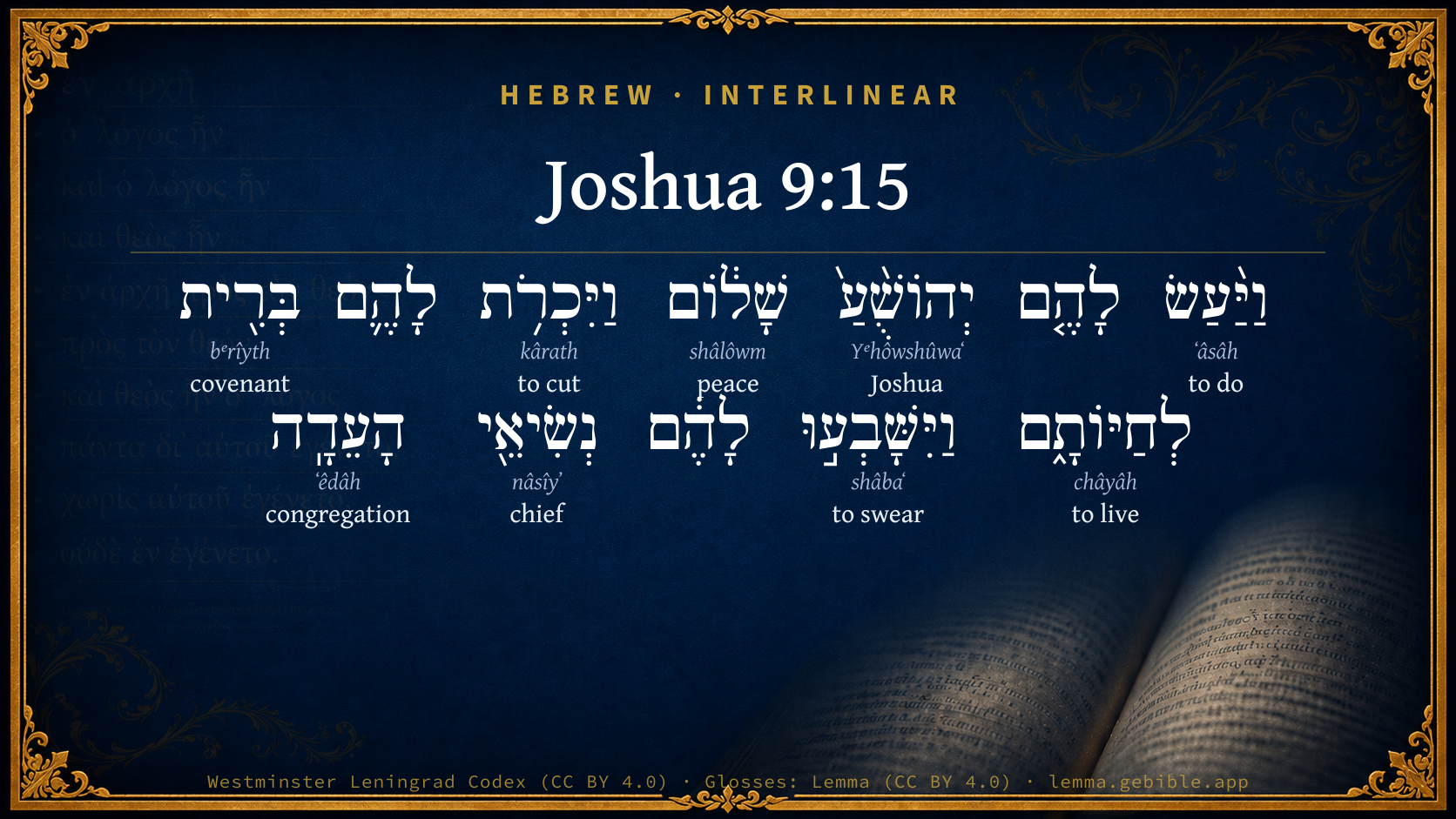
Hebrew (Westminster Leningrad Codex) Joshua 9:15 appears in the Hebrew Old Testament. The text above is from the Westminster Leningrad Codex. Each word links to its Strong’s number, a concise gloss, and parsing drawn from the Open Scriptures Hebrew Bible morphology. Click any word for its full Brown-Driver-Briggs (BDB) entry.
Download image
Cite this verse

Joshua 9:15 (World English Bible). Public Domain. Lemma interlinear Bible study tool, https://lemma.gebible.app/v/joshua/9/15.

Show BibTeX & RIS
BibTeX
RIS
English Translation
Joshua made peace with them, and made a covenant with them, to let them live: and the princes of the congregation swore to them.
World English Bible · Public Domain
Download a study sheet

One document with this verse’s original text, its word-by-word gloss line, the meaning frame, cross-references with their text, attributed commentary, and full source and license credits — printable, and it pastes into notes with its structure intact.

This verse Autodidact and up

Study sheet (.html) Plain text (.txt)

A passage Seminary Student

Up to 50 verses in one chapter. A passage sheet keeps up to 6 commentary sources and 12 cross-references per verse, in the order this page ranks them, and says so on the sheet whenever that leaves anything out. Ask for a single verse and you get the Autodidact verse sheet above.

Everything on this page stays free to read, with no account — the sheet is a download of what is already on screen, not access to it.

Want to remove ads? Support Godless Engineer
Compare translations 3

The same verse in 3 English versions, stacked beneath the original-language interlinear above. Click any original word for its lexicon entry.

Each is an independent rendering of the whole verse — the interlinear is not word-aligned to these translations.

Highlighted words mark where these versions differ — a whole-verse word diff, not a word-by-word alignment.

  • World English Bible Public Domain
    Joshua made peace with them, and made a covenant with them, to let them live: and the princes of the congregation swore to them.
  • King James Version Public Domain
    And Joshua made peace with them, and made a league with them, to let them live: and the princes of the congregation sware unto them.
  • unfoldingWord Literal Text CC BY-SA 4.0
    And Joshua made peace with them, and he cut a covenant with them to let them live. And the leaders of the congregation swore to them.

unfoldingWord Literal Text — © unfoldingWord, licensed CC BY-SA 4.0. Word-aligned USFM3 via Door43 (git.door43.org/unfoldingWord/en_ult).

Versions to compare (up to 4)

3 of 4 selected

Show all 18 translations

Every available English version of this verse, each an independent rendering of the whole verse.

  • World English Bible Public Domain
    Joshua made peace with them, and made a covenant with them, to let them live: and the princes of the congregation swore to them.
  • Berean Standard Bible Public Domain
    And Joshua made a treaty of peace with them to let them live, and the leaders of the congregation swore an oath to them.
  • Majority Standard Bible Public Domain
    And Joshua made a treaty of peace with them to let them live, and the leaders of the congregation swore an oath to them.
  • King James Version Public Domain
    And Joshua made peace with them, and made a league with them, to let them live: and the princes of the congregation sware unto them.
  • American Standard Version (1901) Public Domain
    And Joshua made peace with them, and made a covenant with them, to let them live: and the princes of the congregation sware unto them.
  • Revised Version (1885) Public Domain
    And Joshua made peace with them, and made a covenant with them, to let them live: and the princes of the congregation sware unto them.
  • Geneva Bible (1599) Public Domain
    So Ioshua made peace with them, and made a league with them, that he would suffer them to liue: also the Princes of the Congregation sware vnto them.
  • Douay-Rheims (1899) Public Domain
    And Josue made peace with them, and entering into a league promised that they should not be slain: the princes also of the multitude swore to them.
  • Young's Literal Translation Public Domain
    and Joshua maketh with them peace, and maketh with them a covenant, to keep them alive; and swear to them do the princes of the company.
  • Literal Standard Version CC BY-SA 4.0
    and Joshua makes peace with them, and makes a covenant with them, to keep them alive; and the princes of the congregation swear to them.
  • Unlocked Literal Bible CC BY-SA 4.0
    Joshua made peace with them and made a covenant with them, to let them live. The leaders of the people also made a vow to them.
  • unfoldingWord Literal Text CC BY-SA 4.0
    And Joshua made peace with them, and he cut a covenant with them to let them live. And the leaders of the congregation swore to them.
  • Darby Bible Public Domain
    And Joshua made peace with them, and made a covenant with them, to let them live; and the princes of the assembly swore unto them.
  • World Messianic Bible Public Domain
    Joshua made peace with them, and made a covenant with them, to let them live. The princes of the congregation swore to them.
  • Webster's Bible Public Domain
    And Joshua made peace with them, and made a league with them, to let them live: and the princes of the congregation swore to them.
  • Free Bible Version CC BY-SA 4.0
    Then Joshua made a treaty with them, promising to spare their lives, and the leaders of the assembly swore an oath to guarantee it.
  • Bible in Basic English Public Domain
    So Joshua made peace with them, and made an agreement with them that they were not to be put to death: and the chiefs of the people took an oath to them.
  • JPS Tanakh (1917) Public Domain
    And Joshua made peace with them, and made a covenant with them, to let them live; and the princes of the congregation swore unto them.

Literal Standard Version (2020), Covenant Press — licensed CC BY-SA 4.0. Text via the HelloAO Bible API (eBible.org). Unlocked Literal Bible (unfoldingWord) — licensed CC BY-SA 4.0. Text via the HelloAO Bible API (eBible.org). unfoldingWord Literal Text — © unfoldingWord, licensed CC BY-SA 4.0. Word-aligned USFM3 via Door43 (git.door43.org/unfoldingWord/en_ult). Free Bible Version, Dr. Jonathan Gallagher — licensed CC BY-SA 4.0. Text via the HelloAO Bible API (eBible.org).

Word by word

More ways to search: Search by grammar → Find every occurrence → Compare this word →

Practice this passage: Drill this verse → Learn its vocabulary →

נְשִׂיאֵ֖י
nâsîyʼ
H5387
“chiefs of”
Noun, Common, Masculine, Plural, Construct
Part of Speech
Noun
Type
Common
Gender
Masculine
Number
Plural
State
Construct
Full BDB Definition

Origin: from H5375

TWOT: 1421b , 1421c

one lifted up, chief, prince, captain, leader - rising mist, vapour
  1. וַיַּ֨עַשׂ ʻâsâh H6213 “and · to do” Conjunction + Verb, Qal, Sequential Imperfect, 3rd Person, Masculine, Singular
  2. יְהוֹשֻׁ֨עַ֙ Yᵉhôwshûwaʻ H3091 “Joshua” Noun, Proper
  3. שָׁל֔וֹם shâlôwm H7965 “peace” Noun, Common, Masculine, Singular, Absolute
  4. וַיִּכְרֹ֥ת kârath H3772 “and · to cut” Conjunction + Verb, Qal, Sequential Imperfect, 3rd Person, Masculine, Singular
  5. בְּרִ֖ית bᵉrîyth H1285 “covenant” Noun, Common, Feminine, Singular, Absolute
  6. לְחַיּוֹתָ֑ם châyâh H2421 “to live · them” Preposition + Verb, Piel, Infinitive Construct + Suffix, Personal, 3rd Person, Masculine, Plural
  7. וַיִּשָּׁבְע֣וּ shâbaʻ H7650 “and · to swear” Conjunction + Verb, Niphal, Sequential Imperfect, 3rd Person, Masculine, Plural
  8. הָעֵדָֽה ʻêdâh H5712 “the · congregation” Particle, Definite Article + Noun, Common, Feminine, Singular, Absolute

About this verse

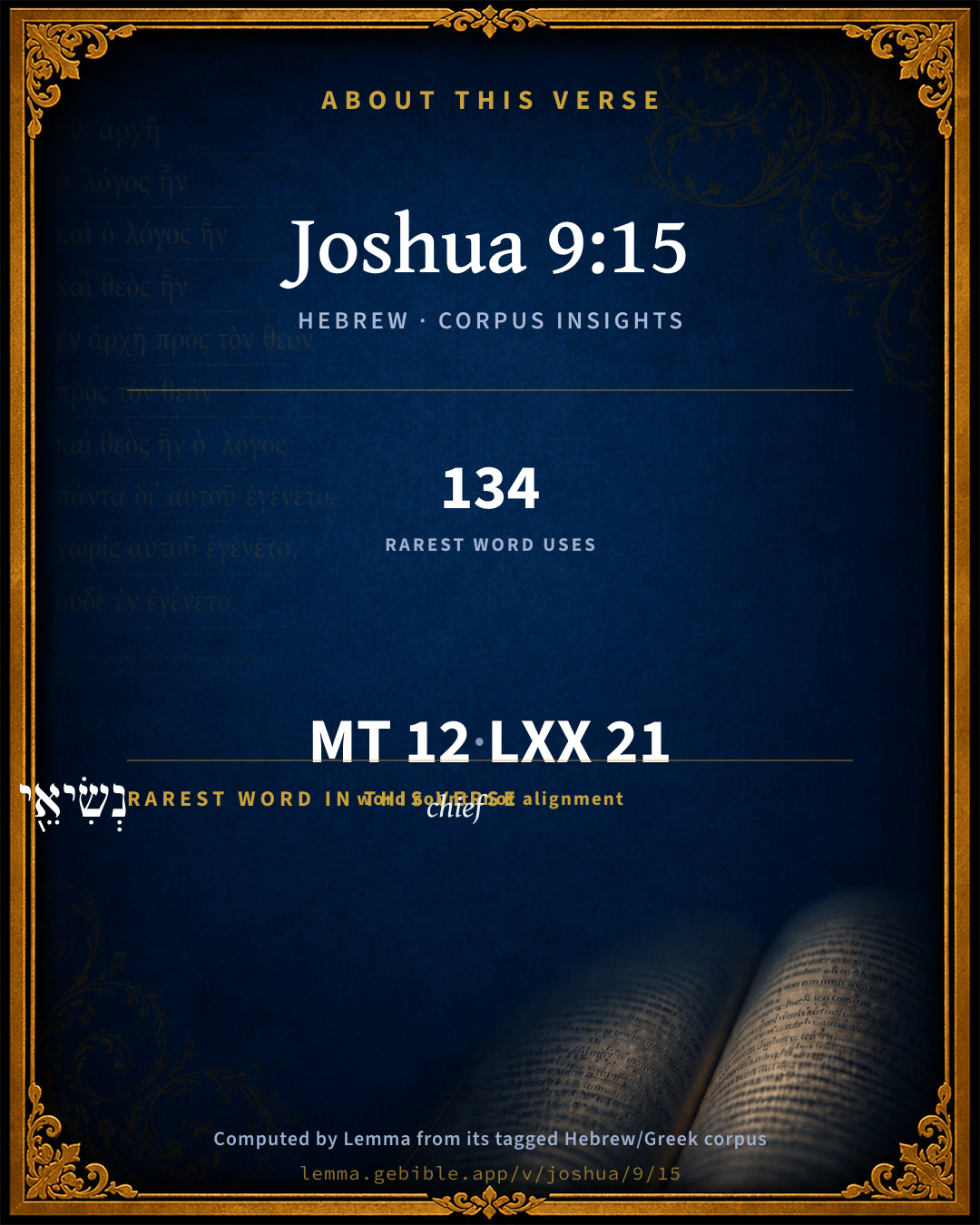
These counts appear in no published source. They are computed here, from the morphology-tagged text and Lemma’s own curated glosses. What Lemma adds →

12
words
9
distinct lemmas
Historical
section

Grammatical profile

  • 4 verbs
  • 5 nouns
  • 3 prepositions

Verb forms

  • וַיַּ֨עַשׂ Qal · Sequential Imperfect
  • וַיִּכְרֹ֥ת Qal · Sequential Imperfect
  • לְחַיּוֹתָ֑ם Piel · Infinitive Construct
  • וַיִּשָּׁבְע֣וּ Niphal · Sequential Imperfect

Hebrew & Septuagint length

In English translation the verse runs 24 words from the Hebrew and 25 from the Septuagint (LXX English) — closely comparable.

A rough comparison of the two English renderings, which tokenize alike — not a word-level alignment.

Word counts can differ between the Hebrew and the Greek without any difference in meaning — e.g. the Hebrew direct-object marker אֵת has no separate Greek word, and Greek often adds the article ὁ.

In the original languages it is 12 Hebrew tokens and 21 Greek tokens — but the two are counted differently (Hebrew bundles its prefixes and suffixes into one token; the Greek is in lemma form), so that isn’t a like-for-like length.

Cross-references

7

Topical passages linked to Joshua 9:15 in the Treasury of Scripture Knowledge — connected by theme and wording, ordered by reader-vote popularity; previews shown in the World English Bible.

  • 2 Samuel 21:2 The king called the Gibeonites, and said to them (now the Gibeonites were not of the children of Israel, but of the remnant of the Amorites; and the children of Israel had sworn to them: and Saul sought to kill them in his zeal for the children of Israel and Judah);
  • Deuteronomy 20:10–11 When you draw near to a city to fight against it, then proclaim peace to it.
  • Joshua 11:19 There was not a city that made peace with the children of Israel, save the Hivites the inhabitants of Gibeon: they took all in battle.
  • Joshua 6:22–25 Joshua said to the two men who had spied out the land, Go into the prostitute's house, and bring out there the woman, and all that she has, as you swore to her.
  • Exodus 23:32 You shall make no covenant with them, nor with their gods.
  • Joshua 2:12–19 Now therefore, please swear to me by Yahweh, since I have dealt kindly with you, that you also will deal kindly with my father's house, and give me a true token;
  • Jeremiah 18:7–8 At what instant I shall speak concerning a nation, and concerning a kingdom, to pluck up and to break down and to destroy it;

Cross-references courtesy of OpenBible.info (CC BY 4.0).

Hebrew and Greek witnesses Masoretic Hebrew ↔ Greek Septuagint

The same verse in the two great witnesses to the Old Testament, shown verse-for-verse.

These are two independent witnesses, not word-aligned to each other, and the Septuagint is shown in lemma (dictionary) form.

Hebrew Joshua 9:15 Masoretic · Westminster Leningrad Codex

וַיַּ֨עַשׂ לָהֶ֤ם יְהוֹשֻׁ֨עַ֙ שָׁל֔וֹם וַיִּכְרֹ֥ת לָהֶ֛ם בְּרִ֖ית לְחַיּוֹתָ֑ם וַיִּשָּׁבְע֣וּ לָהֶ֔ם נְשִׂיאֵ֖י הָעֵדָֽה

Joshua made peace with them, and made a covenant with them, to let them live: and the princes of the congregation swore to them.

World English Bible · Public Domain

Greek LXX Joshua 9:15 Septuagint · lemma form

καί ποιέω ἰησοῦς πρός αὐτός εἰρήνη καί διατίθημι πρός αὐτός διαθήκη ὁ διασώζω αὐτός καί ὄμνυμι αὐτός ὁ ἄρχων ὁ συναγωγή

And Joshua made peace with them, and they made a covenant with them to preserve them; and the princes of the congregation swore to them.

LXX2012 (modern English Septuagint) · Public Domain

Hebrew: Westminster Leningrad Codex (CC BY 4.0). Greek: Septuagint (public domain); English from LXX2012 (modern English Septuagint) (Public Domain). How the Septuagint differs from the Hebrew →

Targum (Aramaic paraphrase)

1

The Targum is the ancient Jewish Aramaic paraphrase of the Hebrew Scriptures — an interpretive translation, not the Hebrew text itself. Onkelos (literal) and Pseudo-Jonathan (expansive) render the Torah, and Jonathan the Prophets. Coverage is partial: where no permissively-licensed English translation exists for a verse, only the Aramaic is shown. This is verse-level text, not a word-by-word alignment to the Hebrew.

  1. Targum Jonathan Prophets (Joshua–Malachi)
    וַעֲבַד לְהוֹן יְהוֹשֻׁעַ שְׁלָם וּגְזַר לְהוֹן קְיָם לְקַיָמוּתְהוֹן וְקַיְימוּ לְהוֹ רַבְרְבֵי כְּנִשְׁתָּא:

    (no public-domain English translation for this verse)

    Targum Jonathan — Aramaic: “Mikraot Gedolot” (public domain). English: “Sefaria Community Translation” (CC0 1.0 (public-domain dedication)); “London "Chaldee Paraphrase," 1871” (public domain). Text via Sefaria.

Commentary

Notes on Joshua 9:15 from classic Christian and Jewish commentators (each source and its license shown beneath its notes). The classic Christian expositions comment on the surrounding passage and are grouped to its opening verse, so a note may address several verses; the Jewish commentaries on the Tanakh (Rashi and others) are per-verse, so they appear only where the commentator wrote on this verse.

Lemma curates 59 commentaries, every one of them public domain or Creative Commons licensed, each selected and text-cleaned for this edition rather than reprinted as found. About our sources →

Matthew Henry's Commentary

Here is, I. The treaty soon concluded with the Gibeonites, Jos 9:15. The thing was not done with much formality, but in short, 1. They agreed to let them live, and more the Gibeonites did not ask. In a common war this would have been but a small matter to be granted; but in the wars of Canaan, which were to make a general destruction, it was a great favour to a Canaanite to have his life given him for a prey, Jer 45:5. 2. This agreement was made not by Joshua only, but by the princes of the congregation in conjunction with him. Though Joshua had an extraordinary call to the government, and extraordinary qualifications for it, yet he would not act in an affair of this nature without the counsel and concurrence of the princes, who were neither kept in the dark nor kept under foot, but were treated by him as sharers in the government. 3. It was ratified by an oath; they swore unto them, not by any of the gods of Canaan, but by the God of Israel only, Jos 9:19. Those that mean honestly do not startle at assurances, but satisfy those with whom they treat, and glorify God by calling him to witness to the sincerity of their intentions. 4. Nothing appears to have been culpable in all this but that it was done rashly; they took of their victuals, by which they satisfied themselves that it was indeed old and dry, but did not consider that his was no proof of their bringing it fresh from home; so that, making use of their senses only, but not their reason, they received the men (as the margin reads it) because of their victuals, perceiving perhaps, upon the view and taste of their bread, not only that now it was old, but that it had been fine and very good at first, whence they inferred that they were persons of some quality, and therefore the friendship of their country was not to be despised. But they asked not counsel at the mouth of the Lord. They had the Urim and Thummim with them, which they might have advised with in this difficult case, and which would have told them no lie, would have led them into no error; but they relied so much on their own politics that they thought it needless to bring the matter to the oracle. Joshua himself was not altogether without blame herein. Note, We make more haste than good speed in any business when we stay not to take God along with us, and by the word and prayer to consult him. Many a time we see cause to reflect upon it with regret that such and such an affair miscarried, because we asked not counsel at the mouth of the Lord; would we acknowledge him in all our ways, we should find them more safe, easy, and successful.

II. The fraud soon discovered, by which this league was procured. A lying tongue is but for a moment, and truth will be the daughter of time. Within three days they found, to their great surprise, that the cities which these ambassadors had treated for were very near them, but one night's foot-march from the camp at Gilgal, Jos 10:9. Either their own scouts or the parties that sallied out to acquaint themselves with the country, or perhaps some deserters that came over to them from the enemy, informed them of the truth in this matter. Those that suffer themselves to be deceived by the wiles of Satan will soon be undeceived to their confusion, and will find that near, even at the door, which they imagined was very far off.

III. The disgust of the congregation at this. They did indeed submit to the restraints which this league laid upon them, and smote not the cities of the Gibeonites, neither slew the persons nor seized the prey; but it vexed them to have their hands thus tied, and they murmured against the princes (Jos 9:18) it is to be feared, more from a jealousy for their own profit than from a zeal for the fulfilling of God's command, though some of them perhaps had a regard to that. Many are forward to arraign and censure the actions of princes while they are ignorant of the springs of those actions and are incompetent judges of the reasons of state that govern them. While therefore we are satisfied in general that those who are over us aim at nothing but the public good, and sincerely seek the welfare of their people, we ought to make the best of what they do and not exercise ourselves in things above us.

IV. The prudent endeavour of the princes to pacify the discontented congregation, and to accommodate the matter; herein all the princes concurred and were unanimous, which doubtless disposed the people to acquiesce.

1. They resolved to spare the lives of the Gibeonites, for so they had expressly sworn to do (Jos 9:15), to let them live. (1.) The oath was lawful, else it had not bound them any more than Herod's oath bound him to cut off John Baptist's head; it is true God had appointed them to destroy all the Canaanites, but the law must be construed, in favorem vitae - with some tender allowance, to mean those only that stood it out and would not surrender their country to them, and not to bind them so far to put off the sense of honour and humanity as to slay those who had never lifted up a hand against them nor ever would, but before they were reduced to any extremity, or ever attempted any act of hostility, with one consent humbled themselves; the kings of Israel were certainly more merciful kings than to do so (Kg1 20:31), and the God of Israel a more merciful God than to order it so. Satis est prostrasse leoni - It is enough to have laid the lion prostrate. And besides, the reason of the law is the law; the mischief designed to be prevented by that law was the infecting of the Israelites with their idolatry, Deu 7:4. But if the Gibeonites renounce their idolatry, and become friends and servants to the house of God, the danger is effectually prevented, the reason of the law ceases, and consequently the obligation of it, especially to a thing of this nature. The conversion of sinners shall prevent their ruin. (2.) The oath being lawful, both the princes and the people for whom they transacted were bound by it, bound in conscience, bound in honour to the God of Israel, by whom they had sworn, and whose name would have been blasphemed by the Canaanites if they had violated this oath. They speak as those that feared an oath (Ecc 9:2), when they argued thus: We will let them live, lest wrath be upon us, because of the oath which we swore, Jos 9:20. He that ratifies a promise with an oath imprecates the divine vengeance if he wilfully break his promise, and has reason to expect that divine justice will take him at his word. God is not mocked, and therefore oaths are not to be jested with. The princes would keep their word, [1.] Though they lost by it. A citizen of Zion swears to his own hurt and changes not, Psa 15:4. Joshua and the princes, when they found it was to their prejudice that they had thus bound themselves, did not apply to Eleazar for a dispensation, much less did they pretend that no faith is to be kept with heretics, with Canaanites; no, they were strangers to the modern artifices of the Romish church to elude the most sacred bonds, and even to sanctify perjuries [2.] Though the people were uneasy at it, and their discontent might have ended in a mutiny, yet the princes would not violate their engagement to the Gibeonites; we must never be over-awed, either by majesty or multitude, to do a sinful thing, and go against our consciences. [3.] Though they were drawn into this league by a wile, and might have had a very plausible pretence to declare it null and void, yet they adhered to it. They might have pleaded that though those were the men with whom they exchanged the ratifications, yet these were not the cities intended in the league; they had promised to spare certain cities, without names, that were very far off, and upon the express consideration of their being so; but these were very near, and therefore not the cities that they covenanted with. And many learned men have thought that they were so grossly imposed upon by the Gibeonites that it would have been lawful for them to have recalled their promise, but to preserve their reputation, and to keep up in Israel a veneration of an oath, they would stand to it; but it is plain that they thought themselves indispensably obliged by it, and were apprehensive that the wrath of God would fall upon them if they broke it. And, however their adherence to it might be displeasing to the congregation, it is plain that it was acceptable to God; for when, in pursuance of this league, they undertook the protection of the Gibeonites, God gave them the most glorious victory that ever they had in all their wars (ch. 10), and long afterwards severely avenged the wrong Saul did to the Gibeonites in violation of this league, Sa2 21:1. Let this convince us all how religiously we ought to perform our promises, and make good our bargains; and what conscience we ought to make of our words when they are once given. If a covenant obtained by so many lies and deceits might not be broken, shall we think to evade the obligation of those that have been made with all possible honesty and fairness? If the fraud of others will not justify or excuse our falsehood, certainly the honesty of others in dealing with us will aggravate and condemn our dishonesty in dealing with them.

2. Though they spared their lives, yet they seized their liberties, and sentenced them to be hewers of wood and drawers of water to the congregation, Jos 9:21. By this proposal the discontented congregation was pacified; for, (1.) Those who were angry that the Gibeonites lived might be content when they saw them condemned to that which, in the general apprehension, is worse than death, perpetual servitude. (2.) Those who were angry that they were not spoiled might be content when their serving the congregation would be more to the public advantage than their best effects could be; and, in short, the Israelites would be not losers either in honour or profit by this peace with the Gibeonites; convince them of this, and they will be satisfied.

Matthew Henry's Commentary on the Whole Bible (1708–1710) — public domain (CC PDM 1.0). Text via the HelloAO Bible API.

Trapp's Complete Commentary

John Trapp

Jos 9:15 And Joshua made peace with them, and made a league with them, to let them live: and the princes of the congregation sware unto them.

Ver. 15. And Joshua made peace with them.] This was not without the Lord; who, as he glorified his justice in rooting out the rest of the Amorites, so he manifested his mercy in saving these Gibeonites from that general deluge of destruction.

John Trapp, A Commentary or Exposition upon All the Books of the Old and New Testament (1647–1656) — public domain. Text from a community e-Sword module.

Joseph Benson's Commentary

Jos 9:15. Joshua made a league with them to let them live — Not merely, it seems, to spare their lives, which, supposing them to belong to a far country, they had no warrant to take away, but to let them continue in the enjoyment of their effects; the word life in Scripture being frequently of equal signification with prosperity. That this league was lawful and obliging, appears, 1st, Because Joshua and all the princes, upon the review, concluded it so to be, and spared them accordingly. 2d, Because God punished the violation of it long after, 2Sa 21:1. 3d, Because God is said to have hardened the hearts of all other cities, not to seek peace with Israel, that so he might utterly destroy them, (Jos 11:19-20,) which seems to imply that their utter destruction did not necessarily come upon them by virtue of any peremptory command of God, but by their own obstinate hardness, whereby they refused to make peace with the Israelites.

Joseph Benson's Commentary on the Old and New Testaments (1811–1818) — public domain. Text from a community e-Sword module.

Tyndale Open Study Notes

Tyndale Open Resources

9:15 Israel entered into a peace treaty with the Gibeonites. The Israelites were God’s vassals, having entered into a suzerain-vassal treaty with God at Sinai (see study note on Exod 20:1–23:33). Israel did not have authority to enter into treaties without the approval of their own suzerain. • guaranteed their safety (literally cut with them a covenant for their lives): Nations ratified covenants by a ceremony that involved cutting sacrificial animals in half. The parties to the covenant walked between the two animal halves (cp. Gen 15:9-18) to symbolize their commitment to be cut in two like the sacrifice if one violated the terms of the covenant. Covenants also were written documents, sometimes chiseled in stone and set up in a public area for all to see and remember (see study note on Josh 8:32). • In Israel, a binding oath was sworn in the name of the Lord. Violating the oath invited the Lord’s judgment for swearing falsely (Exod 20:7).

Tyndale Open Study Notes — © Tyndale Open Resources, licensed CC BY-SA 4.0. Text via the HelloAO Bible API.

Adam Clarke's Commentary

Verse 15. Joshua made peace with them] Joshua agreed to receive them into a friendly connection with the Israelites, and to respect their lives and properties; and the elders of Israel bound themselves to the observance of it, and confirmed it with an oath. As the same words are used here as in Jos 9:6, we may suppose that the covenant was made in the ordinary way, a sacrifice being offered on the occasion, and its blood poured out before the Lord. See Clarke on Ge 15:10, &c.

Adam Clarke's Commentary on the Bible (1810–1826) — public domain. Text from a community e-Sword/MySword module.

John Gill's Exposition

And Joshua made peace with them,.... Upon the report the princes made of having examined what they had said, and which they found to be true, particularly concerning their victuals:

and made a league with them, to let them live; and not destroy them as he did the Canaanites, and was ordered to do; they being supposed not to belong to them by the representation of things they had made:

and the princes of the congregation sware unto them; that they would keep the league and covenant they had made with them inviolable; they ratified it by an oath, which was a sacred solemn thing.

John Gill's Exposition of the Whole Bible (1746–1763) — public domain (CC PDM 1.0). Text via the HelloAO Bible API.

Matthew Poole's English Annotations

To let them live, i.e. that they would not destroy them. Some question whether this league was lawful and obliging, because it is contrary to a positive and precedent law of God, by which they were enjoined to make no peace with them, but utterly to destroy them, Exo 23:32; Exo 34 &c. But this law seems to admit of some exception and favourable interpretation, and that taken from the reason and soul of that law; which was this, that the Israelites might not be tainted with their idolatry and other abominations by cohabitation with them; and therefore when that reason ceased, i.e. if they were willing to relinquish their possessions and idolatry, and other wickedness, and to embrace the true religion, they might be spared. And though this law was delivered in general terms, because God foresaw that the Israelites would be most prone to err on that hand, by sparing those whom they should destroy; yet that it was to be understood with an exception of penitents and true converts might easily be gathered, both from the example of Rahab, and from the tenor of Divine threatenings, which, though absolutely delivered, allow of this exception; as appears from Jer 18:7,8; Jon 3; Jon 4, and from the great kindness and favour which God hath manifested unto all true penitents, in delivering them from evils threatened to them, and inflicted upon others; which kindness of God we also are obliged to imitate by virtue of that natural and moral law of God implanted in us, and revealed to us, to which such positive commands as this of killing the Canaanites must give place. And that this league was lawful and obliging, may seem probable,

1. Because Joshua and all the princes upon the review concluded it so to be, and spared them accordingly, Jos 9:19,20,22,23.

2. Because God punished the violation of it long after, 2Sa 21:1.

3. Because God is said to have hardened the hearts of all other cities not to seek peace with Israel, that so he might utterly destroy them, Jos 11:19,20, which seems to imply that their utter destruction did not necessarily come upon them by virtue of any absolute and peremptory command of God to destroy them, but by their own obstinate hardness, whereby they neglected and refused to make peace with the Israelites.

Object. This league was grounded upon a deceit and error of the persons, which also they had entered a caution against, Jos 9:7.

Answ. Their supposition that they were Canaanites was indeed a part of the foregoing discourse, Jos 9:7, and the Israelites rested satisfied with their answer, and believed they were not, and so entered into the league; but that league was absolute, not suspended upon that or any other condition; and the error was not about the persons, but about the country and people to which they belonged, which was not material to this contract, no more than it is to a contract of marriage, that the one person believed the other to be of another country or family than indeed they were.

Matthew Poole's English Annotations on the Holy Bible (1683–1685) — public domain. Text from a community e-Sword/MySword module.

Whedon's Commentary on the Bible

Daniel D. Whedon

15. Peace — He solemnly pledged the faith of his people to abstain from war against their commonwealth.

A league — This is a step beyond peace; an alliance, binding the two parties to mutual assistance in defensive, if not offensive, war.

Princes of the congregation — Called, in Jos_9:6-7, men of Israel, that is, representative men, consisting of heads of families and elders of the people.

Sware — The Hebrew princes appealed to God in their oaths in such phrase as, “The God of Abraham judge;” “As Jehovah liveth:” “God do so to me and more also;” “God knoweth,” and similar formulas.

Daniel D. Whedon (gen. ed.), Commentary on the Old and New Testaments (1874–1909) — public domain. Text from a community e-Sword module.

The Pulpit Commentary

The princes of the congregation. Literally, the exalted ones, yaeycin of the congregation, "Die obersten der gemeine" (Luther); that is, the heads of the various tribes. (see Num_1:44; and note on Jos_7:14)

HOMILIES BY E. DE PRESSENSE Vers. 15-23. The Gibeonites.

The manner in which Joshua dealt with the Gibeonites shows how inflexible is the respect God requires for truth. That respect is exemplified in two ways in tiffs narrative. First, in the fulfilment of the oath made to the Gibeonites, that their lives should be saved; and second, in the punishment with which they are visited for their falsehood. They deceived Joshua by their miserable subterfuge of mouldy bread and way-worn garments, and thus passed themselves off as the inhabitants of some distant region instead of a neighbouring city. Therefore, while their lives were spared, they were reduced to a state of slavery (ver. 23).

I. NOTHING IS MORE HATEFUL TO THE HOLY GOD THAN A LIE. He is in His very essence light. (1Jn_1:5) Falsehood and cunning pervert all the relationships of life. Lying breaks the social bond, since a man"s word is the only medium of moral exchange between men; and when mutual confidence is lost, the foundations of the social edifice are undermined. Therefore St. Paul says, "Lie not one to another... for ye are members one of another." In the direct education which God gave to His people Israel, He has given unmistakable demonstration of His horror of all deceit. Hence the punishment of the Gibeonites.

II THE PUNISHMENT which these unhappy men brought upon themselves rested not only upon them as individuals, but upon their whole nation. God thus showed that evil is not transformed into good by being made to subserve a public cause. There are not two codes of morality one for private and another for national life. Polities ought to be as scrupulously governed by the law of God as the life of the individual. Although since the abolition of the theocracy, the sphere of religion and of the civil power ought to be kept altogether distinct, it is no less incumbent on the State to adhere to the plain principles of morality. In spite of all that may seem to argue the contrary, every violation of these principles brings its own punishment. History is in its essence one long judgment of God.

III By not allowing the Israelites to break their oath to the Gibeonites, even though they had been deceived by them, GOD TEACHES US THAT WRONG DONE BY OUR NEIGHBOUR DOES NOT AT ALL VINDICATE US IN BEING GUILTY OF A LIKE WRONG. One sin never justifies another. We are to "overcome evil with good," and it is this which distinguishes the people of God from all other people. It is by not being conformed to this world we triumph over it. If the people of God were to act in the same way as the Canaanites, there would be no reason for giving them the ascendancy. When the Church becomes worldly it falls under the condemnation of the world. Let us be, then, everywhere and always men the rule of whose life is the law of God. The only retaliation we must ever allow ourselves is rendering good for evil. "Be not overcome of evil," says St. Paul, "but overcome evil with good". (Rom_12:21) E. DE P.

The Pulpit Commentary (1880–1919), ed. H.D.M. Spence-Jones & Joseph S. Exell — public domain. Text from a community e-Sword module.

John Wesley's Explanatory Notes

To let them live - That is, they should not destroy them. That this league was lawful and obliging, appears,

1. Because Joshua and all the princes, upon the review concluded it so to be, and spared them accordingly.

2. Because God punished the violation of it long after, 2 Sam. xxi, 1.

3. Because God is said to have hardened the hearts of all other cities, not to seek peace with Israel, that so he might utterly destroy them, chap. xi, 19, 20, which seems to imply that their utter destruction did not necessarily come upon them by virtue of any peremptory command of God, but by their own obstinate hardness, whereby they refused to make peace with the Israelites.

John Wesley, Explanatory Notes Upon the Whole Bible (1754–1765) — public domain. Text via the GEBible commentary corpus.

Lesson kit

Teaching starters — assembled from the data on this page, not authored interpretation. Every prompt links to the verse data it draws on. Edit before teaching.

Joshua, in the Historical, opens this verse with 12 words (9 distinct Hebrew lemmas). Its most distinctive word is nâsîyʼ (“chief”). A historical commentator’s framing appears above. Read the whole chapter for the surrounding context.

Discussion questions

  1. The word nâsîyʼ carries the sense “chief.” How does it shape the verse?
  2. How does 2 Samuel 21:2, which shares this passage’s theme, read alongside this verse?
  3. These translations render this verse differently. What is at stake in choosing one wording over another?
  4. «וַיַּ֨עַשׂ» is a Qal Sequential Imperfect verb. How does that grammatical form shape the action described?
  5. Compare how Matthew Henry's Commentary and Trapp's Complete Commentary read this verse. Where do they agree or differ?

Things to notice

Reading settings

Reading text

Shown beneath each verse's original-language words.

Old Testament
Old Testament edition

Read the OT as the Masoretic Hebrew (MT) or the Greek Septuagint (LXX).

English shown for the Greek Septuagint (in the Hebrew ↔ Greek comparison).

Comparing translations? Open the Compare panel on any verse page to stack up to four side by side.