Malachi 2:12

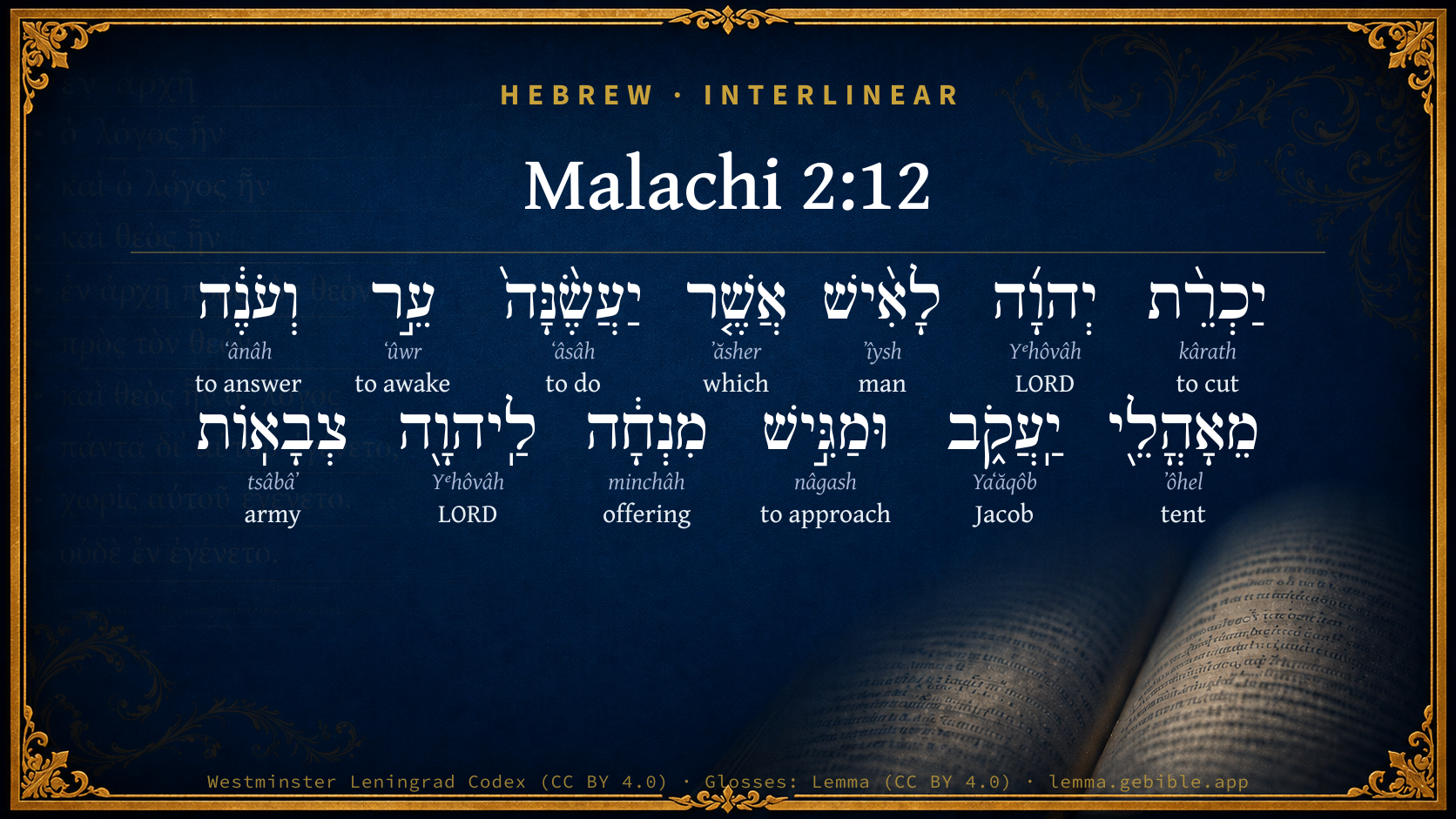
Hebrew (Westminster Leningrad Codex) Malachi 2:12 appears in the Hebrew Old Testament. The text above is from the Westminster Leningrad Codex. Each word links to its Strong’s number, a concise gloss, and parsing drawn from the Open Scriptures Hebrew Bible morphology. Click any word for its full Brown-Driver-Briggs (BDB) entry.
Download image
Cite this verse

Malachi 2:12 (World English Bible). Public Domain. Lemma interlinear Bible study tool, https://lemma.gebible.app/v/malachi/2/12.

Show BibTeX & RIS
BibTeX
RIS
English Translation
Yahweh will cut off, to the man who does this, him who wakes and him who answers, out of the tents of Jacob, and him who offers an offering to Yahweh of Hosts.
World English Bible · Public Domain
Download a study sheet

One document with this verse’s original text, its word-by-word gloss line, the meaning frame, cross-references with their text, attributed commentary, and full source and license credits — printable, and it pastes into notes with its structure intact.

This verse Autodidact and up

Study sheet (.html) Plain text (.txt)

A passage Seminary Student

Up to 50 verses in one chapter. A passage sheet keeps up to 6 commentary sources and 12 cross-references per verse, in the order this page ranks them, and says so on the sheet whenever that leaves anything out. Ask for a single verse and you get the Autodidact verse sheet above.

Everything on this page stays free to read, with no account — the sheet is a download of what is already on screen, not access to it.

Want to remove ads? Support Godless Engineer
Compare translations 3

The same verse in 3 English versions, stacked beneath the original-language interlinear above. Click any original word for its lexicon entry.

Each is an independent rendering of the whole verse — the interlinear is not word-aligned to these translations.

Highlighted words mark where these versions differ — a whole-verse word diff, not a word-by-word alignment.

  • World English Bible Public Domain
    Yahweh will cut off, to the man who does this, him who wakes and him who answers, out of the tents of Jacob, and him who offers an offering to Yahweh of Hosts.
  • King James Version Public Domain
    The LORD will cut off the man that doeth this, the master and the scholar, out of the tabernacles of Jacob, and him that offereth an offering unto the LORD of hosts.
  • unfoldingWord Literal Text CC BY-SA 4.0
    May Yahweh cut off from the tents of Jacob the man who does this, the one being awake and the one answering, even the one bringing an offering to Yahweh of Armies.

unfoldingWord Literal Text — © unfoldingWord, licensed CC BY-SA 4.0. Word-aligned USFM3 via Door43 (git.door43.org/unfoldingWord/en_ult).

Versions to compare (up to 4)

3 of 4 selected

Show all 18 translations

Every available English version of this verse, each an independent rendering of the whole verse.

  • World English Bible Public Domain
    Yahweh will cut off, to the man who does this, him who wakes and him who answers, out of the tents of Jacob, and him who offers an offering to Yahweh of Hosts.
  • Berean Standard Bible Public Domain
    As for the man who does this, may the LORD cut off from the tents of Jacob everyone who is awake and aware—even if he brings an offering to the LORD of Hosts.
  • Majority Standard Bible Public Domain
    As for the man who does this, may the LORD cut off from the tents of Jacob everyone who is awake and aware—even if he brings an offering to the LORD of Hosts.
  • King James Version Public Domain
    The LORD will cut off the man that doeth this, the master and the scholar, out of the tabernacles of Jacob, and him that offereth an offering unto the LORD of hosts.
  • American Standard Version (1901) Public Domain
    Jehovah will cut off, to the man that doeth this, him that waketh and him that answereth, out of the tents of Jacob, and him that offereth an offering unto Jehovah of hosts.
  • Revised Version (1885) Public Domain
    The LORD will cut off to the man that doeth this him that waketh and him that answereth, out of the tents of Jacob, and him that offereth an offering unto the LORD of hosts.
  • Geneva Bible (1599) Public Domain
    The Lord will cut off the man that doeth this: both the master and the seruaunt out of the Tabernacle of Iaacob, and him that offereth an offering vnto the Lord of hostes.
  • Douay-Rheims (1899) Public Domain
    The Lord will cut off the man that hath done this, both the master, and the scholar, out of the tabernacles of Jacob, and him that offereth an offering to the Lord of hosts.
  • Young's Literal Translation Public Domain
    Cut off doth Jehovah the man who doth it, Tempter and tempted -- from the tents of Jacob, Even he who is bringing nigh a present to Jehovah of Hosts.
  • Literal Standard Version CC BY-SA 4.0
    YHWH cuts off the man who does it, || Tempter and tempted—from the tents of Jacob, || Even he who is bringing a present near to YHWH of Hosts.
  • Unlocked Literal Bible CC BY-SA 4.0
    May Yahweh cut off from the tents of Jacob the man who does this, the one who is awake and the one who answers, even if he is bringing an offering to Yahweh of hosts.
  • unfoldingWord Literal Text CC BY-SA 4.0
    May Yahweh cut off from the tents of Jacob the man who does this, the one being awake and the one answering, even the one bringing an offering to Yahweh of Armies.
  • Darby Bible Public Domain
    Jehovah will cut off from the tents of Jacob the man that doeth this, him that calleth and him that answereth; and him that offereth an oblation unto Jehovah of hosts.
  • World Messianic Bible Public Domain
    The LORD will cut off the man who does this, him who wakes and him who answers, out of the tents of Jacob and him who offers an offering to the LORD of Hosts.
  • Webster's Bible Public Domain
    The LORD will cut off the man that doeth this, the master and the scholar, out of the tabernacles of Jacob, and him that offereth an offering to the LORD of hosts.
  • Free Bible Version CC BY-SA 4.0
    May the Lord expel the family of any man who does this from the nation of Israel! May there be no one left to bring an offering to the Lord Almighty!
  • Bible in Basic English Public Domain
    The Lord will have the man who does this cut off root and branch out of the tents of Jacob, and him who makes an offering to the Lord of armies.
  • JPS Tanakh (1917) Public Domain
    May the LORD cut off to the man that doeth this, him that calleth and him that answereth out of the tents of Jacob, and him that offereth an offering unto the LORD of hosts.

Literal Standard Version (2020), Covenant Press — licensed CC BY-SA 4.0. Text via the HelloAO Bible API (eBible.org). Unlocked Literal Bible (unfoldingWord) — licensed CC BY-SA 4.0. Text via the HelloAO Bible API (eBible.org). unfoldingWord Literal Text — © unfoldingWord, licensed CC BY-SA 4.0. Word-aligned USFM3 via Door43 (git.door43.org/unfoldingWord/en_ult). Free Bible Version, Dr. Jonathan Gallagher — licensed CC BY-SA 4.0. Text via the HelloAO Bible API (eBible.org).

Word by word

More ways to search: Search by grammar → Find every occurrence → Compare this word →

Practice this passage: Drill this verse → Learn its vocabulary →

עֵ֣ר
ʻûwr
H5782
“awaking”
Verb, Qal, Participle Active, Masculine, Singular, Absolute
Part of Speech
Verb
Stem
Qal
Form
Participle Active
Gender
Masculine
Number
Singular
State
Absolute
Full BDB Definition

Origin: a primitive root [rather identical with H5783 through the idea of opening the eyes]

TWOT: 1587

to rouse oneself, awake, awaken, incite - (Qal) to rouse oneself, awake - (Niphal) to be roused - (Polel) to stir up, rouse, incite - (Hithpolel) to be excited, be triumphant - (Hiphil) - to rouse, stir up - to act in an aroused manner, awake
  1. יַכְרֵ֨ת kârath H3772 “to cut” Verb, Hiphil, Jussive, 3rd Person, Masculine, Singular
  2. יְהוָ֜ה Yᵉhôvâh H3068 “LORD” Noun, Proper
  3. לָאִ֨ישׁ ʼîysh H376 “to/for the · man” Preposition, Determined + Noun, Common, Masculine, Singular, Absolute
  4. אֲשֶׁ֤ר ʼăsher H834 “which” Particle, Relative
  5. יַעֲשֶׂ֨נָּה֙ ʻâsâh H6213 “to do” Verb, Qal, Imperfect, 3rd Person, Masculine, Singular + Suffix, n
  6. וְעֹנֶ֔ה ʻânâh H6030 “and · answering” Conjunction + Verb, Qal, Participle Active, Masculine, Singular, Absolute
  7. מֵאָהֳלֵ֖י ʼôhel H168 “from · tents of” Preposition + Noun, Common, Masculine, Plural, Construct
  8. יַֽעֲקֹ֑ב Yaʻăqôb H3290 “Jacob” Noun, Proper
  9. וּמַגִּ֣ישׁ nâgash H5066 “and · approaching” Conjunction + Verb, Hiphil, Participle Active, Masculine, Singular, Absolute
  10. מִנְחָ֔ה minchâh H4503 “offering” Noun, Common, Feminine, Singular, Absolute
  11. לַֽיהוָ֖ה Yᵉhôvâh H3068 “to/for · LORD” Preposition + Noun, Proper
  12. צְבָאֽוֹת tsâbâʼ H6635 “armies” Noun, Common, Both, Plural, Absolute

About this verse

These counts appear in no published source. They are computed here, from the morphology-tagged text and Lemma’s own curated glosses. What Lemma adds →

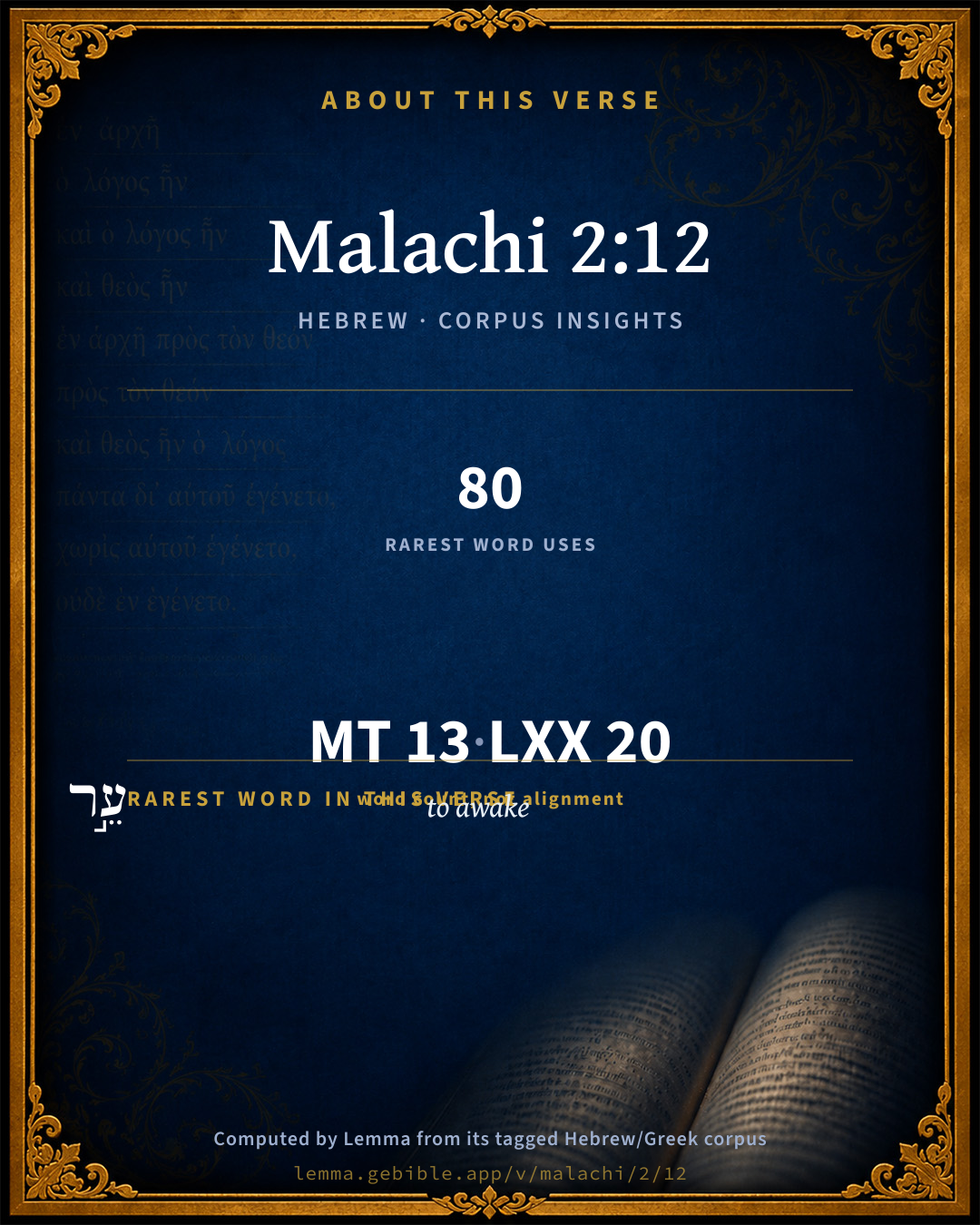
13
words
12
distinct lemmas
Prophets
section

Grammatical profile

  • 5 verbs
  • 7 nouns
  • 1 particle

Verb forms

  • יַכְרֵ֨ת Hiphil · Jussive
  • יַעֲשֶׂ֨נָּה֙ Qal · Imperfect
  • עֵ֣ר Qal · Participle Active
  • וְעֹנֶ֔ה Qal · Participle Active
  • וּמַגִּ֣ישׁ Hiphil · Participle Active

Repetition

A word recurs within this verse — often emphatic in Hebrew:

  • יְהוָ֜ה LORD H3068 ×2

Hebrew & Septuagint length

In English translation the verse runs 33 words from the Hebrew and 35 from the Septuagint (LXX English) — closely comparable.

A rough comparison of the two English renderings, which tokenize alike — not a word-level alignment.

Word counts can differ between the Hebrew and the Greek without any difference in meaning — e.g. the Hebrew direct-object marker אֵת has no separate Greek word, and Greek often adds the article ὁ.

In the original languages it is 13 Hebrew tokens and 20 Greek tokens — but the two are counted differently (Hebrew bundles its prefixes and suffixes into one token; the Greek is in lemma form), so that isn’t a like-for-like length.

Cross-references

26

Topical passages linked to Malachi 2:12 in the Treasury of Scripture Knowledge — connected by theme and wording, ordered by reader-vote popularity; previews shown in the World English Bible.

  • Genesis 4:3–5 As time passed, it happened that Cain brought an offering to Yahweh from the fruit of the ground.
  • Leviticus 18:29 "'For whoever shall do any of these abominations, even the souls that do them shall be cut off from among their people.
  • Leviticus 20:3 I also will set my face against that person, and will cut him off from among his people because he has given of his seed to Molech, to defile my sanctuary, and to profane my holy name.
  • Numbers 15:30–31 But the soul who does anything with a high hand, whether he is home-born or a foreigner, the same blasphemes Yahweh; and that soul shall be cut off from among his people.
  • Numbers 24:5 How goodly are your tents, Jacob, Your tents, Israel!
  • Joshua 23:12–13 Else if you do at all go back, and cleave to the remnant of these nations, even these who remain among you, and make marriages with them, and go in to them, and they to you;
  • 1 Samuel 2:31–34 Behold, the days come, that I will cut off your arm, and the arm of your father's house, that there shall not be an old man in your house.
  • 1 Samuel 3:14 Therefore I have sworn to the house of Eli, that the iniquity of Eli's house shall not be expiated with sacrifice nor offering forever.
  • 1 Samuel 15:22–23 Samuel said, Has Yahweh as great delight in burnt offerings and sacrifices, as in obeying the voice of Yahweh? Behold, to obey is better than sacrifice, and to listen than the fat of rams.
  • 1 Chronicles 25:8 They cast lots for their offices, all alike, as well the small as the great, the teacher as the scholar.
  • Ezra 10:18–19 Among the sons of the priests there were found who had married foreign women: [namely], of the sons of Jeshua, the son of Jozadak, and his brothers, Maaseiah, and Eliezer, and Jarib, and Gedaliah.
  • Nehemiah 13:28–29 One of the sons of Joiada, the son of Eliashib the high priest, was son-in-law to Sanballat the Horonite: therefore I chased him from me.
  • Isaiah 9:14–16 Therefore Yahweh will cut off from Israel head and tail, palm-branch and rush, in one day.
  • Isaiah 24:1–2 Behold, Yahweh makes the earth empty, and makes it waste, and turns it upside down, and scatters abroad the inhabitants of it.
  • Isaiah 61:8 For I, Yahweh, love justice, I hate robbery with iniquity; and I will give them their recompense in truth, and I will make an everlasting covenant with them.
  • Isaiah 66:3 He who kills an ox is as he who kills a man; he who sacrifices a lamb, as he who breaks a dog's neck; he who offers an offering, [as he who offers] pig's blood; he who burns frankincense, as he who blesses an idol. Yes, they have chosen their own ways, and their soul delights in their abominations:
  • Ezekiel 14:10 They shall bear their iniquity: the iniquity of the prophet shall be even as the iniquity of him who seeks [to him];
  • Ezekiel 24:21 Speak to the house of Israel, Thus says the Lord Yahweh: Behold, I will profane my sanctuary, the pride of your power, the desire of your eyes, and that which your soul pities; and your sons and your daughters whom you have left behind shall fall by the sword.
  • Hosea 4:4–5 "Yet let no man bring a charge, neither let any man accuse; For your people are like those who bring charges against a priest.
  • Amos 5:22 Yes, though you offer me your burnt offerings and meal-offerings, I will not accept them; Neither will I regard the peace offerings of your fat animals.
  • Zechariah 12:7 Yahweh also will save the tents of Judah first, that the glory of the house of David and the glory of the inhabitants of Jerusalem not be magnified above Judah.
  • Malachi 1:10 "Oh that there were one among you who would shut the doors, that you might not kindle fire on my altar in vain! I have no pleasure in you," says Yahweh of hosts, "neither will I accept an offering at your hand.
  • Malachi 2:10 Don't we all have one father? Hasn't one God created us? Why do we deal treacherously every man against his brother, profaning the covenant of our fathers?
  • Matthew 15:14 Leave them alone. They are blind guides of the blind. If the blind guide the blind, both will fall into a pit."
  • 2 Timothy 3:13 But evil men and impostors will grow worse and worse, deceiving and being deceived.
  • Revelation 19:20 The beast was taken, and with him the false prophet who worked the signs in his sight, with which he deceived those who had received the mark of the beast and those who worshiped his image. These two were thrown alive into the lake of fire that burns with sulfur.

Cross-references courtesy of OpenBible.info (CC BY 4.0).

Hebrew and Greek witnesses Masoretic Hebrew ↔ Greek Septuagint

The same verse in the two great witnesses to the Old Testament, shown verse-for-verse.

These are two independent witnesses, not word-aligned to each other, and the Septuagint is shown in lemma (dictionary) form.

Hebrew Malachi 2:12 Masoretic · Westminster Leningrad Codex

יַכְרֵ֨ת יְהוָ֜ה לָאִ֨ישׁ אֲשֶׁ֤ר יַעֲשֶׂ֨נָּה֙ עֵ֣ר וְעֹנֶ֔ה מֵאָהֳלֵ֖י יַֽעֲקֹ֑ב וּמַגִּ֣ישׁ מִנְחָ֔ה לַֽיהוָ֖ה צְבָאֽוֹת

Yahweh will cut off, to the man who does this, him who wakes and him who answers, out of the tents of Jacob, and him who offers an offering to Yahweh of Hosts.

World English Bible · Public Domain

Greek LXX Malachi 2:12 Septuagint · lemma form

ἐκὀλεθρεύω κύριος ὁ ἄνθρωπος ὁ ποιέω οὗτος ἕως καί ταπεινόω ἐκ σκήνωμα ἰακώβ καί ἐκ προςἄγω θυσία ὁ κύριος παντοκράτωρ

The Lord will utterly destroy the man that does these things, until he be even cast down from out of the tabernacles of Jacob, and from among them that offer sacrifice to the Lord Almighty.

LXX2012 (modern English Septuagint) · Public Domain

On this verse, Haydock's Catholic Bible Commentary discusses the Septuagint’s reading. Read the note in Commentary ↓

Hebrew: Westminster Leningrad Codex (CC BY 4.0). Greek: Septuagint (public domain); English from LXX2012 (modern English Septuagint) (Public Domain). How the Septuagint differs from the Hebrew →

Targum (Aramaic paraphrase)

1

The Targum is the ancient Jewish Aramaic paraphrase of the Hebrew Scriptures — an interpretive translation, not the Hebrew text itself. Onkelos (literal) and Pseudo-Jonathan (expansive) render the Torah, and Jonathan the Prophets. Coverage is partial: where no permissively-licensed English translation exists for a verse, only the Aramaic is shown. This is verse-level text, not a word-by-word alignment to the Hebrew.

  1. Targum Jonathan Prophets (Joshua–Malachi)
    יְשֵׁיצֵי יְיָ לִגְבַר דְיַעְבְּדִנָהּ בַּר וּבַר בַר מִקִרְוֵי יַעֲקֹב וְאִם כָּהֵן הוּא לָא יְהֵי לֵיהּ מַקְרִיב קוּרְבָּנָא בְּבֵית מַקְדְשָׁא דַייָ צְבָאוֹת:

    (no public-domain English translation for this verse)

    Targum Jonathan — Aramaic: “Mikraot Gedolot” (public domain). English: “Sefaria Community Translation” (CC0 1.0 (public-domain dedication)); “London "Chaldee Paraphrase," 1871” (public domain). Text via Sefaria.

Commentary

Notes on Malachi 2:12 from classic Christian and Jewish commentators (each source and its license shown beneath its notes). The classic Christian expositions comment on the surrounding passage and are grouped to its opening verse, so a note may address several verses; the Jewish commentaries on the Tanakh (Rashi and others) are per-verse, so they appear only where the commentator wrote on this verse.

Lemma curates 59 commentaries, every one of them public domain or Creative Commons licensed, each selected and text-cleaned for this edition rather than reprinted as found. About our sources →

Trapp's Complete Commentary

John Trapp

Mal 2:12 The LORD will cut off the man that doeth this, the master and the scholar, out of the tabernacles of Jacob, and him that offereth an offering unto the LORD of hosts.

Ver. 12. The Lord will cut off the man that doth this] Though the magistrate be careless and corrupt; though he either cannot punish this evil, it being grown so universal, or will not (and so impunity in the magistrate maketh impenitence in the offenders), God will take the sword in hand, and cut off every mother’s child that doth this, nisi currat poeniteatia; as a surgeon cutteth off a rotten member, so will God destroy such for ever, Metaphora est a Medicis ducta (Polan.): he will take them away, and pluck them out of their dwellingplaces, and root them out of the land of the living, Psa 52:5. Neither shall this be done to himself only, but to his wretched posterity (such a legacy, like Joab’s leprosy, leaves every graceless man to his children), for so the Chaldee here rendereth and interpreteth that proverbial expression in the text, both the master and the scholar, filium et filium filii, his son, and his son’s son, though he teach never so well by wholesome instruction, and political advisement, to prevent the mischief. Agreeably hereunto for sense Piscator rendereth this text thus, The Lord will cut off his children that doth thus, the children that he begets of the daughter of a strange god. A heavy curse, surely, and frequently inflicted, as upon Ahab; though he, to avoid it, so followed the work of generation, that he left seventy sons behind him; which yet would not do.

And him that offereth an offering, &c.] That is, although he be a priest; or, although he seek to make peace with me by an offering; as hoping thereby to stop my mouth or stay my hand, to expiate his sin, or to purchase a dispensation, as those Mic 6:6-7 Isa 58:2-3. Thus Saul sacrificeth; Ahab trembleth and humbleth; Jeroboam’s wife goeth to the prophet; Joab taketh hold of the horns of the altar; the King of Persia, having lost some of his children by untimely death, as Ctesias reporteth, sends earnestly to the Jews for prayers for him and his, Ezr 6:10. So did Maximinus in like case to the Christians. Cicero (de Nat. Deor.) tells us that they which prayed whole days together and offered sacrifice, ut sui liberi superstites sibi essent, that their children might outlive them, these were first called superstitious persons; afterwards the word was taken in a larger sense. But devotion without holy conversation avails nothing to avert God’s judgments, Isa 1:12; Isa 1:15; Isa 66:3. He that killeth an ox, unless he also kills his corruptions, is as if he slew a man; he that sacrificeth a lamb, unless by faith he lay hold upon the Lamb of God, is as if he cut off a dog’s neck; he that offereth an oblation, &c. This men are hardly drawn to, viz. to part with their sins, to cast the traitor’s head over the wall, to hang up the heads of the people before the sun. Sin, harboured in the soul, is like Achan in the army, or Jonah in the ship; much pains the mariners endured, and much loss too, to have saved Jonah from the sea; they ventured their own casting away ere they would cast him overboard; but there could be no calm till they had done it effectually. So it is here. Full fain men would keep their sins, and yet save their souls; but that is impossible. God will not be bribed, Psa 50:16-23, nor brought to suffer sin unrepented to escape unpunished. Poor souls, when stung by the friars’ sermons, they set them penances, pilgrimages, all sorts of good works, which stilled them a while; and for them they thought they should have pardon. So many run now among us to holy duties, but with the same opinion they did them as bribes for a pardon. These dig for pearls in their own dunghills, make the means their mediators, think to save themselves by riding on horses, &c., Hos 14:3.

John Trapp, A Commentary or Exposition upon All the Books of the Old and New Testament (1647–1656) — public domain. Text from a community e-Sword module.

The Biblical Illustrator

Joseph S. Exell

Mal_2:12

The master and the scholar.

An interesting relationship

Various renderings have been given of these words. The meaning, however, from the context is clear. The leaders of the people were causing them to err. They had committed the evil themselves of casting off their Jewish wives for heathen women, and were teaching that it was no sin. God threatened that He would cut them off for this, and those whom they misled. An evil teacher works widespread ruin. But intellectual masterships are beneficial as well as evil. It is a Divine arrangement that some minds should control others.

I. The relationship in which the master and the scholar stand to each other. Mastership consists in superior mental ability, knowledge, culture, and character. The possession of such gifts involves heavy responsibilities. Real mastership may ever be distinguished from mere positional authority. Scholars soon detect the difference; they render spontaneous homage to the one, but contemn the other.

1. The relationship is one of mutual benefit. The scholar receives much from the training, instruction, and example of the master; but the master also receives much from the scholar. He is stimulated to mental effort, made watchful over his conduct, and obtains a ready command of knowledge.

2. This relationship has much to do with the shaping of the scholars character and destiny. The work of the master is the chief element in the formation of his being. The minds that mastered him in the formative period of life have shaped him, and will have much to do with fixing his destiny. Illustrate Arnold of Rugby. Masters may be great benefactors. They can--

(1) Awaken latent energies.

(2) Instil noble and life-giving thoughts.

(3) Implant eternal principles.

(4) Save the souls of their scholars from everlasting death.

3. This relationship tends to the general advancement of the race in knowledge and wisdom. The cultured minds of one generation convey, in this manner, its accumulations of knowledge and experience to that which follows it. The young of each age stand on a higher vantage ground than their fathers.

II. The duties which arise to the master and scholar from the relationship in which they stand to each other. Every relationship has its peculiar duties.

1. The masters--

(1) To set a worthy example to his scholars. His own character will be his most influential lesson.

(2) To eagerly impart knowledge to his scholars. He holds his position because of his possession of knowledge, and ability to impart it. He should have an enthusiasm to teach.

(3) To unfold the natures of his scholars. Each one should be separately studied.

(4) To administer correction to them. Some will only learn by the rod.

(5) To seek to ensure their moral and spiritual welfare. To overlook the highest capabilities in education is folly. The work of the master should comprehend the whole nature.

2. The scholars.

(1) To respect his masters authority. Disrespect leads to disobedience, anarchy, and ignorance.

(2) To give attention to his masters instructions. Attention is generally the measure of attainment.

(3) To possess a teachable disposition. He should seek to remove prejudice, conceit, and obstinacy, and yield himself to his masters guidance.

(4) To remember that the results of his masters teaching will affect his future life in this world, and in the world to come. The future rests upon the present; eternity, on time. He is placed under instructors for his good; but neglect may rob him of all benefit, and send him forth unprepared for lifes struggles, and unmeet for the solemn realities of eternity. (W. Osborne Lilley.)

The Biblical Illustrator, edited by Joseph S. Exell (c. 1880s–1900s) — public domain. Text from a community e-Sword module.

MacLaren's Expositions of Holy Scripture

Alexander MacLaren

Malachi

A DIALOGUE WITH GOD

Mal 2:12, Mal 2:14.

It is obvious from the whole context that divorce and foreign inter-marriage were becoming increasingly prevalent in Malachi’s time. The conditions in these respects were nearly similar to that prevailing in the times of Ezra and Nehemiah. It is these sins which the Prophet is here vehemently condemning, and for which he threatens to cut off the transgressors out of the tents of Jacob, and to regard no more their offerings and simulated worship. They might cover ‘the altar of the Lord with tears,’ but the sacrifice which they laid upon it was polluted by the sins of their daily domestic life, and therefore was not ‘regarded by Him any more.’ Malachi is true to the prophetic spirit when he denounces a religion which has the form of godliness without its power over the practical life. But his sharp accusations have their edge turned by the question, ‘Wherefore?’ which again calls out from the Prophet’s lips a more sharply-pointed accusation, and a solemner warning that none should ‘deal treacherously against the wife of his youth,’ ‘for I hate putting away, saith the Lord.’ We may dismiss any further reference to the circumstances of the text, and regard it as but one instance of man’s way of treating the voice of God when it warns of the consequences of the sin of man. Looked at from such a point of view the words of our text bring before us God’s merciful threatenings and man’s incredulous rejection of them.

I. God’s merciful threatenings.

The fact of sin affects God’s relation to and dealings with the sinner. It does not prevent the flowing forth of His love, which is not drawn out by anything in us, but wells up from the depths of His being, like the Jordan from its source at Dan, a broad stream gushing forth from the rock. But that love which is the outgoing of perfect moral purity must necessarily become perfect opposition to its own opposite in the sinfulness of man. The divine character is many-sided, and whilst ‘to the pure’ it ‘shows itself pure,’ it cannot but be that ‘to the froward’ it ‘will show itself froward.’ Man’s sin has for its most certain and dreadful consequence that, if we may so say, it forces God to present the stern side of His nature which hates evil. But not merely does sin thus modify the fact of the divine relation to men, but it throws men into opposition in which they can see only the darkness which dwells in the light of God. To the eye looking through a red tinted medium all things are red, and even the crystal sea before the throne is ‘a sea of glass mingled with fire.’

No sin can stay our reception of a multitude of good gifts appealing to our hearts and revealing the patient love of our Father in heaven, but every sin draws after it as certainly as the shadow follows the substance, evil consequences which work themselves out on the large scale in nations and communities, and in the smaller spheres of individual life. And surely it is the voice of love and not of anger that comes to warn us of the death which is the wages of sin. It is not God who has ordained that ‘the soul that sinneth it shall die,’ but it is God who tells us so. The train is rushing full steam ahead to the broken bridge, and will crash down the gulph and be huddled, a hideous ruin, on the rocks; surely it is care for life that holds out the red flag of danger, and surely God is not to be blamed if in spite of the flag full speed is kept up and the crash comes.

The miseries and sufferings which follow our sins are self-inflicted, and for the most part automatic. ‘Whatsoever a man soweth, that’-and not some other crop-’will he also reap.’ The wages of sin are paid in ready money; and it is as just to lay them at God’s door as it would be to charge Him with inflicting the disease which the dissolute man brings upon himself. It is no arbitrary appointment of God’s that ‘he that soweth to the flesh shall of the flesh reap corruption’; nor is it His will acting as that of a jealous despot which makes it inevitably true that here and hereafter, ‘Every transgression and disobedience shall receive its just recompense of reward,’ and that to be parted from Him is death.

If then we rightly understand the connection between sin and suffering, and the fact that the sorrows which are but the echoes of preceding sins have all a distinctly moral and restorative purpose, we are prepared rightly to estimate how tenderly the God who warns us against our sins by what men call threatenings loves us while He speaks.

II. Man’s rejection of God’s merciful threatenings.

It is the great mystery and tragedy of life that men oppose themselves to God’s merciful warnings that all sin is a bitter, because it is an evil, thing. He has to lament, ‘I have smitten your children, and they have received no correction.’ The question ‘Wherefore?’ is asked in very various tones, but none of them has in it the accent of true conviction; and there is a whole world of difference between the lowly petition, ‘Show me wherefore Thou contendest with me,’ and the curt, self-complacent brushing aside of God’s merciful threatenings in the text. The last thing which most of us think of as the cause of our misfortunes is ourselves; and we resent as almost an insult the word, which if we were wise, we should welcome as the crowning proof of the seeking love of our Father in heaven. We are more obstinate and foolish than Balaam, who persisted in his purpose when the angel with the drawn sword in his hand would have barred his way, not to the tree of life, but to death. The awful mystery that a human will can, and the yet sadder mystery that it does, set itself against the divine, is never more unintelligible, never so stupid, and never so tragic as when God says, ‘Turn ye, turn ye, why will ye die?’ and we say, ‘Why need I die? I will not turn.’

The ‘Wherefore?’ of our text is widely asked in the present day as an expression of utter bewilderment at the miseries of humanity, both in the wide area of this disordered world and in the narrower field of individual lives. There are whole schools of so-called political and social thinkers who have yet to learn that the one thing which the world and the individual need is not a change of conditions or environment, but redemption from sin. Man’s sorrows are but a symptom of his disease, and he is no more to be healed by tinkering with these than a fever-stricken patient can be restored to health by treating the blotches on his skin which tell of the disease that courses through his veins.

But sometimes the question is more than an expression of bewilderment; it conceals an arraignment of God’s justice, or even a denial that there is a God at all. There are men among us who hesitate not to avow that the miseries of the world have rooted out of their minds a belief in Him; and who point to all the ills under which humanity staggers as conclusive against the ancient faith of a God of love. They, too, forget that that love is righteousness, and that if there be sin in the world and God above it, He must necessarily war against it and hate it.

Our right response to God’s merciful threatenings is to ask this question in the right spirit. We are not wise if we turn a deaf ear to His warnings, or go on in a headlong course which He by His providences declared to be dangerous and fatal. We use them as wise men should, only if our ‘Wherefore?’ is asked in order to learn our evil, and having learned it, to purge our bosoms of the perilous stuff by confession and to seek pardon and victory in Christ. Then we shall ‘know the secret of the Lord’ which is ‘with them that fear Him’; and the mysteries that still hang over our own histories and the world’s destiny will have shining down upon them the steadfast light of that love which seeks to make men blessed by making them good.

Alexander MacLaren, Expositions of Holy Scripture (1904–1910) — public domain. Text from a community e-Sword module.

Tyndale Open Study Notes

Tyndale Open Resources

2:12 cut off: The intent was to blot out or destroy evildoers, in contrast to social banishment or religious excommunication.

Tyndale Open Study Notes — © Tyndale Open Resources, licensed CC BY-SA 4.0. Text via the HelloAO Bible API.

Geneva Bible (1599)

Geneva Bible translators

That is, the Priest.

Geneva Bible (1599) marginal notes — public domain. Text via Bolls.life.

Jamieson, Fausset & Brown

Robert Jamieson, A. R. Fausset & David Brown

master and . . . scholar--literally, "him that watcheth and him that answereth." So "wakeneth" is used of the teacher or "master" (Isa 50:4); masters are watchful in guarding their scholars. The reference is to the priests, who ought to have taught the people piety, but who led them into evil. "Him that answereth" is the scholar who has to answer the questions of his teacher (Luk 2:47) [GROTIUS]. The Arabs have a proverb, "None calling and none answering," that is, there being not one alive. So GESENIUS explains it of the Levite watches in the temple (Psa 134:1), one watchman calling and another answering. But the scholar is rather the people, the pupils of the priests "in doing this," namely, forming unions with foreign wives. "Out of the tabernacles of Jacob" proves it is not the priests alone. God will spare neither priests nor people who act so.

him that offereth--His offerings will not avail to shield him from the penalty of his sin in repudiating his Jewish wife and taking a foreign one.

Jamieson, Fausset & Brown — Commentary Critical and Explanatory on the Whole Bible (1871) — public domain (CC PDM 1.0). Text via the HelloAO Bible API.

Adam Clarke's Commentary

Verse 12. The master and the scholar] He who teachers such doctrine, and he who follows this teaching, the Lord will cut off both the one and the other.

Adam Clarke's Commentary on the Bible (1810–1826) — public domain. Text from a community e-Sword/MySword module.

John Calvin's Commentaries

The Prophet here teaches us, that neither the priests nor the people would go unpunished, because they had mingled with the pollutions of the heathens, and profaned and violated the covenant of God. God then says, Cut off (the word means to scrape off or to blot out) shall God the man who has done this, the mover, or prompter, as well as the respondent Jerome renders the last words, the master and the disciple; and interpreters vary. Some indeed explain the terms allegorically, and apply them to the dead; but by the mover, I have no doubt, he understands every one who was in power, and could command others, and by the respondent the man who was subject to the authority of his master. The masters then prompted or roused, for it belonged to them to command; and the servants responded, for it was their duty to receive orders and to obey them. It is the same as though the Prophet had said, that God would punish this perfidy, without passing by any, so that he would spare neither the common people nor the chief men: and he also adds the priests, intimating, that the priests themselves would not be excepted.

In short, he denounces punishment on the Jews universally, and shows that however prevalent had this impiety become everywhere, and that though every one thought that whatever was commonly practiced was lawful, yet God would become an avenger, and would include in the same punishment both the masters and the servants, and would not exempt the priests, who considered themselves safe by peculiar privilege. The rest tomorrow.

John Calvin's Commentaries (1540-1563) — public domain. Text from the Calvin Translation Society English edition (1840s-50s) via the Christian Classics Ethereal Library (ccel.org). Calvin's coverage is partial (roughly two-thirds of the Bible); uncommented books and verses are honest gaps, never fabricated. The 19th-century editor's footnotes and remarks are omitted so the notes are faithfully Calvin's own voice.

Ellicott's Commentary for English Readers

(12) The man.—Better, to the man.

The master and the scholar.—This is the Talmudic interpretation of the Hebrew expression, which occurs only in this passage, but it is unsuitable (besides being philologically precarious), for the passage refers to the whole nation rather than to those who were their appointed scholars and teachers. It is better to render it, “watchman and answerer: i.e., the watchman who cried in the city, “Who comes there?” and him who answers, “Friend,” which is an exhaustive expression for all living persons, and so, in this context, “all posterity.” This is the interpretation of Gesenius, who quotes in support of it an Arabic expression from the life of Tímúr-lang (Timur the lame, Tamerlane):—“When he left the city, there was not a crier or an answerer in it”—i.e., there was not a person left alive. “Neither root nor branch” is another exhaustive term used by our prophet (Mal_4:1). The Chaldee paraphrase gives the sense of the words in “son and son’s son.”

And him that offereth an offering . . .—Some refer this to the case in which the offender is a priest (Neh_13:28); others understand it as “any one who might offer a sacrifice for him in expiation of his sin.” But since the highest privilege of the Jew was to bring offerings to the Sanctuary, the words may be merely a repetition of the former expression in different terms, and mean “a descendant enjoying religious privileges.” The intermarriage with heathens referred to here is that mentioned in Neh_13:23-28, not the earlier case recorded in Ezra 9, 10.

A Bible Commentary for English Readers, edited by Charles John Ellicott (1878–1897) — public domain. Text from a community e-Sword module.

The Cambridge Bible for Schools and Colleges

gen. ed. J. J. S. Perowne

12. the man] Rather, to the man, as R.V., i.e. out of his family.

the master and the scholar] Rather, as A.V. margin and R.V., him that waketh and him that answereth. It is a proverbial expression, like “him that is shut up and him that is left at large” (1Ki_21:21), meaning all without exception. It is taken from sentries or watchmen who as they go their rounds give their challenge and receive the watch-word in reply. In the same sense the Arabs say, ‘no one crying out, and no one answering, i.e. no one alive’. See Gesen. Thes. p. 1004 a.

him that offereth] nor shall the religious service, whether of priest or layman, avert his doom.

The Cambridge Bible for Schools and Colleges (gen. ed. J. J. S. Perowne; Cambridge University Press, 1878–1918) — public domain. Text from a community e-Sword module.

John Gill's Exposition

The Lord will cut off the man that doeth this,.... That is guilty of such treachery, wickedness, and idolatry: or "to the man that doeth this" (y); all that belong to him, his children and substance: it denotes the utter destruction, not of a single man and his family only, but of the whole Jewish nation and its polity, civil and ecclesiastical, as follows:

the master and the scholar out of the tabernacles of Jacob; the Targum paraphrases it,

"the son, and son's son, out of the cities of Jacob;''

agreeable to which is Kimchi's note,

"it is as if it was said, there shall not be left in his house one alive; that there shall not be in his house one that answers him, that calls by name.''

In the Hebrew text it is, "him that is awake, and him that answers" (z); which the Talmudists (a) explain, the former of the wise men or masters, and the latter of the disciples of the wise men; to which sense our version agrees: but by "him that waketh or watcheth", according to Cocceius, is meant the civil magistrate, who watches for the good of the commonwealth, and so may design the elders and rulers of the people; and by him that "answereth", the prophet, who returns answers when he is consulted in things belonging to the law of God, and such were the scribes and lawyers.

And him that offereth an offering unto the Lord of hosts; the priests, that offered sacrifice for the people; so that hereby is threatened an entire destruction, both of the civil and ecclesiastical polity of the Jews, that there should be no prince, prophet, and priest among them; all should be removed out of the tents of Jacob, or cities of Israel; see Hos 3:4.

(y) "viro", Drusius, Cocceius, Burkius, De Dieu; "filius et qui fecerit istud", Piscator. (z) "vigilantem et respondentem", Montanus, Vatablus, Drusius, Grotius; "vigilantem et responsantem", Junius & Tremellius; "vigilem et respondentem", Burkius. (a) T. Bab. Sanhedrin, fol. 82. 1.

John Gill's Exposition of the Whole Bible (1746–1763) — public domain (CC PDM 1.0). Text via the HelloAO Bible API.

Albert Barnes' Notes on the Bible

The Lord will cut off the man that doeth this, the master and the scholar - , literally “The Lord cut off from the man that doeth this, watcher and answerer.” A proverbial saying apparently, in which the two corresponding classes comprise the whole. Yet so, probably, that the one is the active agent; the other, the passive. The one as a “watcher” goes his rounds, to see that nothing stirreth against that which he is to guard; the other “answereth,” when roused. Together, they express the two opposite classes, active and passive sin; those who originate the sin, and those who adopt or retain it at the instigation of the inventor or active propagator of it. It will not exempt from punishment, that he was led into the sin.

From the tabernacles of Jacob - Perhaps “he chose the word, to remind them of their unsettled condition,” out of which God had brought them.

And him that offereth an offering unto the Lord of hosts - i. e., him, who, doing these things, offereth an offering to God, to bribe Him, as it were, to connivance at his sin. In the same meaning, Isaiah says, that God hateth Isa 1:13. “iniquity and the solemn meeting,” and Isa 61:8, “I hate robbery with burnt-offering;” or Solomon Pro 15:8, “The sacrifice of the wicked is an abomination to the Lord Pro 28:9; he that turneth away his ear from hearing the law, his prayer shall be an abomination.” And God by Amos says , “I hate, I despise, your feast-days, and will not accept your solemn assemblies.” In one sense the sacrifice was an aggravation, in that the worship of God made the offence either a sin against light, or implied that God might be bribed into connivance in the breaking of His laws. The ancient discipline of removing from communion those guilty of grievous sin was founded on this principle.

Albert Barnes' Notes on the Bible (1834–1885) — public domain. Text from a community e-Sword/MySword module.

Haydock's Catholic Bible Commentary

Master. Hebrew, "the watcher, and him who answers," on guard. (Calmet) --- Septuagint, "doth such things, till he be tumbled out," &c. --- Him. Septuagint, "and out of those who offer a sacrifice to," &c. Such people shall be excluded from the society of God’s servants. (Haydock)

George Leo Haydock (1774–1849), Haydock's Catholic Family Bible and Commentary, 1859 edition — public domain. Excludes Psalms (Douay-Rheims chapter numbering differs from Protestant) and Deuterocanonical books (Catholic canon only).

Matthew Poole's English Annotations

The Lord will cut off the man that doeth this; the family of those who do this shall be destroyed utterly by the hand of God, he will punish this crime.

The master and the scholar; him that calleth and him that answereth; there shall be left neither any to teach nor any to learn, none to call nor any to answer, all the living cut off.

Out of the tabernacles of Jacob: this points to the people, or laity, who dwelt in the cities of Jacob, they shall be rooted out of the land.

And him that offereth an offering; the priests that are guilty of this fault shall be put out of the office of priest, and minister no more before the Lord.

Matthew Poole's English Annotations on the Holy Bible (1683–1685) — public domain. Text from a community e-Sword/MySword module.

Whedon's Commentary on the Bible

Daniel D. Whedon

12. Jehovah must punish this desecration with destruction. The entire verse is more or less obscure, but the translation of R.V. is to be preferred: “Jehovah will cut off, to the man that doeth this, him that waketh and him that answereth, out of the tents of Jacob, and him that offereth an offering unto Jehovah of hosts.” A more literal rendering would be in the form of a wish, “May Jehovah cut off…”; but, since the wish is born of the conviction that Jehovah will do it, the translation of R.V. is permissible.

To the man (R.V.) — The judgment will fall upon the criminal, but it will not stop with his own destruction; his offspring also will be slain.

Him that waketh and him that answereth (R.V.) — A.V., “the master and the scholar,” a translation that is based upon ancient rabbinical tradition. Of these words Torrey says, “The phrase has always been, and is still, a riddle.” All interpreters agree that an expression including the entire family or posterity of the condemned man is expected, and various attempts have been made to get this meaning from the present Hebrew text. It is easy to call the phrase “a proverbial expression for every living member of the transgressor’s family”; but to prove the assertion is more difficult. That the Hebrew does at times express “totality by opposites” is true (Deu_32:36), but is wake the opposite of answer? Von Orelli renders the first verb “that calleth,” but this translation is without support in Hebrew usage. Perowne says, “It is taken from sentries or watchmen who as they go their rounds give their challenge and receive the watchword in reply.” Then, following Gesenius, he calls attention to the Arabic expression, “no one crying out and no one answering,” that is, no one alive; but again, wake is not the same as cry out. And yet if the text is correct, some such meaning must be given to the words. Following LXX., Wellhausen, by changing a single consonant, gets “witness and defender”; G.A. Smith, “champion”; as if the prophet meant to say that everyone who might take the part of the criminal would be cut off. It may be questioned whether this is really an improvement over the present text, for the introduction of legal terms and a judgment scene seems unexpected and out of place in this context. Peshitto reads, “his son and his son’s son,” which expresses the right idea, but, as Torrey remarks, may be only a sensible guess. On the basis of “root… branch” in Mal_4:1, Torrey suggests to read the same words here, completely (see on Amo_2:9). If an emendation is needed, which is by no means certain, since the present reading may embody an idiomatic saying whose full force is no longer understood, that of Torrey is the most satisfactory offered thus far. The tents of Jacob (R.V.) — A poetic designation of the entire Jewish community.

Him that offereth an offering — These words are not to be limited to the priests, but include everyone “who is willing to offer a gift upon the altar for men of this description” (Jerome).

In Mal_2:13 the prophet passes to the second crime against the covenant (Mal_2:10), the divorcing of Jewish wives, which in many cases — though by no means always — may have been closely connected with the marrying of heathen women, a fact which may explain the joining of the two accusations. The utterance of Malachi marks an advance from Deu_24:1, which permits divorce under certain conditions, toward the words of Jesus (Mat_19:3 ff.), due, perhaps, to the fact that in his day the divorce evil had become prevalent enough to prove a menace to the integrity of the community, so that it was necessary to take stringent measures against it.

And this have ye done again — R.V., “And this again ye do.” The words introduce the second accusation and might be rendered freely, “And, secondly, ye do this.” The rest of the verse is explanatory of this.

Covering — Though this is a literal translation, R.V. expresses the thought more idiomatically, “ye cover.”

Tears.… weeping,… crying out — R.V., “sighing.” Not the weeping and sighing of the cast-off wives, but the weeping of the treacherous and profane in the community (Mal_2:10).

Inasmuch — They cry out in despair, because they cannot understand why Jehovah refuses to look with favor upon their religious ceremonies (compare Mal_1:9).

Daniel D. Whedon (gen. ed.), Commentary on the Old and New Testaments (1874–1909) — public domain. Text from a community e-Sword module.

The Pulpit Commentary

Will cut off. The Hebrew is an imprecation, "May the Lord cut off". (Deu_7:2, Deu_7:3) It implies that the transgressor shall be deprived of his position as one of the covenant people, and shall leave no one to maintain his name and family. The man. Others render, "unto the man," making the following words the direct object of the verb. The master and the scholar; so the Vulgate, magistrum et discipulum; literally, the watcher and the answerer, i.e. the watchman and the inhabitants of the city; the LXX, reading somewhat differently, has, ewv kai tapeinwyh ek skhnwmatwn Iakwb , "until he be brought low from the tents of Jacob," meaning, until he repent and return humbly to obedience. In this case the term "cut off" must be taken in some milder sense than "exterminate." The present text, however, seems to be a kind of alliterative proverbial saying to express totality, everybody; though whence it arose, and what is its exact signification, are matters of great uncertainty. Some take the phrase to mean," every waking and speaking person," i.e. every living soul. The English and Latin Versions proceed on the assumption (which Pusey denies) that the first verb can be taken actively, "he that awakeneth," the teacher being so called as stimulating the scholar, who is named "the answerer." The Targum and Syriac explain it by "son and son"s son." Of the various suggestions offered, the most probable is that it is a military phrase derived from the challenge of the sentinels and the answer thereto, which in time came to de. note the whole inhabitants of a camp or city. The tabernacles. The dwellings. Or the word, as Dr. Cox supposes, may belong to the original saying, and have come down from the remote period when the Israelites lived in tents. And him that offereth an offering (michchah) unto the Lord of hosts. The same punishment shall fall on one who offers even an oblation of meal for men who are guilty of this sin. This sin would appertain specially to the priests. Or we may take the clause in a general sense. God will cut off every such transgressor, even if he try to propitiate the Lord by making an offering before trim (Ecclus. 35. 32 12), "Do not think to corrupt with gifts; for such he will not receive: and trust not to unrighteous sacrifices; for the Lord is Judge, and with him is no respect of persons."

The Pulpit Commentary (1880–1919), ed. H.D.M. Spence-Jones & Joseph S. Exell — public domain. Text from a community e-Sword module.

John Wesley's Explanatory Notes

The master and the scholar - There shall be left neither any to teach nor any to learn. Him that offereth - The priests.

John Wesley, Explanatory Notes Upon the Whole Bible (1754–1765) — public domain. Text via the GEBible commentary corpus.

Rashi

Rabbi Shlomo Yitzchaki (Rashi)

one of acuity or erudition An ingenious one among the students, and one who can answer among the sages. עֵר An expression of an ingenious person.

and one who offers up an offering And if he is a priest, he will not have a son who offers up an offering.

Rashi on the Tanakh — English translations: “The Judaica Press complete Tanach with Rashi, translated by A. J. Rosenberg” (CC BY 4.0); “Pentateuch with Rashi's commentary by M. Rosenbaum and A.M. Silbermann, 1929-1934” (public domain); “The Metsudah Tanach series, Lakewood, N.J” (CC BY 4.0); and “The Book of Joshua, Metsudah Publications, 1997” (CC BY 4.0). Text via Sefaria.

Lesson kit

Teaching starters — assembled from the data on this page, not authored interpretation. Every prompt links to the verse data it draws on. Edit before teaching.

Malachi, in the Prophets, opens this verse with 13 words (12 distinct Hebrew lemmas). Its most distinctive word is ʻûwr (“to awake”). A historical commentator’s framing appears above. Read the whole chapter for the surrounding context.

Discussion questions

  1. What does “to awake” (ʻûwr) contribute to the verse as a whole?
  2. Genesis 4:3–5 shares this passage’s theme. How do the two illuminate each other?
  3. “LORD” occurs 2× in this one verse. What is the effect of the repetition?
  4. These translations render this verse differently. What is at stake in choosing one wording over another?
  5. The verb «יַכְרֵ֨ת» is Hiphil Jussive. How does its form color the action?
  6. Reading how Trapp's Complete Commentary and The Biblical Illustrator read this verse, where do the two commentators agree and where do they part?

Things to notice

Reading settings

Reading text

Shown beneath each verse's original-language words.

Old Testament
Old Testament edition

Read the OT as the Masoretic Hebrew (MT) or the Greek Septuagint (LXX).

English shown for the Greek Septuagint (in the Hebrew ↔ Greek comparison).

Comparing translations? Open the Compare panel on any verse page to stack up to four side by side.