
Joshua 7:9

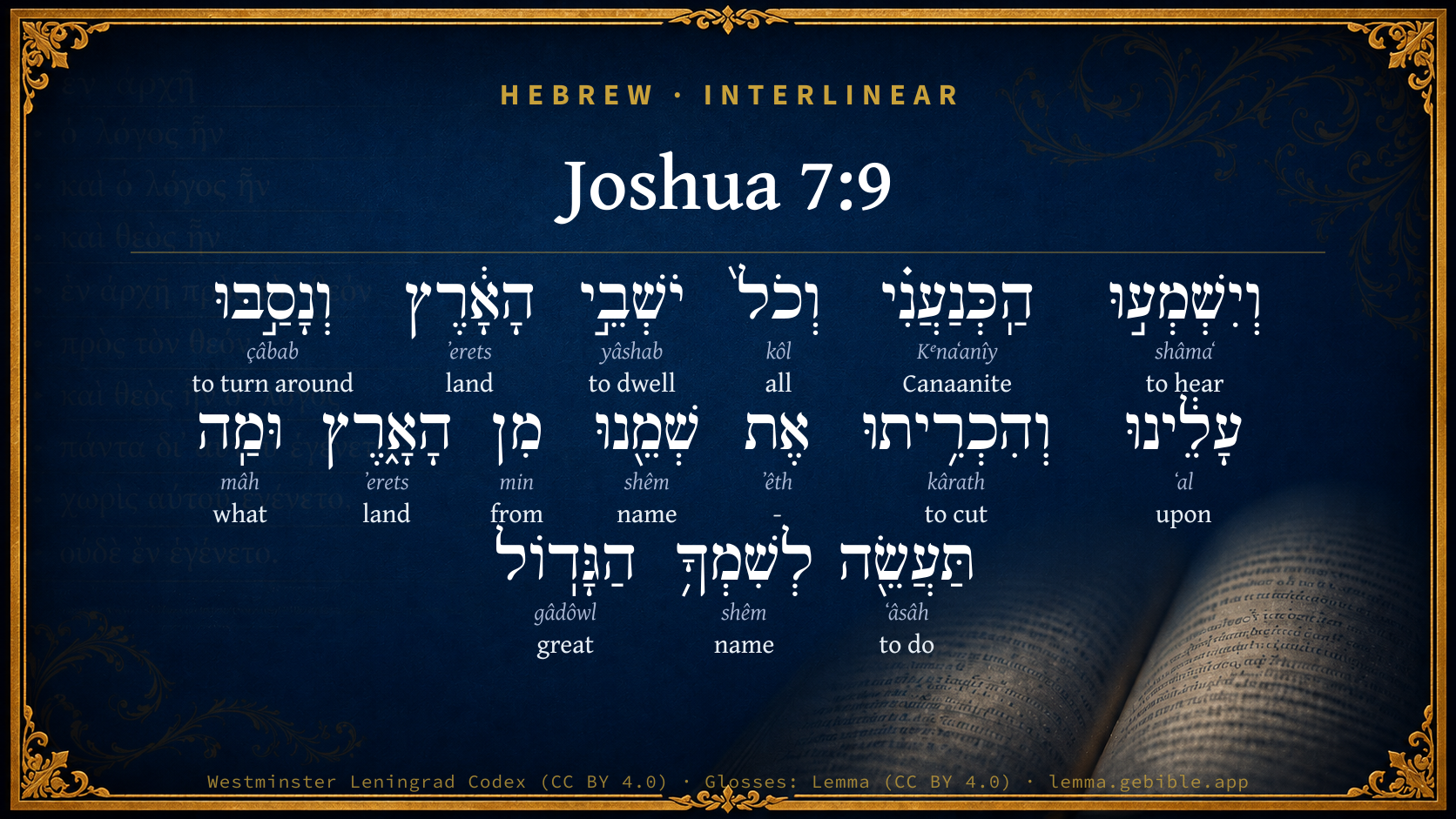
Hebrew (Westminster Leningrad Codex) Joshua 7:9 appears in the Hebrew Old Testament. The text above is from the Westminster Leningrad Codex. Each word links to its Strong’s number, a concise gloss, and parsing drawn from the Open Scriptures Hebrew Bible morphology. Click any word for its full Brown-Driver-Briggs (BDB) entry.
Download image
Cite this verse

Joshua 7:9 (World English Bible). Public Domain. Lemma interlinear Bible study tool, https://lemma.gebible.app/v/joshua/7/9.

Show BibTeX & RIS
BibTeX
RIS
English Translation
For the Canaanites and all the inhabitants of the land will hear of it, and will compass us round, and cut off our name from the earth: and what will you do for your great name?
World English Bible · Public Domain
Download a study sheet

One document with this verse’s original text, its word-by-word gloss line, the meaning frame, cross-references with their text, attributed commentary, and full source and license credits — printable, and it pastes into notes with its structure intact.

This verse Autodidact and up

Study sheet (.html) Plain text (.txt)

A passage Seminary Student

Up to 50 verses in one chapter. A passage sheet keeps up to 6 commentary sources and 12 cross-references per verse, in the order this page ranks them, and says so on the sheet whenever that leaves anything out. Ask for a single verse and you get the Autodidact verse sheet above.

Everything on this page stays free to read, with no account — the sheet is a download of what is already on screen, not access to it.

Want to remove ads? Support Godless Engineer
Compare translations 3

The same verse in 3 English versions, stacked beneath the original-language interlinear above. Click any original word for its lexicon entry.

Each is an independent rendering of the whole verse — the interlinear is not word-aligned to these translations.

Highlighted words mark where these versions differ — a whole-verse word diff, not a word-by-word alignment.

  • World English Bible Public Domain
    For the Canaanites and all the inhabitants of the land will hear of it, and will compass us round, and cut off our name from the earth: and what will you do for your great name?
  • King James Version Public Domain
    For the Canaanites and all the inhabitants of the land shall hear of it, and shall environ us round, and cut off our name from the earth: and what wilt thou do unto thy great name?
  • unfoldingWord Literal Text CC BY-SA 4.0
    And the Canaanite and all the dwellers of the land will hear, and they will surround us and cut off our name from the earth. And what will you do for your great name?”

unfoldingWord Literal Text — © unfoldingWord, licensed CC BY-SA 4.0. Word-aligned USFM3 via Door43 (git.door43.org/unfoldingWord/en_ult).

Versions to compare (up to 4)

3 of 4 selected

Show all 18 translations

Every available English version of this verse, each an independent rendering of the whole verse.

  • World English Bible Public Domain
    For the Canaanites and all the inhabitants of the land will hear of it, and will compass us round, and cut off our name from the earth: and what will you do for your great name?
  • Berean Standard Bible Public Domain
    When the Canaanites and all who live in the land hear about this, they will surround us and wipe out our name from the earth. Then what will You do for Your great name?”
  • Majority Standard Bible Public Domain
    When the Canaanites and all who live in the land hear about this, they will surround us and wipe out our name from the earth. Then what will You do for Your great name?”
  • King James Version Public Domain
    For the Canaanites and all the inhabitants of the land shall hear of it, and shall environ us round, and cut off our name from the earth: and what wilt thou do unto thy great name?
  • American Standard Version (1901) Public Domain
    For the Canaanites and all the inhabitants of the land will hear of it, and will compass us round, and cut off our name from the earth: and what wilt thou do for thy great name?
  • Revised Version (1885) Public Domain
    For the Canaanites and all the inhabitants of the land shall hear of it, and shall compass us round, and cut off our name from the earth: and what wilt thou do for thy great name?
  • Geneva Bible (1599) Public Domain
    For the Canaanites, and all the inhabitants of the land shall heare of it, and shall compasse vs, and destroy our name out of the earth: and what wilt thou doe vnto thy mightie Name?
  • Douay-Rheims (1899) Public Domain
    The Chanaanites, and all the inhabitants of the land will hear of it, and being gathered together will surround us and cut off our name from the earth: and what wilt thou do to thy great name?
  • Young's Literal Translation Public Domain
    and the Canaanite and all the inhabitants of the land do hear, and have come round against us, and cut off our name out of the earth; and what dost Thou do for Thy great name?'
  • Literal Standard Version CC BY-SA 4.0
    And the Canaanite and all the inhabitants of the land hear, and have come around against us, and cut off our name from the earth; and what do You do for Your great Name?”
  • Unlocked Literal Bible CC BY-SA 4.0
    For the Canaanites and all the inhabitants of the land will hear of it. They will surround us and make the people of the earth forget our name. What will you do for your great name?”
  • unfoldingWord Literal Text CC BY-SA 4.0
    And the Canaanite and all the dwellers of the land will hear, and they will surround us and cut off our name from the earth. And what will you do for your great name?”
  • Darby Bible Public Domain
    When the Canaanites and all the inhabitants of the land shall hear [of it], they will surround us, and cut off our name from the earth. And what wilt thou do unto thy great name?
  • World Messianic Bible Public Domain
    For the Canaanites and all the inhabitants of the land will hear of it, and will surround us, and cut off our name from the earth. What will you do for your great name?”
  • Webster's Bible Public Domain
    For the Canaanites, and all the inhabitants of the land will hear of it, and will environ us, and cut off our name from the earth: and what wilt thou do to thy great name?
  • Free Bible Version CC BY-SA 4.0
    The Canaanites and everyone living in the land will come and surround us and wipe us out so completely that even our name will be forgotten. Then what will happen to your great reputation?”
  • Bible in Basic English Public Domain
    For when the news comes to the Canaanites and all the people of the land, they will come up, shutting us in and cutting off our name from the earth: and what will you do for the honour of your great name?
  • JPS Tanakh (1917) Public Domain
    For when the Canaanites and all the inhabitants of the land hear of it, they will compass us round, and cut off our name from the earth; and what wilt Thou do for Thy great name?'

Literal Standard Version (2020), Covenant Press — licensed CC BY-SA 4.0. Text via the HelloAO Bible API (eBible.org). Unlocked Literal Bible (unfoldingWord) — licensed CC BY-SA 4.0. Text via the HelloAO Bible API (eBible.org). unfoldingWord Literal Text — © unfoldingWord, licensed CC BY-SA 4.0. Word-aligned USFM3 via Door43 (git.door43.org/unfoldingWord/en_ult). Free Bible Version, Dr. Jonathan Gallagher — licensed CC BY-SA 4.0. Text via the HelloAO Bible API (eBible.org).

Word by word

More ways to search: Search by grammar → Find every occurrence → Compare this word →

Practice this passage: Drill this verse → Learn its vocabulary →

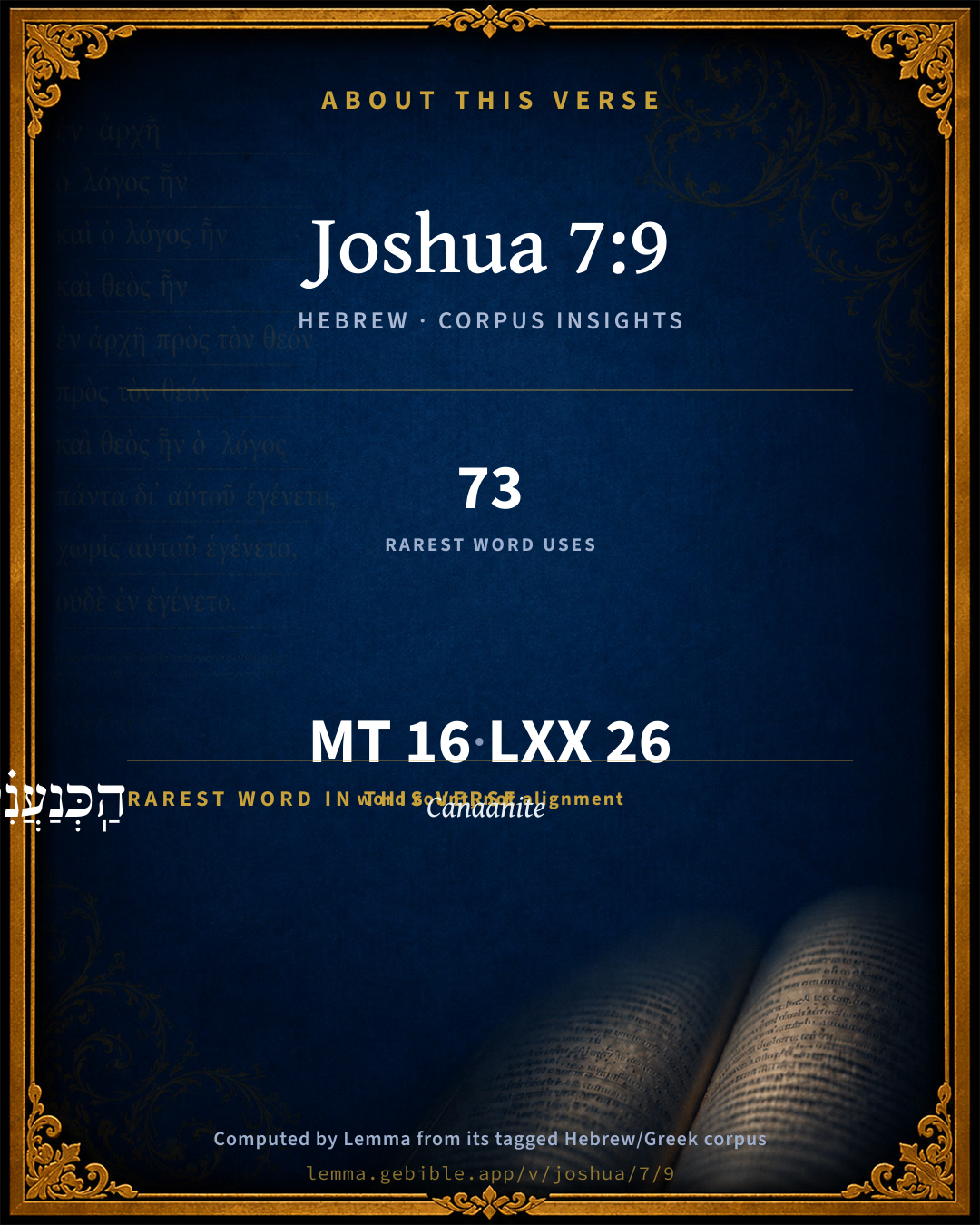
הַֽכְּנַעֲנִ֗י
Kᵉnaʻanîy
H3669
“the · Canaanite”
Particle, Definite Article + Noun, Gentilic, Masculine, Singular, Absolute
Part of Speech
Particle + Noun
Type
Gentilic
Gender
Masculine
Number
Singular
State
Absolute
Full BDB Definition

Origin: patrial from H3667

TWOT: 1002a , 1002b

Canaanite = see Cana " zealous" - descendant of inhabitant of Canaan (adjective) - descendant or inhabitant of Canaan (noun) - a merchant, trader (noun)
  1. וְיִשְׁמְע֣וּ shâmaʻ H8085 “and · to hear” Conjunction + Verb, Qal, Imperfect, 3rd Person, Masculine, Plural
  2. וְכֹל֙ kôl H3605 “and · all of” Conjunction + Noun, Common, Masculine, Singular, Construct
  3. יֹשְׁבֵ֣י yâshab H3427 “dwelling” Verb, Qal, Participle Active, Masculine, Plural, Construct
  4. הָאָ֔רֶץ ʼerets H776 “the · land” Particle, Definite Article + Noun, Common, Both, Singular, Absolute
  5. וְנָסַ֣בּוּ çâbab H5437 “and · to turn around” Conjunction + Verb, Niphal, Sequential Perfect, 3rd Person, Common, Plural
  6. עָלֵ֔ינוּ ʻal H5921 “upon · us” Preposition + Suffix, Personal, 1st Person, Common, Plural
  7. וְהִכְרִ֥יתוּ kârath H3772 “and · to cut” Conjunction + Verb, Hiphil, Sequential Perfect, 3rd Person, Common, Plural
  8. אֶת ʼêth H853 “-” Particle, Direct Object
  9. שְׁמֵ֖נוּ shêm H8034 “name · our” Noun, Common, Masculine, Singular, Construct + Suffix, Personal, 1st Person, Common, Plural
  10. מִן min H4480 “from” Preposition
  11. הָאָ֑רֶץ ʼerets H776 “the · land” Particle, Definite Article + Noun, Common, Both, Singular, Absolute
  12. וּמַֽה mâh H4100 “and · what” Conjunction + Particle, Interrogative
  13. תַּעֲשֵׂ֖ה ʻâsâh H6213 “to do” Verb, Qal, Imperfect, 2nd Person, Masculine, Singular
  14. לְשִׁמְךָ֥ shêm H8034 “to/for · name · your” Preposition + Noun, Common, Masculine, Singular, Construct + Suffix, Personal, 2nd Person, Masculine, Singular
  15. הַגָּדֽוֹל gâdôwl H1419 “the · great” Particle, Definite Article + Adjective, Adjective, Masculine, Singular, Absolute

About this verse

These counts appear in no published source. They are computed here, from the morphology-tagged text and Lemma’s own curated glosses. What Lemma adds →

16
words
14
distinct lemmas
Historical
section

Grammatical profile

  • 5 verbs
  • 6 nouns
  • 1 adjective
  • 2 prepositions
  • 2 particles

Verb forms

  • וְיִשְׁמְע֣וּ Qal · Imperfect
  • יֹשְׁבֵ֣י Qal · Participle Active
  • וְנָסַ֣בּוּ Niphal · Sequential Perfect
  • וְהִכְרִ֥יתוּ Hiphil · Sequential Perfect
  • תַּעֲשֵׂ֖ה Qal · Imperfect

Repetition

Words recur within this verse — often emphatic in Hebrew:

  • הָאָ֔רֶץ land H776 ×2
  • שְׁמֵ֖נוּ name H8034 ×2

Hebrew & Septuagint length

In English translation the verse runs 36 words from the Hebrew and 34 from the Septuagint (LXX English) — closely comparable.

A rough comparison of the two English renderings, which tokenize alike — not a word-level alignment.

Word counts can differ between the Hebrew and the Greek without any difference in meaning — e.g. the Hebrew direct-object marker אֵת has no separate Greek word, and Greek often adds the article ὁ.

In the original languages it is 16 Hebrew tokens and 26 Greek tokens — but the two are counted differently (Hebrew bundles its prefixes and suffixes into one token; the Greek is in lemma form), so that isn’t a like-for-like length.

Cross-references

11

Topical passages linked to Joshua 7:9 in the Treasury of Scripture Knowledge — connected by theme and wording, ordered by reader-vote popularity; previews shown in the World English Bible.

  • Exodus 32:12 Why should the Egyptians speak, saying, 'He brought them forth for evil, to kill them in the mountains, and to consume them from the surface of the earth?' Turn from your fierce wrath, and repent of this evil against your people.
  • Psalms 83:4 "Come," they say, "and let's destroy them as a nation, That the name of Israel may be remembered no more."
  • Ezekiel 36:22–23 Therefore tell the house of Israel, Thus says the Lord Yahweh: I don't do [this] for your sake, house of Israel, but for my holy name, which you have profaned among the nations, where you went.
  • John 12:28 Father, glorify your name!" Then there came a voice out of the sky, saying, "I have both glorified it, and will glorify it again."
  • Numbers 14:13 Moses said to Yahweh, Then the Egyptians will hear it; for you brought up this people in your might from among them;
  • Deuteronomy 9:28 lest the land whence you brought us out say, Because Yahweh was not able to bring them into the land which he promised to them, and because he hated them, he has brought them out to kill them in the wilderness.
  • Psalms 124:2–3 If it had not been Yahweh who was on our side, When men rose up against us;
  • Joel 2:17 Let the priests, the ministers of Yahweh, weep between the porch and the altar, And let them say, "Spare your people, Yahweh, And don't give your heritage to reproach, That the nations should rule over them. Why should they say among the peoples, 'Where is their God?'"
  • Deuteronomy 32:26–27 I said, I would scatter them afar, I would make the memory of them to cease from among men;
  • Psalms 106:6–8 We have sinned with our fathers. We have committed iniquity. We have done wickedly.
  • Ezekiel 20:9 But I worked for my name's sake, that it should not be profaned in the sight of the nations, among which they were, in whose sight I made myself known to them, in bringing them forth out of the land of Egypt.

Cross-references courtesy of OpenBible.info (CC BY 4.0).

Hebrew and Greek witnesses Masoretic Hebrew ↔ Greek Septuagint

The same verse in the two great witnesses to the Old Testament, shown verse-for-verse.

These are two independent witnesses, not word-aligned to each other, and the Septuagint is shown in lemma (dictionary) form.

Hebrew Joshua 7:9 Masoretic · Westminster Leningrad Codex

וְיִשְׁמְע֣וּ הַֽכְּנַעֲנִ֗י וְכֹל֙ יֹשְׁבֵ֣י הָאָ֔רֶץ וְנָסַ֣בּוּ עָלֵ֔ינוּ וְהִכְרִ֥יתוּ אֶת שְׁמֵ֖נוּ מִן הָאָ֑רֶץ וּמַֽה תַּעֲשֵׂ֖ה לְשִׁמְךָ֥ הַגָּדֽוֹל

For the Canaanites and all the inhabitants of the land will hear of it, and will compass us round, and cut off our name from the earth: and what will you do for your great name?

World English Bible · Public Domain

Greek LXX Joshua 7:9 Septuagint · lemma form

καί ἀκούω ὁ χαναναῖος καί πᾶς ὁ καταοἰκέω ὁ γῆ περικυκλόω ἐγώ καί ἐκτρίβω ἐγώ ἀπό ὁ γῆ καί τίς ποιέω ὁ ὄνομα σύ ὁ μέγας

And when the Chananite and all the inhabitants of the land hear it, they shall compass us round and destroy us from off the land: and what will you do for your great name?

LXX2012 (modern English Septuagint) · Public Domain

Hebrew: Westminster Leningrad Codex (CC BY 4.0). Greek: Septuagint (public domain); English from LXX2012 (modern English Septuagint) (Public Domain). How the Septuagint differs from the Hebrew →

Targum (Aramaic paraphrase)

1

The Targum is the ancient Jewish Aramaic paraphrase of the Hebrew Scriptures — an interpretive translation, not the Hebrew text itself. Onkelos (literal) and Pseudo-Jonathan (expansive) render the Torah, and Jonathan the Prophets. Coverage is partial: where no permissively-licensed English translation exists for a verse, only the Aramaic is shown. This is verse-level text, not a word-by-word alignment to the Hebrew.

  1. Targum Jonathan Prophets (Joshua–Malachi)
    וְיִשְׁמְעוּן כְּנַעֲנָאֵי וְכָל יַתְבֵי אַרְעָא וְיִסְתַּחֲרוּן עֲלָנָא וִישֵׁצוּן יַת שְׁמָנָא מִן אַרְעָא וּמָה תַּעֲבֵּד בְּדִיל שְׁמָךְ רַבָּא:

    (no public-domain English translation for this verse)

    Targum Jonathan — Aramaic: “Mikraot Gedolot” (public domain). English: “Sefaria Community Translation” (CC0 1.0 (public-domain dedication)); “London "Chaldee Paraphrase," 1871” (public domain). Text via Sefaria.

Commentary

Notes on Joshua 7:9 from classic Christian and Jewish commentators (each source and its license shown beneath its notes). The classic Christian expositions comment on the surrounding passage and are grouped to its opening verse, so a note may address several verses; the Jewish commentaries on the Tanakh (Rashi and others) are per-verse, so they appear only where the commentator wrote on this verse.

Lemma curates 59 commentaries, every one of them public domain or Creative Commons licensed, each selected and text-cleaned for this edition rather than reprinted as found. About our sources →

Trapp's Complete Commentary

John Trapp

Jos 7:9 For the Canaanites and all the inhabitants of the land shall hear [of it], and shall environ us round, and cut off our name from the earth: and what wilt thou do unto thy great name?

Ver. 9. And what wilt thou do unto thy great name?] This was Joshua’s chief care, - lest God should suffer in the glory of his power and truth. It is the ingenuity of saints, to study God’s share more than their own, and to desire far more that God may be glorified than themselves gratified; they drown all self-respects in his honour, and can believe, when things are at worst, that Christ’s cause shall prevail. There are many golden sayings of Luther sounding to this sense, in his epistles to Melancthon especially, such as a man would fetch upon his knees from Rome or Jerusalem, saith one.

John Trapp, A Commentary or Exposition upon All the Books of the Old and New Testament (1647–1656) — public domain. Text from a community e-Sword module.

Geneva Bible (1599)

Geneva Bible translators

When thine enemies shall blaspheme thee and say, that thou wast not able to defend us from them.

Geneva Bible (1599) marginal notes — public domain. Text via Bolls.life.

John Calvin's Commentaries

9. For the Canaanites and all the inhabitants, etc He mentions another ground of fear. All the neighboring nations, who, either subdued by calamities or terrified by miracles, were quiet, will now resume their confidence and make a sudden attack upon the people. It was indeed probable, that as the divine power had crushed their spirit and filled them with dismay, they would come boldly forward to battle as soon as they knew that God had become hostile to the Israelites. He therefore appeals to God in regard to the future danger, entreating him to make speedy provision against it, as the occasion would be seized by the Canaanites, who, though hitherto benumbed with terror, will now assume the aggressive, and easily succeed in destroying a panic-struck people.

It is manifest, however, from the last clause, that he is not merely thinking of the safety of the people, but is concerned above all for the honor of the divine name, that it may remain inviolable, and not be trampled under foot by the petulance of the wicked, as it would be if the people were ejected from the inheritance so often promised. We know the language which God himself employed, as recorded in the song of Moses, (Deuteronomy 32:26, 27)

“I would scatter them into corners, I would make the remembrance of them cease among men; were it not that I feared the wrath (pride) of the enemy, lest their adversaries should behave themselves strangely, and lest they should say, Our hand is high, and the Lord has not done all this.”

The very thing, then, which God declares that he was, humanly speaking, afraid of, Joshua wishes now to be timelessly prevented; otherwise the enemy, elated by the defeat of the people, will grow insolent and boast of triumphing over God himself.

John Calvin's Commentaries (1540-1563) — public domain. Text from the Calvin Translation Society English edition (1840s-50s) via the Christian Classics Ethereal Library (ccel.org). Calvin's coverage is partial (roughly two-thirds of the Bible); uncommented books and verses are honest gaps, never fabricated. The 19th-century editor's footnotes and remarks are omitted so the notes are faithfully Calvin's own voice.

Ellicott's Commentary for English Readers

(9) The Canaanites . . . shall environ us round.—A thing extremely probable in itself, apart from the supernatural character of the invasion.

A Bible Commentary for English Readers, edited by Charles John Ellicott (1878–1897) — public domain. Text from a community e-Sword module.

John Gill's Exposition

For the Canaanites,.... Those that dwell on the east and on the west of the land, see Jos 11:3; who were one of the seven nations:

and all the inhabitants of the land shall hear of it; of this defeat; not only the Amorites, among whom they now were, and the Canaanites before mentioned, but the Hittites, the Hivites, the Perizzites, and the Jebusites:

and shall environ us round; come with all their forces from all parts of the land, and surround us, so that there will be no escaping for us:

and cut off our name from the earth; utterly destroy us, that we shall be no more a nation and people, and the name of an Israelite no more be heard of, see Psa 83:4,

and what wilt thou do unto thy great name? this, though mentioned last, was uppermost in the heart of Joshua, and was reserved by him as his strongest argument with God to appear for them and save them; since his own glory, the glory of his perfections, his wisdom, goodness, power, truth, and faithfulness, was so much concerned in their salvation.

John Gill's Exposition of the Whole Bible (1746–1763) — public domain (CC PDM 1.0). Text via the HelloAO Bible API.

Albert Barnes' Notes on the Bible

What wilt thou do unto thy great name? - i. e. “after the Canaanites have cut off our name what will become of Thy Name?” This bold expostulation, that of one wrestling in sore need with God in prayer, like the similar appeals of Moses in earlier emergencies (Compare the marginal references), is based upon God’s past promises and mercies. What would be said of (God by the pagan if now He permitted Israel to be destroyed?

Albert Barnes' Notes on the Bible (1834–1885) — public domain. Text from a community e-Sword/MySword module.

Matthew Poole's English Annotations

Which will upon this occasion be blasphemed and charged with inconstancy, unkindness, and unfaithfulness to thine own people, and with inability to resist them, or to do thy people that good thou didst intend them. Compare Exo 32:12; Num 14:13; Deu 33:27; Joe 2:17.

Matthew Poole's English Annotations on the Holy Bible (1683–1685) — public domain. Text from a community e-Sword/MySword module.

Whedon's Commentary on the Bible

Daniel D. Whedon

9. And cut off our name — Our enemies will be encouraged to make a combined assault, and destroy our communications with eastern Palestine.

And what wilt thou do unto thy great name? — That is, with regard to thy great name. Exalted and true views of God are necessary to elevate man and restore in him the image of God. Reverence for him is the basis of all true holiness. The preservation of the glory of God’s name in order that monotheism should finally be the religion of the earth was, according to God’s plan, the very mission of Israel. Joshua therefore appropriately argues, Will God defeat that plan, and upset the whole of Israel’s future history? It does not detract from this prayer to say that the successive arguments used to move God are eminently human — such as a man would address to his fellow. Moses, in his entreaty, for his nation, uses the same argument. Num_14:13-19; Deu_9:28.

Daniel D. Whedon (gen. ed.), Commentary on the Old and New Testaments (1874–1909) — public domain. Text from a community e-Sword module.

The Pulpit Commentary

For the Canaanites and all the inhabitants of the land shall hear of it. The invariable argument of Moses. (Exo_32:12 Num_14:13-16 Deu_9:28 Deu_32:26, Deu_32:27) The disgrace which the sin of man brings upon the cause of the Lord is a real and very terrible thing. (cf. 2Sa_12:14 Eze_36:23)

The Pulpit Commentary (1880–1919), ed. H.D.M. Spence-Jones & Joseph S. Exell — public domain. Text from a community e-Sword module.

John Wesley's Explanatory Notes

Thy great name - Which will upon this occasion be blasphemed and charged with inconstancy, and with inability to resist them, or to do thy people that good which thou didst intend them. The name of God is a great name, above every name. And whatever happens, we ought to pray, that this may not be polluted. This should be our concern more than any thing else: on this we should fix our eye: and we cannot urge a better plea than this, Lord, what wilt thou do for thy great name? Let God in all be glorified, and then welcome his whole will!

John Wesley, Explanatory Notes Upon the Whole Bible (1754–1765) — public domain. Text via the GEBible commentary corpus.

Rashi

Rabbi Shlomo Yitzchaki (Rashi)

And what will you do for Your Name, which is associated with our name? This is the Aggadic interpretation. The simple meaning is, What will you do for your mighty Name, that has already achieved such fame; and now they will be able to say, His strength has become lessened.

Rashi on the Tanakh — English translations: “The Judaica Press complete Tanach with Rashi, translated by A. J. Rosenberg” (CC BY 4.0); “Pentateuch with Rashi's commentary by M. Rosenbaum and A.M. Silbermann, 1929-1934” (public domain); “The Metsudah Tanach series, Lakewood, N.J” (CC BY 4.0); and “The Book of Joshua, Metsudah Publications, 1997” (CC BY 4.0). Text via Sefaria.

Lesson kit

Teaching starters — assembled from the data on this page, not authored interpretation. Every prompt links to the verse data it draws on. Edit before teaching.

Joshua, in the Historical, opens this verse with 16 words (14 distinct Hebrew lemmas). Its most distinctive word is Kᵉnaʻanîy (“Canaanite”). A historical commentator’s framing appears above. Read the whole chapter for the surrounding context.

Discussion questions

  1. How does “Canaanite” (Kᵉnaʻanîy) shape what this verse is saying?
  2. Exodus 32:12 shares this passage’s theme. How do the two illuminate each other?
  3. “land” occurs 2× in this one verse. What is the effect of the repetition?
  4. These translations render this verse differently; the difference is in the English rendering, not the original. What questions does that raise?
  5. The verb «וְיִשְׁמְע֣וּ» is Qal Imperfect. How does its form color the action?
  6. Reading how Trapp's Complete Commentary and Geneva Bible (1599) read this verse, where do the two commentators agree and where do they part?

Things to notice

Reading settings

Reading text

Shown beneath each verse's original-language words.

Old Testament
Old Testament edition

Read the OT as the Masoretic Hebrew (MT) or the Greek Septuagint (LXX).

English shown for the Greek Septuagint (in the Hebrew ↔ Greek comparison).

Comparing translations? Open the Compare panel on any verse page to stack up to four side by side.