Deuteronomy 29:12

Hebrew (Westminster Leningrad Codex) Deuteronomy 29:12 appears in the Hebrew Old Testament. The text above is from the Westminster Leningrad Codex. Each word links to its Strong’s number, a concise gloss, and parsing drawn from the Open Scriptures Hebrew Bible morphology. Click any word for its full Brown-Driver-Briggs (BDB) entry.
Download image
Cite this verse

Deuteronomy 29:12 (World English Bible). Public Domain. Lemma interlinear Bible study tool, https://lemma.gebible.app/v/deuteronomy/29/12.

Show BibTeX & RIS
BibTeX
RIS
English Translation
that you may enter into the covenant of Yahweh your God, and into his oath, which Yahweh your God makes with you this day;
World English Bible · Public Domain
Download a study sheet

One document with this verse’s original text, its word-by-word gloss line, the meaning frame, cross-references with their text, attributed commentary, and full source and license credits — printable, and it pastes into notes with its structure intact.

This verse Autodidact and up

Study sheet (.html) Plain text (.txt)

A passage Seminary Student

Up to 50 verses in one chapter. A passage sheet keeps up to 6 commentary sources and 12 cross-references per verse, in the order this page ranks them, and says so on the sheet whenever that leaves anything out. Ask for a single verse and you get the Autodidact verse sheet above.

Everything on this page stays free to read, with no account — the sheet is a download of what is already on screen, not access to it.

Want to remove ads? Support Godless Engineer
Compare translations 3

The same verse in 3 English versions, stacked beneath the original-language interlinear above. Click any original word for its lexicon entry.

Each is an independent rendering of the whole verse — the interlinear is not word-aligned to these translations.

Highlighted words mark where these versions differ — a whole-verse word diff, not a word-by-word alignment.

  • World English Bible Public Domain
    that you may enter into the covenant of Yahweh your God, and into his oath, which Yahweh your God makes with you this day;
  • King James Version Public Domain
    That thou shouldest enter into covenant with the LORD thy God, and into his oath, which the LORD thy God maketh with thee this day:
  • unfoldingWord Literal Text CC BY-SA 4.0
    to enter into the covenant of Yahweh your God and into the oath that Yahweh your God is cutting with you today,

unfoldingWord Literal Text — © unfoldingWord, licensed CC BY-SA 4.0. Word-aligned USFM3 via Door43 (git.door43.org/unfoldingWord/en_ult).

Versions to compare (up to 4)

3 of 4 selected

Show all 18 translations

Every available English version of this verse, each an independent rendering of the whole verse.

  • World English Bible Public Domain
    that you may enter into the covenant of Yahweh your God, and into his oath, which Yahweh your God makes with you this day;
  • Berean Standard Bible Public Domain
    so that you may enter into the covenant of the LORD your God, which He is making with you today, and into His oath,
  • Majority Standard Bible Public Domain
    so that you may enter into the covenant of the LORD your God, which He is making with you today, and into His oath,
  • King James Version Public Domain
    That thou shouldest enter into covenant with the LORD thy God, and into his oath, which the LORD thy God maketh with thee this day:
  • American Standard Version (1901) Public Domain
    that thou mayest enter into the covenant of Jehovah thy God, and into his oath, which Jehovah thy God maketh with thee this day;
  • Revised Version (1885) Public Domain
    that thou shouldest enter into the covenant of the LORD thy God, and into his oath, which the LORD thy God maketh with thee this day:
  • Geneva Bible (1599) Public Domain
    That thou shouldest passe into the couenant of the Lord thy God, and into his othe which the Lord thy God maketh with thee this day,
  • Douay-Rheims (1899) Public Domain
    That thou mayst pass in the covenant of the Lord thy God, and in the oath which this day the Lord thy God maketh with thee.
  • Young's Literal Translation Public Domain
    for thy passing over into the covenant of Jehovah thy God, and into His oath which Jehovah thy God is making with thee to-day;
  • Literal Standard Version CC BY-SA 4.0
    for your passing over into the covenant of your God YHWH, and into His oath which your God YHWH is making with you today,
  • Unlocked Literal Bible CC BY-SA 4.0
    You are here in order to enter into the covenant of Yahweh your God and into the oath that Yahweh your God is making with you today,
  • unfoldingWord Literal Text CC BY-SA 4.0
    to enter into the covenant of Yahweh your God and into the oath that Yahweh your God is cutting with you today,
  • Darby Bible Public Domain
    that thou mayest enter into the covenant of Jehovah thy God, and into his oath, which Jehovah thy God maketh with thee this day;
  • World Messianic Bible Public Domain
    that you may enter into the covenant of the LORD your God, and into his oath, which the LORD your God makes with you today,
  • Webster's Bible Public Domain
    That thou shouldst enter into covenant with the LORD thy God, and into his oath, which the LORD thy God maketh with thee this day:
  • Free Bible Version CC BY-SA 4.0
    You're here so you can enter into the agreement of the Lord your God, which he is making with you today, and accept his solemn promise,
  • Bible in Basic English Public Domain
    With the purpose of taking part in the agreement of the Lord your God, and his oath which he makes with you today:
  • JPS Tanakh (1917) Public Domain
    (29-11) that thou shouldest enter into the covenant of the LORD thy God — and into His oath — which the LORD thy God maketh with thee this day;

Literal Standard Version (2020), Covenant Press — licensed CC BY-SA 4.0. Text via the HelloAO Bible API (eBible.org). Unlocked Literal Bible (unfoldingWord) — licensed CC BY-SA 4.0. Text via the HelloAO Bible API (eBible.org). unfoldingWord Literal Text — © unfoldingWord, licensed CC BY-SA 4.0. Word-aligned USFM3 via Door43 (git.door43.org/unfoldingWord/en_ult). Free Bible Version, Dr. Jonathan Gallagher — licensed CC BY-SA 4.0. Text via the HelloAO Bible API (eBible.org).

Word by word

More ways to search: Search by grammar → Find every occurrence → Compare this word →

Practice this passage: Drill this verse → Learn its vocabulary →

וּבְאָלָת֑וֹ
ʼâlâh
H423
“and · in/at · oath · his”
Conjunction + Preposition + Noun, Common, Feminine, Singular, Construct + Suffix, Personal, 3rd Person, Masculine, Singular
Part of Speech
Conjunction + Preposition + Noun
Type
Common
Gender
Feminine
Number
Singular
State
Construct
Full BDB Definition

Origin: from H422

TWOT: 91a

oath - oath of covenant - curse - from God - from men - execration
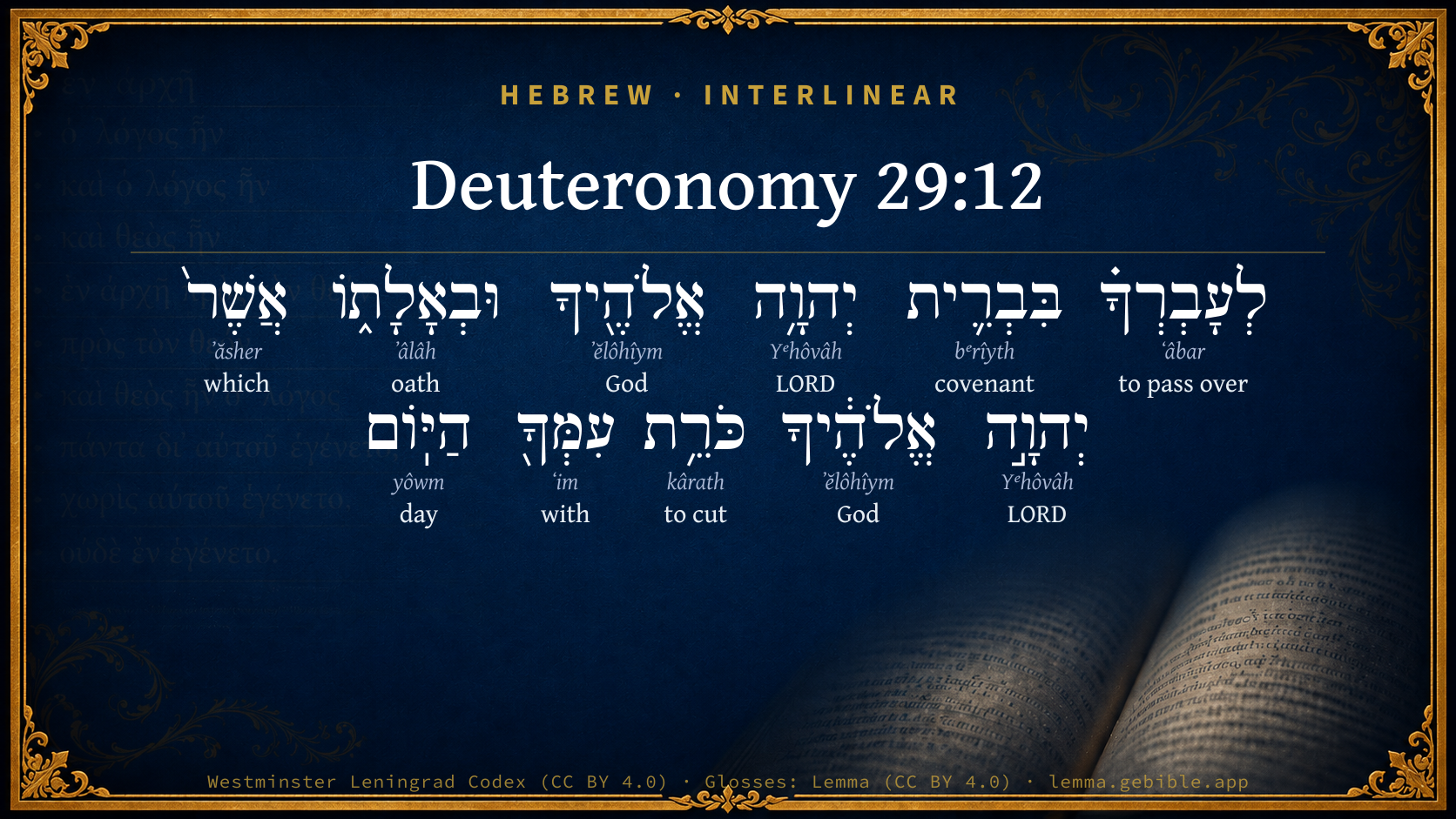
  1. לְעָבְרְךָ֗ ʻâbar H5674 “to pass over · you” Preposition + Verb, Qal, Infinitive Construct + Suffix, Personal, 2nd Person, Masculine, Singular
  2. בִּבְרִ֛ית bᵉrîyth H1285 “in/at · covenant of” Preposition + Noun, Common, Feminine, Singular, Construct
  3. יְהוָ֥ה Yᵉhôvâh H3068 “LORD” Noun, Proper
  4. אֱלֹהֶ֖יךָ ʼĕlôhîym H430 “God(s) · your” Noun, Common, Masculine, Plural, Construct + Suffix, Personal, 2nd Person, Masculine, Singular
  5. אֲשֶׁר֙ ʼăsher H834 “which” Particle, Relative
  6. יְהוָ֣ה Yᵉhôvâh H3068 “LORD” Noun, Proper
  7. אֱלֹהֶ֔יךָ ʼĕlôhîym H430 “God(s) · your” Noun, Common, Masculine, Plural, Construct + Suffix, Personal, 2nd Person, Masculine, Singular
  8. כֹּרֵ֥ת kârath H3772 “cutting” Verb, Qal, Participle Active, Masculine, Singular, Absolute
  9. עִמְּךָ֖ ʻim H5973 “with · you” Preposition + Suffix, Personal, 2nd Person, Masculine, Singular
  10. הַיּֽוֹם yôwm H3117 “the · day” Particle, Definite Article + Noun, Common, Masculine, Singular, Absolute

About this verse

These counts appear in no published source. They are computed here, from the morphology-tagged text and Lemma’s own curated glosses. What Lemma adds →

11
words
9
distinct lemmas
Pentateuch
section

Shared distinctive vocabulary

וּבְאָלָת֑וֹ oath H423 occurs in 32 verses of the Hebrew Bible. Also found in:

Grammatical profile

  • 2 verbs
  • 7 nouns
  • 1 preposition
  • 1 particle

Verb forms

  • לְעָבְרְךָ֗ Qal · Infinitive Construct
  • כֹּרֵ֥ת Qal · Participle Active

Repetition

Words recur within this verse — often emphatic in Hebrew:

  • יְהוָ֥ה LORD H3068 ×2
  • אֱלֹהֶ֖יךָ God H430 ×2

Hebrew & Septuagint length

In English translation the verse runs 24 words from the Hebrew and 27 from the Septuagint (LXX English) — closely comparable.

A rough comparison of the two English renderings, which tokenize alike — not a word-level alignment.

Word counts can differ between the Hebrew and the Greek without any difference in meaning — e.g. the Hebrew direct-object marker אֵת has no separate Greek word, and Greek often adds the article ὁ.

Cross-references

7

Topical passages linked to Deuteronomy 29:12 in the Treasury of Scripture Knowledge — connected by theme and wording, ordered by reader-vote popularity; previews shown in the World English Bible.

  • 2 Chronicles 15:12–15 They entered into the covenant to seek Yahweh, the God of their fathers, with all their heart and with all their soul;
  • Exodus 19:5–6 Now therefore, if you will indeed obey my voice, and keep my covenant, then you shall be my own possession from among all peoples; for all the earth is mine;
  • Deuteronomy 5:2–3 Yahweh our God made a covenant with us in Horeb.
  • Deuteronomy 29:14 Neither with you only do I make this covenant and this oath,
  • Joshua 24:25 So Joshua made a covenant with the people that day, and set them a statute and an ordinance in Shechem.
  • 2 Kings 11:17 Jehoiada made a covenant between Yahweh and the king and the people, that they should be Yahweh's people; between the king also and the people.
  • Nehemiah 10:28–29 The rest of the people, the priests, the Levites, the porters, the singers, the Nethinim, and all those who had separated themselves from the peoples of the lands to the law of God, their wives, their sons, and their daughters, everyone who had knowledge, and understanding;

Cross-references courtesy of OpenBible.info (CC BY 4.0).

Hebrew and Greek witnesses Masoretic Hebrew ↔ Greek Septuagint

The same verse in the two great witnesses to the Old Testament, shown verse-for-verse.

These are two independent witnesses, not word-aligned to each other, and the Septuagint is shown in lemma (dictionary) form.

Hebrew Deuteronomy 29:12 Masoretic · Westminster Leningrad Codex

לְעָבְרְךָ֗ בִּבְרִ֛ית יְהוָ֥ה אֱלֹהֶ֖יךָ וּבְאָלָת֑וֹ אֲשֶׁר֙ יְהוָ֣ה אֱלֹהֶ֔יךָ כֹּרֵ֥ת עִמְּךָ֖ הַיּֽוֹם

that you may enter into the covenant of Yahweh your God, and into his oath, which Yahweh your God makes with you this day;

World English Bible · Public Domain

Greek LXX Deuteronomy 29:12 Septuagint · lemma form

ἵνα ἵστημι σύ αὐτός εἰς λαός καί αὐτός εἰμί σύ θεός ὅς τρόπος εἶπον σύ καί ὅς τρόπος ὄμνυμι ὁ πατήρ σύ ἀβραάμ καί ισαακ καί ἰακώβ

that you should enter into the covenant of the Lord your God and into his oaths, as many as the Lord your God appoints you this day;

LXX2012 (modern English Septuagint) · Public Domain

On this verse, Haydock's Catholic Bible Commentary discusses the Septuagint’s reading. Read the note in Commentary ↓

Hebrew: Westminster Leningrad Codex (CC BY 4.0). Greek: Septuagint (public domain); English from LXX2012 (modern English Septuagint) (Public Domain). How the Septuagint differs from the Hebrew →

Targum (Aramaic paraphrase)

2

The Targum is the ancient Jewish Aramaic paraphrase of the Hebrew Scriptures — an interpretive translation, not the Hebrew text itself. Onkelos (literal) and Pseudo-Jonathan (expansive) render the Torah, and Jonathan the Prophets. Coverage is partial: where no permissively-licensed English translation exists for a verse, only the Aramaic is shown. This is verse-level text, not a word-by-word alignment to the Hebrew.

  1. Targum Onkelos Torah (Genesis–Deuteronomy)
    בְּדִיל לַאֲקָמָא יָתָךְ יוֹמָא דֵין קֳדָמוֹהִי לְעַמָא וְהוּא יְהֵי לָךְ לֶאֶלָהּ כְּמָא דִי מַלִיל לָךְ וּכְמָא דִי קַיִים לַאֲבָהָתָךְ לְאַבְרָהָם לְיִצְחָק וּלְיַעֲקֹב

    (no public-domain English translation for this verse)

    Targum Onkelos — Aramaic: “Onkelos Genesis” (public domain); “Onkelos Exodus” (public domain); “Onkelos Leviticus” (public domain); “Onkelos Numbers” (public domain); “Onkelos Deuteronomy” (public domain). English: “Sefaria Community Translation” (CC0 1.0 (public-domain dedication)); “J.W. Etheridge. The Targums of Onkelos and Jonathan Ben Uzziel on the Pentateuch. London: Longmans, Green, 1862” (public domain). Text via Sefaria.

  2. Targum Pseudo-Jonathan Torah (Genesis–Deuteronomy)
    מִן בִּגְלַל לְקַיָימָא יַתְכוֹן יוֹמָנָא לֵיהּ לְאוּמָא בְּרִירָא וְהוּא יֶהֱוֵי לְכוֹן לֶאֱלָהָא הֵיכְמָא דְמַלֵיל לְכוֹן וְהֵיכְמָא דְקַיֵים לְאַבְהַתְכוֹן לְאַבְרָהָם לְיִצְחָק וּלְיַעֲקב

    that you may stand today before Him a purified people; and that He may be a God to you, as He hath spoken to you, and as He did swear unto Abraham, Izhak, and Jakob.

    Targum Pseudo-Jonathan — Aramaic: “Targum Jonathan on Genesis” (public domain); “Targum Jonathan on Exodus” (public domain); “Targum Jonathan on Leviticus” (public domain); “Targum Jonathan on Numbers” (public domain); “Targum Jonathan on Deuteronomy” (public domain). English: “The Targum of Jonathan ben Uzziel, trans. J. W. Etheridge, London, 1862” (public domain). Text via Sefaria.

Commentary

Notes on Deuteronomy 29:12 from classic Christian and Jewish commentators (each source and its license shown beneath its notes). The classic Christian expositions comment on the surrounding passage and are grouped to its opening verse, so a note may address several verses; the Jewish commentaries on the Tanakh (Rashi and others) are per-verse, so they appear only where the commentator wrote on this verse.

Lemma curates 59 commentaries, every one of them public domain or Creative Commons licensed, each selected and text-cleaned for this edition rather than reprinted as found. About our sources →

Tyndale Open Study Notes

Tyndale Open Resources

29:12 The technical phrase to enter into the covenant meant subscribing to the terms of the agreement.

Tyndale Open Study Notes — © Tyndale Open Resources, licensed CC BY-SA 4.0. Text via the HelloAO Bible API.

Geneva Bible (1599)

Geneva Bible translators

Alluding to them, that when they made a sure covenant, divided a beast in twain, and passed between the parts divided, Gen. 15:10.

Geneva Bible (1599) marginal notes — public domain. Text via Bolls.life.

Adam Clarke's Commentary

Verse 12. That thou shouldest enter] לעבר leaber, to pass through, that is, between the separated parts of the covenant sacrifice. See Clarke on Ge 15:18.

And into his oath] Thus we find that in a covenant were these seven particulars:

1. The parties about to contract were considered as being hitherto separated.

2. They now agree to enter into a state of close and permanent amity. 3. They meet together in a solemn manner for this purpose.

4. A sacrifice is offered to God on the occasion, for the whole is a religious act.

5. The victim is separated exactly into two equal parts, the separation being in the direction of the spine; and those parts are laid opposite to each other, sufficient room being allowed for the contracting parties to pass between them.

6. The contracting parties meet in the victim, and the conditions of the covenant by which they are to be mutually bound are recited.

7. An oath is taken by these parties that they shall punctually and faithfully perform their respective conditions, and thus the covenant is made and ratified. See Jer 34:18-19, and Clarke's notes on "Ge 6:18"; "Ge 15:18"; "Ex 29:45"; Le 26:44-45.

Adam Clarke's Commentary on the Bible (1810–1826) — public domain. Text from a community e-Sword/MySword module.

Ellicott's Commentary for English Readers

(12) Enter (literally “pass “) into covenant with the Lord.—Comp. Eze_20:37 : “I will cause you to pass under the rod, and I will bring you into the bond of the covenant” Rashi illustrates by Jer_34:18, the passing between the parts of the divided victim, in order to enter into the covenant. (Comp. Gen_15:17-18.) But no such ceremony is mentioned here, and therefore we can only say that possibly the practice may have given occasion for this use of the word “pass.”

His oath.—A word here used for the first time in Deuteronomy. It is rendered “curse” in Deu_29:19-21. It seems to mean an imprecation in the name of God (comp. Lev_5:4; Gen_24:41), which may bring a curse if the thing sworn to is not fulfilled.

Which the Lord thy God maketh with thee.—Maketh; literally, cutteth. The word refers to the “covenant.”

A Bible Commentary for English Readers, edited by Charles John Ellicott (1878–1897) — public domain. Text from a community e-Sword module.

The Cambridge Bible for Schools and Colleges

gen. ed. J. J. S. Perowne

12. enter into the covenant] Lit. pass over into only here. Cp. the passing over into a select and numbered body, Exo_30:13 f. (P); also the prepositions in our terms ‘trans-act,’ ‘carry through.’ On covenant see Deu_4:13.

and into his oath] Cp. Neh_10:29 : enter into an oath. God confirms His covenant by an oath, Deu_4:31, etc. The Heb. ’alah is used three times in this ch., 12, 14, 19 (q.v.), as = oath, and thrice Deu_29:20-21 and Deu_30:7 as imprecation, or curse; but nowhere else in Deut.

The Cambridge Bible for Schools and Colleges (gen. ed. J. J. S. Perowne; Cambridge University Press, 1878–1918) — public domain. Text from a community e-Sword module.

John Gill's Exposition

That thou shouldest enter into covenant with the Lord thy God,.... That is, they were all to appear and stand in this order before the Lord, that they might solemnly avouch him to be their God, and hear him declaring them to be his people, and the many promises and prophecies of good things he should deliver to them, as well as threatenings of wrath and vengeance in case of disobedience to him: or "that thou shouldest pass" (e): which some think is an allusion to the manner of making covenants, by slaying a creature, and cutting it in pieces, and passing between them, as in Jer 34:18; so Jarchi and Aben Ezra:

and into his oath; annexed to his covenant and promise, to show the immutability and certain fulfilment of it on his part; and may signify not only the oath he swore that they should be his people, but the oath he gave them, and they took, that he should be their God:

which the Lord thy God maketh with thee this day; which refers both to the covenant and the oath, or the covenant confirmed by an oath, even the covenant now made in the plains of Moab, distinct from that at Horeb or Sinai.

(e) "ut transeas", V. L. Tigurine version, Munster, Vatablus, Pagniuns, Cocceius; "ad transeundum", Montanus.

John Gill's Exposition of the Whole Bible (1746–1763) — public domain (CC PDM 1.0). Text via the HelloAO Bible API.

Haydock's Catholic Bible Commentary

Pass; alluding to the custom of people who pass between the victims, when they engage in a solemn covenant, as Abraham did, Genesis xv. 10. --- Oath. Septuagint, "imprecations," specified in the preceding chapters, ver. 14. (Calmet)

George Leo Haydock (1774–1849), Haydock's Catholic Family Bible and Commentary, 1859 edition — public domain. Excludes Psalms (Douay-Rheims chapter numbering differs from Protestant) and Deuterocanonical books (Catholic canon only).

Matthew Poole's English Annotations

Into covenant, and into his oath, i.e. into covenant or agreement, confirmed by a solemn oath.

Matthew Poole's English Annotations on the Holy Bible (1683–1685) — public domain. Text from a community e-Sword/MySword module.

John Wesley's Explanatory Notes

Into covenant and into his oath - Into covenant, confirmed by a solemn oath.

John Wesley, Explanatory Notes Upon the Whole Bible (1754–1765) — public domain. Text via the GEBible commentary corpus.

unfoldingWord translationNotes

Door43 World Missions Community

General Information:

Moses speaks to the Israelites as if they were one man, so the words "you" and "your" here are singular. (See: Forms of You)

to enter into the covenant of Yahweh your God and into the oath that Yahweh your God is making with you today

"to agree to the covenant and to swear that you will obey all that Yahweh your God commands"

a people for himself

"a people group that belongs to him alone"

translationWords

covenant

God

oath

people of God

Abraham

Isaac

Jacob

unfoldingWord translationNotes — © Distant Shores Media and the Door43 World Missions Community, licensed CC BY-SA 4.0. Source: git.door43.org/Door43/en_tn.

Rashi

Rabbi Shlomo Yitzchaki (Rashi)

למען הקים אתך היום לו לעם THAT HE MAY ESTABLISH THEE TO-DAY FOR A PEOPLE UNTO HIMSELF — He undertakes so much trouble (in making another covenant with you) in order that He may keep (הקים) you for a people in His presence,

והוא יהיה לך לאלהים SINCE HE MUST BE UNTO THEE A GOD, because He has promised it unto you and has sworn unto your fathers not to exchange their descendants for another nation. For this reason He binds you by these oaths not to provoke Him to anger since He, on His part, cannot dissociate Himself from you. — Thus far I have given an exposition according to the literal sense of the chapter. An Agadic explanation, however, is: Why is the section beginning with the words, “Ye are standing this day” put in juxtaposition to the curses in the previous chapter? Because when Israel heard these ninety-eight curses besides the forty-nine that are contained in Torath-Cohanim (Leviticus 26:14 ff.), their faces turned pale (they were horrified), and they exclaimed, “Who can possibly stand against these?!” Therefore Moses began to calm them: “See, you are standing today before the Lord!” — many a time have you provoked the Omnipresent to anger and yet He has not made an end to you, but you still continue in His presence (Midrash Tanchuma, Nitzavim 1).

היום THIS DAY — like the “day” which endures for ever, for though it becomes dark for a period it shines again, (cf. Midrash Tanchuma, Nitzavim 1, Sanhedrin 110b); so has He made you shine (i.e. given you periods when you have had nought but happiness) and will again make you shine; and it is just the curses and the sufferings that give you permanence and stability (נצבים) before Him. — So, too, the section preceding this (1 ff. which follows immediately after the curses) consists of comforting words: “Ye have seen all the Lord did [before your eyes in the land of Egypt unto Pharaoh, etc.]”. — Another explanation of אתם נצבים: Because the Israelites were now passing from one leader to another, from Moses to Joshua, therefore he (Moses) made them stand in ranks (מצבה) that he might address admonitions to them. Similarly did Joshua (cf. Joshua 24:1) and similarly did Samuel, who said, (I Samuel 12:7): “Now therefore take your stand (התיצבו) that I may reason with you before the Lord”, when they were leaving his hand (leadership) and were coming under the hand of Saul (cf. Midrash Tanchuma, Nitzavim 1).

Rashi on the Tanakh — English translations: “The Judaica Press complete Tanach with Rashi, translated by A. J. Rosenberg” (CC BY 4.0); “Pentateuch with Rashi's commentary by M. Rosenbaum and A.M. Silbermann, 1929-1934” (public domain); “The Metsudah Tanach series, Lakewood, N.J” (CC BY 4.0); and “The Book of Joshua, Metsudah Publications, 1997” (CC BY 4.0). Text via Sefaria.

Lesson kit

Teaching starters — assembled from the data on this page, not authored interpretation. Every prompt links to the verse data it draws on. Edit before teaching.

Deuteronomy, in the Pentateuch, opens this verse with 11 words (9 distinct Hebrew lemmas). Its most distinctive word is ʼâlâh (“oath”). A historical commentator’s framing appears above. Read the whole chapter for the surrounding context.

Discussion questions

  1. What does “oath” (ʼâlâh) contribute to the verse as a whole?
  2. How does Genesis 24:41, which shares the word «oath», read alongside this verse?
  3. What does the repetition of “LORD” (2× in this one verse) do in this verse?
  4. These translations render this verse differently; the difference is in the English rendering, not the original. What questions does that raise?
  5. «לְעָבְרְךָ֗» is a Qal Infinitive Construct verb. How does that grammatical form shape the action described?
  6. Compare how Tyndale Open Study Notes and Geneva Bible (1599) read this verse. Where do they agree or differ?

Things to notice

Reading settings

Reading text

Shown beneath each verse's original-language words.

Old Testament
Old Testament edition

Read the OT as the Masoretic Hebrew (MT) or the Greek Septuagint (LXX).

English shown for the Greek Septuagint (in the Hebrew ↔ Greek comparison).

Comparing translations? Open the Compare panel on any verse page to stack up to four side by side.