
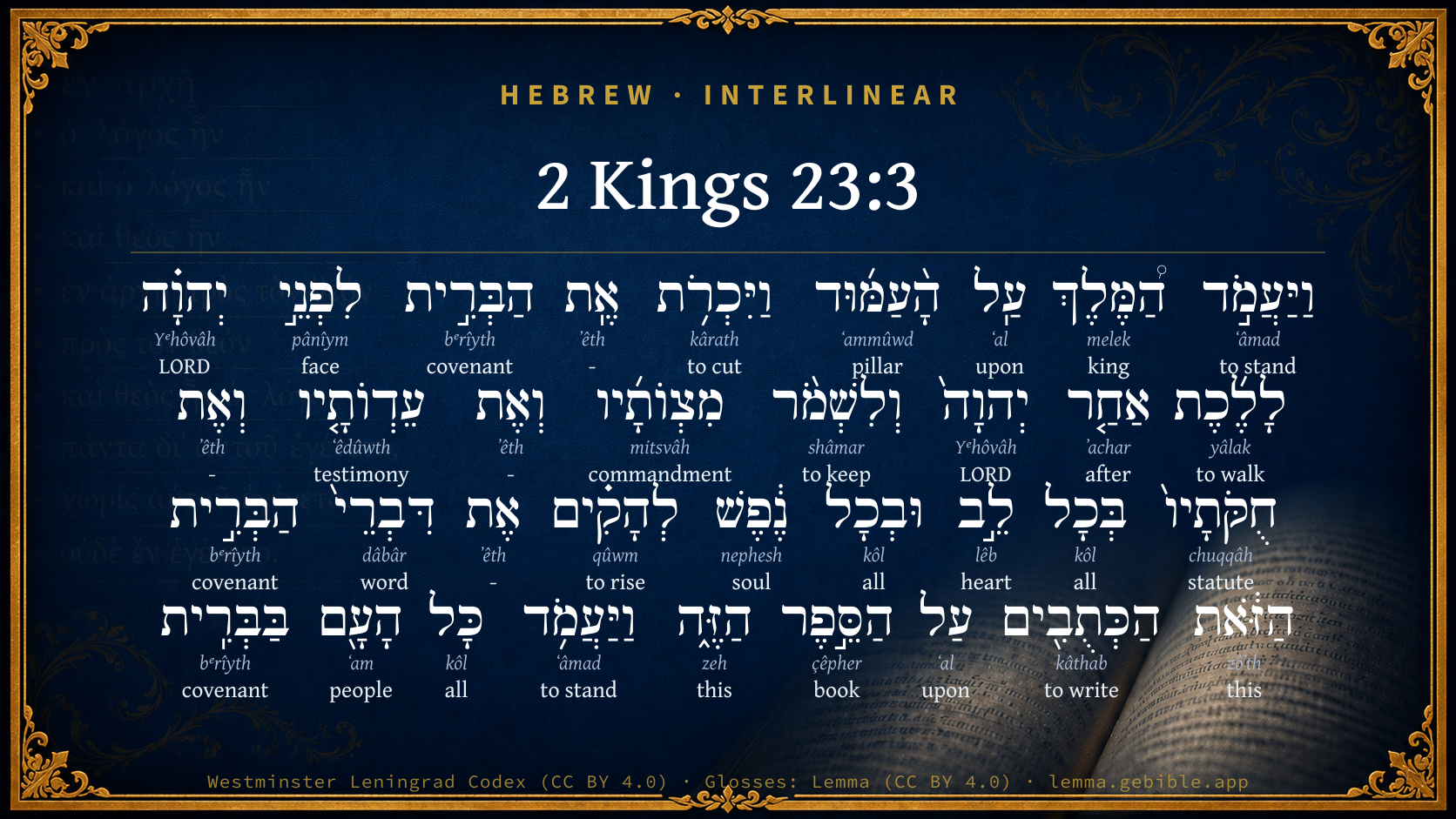
2 Kings 23:3

Hebrew (Westminster Leningrad Codex) 2 Kings 23:3 appears in the Hebrew Old Testament. The text above is from the Westminster Leningrad Codex. Each word links to its Strong’s number, a concise gloss, and parsing drawn from the Open Scriptures Hebrew Bible morphology. Click any word for its full Brown-Driver-Briggs (BDB) entry.
Download image
Cite this verse

2 Kings 23:3 (World English Bible). Public Domain. Lemma interlinear Bible study tool, https://lemma.gebible.app/v/2-kings/23/3.

Show BibTeX & RIS
BibTeX
RIS
English Translation
The king stood by the pillar, and made a covenant before Yahweh, to walk after Yahweh, and to keep his commandments, and his testimonies, and his statutes, with all [his] heart, and all [his] soul, to confirm the words of this covenant that were written in this book: and all the people stood to the covenant.
World English Bible · Public Domain
Download a study sheet

One document with this verse’s original text, its word-by-word gloss line, the meaning frame, cross-references with their text, attributed commentary, and full source and license credits — printable, and it pastes into notes with its structure intact.

This verse Autodidact and up

Study sheet (.html) Plain text (.txt)

A passage Seminary Student

Up to 50 verses in one chapter. A passage sheet keeps up to 6 commentary sources and 12 cross-references per verse, in the order this page ranks them, and says so on the sheet whenever that leaves anything out. Ask for a single verse and you get the Autodidact verse sheet above.

Everything on this page stays free to read, with no account — the sheet is a download of what is already on screen, not access to it.

Want to remove ads? Support Godless Engineer
Compare translations 3

The same verse in 3 English versions, stacked beneath the original-language interlinear above. Click any original word for its lexicon entry.

Each is an independent rendering of the whole verse — the interlinear is not word-aligned to these translations.

Highlighted words mark where these versions differ — a whole-verse word diff, not a word-by-word alignment.

  • World English Bible Public Domain
    The king stood by the pillar, and made a covenant before Yahweh, to walk after Yahweh, and to keep his commandments, and his testimonies, and his statutes, with all [his] heart, and all [his] soul, to confirm the words of this covenant that were written in this book: and all the people stood to the covenant.
  • King James Version Public Domain
    And the king stood by a pillar, and made a covenant before the LORD, to walk after the LORD, and to keep his commandments and his testimonies and his statutes with all their heart and all their soul, to perform the words of this covenant that were written in this book. And all the people stood to the covenant.
  • unfoldingWord Literal Text CC BY-SA 4.0
    And the king stood by the pillar, and he cut a covenant to the face of Yahweh to walk after Yahweh and to keep his commandments and his testimonies and his statutes with all of the heart and with all of the soul, to raise up the words of this covenant written on that scroll. And all of the people stood in the covenant.

unfoldingWord Literal Text — © unfoldingWord, licensed CC BY-SA 4.0. Word-aligned USFM3 via Door43 (git.door43.org/unfoldingWord/en_ult).

Versions to compare (up to 4)

3 of 4 selected

Show all 18 translations

Every available English version of this verse, each an independent rendering of the whole verse.

  • World English Bible Public Domain
    The king stood by the pillar, and made a covenant before Yahweh, to walk after Yahweh, and to keep his commandments, and his testimonies, and his statutes, with all [his] heart, and all [his] soul, to confirm the words of this covenant that were written in this book: and all the people stood to the covenant.
  • Berean Standard Bible Public Domain
    So the king stood by the pillar and made a covenant before the LORD to follow the LORD and to keep His commandments, decrees, and statutes with all his heart and all his soul, and to carry out the words of this covenant that were written in this book. And all the people entered into the covenant.
  • Majority Standard Bible Public Domain
    So the king stood by the pillar and made a covenant before the LORD to follow the LORD and to keep His commandments, decrees, and statutes with all his heart and all his soul, and to carry out the words of the covenant that were written in this book. And all the people entered into the covenant.
  • King James Version Public Domain
    And the king stood by a pillar, and made a covenant before the LORD, to walk after the LORD, and to keep his commandments and his testimonies and his statutes with all their heart and all their soul, to perform the words of this covenant that were written in this book. And all the people stood to the covenant.
  • American Standard Version (1901) Public Domain
    And the king stood by the pillar, and made a covenant before Jehovah, to walk after Jehovah, and to keep his commandments, and his testimonies, and his statutes, with all `his' heart, and all `his' soul, to confirm the words of this covenant that were written in this book: and all the people stood to the covenant.
  • Revised Version (1885) Public Domain
    And the king stood by the pillar, and made a covenant before the LORD, to walk after the LORD, and to keep his commandments, and his testimonies, and his statutes, with all his heart, and all his soul, to confirm the words of this covenant that were written in this book: and all the people stood to the covenant.
  • Geneva Bible (1599) Public Domain
    And the King stood by the pillar, and made a couenant before the Lord, that they shoulde walke after the Lord, and keepe his commandements, and his testimonies, and his statutes with all their heart, and with all their soule, that they might accomplish the wordes of this couenant written in this booke. And all the people stood to the couenant.
  • Douay-Rheims (1899) Public Domain
    And the king stood upon the step: and made a covenant with the Lord, to walk after the Lord, and to keep his commandments, and his testimonies and his ceremonies, with all their heart, and with all their soul, and to perform the words of this covenant, which were written in that book: and the people agreed to the covenant.
  • Young's Literal Translation Public Domain
    And the king standeth by the pillar, and maketh the covenant before Jehovah, to walk after Jehovah, and to keep His commands, and His testimonies, and His statutes, with all the heart, and with all the soul, to establish the words of this covenant that are written on this book, and all the people stand in the covenant.
  • Literal Standard Version CC BY-SA 4.0
    And the king stands by the pillar, and makes the covenant before YHWH, to walk after YHWH, and to keep His commands, and His testimonies, and His statutes, with all the heart, and with all the soul, to establish the words of this covenant that are written on this scroll, and all the people stand in the covenant.
  • Unlocked Literal Bible CC BY-SA 4.0
    The king stood by the pillar and made a covenant before Yahweh, to walk after Yahweh and to keep his commandments, his regulations, and his statutes, with all his heart and all his soul, to confirm the words of this covenant that were written in this book. So all the people agreed to stand by the covenant.
  • unfoldingWord Literal Text CC BY-SA 4.0
    And the king stood by the pillar, and he cut a covenant to the face of Yahweh to walk after Yahweh and to keep his commandments and his testimonies and his statutes with all of the heart and with all of the soul, to raise up the words of this covenant written on that scroll. And all of the people stood in the covenant.
  • Darby Bible Public Domain
    And the king stood on the dais, and made a covenant before Jehovah, to walk after Jehovah, and to keep his commandments and his testimonies and his statutes with all [his] heart, and with all [his] soul, to establish the words of this covenant that are written in this book. And all the people stood to the covenant.
  • World Messianic Bible Public Domain
    The king stood by the pillar and made a covenant before the LORD to walk after the LORD and to keep his commandments, his testimonies, and his statutes with all his heart and all his soul, to confirm the words of this covenant that were written in this book; and all the people agreed to the covenant.
  • Webster's Bible Public Domain
    And the king stood by a pillar, and made a covenant before the LORD, to walk after the LORD, and to keep his commandments, and his testimonies, and his statutes, with all their heart and all their soul, to perform the words of this covenant that were written in this book. And all the people stood to the covenant.
  • Free Bible Version CC BY-SA 4.0
    The king stood by the pillar and made a solemn agreement before the Lord to follow him and to keep his commandments, laws, and regulations with total dedication, and to observe the requirements of the agreement as written in the book. All the people entered into the agreement.
  • Bible in Basic English Public Domain
    And the king took his place by the pillar, and made an agreement before the Lord, to go in the way of the Lord, and keep his orders and his decisions and his rules with all his heart and all his soul, and to keep the words of the agreement recorded in the book; and all the people gave their word to keep the agreement.
  • JPS Tanakh (1917) Public Domain
    And the king stood on the platform, and made a covenant before the LORD, to walk after the LORD, and to keep His commandments, and His testimonies, and His statutes, with all his heart, and all his soul, to confirm the words of this covenant that were written in this book; and all the people stood to the covenant.

Literal Standard Version (2020), Covenant Press — licensed CC BY-SA 4.0. Text via the HelloAO Bible API (eBible.org). Unlocked Literal Bible (unfoldingWord) — licensed CC BY-SA 4.0. Text via the HelloAO Bible API (eBible.org). unfoldingWord Literal Text — © unfoldingWord, licensed CC BY-SA 4.0. Word-aligned USFM3 via Door43 (git.door43.org/unfoldingWord/en_ult). Free Bible Version, Dr. Jonathan Gallagher — licensed CC BY-SA 4.0. Text via the HelloAO Bible API (eBible.org).

Word by word

More ways to search: Search by grammar → Find every occurrence → Compare this word →

Practice this passage: Drill this verse → Learn its vocabulary →

עֵדְוֺתָ֤יו
ʻêdûwth
H5715
“testimonies · his”
Noun, Common, Feminine, Plural, Construct + Suffix, Personal, 3rd Person, Masculine, Singular
Part of Speech
Noun
Type
Common
Gender
Feminine
Number
Plural
State
Construct
Full BDB Definition

Origin: from H5707

TWOT: 1576f

testimony
  1. וַיַּעֲמֹ֣ד ʻâmad H5975 “and · to stand” Conjunction + Verb, Qal, Sequential Imperfect, 3rd Person, Masculine, Singular
  2. הַ֠מֶּלֶךְ melek H4428 “the · king” Particle, Definite Article + Noun, Common, Masculine, Singular, Absolute
  3. עַֽל ʻal H5921 “upon” Preposition
  4. הָ֨עַמּ֜וּד ʻammûwd H5982 “the · pillar” Particle, Definite Article + Noun, Common, Masculine, Singular, Absolute
  5. וַיִּכְרֹ֥ת kârath H3772 “and · to cut” Conjunction + Verb, Qal, Sequential Imperfect, 3rd Person, Masculine, Singular
  6. אֶֽת ʼêth H853 “-” Particle, Direct Object
  7. הַבְּרִ֣ית bᵉrîyth H1285 “the · covenant” Particle, Definite Article + Noun, Common, Feminine, Singular, Absolute
  8. לִפְנֵ֣י pânîym H6440 “to/for · face(s) of” Preposition + Noun, Common, Both, Plural, Construct
  9. יְהוָ֗ה Yᵉhôvâh H3068 “LORD” Noun, Proper
  10. לָלֶ֜כֶת yâlak H3212 “to walk” Preposition + Verb, Qal, Infinitive Construct
  11. אַחַ֤ר ʼachar H310 “after” Preposition
  12. יְהוָה֙ Yᵉhôvâh H3068 “LORD” Noun, Proper
  13. וְלִשְׁמֹ֨ר shâmar H8104 “and · to keep” Conjunction + Preposition + Verb, Qal, Infinitive Construct
  14. מִצְוֺתָ֜יו mitsvâh H4687 “commandments · his” Noun, Common, Feminine, Plural, Construct + Suffix, Personal, 3rd Person, Masculine, Singular
  15. וְאֶת ʼêth H853 “and · -” Conjunction + Particle, Direct Object
  16. וְאֶת ʼêth H853 “and · -” Conjunction + Particle, Direct Object
  17. חֻקֹּתָיו֙ chuqqâh H2708 “statutes · his” Noun, Common, Both, Plural, Construct + Suffix, Personal, 3rd Person, Masculine, Singular
  18. בְּכָל kôl H3605 “in/at · all of” Preposition + Noun, Common, Masculine, Singular, Construct
  19. לֵ֣ב lêb H3820 “heart” Noun, Common, Masculine, Singular, Absolute
  20. וּבְכָל kôl H3605 “and · in/at · all of” Conjunction + Preposition + Noun, Common, Masculine, Singular, Construct
  21. נֶ֔פֶשׁ nephesh H5315 “soul” Noun, Common, Both, Singular, Absolute
  22. לְהָקִ֗ים qûwm H6965 “to rise” Preposition + Verb, Hiphil, Infinitive Construct
  23. אֶת ʼêth H853 “-” Particle, Direct Object
  24. דִּבְרֵי֙ dâbâr H1697 “words of” Noun, Common, Masculine, Plural, Construct
  25. הַבְּרִ֣ית bᵉrîyth H1285 “the · covenant” Particle, Definite Article + Noun, Common, Feminine, Singular, Absolute
  26. הַזֹּ֔את zôʼth H2063 “the · this” Particle, Definite Article + Pronoun, Demonstrative, Feminine, Singular
  27. הַכְּתֻבִ֖ים kâthab H3789 “the · written” Particle, Definite Article + Verb, Qal, Participle Passive, Masculine, Plural, Absolute
  28. עַל ʻal H5921 “upon” Preposition
  29. הַסֵּ֣פֶר çêpher H5612 “the · book” Particle, Definite Article + Noun, Common, Masculine, Singular, Absolute
  30. הַזֶּ֑ה zeh H2088 “the · this” Particle, Definite Article + Pronoun, Demonstrative, Masculine, Singular
  31. וַיַּעֲמֹ֥ד ʻâmad H5975 “and · to stand” Conjunction + Verb, Qal, Sequential Imperfect, 3rd Person, Masculine, Singular
  32. כָּל kôl H3605 “all of” Noun, Common, Masculine, Singular, Construct
  33. הָעָ֖ם ʻam H5971 “the · people” Particle, Definite Article + Noun, Common, Masculine, Singular, Absolute
  34. בַּבְּרִֽית bᵉrîyth H1285 “in/at the · covenant” Preposition, Determined + Noun, Common, Feminine, Singular, Absolute

About this verse

These counts appear in no published source. They are computed here, from the morphology-tagged text and Lemma’s own curated glosses. What Lemma adds →

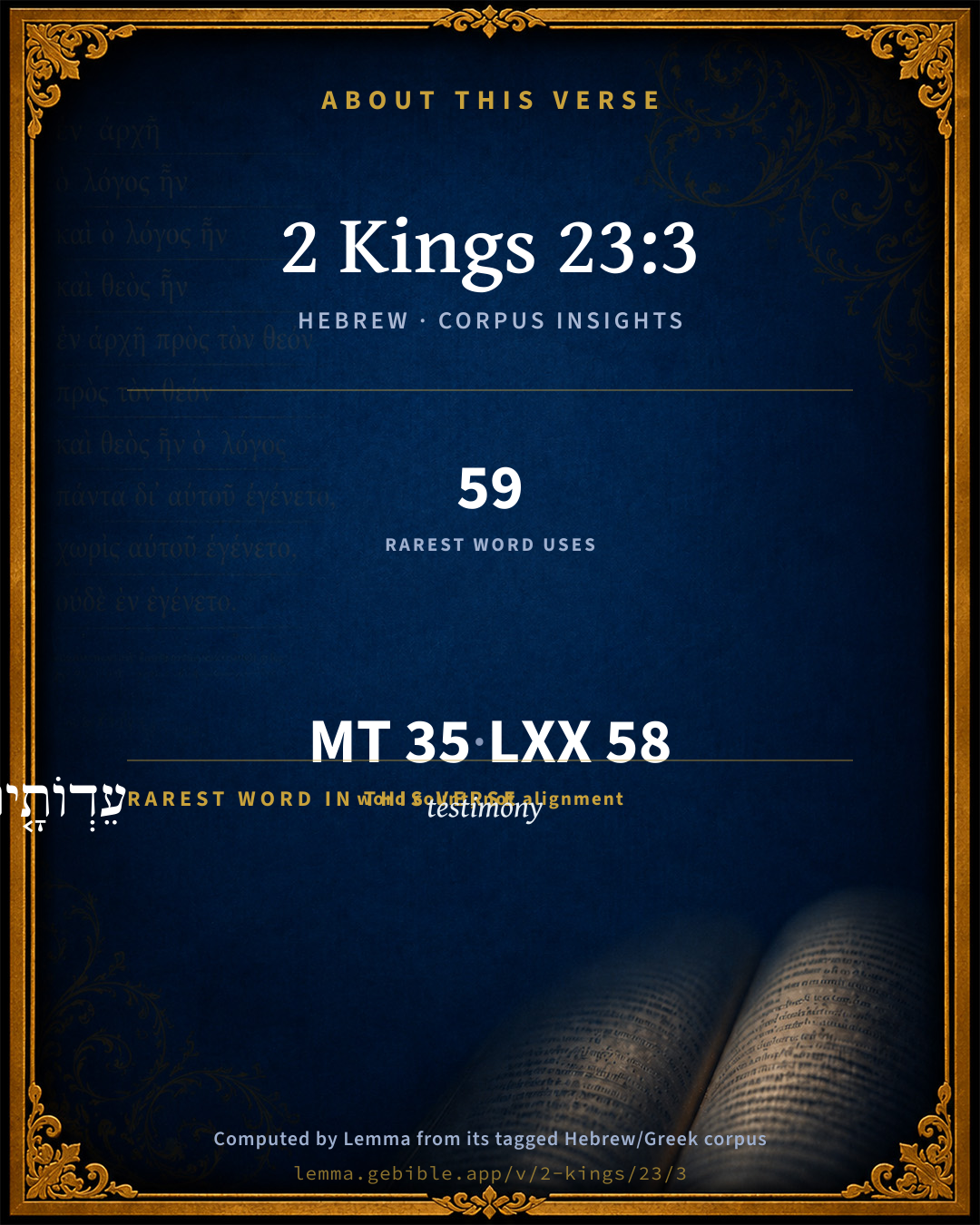
35
words
25
distinct lemmas
Historical
section

Shared distinctive vocabulary

עֵדְוֺתָ֤יו testimony H5715 occurs in 57 verses of the Hebrew Bible. Also found in:

Grammatical profile

  • 7 verbs
  • 19 nouns
  • 2 pronouns
  • 3 prepositions
  • 4 particles

Verb forms

  • וַיַּעֲמֹ֣ד Qal · Sequential Imperfect
  • וַיִּכְרֹ֥ת Qal · Sequential Imperfect
  • לָלֶ֜כֶת Qal · Infinitive Construct
  • וְלִשְׁמֹ֨ר Qal · Infinitive Construct
  • לְהָקִ֗ים Hiphil · Infinitive Construct
  • הַכְּתֻבִ֖ים Qal · Participle Passive
  • וַיַּעֲמֹ֥ד Qal · Sequential Imperfect

Repetition

Words recur within this verse — often emphatic in Hebrew:

  • הַבְּרִ֣ית covenant H1285 ×3
  • בְּכָל all H3605 ×3
  • וַיַּעֲמֹ֣ד to stand H5975 ×2
  • עַֽל upon H5921 ×2
  • יְהוָ֗ה LORD H3068 ×2

Hebrew & Septuagint length

In English translation the verse runs 56 words from the Hebrew and 60 from the Septuagint (LXX English) — closely comparable.

A rough comparison of the two English renderings, which tokenize alike — not a word-level alignment.

Word counts can differ between the Hebrew and the Greek without any difference in meaning — e.g. the Hebrew direct-object marker אֵת has no separate Greek word, and Greek often adds the article ὁ.

In the original languages it is 35 Hebrew tokens and 58 Greek tokens — but the two are counted differently (Hebrew bundles its prefixes and suffixes into one token; the Greek is in lemma form), so that isn’t a like-for-like length.

Cross-references

31

Topical passages linked to 2 Kings 23:3 in the Treasury of Scripture Knowledge — connected by theme and wording, ordered by reader-vote popularity; previews shown in the World English Bible.

  • 2 Kings 11:14 and she looked, and, behold, the king stood by the pillar, as the manner was, and the captains and the trumpets by the king; and all the people of the land rejoiced, and blew trumpets. Then Athaliah tore her clothes, and cried, Treason! treason!
  • 2 Kings 11:17 Jehoiada made a covenant between Yahweh and the king and the people, that they should be Yahweh's people; between the king also and the people.
  • Deuteronomy 13:4 You shall walk after Yahweh your God, and fear him, and keep his commandments, and obey his voice, and you shall serve him, and cleave to him.
  • Exodus 24:3 Moses came and told the people all the words of Yahweh, and all the ordinances; and all the people answered with one voice, and said, "All the words which Yahweh has spoken will we do."
  • Exodus 24:7–8 He took the book of the covenant and read it in the hearing of the people, and they said, "All that Yahweh has spoken will we do, and be obedient."
  • Deuteronomy 4:45 these are the testimonies, and the statutes, and the ordinances, which Moses spoke to the children of Israel, when they came forth out of Egypt,
  • Deuteronomy 5:1–3 Moses called to all Israel, and said to them, Hear, Israel, the statutes and the ordinances which I speak in your ears this day, that you may learn them, and observe to do them.
  • Deuteronomy 6:1 Now this is the commandment, the statutes, and the ordinances, which Yahweh your God commanded to teach you, that you might do them in the land where you go over to possess it;
  • Deuteronomy 6:5 and you shall love Yahweh your God with all your heart, and with all your soul, and with all your might.
  • Deuteronomy 8:19 It shall be, if you shall forget Yahweh your God, and walk after other gods, and serve them, and worship them, I testify against you this day that you shall surely perish.
  • Deuteronomy 10:12 Now, Israel, what does Yahweh your God require of you, but to fear Yahweh your God, to walk in all his ways, and to love him, and to serve Yahweh your God with all your heart and with all your soul,
  • Deuteronomy 11:13 It shall happen, if you shall listen diligently to my commandments which I command you this day, to love Yahweh your God, and to serve him with all your heart and with all your soul,
  • Deuteronomy 29:1 These are the words of the covenant which Yahweh commanded Moses to make with the children of Israel in the land of Moab, besides the covenant which he made with them in Horeb.
  • Deuteronomy 29:10–15 You stand this day all of you before Yahweh your God; your heads, your tribes, your elders, and your officers, even all the men of Israel,
  • Joshua 24:24–25 The people said to Joshua, Yahweh our God will we serve, and to his voice will we listen.
  • 2 Chronicles 15:12–14 They entered into the covenant to seek Yahweh, the God of their fathers, with all their heart and with all their soul;
  • 2 Chronicles 23:13 and she looked, and, behold, the king stood by his pillar at the entrance, and the captains and the trumpets by the king; and all the people of the land rejoiced, and blew trumpets; the singers also [played] on instruments of music, and led the singing of praise. Then Athaliah tore her clothes, and said, Treason! treason!
  • 2 Chronicles 23:16 Jehoiada made a covenant between himself, and all the people, and the king, that they should be Yahweh's people.
  • 2 Chronicles 29:10 Now it is in my heart to make a covenant with Yahweh, the God of Israel, that his fierce anger may turn away from us.
  • 2 Chronicles 34:31–33 The king stood in his place, and made a covenant before Yahweh, to walk after Yahweh, and to keep his commandments, and his testimonies, and his statutes, with all his heart, and with all his soul, to perform the words of the covenant that were written in this book.
  • Ezra 10:3 Now therefore let us make a covenant with our God to put away all the wives, and such as are born of them, according to the counsel of my lord, and of those who tremble at the commandment of our God; and let it be done according to the law.
  • Nehemiah 9:38 Yet for all this we make a sure covenant, and write it; and our princes, our Levites, [and] our priests, seal to it.
  • Nehemiah 10:28–39 The rest of the people, the priests, the Levites, the porters, the singers, the Nethinim, and all those who had separated themselves from the peoples of the lands to the law of God, their wives, their sons, and their daughters, everyone who had knowledge, and understanding;
  • Psalms 19:7–9 Yahweh's law is perfect, restoring the soul. Yahweh's testimony is sure, making wise the simple.
  • Ecclesiastes 8:2 I say, "Keep the king's command!" because of the oath to God.
  • Jeremiah 4:2 and you shall swear, As Yahweh lives, in truth, in justice, and in righteousness; and the nations shall bless themselves in him, and in him shall they glory.
  • Jeremiah 50:5 They shall inquire concerning Zion with their faces turned toward it, [saying], Come you, and join yourselves to Yahweh in an everlasting covenant that shall not be forgotten.
  • Matthew 22:36–37 "Teacher, which is the greatest commandment in the law?"
  • Hebrews 8:8–13 For finding fault with them, he said, "Behold, the days come," says the Lord, "That I will make a new covenant with the house of Israel and with the house of Judah;
  • Hebrews 12:24 to Jesus, the mediator of a new covenant, and to the blood of sprinkling that speaks better than that of Abel.
  • Hebrews 13:20 Now may the God of peace, who brought again from the dead the great shepherd of the sheep with the blood of an eternal covenant, our Lord Jesus,

Cross-references courtesy of OpenBible.info (CC BY 4.0).

Hebrew and Greek witnesses Masoretic Hebrew ↔ Greek Septuagint

The same verse in the two great witnesses to the Old Testament, shown verse-for-verse.

These are two independent witnesses, not word-aligned to each other, and the Septuagint is shown in lemma (dictionary) form.

Hebrew 2 Kings 23:3 Masoretic · Westminster Leningrad Codex

וַיַּעֲמֹ֣ד הַ֠מֶּלֶךְ עַֽל הָ֨עַמּ֜וּד וַיִּכְרֹ֥ת אֶֽת הַבְּרִ֣ית לִפְנֵ֣י יְהוָ֗ה לָלֶ֜כֶת אַחַ֤ר יְהוָה֙ וְלִשְׁמֹ֨ר מִצְוֺתָ֜יו וְאֶת עֵדְוֺתָ֤יו וְאֶת חֻקֹּתָיו֙ בְּכָל לֵ֣ב וּבְכָל נֶ֔פֶשׁ לְהָקִ֗ים אֶת דִּבְרֵי֙ הַבְּרִ֣ית הַזֹּ֔את הַכְּתֻבִ֖ים עַל הַסֵּ֣פֶר הַזֶּ֑ה וַיַּעֲמֹ֥ד כָּל הָעָ֖ם בַּבְּרִֽית

The king stood by the pillar, and made a covenant before Yahweh, to walk after Yahweh, and to keep his commandments, and his testimonies, and his statutes, with all [his] heart, and all [his] soul, to confirm the words of this covenant that were written in this book: and all the people stood to the covenant.

World English Bible · Public Domain

Greek LXX 2 Kings 23:3 Septuagint · lemma form

καί ἵστημι ὁ βασιλεύς πρός ὁ στῦλος καί διατίθημι διαθήκη ἐνώπιον κύριος ὁ πορεύομαι ὀπίσω κύριος καί ὁ φυλάσσω ὁ ἐντολή αὐτός καί ὁ μαρτύριον αὐτός καί ὁ δικαίωμα αὐτός ἐν πᾶς καρδία καί ἐν πᾶς ψυχή ὁ ἀναἵστημι ὁ λόγος ὁ διαθήκη οὗτος ὁ γράφω ἐπί ὁ βιβλίον οὗτος καί ἵστημι πᾶς ὁ λαός ἐν ὁ διαθήκη

And the king stood by a pillar, and made a covenant before the Lord, to walk after the Lord, to keep his commandments and his testimonies and his ordinances with all the heart and with all the soul, to confirm the words of this covenant; even the things written in this book. And all the people stood to the covenant.

LXX2012 (modern English Septuagint) · Public Domain

Hebrew: Westminster Leningrad Codex (CC BY 4.0). Greek: Septuagint (public domain); English from LXX2012 (modern English Septuagint) (Public Domain). How the Septuagint differs from the Hebrew →

Targum (Aramaic paraphrase)

1

The Targum is the ancient Jewish Aramaic paraphrase of the Hebrew Scriptures — an interpretive translation, not the Hebrew text itself. Onkelos (literal) and Pseudo-Jonathan (expansive) render the Torah, and Jonathan the Prophets. Coverage is partial: where no permissively-licensed English translation exists for a verse, only the Aramaic is shown. This is verse-level text, not a word-by-word alignment to the Hebrew.

  1. Targum Jonathan Prophets (Joshua–Malachi)
    וְקָם מַלְכָּא עַל אִסְטְוָנָא וּגְזַר יַת קְיָמָא קָדָם יְיָ לִמְהַךְ בָּתַר פּוּלְחָנָא דַייָ וּלְמִטַר פִּקוּדוֹהִי וְיַת סְהִידְוָתוֹהִי וְיַת קְיָמוֹהִי בְּכָל לִבָּא וּבְכָל נְפַשׁ לְקַיָמָא יַת פִּתְגָמֵי קְיָמָא הָדֵין דִכְתִיבִין עַל סִפְרָא הָדֵין וְקַבִּילוּ כָל עַמָא עֲלֵיהוֹן קְיָמָא:

    (no public-domain English translation for this verse)

    Targum Jonathan — Aramaic: “Mikraot Gedolot” (public domain). English: “Sefaria Community Translation” (CC0 1.0 (public-domain dedication)); “London "Chaldee Paraphrase," 1871” (public domain). Text via Sefaria.

Commentary

Notes on 2 Kings 23:3 from classic Christian and Jewish commentators (each source and its license shown beneath its notes). The classic Christian expositions comment on the surrounding passage and are grouped to its opening verse, so a note may address several verses; the Jewish commentaries on the Tanakh (Rashi and others) are per-verse, so they appear only where the commentator wrote on this verse.

Lemma curates 59 commentaries, every one of them public domain or Creative Commons licensed, each selected and text-cleaned for this edition rather than reprinted as found. About our sources →

Trapp's Complete Commentary

John Trapp

2Ki 23:3 And the king stood by a pillar, and made a covenant before the LORD, to walk after the LORD, and to keep his commandments and his testimonies and his statutes with all [their] heart and all [their] soul, to perform the words of this covenant that were written in this book. And all the people stood to the covenant.

Ver. 3. And the king stood by a pillar.] See 2Ki 11:14.

To walk after the Lord.] To be in communion with him, and in conformity unto him. This is elsewhere called walking with God, and walking before God.

And all the people stood to the covenant.] They pretended and professed so to do; but the most of them dissembled and dealt deceitfully, not turning to God with their whole hearts, as good Jeremiah complaineth, {Jer 3:1-25} and therefore calleth upon them {Jer 4:3; Jer 4:14} to "break up their fallow ground, to circumcise themselves unto the Lord, and to wash their hearts from wickedness, that they might be saved."

John Trapp, A Commentary or Exposition upon All the Books of the Old and New Testament (1647–1656) — public domain. Text from a community e-Sword module.

Joseph Benson's Commentary

2Ki 23:3. The king stood by a pillar — Of which see on chap. 2Ki 11:14. And made a covenant before the Lord — The king himself was the first and principal covenanter, who publicly and solemnly declared his consent to this covenant, to set the elders, priests, and people an example, and to assure them not only of his protection, but of all the furtherance his power could give them in their obedience. And all the people stood to the covenant — They declared their consent to it, and their concurrence with the king in that act, which possibly they did by standing up, as the king himself stood when ha took it. It is of good use, with all possible solemnity, to oblige ourselves to our duty: and he that bears an honest heart, does not startle at assurances.

Joseph Benson's Commentary on the Old and New Testaments (1811–1818) — public domain. Text from a community e-Sword module.

Tyndale Open Study Notes

Tyndale Open Resources

23:3 The king . . . renewed the covenant: Covenant renewal was observed at several critical points in the history of God’s people (see 11:12, 17; Josh 24:1-27; 1 Kgs 8:1-53).

Tyndale Open Study Notes — © Tyndale Open Resources, licensed CC BY-SA 4.0. Text via the HelloAO Bible API.

Geneva Bible (1599)

Geneva Bible translators

Where the king had his place, 2 Kings 11:14.

As Joshua did, Josh. 24:22, 25.

Geneva Bible (1599) marginal notes — public domain. Text via Bolls.life.

Jamieson, Fausset & Brown

Robert Jamieson, A. R. Fausset & David Brown

all the people stood to the covenant--that is, they agreed to the proposals made; they assented to what was required of them.

Jamieson, Fausset & Brown — Commentary Critical and Explanatory on the Whole Bible (1871) — public domain (CC PDM 1.0). Text via the HelloAO Bible API.

Adam Clarke's Commentary

Verse 3. Stood by a pillar] He stood, על העמוד al haammud, "upon the stairs or pulpit." This is what is called the brazen scaffold or pulpit which Solomon made, and on which the kings were accustomed to stand when they addressed the people. See 2Ch 6:13, and the parallel places.

Made a covenant] This was expressed,

1. In general. To walk after Jehovah; to have no gods besides him.

2. To take his law for the regulation of their conduct.

3. In particular. To bend their whole heart and soul to the observance of it, so that, they might not only have religion without, but, piety within.

To this all the people stood up, thus giving their consent, and binding themselves to obedience.

Adam Clarke's Commentary on the Bible (1810–1826) — public domain. Text from a community e-Sword/MySword module.

Ellicott's Commentary for English Readers

(3) By a pillar.—On the stand or dais (2Ki_11:14).

A covenant.—The covenant, which had so often been broken. Josiah pledged himself “to walk after the Lord,” and imposed a similar pledge on the people.

Stood to the covenant—i.e., entered it; took the same pledge as the king. (Comp. 2Ki_18:28.)

A Bible Commentary for English Readers, edited by Charles John Ellicott (1878–1897) — public domain. Text from a community e-Sword module.

The Cambridge Bible for Schools and Colleges

gen. ed. J. J. S. Perowne

3. And the king stood by a [R.V. the] pillar] See 2Ki_11:14 and the notes there.

to walk after the Lord &c.] The words of the covenant are dictated by Deu_13:4.

all their [R.V. his] heart and all their [R.V. his] soul] This was the king’s own solemn pledge.

to perform [R.V. confirm] the words of this covenant] ‘Confirm’ is the rendering of this verb in A.V. in a very similar passage (Deu_27:26) ‘Cursed be he that confirmeth not all the words of this law to do them’.

The Cambridge Bible for Schools and Colleges (gen. ed. J. J. S. Perowne; Cambridge University Press, 1878–1918) — public domain. Text from a community e-Sword module.

John Gill's Exposition

And the king commanded Hilkiah the high priest, and the priests of the second order,.... Or the second course of the priests; the course of Jedaiah, Ch1 24:7 as some think; or rather, the two chief priests next to the high priest, who were of the line both of Eleazar and Ithamar; though the Targum interprets it of the Sagan of the priests, a deputy of the high priest, such as in later times the high priest had always appointed for him on the day of atonement (r):

and the keepers of the door: the porters at the door and gates of the temple; or rather the treasurers, as the Targum; such as were appointed over the vessels of the sanctuary, as the Jewish writers generally interpret it, and which best agrees with what follows:

to bring forth out of the temple of the Lord all the vessels that were made for Baal: used in burning incense, or offering sacrifices to him:

and for the grove: the idol of the grove, or Asherah, that is, Ashtoreth, or Astarte, the same with Venus, or the moon, as Baal was the sun, the one the husband, and the other the wife, according to the Jews (s):

and for all the host of heaven: the stars:

and he burnt them without Jerusalem in the fields of Kidron; or plain of Kidron, as the Targum; through which the brook Kidron ran:

and carried the ashes of them unto Bethel; where one of Jeroboam's calves was set, and was the source of idolatry; and this he did in contempt of that place; and, to show his detestation of the idolatry there, he made it a dunghill of ashes of things used in idolatrous service; this he could do, that place being in the hands of the kings of Judah from the times of Ahijah, Ch2 13:19.

(r) Misn. Yoma, c. 1. sect. 1. (s) Zohar in Gen. fol. 34. 3.

John Gill's Exposition of the Whole Bible (1746–1763) — public domain (CC PDM 1.0). Text via the HelloAO Bible API.

Albert Barnes' Notes on the Bible

By a pillar - Rather, “upon the pillar” (see 2Ki 11:14, note).

Made a covenant - “The covenant.” Josiah renewed the old covenant made between God and His people in Horeb Deu 5:2, so far at least as such renewal was possible by the mere act of an individual. He bound himself by a solemn promise to the faithful performance of the entire Law.

With all their heart - “Their” rather than “his,” because the king was considered as pledging the whole nation to obedience with himself. He and they “stood to it,” i. e., “accepted it, came into the covenant.”

Albert Barnes' Notes on the Bible (1834–1885) — public domain. Text from a community e-Sword/MySword module.

Haydock's Catholic Bible Commentary

The step. His tribune or tribunal, a more eminent place, from whence he might be seen and heard by the people. (Challoner) --- This brazen tribune is described [in] chap. xi. 14., and 2 Paralipomenon vi. 12. --- To the covenant, but with much less exactitude than the king. (Calmet)

George Leo Haydock (1774–1849), Haydock's Catholic Family Bible and Commentary, 1859 edition — public domain. Excludes Psalms (Douay-Rheims chapter numbering differs from Protestant) and Deuterocanonical books (Catholic canon only).

Matthew Poole's English Annotations

By the pillar; of which See Poole "2Ki 11:14"; See Poole "2Ch 34:31".

To the covenant, to wit, as to the taking of it; they declared their consent to it, and their concurrence with the king in that act, which possibly they did by standing upright, as the king himself stood when he took it.

Matthew Poole's English Annotations on the Holy Bible (1683–1685) — public domain. Text from a community e-Sword/MySword module.

Whedon's Commentary on the Bible

Daniel D. Whedon

3. Stood by a pillar — Rather, by the pillar: the same pillar by which the youthful Joash stood when the high priest Jehoiada made a covenant between the king and the people. See note on 2Ki_11:14.

All the people stood to the covenant — They entered into the covenant like the king, by taking upon themselves solemn vows and oaths to keep the commandments. Stanley remarks that it was “one of those national vows or covenants which were in the monarchy what the vows of individuals had been in the earlier stages of the nation.”

Daniel D. Whedon (gen. ed.), Commentary on the Old and New Testaments (1874–1909) — public domain. Text from a community e-Sword module.

The Pulpit Commentary

And the king stood by a pillar dwOMj; l is not "by the pillar," but (as in 2Ki_11:14) "on the platform" (see the comment on that place)and made a covenant before the Lord; literally, made the covenant; (as in 2Ki_11:17) i.e. made, or renewed, the old covenant with God, (Exo_24:5-8) which had been broken by the complete neglect of the Law, and the manifold idolatries of Manasseh and Amon. He renewed this covenant "before the Lord," i.e. from his platform in the court, directly opposite the entrance to the temple, through which he could, perhaps, see the veil hanging in front of the holy of holies-at any rate being, and feeling himself to be, in the immediate presence of God. To walk after the Lordi.e. to be his true follower and servantand to keep his commandments and his testimonies and his statutes. (On the multiplication of such terms, see the comment upon (1Ki_2:3) They are intended to express "the totality of the Law," all its requirements without exception. With all their heart and all their soul obedience was worthless, unless paid from the heart and soul (see Deu_4:29 Deu_30:2; Joe_2:12, Joe_2:13) to perform the words of this covenant that were written in this book. And all the people stood to the covenant. The representatives of the people, one and all, were parties to the premise made on their behalf by the king, and signified their consent, probably as they had done in Horeb, when "Moses took the book of the covenant, and read in the audience of the people; and they said, All that the Lord has said will we do, and be obedient". (see Deu_24:7)

The Pulpit Commentary (1880–1919), ed. H.D.M. Spence-Jones & Joseph S. Exell — public domain. Text from a community e-Sword module.

John Wesley's Explanatory Notes

Stood - They declared their consent to it, and their concurrence with the king in that act, which possibly they did by standing up, as the king himself stood when he took it. It is of good use, with all possible solemnity, to oblige ourselves to our duty. And he that bears an honest heart, does not startle at assurances.

John Wesley, Explanatory Notes Upon the Whole Bible (1754–1765) — public domain. Text via the GEBible commentary corpus.

unfoldingWord translationNotes

Door43 World Missions Community

walk after Yahweh

The way a person lives is spoken of as if that person were walking on a path, and "to walk after" someone is a metonym for doing what that other person does or wants others to do. AT: "live obeying Yahweh" (See: Metaphor and Metonymy)

his commandments, his regulations, and his statutes

These words all share similar meanings. Together they emphasize everything that Yahweh had commanded in the law. (See: Doublet)

with all his heart and all his soul

The idiom "with all his heart" means "completely" and "with all his soul" means "with all his being." These two phrases have similar meanings. AT: "with all his being" or "with all his energy" (See: Idiom and Doublet)

that were written in this book

This can be translated in active form. AT: "that this book contained" (See: Active or Passive)

stand by the covenant

This idiom means to "obey the terms of the covenant." (See: Idiom)

translationWords

column

Yahweh

walk

command

decree

statute

heart

confirm

unfoldingWord translationNotes — © Distant Shores Media and the Door43 World Missions Community, licensed CC BY-SA 4.0. Source: git.door43.org/Door43/en_tn.

Rashi

Rabbi Shlomo Yitzchaki (Rashi)

At his place. The place where the king stands in the Beis Hamikdosh.

Rashi on the Tanakh — English translations: “The Judaica Press complete Tanach with Rashi, translated by A. J. Rosenberg” (CC BY 4.0); “Pentateuch with Rashi's commentary by M. Rosenbaum and A.M. Silbermann, 1929-1934” (public domain); “The Metsudah Tanach series, Lakewood, N.J” (CC BY 4.0); and “The Book of Joshua, Metsudah Publications, 1997” (CC BY 4.0). Text via Sefaria.

Lesson kit

Teaching starters — assembled from the data on this page, not authored interpretation. Every prompt links to the verse data it draws on. Edit before teaching.

2 Kings, in the Historical, opens this verse with 35 words (25 distinct Hebrew lemmas). Its most distinctive word is ʻêdûwth (“testimony”). A historical commentator’s framing appears above. Read the whole chapter for the surrounding context.

Discussion questions

  1. What does “testimony” (ʻêdûwth) contribute to the verse as a whole?
  2. Exodus 16:34 shares the word «testimony» with this verse. How do the two illuminate each other?
  3. “covenant” occurs 3× in this one verse. What is the effect of the repetition?
  4. These translations render this verse differently; the difference is in the English rendering, not the original. What questions does that raise?
  5. The verb «וַיַּעֲמֹ֣ד» is Qal Sequential Imperfect. How does its form color the action?
  6. Reading how Trapp's Complete Commentary and Joseph Benson's Commentary read this verse, where do the two commentators agree and where do they part?

Things to notice

Reading settings

Reading text

Shown beneath each verse's original-language words.

Old Testament
Old Testament edition

Read the OT as the Masoretic Hebrew (MT) or the Greek Septuagint (LXX).

English shown for the Greek Septuagint (in the Hebrew ↔ Greek comparison).

Comparing translations? Open the Compare panel on any verse page to stack up to four side by side.