
Psalms 109:13

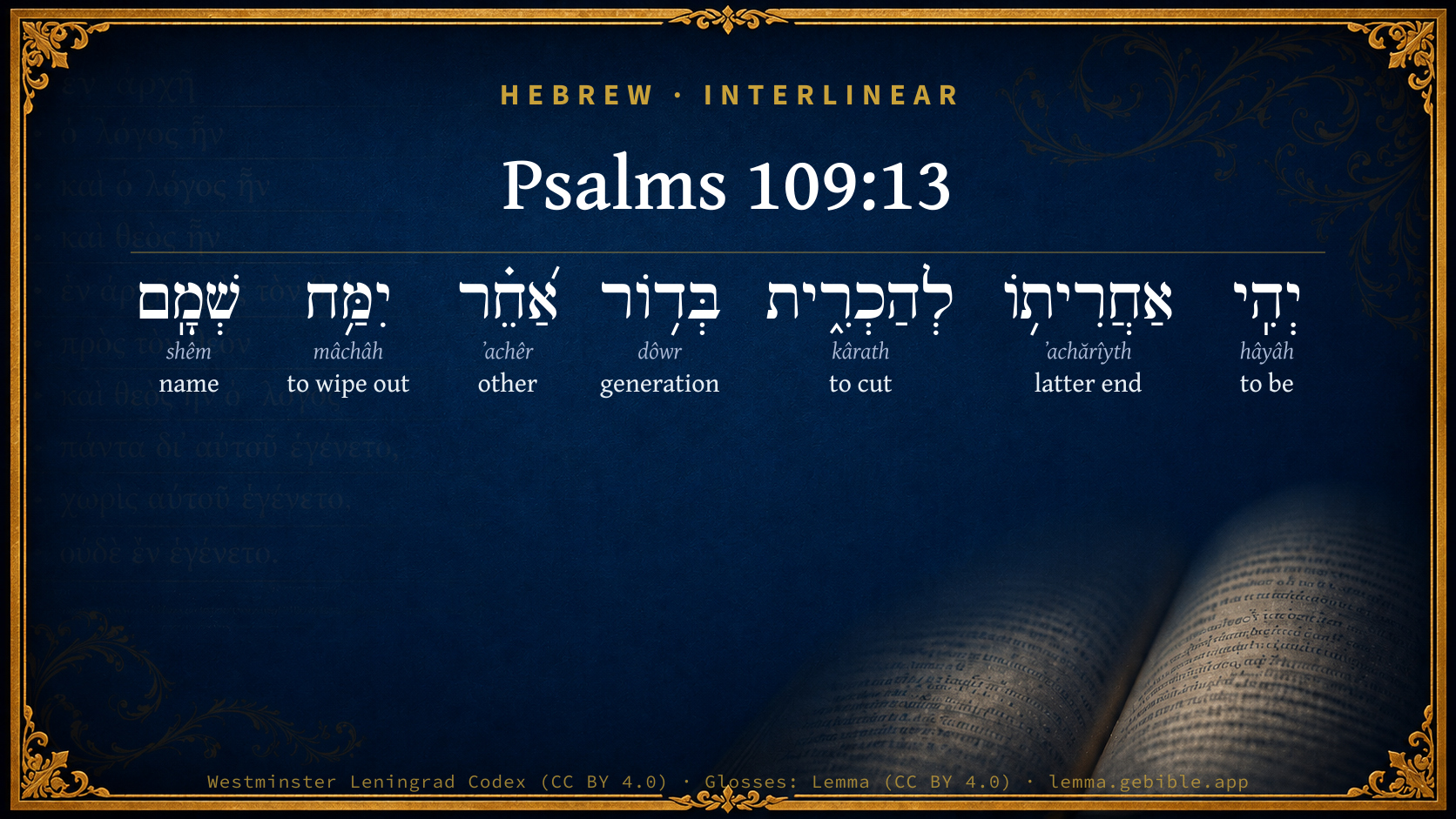
Hebrew (Westminster Leningrad Codex) Psalms 109:13 appears in the Hebrew Old Testament. The text above is from the Westminster Leningrad Codex. Each word links to its Strong’s number, a concise gloss, and parsing drawn from the Open Scriptures Hebrew Bible morphology. Click any word for its full Brown-Driver-Briggs (BDB) entry.
Download image
Cite this verse

Psalms 109:13 (World English Bible). Public Domain. Lemma interlinear Bible study tool, https://lemma.gebible.app/v/psalms/109/13.

Show BibTeX & RIS
BibTeX
RIS
English Translation
Let his posterity be cut off. In the generation following let their name be blotted out.
World English Bible · Public Domain
Download a study sheet

One document with this verse’s original text, its word-by-word gloss line, the meaning frame, cross-references with their text, attributed commentary, and full source and license credits — printable, and it pastes into notes with its structure intact.

This verse Autodidact and up

Study sheet (.html) Plain text (.txt)

A passage Seminary Student

Up to 50 verses in one chapter. A passage sheet keeps up to 6 commentary sources and 12 cross-references per verse, in the order this page ranks them, and says so on the sheet whenever that leaves anything out. Ask for a single verse and you get the Autodidact verse sheet above.

Everything on this page stays free to read, with no account — the sheet is a download of what is already on screen, not access to it.

Want to remove ads? Support Godless Engineer
Compare translations 3

The same verse in 3 English versions, stacked beneath the original-language interlinear above. Click any original word for its lexicon entry.

Each is an independent rendering of the whole verse — the interlinear is not word-aligned to these translations.

Highlighted words mark where these versions differ — a whole-verse word diff, not a word-by-word alignment.

  • World English Bible Public Domain
    Let his posterity be cut off. In the generation following let their name be blotted out.
  • King James Version Public Domain
    Let his posterity be cut off; and in the generation following let their name be blotted out.
  • unfoldingWord Literal Text CC BY-SA 4.0
    May his posterity be to cut off; may their name be blotted out in the next generation.

unfoldingWord Literal Text — © unfoldingWord, licensed CC BY-SA 4.0. Word-aligned USFM3 via Door43 (git.door43.org/unfoldingWord/en_ult).

Versions to compare (up to 4)

3 of 4 selected

Show all 18 translations

Every available English version of this verse, each an independent rendering of the whole verse.

  • World English Bible Public Domain
    Let his posterity be cut off. In the generation following let their name be blotted out.
  • Berean Standard Bible Public Domain
    May his descendants be cut off; may their name be blotted out from the next generation.
  • Majority Standard Bible Public Domain
    May his descendants be cut off; may their name be blotted out from the next generation.
  • King James Version Public Domain
    Let his posterity be cut off; and in the generation following let their name be blotted out.
  • American Standard Version (1901) Public Domain
    Let his posterity be cut off; In the generation following let their name be blotted out.
  • Revised Version (1885) Public Domain
    Let his posterity be cut off; in the generation following let their name be blotted out.
  • Geneva Bible (1599) Public Domain
    Let his posteritie be destroied, and in the generation following let their name be put out.
  • Douay-Rheims (1899) Public Domain
    May his posterity be cut off; in one generation may his name be blotted out.
  • Young's Literal Translation Public Domain
    His posterity is for cutting off, In another generation is their name blotted out.
  • Literal Standard Version CC BY-SA 4.0
    His posterity is for cutting off, || Their name is blotted out in another generation.
  • Unlocked Literal Bible CC BY-SA 4.0
    May his children be cut off; may their name be blotted out in the next generation.
  • unfoldingWord Literal Text CC BY-SA 4.0
    May his posterity be to cut off; may their name be blotted out in the next generation.
  • Darby Bible Public Domain
    Let his posterity be cut off; in the generation following let their name be blotted out:
  • World Messianic Bible Public Domain
    Let his posterity be cut off. In the generation following let their name be blotted out.
  • Webster's Bible Public Domain
    Let his posterity be cut off; and in the generation following let their name be blotted out.
  • Free Bible Version CC BY-SA 4.0
    May his descendants die; may his family name be wiped out in the next generation.
  • Bible in Basic English Public Domain
    Let his seed be cut off; in the coming generation let their name go out of memory.
  • JPS Tanakh (1917) Public Domain
    Let his posterity be cut off; in the generation following let their name be blotted out.

Literal Standard Version (2020), Covenant Press — licensed CC BY-SA 4.0. Text via the HelloAO Bible API (eBible.org). Unlocked Literal Bible (unfoldingWord) — licensed CC BY-SA 4.0. Text via the HelloAO Bible API (eBible.org). unfoldingWord Literal Text — © unfoldingWord, licensed CC BY-SA 4.0. Word-aligned USFM3 via Door43 (git.door43.org/unfoldingWord/en_ult). Free Bible Version, Dr. Jonathan Gallagher — licensed CC BY-SA 4.0. Text via the HelloAO Bible API (eBible.org).

Word by word

More ways to search: Search by grammar → Find every occurrence → Compare this word →

Practice this passage: Drill this verse → Learn its vocabulary →

יִמַּ֥ח
mâchâh
H4229
“to wipe out”
Verb, Niphal, Imperfect, 3rd Person, Masculine, Singular
Part of Speech
Verb
Stem
Niphal
Form
Imperfect
Person
3rd Person
Gender
Masculine
Number
Singular
Full BDB Definition

Origin: a primitive root

TWOT: 1178 , 1179 , 1181c

to wipe, wipe out - (Qal) - to wipe - to blot out, obliterate - to blot out, exterminate - (Niphal) - to be wiped out - to be blotted out - to be exterminated - (Hiphil) to blot out (from memory) - (Qal) to strike - (Pual) full of marrow (participle)
  1. יְהִֽי hâyâh H1961 “to be” Verb, Qal, Imperfect, 3rd Person, Masculine, Singular
  2. אַחֲרִית֥וֹ ʼachărîyth H319 “latter end · his” Noun, Common, Feminine, Singular, Construct + Suffix, Personal, 3rd Person, Masculine, Singular
  3. לְהַכְרִ֑ית kârath H3772 “to cut” Preposition + Verb, Hiphil, Infinitive Construct
  4. בְּד֥וֹר dôwr H1755 “in/at · generation” Preposition + Noun, Common, Masculine, Singular, Absolute
  5. אַ֝חֵ֗ר ʼachêr H312 “other” Adjective, Adjective, Masculine, Singular, Absolute
  6. שְׁמָֽם shêm H8034 “name · their” Noun, Common, Masculine, Singular, Construct + Suffix, Personal, 3rd Person, Masculine, Plural

About this verse

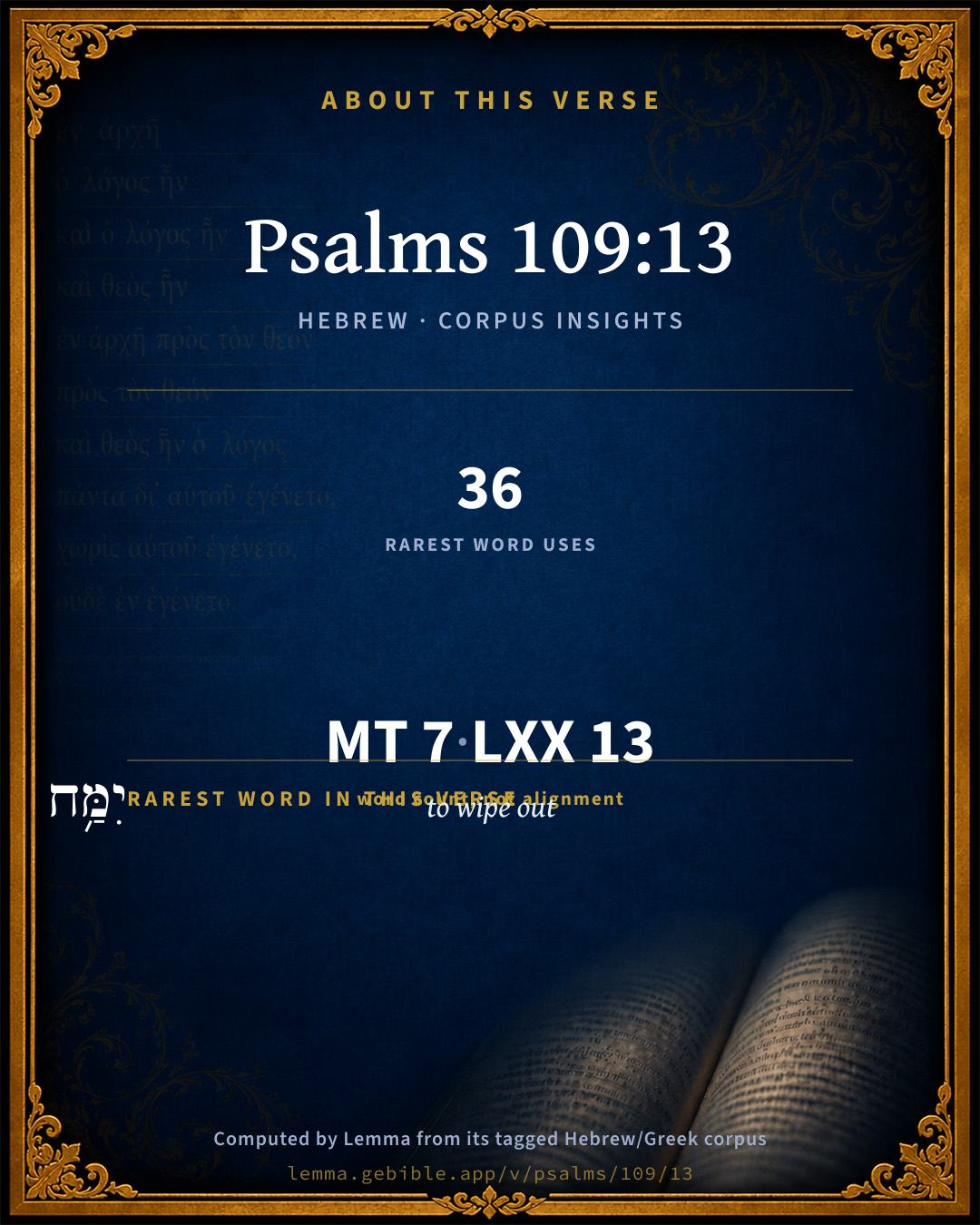
These counts appear in no published source. They are computed here, from the morphology-tagged text and Lemma’s own curated glosses. What Lemma adds →

7
words
7
distinct lemmas
Wisdom
section

Shared distinctive vocabulary

יִמַּ֥ח to wipe out H4229 occurs in 32 verses of the Hebrew Bible. Also found in:

Grammatical profile

  • 3 verbs
  • 3 nouns
  • 1 adjective

Verb forms

  • יְהִֽי Qal · Imperfect
  • לְהַכְרִ֑ית Hiphil · Infinitive Construct
  • יִמַּ֥ח Niphal · Imperfect

Hebrew & Septuagint length

In English translation the verse runs 16 words from the Hebrew and 18 from the Septuagint (LXX English) — closely comparable.

A rough comparison of the two English renderings, which tokenize alike — not a word-level alignment.

Word counts can differ between the Hebrew and the Greek without any difference in meaning — e.g. the Hebrew direct-object marker אֵת has no separate Greek word, and Greek often adds the article ὁ.

In the original languages it is 7 Hebrew tokens and 13 Greek tokens — but the two are counted differently (Hebrew bundles its prefixes and suffixes into one token; the Greek is in lemma form), so that isn’t a like-for-like length.

Cross-references

12

Topical passages linked to Psalms 109:13 in the Treasury of Scripture Knowledge — connected by theme and wording, ordered by reader-vote popularity; previews shown in the World English Bible.

  • Proverbs 10:7 The memory of the righteous is blessed, But the name of the wicked will rot.
  • Job 18:19 He shall have neither son nor grandson among his people, Nor any remaining where he sojourned.
  • Psalms 37:28 For Yahweh loves justice, And doesn't forsake his saints. They are preserved forever, But the children of the wicked shall be cut off.
  • Deuteronomy 9:14 let me alone, that I may destroy them, and blot out their name from under the sky; and I will make of you a nation mightier and greater than they.
  • Deuteronomy 25:19 Therefore it shall be, when Yahweh your God has given you rest from all your enemies round about, in the land which Yahweh your God gives you for an inheritance to possess it, that you shall blot out the memory of Amalek from under the sky; you shall not forget.
  • Deuteronomy 29:20 Yahweh will not pardon him, but then the anger of Yahweh and his jealousy will smoke against that man, and all the curse that is written in this book shall lie on him, and Yahweh will blot out his name from under the sky.
  • 1 Samuel 2:31–33 Behold, the days come, that I will cut off your arm, and the arm of your father's house, that there shall not be an old man in your house.
  • 1 Samuel 3:13 For I have told him that I will judge his house forever, for the iniquity which he knew, because his sons did bring a curse on themselves, and he didn't restrain them.
  • 2 Kings 10:10–11 Know now that there shall fall to the earth nothing of the word of Yahweh, which Yahweh spoke concerning the house of Ahab: for Yahweh has done that which he spoke by his servant Elijah.
  • Psalms 21:10 You will destroy their descendants from the earth, Their posterity from among the children of men.
  • Isaiah 14:20–22 You shall not be joined with them in burial, because you have destroyed your land, you have killed your people; the seed of evil-doers shall not be named forever.
  • Jeremiah 22:30 Thus says Yahweh, Write you this man childless, a man who shall not prosper in his days; for no more shall a man of his seed prosper, sitting on the throne of David, and ruling in Judah.

Cross-references courtesy of OpenBible.info (CC BY 4.0).

Hebrew and Greek witnesses Masoretic Hebrew ↔ Greek Septuagint

The same verse in the two great witnesses to the Old Testament, shown verse-for-verse.

You’re reading Greek Psalm 108 (Hebrew Psalm 109). The Septuagint counts the superscription, so verse numbers can differ from the Hebrew — chapter-level alignment, not verse-by-verse. Numbering follows Rahlfs.

These are two independent witnesses, not word-aligned to each other, and the Septuagint is shown in lemma (dictionary) form.

Hebrew Psalms 109:13 Masoretic · Westminster Leningrad Codex

יְהִֽי אַחֲרִית֥וֹ לְהַכְרִ֑ית בְּד֥וֹר אַ֝חֵ֗ר יִמַּ֥ח שְׁמָֽם

Let his posterity be cut off. In the generation following let their name be blotted out.

World English Bible · Public Domain

Greek LXX Greek Psalm 108:13 Septuagint · lemma form

γίγνομαι ὁ τέκνον αὐτός εἰς ἐξολέθρευσις ἐν γενεά εἷς ἐκἀλείφω ὁ ὄνομα αὐτός

Let his children be given up to utter destruction: in one generation let his name be blotted out.

LXX2012 (modern English Septuagint) · Public Domain

On this verse, The Cambridge Bible for Schools and Colleges discusses the Septuagint’s reading. Read the note in Commentary ↓

Hebrew: Westminster Leningrad Codex (CC BY 4.0). Greek: Septuagint (public domain); English from LXX2012 (modern English Septuagint) (Public Domain). How the Septuagint differs from the Hebrew →

Commentary

Notes on Psalms 109:13 from classic Christian and Jewish commentators (each source and its license shown beneath its notes). The classic Christian expositions comment on the surrounding passage and are grouped to its opening verse, so a note may address several verses; the Jewish commentaries on the Tanakh (Rashi and others) are per-verse, so they appear only where the commentator wrote on this verse.

Lemma curates 59 commentaries, every one of them public domain or Creative Commons licensed, each selected and text-cleaned for this edition rather than reprinted as found. About our sources →

Trapp's Complete Commentary

John Trapp

Psa 109:13 Let his posterity be cut off; [and] in the generation following let their name be blotted out.

Ver. 13. Let his posterity be cut Off] Sit eius exitus excidium, so some render it, let his end be destruction; and it is better to take it, as we translate, "Let his posterity," &c. Let them be razed and rooted out of remembrance, they and their whole race.

Let their name be blotted out] That they may not live, so much as by fame. The Edomites, Moabites, Ammonites, have no memorial but what they have in the Bible, and that is for no good. And the like may be said of Meroz, Jdg 5:23, which seemeth to have been some city near the place where the battle was fought; but what it was none can determine, since there is no mention elsewhere to be found of it, which seemeth to be an effect of that bitter curse pronounced against it. See Pro 10:7.

John Trapp, A Commentary or Exposition upon All the Books of the Old and New Testament (1647–1656) — public domain. Text from a community e-Sword module.

Joseph Benson's Commentary

Psa 109:13-15. Let his posterity, &c. — His posterity shall be cut off, &c: they suffered an excision by the Roman sword, and in the generation following, their name, as a church, and civil polity, were blotted out of the list of states and kingdoms. Let the iniquity of his father be remembered — Hebrew, יזכר, it shall be remembered against him, or punished in him, as God had threatened to deal with great delinquents, Exo 20:5. Let them be — יהיו, they shall be, namely, the sins of his parents last mentioned; before the Lord — In God’s sight and memory, to provoke him to punish them: they shall not be covered nor pardoned. That upon them, as Christ foretold, might come all the righteous blood shed from the blood of righteous Abel; &c., Mat 22:25. For “the blood of the prophets cried for vengeance against those who crucified the Lord of the prophets.”

Joseph Benson's Commentary on the Old and New Testaments (1811–1818) — public domain. Text from a community e-Sword module.

J. A. Alexander on Psalms

Joseph Addison Alexander

13. (Psa 109:13) Let his posterity be cut off; in the next generation, blotted out be their name. The word for posterity strictly means futurity, after part, or latter end. See above, Psa 37:37-38. Cut off, literally for cutting off. The next or ufter generation, as in Psa 48:13. The plural pronoun their refers to the collective noun posterity.

Joseph Addison Alexander, The Psalms Translated and Explained (1850) — public domain. Text from a community e-Sword module.

Tyndale Open Study Notes

Tyndale Open Resources

109:13 If one’s family name was blotted out, it meant there was no offspring to carry on the family name or remember its history (see Prov 10:7).

Tyndale Open Study Notes — © Tyndale Open Resources, licensed CC BY-SA 4.0. Text via the HelloAO Bible API.

Adam Clarke's Commentary

Verse 13. Let his posterity be cut off] It is a fact that the distinction among the Jewish tribes in entirely lost. Not a Jew in the world knows from what tribe he is sprung; and as to the royal family, it remains nowhere but in the person of Jesus the Messiah. He alone is the Lion of the tribe of Judah. Except as it exists in him, the name is blotted out.

Adam Clarke's Commentary on the Bible (1810–1826) — public domain. Text from a community e-Sword/MySword module.

John Calvin's Commentaries

13. Let his posterity be cut off. This is a continuation of the same subject, upon the consideration of which the prophet had just now entered, that God would visit the iniquities of the fathers upon their children. And as he had to deal with the whole court of Saul, and not with any single individual, he here employs the plural number. But as in deeds of wickedness, there are always some who are the prime movers, and act as the ringleaders of others, we need not be surprised that having spoken of one person, he next addresses the many, and then returns to the same person. The more natural and simple mode of explanation is to refer it to his offspring, for the Hebrew term which signifies posterity is collective, implying a multitude, and not a single individual only. This is a heavier imprecation than the former. It sometimes happens, that a family, overthrown by an unexpected disaster, rises up again at a subsequent period; here, however, it is the wish of the prophet, that the wicked may be so completely ruined, as never to be able to regain their former state; for thus much is implied in their name being effaced in the next generation, or after the lapse of ages.

John Calvin's Commentaries (1540-1563) — public domain. Text from the Calvin Translation Society English edition (1840s-50s) via the Christian Classics Ethereal Library (ccel.org). Calvin's coverage is partial (roughly two-thirds of the Bible); uncommented books and verses are honest gaps, never fabricated. The 19th-century editor's footnotes and remarks are omitted so the notes are faithfully Calvin's own voice.

Ellicott's Commentary for English Readers

(13) Posterity.—The Hebrew theory of the Divine government was, that if ruin did not overtake the sinner himself, it would fall on his posterity; his name would be forgotten, and his race extinct.

A Bible Commentary for English Readers, edited by Charles John Ellicott (1878–1897) — public domain. Text from a community e-Sword module.

The Cambridge Bible for Schools and Colleges

gen. ed. J. J. S. Perowne

13. Cp. Psa_37:28; Psa_37:38; Job_18:13-21. May his sons die childless, and in the next generation their name be removed from the register of citizens. Cp. Psa_69:28. An Israelite, with his strong sense of family solidarity, looked forward to living on in his descendants; and the extinction of the family was contemplated as the most terrible of calamities. P.B.V. ‘his name,’ follows the Vulg. from the LXX.

The Cambridge Bible for Schools and Colleges (gen. ed. J. J. S. Perowne; Cambridge University Press, 1878–1918) — public domain. Text from a community e-Sword module.

John Gill's Exposition

Let the iniquity of his fathers be remembered with the Lord,.... Not of Abraham, Isaac, and Jacob; who, though they had their failings, they were not remembered, and much less punished in their posterity, but were forgiven: rather of the Amorites and Hittites; the one being said to be the father, and the other the mother, of the Jews, Eze 16:3, they succeeding them in their land, and imitating their example, and committing the same sins they did: or rather of their wicked ancestors, who killed the prophets; and the measure of whose sins Judas and the Jews filled up in crucifying Christ, see Mat 23:31. The iniquity of these may be said to be remembered, it not being forgiven, when it was brought to account, and punished in their posterity, doing the same wicked actions; compare with this Rev 16:19.

And let not the sin of his mother be blotted out: or forgiven; but stand as a debt to be accounted for: meaning not the sin of his mother Eve, nor of his immediate parent; but either of the Hittite as before, or of the synagogue of the Jews, or Jerusalem, which killed the prophets of the Lord.

John Gill's Exposition of the Whole Bible (1746–1763) — public domain (CC PDM 1.0). Text via the HelloAO Bible API.

Albert Barnes' Notes on the Bible

Let his posterity be cut off - To have a numerous posterity, to have the name and family perpetuated, was regarded among the Hebrews as one of the greatest and most desirable blessings. Hence, to pray that all one’s family might be cut off was one of the severest forms of malediction which could be employed.

And in the generation following - The very next generation. Let not his family be perpetuated at all.

Let their name be blotted out - As a name is erased from a catalogue or muster-roll when one dies.

Albert Barnes' Notes on the Bible (1834–1885) — public domain. Text from a community e-Sword/MySword module.

Matthew Poole's English Annotations

In the generation following, Heb. in another generation; either in the third generation, or in the second, or that which next followed the generation of his fathers. So in this clause he limits the time of that destruction which he imprecates or foretells in the former.

Matthew Poole's English Annotations on the Holy Bible (1683–1685) — public domain. Text from a community e-Sword/MySword module.

The Treasury of David

Charles H. Spurgeon

Ver. 13. Let his posterity be cut off; and in the generation following let their name be blotted out. Both from existence and from memory let them pass away till none shall know that such a vile brood ever existed. Who wishes to see the family of Domitian or Julian continued upon earth? Who would mourn if the race of Tom Paine or of Voltaire should come to an utter end? It would be undesirable that the sons of the utterly villainous and bloodthirsty should rise to honour, and if they did they would only revive the memory of their father's sins.

Psalms 109:14*

Charles H. Spurgeon's The Treasury of David (1869–1885) — public domain. Psalms only. Text from a community e-Sword/MySword module.

Whedon's Commentary on the Bible

Daniel D. Whedon

13. Posterity be cut off—The word “posterity” literally signifies the end, or future of the man, and the form answers to Psa_37:38, “The end of the wicked shall be cut off.” But the second member requires the sense of “posterity,” as in the English version, (Septuagint, τεκνα αυτου, their children,) which sense the Hebrew admits, though it is of extreme rarity.

The idea is, in one generation his family name shall be blotted out. Thus his future shall be cut off. And this implies also the extinction of all his hopes and plans.

Daniel D. Whedon (gen. ed.), Commentary on the Old and New Testaments (1874–1909) — public domain. Text from a community e-Sword module.

The Pulpit Commentary

Let his posterity be cut off. If he have children; let them die without offspring; literally, let them be for extinction. And in the generation following let their name be blotted out. This would be the natural result if the preceding wish were accomplished. The family having come to an end, their very name would be soon forgotten. (comp. Job_18:18 Psa_37:28 Pro_10:7)

The Pulpit Commentary (1880–1919), ed. H.D.M. Spence-Jones & Joseph S. Exell — public domain. Text from a community e-Sword module.

Rashi

Rabbi Shlomo Yitzchaki (Rashi)

in another generation that will come after his being cut off, his name and his fame will be blotted out so that not even a remembrance will remain of him in the mouth of the generation that is born in the world after his name will be destroyed, sa retremure in Old French, its extirpation.

Rashi on the Tanakh — English translations: “The Judaica Press complete Tanach with Rashi, translated by A. J. Rosenberg” (CC BY 4.0); “Pentateuch with Rashi's commentary by M. Rosenbaum and A.M. Silbermann, 1929-1934” (public domain); “The Metsudah Tanach series, Lakewood, N.J” (CC BY 4.0); and “The Book of Joshua, Metsudah Publications, 1997” (CC BY 4.0). Text via Sefaria.

Lesson kit

Teaching starters — assembled from the data on this page, not authored interpretation. Every prompt links to the verse data it draws on. Edit before teaching.

Psalms, in the Wisdom, opens this verse with 7 words (7 distinct Hebrew lemmas). Its most distinctive word is mâchâh (“to wipe out”). A historical commentator’s framing appears above. Read the whole chapter for the surrounding context.

Discussion questions

  1. How does “to wipe out” (mâchâh) shape what this verse is saying?
  2. Genesis 6:7 shares the word «to wipe out» with this verse. How do the two illuminate each other?
  3. The translations on this page render this verse differently — a whole-verse word diff, not a word-by-word alignment. What might account for the different wordings?
  4. The verb «יְהִֽי» is Qal Imperfect. How does its form color the action?
  5. Reading how Trapp's Complete Commentary and Joseph Benson's Commentary read this verse, where do the two commentators agree and where do they part?

Things to notice

Reading settings

Reading text

Shown beneath each verse's original-language words.

Old Testament
Old Testament edition

Read the OT as the Masoretic Hebrew (MT) or the Greek Septuagint (LXX).

English shown for the Greek Septuagint (in the Hebrew ↔ Greek comparison).

Comparing translations? Open the Compare panel on any verse page to stack up to four side by side.