
2 Chronicles 2:16

Hebrew (Westminster Leningrad Codex) 2 Chronicles 2:16 appears in the Hebrew Old Testament. The text above is from the Westminster Leningrad Codex. Each word links to its Strong’s number, a concise gloss, and parsing drawn from the Open Scriptures Hebrew Bible morphology. Click any word for its full Brown-Driver-Briggs (BDB) entry.
Download image
Cite this verse

2 Chronicles 2:16 (World English Bible). Public Domain. Lemma interlinear Bible study tool, https://lemma.gebible.app/v/2-chronicles/2/16.

Show BibTeX & RIS
BibTeX
RIS
English Translation
and we will cut wood out of Lebanon, as much as you shall need; and we will bring it to you in floats by sea to Joppa; and you shall carry it up to Jerusalem.
World English Bible · Public Domain
Highlights
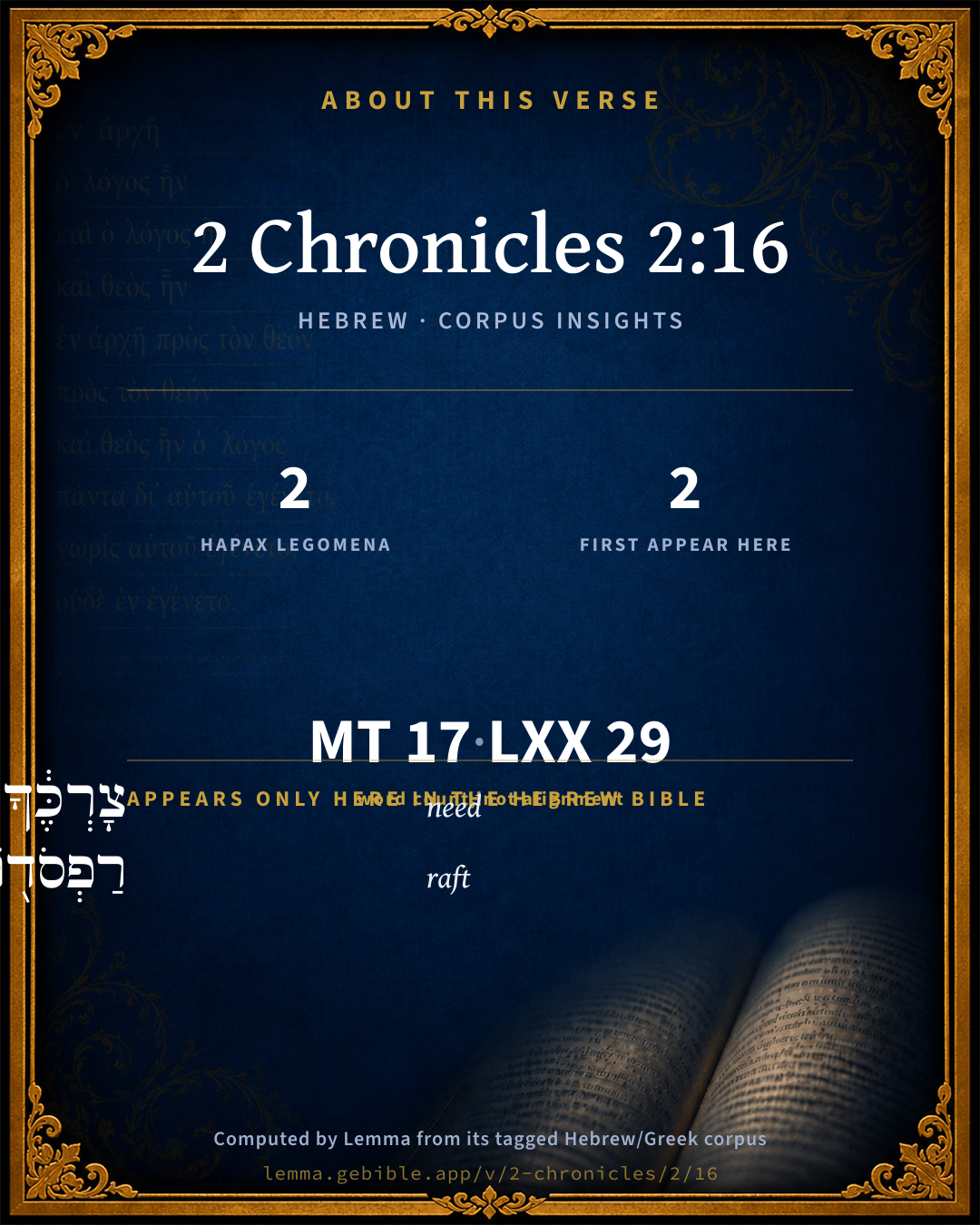
  • 2 hapax legomena — only here in the Hebrew Bible
  • 2 first appearances in the Hebrew Bible
Full analysis ↓
Download a study sheet

One document with this verse’s original text, its word-by-word gloss line, the meaning frame, cross-references with their text, attributed commentary, and full source and license credits — printable, and it pastes into notes with its structure intact.

This verse Autodidact and up

Study sheet (.html) Plain text (.txt)

A passage Seminary Student

Up to 50 verses in one chapter. A passage sheet keeps up to 6 commentary sources and 12 cross-references per verse, in the order this page ranks them, and says so on the sheet whenever that leaves anything out. Ask for a single verse and you get the Autodidact verse sheet above.

Everything on this page stays free to read, with no account — the sheet is a download of what is already on screen, not access to it.

Want to remove ads? Support Godless Engineer
Compare translations 3

The same verse in 3 English versions, stacked beneath the original-language interlinear above. Click any original word for its lexicon entry.

Each is an independent rendering of the whole verse — the interlinear is not word-aligned to these translations.

Highlighted words mark where these versions differ — a whole-verse word diff, not a word-by-word alignment.

  • World English Bible Public Domain
    and we will cut wood out of Lebanon, as much as you shall need; and we will bring it to you in floats by sea to Joppa; and you shall carry it up to Jerusalem.
  • King James Version Public Domain
    And we will cut wood out of Lebanon, as much as thou shalt need: and we will bring it to thee in floats by sea to Joppa; and thou shalt carry it up to Jerusalem.
  • unfoldingWord Literal Text CC BY-SA 4.0
    And we ourselves will cut trees from Lebanon, according to all your need, and we will bring them to you by rafts by sea to Joppa, and you yourself will bring them up to Jerusalem.”

unfoldingWord Literal Text — © unfoldingWord, licensed CC BY-SA 4.0. Word-aligned USFM3 via Door43 (git.door43.org/unfoldingWord/en_ult).

Versions to compare (up to 4)

3 of 4 selected

Show all 18 translations

Every available English version of this verse, each an independent rendering of the whole verse.

  • World English Bible Public Domain
    and we will cut wood out of Lebanon, as much as you shall need; and we will bring it to you in floats by sea to Joppa; and you shall carry it up to Jerusalem.
  • Berean Standard Bible Public Domain
    We will cut logs from Lebanon, as many as you need, and we will float them to you as rafts by sea down to Joppa. Then you can take them up to Jerusalem.”
  • Majority Standard Bible Public Domain
    We will cut logs from Lebanon, as many as you need, and we will float them to you as rafts by sea down to Joppa. Then you can take them up to Jerusalem.”
  • King James Version Public Domain
    And we will cut wood out of Lebanon, as much as thou shalt need: and we will bring it to thee in floats by sea to Joppa; and thou shalt carry it up to Jerusalem.
  • American Standard Version (1901) Public Domain
    and we will cut wood out of Lebanon, as much as thou shalt need; and we will bring it to thee in floats by sea to Joppa; and thou shalt carry it up to Jerusalem.
  • Revised Version (1885) Public Domain
    and we will cut wood out of Lebanon, as much as thou shalt need: and we will bring it to thee in floats by sea to Joppa; and thou shalt carry it up to Jerusalem.
  • Geneva Bible (1599) Public Domain
    And we wil cut wood in Lebanon as much as thou shalt neede, and will bring it to thee in raftes by the sea to Iapho, so thou mayest cary them to Ierusalem.
  • Douay-Rheims (1899) Public Domain
    And we will cut down as many trees out of Libanus, as thou shalt want, and will convey them in floats by sea to Joppe: and it will be thy part to bring them thence to Jerusalem.
  • Young's Literal Translation Public Domain
    and we -- we cut trees out of Lebanon, according to all thy need, and bring them in to thee -- floats by sea, to Joppa, and thou dost take them up to Jerusalem.'
  • Literal Standard Version CC BY-SA 4.0
    and we cut trees out of Lebanon, according to all your need, and bring them to you—floats by sea, to Joppa, and you take them up to Jerusalem.”
  • Unlocked Literal Bible CC BY-SA 4.0
    We will cut wood from Lebanon, as much wood as you need. We will take it to you as rafts by sea to Joppa, and you will carry it up to Jerusalem.”
  • unfoldingWord Literal Text CC BY-SA 4.0
    And we ourselves will cut trees from Lebanon, according to all your need, and we will bring them to you by rafts by sea to Joppa, and you yourself will bring them up to Jerusalem.”
  • Darby Bible Public Domain
    And we will cut wood out of Lebanon, as much as thou shalt need; and we will bring it to thee [in] floats by sea to Joppa, and thou shalt carry it up to Jerusalem.
  • World Messianic Bible Public Domain
    and we will cut wood out of Lebanon, as much as you need. We will bring it to you in rafts by sea to Joppa; then you shall carry it up to Jerusalem.”
  • Webster's Bible Public Domain
    And we will cut wood out of Lebanon, as much as thou shalt need: and we will bring it to thee in floats by sea to Joppa; and thou mayest convey it to Jerusalem.
  • Free Bible Version CC BY-SA 4.0
    We will cut all timber you need from Lebanon and take it to you by sea in rafts to Joppa. From there you can transport it to Jerusalem.”
  • Bible in Basic English Public Domain
    And we will have wood cut from Lebanon, as much as you have need of, and will send it to you on flat boats by sea to Joppa, and from there you may take it up to Jerusalem.
  • JPS Tanakh (1917) Public Domain
    (2-15) and we will cut wood out of Lebanon, as much as thou shalt need; and we will bring it to thee in floats by sea to Joppa; and thou shalt carry it up to Jerusalem.'

Literal Standard Version (2020), Covenant Press — licensed CC BY-SA 4.0. Text via the HelloAO Bible API (eBible.org). Unlocked Literal Bible (unfoldingWord) — licensed CC BY-SA 4.0. Text via the HelloAO Bible API (eBible.org). unfoldingWord Literal Text — © unfoldingWord, licensed CC BY-SA 4.0. Word-aligned USFM3 via Door43 (git.door43.org/unfoldingWord/en_ult). Free Bible Version, Dr. Jonathan Gallagher — licensed CC BY-SA 4.0. Text via the HelloAO Bible API (eBible.org).

Word by word

More ways to search: Search by grammar → Find every occurrence → Compare this word →

Practice this passage: Drill this verse → Learn its vocabulary →

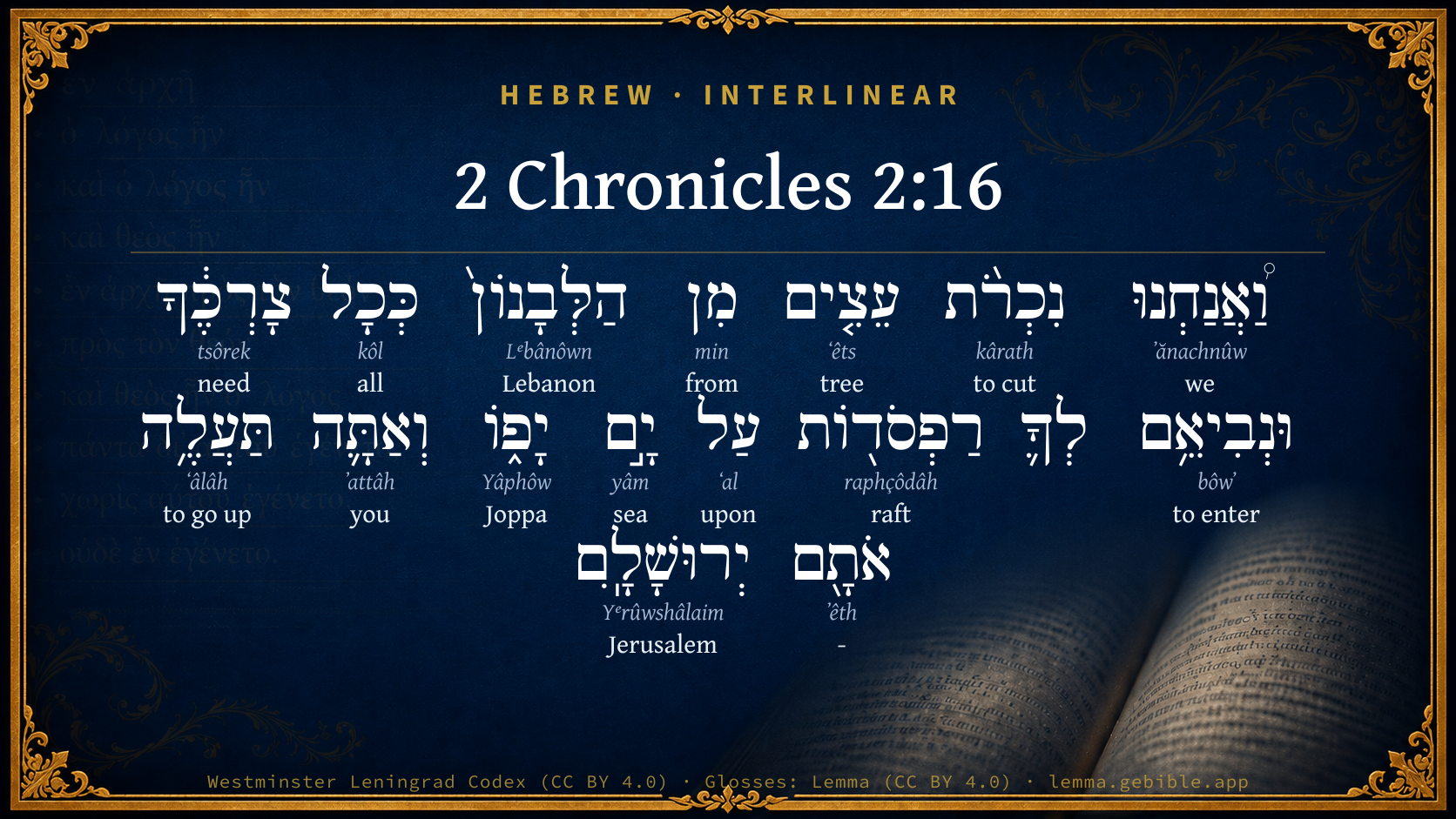
צָרְכֶּ֔ךָ
tsôrek
H6878
“need · your”
Noun, Common, Masculine, Singular, Construct + Suffix, Personal, 2nd Person, Masculine, Singular
Part of Speech
Noun
Type
Common
Gender
Masculine
Number
Singular
State
Construct
Full BDB Definition

Origin: from an unused root meaning to need

TWOT: 1970a

need
  1. וַ֠אֲנַחְנוּ ʼănachnûw H587 “and · we” Conjunction + Pronoun, Personal, 1st Person, Common, Plural
  2. נִכְרֹ֨ת kârath H3772 “to cut” Verb, Qal, Imperfect, 1st Person, Common, Plural
  3. עֵצִ֤ים ʻêts H6086 “trees” Noun, Common, Masculine, Plural, Absolute
  4. מִן min H4480 “from” Preposition
  5. הַלְּבָנוֹן֙ Lᵉbânôwn H3844 “the · Lebanon” Particle, Definite Article + Noun, Proper
  6. כְּכָל kôl H3605 “like/as · all of” Preposition + Noun, Common, Masculine, Singular, Construct
  7. וּנְבִיאֵ֥ם bôwʼ H935 “and · to enter · them” Conjunction + Verb, Hiphil, Imperfect, 1st Person, Common, Plural + Suffix, Personal, 3rd Person, Masculine, Plural
  8. רַפְסֹד֖וֹת raphçôdâh H7513 “rafts” Noun, Common, Feminine, Plural, Absolute
  9. עַל ʻal H5921 “upon” Preposition
  10. יָ֣ם yâm H3220 “sea” Noun, Common, Masculine, Singular, Absolute
  11. יָפ֑וֹ Yâphôw H3305 “Joppa” Noun, Proper
  12. וְאַתָּ֛ה ʼattâh H859 “and · you” Conjunction + Pronoun, Personal, 2nd Person, Masculine, Singular
  13. תַּעֲלֶ֥ה ʻâlâh H5927 “to go up” Verb, Hiphil, Imperfect, 2nd Person, Masculine, Singular
  14. אֹתָ֖ם ʼêth H853 “- · them” Particle, Direct Object + Suffix, Personal, 3rd Person, Masculine, Plural
  15. יְרוּשָׁלִָֽם Yᵉrûwshâlaim H3389 “Jerusalem” Noun, Proper

About this verse

These counts appear in no published source. They are computed here, from the morphology-tagged text and Lemma’s own curated glosses. What Lemma adds →

17
words
16
distinct lemmas
Historical
section

Notable vocabulary

2 hapax legomena — words that appear only here in the entire Hebrew Bible:

  • צָרְכֶּ֔ךָ need H6878
  • רַפְסֹד֖וֹת raft H7513

First appearance in Scripture

These words make their first canonical appearance in the Hebrew Bible here:

  • צָרְכֶּ֔ךָ need H6878
  • רַפְסֹד֖וֹת raft H7513

Shared distinctive vocabulary

יָפ֑וֹ Joppa H3305 occurs in 4 verses of the Hebrew Bible. Also found in:

Grammatical profile

  • 3 verbs
  • 8 nouns
  • 2 pronouns
  • 3 prepositions
  • 1 particle

Verb forms

  • נִכְרֹ֨ת Qal · Imperfect
  • וּנְבִיאֵ֥ם Hiphil · Imperfect
  • תַּעֲלֶ֥ה Hiphil · Imperfect

Hebrew & Septuagint length

In English translation the verse runs 35 words from the Hebrew and 32 from the Septuagint (LXX English) — closely comparable.

A rough comparison of the two English renderings, which tokenize alike — not a word-level alignment.

Word counts can differ between the Hebrew and the Greek without any difference in meaning — e.g. the Hebrew direct-object marker אֵת has no separate Greek word, and Greek often adds the article ὁ.

In the original languages it is 17 Hebrew tokens and 29 Greek tokens — but the two are counted differently (Hebrew bundles its prefixes and suffixes into one token; the Greek is in lemma form), so that isn’t a like-for-like length.

Cross-references

6

Topical passages linked to 2 Chronicles 2:16 in the Treasury of Scripture Knowledge — connected by theme and wording, ordered by reader-vote popularity; previews shown in the World English Bible.

  • Joshua 19:46 and Me-jarkon, and Rakkon, with the border over against Joppa.
  • 1 Kings 5:8–9 Hiram sent to Solomon, saying, I have heard [the message] which you have sent to me: I will do all your desire concerning timber of cedar, and concerning timber of fir.
  • Ezra 3:7 They gave money also to the masons, and to the carpenters; and food, and drink, and oil, to them of Sidon, and to them of Tyre, to bring cedar trees from Lebanon to the sea, to Joppa, according to the grant that they had of Cyrus king of Persia.
  • John 1:3 All things were made through him. Without him was not anything made that has been made.
  • Acts 9:36 Now there was at Joppa a certain disciple named Tabitha, which when translated, means Dorcas. This woman was full of good works and acts of mercy which she did.
  • Acts 10:32 Send therefore to Joppa, and summon Simon, who is surnamed Peter. He lodges in the house of Simon a tanner, by the seaside. When he comes, he will speak to you.'

Cross-references courtesy of OpenBible.info (CC BY 4.0).

Hebrew and Greek witnesses Masoretic Hebrew ↔ Greek Septuagint

The same verse in the two great witnesses to the Old Testament, shown verse-for-verse.

These are two independent witnesses, not word-aligned to each other, and the Septuagint is shown in lemma (dictionary) form.

Hebrew 2 Chronicles 2:16 Masoretic · Westminster Leningrad Codex

וַ֠אֲנַחְנוּ נִכְרֹ֨ת עֵצִ֤ים מִן הַלְּבָנוֹן֙ כְּכָל צָרְכֶּ֔ךָ וּנְבִיאֵ֥ם לְךָ֛ רַפְסֹד֖וֹת עַל יָ֣ם יָפ֑וֹ וְאַתָּ֛ה תַּעֲלֶ֥ה אֹתָ֖ם יְרוּשָׁלִָֽם

and we will cut wood out of Lebanon, as much as you shall need; and we will bring it to you in floats by sea to Joppa; and you shall carry it up to Jerusalem.

World English Bible · Public Domain

Greek LXX 2 Chronicles 2:16 Septuagint · lemma form

καί συνἄγω σαλωμών πᾶς ὁ ἀνήρ ὁ προσήλυτος ἐν γῆ ἰσραήλ μετά ὁ ἀριθμός ὅς ἀριθμέω αὐτός δαυίδ ὁ πατήρ αὐτός καί εὑρίσκω ἑκατόν πεντήκοντα χιλίας καί τρισχίλιοι ἑξακόσιοι

And we will cut timber out of Libanus according to all your need, and we will bring it on rafts to the sea of Joppa, and you shall bring it to Jerusalem.

LXX2012 (modern English Septuagint) · Public Domain

On this verse, Ellicott's Commentary for English Readers discusses the Septuagint’s reading. Read the note in Commentary ↓

Hebrew: Westminster Leningrad Codex (CC BY 4.0). Greek: Septuagint (public domain); English from LXX2012 (modern English Septuagint) (Public Domain). How the Septuagint differs from the Hebrew →

Commentary

Notes on 2 Chronicles 2:16 from classic Christian and Jewish commentators (each source and its license shown beneath its notes). The classic Christian expositions comment on the surrounding passage and are grouped to its opening verse, so a note may address several verses; the Jewish commentaries on the Tanakh (Rashi and others) are per-verse, so they appear only where the commentator wrote on this verse.

Lemma curates 59 commentaries, every one of them public domain or Creative Commons licensed, each selected and text-cleaned for this edition rather than reprinted as found. About our sources →

Trapp's Complete Commentary

John Trapp

2Ch 2:16 And we will cut wood out of Lebanon, as much as thou shalt need: and we will bring it to thee in floats by sea to Joppa; and thou shalt carry it up to Jerusalem.

Ver. 16. And we will cut wood.] See the benefit of a good neighbour, ready to every good office, as Hesiod describeth him.

John Trapp, A Commentary or Exposition upon All the Books of the Old and New Testament (1647–1656) — public domain. Text from a community e-Sword module.

Geneva Bible (1599)

Geneva Bible translators

Or, ships.

Or, Joppa.

Geneva Bible (1599) marginal notes — public domain. Text via Bolls.life.

Adam Clarke's Commentary

Verse 16. In floats by sea to Joppa] 1Kg 5:9, and on the parallel places, for other matters contained in this chapter.

Adam Clarke's Commentary on the Bible (1810–1826) — public domain. Text from a community e-Sword/MySword module.

Ellicott's Commentary for English Readers

(16) And we will cut wood.—The we is emphatic, and we, on our part, the pronoun being expressed in the Hebrew.

Wood (= “timber,” 2Ch_2:8-10; 2Ch_2:14).—Properly trees.

As much as thou shalt need.—See margin. “Need” (çôrek) occurs here only in the Old Testament. The word is common in the Targums, and in Rabbinic writings; 1Ki_5:8 has the classical phrase, “all thy desire.”

In flotes.—Heb., raphsôdôth. Another isolated expression. Rendered “rafts” by the LXX. and Vulgate, but omitted by Syriac and Arabic. 1Ki_5:9 has dôbĕrôth, “rafts,” which settles the meaning.

To Joppa.—1Ki_5:9 has the less definite “unto the place that thou shalt appoint me.” Joppa (modern Jaffa) was the harbour nearest Jerusalem.

And thou shalt carry it up to Jerusalem.—This interprets the curt phrase of 1Ki_5:9, “and thou shalt take (them) away.”

A comparison of this and the parallel account of Huram’s letter makes it clear (1) that the chronicler has not written without knowledge of the older text; (2; that neither text has preserved the exact form of the original documents. From Josephus (Ant. viii. 2, 8) it would appear that some record of the negotiations between Huram and Solomon was still extant at Tyre in his day, if only we might trust his authority.

A Bible Commentary for English Readers, edited by Charles John Ellicott (1878–1897) — public domain. Text from a community e-Sword module.

The Cambridge Bible for Schools and Colleges

gen. ed. J. J. S. Perowne

16. Joppa] Hebrew, Japho, modern Jaffa (Yâfâ).

The Cambridge Bible for Schools and Colleges (gen. ed. J. J. S. Perowne; Cambridge University Press, 1878–1918) — public domain. Text from a community e-Sword module.

John Gill's Exposition

And he set threescore and ten thousand of them,.... Which is repeated from Ch2 2:2, to show how the above number of strangers were disposed of; 70,000 of them bearers of burdens, 80,000 of them hewers of wood, and 3,600 overseers of the workmen, in all 153,600; an emblem of the Gentiles employed in building the spiritual temple, the church, Zac 6:15.

Next: 2 Chronicles Chapter 3

John Gill's Exposition of the Whole Bible (1746–1763) — public domain (CC PDM 1.0). Text via the HelloAO Bible API.

Haydock's Catholic Bible Commentary

CHAPTER II.

Floats. So the Septuagint well express the Hebrew raphsodoth, which seems to be borrowed from the Greek Rapsodia, which denotes a collection of verses (Calmet) and was applied to Homer’s poems, before they were collected. (Ælian xiii. 14.) Joppe was a port much used, (Calmet) though dangerous. (Josephus, Jewish Wars iii. 15.)

George Leo Haydock (1774–1849), Haydock's Catholic Family Bible and Commentary, 1859 edition — public domain. Excludes Psalms (Douay-Rheims chapter numbering differs from Protestant) and Deuterocanonical books (Catholic canon only).

The Pulpit Commentary

Joppa, This was one of the most ancient of towns, and is referred to by Pliny ("Hist. Nat.," 5:13), as "Joppa Phoenicum, antiquior terrarum inundatione, ut ferunt." Its name (wOpy "beauty") is said to have been justified by the beautiful groves in its neighbourhood. It is mentioned Jos_19:46 as Japho, where also we learn the circumstances under which the Dan tribe were possessed of it. It is remarkable that it is not mentioned again till our present verse, not even in the parallel. (1Ki_5:9) But it appears again in Ezr_3:7; Jon_1:3, and in several places in the Acts of the Apostles. The modern name of it is Joffa, and it is not reputed as a good port now. It was distant from Jerusalem some thirty-four miles. The carriage of the tim-bet this road-journey is nowhere described in detail, nor is the exact spot of the coast west of Lebanon mentioned where the flotes were made, and thence despatched.

The Pulpit Commentary (1880–1919), ed. H.D.M. Spence-Jones & Joseph S. Exell — public domain. Text from a community e-Sword module.

Rashi

Rabbi Shlomo Yitzchaki (Rashi)

And Solomon counted all the strangers who were in the land of Israel - Heb. הַגֵּירִים. This is written with the plene spelling, two yuds. In the beginning, when David counted them (I Chron 22:2), they were called הַגֵּרִים with one yud, but Solomon counted them at the time of the deed, when he built; therefore, it is written with the plene spelling. A similar instance: “then you shall bring up my bones from this place.” “With you” is missing in the portion of וַיְחִי (Gen. 50:25), but at the time of the deed (in the portion of בְּשַׁלַּח, Ex. 13:19), when he took them, it is written: “with you.”

And Solomon counted, etc., after the census above (I Chron. 22:2), as it is written: “And David ordered to gather the strangers.”

Rashi on the Tanakh — English translations: “The Judaica Press complete Tanach with Rashi, translated by A. J. Rosenberg” (CC BY 4.0); “Pentateuch with Rashi's commentary by M. Rosenbaum and A.M. Silbermann, 1929-1934” (public domain); “The Metsudah Tanach series, Lakewood, N.J” (CC BY 4.0); and “The Book of Joshua, Metsudah Publications, 1997” (CC BY 4.0). Text via Sefaria.

Lesson kit

Teaching starters — assembled from the data on this page, not authored interpretation. Every prompt links to the verse data it draws on. Edit before teaching.

2 Chronicles, in the Historical, opens this verse with 17 words (16 distinct Hebrew lemmas). Its most distinctive word is tsôrek (“need”). A historical commentator’s framing appears above. Read the whole chapter for the surrounding context.

Discussion questions

  1. The word tsôrek carries the sense “need.” How does it shape the verse?
  2. 2 words here appear nowhere else in the Hebrew Bible. Why might the author reach for such rare wording?
  3. 2 words make their first appearance in Scripture here. What does this debut establish?
  4. How does Joshua 19:46, which shares the word «Joppa», read alongside this verse?
  5. These translations render this verse differently; the difference is in the English rendering, not the original. What questions does that raise?
  6. «נִכְרֹ֨ת» is a Qal Imperfect verb. How does that grammatical form shape the action described?
  7. Compare how Trapp's Complete Commentary and Geneva Bible (1599) read this verse. Where do they agree or differ?

Things to notice

Reading settings

Reading text

Shown beneath each verse's original-language words.

Old Testament
Old Testament edition

Read the OT as the Masoretic Hebrew (MT) or the Greek Septuagint (LXX).

English shown for the Greek Septuagint (in the Hebrew ↔ Greek comparison).

Comparing translations? Open the Compare panel on any verse page to stack up to four side by side.