
Leviticus 17:4

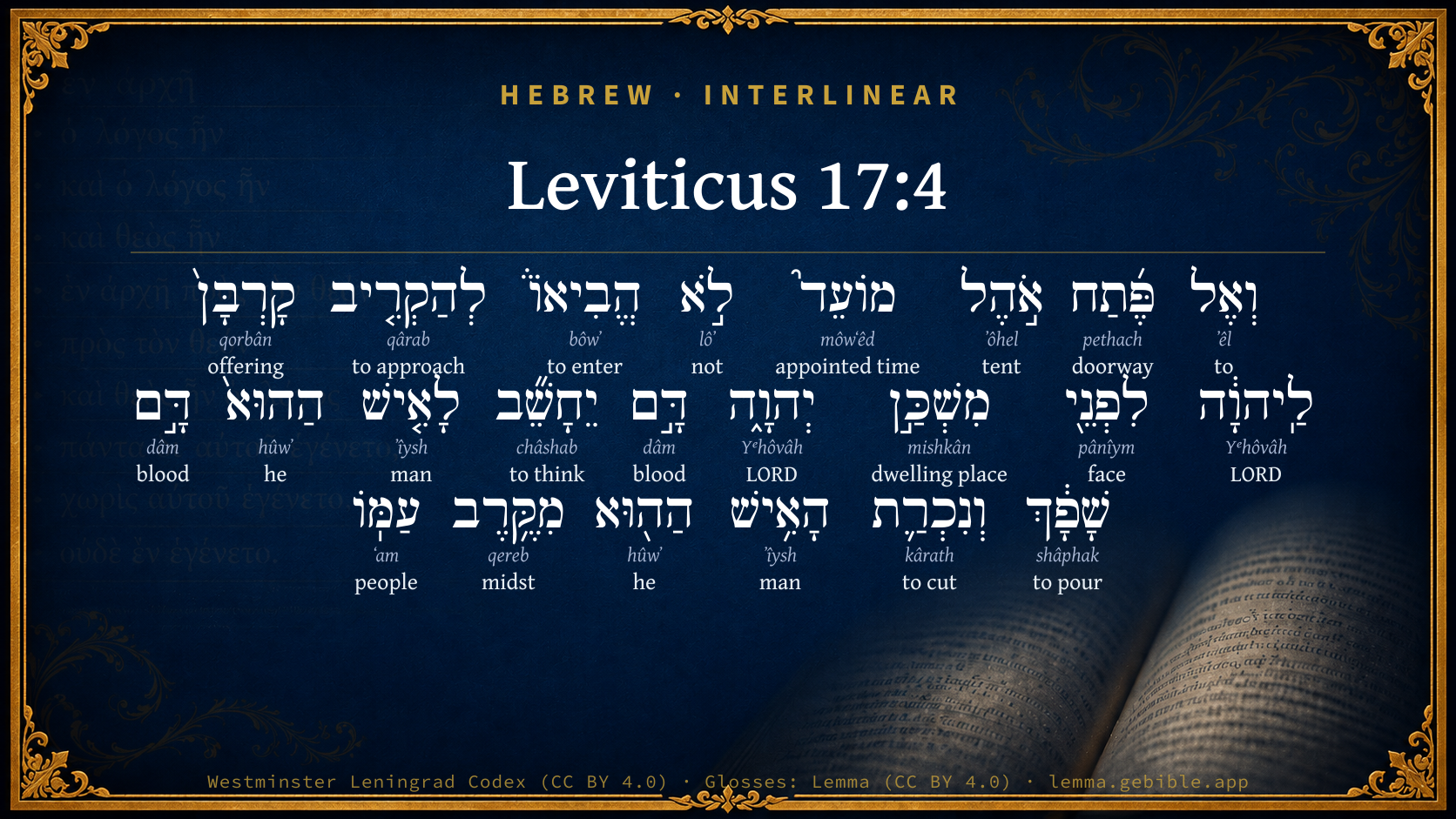
Hebrew (Westminster Leningrad Codex) Leviticus 17:4 appears in the Hebrew Old Testament. The text above is from the Westminster Leningrad Codex. Each word links to its Strong’s number, a concise gloss, and parsing drawn from the Open Scriptures Hebrew Bible morphology. Click any word for its full Brown-Driver-Briggs (BDB) entry.
Download image
Cite this verse

Leviticus 17:4 (World English Bible). Public Domain. Lemma interlinear Bible study tool, https://lemma.gebible.app/v/leviticus/17/4.

Show BibTeX & RIS
BibTeX
RIS
English Translation
and hasn't brought it to the door of the Tent of Meeting, to offer it as an offering to Yahweh before the tabernacle of Yahweh: blood shall be imputed to that man. He has shed blood; and that man shall be cut off from among his people.
World English Bible · Public Domain
Download a study sheet

One document with this verse’s original text, its word-by-word gloss line, the meaning frame, cross-references with their text, attributed commentary, and full source and license credits — printable, and it pastes into notes with its structure intact.

This verse Autodidact and up

Study sheet (.html) Plain text (.txt)

A passage Seminary Student

Up to 50 verses in one chapter. A passage sheet keeps up to 6 commentary sources and 12 cross-references per verse, in the order this page ranks them, and says so on the sheet whenever that leaves anything out. Ask for a single verse and you get the Autodidact verse sheet above.

Everything on this page stays free to read, with no account — the sheet is a download of what is already on screen, not access to it.

Want to remove ads? Support Godless Engineer
Compare translations 3

The same verse in 3 English versions, stacked beneath the original-language interlinear above. Click any original word for its lexicon entry.

Each is an independent rendering of the whole verse — the interlinear is not word-aligned to these translations.

Highlighted words mark where these versions differ — a whole-verse word diff, not a word-by-word alignment.

  • World English Bible Public Domain
    and hasn't brought it to the door of the Tent of Meeting, to offer it as an offering to Yahweh before the tabernacle of Yahweh: blood shall be imputed to that man. He has shed blood; and that man shall be cut off from among his people.
  • King James Version Public Domain
    And bringeth it not unto the door of the tabernacle of the congregation, to offer an offering unto the LORD before the tabernacle of the LORD; blood shall be imputed unto that man; he hath shed blood; and that man shall be cut off from among his people:
  • unfoldingWord Literal Text CC BY-SA 4.0
    but to the entrance of the tent of meeting he does not bring it to present an offering to Yahweh to the face of the Dwelling of Yahweh—blood will be reckoned to that man. He has shed blood, and that man shall be cut off from the midst of his people

unfoldingWord Literal Text — © unfoldingWord, licensed CC BY-SA 4.0. Word-aligned USFM3 via Door43 (git.door43.org/unfoldingWord/en_ult).

Versions to compare (up to 4)

3 of 4 selected

Show all 18 translations

Every available English version of this verse, each an independent rendering of the whole verse.

  • World English Bible Public Domain
    and hasn't brought it to the door of the Tent of Meeting, to offer it as an offering to Yahweh before the tabernacle of Yahweh: blood shall be imputed to that man. He has shed blood; and that man shall be cut off from among his people.
  • Berean Standard Bible Public Domain
    instead of bringing it to the entrance to the Tent of Meeting to present it as an offering to the LORD before His tabernacle—that man shall incur bloodguilt. He has shed blood and must be cut off from among his people.
  • Majority Standard Bible Public Domain
    instead of bringing it to the entrance to the Tent of Meeting to present it as an offering to the LORD before His tabernacle—that man shall incur bloodguilt. He has shed blood and must be cut off from among his people.
  • King James Version Public Domain
    And bringeth it not unto the door of the tabernacle of the congregation, to offer an offering unto the LORD before the tabernacle of the LORD; blood shall be imputed unto that man; he hath shed blood; and that man shall be cut off from among his people:
  • American Standard Version (1901) Public Domain
    and hath not brought it unto the door of the tent of meeting, to offer it as an oblation unto Jehovah before the tabernacle of Jehovah: blood shall be imputed unto that man; he hath shed blood; and that man shall be cut off from among his people:
  • Revised Version (1885) Public Domain
    and hath not brought it unto the door of the tent of meeting, to offer it as an oblation unto the LORD before the tabernacle of the LORD: blood shall be imputed unto that man; he hath shed blood; and that man shall be cut off from among his people:
  • Geneva Bible (1599) Public Domain
    And bringeth it not vnto the doore of the Tabernacle of the Congregation to offer an offring vnto the Lord before the Tabernacle of the Lord, blood shalbe imputed vnto that man: he hath shed blood, wherefore that man shall be cut off from among his people.
  • Douay-Rheims (1899) Public Domain
    And offer it not at the door of the tabernacle an oblation to the Lord, shall be guilty of blood: as if he had shed blood, so shall he perish from the midst of his people.
  • Young's Literal Translation Public Domain
    and unto the opening of the tent of meeting hath not brought it in to bring near an offering to Jehovah before the tabernacle of Jehovah, blood is reckoned to that man -- blood he hath shed -- and that man hath been cut off from the midst of his people;
  • Literal Standard Version CC BY-SA 4.0
    and has not brought it in to the opening of the Tent of Meeting to bring an offering near to YHWH before the Dwelling Place of YHWH, blood is reckoned to that man—he has shed blood—and that man has been cut off from the midst of his people;
  • Unlocked Literal Bible CC BY-SA 4.0
    if he does not bring it to the entrance of the tent of meeting to offer it as a sacrifice to Yahweh before his tabernacle, that man is guilty of bloodshed. He has shed blood, and that man must be cut off from among his people.
  • unfoldingWord Literal Text CC BY-SA 4.0
    but to the entrance of the tent of meeting he does not bring it to present an offering to Yahweh to the face of the Dwelling of Yahweh—blood will be reckoned to that man. He has shed blood, and that man shall be cut off from the midst of his people
  • Darby Bible Public Domain
    and doth not bring it to the entrance of the tent of meeting to present it as an offering to Jehovah, before the tabernacle of Jehovah, blood shall be reckoned unto that man: he hath shed blood; and that man shall be cut off from among his people,
  • World Messianic Bible Public Domain
    and hasn’t brought it to the door of the Tent of Meeting to offer it as an offering to the LORD before the LORD’s tabernacle: blood shall be imputed to that man. He has shed blood. That man shall be cut off from among his people.
  • Webster's Bible Public Domain
    And bringeth it not to the door of the tabernacle of the congregation, to offer an offering to the LORD before the tabernacle of the LORD; blood shall be imputed to that man; he hath shed blood; and that man shall be cut off from among his people:
  • Free Bible Version CC BY-SA 4.0
    instead of bringing it to the entrance to the Tent of Meeting to present it as an offering to the Lord there, that person shall be held guilty of illegal killing. They have shed blood and must be expelled from their people.
  • Bible in Basic English Public Domain
    And has not taken it to the door of the Tent of meeting, to make an offering to the Lord, before the Lord's House, its blood will be on him, for he has taken life, and he will be cut off from among his people:
  • JPS Tanakh (1917) Public Domain
    and hath not brought it unto the door of the tent of meeting, to present it as an offering unto the LORD before the tabernacle of the LORD, blood shall be imputed unto that man; he hath shed blood; and that man shall be cut off from among his people.

Literal Standard Version (2020), Covenant Press — licensed CC BY-SA 4.0. Text via the HelloAO Bible API (eBible.org). Unlocked Literal Bible (unfoldingWord) — licensed CC BY-SA 4.0. Text via the HelloAO Bible API (eBible.org). unfoldingWord Literal Text — © unfoldingWord, licensed CC BY-SA 4.0. Word-aligned USFM3 via Door43 (git.door43.org/unfoldingWord/en_ult). Free Bible Version, Dr. Jonathan Gallagher — licensed CC BY-SA 4.0. Text via the HelloAO Bible API (eBible.org).

Word by word

More ways to search: Search by grammar → Find every occurrence → Compare this word →

Practice this passage: Drill this verse → Learn its vocabulary →

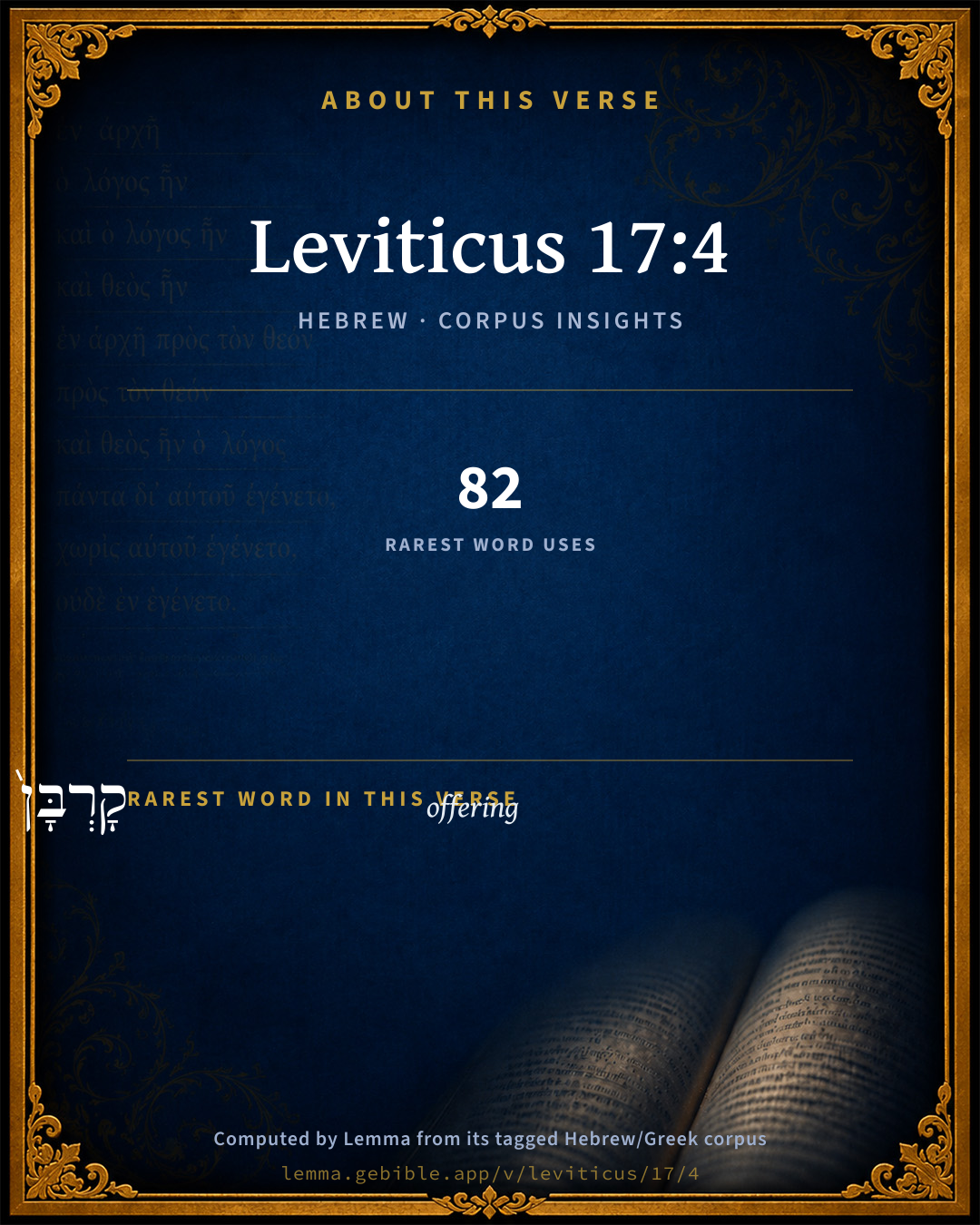
קָרְבָּן֙
qorbân
H7133
“offering”
Noun, Common, Masculine, Singular, Absolute
Part of Speech
Noun
Type
Common
Gender
Masculine
Number
Singular
State
Absolute
Full BDB Definition

Origin: from H7126

TWOT: 2065e

offering, oblation
  1. וְאֶל ʼêl H413 “and · to” Conjunction + Preposition
  2. פֶּ֜תַח pethach H6607 “doorway of” Noun, Common, Masculine, Singular, Construct
  3. אֹ֣הֶל ʼôhel H168 “tent of” Noun, Common, Masculine, Singular, Construct
  4. מוֹעֵד֮ môwʻêd H4150 “appointed time” Noun, Common, Masculine, Singular, Absolute
  5. לֹ֣א lôʼ H3808 “not” Particle, Negative
  6. הֱבִיאוֹ֒ bôwʼ H935 “to enter · him” Verb, Hiphil, Perfect, 3rd Person, Masculine, Singular + Suffix, Personal, 3rd Person, Masculine, Singular
  7. לְהַקְרִ֤יב qârab H7126 “to approach” Preposition + Verb, Hiphil, Infinitive Construct
  8. לַֽיהוָ֔ה Yᵉhôvâh H3068 “to/for · LORD” Preposition + Noun, Proper
  9. לִפְנֵ֖י pânîym H6440 “to/for · face(s) of” Preposition + Noun, Common, Both, Plural, Construct
  10. מִשְׁכַּ֣ן mishkân H4908 “dwelling place of” Noun, Common, Masculine, Singular, Construct
  11. יְהוָ֑ה Yᵉhôvâh H3068 “LORD” Noun, Proper
  12. דָּ֣ם dâm H1818 “blood” Noun, Common, Masculine, Singular, Absolute
  13. יֵחָשֵׁ֞ב châshab H2803 “to think” Verb, Niphal, Imperfect, 3rd Person, Masculine, Singular
  14. לָאִ֤ישׁ ʼîysh H376 “to/for the · man” Preposition, Determined + Noun, Common, Masculine, Singular, Absolute
  15. הַהוּא֙ hûwʼ H1931 “the · he” Particle, Definite Article + Pronoun, Personal, 3rd Person, Masculine, Singular
  16. דָּ֣ם dâm H1818 “blood” Noun, Common, Masculine, Singular, Absolute
  17. שָׁפָ֔ךְ shâphak H8210 “to pour” Verb, Qal, Perfect, 3rd Person, Masculine, Singular
  18. וְנִכְרַ֛ת kârath H3772 “and · to cut” Conjunction + Verb, Niphal, Sequential Perfect, 3rd Person, Masculine, Singular
  19. הָאִ֥ישׁ ʼîysh H376 “the · man” Particle, Definite Article + Noun, Common, Masculine, Singular, Absolute
  20. הַה֖וּא hûwʼ H1931 “the · he” Particle, Definite Article + Pronoun, Personal, 3rd Person, Masculine, Singular
  21. מִקֶּ֥רֶב qereb H7130 “from · midst of” Preposition + Noun, Common, Masculine, Singular, Construct
  22. עַמּֽוֹ ʻam H5971 “people · his” Noun, Common, Masculine, Singular, Construct + Suffix, Personal, 3rd Person, Masculine, Singular

About this verse

These counts appear in no published source. They are computed here, from the morphology-tagged text and Lemma’s own curated glosses. What Lemma adds →

23
words
19
distinct lemmas
Pentateuch
section

Grammatical profile

  • 5 verbs
  • 14 nouns
  • 2 pronouns
  • 1 preposition
  • 1 particle

Verb forms

  • הֱבִיאוֹ֒ Hiphil · Perfect
  • לְהַקְרִ֤יב Hiphil · Infinitive Construct
  • יֵחָשֵׁ֞ב Niphal · Imperfect
  • שָׁפָ֔ךְ Qal · Perfect
  • וְנִכְרַ֛ת Niphal · Sequential Perfect

Repetition

Words recur within this verse — often emphatic in Hebrew:

  • לַֽיהוָ֔ה LORD H3068 ×2
  • דָּ֣ם blood H1818 ×2
  • לָאִ֤ישׁ man H376 ×2
  • הַהוּא֙ he H1931 ×2

Hebrew & Septuagint length

In English translation the verse runs 47 words from the Hebrew and 92 from the Septuagint (LXX English) — the Septuagint runs noticeably longer here. See the side-by-side →

A rough comparison of the two English renderings, which tokenize alike — not a word-level alignment.

Word counts can differ between the Hebrew and the Greek without any difference in meaning — e.g. the Hebrew direct-object marker אֵת has no separate Greek word, and Greek often adds the article ὁ.

Cross-references

23

Topical passages linked to Leviticus 17:4 in the Treasury of Scripture Knowledge — connected by theme and wording, ordered by reader-vote popularity; previews shown in the World English Bible.

  • Genesis 17:14 The uncircumcised male who is not circumcised in the flesh of his foreskin, that soul shall be cut off from his people. He has broken my covenant."
  • Deuteronomy 12:5–21 But to the place which Yahweh your God shall choose out of all your tribes, to put his name there, even to his habitation shall you seek, and there you shall come;
  • Isaiah 66:3 He who kills an ox is as he who kills a man; he who sacrifices a lamb, as he who breaks a dog's neck; he who offers an offering, [as he who offers] pig's blood; he who burns frankincense, as he who blesses an idol. Yes, they have chosen their own ways, and their soul delights in their abominations:
  • Ezekiel 20:40 For in my holy mountain, in the mountain of the height of Israel, says the Lord Yahweh, there shall all the house of Israel, all of them, serve me in the land: there will I accept them, and there will I require your offerings, and the first fruits of your offerings, with all your holy things.
  • John 10:7 Jesus therefore said to them again, "Most assuredly, I tell you, I am the sheep's door.
  • John 10:9 I am the door. If anyone enters in by me, he will be saved, and will go in and go out, and will find pasture.
  • John 14:6 Jesus said to him, "I am the way, the truth, and the life. No one comes to the Father, except through me.
  • Exodus 12:15 Seven days shall you eat unleavened bread; even the first day you shall put away yeast out of your houses, for whoever eats leavened bread from the first day until the seventh day, that soul shall be cut off from Israel.
  • Exodus 12:19 Seven days shall there be no yeast found in your houses, for whoever eats that which is leavened, that soul shall be cut off from the congregation of Israel, whether he be a foreigner, or one who is born in the land.
  • Leviticus 1:3 "'If his offering is a burnt offering from the herd, he shall offer a male without blemish. He shall offer it at the door of the Tent of Meeting, that he may be accepted before Yahweh.
  • Leviticus 7:18 If any of the flesh of the sacrifice of his peace offerings is eaten on the third day, it will not be accepted, neither shall it be imputed to him who offers it. It will be an abomination, and the soul who eats any of it will bear his iniquity.
  • Leviticus 17:10 "'Any man of the house of Israel, or of the strangers who live as foreigners among them, who eats any kind of blood, I will set my face against that soul who eats blood, and will cut him off from among his people.
  • Leviticus 17:14 For as to the life of all flesh, its blood is with its life: therefore I said to the children of Israel, "You shall not eat the blood of any kind of flesh; for the life of all flesh is its blood. Whoever eats it shall be cut off."
  • Leviticus 18:29 "'For whoever shall do any of these abominations, even the souls that do them shall be cut off from among their people.
  • Leviticus 20:3 I also will set my face against that person, and will cut him off from among his people because he has given of his seed to Molech, to defile my sanctuary, and to profane my holy name.
  • Leviticus 20:16 "'If a woman approaches any animal, and lies down with it, you shall kill the woman, and the animal: they shall surely be put to death; their blood shall be upon them.
  • Leviticus 20:18 "'If a man lies with a woman having her monthly period, and uncovers her nakedness; he has made naked her fountain, and she has uncovered the fountain of her blood: and both of them shall be cut off from among their people.
  • Numbers 15:30–31 But the soul who does anything with a high hand, whether he is home-born or a foreigner, the same blasphemes Yahweh; and that soul shall be cut off from among his people.
  • Psalms 32:2 Blessed is the man to whom Yahweh doesn't impute iniquity, In whose spirit there is no deceit.
  • Romans 4:6 Even as David also pronounces blessing on the man to whom God counts righteousness apart from works,
  • Romans 5:13 For until the law, sin was in the world; but sin is not charged when there is no law.
  • Romans 5:20 The law came in besides, that the trespass might abound; but where sin abounded, grace did abound more exceedingly;
  • Philemon 1:18–19 But if he has wronged you at all, or owes you anything, put that to my account.

Cross-references courtesy of OpenBible.info (CC BY 4.0).

Hebrew and Greek witnesses Masoretic Hebrew ↔ Greek Septuagint

The same verse in the two great witnesses to the Old Testament, shown verse-for-verse.

Here the Septuagint runs noticeably longer than the Hebrew — LXX2012 (modern English Septuagint) 92 words vs World English Bible 47. A rough length comparison of the two English translations, not a word-level alignment — read both below.

These are two independent witnesses, not word-aligned to each other, and the Septuagint is shown in lemma (dictionary) form.

Hebrew Leviticus 17:4 Masoretic · Westminster Leningrad Codex

וְאֶל פֶּ֜תַח אֹ֣הֶל מוֹעֵד֮ לֹ֣א הֱבִיאוֹ֒ לְהַקְרִ֤יב קָרְבָּן֙ לַֽיהוָ֔ה לִפְנֵ֖י מִשְׁכַּ֣ן יְהוָ֑ה דָּ֣ם יֵחָשֵׁ֞ב לָאִ֤ישׁ הַהוּא֙ דָּ֣ם שָׁפָ֔ךְ וְנִכְרַ֛ת הָאִ֥ישׁ הַה֖וּא מִקֶּ֥רֶב עַמּֽוֹ

and hasn't brought it to the door of the Tent of Meeting, to offer it as an offering to Yahweh before the tabernacle of Yahweh: blood shall be imputed to that man. He has shed blood; and that man shall be cut off from among his people.

World English Bible · Public Domain

Greek LXX Leviticus 17:4 Septuagint · lemma form

καί ἐπί ὁ θύρα ὁ σκηνή ὁ μαρτύριον μή φέρω ὥστε ποιέω αὐτός εἰς ὁλοκαύτωμα ἤ σωτήριον κύριος δεκτός εἰς ὀσμή εὐωδία καί ὅς ἄν σφάζω ἔξω καί ἐπί ὁ θύρα ὁ σκηνή ὁ μαρτύριον μή φέρω αὐτός ὥστε μή προςφέρω δῶρον κύριος ἀπέναντι ὁ σκηνή κύριος καί λογίζομαι ὁ ἄνθρωπος ἐκεῖνος αἷμα αἷμα ἐκχέω ἐκὀλεθρεύω ὁ ψυχή ἐκεῖνος ἐκ ὁ λαός αὐτός

and shall not bring it to the door of the tabernacle of witness, so as to sacrifice it for a whole burnt offering or peace-offering to the Lord to be acceptable for a sweet smelling savor: and whoever shall kill it without, and shall not bring it to the door of the tabernacle of witness, so as to offer it as a gift to the Lord before the tabernacle of the Lord; blood shall be imputed to that man, he has shed blood; that soul shall be cut off from his people.

LXX2012 (modern English Septuagint) · Public Domain

Hebrew: Westminster Leningrad Codex (CC BY 4.0). Greek: Septuagint (public domain); English from LXX2012 (modern English Septuagint) (Public Domain). How the Septuagint differs from the Hebrew →

Targum (Aramaic paraphrase)

2

The Targum is the ancient Jewish Aramaic paraphrase of the Hebrew Scriptures — an interpretive translation, not the Hebrew text itself. Onkelos (literal) and Pseudo-Jonathan (expansive) render the Torah, and Jonathan the Prophets. Coverage is partial: where no permissively-licensed English translation exists for a verse, only the Aramaic is shown. This is verse-level text, not a word-by-word alignment to the Hebrew.

  1. Targum Onkelos Torah (Genesis–Deuteronomy)
    וְלִתְרַע מַשְׁכַּן זִמְנָא לָא אַיְתֵהּ לְקָרָבָא קֻרְבָּנָא קֳדָם יְיָ קֳדָם מַשְׁכְּנָא דַיְיָ דְמָא יִתְחַשַׁב לְגַבְרָא הַהוּא דְמָא אֲשַׁד וְיִשְׁתֵּיצֵי אֲנָשָׁא הַהוּא מִגוֹ עַמֵהּ

    (no public-domain English translation for this verse)

    Targum Onkelos — Aramaic: “Onkelos Genesis” (public domain); “Onkelos Exodus” (public domain); “Onkelos Leviticus” (public domain); “Onkelos Numbers” (public domain); “Onkelos Deuteronomy” (public domain). English: “Sefaria Community Translation” (CC0 1.0 (public-domain dedication)); “J.W. Etheridge. The Targums of Onkelos and Jonathan Ben Uzziel on the Pentateuch. London: Longmans, Green, 1862” (public domain). Text via Sefaria.

  2. Targum Pseudo-Jonathan Torah (Genesis–Deuteronomy)
    וְלִתְרַע מַשְׁכַּן זִמְנָא לָא אַיְיתֵיהּ לְקָרָבָא קָרְבָּנָא קֳדָם יְיָ קֳדָם מַשְׁכְּנָא דַיְיָ אֲדַם קְטוֹל יִתְחַשֵׁב לְגַבְרָא הַהוּא וּתְהֵי לֵיהּ כְּאִילוּ אֲדַם זַכְּאַי אָשַׁד וְיִשְׁתֵּצֵי בַּר נְשָׁא הַהוּא מֵעַמֵיהּ

    and bringeth it not to the door of the tabernacle of ordinance to offer it an oblation before the Lord, before the tabernacle of the Lord, the blood of slaughter shall be reckoned to that man, and it shall be to him as if he had shed innocent blood, and that man shall be destroyed from his people.

    Targum Pseudo-Jonathan — Aramaic: “Targum Jonathan on Genesis” (public domain); “Targum Jonathan on Exodus” (public domain); “Targum Jonathan on Leviticus” (public domain); “Targum Jonathan on Numbers” (public domain); “Targum Jonathan on Deuteronomy” (public domain). English: “The Targum of Jonathan ben Uzziel, trans. J. W. Etheridge, London, 1862” (public domain). Text via Sefaria.

Commentary

Notes on Leviticus 17:4 from classic Christian and Jewish commentators (each source and its license shown beneath its notes). The classic Christian expositions comment on the surrounding passage and are grouped to its opening verse, so a note may address several verses; the Jewish commentaries on the Tanakh (Rashi and others) are per-verse, so they appear only where the commentator wrote on this verse.

Lemma curates 59 commentaries, every one of them public domain or Creative Commons licensed, each selected and text-cleaned for this edition rather than reprinted as found. About our sources →

Trapp's Complete Commentary

John Trapp

Lev 17:4 And bringeth it not unto the door of the tabernacle of the congregation, to offer an offering unto the LORD before the tabernacle of the LORD; blood shall be imputed unto that man; he hath shed blood; and that man shall be cut off from among his people:

Ver. 4. And bringeth it not unto the door.] To teach, that in the Church alone, and by Christ alone, that is, by faith in him, acceptable service can be performed to God. Christ is the door of the sheep, {Joh 10:7; Joh 10:9} by whom we come to the Father, {Joh 14:6} and may everywhere lift up pure hands, without wrath, without doubting.

John Trapp, A Commentary or Exposition upon All the Books of the Old and New Testament (1647–1656) — public domain. Text from a community e-Sword module.

Joseph Benson's Commentary

Lev 17:4. The tabernacle — This was appointed in opposition to the heathens, who sacrificed in all places; to cut off occasions of idolatry; to prevent the people’s usurpation of the priest’s office, and to signify that God would accept of no sacrifices but through Christ and in the church; of both which the tabernacle was a type. But though men were tied to this law, God was free to dispense with his own law, which he did sometimes to the prophets, as 1Sa 7:9; 1Sa 11:15. He hath shed blood — He shall be punished as a murderer. The reason is, because he shed that blood, which, though not man’s blood, yet was precious, being sacred and appropriated to God, and typically the price by which men’s lives were ransomed.

Joseph Benson's Commentary on the Old and New Testaments (1811–1818) — public domain. Text from a community e-Sword module.

Tyndale Open Study Notes

Tyndale Open Resources

17:4 will be as guilty as a murderer: The person had shed an animal’s blood in an unlawful manner. The life of the animal had been given by God; it had to be returned to him in the blood of the sacrificed animal. • cut off: See study note on 7:20-21.

Tyndale Open Study Notes — © Tyndale Open Resources, licensed CC BY-SA 4.0. Text via the HelloAO Bible API.

Geneva Bible (1599)

Geneva Bible translators

I do as much abhor it as though he had killed a man, as Isa. 66:3.

Geneva Bible (1599) marginal notes — public domain. Text via Bolls.life.

Adam Clarke's Commentary

Verse 4. And bringeth it not unto the door] As sacrifice was ever deemed essential to true religion, it was necessary that it should be performed in such a way as to secure the great purpose of its institution. God alone could show how this should be done so as to be pleasing in his sight, and therefore he has given the most plain and particular directions concerning it. The Israelites, from their long residence in Egypt, an idolatrous country, had doubtless adopted many of their usages; and many portions of the Pentateuch seem to have been written merely to correct and bring them back to the purity of the Divine worship.

That no blood should be offered to idols, God commands every animal used for food or sacrifice to be slain at the door of the tabernacle. While every animal was slain in this sacrificial way, even the daily food of the people must put them in mind of the necessity of a sacrifice for sin. Perhaps St. Paul had this circumstance in view when he said, Whether therefore ye eat or drink, or whatsoever ye do, do all to the glory of God, 1Co 10:31; and, Whatsoever ye do in word or deed, do all in the name of the Lord Jesus, giving thanks to God and the Father by him.

While the Israelites were encamped in the wilderness, it was comparatively easy to prevent all abuses of this Divine institution; and therefore they were all commanded to bring the oxen, sheep, and goats to the door of the tabernacle of the congregation, that they might be slain there, and their blood sprinkled upon the altar of the Lord. But when they became settled in the promised land, and the distance, in many cases, rendered it impossible for them to bring the animals to be slain for domestic uses to the temple, they were permitted to pour out the blood in a sacrificial way unto God at their respective dwellings, and to cover it with the dust; see Le 17:13, and De 12:20-21.

Blood shall be imputed unto that man] Having poured out the blood improperly, he shall be considered as guilty of murder, because that blood, had it been properly and sacrificially employed, might have made atonement for the life of a man.

Adam Clarke's Commentary on the Bible (1810–1826) — public domain. Text from a community e-Sword/MySword module.

Ellicott's Commentary for English Readers

(4) And bringeth it not unto the door of the tabernacle of the congregation.—Better, and bringeth it not to the entrance of the tent of meeting; that is, if he does not bring it to the place where the sacrifices are killed, and offer it first as a peace offering to Jehovah, he is to be regarded as wantonly shedding blood, and will be visited with the penalty of excision.

A Bible Commentary for English Readers, edited by Charles John Ellicott (1878–1897) — public domain. Text from a community e-Sword module.

The Cambridge Bible for Schools and Colleges

gen. ed. J. J. S. Perowne

4. the tent of meeting … the tabernacle] For the significance of the double indication of place which suggests a combination of two sources see p. 88.

The Cambridge Bible for Schools and Colleges (gen. ed. J. J. S. Perowne; Cambridge University Press, 1878–1918) — public domain. Text from a community e-Sword module.

John Gill's Exposition

And bringeth it not unto the door of the tabernacle of the congregation,.... Near to which stood the altar of burnt offering to offer it upon, and the priests ready for such service: now the Lord would have every sacrifice brought thither

to offer an offering to the Lord before the tabernacle of the Lord; that it might be offered publicly, and be known to be offered to the Lord, and not to idols or devils, as in Lev 17:7; and so to prevent private idolatry, and private persons from intruding into the priest's office; and this was typical of the acceptance of all spiritual sacrifices in the church of God, through Christ the minister of the tabernacle, which God pitched, and not man; and who is the door into the house of God, where such sacrifices are publicly to be offered up:

blood shall be imputed unto that man, he hath shed blood; which though it was only the blood of a beast, yet being shed as a sacrifice for man, and typical of the blood of Christ to be shed for man, was sacred and precious to God; and therefore he resented the shedding of it to any but himself, or by any person, or in any place but by his appointment; such a man was to be punished as a murderer, idolatry being equally heinous in the sight of God as murder, see Isa 66:3,

and that man shall be cut off from among his people; not merely excommunicated from the church of God, deprived of the privileges of his house, but even put to death; for such a man was guilty of blood, that is, of death, and therefore to be put to death either by the hand of the civil magistrate, if his case was known and came under their cognizance, or by the immediate hand of God by a premature death, which seems to be chiefly intended; also see Lev 17:10.

John Gill's Exposition of the Whole Bible (1746–1763) — public domain (CC PDM 1.0). Text via the HelloAO Bible API.

Matthew Poole's English Annotations

This was appointed, partly, in opposition to the heathens, who sacrificed in all places; partly, to cut off occasions of idolatry; partly, to prevent the people’s usurpation of the priest’s office; and partly, to signify that God would accept of no sacrifices but through Christ and in the church, (of both which the tabernacle was a type: see Heb 9:11) and according to his own prescript. But though men were tied to this law, God was free to dispense with his own law, which he did sometimes to the prophets, as 1Sa 7:9; 11:15; &c., and afterwards more fully and generally in the days of the Messiah, Mal 1:11; Joh 4:21,24.

Blood shall be imputed unto that man; he shall be esteemed and punished as a murderer both by God and by men. See Isa 66:3. The reason is, because he shed that blood, which, though not man’s blood, yet was as precious, being sacred and appropriated to God, and typically the price by which men’s lives were ransomed.

He shall be cut off by death, either by the hand of God, in case men do not know it or neglect to punish it, or by men, if the fact was public and evident.

Matthew Poole's English Annotations on the Holy Bible (1683–1685) — public domain. Text from a community e-Sword/MySword module.

Whedon's Commentary on the Bible

Daniel D. Whedon

4. An offering unto the Lord — The blood and fat were sacrificially treated, but nothing is said respecting the priest’s portion which was allotted in peace offerings. There was also the same priestly inspection.

Modern Jews eat no meat which has not the seal of the rabbi certifying that the animal was without blemish. Herein again is a sanitary safeguard.

Blood shall be imputed — This is explained by the following words: He hath shed blood. He is classified with those who have wickedly shed human blood, and are guilty of murder.

Cut off — He shall be punished with death, without defining the manner. Thus the Seventy and the Vulgate. The punishment is never exile, as is supposed by J.D. Michaelis.

Daniel D. Whedon (gen. ed.), Commentary on the Old and New Testaments (1874–1909) — public domain. Text from a community e-Sword module.

The Pulpit Commentary

In case a man offers a sacrifice elsewhere than at the door of the tabernacle of the congregation,... blood shall be imputed unto that man; that is, it shall no longer be regarded as a sacrifice at all, but an unjustifiable shedding of blood, for which he is to be cut off from among his people, that is, excommunicated.

The Pulpit Commentary (1880–1919), ed. H.D.M. Spence-Jones & Joseph S. Exell — public domain. Text from a community e-Sword module.

John Wesley's Explanatory Notes

The tabernacle - This was appointed in opposition to the Heathens, who sacrificed in all places; to cut off occasions of idolatry; to prevent the people's usurpation of the priest's office, and to signify that God would accept of no sacrifices but through Christ and in the Church; (of both which the tabernacle was a type.) But though men were tied to this law, God was free to dispense with his own law, which he did sometimes to the prophets, as 1 Sam. vii, 9, xi, 15. He hath shed blood - He shall be punished as a murderer. The reason is, because he shed that blood, which, though not man's blood, yet was precious, being sacred and appropriated to God, and typically the price by which men's lives were ransomed.

John Wesley, Explanatory Notes Upon the Whole Bible (1754–1765) — public domain. Text via the GEBible commentary corpus.

Rashi

Rabbi Shlomo Yitzchaki (Rashi)

דם יחשב BLOOD SHALL BE IMPUTED [UNTO THAN MAN] — As though he had shed the blood of a human being, who is guilty of a deadly sin.

דם שפך HE HATH SHED BLOOD — These apparently redundant words are intended to include in the penalty of כרת him who sprinkles outside the fore-court the blood of a sacrifice which has been slaughtered within it as is here commanded (Sanhedrin 34b; Zevachim 107a).

Rashi on the Tanakh — English translations: “The Judaica Press complete Tanach with Rashi, translated by A. J. Rosenberg” (CC BY 4.0); “Pentateuch with Rashi's commentary by M. Rosenbaum and A.M. Silbermann, 1929-1934” (public domain); “The Metsudah Tanach series, Lakewood, N.J” (CC BY 4.0); and “The Book of Joshua, Metsudah Publications, 1997” (CC BY 4.0). Text via Sefaria.

Ramban (Nachmanides)

Rabbi Moshe ben Nachman (Ramban / Nachmanides)

BLOOD SHALL BE IMPUTED UNTO THAT MAN. This means that [his guilt is as] of the time of Creation., 9:5, pp. 134-135). Hence the meaning of the verse here is that if one slaughters an animal outside the camp, then since it is forbidden to him as food, it shall be imputed to him as if he is guilty of bloodshed “as at the time of Creation.” See also Ramban here on Verse 11. The verse is thus stating: “Now of all living creatures except man, I [the Eternal] have declared their blood to be as water, and their flesh as dung, just as it is said [at the time of Noah], as the green herb I have given you all. But if one slaughters an animal outside the camp, then [since it is forbidden to be eaten], it shall be imputed to him as if he had shed blood [of a fellow man].”

Ramban (Nachmanides) on the Tanakh — English translation: “Commentary on the Torah by Ramban (Nachmanides). Translated and annotated by Charles B. Chavel. New York, Shilo Pub. House, 1971-1976” (CC BY 4.0). Text via Sefaria.

Lesson kit

Teaching starters — assembled from the data on this page, not authored interpretation. Every prompt links to the verse data it draws on. Edit before teaching.

Leviticus, in the Pentateuch, opens this verse with 23 words (19 distinct Hebrew lemmas). Its most distinctive word is qorbân (“offering”). The Greek Septuagint runs longer here. A historical commentator’s framing appears above. Read the whole chapter for the surrounding context.

Discussion questions

  1. The word qorbân carries the sense “offering.” How does it shape the verse?
  2. Genesis 17:14 shares this passage’s theme. How do the two illuminate each other?
  3. “LORD” occurs 2× in this one verse. What is the effect of the repetition?
  4. Compared with the Hebrew, the Septuagint runs longer here. What questions does that raise?
  5. The translations on this page render this verse differently — a whole-verse word diff, not a word-by-word alignment. What might account for the different wordings?
  6. The verb «הֱבִיאוֹ֒» is Hiphil Perfect. How does its form color the action?
  7. Reading how Trapp's Complete Commentary and Joseph Benson's Commentary read this verse, where do the two commentators agree and where do they part?

Things to notice

Reading settings

Reading text

Shown beneath each verse's original-language words.

Old Testament
Old Testament edition

Read the OT as the Masoretic Hebrew (MT) or the Greek Septuagint (LXX).

English shown for the Greek Septuagint (in the Hebrew ↔ Greek comparison).

Comparing translations? Open the Compare panel on any verse page to stack up to four side by side.