
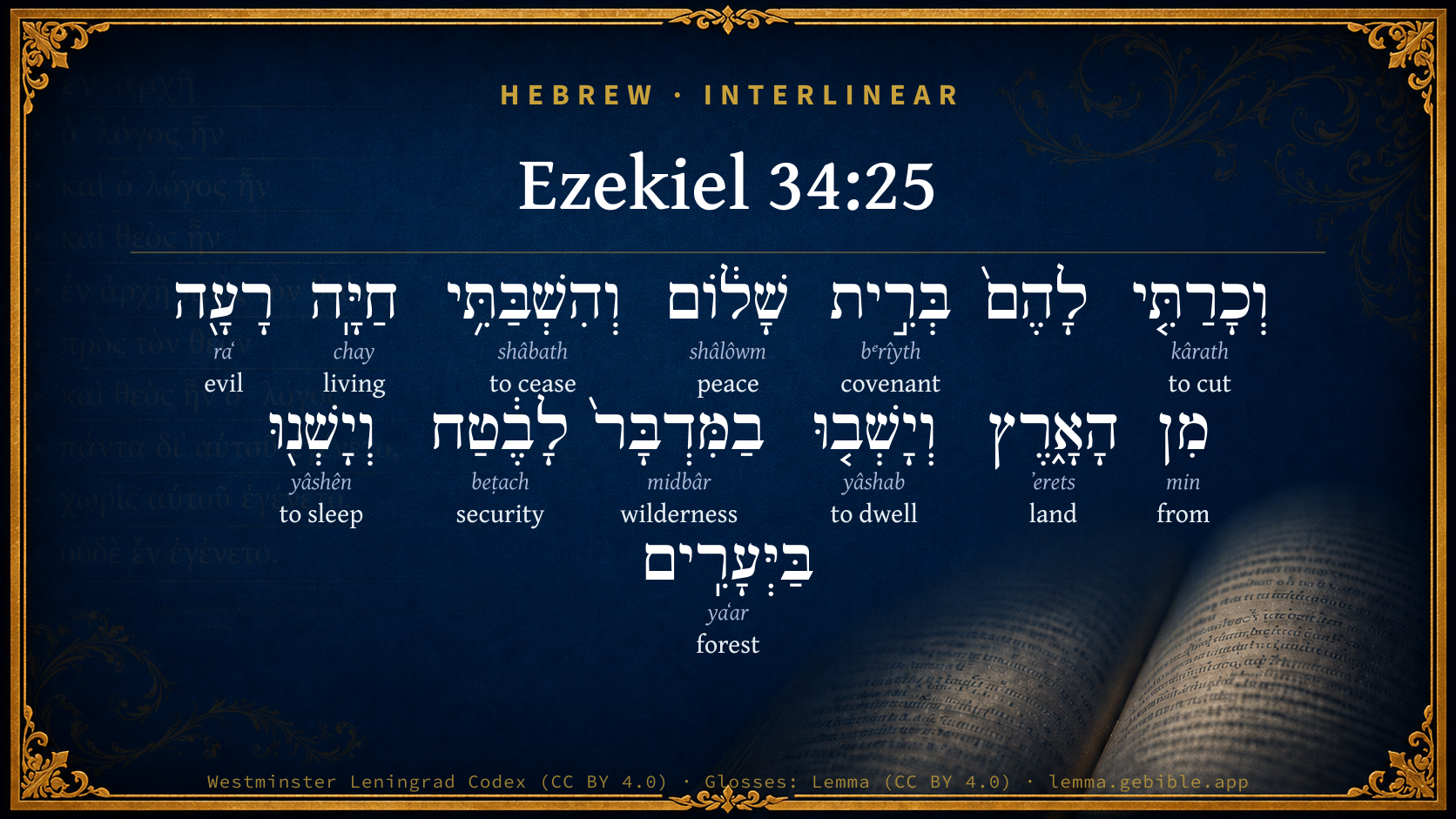
Ezekiel 34:25

Hebrew (Westminster Leningrad Codex) Ezekiel 34:25 appears in the Hebrew Old Testament. The text above is from the Westminster Leningrad Codex. Each word links to its Strong’s number, a concise gloss, and parsing drawn from the Open Scriptures Hebrew Bible morphology. Click any word for its full Brown-Driver-Briggs (BDB) entry.
Download image
Cite this verse

Ezekiel 34:25 (World English Bible). Public Domain. Lemma interlinear Bible study tool, https://lemma.gebible.app/v/ezekiel/34/25.

Show BibTeX & RIS
BibTeX
RIS
English Translation
I will make with them a covenant of peace, and will cause evil animals to cease out of the land; and they shall dwell securely in the wilderness, and sleep in the woods.
World English Bible · Public Domain
Download a study sheet

One document with this verse’s original text, its word-by-word gloss line, the meaning frame, cross-references with their text, attributed commentary, and full source and license credits — printable, and it pastes into notes with its structure intact.

This verse Autodidact and up

Study sheet (.html) Plain text (.txt)

A passage Seminary Student

Up to 50 verses in one chapter. A passage sheet keeps up to 6 commentary sources and 12 cross-references per verse, in the order this page ranks them, and says so on the sheet whenever that leaves anything out. Ask for a single verse and you get the Autodidact verse sheet above.

Everything on this page stays free to read, with no account — the sheet is a download of what is already on screen, not access to it.

Want to remove ads? Support Godless Engineer
Compare translations 3

The same verse in 3 English versions, stacked beneath the original-language interlinear above. Click any original word for its lexicon entry.

Each is an independent rendering of the whole verse — the interlinear is not word-aligned to these translations.

Highlighted words mark where these versions differ — a whole-verse word diff, not a word-by-word alignment.

  • World English Bible Public Domain
    I will make with them a covenant of peace, and will cause evil animals to cease out of the land; and they shall dwell securely in the wilderness, and sleep in the woods.
  • King James Version Public Domain
    And I will make with them a covenant of peace, and will cause the evil beasts to cease out of the land: and they shall dwell safely in the wilderness, and sleep in the woods.
  • unfoldingWord Literal Text CC BY-SA 4.0
    Then I will make a covenant of peace with them and remove the evil wild animals from the land, so that they will live securely in the wilderness and safely sleep in the forests.

unfoldingWord Literal Text — © unfoldingWord, licensed CC BY-SA 4.0. Word-aligned USFM3 via Door43 (git.door43.org/unfoldingWord/en_ult).

Versions to compare (up to 4)

3 of 4 selected

Show all 18 translations

Every available English version of this verse, each an independent rendering of the whole verse.

  • World English Bible Public Domain
    I will make with them a covenant of peace, and will cause evil animals to cease out of the land; and they shall dwell securely in the wilderness, and sleep in the woods.
  • Berean Standard Bible Public Domain
    I will make with them a covenant of peace and rid the land of wild animals, so that they may dwell securely in the wilderness and sleep in the forest.
  • Majority Standard Bible Public Domain
    I will make with them a covenant of peace and rid the land of wild animals, so that they may dwell securely in the wilderness and sleep in the forest.
  • King James Version Public Domain
    And I will make with them a covenant of peace, and will cause the evil beasts to cease out of the land: and they shall dwell safely in the wilderness, and sleep in the woods.
  • American Standard Version (1901) Public Domain
    And I will make with them a covenant of peace, and will cause evil beasts to cease out of the land; and they shall dwell securely in the wilderness, and sleep in the woods.
  • Revised Version (1885) Public Domain
    And I will make with them a covenant of peace, and will cause evil beasts to cease out of the land: and they shall dwell securely in the wilderness, and sleep in the woods.
  • Geneva Bible (1599) Public Domain
    And I will make with them a couenant of peace, and will cause the euil beastes to cease out of the land: and they shall dwel safely in the wildernesse, and sleepe in the woods.
  • Douay-Rheims (1899) Public Domain
    And I will make a covenant of peace with them, and will cause the evil beasts to cease out of the land: and they that dwell in the wilderness shall sleep secure in the forests.
  • Young's Literal Translation Public Domain
    And I have made for them a covenant of peace, And caused evil beasts to cease out of the land, And they have dwelt in a wilderness confidently, And they have slept in forests.
  • Literal Standard Version CC BY-SA 4.0
    And I have made a covenant of peace with them, || And caused evil beasts to cease out of the land, || And they have dwelt confidently in a wilderness, || And they have slept in forests.
  • Unlocked Literal Bible CC BY-SA 4.0
    Then I will make a covenant of peace with them and remove the evil wild animals from the land, so that they will live securely in the wilderness and safely sleep in the forests.
  • unfoldingWord Literal Text CC BY-SA 4.0
    Then I will make a covenant of peace with them and remove the evil wild animals from the land, so that they will live securely in the wilderness and safely sleep in the forests.
  • Darby Bible Public Domain
    And I will make with them a covenant of peace, and will cause evil beasts to cease out of the land; and they shall dwell in safety in the wilderness, and sleep in the woods.
  • World Messianic Bible Public Domain
    “‘I will make with them a covenant of peace, and will cause evil animals to cease out of the land. They will dwell securely in the wilderness and sleep in the woods.
  • Webster's Bible Public Domain
    And I will make with them a covenant of peace, and will cause the evil beasts to cease out of the land: and they shall dwell safely in the wilderness, and sleep in the woods.
  • Free Bible Version CC BY-SA 4.0
    I will make an agreement of peace with them, and get rid of the wild animals from the country, so that they can live safely in the wilderness and sleep securely in the forest.
  • Bible in Basic English Public Domain
    And I will make with them an agreement of peace, and will put an end to evil beasts through all the land: and they will be living safely in the waste land, sleeping in the woods.
  • JPS Tanakh (1917) Public Domain
    And I will make with them a covenant of peace, and will cause evil beasts to cease out of the land; and they shall dwell safely in the wilderness, and sleep in the woods.

Literal Standard Version (2020), Covenant Press — licensed CC BY-SA 4.0. Text via the HelloAO Bible API (eBible.org). Unlocked Literal Bible (unfoldingWord) — licensed CC BY-SA 4.0. Text via the HelloAO Bible API (eBible.org). unfoldingWord Literal Text — © unfoldingWord, licensed CC BY-SA 4.0. Word-aligned USFM3 via Door43 (git.door43.org/unfoldingWord/en_ult). Free Bible Version, Dr. Jonathan Gallagher — licensed CC BY-SA 4.0. Text via the HelloAO Bible API (eBible.org).

Word by word

More ways to search: Search by grammar → Find every occurrence → Compare this word →

Practice this passage: Drill this verse → Learn its vocabulary →

וְיָשְׁנ֖וּ
yâshên
H3462
“and · to sleep”
Conjunction + Verb, Qal, Sequential Perfect, 3rd Person, Common, Plural
Part of Speech
Conjunction + Verb
Stem
Qal
Form
Sequential Perfect
Person
3rd Person
Gender
Common
Number
Plural
Full BDB Definition

Origin: a primitive root

TWOT: 928

to sleep, be asleep - (Qal) to sleep, go to sleep, be asleep - (Niphal) - to remain a long time, be stored up - to be festering (of leprosy) - (Piel) to cause to sleep, entice to sleep
  1. וְכָרַתִּ֤י kârath H3772 “and · to cut” Conjunction + Verb, Qal, Sequential Perfect, 1st Person, Common, Singular
  2. בְּרִ֣ית bᵉrîyth H1285 “covenant of” Noun, Common, Feminine, Singular, Construct
  3. שָׁל֔וֹם shâlôwm H7965 “peace” Noun, Common, Masculine, Singular, Absolute
  4. וְהִשְׁבַּתִּ֥י shâbath H7673 “and · to cease” Conjunction + Verb, Hiphil, Sequential Perfect, 1st Person, Common, Singular
  5. חַיָּֽה chay H2416 “living” Noun, Common, Feminine, Singular, Absolute
  6. רָעָ֖ה raʻ H7451 “evil” Adjective, Adjective, Feminine, Singular, Absolute
  7. מִן min H4480 “from” Preposition
  8. הָאָ֑רֶץ ʼerets H776 “the · land” Particle, Definite Article + Noun, Common, Both, Singular, Absolute
  9. וְיָשְׁב֤וּ yâshab H3427 “and · to dwell” Conjunction + Verb, Qal, Sequential Perfect, 3rd Person, Common, Plural
  10. בַמִּדְבָּר֙ midbâr H4057 “in/at the · wilderness” Preposition, Determined + Noun, Common, Masculine, Singular, Absolute
  11. לָבֶ֔טַח beṭach H983 “to/for · security” Preposition + Noun, Common, Masculine, Singular, Absolute
  12. בַּיְּעָרִֽים yaʻar H3293 “in/at the · forests” Preposition, Determined + Noun, Common, Masculine, Plural, Absolute

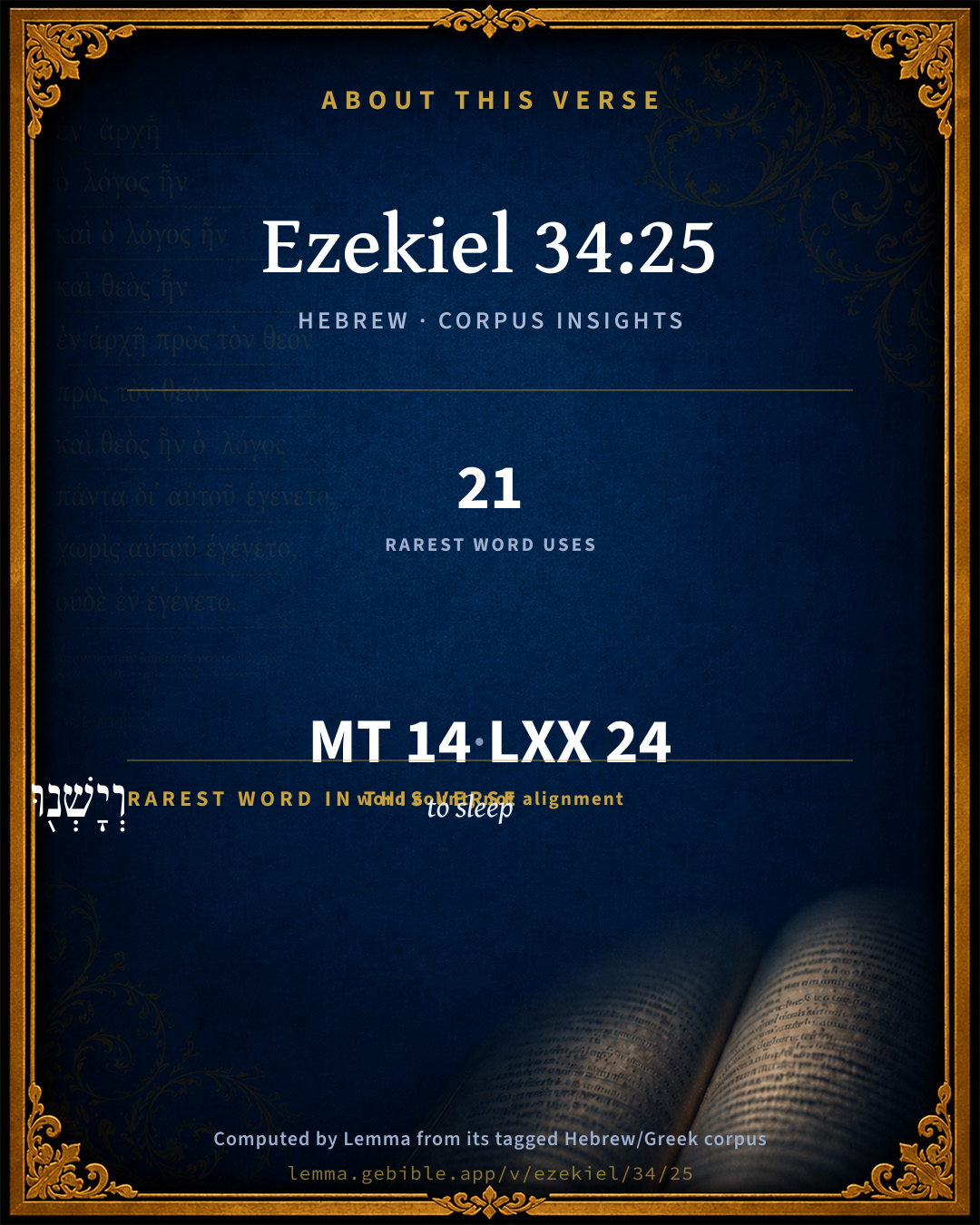
About this verse

These counts appear in no published source. They are computed here, from the morphology-tagged text and Lemma’s own curated glosses. What Lemma adds →

14
words
13
distinct lemmas
Prophets
section

Notable vocabulary

The rarest word here is וְיָשְׁנ֖וּ to sleep H3462 — appearing just 21 times in the whole Hebrew Bible.

Shared distinctive vocabulary

וְיָשְׁנ֖וּ to sleep H3462 occurs in 21 verses of the Hebrew Bible. Also found in:

Grammatical profile

  • 4 verbs
  • 7 nouns
  • 1 adjective
  • 2 prepositions

Verb forms

  • וְכָרַתִּ֤י Qal · Sequential Perfect
  • וְהִשְׁבַּתִּ֥י Hiphil · Sequential Perfect
  • וְיָשְׁב֤וּ Qal · Sequential Perfect
  • וְיָשְׁנ֖וּ Qal · Sequential Perfect

Hebrew & Septuagint length

In English translation the verse runs 33 words from the Hebrew and 33 from the Septuagint (LXX English) — the same length.

A rough comparison of the two English renderings, which tokenize alike — not a word-level alignment.

Word counts can differ between the Hebrew and the Greek without any difference in meaning — e.g. the Hebrew direct-object marker אֵת has no separate Greek word, and Greek often adds the article ὁ.

In the original languages it is 14 Hebrew tokens and 24 Greek tokens — but the two are counted differently (Hebrew bundles its prefixes and suffixes into one token; the Greek is in lemma form), so that isn’t a like-for-like length.

Cross-references

14

Topical passages linked to Ezekiel 34:25 in the Treasury of Scripture Knowledge — connected by theme and wording, ordered by reader-vote popularity; previews shown in the World English Bible.

  • Isaiah 11:6–9 The wolf shall dwell with the lamb, and the leopard shall lie down with the kid; and the calf and the young lion and the fattened calf together; and a little child shall lead them.
  • Ezekiel 37:26 Moreover I will make a covenant of peace with them; it shall be an everlasting covenant with them; and I will place them, and multiply them, and will set my sanctuary in the midst of them forevermore.
  • Leviticus 26:6 "'I will give peace in the land, and you shall lie down, and no one will make you afraid; and I will remove evil animals out of the land, neither shall the sword go through your land.
  • Psalms 4:8 In peace I will both lay myself down and sleep, For you, Yahweh alone, make me live in safety.
  • Isaiah 35:9 No lion shall be there, nor shall any ravenous animal go up thereon; they shall not be found there; but the redeemed shall walk [there]:
  • Jeremiah 23:6 In his days Judah shall be saved, and Israel shall dwell safely; and this is his name by which he shall be called: Yahweh our righteousness.
  • Jeremiah 33:16 In those days shall Judah be saved, and Jerusalem shall dwell safely; and this is [the name] by which she shall be called: Yahweh our righteousness.
  • Ezekiel 34:28 They shall no more be a prey to the nations, neither shall the animals of the earth devour them; but they shall dwell securely, and none shall make them afraid.
  • Job 5:22 At destruction and famine you shall laugh, Neither shall you be afraid of the animals of the earth.
  • Hosea 2:18–23 In that day I will make a covenant for them with the animals of the field, And with the birds of the sky, And with the creeping things of the ground. I will break the bow, the sword, and the battle out of the land, And will make them lie down safely.
  • Zechariah 6:13 even he shall build the temple of Yahweh; and he shall bear the glory, and shall sit and rule on his throne; and he shall be a priest on his throne; and the counsel of peace shall be between them both.
  • Hebrews 13:20 Now may the God of peace, who brought again from the dead the great shepherd of the sheep with the blood of an eternal covenant, our Lord Jesus,
  • Isaiah 55:3 Turn your ear, and come to me; hear, and your soul shall live: and I will make an everlasting covenant with you, even the sure mercies of David.
  • Jeremiah 31:31–33 Behold, the days come, says Yahweh, that I will make a new covenant with the house of Israel, and with the house of Judah:

Cross-references courtesy of OpenBible.info (CC BY 4.0).

Hebrew and Greek witnesses Masoretic Hebrew ↔ Greek Septuagint

The same verse in the two great witnesses to the Old Testament, shown verse-for-verse.

These are two independent witnesses, not word-aligned to each other, and the Septuagint is shown in lemma (dictionary) form.

Hebrew Ezekiel 34:25 Masoretic · Westminster Leningrad Codex

וְכָרַתִּ֤י לָהֶם֙ בְּרִ֣ית שָׁל֔וֹם וְהִשְׁבַּתִּ֥י חַיָּֽה רָעָ֖ה מִן הָאָ֑רֶץ וְיָשְׁב֤וּ בַמִּדְבָּר֙ לָבֶ֔טַח וְיָשְׁנ֖וּ בַּיְּעָרִֽים

I will make with them a covenant of peace, and will cause evil animals to cease out of the land; and they shall dwell securely in the wilderness, and sleep in the woods.

World English Bible · Public Domain

Greek LXX Ezekiel 34:25 Septuagint · lemma form

καί διατίθημι ὁ δαυίδ διαθήκη εἰρήνη καί ἀπο ἀναἵζω θηρίον πονηρός ἀπό ὁ γῆ καί καταοἰκέω ἐν ὁ ἔρημος καί ὑπνόω ἐν ὁ δρυμός

And I will make with David a covenant of peace and I will utterly destroy evil beasts from off the land; and they shall dwell in the wilderness, and sleep in the forests.

LXX2012 (modern English Septuagint) · Public Domain

Hebrew: Westminster Leningrad Codex (CC BY 4.0). Greek: Septuagint (public domain); English from LXX2012 (modern English Septuagint) (Public Domain). How the Septuagint differs from the Hebrew →

Targum (Aramaic paraphrase)

1

The Targum is the ancient Jewish Aramaic paraphrase of the Hebrew Scriptures — an interpretive translation, not the Hebrew text itself. Onkelos (literal) and Pseudo-Jonathan (expansive) render the Torah, and Jonathan the Prophets. Coverage is partial: where no permissively-licensed English translation exists for a verse, only the Aramaic is shown. This is verse-level text, not a word-by-word alignment to the Hebrew.

  1. Targum Jonathan Prophets (Joshua–Malachi)
    וְאֶגְזַר לְהוֹן קְיָם שְׁלָם וַאֲבַטֵל חַיְתָא בִּישְׁתָא מִן אַרְעָא וִיתִיבוּן בְּמַדְבְּרָא לְרוֹחֲצָן וְיִתְעַתְּקוּן בִּרְחוּשָׁא:

    (no public-domain English translation for this verse)

    Targum Jonathan — Aramaic: “Mikraot Gedolot” (public domain). English: “Sefaria Community Translation” (CC0 1.0 (public-domain dedication)); “London "Chaldee Paraphrase," 1871” (public domain). Text via Sefaria.

Commentary

Notes on Ezekiel 34:25 from classic Christian and Jewish commentators (each source and its license shown beneath its notes). The classic Christian expositions comment on the surrounding passage and are grouped to its opening verse, so a note may address several verses; the Jewish commentaries on the Tanakh (Rashi and others) are per-verse, so they appear only where the commentator wrote on this verse.

Lemma curates 59 commentaries, every one of them public domain or Creative Commons licensed, each selected and text-cleaned for this edition rather than reprinted as found. About our sources →

Trapp's Complete Commentary

John Trapp

Eze 34:25 And I will make with them a covenant of peace, and will cause the evil beasts to cease out of the land: and they shall dwell safely in the wilderness, and sleep in the woods.

Ver. 25. And I will make with them a covenant of peace.] Pactum pacis, pacis omnimodae {Jer 31:13 Isa 11:10 Joh 14:27}

And will cause the evil beasts.] That were wont to worry the flock. I will set them safe from Satan and his imps, his instruments, such as was Nero the lion, and bloody Bonner, the Pope’s slaughter slave here.

John Trapp, A Commentary or Exposition upon All the Books of the Old and New Testament (1647–1656) — public domain. Text from a community e-Sword module.

The Biblical Illustrator

Joseph S. Exell

Eze_34:25-26

I will make with them a covenant of peace.

Gods covenant with His people, and their assured safety in the wilderness

I. The Kings charter. Observe, the text does not say, We will make a covenant with one another, God and man; it says, I will make them a covenant; originating in the electing love of God.

II. The exercise of the royal prerogative--I will cause the evil beasts to cease out of the land. Satan cares not how many churches or chapels are built, provided the things of the Kings charter are never talked of. But, says Jehovah, I will cause the evil beasts to cease out of the land. Hells powers are vanquished. Who is He that said, He spoiled principalities and powers, and made a show of them openly? Who is He that is said to have destroyed death, and him that bad the power of death, that is, the devil, and thereby delivered them, who through fear of death were all their lifetime subject to bondage? Who is he of whom it was predicted, that He should bruise the serpents head? Even the second Person in the glorious Trinity, who in this covenant of peace became Himself the peace of the Church.

III. The position, which this Kings dominion occupies in His world in the wilderness. What is the wilderness? A place haunted by every description of evil beast; a place uncultivated, trackless, and dangerous. If you can picture to yourselves, for a moment, what that wilderness was to the tribes of Israel literally, you may draw the inference, and a very fair one, that just such the world through which we pass is to a believer spiritually. It is a wilderness; but God has a Church in it, and that is the mercy. Of Christ it is said, that He was with His Church in the wilderness. He had, then, His Church in the wilderness, His spiritual family; and so He has now,--a Church, a little flock, an encamped land, a chosen family, brought out of Egypt by miracles of grace, and travelling towards Canaan, the constant object of His love. Such is the portion of the Church--in the wilderness.

IV. The precious promise of tranquillity. Though the Church may occupy a position so frightful, so fearful, so alarming as that I have described, the text says, they shall dwell safely. What protection! And they shall sleep too; that is, they shall rest. Mark these two things

1. In these woods, solemn as they are,--and really they are more affecting than any language can describe,--they are encompassed with Deity--with all the attributes of Deity--encompassed with angelic guardians--encompassed, as we read in the Psalms, by the Angel of the Lord. Jesus encircles His Church with His own perfections and attributes. He guarantees her security in the wilderness; and this accounts for her dwelling safely.

2. Mark one thing more; they were to see the salvation of God. If you get a fair sight of it you will stand still. Faiths telescope will not bear much shaking about; and if you have a fair view of the salvation of God you will stand still. He works best when we do nothing; He displays His glory most when we most feel our need of it. He shines abroad, and even rides upon heaven for help when we cannot crawl on earth to ask for it. (J. Irons.)

Peace possible under all circumstances

If you have Christ in your heart, then life is possible, peace is possible, joy is possible, under all circumstances and in all places. Everything which the soul can desire it possesses. You will be like men that live in a beleaguered castle, and in the courtyard a sparkling spring, fed from some source high up in the mountains, and finding its way in there by underground channels which no besiegers can ever touch. (A. Maclaren.)

I will make them and the places round about My hill a blessing.

Gods gracious engagements with His Church

I. The description given of Gods Church. My hill.

1. The term denotes--

(1) Elevation. World is sunk, fallen, degraded. The Church is raised out of it, exalted, etc.

(2) Firmness and stability. Not an erection upon sand, endangered by every storm, etc., but upon the towering hill that has withstood the blasts of centuries.

(3) Visibility. It is a hill to be visible to all in every direction, its top pointing towards the skies.

(4) Healthfulness and purity. The mountain air pure, balmy, bracing the system, etc. Here souls are matured for the healthy regions of the celestial paradise.

2. But this is described as Gods hill.

(1) The Lord founded it.

(2) The place of His Divine residence.

(3) The scene of His glories (Psa_27:4).

(4) The object of His especial love.

II. The promises made to it. I will cause the shower to come down, etc.

1. The promise is general. Protection, provision, comfort, and prosperity, all included.

2. The promise includes abundance. Showers of blessings. Bounty of God infinite (2Ki_4:1; Mal_3:10).

3. The blessings are to be seasonable. Shower in his season. Not before necessary, not when it is too late; but at the crisis of need, etc. (Psa_107:1-43.)

4. The blessings are to promote a happy influence on all around. The Church is to spread the savour of grace through the whole earth.

Application--

1. Do we dwell in the Lords holy hill? (See Psa_15:1-5.)

2. Congratulate the children of Zion. Let them be joyful, etc.

3. Invite sinners all around to come and join themselves to the people of the Lord, etc. (J. Burns, D. D.)

The hill of Zion

I. An interesting place. The most interesting in the whole universe, and connected with the most pleasing, delightful, affecting associations. Consider wherein the Church resembles Mount Zion.

1. In point of elevation and grandeur. Believers are raised up together with Christ, and made to sit together with Him in heavenly places. They follow out sublime designs far above this world; and they are animated by lofty aspirations.

2. A mountain is an object of visibility and attraction. So is the Church; it stands not in a valley, but on a hill, visible, and calculated to excite attention. It is also an object of attraction. It occupies a conspicuous place, and millions have been attracted by it and drawn. It points upward to the skies.

3. A mountain is a place of strength and stability. So is the Church. It is not founded upon the sand. Century after century has passed away; empires have arisen and fallen in close succession; but this Hill of Zion remains in all its strength and glory.

II. An encouraging promise.

1. Its nature. A blessing. In this everything is included. It is not nominal, but real, solid, and substantial. The blessing God gives is suitable, sweet, sufficient, free, and lasting. It includes protection from evil, enjoyment of good, peace, prosperity.

2. Its abundance. Showers of blessings. This is like the Great Master. Ask as a sinner, He gives like God;--not a scanty portion, not drops, but showers (Deu_32:2; Psa_72:6; Mal_3:10; Rom_10:12). Think of the infinitude of God, and of the infinity of His love--and think of His power!--He is able to do exceedingly abundantly.

3. Its seasonableness. And I will cause the shower to come down in his season. We do not know the time when deliverance will come;--often out in our judgment of things, and imagine that all things are against us. Providence is like a piece of machinery, the wheels of which are to our view perplexing, and which we cannot understand.

4. Its extent. I will make them, etc. Oh! to be made a blessing! What an honour!--to be a blessing to the Church, to the cause of God, and to the generation in which we live. (E. Temple.)

The Church of Christ

I. Christs Church is to be a blessing. The object of God, in choosing a people before all worlds, was not only to save that people, but through them to confer essential benefits upon the whole human race. The Gospel was sent that it might first bless those that embrace it, and then expand, so as to make them a blessing to the whole human race.

1. Here is divinity. It is God the everlasting Jehovah speaking: He says, I will make them a blessing.

(1) God makes His people a blessing by helping them. What can we do without Gods help? We want Gods aid in every position; and once give us that assistance, and there is no telling with how little labour we may become a blessing.

(2) But there is constraint here. I will make them a blessing. I will give them to be a blessing; I will constrain them to be a blessing.

2. The personality of the blessing. I will make them a blessing. I will make each member of the Church a blessing. God never makes useless things; He has no superfluous workmanship. I care not what you are; you have somewhat to do. And oh! may God show you what it is, and then make you do it, by the wondrous compulsion of His providence and His grace.

3. The development of Gospel blessing. I will make them a blessing; but it does not end there. And the places round about My hill. Religion is an expansive thing. When it begins in the heart, at first it is like a tiny grain of mustard seed, but it gradually increases, and becomes a great tree, so that the birds of the air lodge in the branches thereof. A man cannot be religious to himself. What are the places round about our hill? I think they are, first, our agencies; secondly, our neighbourhood; thirdly, the churches adjacent to us.

II. Gods people are not only to be a blessing, but they are to be blessed.

1. Is it not sovereign, Divine mercy, for who can say I will give them showers except God?

2. It is needed grace. What would the ground do without showers? You may break the clods, you may sow your seeds, but what can you do without the rain! Ah! you may prepare your barn, and sharpen your sickles; but your sickles will be rusted before you have any wheat, unless there are showers. They are needed. So is the Divine blessing.

3. It is plenteous grace. It does not say, I will send them drops, but showers. It seldom rains, but it pours. So it is with grace. If God gives a blessing, He usually gives it in such a measure that there is not room enough to receive it.

4. It is seasonable grace. I will give them the shower in its season. There is nothing like seasonable grace. There are fruits, you know, that are best in their season, and they are not good at any other time; and there are graces that are good in their season, but we do not always require them. A person vexes and irritates me; I want grace just at that time to be patient. I have not got it, and I get angry; ten minutes after I am ever so patient; but I have not had grace in its season.

5. Here is a varied blessing. I will give thee showers of blessing. The word is in the plural. All kinds of blessings God will send. The rain is all of one kind when it comes; but grace is not all of one kind, or it does not produce the same effect. God sends showers of blessings. If He gives comforting grace, He will also give converting grace; if He makes the trumpet blow for the bankrupt sinner, He will also make it sound a shout of joy for the sinner that is pardoned and forgiven. (C. H. Spurgeon.)

There shall be showers of blessing.--

Showers of blessing

The word blessing belongs strictly to the vocabulary of religion. In prayer there is no petition which a Christian man so naturally offers for himself as that God should bless him, and when he is thinking affectionately of others, he naturally asks God to bless them. Even as he takes his daily bread, he invokes on it a blessing. What does it mean? Take the simplest case of all--that to which I have just alluded. Why, when we are about to partake of food, do we ask a blessing on it? It is an acknowledgment that, in addition to the natural property of food to sustain the bodily strength, there is needed a certain superintendence and favour of heaven to maintain the health of the body, and that Divine wisdom and strength are necessary to make a good use of health when we have it. In the same way when, in the morning, we ask God to bless the work of our hands during the day, as in Scripture He often promises to do to those who ask Him, it is an acknowledgment that, along with our skilful planning, and our conscientious performance, there is necessary a something else which we cannot define but which we refer to God, to give us good success. Men of the world call it good luck, but men of God and the Word of God call it Gods blessing. Even in temporal things there is a large element of unspeakable value for which there is no true and reverent name except the blessing of God. But it is in the spiritual domain that this word has its true scope. If in religion there is any reality at all, then it is the grandest of realities. It is not only an essence which can sweeten and enhance all the elements of life, but it is in itself so valuable that he who possesses it is rich though he be stripped of all the other possessions which are the accepted badges of happiness. It is the pearl of great price, which a man may well sell all he has to buy. It is the blessing of God, and we have only in silent and lowly awe to take it when it comes.

I. The copiousness of Gods blessing. There shall be showers of blessing. If the blessing of God is so essential to human welfare, it may be asked why so few are possessors of a thing so precious? It is not because it is difficult to get at. If the will and love of God could have free course there would be showers of blessing. The obstacle which hinders is in ourselves. Have you never, when enjoying any of the simple pleasures of nature, reflected with surprise on how little they are taken advantage of? There is not in nature a sublimer sight than the rising of the sun. There is no other which can suffuse the mind with deeper peace, yet multitudes live and die without ever seeing this great sight once; and the average man does not see it a score of times in a lifetime. The blessing of God is like this. It is so near, and yet it is so far on account of our negligence. What a peace, for example, is bred, and what a cool, firm grasp on life is given by the practice of spending a short time with God in prayer, and in the study of His Word, before beginning the work of the day. Yet how few cultivate this source of blessing. We are not straitened in God: we are straitened in our own hearts.

II. Its timeliness. I will cause the shower to come down in his season. This refers to the well-known fact that in Palestine rain fell only at certain seasons of the year. It was of the utmost consequence that at these seasons it should not fail. If it did not come, the drought meant loss or even ruin to the husbandman; but if it came copiously, it caused the fields to rejoice with abundant crops and made glad the heart of the husbandman. No doubt our text refers, in the first place, to this temporal blessing, but it has also a wider scope; blessing of every kind may be said to come in its season. God is not, indeed, bound to times and seasons, and sometimes His blessings come when they are least expected, resembling, in this respect, the sudden showers of rain to which we are accustomed in our own variable climate. But, as a rule, the blessing comes in the time of need, when the hearts of men are sighing and crying for it. Are you expecting a blessing today? Is your heart longing for it? Then this is a promise for you: I will cause the shower to come down in his season. You may be very near a great blessing which would change your spiritual existence from an invalid, backsliding condition into a life of joy, of power, and unfaltering progress. I once asked a friend why a mutual friend of ours, though a man of many accomplishments, did not succeed in the pulpit. Well, said he, giving a slight crack of finger and thumb, he just wants that. Yes, that was exactly it. It is this something extra, this little more, that makes everything exceptional and excellent. And many of us are just needing this to make us holy, happy, creditable Christians. Why should you not be baptized with power?

III. The diffusiveness of Gods blessing. I will make them and the places round about My hill a blessing. The happiness of some people is rather to be pitied than envied, because they are made happy by such questionable things. But blessedness is derived from a pure as well as an inexhaustible source. Yet this is not the best result of the blessing of God--that those on whom it falls are themselves blessed. It is a far nobler thing which is promised in our text, I will make them a blessing--they shall be the means of making others blessed. From of old this has been the noble prerogative of the people of God. In Christianity this element has come to the very front. What is it to be a Christian? Is it to be blessed? is it to be filled with the peace, the joy, the life, the power of God? No, it is to be so filled with these that the vessel runs over, and all that are round about get the benefit. This is a text to try our Christianity by. Has the sound of the Gospel not only reached us, but sounded out from us, as a testimony which has arrested and awakened others? It is a severe test. But some can stand it. There are Christian souls which move through the world surrounded with a halo of blessing. There are Christian homes which radiate happiness. There are Christian congregations which you cannot enter without feeling that the power of God is there, and streams of blessing flow out from them over the city, the country, and the world. (J. Stalker, D. D.)

Showers of blessing

I. This communication is needed by the world.

1. Contemplate the vast portion of the world, which is still destitute of the presence and the power of true religion.

2. Contemplate the tardiness with which true religion is now advancing among men.

II. This communication is promised by God.

1. The promise of God defines the nature of this communication. It consists in the influences of the Holy Spirit, made to affect the hearts and the consciences of men by the truth, which the Gospel embodies and displays.

2. The promise of God has also defined its extent. There are to be showers--impartations commensurate with the existing need, and designed absolutely and entirely to extinguish and terminate that need.

3. The purpose of God has also defined its results. There shall be showers of blessing.

III. This communication, which is needed by the world, and which is promised by God, must be sought by the Church.

1. The Church must seek for this communication by the removal of worldly confortuity.

2. The Church must seek for this communication by the cultivation of union and fraternal love.

3. The Church must seek this communication by the employment of vigorous and zealous exertions, in the practical distribution of the truth, which has been affirmed to be the instrument, through which the Spirit of God is to descend in blessing upon the world.

4. The Church must seek for this communication by the offering of fervent and importunate prayer. (J. Parsons, M. A.)

Showers of blessing,

This blessed promise may be claimed by--

I. The believer.

1. In the joy of the morning. Songs in the night, but blessings for the morning. A blessing is added strength.

2. In the heat of the noonday. As a reminder of Providence, and a remembrancer of the God who promised that the sun shall not smite thee by day, these cooling showers shall come.

3. In the weary evening. Do doubts assail, do fears annoy? Do sorrows gather, do tempests rise? There shall be showers of blessing, and dewy eve will be a time of surcease from grief and labour, turmoil and care, and He will give His beloved sleep.

4. In the desolate night. After all friends have gone, after even friendly twilight has withdrawn herself, in that dark and lonely hour, they shall fall upon him to season his meditations or perchance to lull to repose his wearied and inflamed orbs.

5. Ever, there shall be showers of blessing for the believer.

II. The backslider.

1. In the hour of thoughtfulness. When he considers his relations to God, and how strained they are.

2. In the hour of remembrance. The blessed Remembrancer, the good Spirit of Truth, will bring forsaken joys, discarded delights, and vanished experiences to his memory.

3. In the hour of penitence. Is it not recorded that God resisteth the proud but giveth grace to the humble? and humility is twin sister to penitence.

4. In the hour of return. When the prodigal son returned, the tears which bedewed the cheeks of reconciled father and repentant son were indeed showers of blessing.

III. The sinner. Blessed showers will come when--

1. He feels his need.

2. Loathes himself.

3. Cries to God.

4. Trusts in the Saviour. (J. B. Esenwein.)

Showers of blessing

I. All temporal and spiritual blessings, like showers, descend from above.

1. Showers am abundant. The great Creator does not give the rain stingily, but opens the windows of heaven, and pears down His blessings upon the dry and thirsty land. So spiritual blessings come upon the thirsty and longing hearts of men.

2. Showers are repeated and continued; for season after season descend the early and the latter rain, and by repeated showers the earth brings forth and buds, and gives seed to the sower and bread to the eater. So in the history of the Church, and of every individual believing soul, there has been given grace for grace, that there might be progress from strength to strength in the journey Zionward.

3. Showers are gratuitous; they come down freely from the clouds, without money and without price. We could not purchase them, for the silver and the gold belong to God, as well as the cattle upon a thousand hills. So all spiritual blessings are free; indeed, they are priceless, as well as peerless.

4. Showers are suitable; as they fall upon the earth they make it soft, and drop fatness into the soil, and become the occasion of beauty and bountifulness. So the blessings that crown our lives are suitable to our needs and adapted to minister to our well-being and joy. Especially is this true of spiritual blessings.

5. Showers are gentle. How softly, as a rule, they fall, feeding the roots of the mightiest trees, and yet not wounding the leaves or blossoms of the tiniest flowers. How gently our temporal blessings come to us, how softly the light streams over the earth to gladden our eyes, and how gently the tide of health flows into our system, to make us strong and fit for our ever-recurring toils of life. And the blessings that refresh our spirits and revive our faith, they fall gently upon us while we pray and praise, and nestle upon our hearts while we engage in Christian work and worship.

II. Temporal and spiritual blessings, like showers, require the cooperation of man; or the design with which they descend from above will be frustrated. We must cooperate with Providence in the temporal blessings sent us, or they will not answer the end designed. The human and the Divine must work hand in hand. This is equally true of the Church and of individual souls. God sends down showers of blessing, but there must be preparation for them and cooperation with them; then the wilderness and solitary place shall be glad, and the desert shall rejoice and blossom as the rose. Showers come when the land is thirsty, and when the vapours from the earth have ascended and formed themselves into thick clouds; and showers of blessing will come upon us when our hearts are thirsty, and cry out for the living God; when our prayer-like clouds of incense have ascended to Heaven for the downcoming of the Holy Ghost. (F. W. Brown.)

Showers of blessing

1. Here is sovereign mercy--I will give them the shower in its season.

2. Is it not sovereign, Divine mercy?--for who can say, I will give them showers, except God? There is only one voice which can speak to the clouds, and bid them beget the rain. Who sendeth down the rain upon the earth? Do not I, the Lord? So, grace is the gift of God, and is not to be created by man.

3. It is also needed grace. What would the ground do without showers? You may break the clods, you may sow your seeds, but what can you do without the rain? As absolutely needful is the Divine blessing. In vain you labour, until God the plenteous shower bestows, and sends salvation down.

4. Then it is plenteous grace. There shall be showers. It does not say, I will send them drops, but showers. So it is with grace. If God gives a blessing, He usually gives it in such a measure that there is not room enough to receive it. Plenteous grace! Ah! we want plenteous grace to keep us humble, to make us prayerful, to make us holy; plenteous grace to make us zealous, to preserve us through this fife, and at last to land us in heaven. We cannot do without saturating showers of grace.

5. Again, it is seasonable grace. I will cause the shower to come down in his season. What is thy season this morning? Is it the season of drought? Then that is the season for showers. Is it a season of great heaviness and black clouds? Then that is the season for showers. As thy days, so shall thy strength be.

6. And here is a varied blessing. I will give thee showers of blessing. The word is in the plural. All kinds of blessings God will send. All Gods blessings go together, like links in a golden chain. If He gives converting grace, He will also give comforting grace. He will send showers of blessing. Look up today, O parched plant, and open thy leaves and flowers for a heavenly watering! (C. H. Spurgeon.)

Showers of blessing sent from God

I. The blessings bestowed on the peculiar people of God are blessings of unspeakable value.

1. Their origin, and the glory and the grace of their author (Jam_1:17; Eph_1:3).

2. The price paid for their purchase (1Pe_1:18-19; 2Co_8:9).

3. Our indispensable need of them (Rev_3:17).

4. The peculiar and transcendent happiness which the possession of them ensures (Rev_3:18; Psa_4:7; Php_4:7; 1Co_2:9).

II. The precious blessings bestowed on the people of God are incalculably numerous.

1. Can you calculate the number of showers that fall to refresh, to fructify, and to bless the earth, in the course of the revolving seasons? nay, I will ask further, can you calculate the number of drops of which each shower is composed? Then may you calculate the number of blessings bestowed on the people of God.

2. Can you tell how numerous, or, rather, innumerable, the wants of Gods people are?

III. The blessings peculiar to Gods people are all most opportunely bestowed. I will cause the shower to come down in his season. To the young, to the middle-aged, and to the old, they come just as their various and peculiar circumstances render necessary. To the poor, to the afflicted, to the tempted, and to the dying, how seasonable are the supplies of all those blessings especially requisite for them! The promise in each individual case is fully and happily realised (Deu_33:25).

IV. The blessings bestowed on Gods people are all the result of Divine agency.

1. Who but the blessed God could have devised that wondrous plan of grace, by which the blessings of the everlasting covenant are secured to His people? (Rom_3:24-26; Rom_11:33.)

2. Who but a Divine person could have paid the price by which these blessings have been purchased? (Rom_8:3; Rom_8:34; Joh_1:1, compared with verse 14.)

3. The actual application of these blessings, too, is all of God (Php_2:13). Who gives the new heart? (Eze_36:26.) Who gives pardon? (Isa_43:25.) Who sanctifies them? (Exo_31:13; 1Th_5:23.) Who completes the work of their redemption? (Php_1:6; Rev_3:21.)

Application--

1. It is no presumption to expect great and manifold blessings from the great and manifold grace of God (Rev_3:21).

2. What a happy people must the people of God be! (Deu_33:29.)

3. To God alone we should ascribe the glory and praise of all our blessings (Psa_115:1).

4. We should be encouraged, from the receipt of common mercies, to expect special blessings from God.

5. The wickedest of men may yet be blessed of God (Isa_55:1-3). (A. Thomson, D. D.)

Conditions necessary for showers

An Irish gentleman remarked in my hearing that he had always noticed that when it rained there were clouds about, and so all the air was in right order for the descent of rain. We have noticed the same, and it so happens that the clouds and general constitution of the atmosphere have much to do with the value of moisture for the herbs. It is no good watering them in the sun, the circumstances do not benefit them. So with revivals. Certain things done under certain circumstances become abundantly useful, but if you have not similar circumstances, you may use the same machinery, but mischief instead of good will follow. Begin yourself with the Master, and then go outward to His service, but plans of action must be secondary. (C. H. Spurgeon.)

The Biblical Illustrator, edited by Joseph S. Exell (c. 1880s–1900s) — public domain. Text from a community e-Sword module.

Tyndale Open Study Notes

Tyndale Open Resources

34:25-26 God planned to provide his people with a new and better ruler and to make a covenant of peace with them. Their present experience of dangerous animals, drought, famine, and sword was the outworking of the curses of the covenant made at Sinai (see Lev 26:14-35). From now on, they would camp safely, experiencing the blessings of that covenant; God would send the showers they needed for fruitfulness and peace (see Lev 26:4-13).

Tyndale Open Study Notes — © Tyndale Open Resources, licensed CC BY-SA 4.0. Text via the HelloAO Bible API.

Geneva Bible (1599)

Geneva Bible translators

This declareth that under Christ the flock should be truly delivered from sin, and hell, and so be safely preserved in the Church, where they should never perish.

Geneva Bible (1599) marginal notes — public domain. Text via Bolls.life.

Jamieson, Fausset & Brown

Robert Jamieson, A. R. Fausset & David Brown

covenant of peace . . . evil beasts . . . to cease . . . dwell safely--The original promise of the law (Lev 26:6) shall be realized for the first time fully under Messiah (Isa 11:6-9; Isa 35:9; Hos 2:18).

Jamieson, Fausset & Brown — Commentary Critical and Explanatory on the Whole Bible (1871) — public domain (CC PDM 1.0). Text via the HelloAO Bible API.

Adam Clarke's Commentary

Verse 25. I will make with them a covenant of peace] The original is emphatic: וכרתי להם ברית שלום vecharatti lahem berith shalom, "And I will cut with them the peace covenant;" that is, a covenant sacrifice, procuring and establishing peace between God and man, and between man and his fellows. I need not tell the reader that the cutting refers to the ancient mode of making covenants. The blood was poured out; the animal was divided from mouth to tail, exactly in two; the divisions placed opposite to each other; the contracting parties entered into the space, going in at each end, and met in the middle, and there took the covenant oath. He is the Prince of peace, and through him come glory to God in the highest, and peace and good will to men upon earth.

And will cause the evil beasts to cease] These false and ravenous pastors. Christ purges them out of his Church, and destroys that power by which they lorded it over God's heritage.

Adam Clarke's Commentary on the Bible (1810–1826) — public domain. Text from a community e-Sword/MySword module.

The Cambridge Bible for Schools and Colleges

gen. ed. J. J. S. Perowne

25. a covenant of peace] a covenant securing everlasting peace and therefore implying the removal of all that would injure or disturb them. In Hos_2:20 the sense is somewhat different: Jehovah makes a covenant for them with the beasts of the field, that they shall not hurt. In Hos. “beasts” is used literally (cf. Isa_11:6), here figuratively, meaning foes, heathen assailants, though the figure of the flock is still maintained (Lev_26:6). The “wilderness” is the uncultivated pasture land as distinguished from that under tillage, covered with crops or fruit-trees (Carmel). Even in the “woods,” the parts covered with bush, the haunts of wild beasts, the flock shall sleep safely.

The Cambridge Bible for Schools and Colleges (gen. ed. J. J. S. Perowne; Cambridge University Press, 1878–1918) — public domain. Text from a community e-Sword module.

John Gill's Exposition

And I will make them, and the places round about my hill, a blessing,.... Alluding either to the city of Jerusalem, and the places adjacent; or to the temple, and the houses about it. So the Targum,

"I will cause them to dwell round about the house of my sanctuary;''

and so Kimchi interprets it of the temple. Some Christian interpreters, by the "hill" or mountain, understand Christ; and not amiss; who may be compared to one for height; he being higher than the kings of the earth, or than the heavens and angels there, as man and Mediator; as well as is God over all, blessed for ever; and for fruitfulness, from whom the saints have all theirs, either in grace or good works; and for shade, he being the shadow of a great rock in a weary land; which yields delight and refreshment, and is a protection from the heat of a fiery law, flaming justice, the wrath of God and man, and the fiery darts of Satan; and for shelter and security, there being salvation in him, when none in other hills and mountains; and for duration and immovableness, being the same today, yesterday, and for ever: and now the persons about him are such who are made nigh by his blood; brought to him by his powerful and efficacious grace; are worshippers about the throne where he sits; such as cleave to him, and follow him wherever he goes, and shall be with him to all eternity; these he makes a blessing, or most blessed. So the Targum renders it,

"and they shall be blessed;''

they are blessed in Christ their head; they are blessed through him as their Redeemer and Saviour, who was made a curse for them; they are blessed through being in him, and by the imputation of blessings to them from him, and through the application of them by his Spirit; their persons are blessed, and so are the places or habitations where they dwell: or rather this may be understood of the church of God, often compared to a hill for its height and eminence; for its fertility and fruitfulness; for its stability and firmness; and in allusion to the hill of Zion for its holiness, and being the place of the divine residence; see Psa 15:1 now, the persons about this hill are those who are come to Mount Zion the church of God; being brought there by the Lord himself, and who take up their abode there; who lie about this hill, as flocks of sheep, in their several folds or congregated churches; see Jer 23:3 and these the Lord makes a blessing to one another, by their spiritual conversation, prayers, and services of love; and to the world, to kingdoms and states, to cities, towns, and neighbourhoods, and to particular families, where they are placed; and even to the world in general; for they are the light, stay, and stability of it; and without which it would be in darkness, corrupt and putrefy, and not continue long:

and I will cause the shower to come down in his season; which, in the spiritual sense, may design the Gospel; which, like a shower of rain, comes from God; descends from heaven; is a gift of God; which falls according to divine direction; refreshes, revives, and makes fruitful; brings a plenty of divine blessings with it; and comes in season, at its proper time; and is a word in season to weary souls:

there shall be showers of blessings; which the Gospel brings with it; spiritual blessings, blessings of grace; such as peace, pardon, righteousness, and eternal life: these, like showers, come from God; are free grace gifts of his, of which there is a large abundance; and which descend on Mount Zion the church of God; which is another Gerizim, on which the blessings are pronounced, Psa 133:3.

John Gill's Exposition of the Whole Bible (1746–1763) — public domain (CC PDM 1.0). Text via the HelloAO Bible API.

Haydock's Catholic Bible Commentary

Peace. Christ pacifies all, Romans xv. 33., Micheas v. 5., and Ephesians vi. 15. --- Beasts: those who promote idolatry; or, speaking of Christians, who teach heretical doctrine and persecute the Church. (Calmet)

George Leo Haydock (1774–1849), Haydock's Catholic Family Bible and Commentary, 1859 edition — public domain. Excludes Psalms (Douay-Rheims chapter numbering differs from Protestant) and Deuterocanonical books (Catholic canon only).

Matthew Poole's English Annotations

Will make; renew and confirm to them.

A covenant of peace; a covenant of promises, which contain and shall bring peace; in the Hebrew dialect,

all good. This, as it refers to the state of this people after their return, comprehends that outward peace and prosperity that God gave them, but it hath a higher and more excellent import, better mercies of this covenant established on better promises, i.e. best, because spiritual and eternal.

Evil beasts: during the Babylonish captivity evil beasts had exceedingly increased, through seventy years’ desolation in Judea, but on the replanting and increasing of men these were diminished, and destroyed at last; thus literally. But mystically, under the bondage of Satan, worse beasts destroyed men; these Christ, who turns back that captivity, will destroy.

Safely; without danger and without fear: see Eze 28:26.

In the wilderness; in which both wild and hurtful beasts, and wilder, more hurtful robbers, did haunt. There is somewhat of an hyperbole here; after the temporal redemption from Babylon, they should have such safety as they should account very great after such long and great troubles; in the spiritual redemption they should have greater safety, when, delivered from the hand of enemies, they serve God in holiness before him all their days.

In the woods, places where venomous and devouring creatures usually lurk, yet there shall ye venture confidently to sleep, and without much danger.

Matthew Poole's English Annotations on the Holy Bible (1683–1685) — public domain. Text from a community e-Sword/MySword module.

The Pulpit Commentary

I will make with them a servant of peace. The whole verse is an echo of Lev_26:6, in part also of Hos_2:20 English version, ver. 18. The words are less definite as to the nature of the covenant than those of Jer_31:31, but probably the same thought underlies both. Sins are pardoned, the capacity for righteousness, righteousness itself, are given. In bright contrast with the picture of a country haunted by the lion, the jackal, and the wolf the "evil beasts" of Eze_14:15 so that no man could pass through without risk, we have that of a land from which such evil boasts have been cleared out, so that men may sleep safely even in the wilderness and the woods. The language, however, is figurative rather than literal. As the "sheep" are the people of the true Israel, so the evil beasts must, at least, include the enemies, Chaldeans, Edomites, Philistines, and others, that had before made havoc of them.

A covenant of peace.

I THE MAKING OF THE COVENANT. A covenant is an agreement between two parties. But in the case of covenants between God and man this agreement is not arrived at after the fashion of human bargaining, in which the two who are concerned meet on equal terms. The covenant is made by God and offered to man, by whom it has to be accepted in order that it may take effect. "We meet with several successive covenants with Adam, with Noah, with Abraham, with Israel in the Law. Jeremiah promises a new covenant. (Jer_31:31) A similar idea is here presented by Ezekiel. The old arrangement has broken down. For a time, the people of God are outlawed exiles, cut off from their ancient privileges, with little hope for the future. Now they are assured that God will not forsake them. It is impossible to renew the old covenant; but a new one shall be granted. God now approaches us in the gospel with that new covenant which Christ said was given in his blood. (Luk_22:20) It was given to the world in the work of Christ. But it is ratified afresh with every soul that accepts its conditions viz., repentance and faith in the Lord Jesus Christ. (Act_3:19, Act_3:26) All who thus enter into it enjoy the privileges of God"s covenant mercies mercies promised and assured to God"s people.

II THE CHARACTER OF THE COVENANT. It is essentially a covenant of peace. Every covenant is intended to be of this character. It is to prevent misunderstandings, to define mutual relations, to harmonize reciprocal actions. It is, in fact, a sort of treaty; and treaties, as long as they are observed, are instruments of peace. But the new covenant is emphatically and in a very special manner one of peace.

1. It endorses the restoration of peace between God and man. Sin is a breach of the peace, pardon is the making of peace. The restored Jews were brought into relations of peace with God. Christ reconciles us to God.

2. It signalizes the establishment of peace between man and his fallow-man. Christ is our peace in regard to mutual human relations. He breaks down "the middle wall of partition" between Jew and Gentile. (Eph_2:14) He brings peace on earth. (Luk_2:14)

3. It is the outward evidence of internal peace. Christ gives peace to the soul. The covenant assures his people that this peace is sound and solid. (Joh_14:27)

III THE FRUITS OF THE COVENANT. The evil beasts are to depart and the people are to dwell safely in the open pastures and even sleep in the woods without danger. The departure of man is followed by an incursion of wild beasts. Lions came into the land when it was much depopulated by the Captivity. Then it would only be safe for people to live in close communities. At the present day we never see in Palestine those scattered farmhouses and cottages that give so much picturesqueness to rural England. The people all live in villages or towns. That must be a very safe condition of the country which would admit the manner of living described in our text. A similar condition spiritually is brought about under the new covenant of Christ. The wild beasts of haunting sins and prowling temptations are driven away. It is possible to enjoy a sense of freedom and security when under the protection of Christ. To plant one"s homestead in the midst of the pasturage, to be able to sleep out in the woods in the summer-time when at work far from home, would mean much comfort and happiness in a safe and settled community. Such a condition is typical of the citizen of the kingdom of heaven, and though certainly it is not yet fully enjoyed, it will be when the reign of Christ is perfectly established.

The Pulpit Commentary (1880–1919), ed. H.D.M. Spence-Jones & Joseph S. Exell — public domain. Text from a community e-Sword module.

John Wesley's Explanatory Notes

A covenant - A covenant of promises, which contain, and shall bring peace, that is all good.

John Wesley, Explanatory Notes Upon the Whole Bible (1754–1765) — public domain. Text via the GEBible commentary corpus.

unfoldingWord translationNotes

Door43 World Missions Community

General Information:

Yahweh continues giving Ezekiel his message to the people of Israel.

General Information:

Yahweh continues speaking of the people of Israel as if they were a flock of sheep. (See: Metaphor)

a covenant of peace

"a covenant that brings peace"

the evil wild animals

These are wild animals that could kill the sheep and the goats.

I will also bring blessings on them and on the places around my hill

Some versions of the Bible translate this as "I will also turn them and the places around my hill into a blessing."

my hill

This refers to Mount Zion. (See: Assumed Knowledge and Implicit Information)

I will send out showers

"I will cause it to rain"

in due season

"at the right time"

These will be showers of blessing

"This rain will be a blessing"

the earth will yield its produce

"the earth will grow food" or "food will grow on the earth"

will be secure

"will be safe"

know that I am Yahweh

When Yahweh says that people will know that he is Yahweh, he is implying that they will know that he is the one true God who has supreme authority and power. See how you translated this in Ezekiel 6:7. AT: "understand that I am Yahweh, the one true God" or "realize that I, Yahweh, have supreme power and authority" (See: Assumed Knowledge and Implicit Information)

when I break the bars of their yoke

Slavery is spoken of as if it were a yoke that people wear like some animals. AT: "when I free them from being slaves" (See: Metaphor)

from the hand of those who enslaved them

Here "hand" represents power or control. AT: "from the control of those who made them slaves" or "from those who made them slaves" (See: Metonymy)

translationWords

covenant

peace

evil

desert

bless

send

know

yoke

hand

enslave

unfoldingWord translationNotes — © Distant Shores Media and the Door43 World Missions Community, licensed CC BY-SA 4.0. Source: git.door43.org/Door43/en_tn.

Rashi

Rabbi Shlomo Yitzchaki (Rashi)

and grow old in the forests [Heb. וְיָשְּׁנוּ.] Jonathan renders: and they will age [from יָשָׁן] in the forest. It may also be interpreted as an expression of sleep (שִּׁינָה).

Rashi on the Tanakh — English translations: “The Judaica Press complete Tanach with Rashi, translated by A. J. Rosenberg” (CC BY 4.0); “Pentateuch with Rashi's commentary by M. Rosenbaum and A.M. Silbermann, 1929-1934” (public domain); “The Metsudah Tanach series, Lakewood, N.J” (CC BY 4.0); and “The Book of Joshua, Metsudah Publications, 1997” (CC BY 4.0). Text via Sefaria.

Lesson kit

Teaching starters — assembled from the data on this page, not authored interpretation. Every prompt links to the verse data it draws on. Edit before teaching.

Ezekiel, in the Prophets, opens this verse with 14 words (13 distinct Hebrew lemmas). Its most distinctive word is yâshên (“to sleep”). A historical commentator’s framing appears above. Read the whole chapter for the surrounding context.

Discussion questions

  1. The word yâshên carries the sense “to sleep.” How does it shape the verse?
  2. How does Genesis 2:21, which shares the word «to sleep», read alongside this verse?
  3. The translations on this page render this verse differently — a whole-verse word diff, not a word-by-word alignment. What might account for the different wordings?
  4. «וְכָרַתִּ֤י» is a Qal Sequential Perfect verb. How does that grammatical form shape the action described?
  5. Compare how Trapp's Complete Commentary and The Biblical Illustrator read this verse. Where do they agree or differ?

Things to notice

Reading settings

Reading text

Shown beneath each verse's original-language words.

Old Testament
Old Testament edition

Read the OT as the Masoretic Hebrew (MT) or the Greek Septuagint (LXX).

English shown for the Greek Septuagint (in the Hebrew ↔ Greek comparison).

Comparing translations? Open the Compare panel on any verse page to stack up to four side by side.