
1 Samuel 31:9

Hebrew (Westminster Leningrad Codex) 1 Samuel 31:9 appears in the Hebrew Old Testament. The text above is from the Westminster Leningrad Codex. Each word links to its Strong’s number, a concise gloss, and parsing drawn from the Open Scriptures Hebrew Bible morphology. Click any word for its full Brown-Driver-Briggs (BDB) entry.
Download image
Cite this verse

1 Samuel 31:9 (World English Bible). Public Domain. Lemma interlinear Bible study tool, https://lemma.gebible.app/v/1-samuel/31/9.

Show BibTeX & RIS
BibTeX
RIS
English Translation
They cut off his head, and stripped off his armor, and sent into the land of the Philistines round about, to carry the news to the house of their idols, and to the people.
World English Bible · Public Domain
Highlights
  • 1 first appearance in the Hebrew Bible
Full analysis ↓
Download a study sheet

One document with this verse’s original text, its word-by-word gloss line, the meaning frame, cross-references with their text, attributed commentary, and full source and license credits — printable, and it pastes into notes with its structure intact.

This verse Autodidact and up

Study sheet (.html) Plain text (.txt)

A passage Seminary Student

Up to 50 verses in one chapter. A passage sheet keeps up to 6 commentary sources and 12 cross-references per verse, in the order this page ranks them, and says so on the sheet whenever that leaves anything out. Ask for a single verse and you get the Autodidact verse sheet above.

Everything on this page stays free to read, with no account — the sheet is a download of what is already on screen, not access to it.

Want to remove ads? Support Godless Engineer
Compare translations 3

The same verse in 3 English versions, stacked beneath the original-language interlinear above. Click any original word for its lexicon entry.

Each is an independent rendering of the whole verse — the interlinear is not word-aligned to these translations.

Highlighted words mark where these versions differ — a whole-verse word diff, not a word-by-word alignment.

  • World English Bible Public Domain
    They cut off his head, and stripped off his armor, and sent into the land of the Philistines round about, to carry the news to the house of their idols, and to the people.
  • King James Version Public Domain
    And they cut off his head, and stripped off his armor, and sent into the land of the Philistines round about, to publish it in the house of their idols, and among the people.
  • unfoldingWord Literal Text CC BY-SA 4.0
    And they cut off his head and stripped off his equipment. And they sent into the land of the Philistines all around to announce the house of their idols and the people.

unfoldingWord Literal Text — © unfoldingWord, licensed CC BY-SA 4.0. Word-aligned USFM3 via Door43 (git.door43.org/unfoldingWord/en_ult).

Versions to compare (up to 4)

3 of 4 selected

Show all 18 translations

Every available English version of this verse, each an independent rendering of the whole verse.

  • World English Bible Public Domain
    They cut off his head, and stripped off his armor, and sent into the land of the Philistines round about, to carry the news to the house of their idols, and to the people.
  • Berean Standard Bible Public Domain
    They cut off Saul’s head, stripped off his armor, and sent messengers throughout the land of the Philistines to proclaim the news in the temples of their idols and among their people.
  • Majority Standard Bible Public Domain
    They cut off Saul’s head, stripped off his armor, and sent messengers throughout the land of the Philistines to proclaim the news in the temples of their idols and among their people.
  • King James Version Public Domain
    And they cut off his head, and stripped off his armor, and sent into the land of the Philistines round about, to publish it in the house of their idols, and among the people.
  • American Standard Version (1901) Public Domain
    And they cut off his head, and stripped off his armor, and sent into the land of the Philistines round about, to carry the tidings unto the house of their idols, and to the people.
  • Revised Version (1885) Public Domain
    And they cut off his head, and stripped off his armour, and sent into the land of the Philistines round about, to carry the tidings unto the house of their idols, and to the people.
  • Geneva Bible (1599) Public Domain
    And they cut off his head, and stripped him out of his armour, and sent into the land of ye Philistims on euery side, that they should publish it in the temple of their idoles, and among the people.
  • Douay-Rheims (1899) Public Domain
    And they cut off Saul's head, and stripped him of his armour, and sent into the land of the Philistines round about, to publish it in the temples of their idols, and among their people.
  • Young's Literal Translation Public Domain
    and they cut off his head, and strip off his weapons, and send into the land of the Philistines round about, to proclaim tidings `in' the house of their idols, and `among' the people;
  • Literal Standard Version CC BY-SA 4.0
    and they cut off his head, and strip off his weapons, and send [them] into the land of the surrounding Philistines, to proclaim tidings [in] the house of their idols, and [among] the people;
  • Unlocked Literal Bible CC BY-SA 4.0
    They cut off his head and stripped off his armor, and sent messengers into the land of the Philistines throughout to carry the news to their idols' temples and to the people.
  • unfoldingWord Literal Text CC BY-SA 4.0
    And they cut off his head and stripped off his equipment. And they sent into the land of the Philistines all around to announce the house of their idols and the people.
  • Darby Bible Public Domain
    And they cut off his head, and stripped off his armour, and sent [them] into the land of the Philistines round about, to announce the glad tidings in the houses of their idols, and to the people.
  • World Messianic Bible Public Domain
    They cut off his head, stripped off his armor, and sent into the land of the Philistines all around, to carry the news to the house of their idols and to the people.
  • Webster's Bible Public Domain
    And they cut off his head, and stripped off his armor, and sent into the land of the Philistines round about, to publish it in the house of their idols, and among the people.
  • Free Bible Version CC BY-SA 4.0
    They cut off Saul's head, stripped him of his armor, and sent messengers throughout the country of the Philistines to announce the news in the temples of their idols and to their people.
  • Bible in Basic English Public Domain
    And cutting off his head and taking away his war-dress, they sent word into the land of the Philistines round about, to take the news to their gods and to the people.
  • JPS Tanakh (1917) Public Domain
    And they cut off his head, and stripped off his armour, and sent into the land of the Philistines round about, to carry the tidings unto the house of their idols, and to the people.

Literal Standard Version (2020), Covenant Press — licensed CC BY-SA 4.0. Text via the HelloAO Bible API (eBible.org). Unlocked Literal Bible (unfoldingWord) — licensed CC BY-SA 4.0. Text via the HelloAO Bible API (eBible.org). unfoldingWord Literal Text — © unfoldingWord, licensed CC BY-SA 4.0. Word-aligned USFM3 via Door43 (git.door43.org/unfoldingWord/en_ult). Free Bible Version, Dr. Jonathan Gallagher — licensed CC BY-SA 4.0. Text via the HelloAO Bible API (eBible.org).

Word by word

More ways to search: Search by grammar → Find every occurrence → Compare this word →

Practice this passage: Drill this verse → Learn its vocabulary →

עֲצַבֵּיהֶ֖ם
ʻâtsâb
H6091
“idols · their”
Noun, Common, Masculine, Plural, Construct + Suffix, Personal, 3rd Person, Masculine, Plural
Part of Speech
Noun
Type
Common
Gender
Masculine
Number
Plural
State
Construct
Full BDB Definition

Origin: from H6087

TWOT: 1667c

idol, image
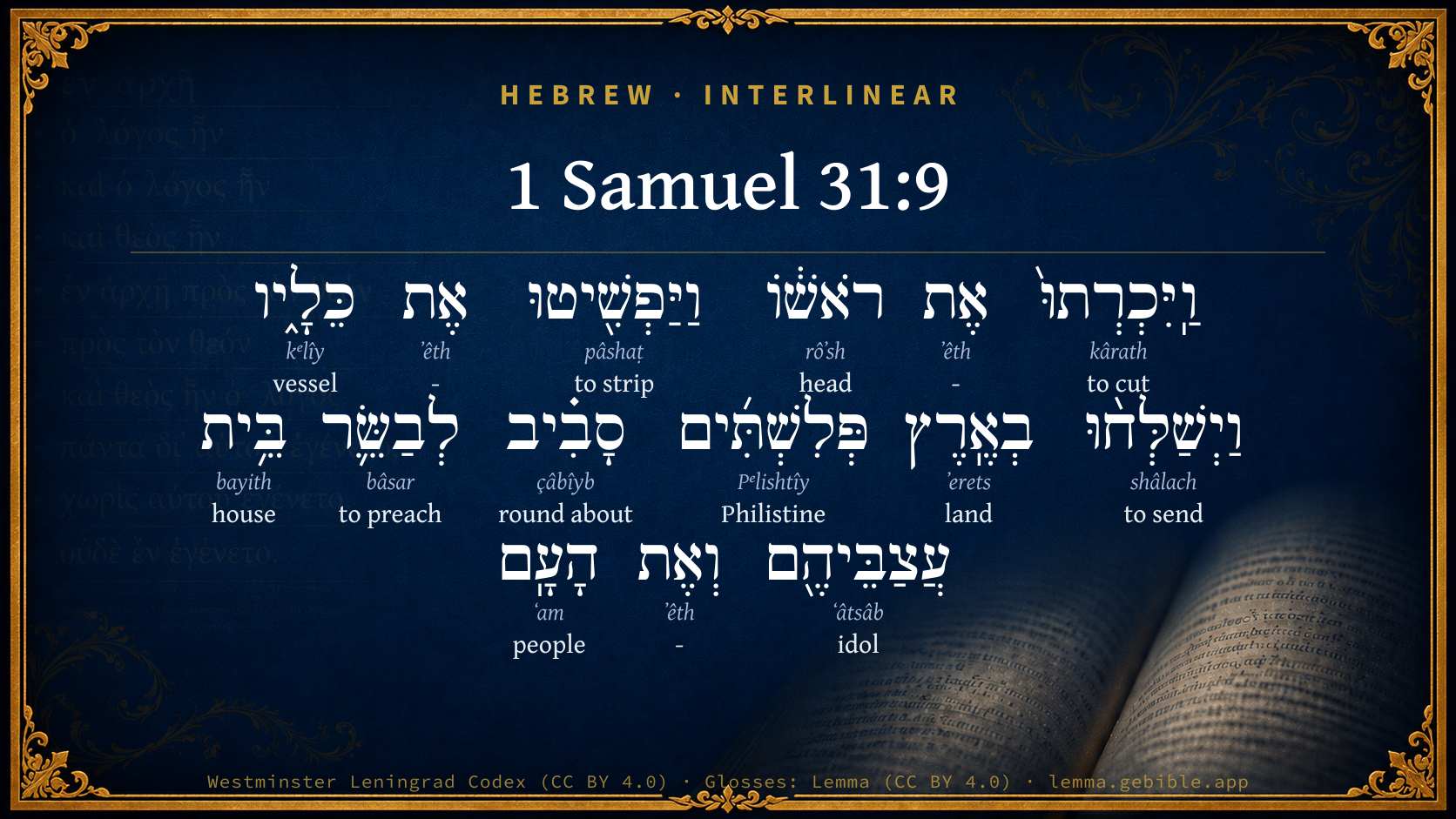
  1. וַֽיִּכְרְתוּ֙ kârath H3772 “and · to cut” Conjunction + Verb, Qal, Sequential Imperfect, 3rd Person, Masculine, Plural
  2. אֶת ʼêth H853 “-” Particle, Direct Object
  3. רֹאשׁ֔וֹ rôʼsh H7218 “head · his” Noun, Common, Masculine, Singular, Construct + Suffix, Personal, 3rd Person, Masculine, Singular
  4. וַיַּפְשִׁ֖יטוּ pâshaṭ H6584 “and · to strip” Conjunction + Verb, Hiphil, Sequential Imperfect, 3rd Person, Masculine, Plural
  5. אֶת ʼêth H853 “-” Particle, Direct Object
  6. כֵּלָ֑יו kᵉlîy H3627 “vessels · his” Noun, Common, Masculine, Plural, Construct + Suffix, Personal, 3rd Person, Masculine, Singular
  7. וַיְשַׁלְּח֨וּ shâlach H7971 “and · to send” Conjunction + Verb, Piel, Sequential Imperfect, 3rd Person, Masculine, Plural
  8. בְאֶֽרֶץ ʼerets H776 “in/at · land of” Preposition + Noun, Common, Both, Singular, Construct
  9. פְּלִשְׁתִּ֜ים Pᵉlishtîy H6430 “Philistines” Noun, Gentilic, Masculine, Plural, Absolute
  10. סָבִ֗יב çâbîyb H5439 “round about” Noun, Common, Both, Singular, Absolute
  11. לְבַשֵּׂ֛ר bâsar H1319 “to preach” Preposition + Verb, Piel, Infinitive Construct
  12. בֵּ֥ית bayith H1004 “house of” Noun, Common, Masculine, Singular, Construct
  13. וְאֶת ʼêth H853 “and · -” Conjunction + Particle, Direct Object
  14. הָעָֽם ʻam H5971 “the · people” Particle, Definite Article + Noun, Common, Masculine, Singular, Absolute

About this verse

These counts appear in no published source. They are computed here, from the morphology-tagged text and Lemma’s own curated glosses. What Lemma adds →

15
words
13
distinct lemmas
Historical
section

Notable vocabulary

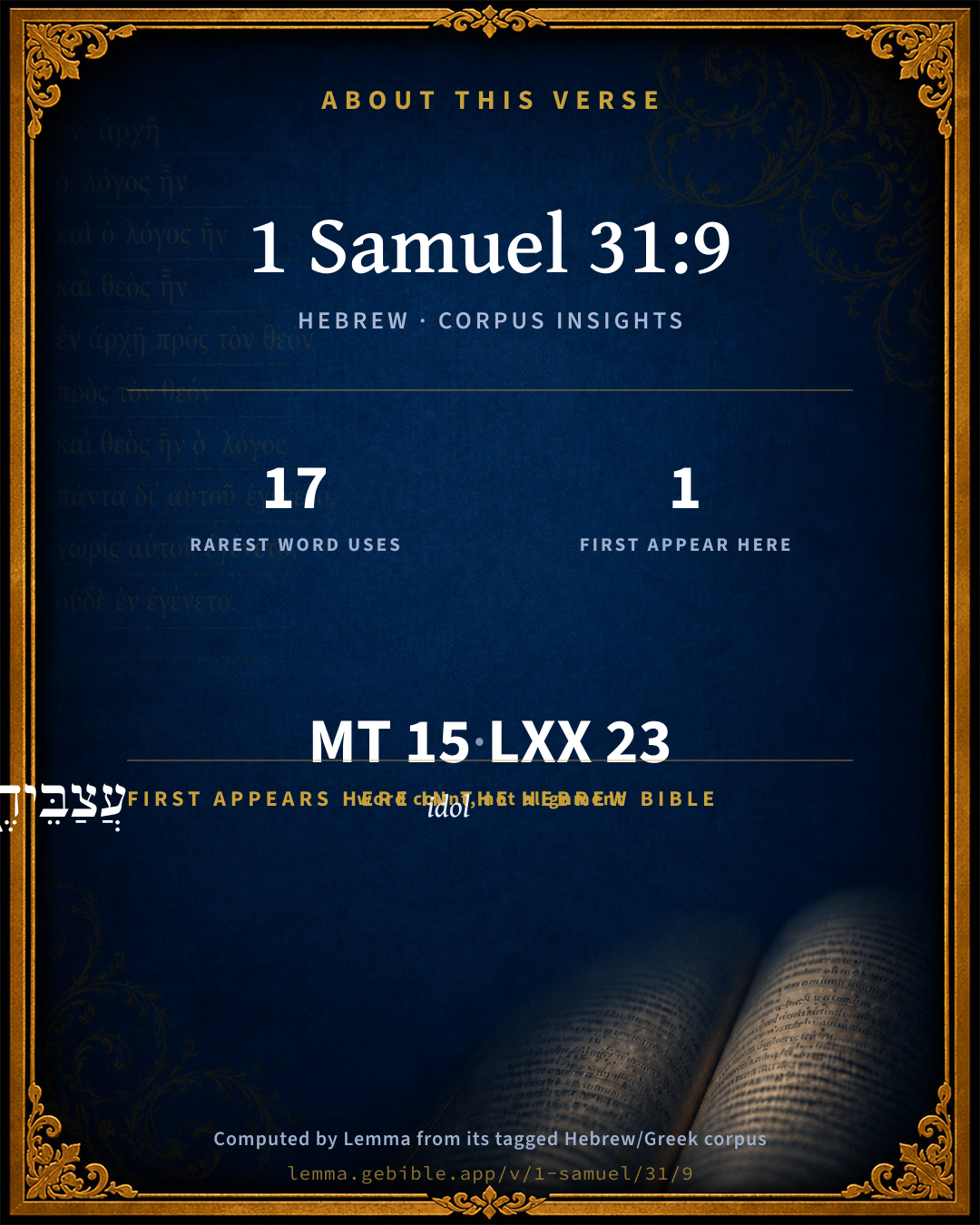
The rarest word here is עֲצַבֵּיהֶ֖ם idol H6091 — appearing just 17 times in the whole Hebrew Bible.

First appearance in Scripture

This word makes its first canonical appearance in the Hebrew Bible here:

  • עֲצַבֵּיהֶ֖ם idol H6091

Shared distinctive vocabulary

עֲצַבֵּיהֶ֖ם idol H6091 occurs in 17 verses of the Hebrew Bible. Also found in:

Grammatical profile

  • 4 verbs
  • 8 nouns
  • 3 particles

Verb forms

  • וַֽיִּכְרְתוּ֙ Qal · Sequential Imperfect
  • וַיַּפְשִׁ֖יטוּ Hiphil · Sequential Imperfect
  • וַיְשַׁלְּח֨וּ Piel · Sequential Imperfect
  • לְבַשֵּׂ֛ר Piel · Infinitive Construct

Hebrew & Septuagint length

In English translation the verse runs 34 words from the Hebrew and 29 from the Septuagint (LXX English) — closely comparable.

A rough comparison of the two English renderings, which tokenize alike — not a word-level alignment.

Word counts can differ between the Hebrew and the Greek without any difference in meaning — e.g. the Hebrew direct-object marker אֵת has no separate Greek word, and Greek often adds the article ὁ.

In the original languages it is 15 Hebrew tokens and 23 Greek tokens — but the two are counted differently (Hebrew bundles its prefixes and suffixes into one token; the Greek is in lemma form), so that isn’t a like-for-like length.

Cross-references

6

Topical passages linked to 1 Samuel 31:9 in the Treasury of Scripture Knowledge — connected by theme and wording, ordered by reader-vote popularity; previews shown in the World English Bible.

  • 2 Samuel 1:20 Don't tell it in Gath, Don't publish it in the streets of Ashkelon; Lest the daughters of the Philistines rejoice, Lest the daughters of the uncircumcised triumph.
  • Judges 16:23–24 The lords of the Philistines gathered them together to offer a great sacrifice to Dagon their god, and to rejoice; for they said, Our god has delivered Samson our enemy into our hand.
  • 1 Samuel 17:51 Then David ran, and stood over the Philistine, and took his sword, and drew it out of the sheath of it, and killed him, and cut off his head therewith. When the Philistines saw that their champion was dead, they fled.
  • 1 Samuel 17:54 David took the head of the Philistine, and brought it to Jerusalem; but he put his armor in his tent.
  • 1 Samuel 31:4 Then said Saul to his armor bearer, Draw your sword, and thrust me through therewith, lest these uncircumcised come and thrust me through, and abuse me. But his armor bearer would not; for he was sore afraid. Therefore Saul took his sword, and fell on it.
  • 1 Chronicles 10:9–10 They stripped him, and took his head, and his armor, and sent into the land of the Philistines round about, to carry the news to their idols, and to the people.

Cross-references courtesy of OpenBible.info (CC BY 4.0).

Hebrew and Greek witnesses Masoretic Hebrew ↔ Greek Septuagint

The same verse in the two great witnesses to the Old Testament, shown verse-for-verse.

These are two independent witnesses, not word-aligned to each other, and the Septuagint is shown in lemma (dictionary) form.

Hebrew 1 Samuel 31:9 Masoretic · Westminster Leningrad Codex

וַֽיִּכְרְתוּ֙ אֶת רֹאשׁ֔וֹ וַיַּפְשִׁ֖יטוּ אֶת כֵּלָ֑יו וַיְשַׁלְּח֨וּ בְאֶֽרֶץ פְּלִשְׁתִּ֜ים סָבִ֗יב לְבַשֵּׂ֛ר בֵּ֥ית עֲצַבֵּיהֶ֖ם וְאֶת הָעָֽם

They cut off his head, and stripped off his armor, and sent into the land of the Philistines round about, to carry the news to the house of their idols, and to the people.

World English Bible · Public Domain

Greek LXX 1 Samuel 31:9 Septuagint · lemma form

καί ἀποστρέφω αὐτός καί ἐκδύω ὁ σκεῦος αὐτός καί ἀποστέλλω αὐτός εἰς γῆ ἀλλόφυλος κύκλος εὐαγγελίζω ὁ εἴδωλον αὐτός καί ὁ λαός αὐτός

And they turned him, and stripped off his armor, and sent it into the land of the Philistines, sending round glad tidings to their idols and to the people.

LXX2012 (modern English Septuagint) · Public Domain

Hebrew: Westminster Leningrad Codex (CC BY 4.0). Greek: Septuagint (public domain); English from LXX2012 (modern English Septuagint) (Public Domain). How the Septuagint differs from the Hebrew →

Targum (Aramaic paraphrase)

1

The Targum is the ancient Jewish Aramaic paraphrase of the Hebrew Scriptures — an interpretive translation, not the Hebrew text itself. Onkelos (literal) and Pseudo-Jonathan (expansive) render the Torah, and Jonathan the Prophets. Coverage is partial: where no permissively-licensed English translation exists for a verse, only the Aramaic is shown. This is verse-level text, not a word-by-word alignment to the Hebrew.

  1. Targum Jonathan Prophets (Joshua–Malachi)
    וּפְסַקוּ יַת רֵישֵׁיהּ וְחַלִיצוּ זְיָנֵיהּ וּשְׁלָחוּ בְּאַרְעָא דִפְלִשְׁתָּאֵי סְחוֹר סְחוֹר לְבַסָרָא בֵּית טַעֲוַתְהוֹן וְיַת עַמָא:

    (no public-domain English translation for this verse)

    Targum Jonathan — Aramaic: “Mikraot Gedolot” (public domain). English: “Sefaria Community Translation” (CC0 1.0 (public-domain dedication)); “London "Chaldee Paraphrase," 1871” (public domain). Text via Sefaria.

Commentary

Notes on 1 Samuel 31:9 from classic Christian and Jewish commentators (each source and its license shown beneath its notes). The classic Christian expositions comment on the surrounding passage and are grouped to its opening verse, so a note may address several verses; the Jewish commentaries on the Tanakh (Rashi and others) are per-verse, so they appear only where the commentator wrote on this verse.

Lemma curates 59 commentaries, every one of them public domain or Creative Commons licensed, each selected and text-cleaned for this edition rather than reprinted as found. About our sources →

Trapp's Complete Commentary

John Trapp

1Sa 31:9 And they cut off his head, and stripped off his armour, and sent into the land of the Philistines round about, to publish [it in] the house of their idols, and among the people.

Ver. 9. And they cut off his head, and stripped off his armour.] They served him in like sort as their champion Goliath had been served: that they might cry quittance with him. Men love to retaliate.

To publish it in the house of their idols.] Heb., Their fray-bugs {object of fear}. So called, because they fright their superstitious followers, instead of instructing and comforting them. See Psa 16:4. {See Trapp on "Psa 16:4"}

And among the people.] This David would not have had done, {2Sa 1:20} but God suffered it, though he some way suffered in it, to show his singular hatred of sin, and show he is set upon the punishment of it.

John Trapp, A Commentary or Exposition upon All the Books of the Old and New Testament (1647–1656) — public domain. Text from a community e-Sword module.

Tyndale Open Study Notes

Tyndale Open Resources

31:9 In the ancient world, the death of an enemy king was good news, for it meant that the enemy’s god had been defeated. However, little did the Philistines know that their victory would be short-lived and hollow. David, the Lord’s true anointed king, would soon come to power and pay back the Philistines mightily. Far from defeating Israel’s God, the Philistines were simply fulfilling his purpose.

Tyndale Open Study Notes — © Tyndale Open Resources, licensed CC BY-SA 4.0. Text via the HelloAO Bible API.

Geneva Bible (1599)

Geneva Bible translators

In token of victory and triumph.

Geneva Bible (1599) marginal notes — public domain. Text via Bolls.life.

Adam Clarke's Commentary

Verse 9. And they cut off his head] It is possible that they cut off the heads of his three sons likewise; for although only his head is said to be cut off, and his body only to be fastened to the walls of Beth-shan, yet we find that the men of Jabesh-gilead found both his body and the bodies of his three sons, fastened to the walls, 1Sa 31:12.

Perhaps they only took off Saul's head, which they sent about to their temples as a trophy of their victory, when they sent the news of the defeat of the Israelites through all their coasts, and at last placed it in the temple of Dagon, 1Ch 10:10.

Adam Clarke's Commentary on the Bible (1810–1826) — public domain. Text from a community e-Sword/MySword module.

Ellicott's Commentary for English Readers

(9) And they cut off his head, and stripped off his armour.—Only Saul’s head and armour is mentioned here, but on comparing 1Sa_31:12, where the bodies of his sons are especially mentioned, it is clear that this act was not confined to the person of the king. The sense of the passage there is, the heads of the king and his three sons were cut off, and their armour stripped from their bodies. The heads and armour were sent as trophies round about the different towns and villages of Philistia, and the headless corpses were fastened to the wall of the city of Beth-shan.

A Bible Commentary for English Readers, edited by Charles John Ellicott (1878–1897) — public domain. Text from a community e-Sword module.

The Cambridge Bible for Schools and Colleges

gen. ed. J. J. S. Perowne

8–13. The burial of Saul and his Sons

9. they cut off his head] The Anointed of Jehovah fares no better than the uncircumcised Goliath, now that God has forsaken him.

to publish it] To publish the good news. Sept. εὐαγγελίζοντες. Cp. 2Sa_1:20.

in the house of their idols] In the temples of their idols, which were regarded as the givers of the victory. Cp. ch. 1Sa_5:2. Chron. reads “to carry tidings to their idols.”

The Cambridge Bible for Schools and Colleges (gen. ed. J. J. S. Perowne; Cambridge University Press, 1878–1918) — public domain. Text from a community e-Sword module.

John Gill's Exposition

And they cut off his head,.... And fastened it in the temple of Dagon, Ch1 10:10; perhaps that which was at Ashdod, one of the principalities of the Philistines, Sa1 5:1,

and stripped off his armour; or vessels (h), his clothes as well as his armour, and what he had about him; as for his crown on his head, and the bracelet on his arm, the Amalekite took them before the Philistines came, Sa2 1:10,

and sent into the land of the Philistines round about: not his head and his armour, for they were placed in the temple of their idols; unless we can suppose these were first carried about for show, and as proofs of the victory: but rather messengers, who were sent express with the news:

to publish it in the house of their idols, and among the people; that so they might be glad and rejoice, and give praise to their idols, to whom they ascribed the success they had.

(h) "vasa ejus", Munster, Montanus.

John Gill's Exposition of the Whole Bible (1746–1763) — public domain (CC PDM 1.0). Text via the HelloAO Bible API.

Haydock's Catholic Bible Commentary

Head, as David had treated that of Goliath, chap. xvii. 54.

George Leo Haydock (1774–1849), Haydock's Catholic Family Bible and Commentary, 1859 edition — public domain. Excludes Psalms (Douay-Rheims chapter numbering differs from Protestant) and Deuterocanonical books (Catholic canon only).

Matthew Poole's English Annotations

They cut off his head, as the Israelites did by Goliath.

To publish it in the house of their idols, to give them the glory of this victory.

Matthew Poole's English Annotations on the Holy Bible (1683–1685) — public domain. Text from a community e-Sword/MySword module.

Whedon's Commentary on the Bible

Daniel D. Whedon

9. They cut off his head — His sons seem to have received the same barbarous treatment. See 1Sa_31:12. This revenge on the lifeless bodies of the slain shows, according to some writers, the low and miserable barbarity of the Philistines; but did not David treat the dead body of Goliath in the same way? (1Sa_17:54;) and what shall be said of Samuel’s hewing of Agag in pieces? 1Sa_15:33. We must not judge the usages of that age by our own.

To publish it — That the daughters of the uncircumcised might rejoice and triumph. 2Sa_1:20.

Daniel D. Whedon (gen. ed.), Commentary on the Old and New Testaments (1874–1909) — public domain. Text from a community e-Sword module.

The Pulpit Commentary

Vers. 9, 10. They cut off his head. This was probably done not simply in retaliation for what had happened to their champion Goliath, but in accordance with the customs of ancient warfare. The fierce joy of the Philistines over the fallen Saul proves how great had been their fear of him, and how successful he had been in breaking their yoke off Israel"s neck. Had he still had David with him the victory would assuredly have remained on his side. They put his armour in the house of Ashtaroth. Hebrew, "of the Ashtaroth." Whether it was divided among the various shrines of Astarte, or whether it was all placed in her famous temple at Askelon, described by Herodotus (1:105) as the most ancient of the fanes of the Syrian Venus, is uncertain. The former view agrees best with the Hebrew text and with what is said in 1Ch_10:10, where we have the additional information that they suspended Saul"s head in the temple of Dagon. They fastened his body to the wall of Beth-shan, as also the bodies of his sons (ver. 12). Beth-shan or Scythopolis lies about four miles from the Jordan on the west, and twelve miles south of the lake of Tiberias. It is almost in a straight line to the west of Mahanaim, and must have been at once occupied by the Philistines, and as they hung the bodies of the fallen king and his sons on its wall, they evidently intended to retain it.

The Pulpit Commentary (1880–1919), ed. H.D.M. Spence-Jones & Joseph S. Exell — public domain. Text from a community e-Sword module.

John Wesley's Explanatory Notes

Cut off his head - As the Israelites did by Goliath, and fastened it in the temple of Dagon, 1 Chron. x, 10. Idols - To give them the glory of this victory. And by this respect shewn to their pretended deities, how do they shame those, who give not the honour of their achievements to the living God?

John Wesley, Explanatory Notes Upon the Whole Bible (1754–1765) — public domain. Text via the GEBible commentary corpus.

unfoldingWord translationNotes

Door43 World Missions Community

the land of the Philistines throughout

"all areas of the land of the Philistines"

to carry the news to their idols' temples and to the people

"to speak the news inside the temples and to the people"

their idols' temples

the buildings where they worshiped their idols

Ashtoreths

ancient false goddesses and idols, also called "Asherah" or "Astarte"

fastened

attached, probably with a large spike or nail

Beth Shan

the name of a city (See: How to Translate Names)

translationWords

armor

send

messenger

Philistines

false god

body

unfoldingWord translationNotes — © Distant Shores Media and the Door43 World Missions Community, licensed CC BY-SA 4.0. Source: git.door43.org/Door43/en_tn.

Lesson kit

Teaching starters — assembled from the data on this page, not authored interpretation. Every prompt links to the verse data it draws on. Edit before teaching.

1 Samuel, in the Historical, opens this verse with 15 words (13 distinct Hebrew lemmas). Its most distinctive word is ʻâtsâb (“idol”). A historical commentator’s framing appears above. Read the whole chapter for the surrounding context.

Discussion questions

  1. How does “idol” (ʻâtsâb) shape what this verse is saying?
  2. This is the first place “idol” appears in Scripture (first appears here). What does its debut here establish?
  3. How does 2 Samuel 5:21, which shares the word «idol», read alongside this verse?
  4. These translations render this verse differently; the difference is in the English rendering, not the original. What questions does that raise?
  5. «וַֽיִּכְרְתוּ֙» is a Qal Sequential Imperfect verb. How does that grammatical form shape the action described?
  6. Compare how Trapp's Complete Commentary and Tyndale Open Study Notes read this verse. Where do they agree or differ?

Things to notice

Reading settings

Reading text

Shown beneath each verse's original-language words.

Old Testament
Old Testament edition

Read the OT as the Masoretic Hebrew (MT) or the Greek Septuagint (LXX).

English shown for the Greek Septuagint (in the Hebrew ↔ Greek comparison).

Comparing translations? Open the Compare panel on any verse page to stack up to four side by side.