
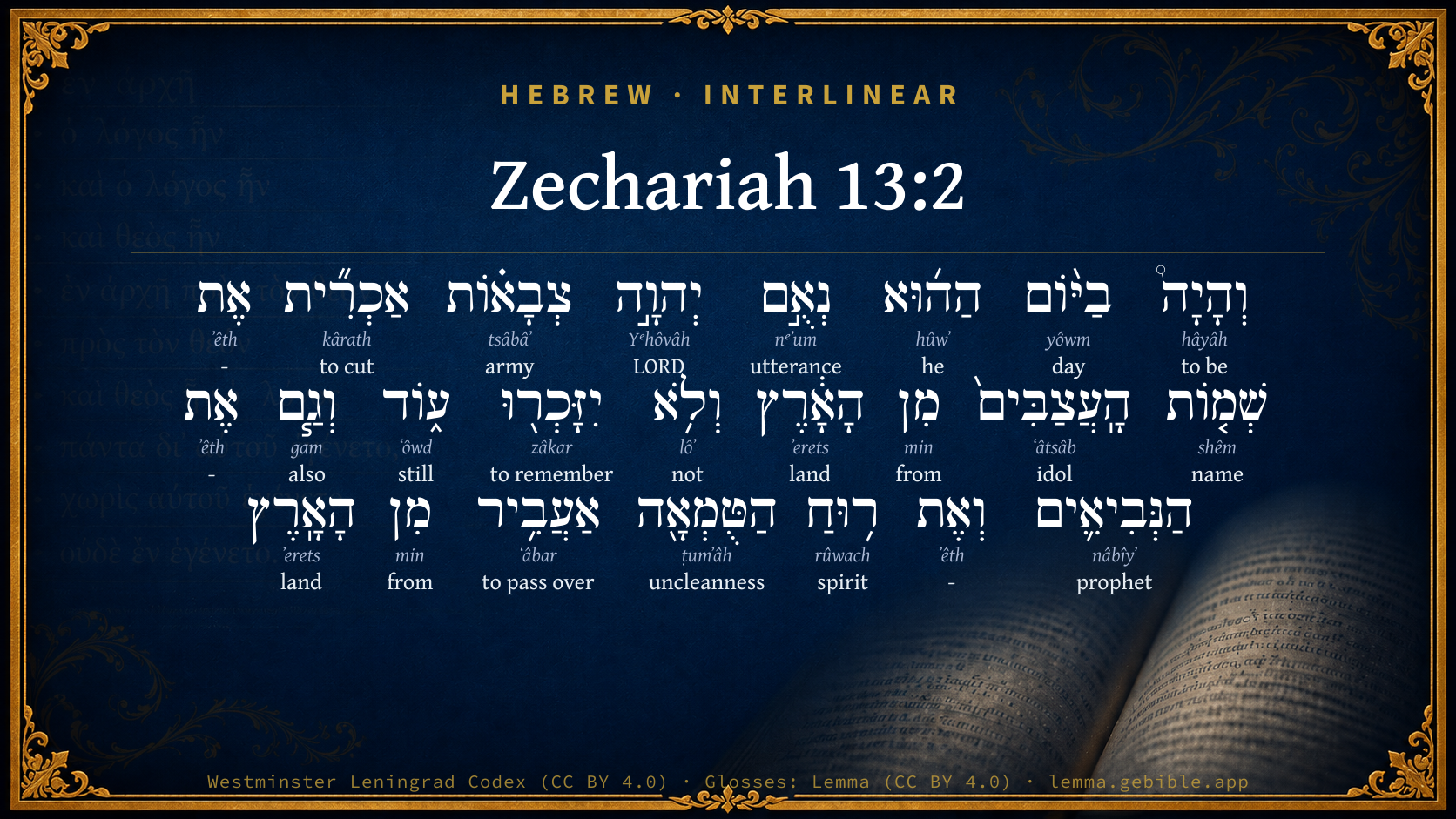
Zechariah 13:2

Hebrew (Westminster Leningrad Codex) Zechariah 13:2 appears in the Hebrew Old Testament. The text above is from the Westminster Leningrad Codex. Each word links to its Strong’s number, a concise gloss, and parsing drawn from the Open Scriptures Hebrew Bible morphology. Click any word for its full Brown-Driver-Briggs (BDB) entry.
Download image
Cite this verse

Zechariah 13:2 (World English Bible). Public Domain. Lemma interlinear Bible study tool, https://lemma.gebible.app/v/zechariah/13/2.

Show BibTeX & RIS
BibTeX
RIS
English Translation
It will come to pass in that day, says Yahweh of Hosts, that I will cut off the names of the idols out of the land, and they will no more be remembered; and also I will cause the prophets and the spirit of impurity to pass out of the land.
World English Bible · Public Domain
Download a study sheet

One document with this verse’s original text, its word-by-word gloss line, the meaning frame, cross-references with their text, attributed commentary, and full source and license credits — printable, and it pastes into notes with its structure intact.

This verse Autodidact and up

Study sheet (.html) Plain text (.txt)

A passage Seminary Student

Up to 50 verses in one chapter. A passage sheet keeps up to 6 commentary sources and 12 cross-references per verse, in the order this page ranks them, and says so on the sheet whenever that leaves anything out. Ask for a single verse and you get the Autodidact verse sheet above.

Everything on this page stays free to read, with no account — the sheet is a download of what is already on screen, not access to it.

Want to remove ads? Support Godless Engineer
Compare translations 3

The same verse in 3 English versions, stacked beneath the original-language interlinear above. Click any original word for its lexicon entry.

Each is an independent rendering of the whole verse — the interlinear is not word-aligned to these translations.

Highlighted words mark where these versions differ — a whole-verse word diff, not a word-by-word alignment.

  • World English Bible Public Domain
    It will come to pass in that day, says Yahweh of Hosts, that I will cut off the names of the idols out of the land, and they will no more be remembered; and also I will cause the prophets and the spirit of impurity to pass out of the land.
  • King James Version Public Domain
    And it shall come to pass in that day, saith the LORD of hosts, that I will cut off the names of the idols out of the land, and they shall no more be remembered: and also I will cause the prophets and the unclean spirit to pass out of the land.
  • unfoldingWord Literal Text CC BY-SA 4.0
    And it will be on that day”—the declaration of Yahweh of Armies—“I will cut off the names of the idols from the land, and they will no longer be remembered. And also the prophets and the spirit of uncleanness I will cause to pass away from the land.

unfoldingWord Literal Text — © unfoldingWord, licensed CC BY-SA 4.0. Word-aligned USFM3 via Door43 (git.door43.org/unfoldingWord/en_ult).

Versions to compare (up to 4)

3 of 4 selected

Show all 18 translations

Every available English version of this verse, each an independent rendering of the whole verse.

  • World English Bible Public Domain
    It will come to pass in that day, says Yahweh of Hosts, that I will cut off the names of the idols out of the land, and they will no more be remembered; and also I will cause the prophets and the spirit of impurity to pass out of the land.
  • Berean Standard Bible Public Domain
    And on that day, declares the LORD of Hosts, I will erase the names of the idols from the land, and they will no longer be remembered. I will also remove the prophets and the spirit of impurity from the land.
  • Majority Standard Bible Public Domain
    And on that day, declares the LORD of Hosts, I will erase the names of the idols from the land, and they will no longer be remembered. I will also remove the prophets and the spirit of impurity from the land.
  • King James Version Public Domain
    And it shall come to pass in that day, saith the LORD of hosts, that I will cut off the names of the idols out of the land, and they shall no more be remembered: and also I will cause the prophets and the unclean spirit to pass out of the land.
  • American Standard Version (1901) Public Domain
    And it shall come to pass in that day, saith Jehovah of hosts, that I will cut off the names of the idols out of the land, and they shall no more be remembered; and also I will cause the prophets and the unclean spirit to pass out of the land.
  • Revised Version (1885) Public Domain
    And it shall come to pass in that day, saith the LORD of hosts, that I will cut off the names of the idols out of the land, and they shall no more be remembered: and also I will cause the prophets and the unclean spirit to pass out of the land.
  • Geneva Bible (1599) Public Domain
    And in that day, sayth the Lord of hostes, I will cut off the names of the idoles out of the land: and they shall no more be remembred: and I will cause the prophets, and the vncleane spirit to depart out of the land.
  • Douay-Rheims (1899) Public Domain
    And it shall come to pass in that day, saith the Lord of hosts, that I will destroy the names of idols out of the earth, and they shall be remembered no more: and I will take away the false prophets, and the unclean spirit out of the earth.
  • Young's Literal Translation Public Domain
    And it hath come to pass, in that day, An affirmation of Jehovah of Hosts, I cut off the names of the idols from the land, And they are not remembered any more, And also the prophets and the spirit of uncleanness I cause to pass away from the land.
  • Literal Standard Version CC BY-SA 4.0
    And it has come to pass in that day,” || A declaration of YHWH of Hosts, || “I cut off the names of the idols from the land, || And they are not remembered anymore, || And also the prophets and the spirit of uncleanness || I cause to pass away from the land.
  • Unlocked Literal Bible CC BY-SA 4.0
    On that day—this is the declaration of Yahweh of hosts—I will cut off the names of the idols from the land and they will no longer be remembered. I will remove the prophets and the spirit of impurity from the land.
  • unfoldingWord Literal Text CC BY-SA 4.0
    And it will be on that day”—the declaration of Yahweh of Armies—“I will cut off the names of the idols from the land, and they will no longer be remembered. And also the prophets and the spirit of uncleanness I will cause to pass away from the land.
  • Darby Bible Public Domain
    And it shall come to pass in that day, saith Jehovah of hosts, [that] I will cut off the names of the idols out of the land, and they shall no more be remembered; and also I will cause the prophets and the unclean spirit to pass out of the land.
  • World Messianic Bible Public Domain
    It will come to pass in that day, says the LORD of Hosts, that I will cut off the names of the idols out of the land, and they will be remembered no more. I will also cause the prophets and the spirit of impurity to pass out of the land.
  • Webster's Bible Public Domain
    And it shall come to pass in that day, saith the LORD of hosts, that I will cut off the names of the idols out of the land, and they shall no more be remembered: and also I will cause the prophets and the unclean spirit to pass out of the land.
  • Free Bible Version CC BY-SA 4.0
    On that day, declares the Lord Almighty, I will wipe out idol worship from the land—the idols will not be remembered any longer. I will remove the false prophets and the spirit of impurity from the land.
  • Bible in Basic English Public Domain
    And it will come about on that day, says the Lord of armies, that I will have the names of the images cut off out of the land, and there will be no more memory of them: and I will send all the prophets and the unclean spirit away from the land.
  • JPS Tanakh (1917) Public Domain
    And it shall come to pass in that day, saith the LORD of hosts, that I will cut off the names of the idols out of the land, and they shall no more be remembered; and also I will cause the prophets and the unclean spirit to pass out of the land.

Literal Standard Version (2020), Covenant Press — licensed CC BY-SA 4.0. Text via the HelloAO Bible API (eBible.org). Unlocked Literal Bible (unfoldingWord) — licensed CC BY-SA 4.0. Text via the HelloAO Bible API (eBible.org). unfoldingWord Literal Text — © unfoldingWord, licensed CC BY-SA 4.0. Word-aligned USFM3 via Door43 (git.door43.org/unfoldingWord/en_ult). Free Bible Version, Dr. Jonathan Gallagher — licensed CC BY-SA 4.0. Text via the HelloAO Bible API (eBible.org).

Word by word

More ways to search: Search by grammar → Find every occurrence → Compare this word →

Practice this passage: Drill this verse → Learn its vocabulary →

הָֽעֲצַבִּים֙
ʻâtsâb
H6091
“the · idols”
Particle, Definite Article + Noun, Common, Masculine, Plural, Absolute
Part of Speech
Particle + Noun
Type
Common
Gender
Masculine
Number
Plural
State
Absolute
Full BDB Definition

Origin: from H6087

TWOT: 1667c

idol, image
  1. וְהָיָה֩ hâyâh H1961 “and · to be” Conjunction + Verb, Qal, Sequential Perfect, 3rd Person, Masculine, Singular
  2. בַיּ֨וֹם yôwm H3117 “in/at the · day” Preposition, Determined + Noun, Common, Masculine, Singular, Absolute
  3. הַה֜וּא hûwʼ H1931 “the · he” Particle, Definite Article + Pronoun, Personal, 3rd Person, Masculine, Singular
  4. נְאֻ֣ם nᵉʼum H5002 “utterance of” Noun, Common, Masculine, Singular, Construct
  5. יְהוָ֣ה Yᵉhôvâh H3068 “LORD” Noun, Proper
  6. צְבָא֗וֹת tsâbâʼ H6635 “armies” Noun, Common, Both, Plural, Absolute
  7. אַכְרִ֞ית kârath H3772 “to cut” Verb, Hiphil, Imperfect, 1st Person, Common, Singular
  8. אֶת ʼêth H853 “-” Particle, Direct Object
  9. שְׁמ֤וֹת shêm H8034 “names of” Noun, Common, Masculine, Plural, Construct
  10. מִן min H4480 “from” Preposition
  11. הָאָ֔רֶץ ʼerets H776 “the · land” Particle, Definite Article + Noun, Common, Both, Singular, Absolute
  12. וְלֹ֥א lôʼ H3808 “and · not” Conjunction + Particle, Negative
  13. יִזָּכְר֖וּ zâkar H2142 “to remember” Verb, Niphal, Imperfect, 3rd Person, Masculine, Plural
  14. ע֑וֹד ʻôwd H5750 “still” Adverb
  15. וְגַ֧ם gam H1571 “and · also” Conjunction + Particle, Accusative
  16. אֶת ʼêth H853 “-” Particle, Direct Object
  17. הַנְּבִיאִ֛ים nâbîyʼ H5030 “the · prophets” Particle, Definite Article + Noun, Common, Masculine, Plural, Absolute
  18. וְאֶת ʼêth H853 “and · -” Conjunction + Particle, Direct Object
  19. ר֥וּחַ rûwach H7307 “spirit of” Noun, Common, Both, Singular, Construct
  20. הַטֻּמְאָ֖ה ṭumʼâh H2932 “the · uncleanness” Particle, Definite Article + Noun, Common, Feminine, Singular, Absolute
  21. אַעֲבִ֥יר ʻâbar H5674 “to pass over” Verb, Hiphil, Imperfect, 1st Person, Common, Singular
  22. מִן min H4480 “from” Preposition
  23. הָאָֽרֶץ ʼerets H776 “the · land” Particle, Definite Article + Noun, Common, Both, Singular, Absolute

About this verse

These counts appear in no published source. They are computed here, from the morphology-tagged text and Lemma’s own curated glosses. What Lemma adds →

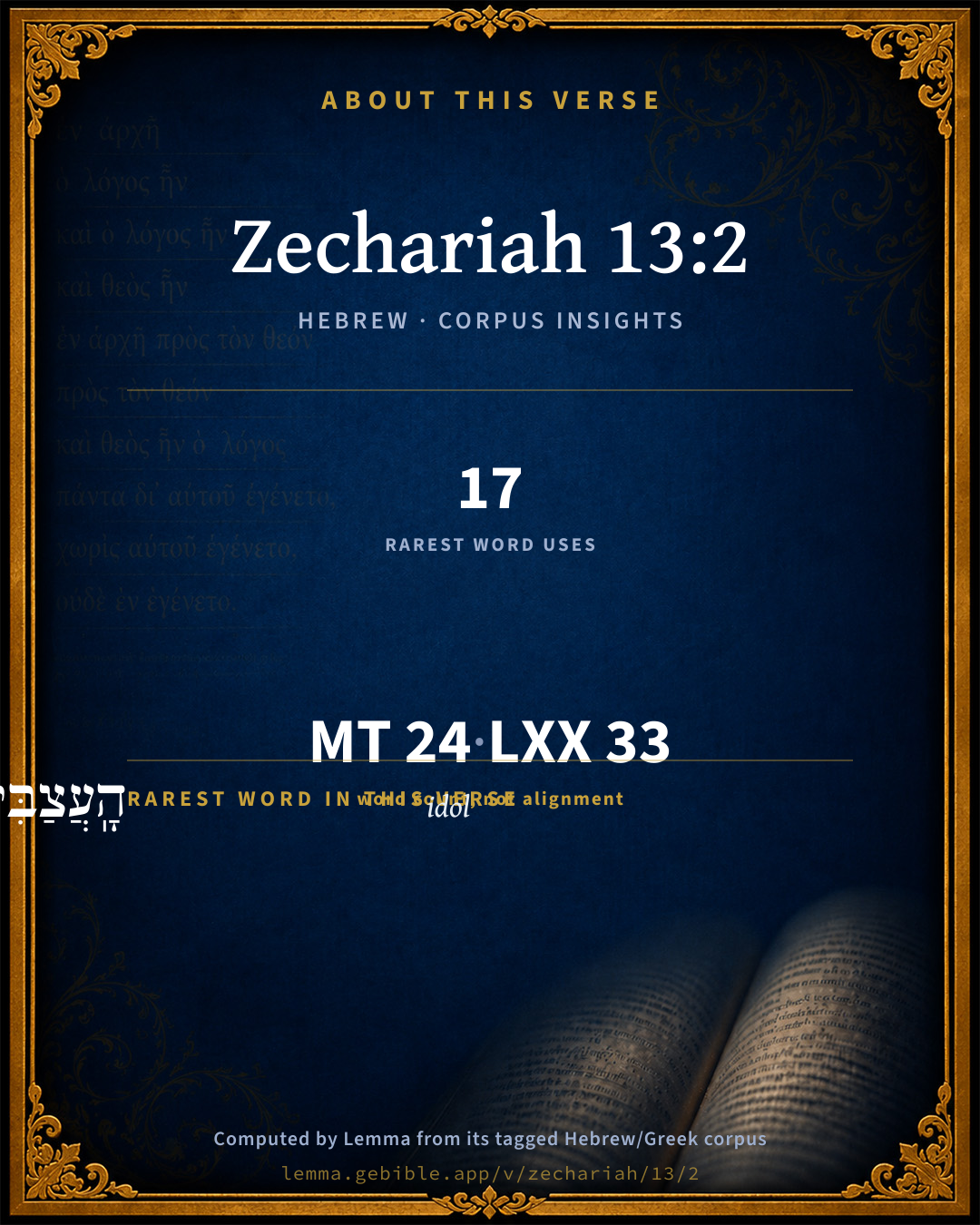
24
words
20
distinct lemmas
Prophets
section

Notable vocabulary

The rarest word here is הָֽעֲצַבִּים֙ idol H6091 — appearing just 17 times in the whole Hebrew Bible.

Shared distinctive vocabulary

הָֽעֲצַבִּים֙ idol H6091 occurs in 17 verses of the Hebrew Bible. Also found in:

Grammatical profile

  • 4 verbs
  • 11 nouns
  • 1 pronoun
  • 2 prepositions
  • 1 adverb
  • 5 particles

Verb forms

  • וְהָיָה֩ Qal · Sequential Perfect
  • אַכְרִ֞ית Hiphil · Imperfect
  • יִזָּכְר֖וּ Niphal · Imperfect
  • אַעֲבִ֥יר Hiphil · Imperfect

Repetition

Words recur within this verse — often emphatic in Hebrew:

  • הָאָ֔רֶץ land H776 ×2
  • מִן from H4480 ×2

Hebrew & Septuagint length

In English translation the verse runs 51 words from the Hebrew and 53 from the Septuagint (LXX English) — closely comparable.

A rough comparison of the two English renderings, which tokenize alike — not a word-level alignment.

Word counts can differ between the Hebrew and the Greek without any difference in meaning — e.g. the Hebrew direct-object marker אֵת has no separate Greek word, and Greek often adds the article ὁ.

In the original languages it is 24 Hebrew tokens and 33 Greek tokens — but the two are counted differently (Hebrew bundles its prefixes and suffixes into one token; the Greek is in lemma form), so that isn’t a like-for-like length.

Cross-references

34

Topical passages linked to Zechariah 13:2 in the Treasury of Scripture Knowledge — connected by theme and wording, ordered by reader-vote popularity; previews shown in the World English Bible.

  • 1 Kings 22:22 Yahweh said to him, 'How?' He said, 'I will go forth, and will be a lying spirit in the mouth of all his prophets.' He said, 'You shall entice him, and shall prevail also: go forth, and do so.'
  • Jeremiah 23:14–15 In the prophets of Jerusalem also I have seen a horrible thing: they commit adultery, and walk in lies; and they strengthen the hands of evil-doers, so that none does return from his wickedness: they are all of them become to me as Sodom, and the inhabitants of it as Gomorrah.
  • Hosea 2:17 For I will take away the names of the Baals out of her mouth, And they will no more be mentioned by their name.
  • Exodus 23:13 "Be careful to do all things that I have said to you; and don't invoke the name of other gods, neither let them be heard out of your mouth.
  • Ezekiel 36:25 I will sprinkle clean water on you, and you shall be clean: from all your filthiness, and from all your idols, will I cleanse you.
  • Ezekiel 30:13 Thus says the Lord Yahweh: I will also destroy the idols, and I will cause the images to cease from Memphis; and there shall be no more a prince from the land of Egypt: and I will put a fear in the land of Egypt.
  • Ezekiel 37:23 neither shall they defile themselves any more with their idols, nor with their detestable things, nor with any of their transgressions; but I will save them out of all their dwelling-places, in which they have sinned, and will cleanse them: so shall they be my people, and I will be their God.
  • 2 Corinthians 11:13–15 For such men are false apostles, deceitful workers, masquerading as Christ's apostles.
  • Deuteronomy 12:3 and you shall break down their altars, and dash in pieces their pillars, and burn their Asherim with fire; and you shall cut down the engraved images of their gods; and you shall destroy their name out of that place.
  • Joshua 23:7 that you not come among these nations, these that remain among you; neither make mention of the name of their gods, nor cause to swear [by them], neither serve them, nor bow down yourselves to them;
  • Psalms 16:4 Their sorrows shall be multiplied who give gifts to another god. Their drink-offerings of blood I will not offer, Nor take their names on my lips.
  • Isaiah 2:18 The idols shall utterly pass away.
  • Isaiah 2:20 In that day, men shall cast away their idols of silver, And their idols of gold, Which have been made for themselves to worship, To the moles and to the bats;
  • Jeremiah 8:10–12 Therefore will I give their wives to others, and their fields to those who shall possess them: for everyone from the least even to the greatest is given to covetousness; from the prophet even to the priest every one deals falsely.
  • Jeremiah 29:23 because they have worked folly in Israel, and have committed adultery with their neighbors' wives, and have spoken words in my name falsely, which I didn't command them; and I am he who knows, and am witness, says Yahweh.
  • Ezekiel 13:12–16 Behold, when the wall is fallen, shall it not be said to you, Where is the daubing with which you have daubed it?
  • Ezekiel 13:23 Therefore you shall no more see false visions, nor practice divination. I will deliver my people out of your hand; and you shall know that I am Yahweh.
  • Ezekiel 14:9 If the prophet be deceived and speak a word, I, Yahweh, have deceived that prophet, and I will stretch out my hand on him, and will destroy him from the midst of my people Israel.
  • Zephaniah 1:3–4 I will sweep away man and animal. I will sweep away the birds of the sky, the fish of the sea, and the heaps of rubble with the wicked. I will cut off man from the surface of the earth, says Yahweh.
  • Zephaniah 2:11 Yahweh will be awesome to them, for he will famish all the gods of the land. Men will worship him, everyone from his place, even all the shores of the nations.
  • Matthew 12:43 But the unclean spirit, when he is gone out of the man, passes through waterless places, seeking rest, and doesn't find it.
  • Luke 11:20 But if I by the finger of God cast out demons, then the Kingdom of God has come to you.
  • 2 Peter 2:15–19 forsaking the right way, they went astray, having followed the way of Balaam the son of Beor, who loved the wages of wrong-doing;
  • Revelation 16:13–14 I saw coming out of the mouth of the dragon, and out of the mouth of the beast, and out of the mouth of the false prophet, three unclean spirits, something like frogs;
  • Exodus 22:13 If it is torn in pieces, let him bring it for evidence. He shall not make good that which was torn.
  • Micah 2:11 If a man walking in a spirit of falsehood lies: 'I will prophesy to you of wine and of strong drink;' He would be the prophet of this people.
  • Micah 5:12–14 I will destroy witchcraft from your hand; And you shall have no soothsayers.
  • Matthew 7:15 "Beware of false prophets, who come to you in sheep's clothing, but inwardly are ravening wolves.
  • 2 Peter 2:1–3 But there also arose false prophets among the people, as among you also there will be false teachers, who will secretly bring in destructive heresies, denying even the Master who bought them, bringing on themselves swift destruction.
  • 1 John 4:1–2 Beloved, don't believe every spirit, but test the spirits, whether they are of God, because many false prophets have gone out into the world.
  • Revelation 19:20 The beast was taken, and with him the false prophet who worked the signs in his sight, with which he deceived those who had received the mark of the beast and those who worshiped his image. These two were thrown alive into the lake of fire that burns with sulfur.
  • Revelation 20:1–3 I saw an angel coming down out of heaven, having the key of the abyss and a great chain in his hand.
  • Revelation 18:2 He cried with a mighty voice, saying, "Fallen, fallen is Babylon the great, and she has become a habitation of demons, a prison of every unclean spirit, and a prison of every unclean and hateful bird!
  • Hosea 14:8 Ephraim, what have I to do any more with idols? I answer, and will take care of him. I am like a green fir tree; From me your fruit is found."

Cross-references courtesy of OpenBible.info (CC BY 4.0).

Hebrew and Greek witnesses Masoretic Hebrew ↔ Greek Septuagint

The same verse in the two great witnesses to the Old Testament, shown verse-for-verse.

These are two independent witnesses, not word-aligned to each other, and the Septuagint is shown in lemma (dictionary) form.

Hebrew Zechariah 13:2 Masoretic · Westminster Leningrad Codex

וְהָיָה֩ בַיּ֨וֹם הַה֜וּא נְאֻ֣ם יְהוָ֣ה צְבָא֗וֹת אַכְרִ֞ית אֶת שְׁמ֤וֹת הָֽעֲצַבִּים֙ מִן הָאָ֔רֶץ וְלֹ֥א יִזָּכְר֖וּ ע֑וֹד וְגַ֧ם אֶת הַנְּבִיאִ֛ים וְאֶת ר֥וּחַ הַטֻּמְאָ֖ה אַעֲבִ֥יר מִן הָאָֽרֶץ

It will come to pass in that day, says Yahweh of Hosts, that I will cut off the names of the idols out of the land, and they will no more be remembered; and also I will cause the prophets and the spirit of impurity to pass out of the land.

World English Bible · Public Domain

Greek LXX Zechariah 13:2 Septuagint · lemma form

καί εἰμί ἐν ὁ ἡμέρα ἐκεῖνος λέγω κύριος ἐκὀλεθρεύω ὁ ὄνομα ὁ εἴδωλον ἀπό ὁ γῆ καί οὐκέτι εἰμί αὐτός μνεία καί ὁ ψευδοπροφήτης καί ὁ πνεῦμα ὁ ἀκάθαρτος ἐκαἴρω ἀπό ὁ γῆ

And it shall come to pass in that day, says the Lord of hosts, that I will utterly destroy the names of the idols from off the land, and there shall be no longer any remembrance of them: and I will cut off the false prophets and the evil spirit from the land.

LXX2012 (modern English Septuagint) · Public Domain

On this verse, Lange's Commentary on the Holy Scriptures discusses the Septuagint’s reading. Read the note in Commentary ↓

Hebrew: Westminster Leningrad Codex (CC BY 4.0). Greek: Septuagint (public domain); English from LXX2012 (modern English Septuagint) (Public Domain). How the Septuagint differs from the Hebrew →

Targum (Aramaic paraphrase)

1

The Targum is the ancient Jewish Aramaic paraphrase of the Hebrew Scriptures — an interpretive translation, not the Hebrew text itself. Onkelos (literal) and Pseudo-Jonathan (expansive) render the Torah, and Jonathan the Prophets. Coverage is partial: where no permissively-licensed English translation exists for a verse, only the Aramaic is shown. This is verse-level text, not a word-by-word alignment to the Hebrew.

  1. Targum Jonathan Prophets (Joshua–Malachi)
    וִיהֵי בְעִדָנָא הַהִיא אֲמַר יְיָ צְבָאוֹת אֱשֵׁיצֵי יַת שׁוּם טַעֲוַת עַמְמַיָא מִן אַרְעָא וְלָא יְהֵי דָכְרָן מִשׁוּמְהוֹן עוֹד וְאַף יַת נְבִיֵי שִׁקְרָא וְיַת רוּחַ מְסַאֲבָא אֲבַטֵיל מִן אַרְעָא:

    (no public-domain English translation for this verse)

    Targum Jonathan — Aramaic: “Mikraot Gedolot” (public domain). English: “Sefaria Community Translation” (CC0 1.0 (public-domain dedication)); “London "Chaldee Paraphrase," 1871” (public domain). Text via Sefaria.

Commentary

Notes on Zechariah 13:2 from classic Christian and Jewish commentators (each source and its license shown beneath its notes). The classic Christian expositions comment on the surrounding passage and are grouped to its opening verse, so a note may address several verses; the Jewish commentaries on the Tanakh (Rashi and others) are per-verse, so they appear only where the commentator wrote on this verse.

Lemma curates 59 commentaries, every one of them public domain or Creative Commons licensed, each selected and text-cleaned for this edition rather than reprinted as found. About our sources →

The Cambridge Bible for Schools and Colleges

gen. ed. J. J. S. Perowne

2. I will cut off] Forgiveness (Zec_13:1) is the middle term between godly sorrow (Zec_12:10-14) and amendment (Zec_13:2-6). It has been argued that the sins which are here said to be abandoned were not the prevalent sins of the Jews after the captivity, and that therefore the prophecy must be assigned to an earlier date. But the fact that this was the case, so far as it is a fact, may be claimed as completing the then present and historical basis, on which Zechariah, writing after the captivity, grounded, as is the wont of the O. T. prophets, the greater future which he was commissioned to reveal. Jerusalem had already proved and should presently prove again to be a “bowl of reeling,” and a “burdensome stone” (Zec_13:2-3) to the enemies who sought to hinder the re-building of the Temple and city. (Ezr_6:6-7; Ezr_6:11-12; Nehemiah 4, 6) Already “the spirit of grace and of supplications” had been poured upon the people and had moved them to penitent sorrow for their sins (Jer_50:4-5), and throughout the era of the return it should in like manner be poured upon them. (Ezra 9; Ezr_10:1; Neh_8:9; Neh_8:9) Already had they set themselves to “cut off the names of the idols,” and to “cause the prophets and the unclean spirit to pass out of the land.” (Ezr_6:21; Ezr_10:2-44; Neh_9:38; Neh_10:28-30; Neh_13:1-9; Neh_13:23-31.) But all these things, the prophet assures them, are but as the scanty drops, the harbingers of the abundant shower, or the few ripe ears, the firstfruits of the plentiful harvest. In the coming age of Messiah, the King (chap. 9) and Shepherd (chap. 11) of Israel, when the Spirit shall indeed be poured from on high, and the true Fountain opened for sin and for uncleanness, the spiritual counterparts of deliverance, of penitence, of amendment shall flourish in the Church of Christ. (Comp. as regards the terms of this verse, “idols,” “prophets,” “unclean spirit,” 1Jn_5:21; 1Jn_4:1). But beyond that is another age, in which in all its particulars, and with a completeness, it may be, and exactness of detail which it had never before attained to, the whole prediction shall be fulfilled.

the unclean spirit] Comp. 1Ki_22:22.

The Cambridge Bible for Schools and Colleges (gen. ed. J. J. S. Perowne; Cambridge University Press, 1878–1918) — public domain. Text from a community e-Sword module.

Trapp's Complete Commentary

John Trapp

Zec 13:2 And it shall come to pass in that day, saith the LORD of hosts, [that] I will cut off the names of the idols out of the land, and they shall no more be remembered: and also I will cause the prophets and the unclean spirit to pass out of the land.

Ver. 2. I will cut off the names of the idols] Heb. of the fray bugs, gnatsabim terriculorum, scarecrows (as they are likewise called, 1Sa 31:9 1Ch 10:9 Psa 115:4; in contempt, as Priapus in Horace - furum aviumque, Maxima formido - ), or, grievous idols, as Psa 16:4, because they tormented the minds of the superstitious, and put them to great pains to no purpose; as is to be seen in Popish pilgrims, who though used hardly, and lose much of their estates and other comforts, yet satisfy themselves in this, I have that I came for, viz. the sight of a dumb idol, as Calvin noteth on that place, Seek ye my face. Now of these idols and monuments of idolatry, these Balaam’s blocks, the Lord here promiseth to rid the land, as he did under the Maccabees. And as in the primitive Church he did by the Christian emperors, styled therefore by the superstitious Iconomachi and Iconoclastae; and of late, by the renowned reformers, as at Geneva, Bern, Basle (where they were burnt all together on an Ash Wednesday of God’s own making), and here in England by the command of King Edward VI; who the self-same day obtained a signal victory at Mussleborough Field.

And they shall no more be remembered] Unless it be with shame and detestation, as Eze 16:61 Psa 16:4 Hos 14:8. Ephraim shall say, What have I to do any more with idols? He shall pollute the idols which he once perfumed, and say unto them, "Get you hence," Isa 30:22. I was an obstinate Papist (saith Latimer of himself) as any was in England, and a gross idolater, &c. But after that he came to a sight of his error, he so far forth abhorred idols, that being brought forth after he was condemned to die to see a procession, he ran as fast as his old bones would carry him to one Spencer’s shop near Carfax, in Oxford, and would not once look toward it (Act. and Mon. fol. 1230).

And also I will cause the prophets] So they will needs be called and counted; when as they are no better than unclean spirits, {See Geneva on "Zec 13:2"} or at least are acted and set on work by that unclean spirit, the devil, {Mat 12:43 Mar 1:26 Joh 8:44 Rev 16:13} {See Trapp on "Mat 12:43"} {See Trapp on "Mar 1:26"} {See Trapp on "Joh 8:44"} {See Trapp on "Rev 16:13"} indeed, they are false prophets, Mat 7:15, false teachers, "who privily bring in damnable heresies," 2Pe 2:1, vanae orationis, cui nulla veritatis vel virtutis ratio subest, sunt artifices stulte loquaces et garruli, saith Montanus; they are loud and lewd liars, inspired by that unclean spirit, the father of lies, ut impurati impurent alios et seducant seducti (Junius in loc.), that being themselves defiled and seduced, they may defile and seduce others. For by corrupt teachers Satan catcheth men; as a cunning fisher by one fish catcheth another, that he may feed upon both.

And the unclean spirit to pass out of the land] This connection is worthy to be noted, saith reverend Calvin here, because it shows us the source of all errors, viz. the letting loose the reins to perverse teachers. I confess, saith he, we are apt enough of ourselves to run after falsities, such is the corruption of our natures. Sed interea ubi grassatur licentia quidvis docendi, necesse est corrumpi totam pietatem, et sic misceri omnia ut nihil differat lux a tenebris, &c. But where in matters of religion every man may think what he lists, and utter what he thinks, and defend what he utters, and publish what he defends, and gather disciples to what he publisheth, this libertas prophetandi, this liberty, or licentiousness, rather, of prophesying (alas, poor England!) must needs bane the Church, and bring in confusion. God therefore here gives us to know that a Church cannot stand unless false teachers be forbidden to turn the truth into a lie, and to prate at their pleasure against the word of God; and this, saith he, is diligently to be noted. Videmus enim ut hodie nebulones quidam, &c.; For we see how at this day certain vile persons take it up for a principle that the Church is not free unless every man may be suffered to preach or broach what he pleaseth; and that it is greatest cruelty to punish a heretic, and not to give him leave to blaspheme the truth. But the prophet here showeth that the Church of God cannot be kept in pure state, nor stand entire and safe, unless the rashness and impudence of such be restrained as dare pervert sound and sincere doctrine. Thus he.

John Trapp, A Commentary or Exposition upon All the Books of the Old and New Testament (1647–1656) — public domain. Text from a community e-Sword module.

Joseph Benson's Commentary

Zec 13:2. I will cut off the names of the idols — I will utterly destroy idols and idolatry. The Jews were forbidden to mention the names of the heathen idols, Exo 23:13; Jos 23:7; and when idolatry should be utterly extirpated, the names of the idols should be buried in oblivion. “It has been urged, in proof that this prophecy was uttered before the Babylonish captivity, that idolatry and groundless pretensions to prophecy were common among the Jews at that time, which has not been the case since. But, admitting the Jews not to have been addicted to idolatry, or false prophesying, at any particular period, [since the Babylonish captivity,] who can say they will not fall into both those transgressions at some future time? It is probable they will do so; for Ezekiel, confessedly prophesying of the latter times, when Israel and Judah, incorporated again into one nation, shall return into their own land, says, to the same effect as Zechariah, Neither shall they defile themselves any more with their idols, nor with their detestable things, nor with any of their transgressions, Eze 37:23. But besides, supposing the Jews themselves to remain untainted with those corruptions, it surely will not be denied that they do and may still prevail among other nations, who may be included in the term הארצ, taken in its most general sense, the earth; and so I conceive it should be: for we are taught to expect that the conversion of the Jews will be followed by a further reformation in the world, Rom 11:15; and that the time will come, when the kingdoms of this world shall become the kingdoms of our God and of his Christ, Rev 11:15; and the beast, the emblem of idolatry, and with him the false prophet, shall be cast into a lake of fire and brimstone, Rev 19:2.” — Blayney. I will cause the prophets — The false prophets; and unclean spirit — This seems to mean those that prophesy by means of an unclean spirit: see Act 16:16; Rev 16:13; and what is said in the next verse of any one that shall prophesy, must be understood of those that undertake to prophesy by means of an impure spirit, or other false pretences.

Joseph Benson's Commentary on the Old and New Testaments (1811–1818) — public domain. Text from a community e-Sword module.

Lange's Commentary on the Holy Scriptures

3. FRUITS OF PENITENCE.

Zec_13:2-6.

A. The Extinction of Idols and False Prophets (Zec_13:2). B. The Latter to be slain by their own Parents (Zec_13:3). C. Other such Prophets shall be ashamed of their Calling (Zec_13:4). D. And even deny it when charged upon them (Zec_13:5-6.)

2 And it shall be in that day, saith Jehovah of Hosts,

I will cut off the names of the idols from the land,23

And they shall be remembered no more;

And also the prophets and the spirit of uncleanness,

Will I cause to pass out of the land.

3 And it shall be, if a man still prophesy,

His father and his mother, who begat him, shall say to him,

Thou shalt not live,

For thou hast spoken a lie in the name of Jehovah;

And his father and his mother, who begat him,

Shall pierce24 him through in his prophesying.

4 And it shall be in that day the prophets shall be ashamed25

Each of his vision in his prophesying;

And shall no more put on a hairy mantle to lie;

5 And [one] shall say,26 I am not a prophet, I am a husbandman,

For a man has sold27 me from my youth.

6 And [the other] shall say28 to him,

What then are these wounds between thy hands?

And he shall say, Those with which I was wounded

In the house of my lovers.29

EXEGETICAL AND CRITICAL

This portion announces the complete extirpation of idolatry and false prophecy, which are here taken to represent all forms of ungodliness and immorality, which they could very properly do, since they had been the chief and most dangerous sins of the covenant people in all their previous history. We have then a vivid presentation of the fruits of the penitence mentioned in the previous chapter, and of the conversion and renovation announced in the opening verse of this chapter. The passage is not to be restricted to any particular period, but describes under local and temporary forms the removal of whatever is offensive to a God of holiness and truth. It will therefore apply to every instance in which the Gospel in its leading elements, repentance toward God and faith in our Lord Jesus Christ, is truly received.

Zec_13:2. I will cut off the names of the idols. The expressions, “to cut off the names,” and “that they be remembered no more,” denote the total extinction of idolatry (cf. Hos_2:17). Of the latter Calvin says, “his meaning is that the hatred of superstition will be so great that the people will shudder at the very name.” Inasmuch as the Jews notoriously after the Captivity shrank from any approach to idol-worship, it has been claimed that this passage shows that the portion of the book to which it belongs was composed prior to the Exile. But the conclusion is not legitimate. Zechariah simply uses the forms of the past in which to depict the future. Idolatry was the common expression of ungodliness in the earlier days of the nation; how could even a post-exilium prophet better set forth the overthrow of false religion in the future than by predicting the oblivion of idols and their names? Köhler indeed deems it possible, on the basis of Rev_9:20; Rev_13:4; Rev_13:15, that gross actual idol-worship may again return, but this would be to interpret an obscure book by one yet obscurer. Possibly the reference may be to that refined idolatry which consists in regarding and serving the creature more than the Creator, and which the New Testament has in view when it declares covetousness to be idolatry (Col_3:5). The prophets must of course be false prophets who spoke without authority, as appears from their association not only with idols but also with the spirit of uncleanness. This latter phrase denotes not merely a pervading principle, but an active, conscious agency, standing in direct contrast with the Spirit of grace (Zec_12:10), which works in its human instruments and leads them to their lying utterances. The false prophets as well as the true were subject to an influence from without (cf. 1Ki_22:21-23, Rev_16:14 with 2Th_2:9-10 and 1Ti_4:2). The completeness of the removal of this form of ungodliness is expressed very energetically in the following verses.

Zec_13:3. If a man still prophesy.… pierce him through. Some infer from the opening words that the mere fact of prophesying will be proof that the man attempting it is a deceiver, since there will be no more prophets (Keil, Köhler), and they refer to Jer_31:33-34, Isa_54:13; but this is an extravagant and needless assumption, for the connection shows plainly enough that Zechariah has in view simply false pretenders to divine inspiration, and the passages quoted by no means imply the final cessation of the spirit of prophecy either in its broad or its narrow sense, as the New Testament plainly shows. The statement in the text rests on Deu_18:20, compared with Zec_13:6-9. The offender shall die, and the first to inflict the sentence shall be his father and his mother, here made more emphatic by the addition, who begat him. Cf. 2Sa_16:11. Several expositors modify the meaning of דָקַר so as to make it=to bind or scourge (LXX., Peshito, Calmet), but there is no ground whatever for this in the origin or usage of the word, nor does it suit the context.

Zec_13:4. Prophets shall be ashamed.… to lie. The revolution will be so great that these pretenders shall become ashamed of their claims, and strip off the outward token of their occupation. The hairy mantle worn by the prophets (2Ki_1:8) was not a form of ascetic discipline, but a sermo propheticus realis, a symbol of the prophet’s grief for the sins which he was commissioned to reprove. It was an acted parable of repentance. The same remark is true of John the Baptist’s “raiment of camel’s hair and leathern girdle” (Mat_3:4). To lie, i. e., to give themselves the appearance of prophets, and thus impose upon the people. Thus far Zechariah has spoken of those who spoke falsely in the name of the Lord, and Hengstenberg supposes that he now turns to another class of pretenders who spoke in the name of strange gods,—a view which seems required by his interpretation of the last word of Zec_13:6. But no break or transition is apparent in the passage, and there is no necessity for violently introducing a new subject.

Zec_13:5-6. I am not a prophet.… lovers. A dramatic representation of the means by which one of these deceivers endeavors to escape detection. Charged with his crime, he denies it, and claims to have been nothing more than a common tiller of the soil. In support of this claim he asserts that this is no recent circumstance, but that he has been sold from his youth. קָנִה=to acquire, h. buy (Isa_24:2), in Hiphil would naturally=to cause to buy, i. e., to sell. Fürst and others make Hiphil the same as Kal. The sense is the same according to either rendering. There seems to be no reason for considering the verb a denominative from מִקְנֶה, servum facere (Maurer, Köhler). To this denial is opposed the question as to the origin of the scars the accused person bears,—wounds between thy hands, i. e., upon the breast. Cf. 2Ki_9:24, where “between the arms” evidently has this meaning. (In Arabic the cognate phrase, ׀َםْהَ םَבَ םْו, occurs frequently, in the sense coram eo.) The questioner considers these gashes upon the person as palpable evidences that the man has wounded himself in connection with idolatrous worship (1Ki_18:28; Tibullus, 1:1:43, respecting the worship of Cybele), and asks an explanation. The reply is that lie received them in the house of his lovers, which some explain as=impure, sinful lovers, i. e., idols (Hengstenberg), in which sense they say that the Piel of אָהַב is always used (which, however, cannot be affirmed of Jer_22:20; Jer_22:22, Lam_1:19); but as the form necessarily signifies only intense affection without regard to quality, I prefer the opinion of those who explain it as=loving friends, and understand the accused person as maintaining that the scars are simply the result of chastisements which he had formerly received when in the house of his relatives. It seems more likely that such a man would resort to an evasion of this kind than that he would make the frank confession involved in the former view.

This verse is commonly applied to the sufferings of Christ, but without any further ground than its mere proximity to that which follows, in which He and his sufferings are clearly predicted” (Henderson). It is quite impossible on any critical ground to vindicate such an application, although Henderson is far astray when he assigns as a reason that “in no tolerable sense could the Jews be called Christ’s lovers or friends,” for it is written (Joh_1:11), “He came unto his own, and his own (οἱ ί̈διοι) received Him not,” and the Apostle (Rom_9:5) speaks of his kinsmen as those "of whom as concerning the flesh Christ came.”

THEOLOGICAL AND MORAL.

1. Idolatry and divination are mentioned by Zechariah, as has been said, only as typical forms of error and sin. But it is singular how well they express the prevailing evils with which the Church is called to contend in modern times. The gross idolatry of the heathen has disappeared from Christendom never to return; but its place is taken by a more refined and more dangerous error of the same sort. There is a devotion rendered to wealth, to pleasure, to position, to genius, which is wholly inconsistent with the just claims of our Maker. There is a materialism which, although glozed over with high sounding names, is as repulsive to the true honor of God as the worship of Baal or Astarte. It dwells on great physical achievements, discoveries in nature or inventions in art, scientific triumphs, or even the multiplication of social conveniences, as if these were the all in all of life and of man. The next world is ignored. God is turned into a mere name. He is not enough thought of to be actively opposed; and men say in Gibbon’s famous formula, all religions are equally true in the eyes of the people, equally false in the eyes of the philosopher, and equally useful in the eyes of the statesman. Now this cool indifference, this pervading earthliness of character and pursuit, is not simply the rejection of God, but the enthronement of something else in his place, i. e., idolatry. And it needs all the energy of a true spiritual faith to overcome it. If the Church is ever to fulfill her function, she must insist that the life is more than meat and the body than raiment; that means are not ends; that man is not merely an animal of the better class, more highly organized and of larger intelligence; but that he is a spiritual being, allied to the infinite Spirit and able to reach the true goal of his existence only in willing obedience to that supreme Spirit. Anything else than this, whether it he the worship of wealth, or the worship of science, is treason to God. It puts the creature in the place of the Creator, and so prepares the way for all ungodliness and unrighteousness. A religious basis is essential to a permanent morality, and although the late Mr. John Stuart Mill held that there could be a religion without a personal God, all experience is against his crude notion. Men who begin by denying the rights of their Maker will sooner or later end by denying the rights of their fellow men.

2. The world has often flattered itself that “the false prophet and the unclean spirit” have completely passed away, that science has effectually disposed of superstition, that the progress of education and intelligence has put an end to soothsaying and necromancy. Yet our own generation has completely exploded this flattering dream. The heart of our own enlightened land where the schoolmaster has been abroad for generations, has witnessed the resurrection and diffusion of errors which are usually considered as belonging only to the twilight of civilization. The miserable first king of Israel resorted to the witch of Endor, only after every other door of knowledge had been hopelessly closed against him; but now under the blaze of a completed revelation, with Christ at the right hand of God, and the Holy Spirit promised to all who seek aright, men revive an antiquated delusion and seek for the living to the dead. Nay, many who reject and scoff at the Scriptures, receive with implicit faith what purport to be communications from the ghosts of the departed. It is a fulfillment of the Apostolic declaration (2Ti_4:4), “They who turn away their ears from the truth shall be turned unto fables.” Man stands too close to the unseen world to deny or ignore its existence; his own condition here with its dependence and exposure makes him look wistfully for something higher and better. If that craving is not satisfied legitimately, it will be illegitimately. The alternative to Faith is not unbelief but misbelief. Men must believe something. If they obey the laws of evidence, they will receive the only proven revelation from the invisible world; if not, then all that remains is belief without evidence, that is, superstition. Nor will this be altered if there be a common school, and a printing press, and a scientific association in every hamlet of the land. No culture of the intellect can destroy or smother man’s moral and spiritual nature. The heart, the conscience, the sense of responsibility, will still survive and demand some appropriate nutriment. To offer to these the latest discoveries in physics, is to offer stones instead of bread, or a scorpion instead of a fish. If they do not receive the living oracles of the Spirit of holiness, they fall into the hands of “the spirit of uncleanness,” whose working is with lying wonders and all deceivableuess of unrighteousness in them that perish, because they received not the love of the truth that they might be saved (2Th_2:9-10).

3. The energy of moral rebuke in a healthy state of Zion, is well shown in the pictorial representation of the Prophet. In the fifth Book of Moses provision is made for the prompt and severe punishment of any one who should introduce the worship of a false god (Deu_13:6-9). The Jewish commonwealth, being an actual theocracy, idolatry was simply and literally high treason, a blow at the life of the state, and as such a capital crime. Hence no degree of kindred or affection was allowed to exempt any one from denouncing such a criminal. Even a man’s nearest relatives were to be the first to put their hands to his execution when he was found judicially obnoxious to the penalty. Even so, declares Zechariah, in days to come will the parents who naturally cling to a prodigal boy, even when he may be hated and despised by all the world, yet overcome their affection, and themselves thrust through the child who is a lying prophet. The representation is strong, but not exaggerated. Literally understood it is of course impossible. Under the Gospel civil punishments for religious errors have and can have no place. But the underlying thought—intense and absolute loyalty to God—is as appropriate now as it ever was. The religious element in man’s nature is to become dominant, nay supreme. Love to God, like Aaron’s rod, is to swallow up all other affections. Nothing is to come into competition with allegiance to truth and holiness. Our Lord presented the duty with all plainness: “He that loveth father or mother more than me is not worthy of me; and he that loveth son or daughter more than me is not worthy of me” (Mat_10:37). It often happens that the claims of relatives and the claims of Christ come into collision; and when they do, the former must give way. We must choose to displease those whom we most love on earth rather than displease Him who died for us on the cross. This doctrine is quite repulsive to the sentimentalists who exalt the domestic affections to the highest place in human esteem, but it is none the less true, being indeed a simple corollary from the first principle of all religion, that the object of worship is to be loved supremely, and all other beings, however near or dear, subordinately.

4. But this is a very different thing from the self inflicted tortures of the heathen and of all false religionists. The man in the text with “wounds between his hands,” represents a class found in all ages and lands. Clear references to these are found in the Scripture (Deu_14:1; Jer_16:6; Jer_41:5), and an actual instance is seen in the priests of Baal in their contest with Elijah (1Ki_18:28). The custom originated in the uneasy consciousness of guilt and of the necessity for expiation. Men in their blindness conceived that by the merciless punishment of their own bodies they would render a species of satisfaction, and so regain the favor of the offended deities. The folly of this form of worship is well exposed by Seneca (quoted by Augustine, Civ. Dei, vi. 10), and yet it is not so absurd as it would seem. For if a man believes that the gods will exact some suffering for sins, and that by inflicting it upon himself he may forestall their action and get off on cheaper terms, it is not easy to refute him on rationalistic grounds. The difficulty in his case is that conscience is aroused, and yet there is no knowledge of the doctrine of substitution or atonement. Hence even in Christian lands, whenever that doctrine is not understood in its simplicity and fullness, the same thing occurs in a less aggravated form. Fastings and mortifications and penances of various kinds are cheerfully endured as compensations for guilt. It is hard for poor human nature to learn that “the blood of Jesus Christ cleanseth from all sin.” Yet nothing is clearer in the Scripture than that the will worship which consists in pains and privations, inflicted and endured for their own sake, is most offensive to the Most High. He Himself never sends afflictions unless there is a needs be, and He does not ask us to be other than Himself, Self denial is indeed a large part of the Christian life, but it is self-denial for an object beyond itself—not as satisfaction for sin or a price paid for heaven, but out of love for Christ, as a means of cultivating holiness or of winning souls for the kingdom. Privation borne with such views is indeed an honor and a blessing; but if inflicted for its own sake, it puts even such a transcendent genius as Pascal with his hair shirt and iron pointed girdle, on the same level with the self gashed devotees of Baal, or the forsworn diviner whom Zechariah describes.

HOMILETICAL AND PRACTICAL.

Moore: Zec_13:3. Love to God must be paramount to all other affections, even the most tender. It is in our present imperfect sanctification inconceivable how we could acquiesce in the perdition of our children without a pang that would poison all the bliss of heaven, and yet it shall be so. Much as we love them, we shall love God and his law immeasurably more.

Zec_13:4-6 : Sinners shall at last be made to confess their sins and the justice of their punishment; and the bitterest drop in the cup of their agony will be that they have wrung it out for themselves, and that it is all just.

Calvin: Falsehood hast thou spoken in the name of Jehovah. If we rightly consider what this is, it will certainly appear to us more detestable than to kill an innocent man, or to destroy a guest with poison, or to lay violent hands upon one’s own father. The greatest of all crimes does not come up to this horrible and monstrous wickedness.

Jay: Wounded in the house of my friends. There are four kinds of such wounds. (1.) Those arising from their just reprehensions. (2.) Those that result from their sufferings. (3.) Those produced by our being bereaved of them. (4.) Those inflicted by their improper conduct. Again. If the Lord Jesus be the sufferer, He is wounded in the house of his friends, by their negligent conduct—by their selfishness—by their distrust—by their timidity—by their gloomy conduct—by their unholiness. His question is, Is this thy kindness to thy friend?

Footnotes:

[23]Zec_13:2.—הָאָרֶץ. Henderson in both cases renders earth, but needlessly. The statement is a general one, but with a local coloring.

[24]Zec_13:3.—דקר is rendered pierce, in order to show that it is the same word which is used in the famous passage Zec_12:10.

[25]Zec_13:4.—Heng. renders בוֹשׁ מִן, to desist with shame, but the established meaning of the phrase is simply, to be ashamed of. The fem. suffix in הִנָבְאֹתוֹ is a peculiarity of this class of verbs (Green, Heb. Gr., 166, 2).

[26]Zec_13:5.—The singular verb here, following the previous plurals, indicates that one case is selected as an example Noyes renders, “each shall say,” but the prophet can scarcely mean that every one of the false prophets is to make the same form of denial.

[27]Zec_13:5.—הִקְנַנִי has been strangely misconceived. LXX. make it ἐγέννησεν; Vulg., Adam meum exemplum; Pesch. renders as if it came from קָנָא. The E. V. followed Kimchi in deriving the verbal form from מִקְנֶה=small cattle.

[28]Zec_13:6.—The implied subject of “shall say” is, of course, the other interlocutor in the dialogue.

[29]Zec_13:6.—מְאַהֲבַי should be rendered lovers, just as it is in all the other places where it occurs: Lam_1:19, Hos_2:7; Hos_2:9; Hos_2:12, etc.; friends is too weak.

Lange's Commentary on the Holy Scriptures (Critical, Doctrinal, and Homiletical), ed. John Peter Lange, English translation edited by Philip Schaff (1864–1880) — public domain. Text from a community e-Sword module.

Tyndale Open Study Notes

Tyndale Open Resources

13:2 By cleansing Israel, God would erase their former penchant for idol worship, giving them a new heart and enabling them to worship God alone (Jer 31:33; 32:38-40; Ezek 36:25-28). • In the biblical world, one’s name embodied one’s existence. When the names of the idols are forgotten, they cease to exist. • The false prophets misrepresented God by fabricating divine revelations or by speaking in the name of other gods (Deut 13:5-11; 18:17-22). They led Israel astray by encouraging idol worship (Jer 23:13, 25) and would continue to do so (see Neh 6:12-14; Mark 13:22; 2 Pet 2:1; 1 Jn 4:1-3) until that day, the day of the Lord.

Tyndale Open Study Notes — © Tyndale Open Resources, licensed CC BY-SA 4.0. Text via the HelloAO Bible API.

Geneva Bible (1599)

Geneva Bible translators

He promiseth that God will also purge them from all superstition, and that their religion shall be pure.

Meaning, the false prophets and teachers, who are the corrupters of all religion, whom the Prophet here calleth unclean spirits.

Geneva Bible (1599) marginal notes — public domain. Text via Bolls.life.

Jamieson, Fausset & Brown

Robert Jamieson, A. R. Fausset & David Brown

Consequences of pardon; not indolence, but the extirpation of sin.

names of . . . idols--Their very names were not to be mentioned; thus the Jews, instead of Mephibaal, said Mephibosheth (Bosheth meaning a contemptible thing) (Exo 23:13; Deu 12:3; Psa 16:4).

out of the land--Judea's two great sins, idolatry and false prophecy, have long since ceased. But these are types of all sin (for example, covetousness, Eph 5:5, a besetting sin of the Jews now). Idolatry, combined with the "spirit" of "Satan," is again to be incarnated in "the man of sin," who is to arise in Judea (Th2 2:3-12), and is to be "consumed with the Spirit of the Lord's mouth." Compare as to Antichrist's papal precursor, "seducing spirits . . . doctrines of devils," &c., Ti1 4:1-3; Pe2 2:1.

the unclean spirit--Hebrew, spirit of uncleanness (compare Rev 16:13); opposed to "the Spirit of holiness" (Rom 1:4), "spirit of error" (Jo1 4:6). One assuming to be divinely inspired, but in league with Satan.

Jamieson, Fausset & Brown — Commentary Critical and Explanatory on the Whole Bible (1871) — public domain (CC PDM 1.0). Text via the HelloAO Bible API.

Adam Clarke's Commentary

Verse 2. I will cut off the names of the idols] There shall not only be no idolatry, but the very names of the idols shall be forgotten, or be held in such abhorrence that no person shall mention them. This prophecy seems to be ancient, and to have been delivered while idolatry had prevalence in Israel and Judah.

I will cause the prophets] All false teachers.

And the unclean spirit] That which leads to impurity, the spirit of divination; the lust of the flesh, and of the eye, and the pride of life. Satan shall have neither a being in, nor power over, the hearts of sincere believers in Christ.

Adam Clarke's Commentary on the Bible (1810–1826) — public domain. Text from a community e-Sword/MySword module.

John Calvin's Commentaries

Here the Prophet mentions another effect, which would follow the repentance of the people, and which the Lord also would thereby produce. There was to be a cleansing from all the defilements of superstitions; for the pure and lawful worship of God cannot be set up without these filthy things being wiped away; inasmuch as to blend sacred with profane things, is the same thing as though one sought to take away the difference between heaven and earth. No religion then can be approved by God, except what is pure and free from all such pollution. We hence see why the Prophet adds, that there would be an end to falsehoods and all errors, and to the delusions of Satan, when God restored his Church; for the simplicity of true doctrine would prevail, and thus abolished would be whatever Satan had previously invented to corrupt religion.

We hence learn what I have just stated — that God cannot be rightly worshipped, except all corruptions, inconsistent with his sincere and pure worship, be taken away. But we must at the same time observe, that this effect is ascribed to God’s word; for it is that which can drive away and banish all the abominations of falsehood, and whatever is uncongenial to true religion. As then by the rising of the sun darkness is put to flight, and all things appear distinctly to the view, so also when God comes forth with the teaching of his word, all the deceptions of Satan must necessarily be dissipated.

Now these two things ought especially to be known; for we see that many, who are not indeed ungodly, but foolish and inconsiderate, think that they give to God his due honor, while they are entangled in many errors, and refrain not from superstitions. Others, more politic, devise this way of peace — that they who think rightly are to concede something to tyrants and false Prophets; and thus they seek to form at this day a new religion for us, made up of Popery and of the simple doctrine of the gospel, and in this manner as it were to transform God. As then we see that men are so disposed to mix all sorts of things together, that the pure simplicity of the gospel may be contaminated by various inventions, we ought to bear in mind this truth, — that the Church cannot be rightly formed, until all superstitions be rejected and banished. This is one thing.

We may also deduce hence another principle — that the word of God not only shows the way to us, but also discovers all the delusions of Satan; for hardly one in a hundred follows what is right, except he is reminded of what he ought to avoid. It is then not enough to declare that there is but one true God, and that we ought to put our trust in Christ, except another thing be added, that is, except we warn men of those intrigues by which Satan has from the beginning deceived miserable mortals: even at this day with what various artifices has he withdrawn the simple and unwary from the true God, and entangled them in a labyrinth of superstitions. Except therefore men be thus warned, the word of God is made known to them only in part. Whosoever then desires to perform all the duties of a good and faithful pastor, ought firmly to resolve, not only to abstain from all impure doctrines, and simply to assert what is true, but also to detect all corruptions which are injurious to religion, to recover men from the deceptions of Satan, and in short, avowedly to carry on war with all superstitions.

This was what Zechariah had in view when he said, In that day, that is, when God would restore his Church, perish shall the names of idols, so that they shall be remembered no more. By this last expression he sets forth more clearly what I have just stated, that the pure worship of God is then established as it ought to be, and that religion has then its own honor, when all errors and impostures cease, so that even the memory of them does not remain. It is indeed true, that superstitions can never be so abolished, so that no mention of them should be made; nay, the recollection of them is useful —

“Thou shalt remember thy ways,” says Ezekiel, “and be ashamed,” (Ezekiel 16:6.)

But by this form of speaking Zechariah means, that such would be the detestation of superstitions, that the people would dread the very mention of them. And hence we may learn how much purity of doctrine is approved by God, since he would have us to feel a horror as at something monstrous, whenever the name of an idol is mentioned.

He then refers to false teachers, I will exterminate, he says, the Prophets and the unclean Spirit from the land. The connection here is worthy of being noticed; for it hence appears how all errors arise, even when a loose rein is given to false teachers. It is indeed true I allow, that the seed of all errors is implanted in each of us, so that every one is a teacher to deceive himself; for we are not only disposed to what is false, but rush headlong into it: it is the corruption of our nature. But at the same time when liberty is taken to teach anything that may please men, the whole of religion must necessarily be corrupted, and all things become mixed together, so that there is no difference between light and darkness. God then here reminds us, that the Church cannot stand, except false teachers be prevented from turning truth into falsehood, and from pealing at their pleasure against the word of God.

And this is what ought to be carefully observed; for we see at this day how some unprincipled men adopt this sentiment — that the Church is not free, except every one is allowed with impunity to promulgate whatever he pleases, and that it is the greatest cruelty to punish a heretic; for they would have all liberty to be given to blasphemies. But the Prophet shows here, that the Church cannot be preserved in a pure state, and, in a word, that it cannot exist as a healthy and sound body, except the rashness and audacity of those who pervert sound and true doctrine be restrained.

We now then understand the import of this verse — that in order that God may be alone and indeed be rightly worshipped, he will take away and banish all idols and all superstitions, and also, that he will exterminate all ungodly teachers who pervert sound doctrine.

He calls them first Prophets, and then unclean spirits. The name of Prophets is conceded to them, though they were wholly unworthy of so honorable a title. As ungodly men ever boast themselves in an audacious manner and hesitate not to pretend God’s name, that they may more boldly proceed in deceiving: hence it is, that Scripture sometimes concedes to them a name which they falsely claim. So also the word spirit is sometimes applied to them —

“Prove the spirits, whether they are of God: every spirit that denies that Christ has come in the flesh, he is a liar.” (1 John 4:1.)

John doubtless adopted this mode of speaking according to common usage; for all false teachers claimed this title with great confidence, and maintained that all the errors they spread abroad were revealed to them by the Spirit.” Be it so then, but ye are lying spirits.”

Now then as to this title, there is no obscurity in what the Prophet means: and by way of explanation he adds the unclean spirit, that he might distinguish those vile men from the faithful ministers of God; as though he had said, “They indeed declare that they have drawn down the Spirit from heaven; but it is the spirit of the devil, it is an unclean spirit.” Now as Zechariah declares, that this would be in the Church of God, we learn how foolish the Papists are, who are content with the mere title of honor, and claim to themselves the greatest power, and will have themselves heard without dispute, as though they were the organs of the Spirit. What right indeed do they pretend? that they have been called by the Lord. The same reason might have been assigned by these unprincipled men, whom it was necessary to drive away, in order that the Church might rise again. It then follows that we are not to consider only what name a person has, or with what title he is distinguished, but how rightly he conducts himself, and how faithfully he performs his duties and discharges the office of a pastor. Let us proceed -

John Calvin's Commentaries (1540-1563) — public domain. Text from the Calvin Translation Society English edition (1840s-50s) via the Christian Classics Ethereal Library (ccel.org). Calvin's coverage is partial (roughly two-thirds of the Bible); uncommented books and verses are honest gaps, never fabricated. The 19th-century editor's footnotes and remarks are omitted so the notes are faithfully Calvin's own voice.

Ellicott's Commentary for English Readers

(2) Unclean spirit.—This is the only passage in the Old Testament in which we find the expression “unclean spirit,” which is of such frequent occurrence in the New. (See on Zec_10:2.)

A Bible Commentary for English Readers, edited by Charles John Ellicott (1878–1897) — public domain. Text from a community e-Sword module.

John Gill's Exposition

And it shall come to pass in that day, saith the Lord of hosts,.... In the latter day, at the time of the conversion of the Jews, when they shall turn to the Lord, and their sins shall be forgiven, and washed away in the fountain of his blood; for this refers not to the times of the Babylonish captivity, and their deliverance from that, which was now over, when idolatry ceased among that people; nor to the times of Christ, when soon after the false prophets among the Heathens, and their lying oracles, ceased, and Paganism in the Roman empire was destroyed; but to the times before mentioned, of which it is predicted by the Lord, saying,

that I will cut off the names of the idols out of the land, and they shall no more be remembered; meaning the idols of gold, silver, brass, and wood; images of the Virgin Mary, and saints departed, worshipped by the Papists, Rev 9:20 for at this time mystical Babylon will fall, the idolatry of the church of Rome will be at an end, and will never be revived more:

and also I will cause the prophets, and the unclean spirit, to pass out of the land; by "the prophets" are meant false prophets, as the Targum explains it, even all the Popish hierarchy, pope, cardinals, archbishops, bishops, priests, &c. all that wretched body, which goes by the name of the false prophet, who at the battle of Armageddon will be taken, and with the beast cast alive into the lake of fire, Rev 19:20 and by "the unclean spirit", or "spirits", the singular for the plural, are meant the three unclean spirits like frogs, and which are the spirits of devils, that come out of the mouth of the dragon beast, and false prophet, the Jesuits, monks, and friars; these shall be no more then on the earth, after these times, Rev 16:13. Jarchi and Kimchi interpret "the unclean spirit" of the corruption of nature; but that will not cease as long as men are in a mortal state. This prophecy is, by the ancient Jews, (p) applied to the times of the Messiah.

(p) Zohar in Gen, fol. 53. 4. & 73. 1.

John Gill's Exposition of the Whole Bible (1746–1763) — public domain (CC PDM 1.0). Text via the HelloAO Bible API.

Albert Barnes' Notes on the Bible

I will cut off the names of the idols - This had been a fence against idolatry. To name evil is a temptation to evil. Wrong words are the parents of wrong acts. To speak of evil awakens curiosity or passion; curiosity is one of the strongest incentives to act. All public mention of terrible crimes (it has been observed) produces imitation of the specific form of crime. Hence, it was commanded, “make no mention of the name of other gods, neither let it be heard out of thy mouth” Exo 23:13. And Joshua names it in his dying charge to Israel, “Be ye therefore very strong to keep and to are all that is written in the book of the law of Moses - either make mention of the name of their gods, nor cause to swear by them” Jos 23:6-7. Hence, they “changed” the “names” of cities , which bare idol names. David speaks of it, as part of fealty to God. “I will, not take their names upon my lips” Psa 16:4.

Hosea prophesies of the times of the new covenant; “I will take away the names of Baalim out of her mouth, and they shall be no more remembered by their name” Hos 2:17. Isaiah, “The idols he shall utterly abolish” Isa 2:18. Zechariah foretells their abolition with a turn of words, formed apparently on those of Hosea ; but slightly varied, because the worship of Baal, such a plague-spot in the time of Hosea, one, which continued until the year before the captivity , was gone, He implies nothing as to his own times, whether idolatry still existed. He predicts its entire abolition in the whole compass of the enlarged Judah, that is, of Christendom.

And also I will cause the prophets and the unclean spirit to pass out of the land - False prophecy sets itself to meet a craving of human nature to know something of its future. False prophets there were, even in the time of Nehemiah , and those in some number, hired to prophesy against the word of God. Our Lord warns against them. “Beware of false prophets, which come to you in sheep’s clothing, but inwardly they are ravening wolves” Mat 7:15. “Many false prophets shall arise and shall deceive many” Mat 24:11. Many false prophets, John says, “are gone out into the world” Joh 4:1. False prophets attended the decline of Judaism. Such was the author of the Jewish Sibylline book, prophesying the destruction of the Romans , and fixing the mind of his people on temporal aggrandizement : false prophets were suborned by the Jewish “tyrants” and encouraged the Jews in the resistance which ruined the devoted city: , false prophets have arisen in Christianity; but, like the Phrygian women who led Tertullian astray, they “went out,” were cast out “from it, as not being of it.”

Cyril: “After that the Only Begotten Word of God appeared to us, the dull and childish toys of idolatry perished and were utterly destroyed, and with it were taken away the strange and impious devices of the false prophets, who were full of the evil, unclean spirit, and could be readily detected as laboring under a kindred disease to the idolaters. For both had one president of impiety, Satan.” Not 50 years after the Crucifixion, a pagan wrote his work, “on the failure of oracles.” The outpouring of the Holy “Spirit of grace and supplication” Zec 12:10, should sweep away “the unclean spirit” , (Zechariah alone anticipates the language of the New Testament) which became “a lying spirit in the mouth of the prophets” 1Ki 22:21-23 sought to them.

Albert Barnes' Notes on the Bible (1834–1885) — public domain. Text from a community e-Sword/MySword module.

Haydock's Catholic Bible Commentary

No more. After the Machabees, the people were free from idolatry, and magical arts were repressed, Osee ii. 16., and Ezechiel xxxvii. 22. (Calmet) --- "Idolatry and heresy are punishable by death, in the law of Christ." (Worthington) --- To judge in these matters belongs only to the Church. (Haydock)

George Leo Haydock (1774–1849), Haydock's Catholic Family Bible and Commentary, 1859 edition — public domain. Excludes Psalms (Douay-Rheims chapter numbering differs from Protestant) and Deuterocanonical books (Catholic canon only).

Matthew Poole's English Annotations

In that day: see Zec 13:1.

I will cut off the names of the idols out of the land; utterly destroy idols and idolatry.

Satan fell from heaven like lightning, as Christ tells us, when the gospel was preached by those he sent; and it is known the birth of Christ silenced the devil, that he could no more give answer to those that inquired at his oracles: the light of the gospel is such, that none of the idols can bear it. The devil put it into the heads of the Romans to keep Christ from being received by public allowance for a God, because he would turn out all the rest of them.

They shall no more be remembered, with veneration, sacrifices, gifts, erecting of temples, depending on or consulting with them; they shall be remembered and abhorred, whereas before they were remembered and adored.

The prophets; either those that, being priests to idols, did consult with them, and pretend to foretell future events; or more likely the false prophets among the Jews, who are prophets as idols are gods.

The unclean spirit, i.e. the devil, which sets the false prophets on work. Christ cast many out of persons possessed, and by his doctrine still doth east out Satan.

Matthew Poole's English Annotations on the Holy Bible (1683–1685) — public domain. Text from a community e-Sword/MySword module.

The Pulpit Commentary

I will cut off the names of the idols. Idols should be so utterly abolished that their very names should perish. (Hos_2:17 Mic_5:12, 13 Zep_1:4) The prophet names the two chief sins which had brought ruin on the old theocracy idolatry and false prophetism, and declares that these shall not be found in the new theocracy. As these two sins were not specially prevalent after the Captivity, some see in their mention here an argument for the pre-exilian authorship of this part of Zechariah. But the prophet, grounding his message on past history, does well to give assurance that such lapses shall not happen again. Nor is it altogether certain that the warning against these errors was not needed after the return. There were false prophets in Nehemiah"s time; (Neh_6:14) and we read in the Book of Maccabees that many Jews adopted heathen rites and customs, among which the worship of idols must have been included, (RAPC 1Ma 1:11, etc.; RAPC 2Ma 4:13, etc.) and the people and even priests contracted marriages with heathen wives; (Ezr_9:2 Neh_13:23) so that there was real danger of relapse. The prophets. The false prophets are meant, as is evident from their being associated with idols and the unclean spirit, and from vers. 3-6. The Septuagint has, "the false prophets;" so the Vulgate. The unclean spirit. This is the lying spirit which works in the false prophets, (see 1Ki_22:19-23) and which we find later denounced by apostles. (Act_16:18 1Co_10:20, 21 2Th_2:9, 10 1Ti_4:1) Septuagint, to pneuma to akayarton . (comp, Mat_12:43 Rev_18:2)

Vers. 2-6. The end of error.

"And it shall come to pass in that day, saith the Lord of hosts, that I will cut off the names of the idols," etc. After the end of sin, the end of that which leads to sin, viz. of error. This gift completes the previous blessings by making them lasting and sure. (comp. Psa_85:8) This gift also, as we find it described here, is most complete in itself. It is so, whether we consider what is told us

(1) as to the future action of God, or

(2) as to the action of men, in brining error to an end.

I THE ACTION OF GOD. It is promised here that he will put an end to error:

1. By abolishing its very symbols. The "names" of idols are the symbols or words by means of which their supposed attributes or connection with different localities are set forth and commemorated; and under which also they are worshipped. Besides numerous classical examples, see in Act_19:34 how evidently the people of Ephesus considered it as equivalent to a declaration of their faith to repeat the mere name of Diana. What is promised here, therefore, is that it should be eventually with all systems of error as it is now with many of the singular and subtle heresies which vexed the primitive Church. They are so far forgotten by this time that it is a matter of difficult antiquarian research even to ascertain their true meaning.

2. By banishing its teachers. Not only then shall the "tares" of falsehood be "rooted up," but the "enemy" also that sowed them shall be taken away, This, moreover, shall be done so completely that not only the false "prophet," but the "unclean spirit" also, his inspirer and confederate, shall "cease" to exist in the land. (comp. 1Sa_28:3, 1Sa_28:9; and see Rev_16:13, 14 19:20 20:1-3) Error, therefore, at that happy season, shall be twice dead, as it were; gone altogether beyond recollection; gone also beyond recovery.

II THE ACTION OF MAN. Even should any persons qualified to act as false prophets be still left in existence, (see again 1Sa_28:7) there will be two further things effectually to prevent them from making use of their gifts. There will be the extent to which, at that time, the false prophet:

1. Shall be hated by others. He will be hated

(1) by all others, including specially even those who, as having brought him into being, will naturally be the most disposed to befriend or endure him. Also

(2) be will be hated by these in the bitterest manner, their mouths pronouncing against him, and their hands inflicting on him sentence of death. And finally

(3) he will be hated thus on account of his connection with error (note for thou speakest lies," and when he prophesieth," in ver. 3). Acting also at that time in the same direction, will be the extent to which the false prophet shall be:

2. Despised by himself. For example, he will be ashamed

(1) of his inward prophetical thoughts or "visions," not thinking more of them as guides to truth than a sensible man does of his dreams. He will be ashamed

(2) of his outward prophetical garb, being so far from wishing to have it "seen of men" (Mat_23:5) that he will never clothe himself in it. And, finally,

(3) he will be ashamed of both these things to such an extent as to be wilting rather to be regarded as a bondman, or slave (so many understand ver. 5), and ready rather (so we may, perhaps, understand the difficult words at ver. 6) to seek shelter from the imputation of being a prophet in any subterfuge, however absurd. "Call me anything but a teacher of truth. Believe what you will of me except that I profess to be that!

Whatever the special application of the passage which sets before us such a complete cessation of error, there are two general principles of much importance which seem illustrated thereby.

3. The increasing light of the future. Compared with the past, whether Jewish or pagan, how full of light the dispensation that now is! (see Mat_13:16, 17 Heb_11:13 1Pe_1:10, 11 Act_17:3 Act_26:18) Compared with the future, how full of darkness! (1Co_13:9-12 1Jo 3:2Co 1Jo 1:12 Rev_21:23 Rev_22:4, Rev_22:5) Much, indeed, yet remains to be revealed to those described in Psa_25:14.

4. The great consequent blessedness of the future. What a scene of distraction, with its "many masters" (see Revised Version, Jam_3:1) and discordant outcries, (Mat_24:23-26) not unlike the scene described in Dan_7:2, is the present! How profound the tranquillity, how sweet the calm, caused by the cessation of all! Happy, indeed, to have the hope of travelling at last "to where beyond these voices there is peace"!

The Pulpit Commentary (1880–1919), ed. H.D.M. Spence-Jones & Joseph S. Exell — public domain. Text from a community e-Sword module.

John Wesley's Explanatory Notes

Cut off - I will utterly destroy idols and idolatry. The prophets - The false prophets. The unclean spirit - The devil who sets the false prophets to work.

John Wesley, Explanatory Notes Upon the Whole Bible (1754–1765) — public domain. Text via the GEBible commentary corpus.

Keil & Delitzsch

C. F. Keil & F. Delitzsch

The house of David and the inhabitants of Jerusalem represent the whole nation here, as in Zac 12:10. This cleansing will be following by a new life in fellowship with God, since the Lord will remove everything that could hinder sanctification. This renewal of life and sanctification is described in Zac 12:2-7. Zac 12:2. "And it will come to pass in that day, is the saying of Jehovah of hosts, I will cut off the names of the idols out of the land, they shall be remembered no more; and the prophets also and the spirit of uncleanness will I remove out of the land. Zac 12:3. And it will come to pass, if a man prophesies any more, his father and his mother, they that begat him, will say to him, Thou must not live, for thou hast spoken deceit in the name of Jehovah: and his father and his mother, they that begat him, will pierce him through because of his prophesying. Zac 12:4. And it will come to pass on that day, the prophets will be ashamed every one of his vision, at his prophesying, and will no more put on a hairy mantle to lie. Zac 12:5. And he will say, I am no prophet, I am a man who cultivates the land; for a man bought me from my youth. Zac 12:6. And if they shall say to him, What scars are these between thy hands? he will say, These were inflicted upon me in the house of my loves." The new life in righteousness and holiness before God is depicted in an individualizing form as the extermination of idols and false prophets out of the holy land, because idolatry and false prophecy were the two principal forms in which ungodliness manifested itself in Israel. The allusion to idols and false prophets by no means points to the times before the captivity; for even of gross idolatry, and therefore false prophecy, did not spread any more among the Jews after the captivity, such passages as Neh 6:10, where lying prophets rise up, and even priests contract marriages with Canaanitish and other heathen wives, from whom children sprang who could not even speak the Jewish language (Ezr 9:2 ff.; Neh 13:23), show very clearly that the danger of falling back into gross idolatry was not a very remote one. Moreover, the more refined idolatry of pharisaic self-righteousness and work-holiness took the place of the grosser idolatry, and the prophets generally depict the future under the forms of the past. The cutting off of the names of the idols denotes utter destruction (cf. Hos 2:19). The prophets are false prophets, who either uttered the thoughts of their hearts as divine inspiration, or stood under the demoniacal influence of the spirit of darkness. This is evident from the fact that they are associated not only with idols, but with the "spirit of uncleanness." For this, the opposite of the spirit of grace (Zac 12:10), is the evil spirit which culminates in Satan, and works in the false prophets as a lying spirit (Kg1 22:21-23; Rev 16:13-14).

The complete extermination of this unclean spirit is depicted thus in Zac 13:3-6, that not only will Israel no longer tolerate any prophet in the midst of it (Zac 13:3), but even the prophets themselves will be ashamed of their calling (Zac 13:4-6). The first case is to be explained from the law in Deu 13:6-11 and Deu 18:20, according to which a prophet who leads astray to idolatry, and one who prophesies in his own name or in the name of false gods, are to be put to death. This commandment will be carried out by the parents upon any one who shall prophesy in the future. They will pronounce him worthy of death as speaking lies, and inflict the punishment of death upon him (dâqar, used for putting to death, as in c. Zac 12:10). This case, that a man is regarded as a false prophet and punished in consequence, simply because he prophesies, rests upon the assumption that at that time there will be no more prophets, and that God will not raise them up or send them any more. This assumption agrees both with the promise, that when God concludes a new covenant with His people and forgives their sins, no one will teach another any more to know the Lord, but all, both great and small, will know Him, and all will be taught of God (Jer 31:33-34; Isa 54:13); and also with the teaching of the Scriptures, that the Old Testament prophecy reached to John the Baptist, and attained its completion and its end in Christ (Mat 11:13; Luk 16:16, cf. Mat 5:17). At that time will those who have had to do with false prophecy no longer pretend to be prophets, or assume the appearance of prophets, or put on the hairy garment of the ancient prophets, of Elias for example, but rather give themselves out as farm-servants, and declare that the marks of wound inflicted upon themselves when prophesying in the worship of heathen gods are the scars of wounds which they have received (Zac 13:4-6). בּושׁ מן, to be ashamed on account of (cf. Isa 1:29), not to desist with shame. The form הנּבאתו in Zac 13:4 instead of הנּבאו (Zac 13:3) may be explained from the fact that the verbs לא and לה frequently borrow forms from one another (Ges. 75, Anm. 20-22). On אדּרת שׂער, see at Kg2 1:8. למען כּחשׁ, to lie, i.e., to give themselves the appearance of prophets, and thereby to deceive the people. The subject to ואמר in Zac 13:5 is אישׁ from Zac 13:4; and the explanation given by the man is not to be taken as an answer to a question asked by another concerning his circumstances, for it has not been preceded by any question, but as a confession made by his own spontaneous impulse, in which he would repudiate his former calling. The verb הקנה is not a denom. of מקנה, servum facere, servo uti (Maurer, Koehler, and others), for miqneh does not mean slave, but that which has been acquired, or an acquisition. It is a simple hiphil of qânâh in the sense of acquiring, or acquiring by purchase, not of selling. That the statement is an untruthful assertion is evident from Zac 13:6, the two clauses of which are to be taken as speech and reply, or question and answer. Some one asks the prophet, who has given himself out as a farm-servant, where the stripes (makkōth, strokes, marks of strokes) between his hands have come from, and he replies that he received them in the house of his lovers. אשׁר הכּיתי, ἅς (sc., πληγάς) ἐπλήγην: cf. Ges. 143, 1. The questioner regards the stripes or wounds as marks of wounds inflicted upon himself, which the person addressed had made when prophesying, as is related of the prophets of Baal in Kg1 18:28 (see the comm.). The expression "between the hands" can hardly be understood in any other way than as relating to the palms of the hands and their continuation up; the arms, since, according to the testimony of ancient writers (Movers, Phniz. i. p. 682), in the self-mutilations connected with the Phrygian, Syrian, and Cappadocian forms of worship, the arms were mostly cut with swords or knives. The meaning of the answer given by the person addressed depends upon the view we take of the word מאהבים. As this word is generally applied to paramours, Hengstenberg retains this meaning here, and gives the following explanation of the passage: namely, that the person addressed confesses that he has received the wounds in the temples of the idols, which he had followed with adulterous love, so that he admits his former folly with the deepest shame. But the context appears rather to indicate that this answer is also nothing more than an evasion, and that he simply pretends that the marks were scars left by the chastisements which he received when a boy in the house of either loving parents or some other loving relations.

Keil & Delitzsch — Biblical Commentary on the Old Testament (1861–1891) — public domain (CC PDM 1.0). Text via the HelloAO Bible API. (Old Testament only.)

Rashi

Rabbi Shlomo Yitzchaki (Rashi)

And also the prophets The false prophets.

and the spirit of contamination The evil inclination.

Rashi on the Tanakh — English translations: “The Judaica Press complete Tanach with Rashi, translated by A. J. Rosenberg” (CC BY 4.0); “Pentateuch with Rashi's commentary by M. Rosenbaum and A.M. Silbermann, 1929-1934” (public domain); “The Metsudah Tanach series, Lakewood, N.J” (CC BY 4.0); and “The Book of Joshua, Metsudah Publications, 1997” (CC BY 4.0). Text via Sefaria.

Lesson kit

Teaching starters — assembled from the data on this page, not authored interpretation. Every prompt links to the verse data it draws on. Edit before teaching.

Zechariah, in the Prophets, opens this verse with 24 words (20 distinct Hebrew lemmas). Its most distinctive word is ʻâtsâb (“idol”). A historical commentator’s framing appears above. Read the whole chapter for the surrounding context.

Discussion questions

  1. What does “idol” (ʻâtsâb) contribute to the verse as a whole?
  2. How does 1 Samuel 31:9, which shares the word «idol», read alongside this verse?
  3. What does the repetition of “land” (2× in this one verse) do in this verse?
  4. The translations on this page render this verse differently — a whole-verse word diff, not a word-by-word alignment. What might account for the different wordings?
  5. «וְהָיָה֩» is a Qal Sequential Perfect verb. How does that grammatical form shape the action described?
  6. Compare how The Cambridge Bible for Schools and Colleges and Trapp's Complete Commentary read this verse. Where do they agree or differ?

Things to notice

Reading settings

Reading text

Shown beneath each verse's original-language words.

Old Testament
Old Testament edition

Read the OT as the Masoretic Hebrew (MT) or the Greek Septuagint (LXX).

English shown for the Greek Septuagint (in the Hebrew ↔ Greek comparison).

Comparing translations? Open the Compare panel on any verse page to stack up to four side by side.