
Exodus 12:15

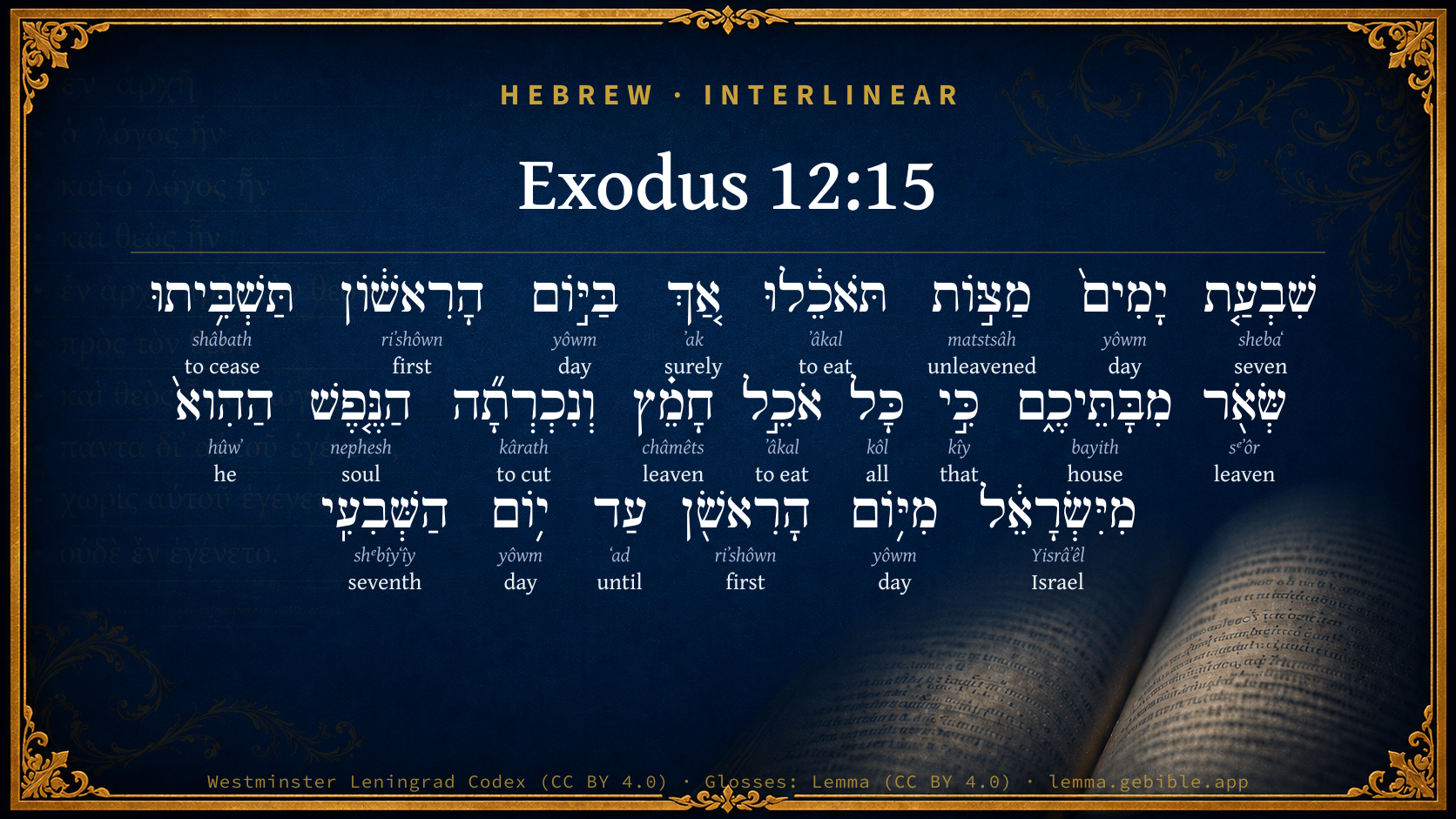
Hebrew (Westminster Leningrad Codex) Exodus 12:15 appears in the Hebrew Old Testament. The text above is from the Westminster Leningrad Codex. Each word links to its Strong’s number, a concise gloss, and parsing drawn from the Open Scriptures Hebrew Bible morphology. Click any word for its full Brown-Driver-Briggs (BDB) entry.
Download image
Cite this verse

Exodus 12:15 (World English Bible). Public Domain. Lemma interlinear Bible study tool, https://lemma.gebible.app/v/exodus/12/15.

Show BibTeX & RIS
BibTeX
RIS
English Translation
Seven days shall you eat unleavened bread; even the first day you shall put away yeast out of your houses, for whoever eats leavened bread from the first day until the seventh day, that soul shall be cut off from Israel.
World English Bible · Public Domain
Highlights
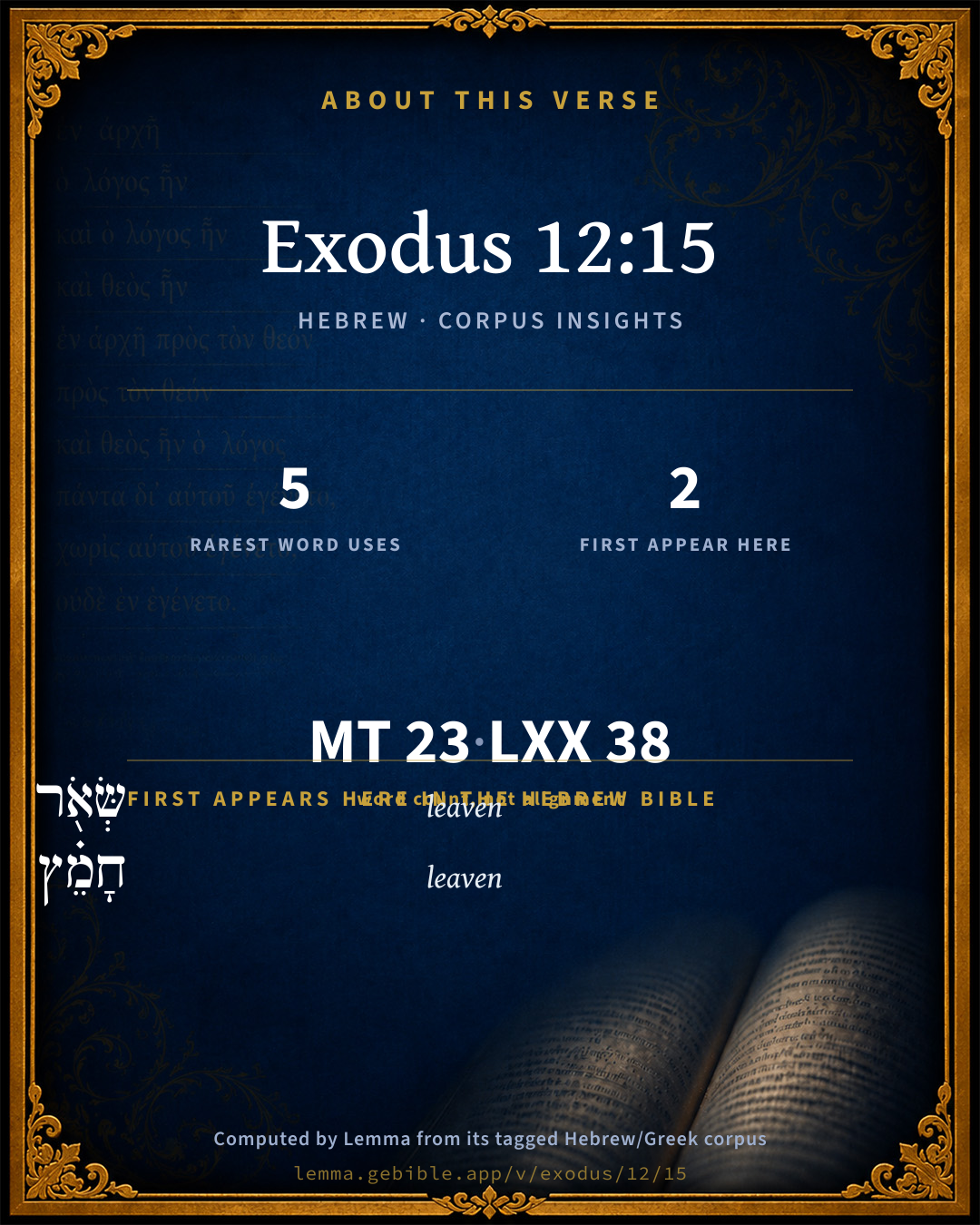
  • 2 first appearances in the Hebrew Bible
Full analysis ↓
Download a study sheet

One document with this verse’s original text, its word-by-word gloss line, the meaning frame, cross-references with their text, attributed commentary, and full source and license credits — printable, and it pastes into notes with its structure intact.

This verse Autodidact and up

Study sheet (.html) Plain text (.txt)

A passage Seminary Student

Up to 50 verses in one chapter. A passage sheet keeps up to 6 commentary sources and 12 cross-references per verse, in the order this page ranks them, and says so on the sheet whenever that leaves anything out. Ask for a single verse and you get the Autodidact verse sheet above.

Everything on this page stays free to read, with no account — the sheet is a download of what is already on screen, not access to it.

Want to remove ads? Support Godless Engineer
Compare translations 3

The same verse in 3 English versions, stacked beneath the original-language interlinear above. Click any original word for its lexicon entry.

Each is an independent rendering of the whole verse — the interlinear is not word-aligned to these translations.

Highlighted words mark where these versions differ — a whole-verse word diff, not a word-by-word alignment.

  • World English Bible Public Domain
    Seven days shall you eat unleavened bread; even the first day you shall put away yeast out of your houses, for whoever eats leavened bread from the first day until the seventh day, that soul shall be cut off from Israel.
  • King James Version Public Domain
    Seven days shall ye eat unleavened bread; even the first day ye shall put away leaven out of your houses: for whosoever eateth leavened bread from the first day until the seventh day, that soul shall be cut off from Israel.
  • unfoldingWord Literal Text CC BY-SA 4.0
    You shall eat unleavened bread for seven days. Yes—on the first day you shall remove yeast from your houses, because anyone who eats leavened bread from the first day until the seventh day, that person shall be cut off from Israel.

unfoldingWord Literal Text — © unfoldingWord, licensed CC BY-SA 4.0. Word-aligned USFM3 via Door43 (git.door43.org/unfoldingWord/en_ult).

Versions to compare (up to 4)

3 of 4 selected

Show all 18 translations

Every available English version of this verse, each an independent rendering of the whole verse.

  • World English Bible Public Domain
    Seven days shall you eat unleavened bread; even the first day you shall put away yeast out of your houses, for whoever eats leavened bread from the first day until the seventh day, that soul shall be cut off from Israel.
  • Berean Standard Bible Public Domain
    For seven days you must eat unleavened bread. On the first day you are to remove the leaven from your houses. Whoever eats anything leavened from the first day through the seventh must be cut off from Israel.
  • Majority Standard Bible Public Domain
    For seven days you must eat unleavened bread. On the first day you are to remove the leaven from your houses. Whoever eats anything leavened from the first day through the seventh must be cut off from Israel.
  • King James Version Public Domain
    Seven days shall ye eat unleavened bread; even the first day ye shall put away leaven out of your houses: for whosoever eateth leavened bread from the first day until the seventh day, that soul shall be cut off from Israel.
  • American Standard Version (1901) Public Domain
    Seven days shall ye eat unleavened bread; even the first day ye shall put away leaven out of your houses: for whosoever eateth leavened bread from the first day until the seventh day, that soul shall be cut off from Israel.
  • Revised Version (1885) Public Domain
    Seven days shall ye eat unleavened bread; even the first day ye shall put away leaven out of your houses: for whosoever eateth leavened bread from the first day until the seventh day, that soul shall be cut off from Israel.
  • Geneva Bible (1599) Public Domain
    Seuen daies shall ye eat vnleauened bread, and in any case ye shall put away leauen the first day out of your houses: for whosoeuer eateth leauened bread from the first daie vntill the seuenth day, that person shalbe cut off from Israel.
  • Douay-Rheims (1899) Public Domain
    Seven days shall you eat unleavened bread: in the first day there shall be no leaven in your houses: whosoever shall eat any thing leavened, from the first day until the seventh day, that soul shall perish out of Israel.
  • Young's Literal Translation Public Domain
    Seven days ye eat unleavened things; only -- in the first day ye cause leaven to cease out of your houses; for any one eating anything fermented from the first day till the seventh day, even that person hath been cut off from Israel.
  • Literal Standard Version CC BY-SA 4.0
    Seven days you eat unleavened things; only—in the first day you cause leaven to cease out of your houses; for anyone eating anything fermented from the first day until the seventh day, indeed, that person has been cut off from Israel.
  • Unlocked Literal Bible CC BY-SA 4.0
    You will eat bread without yeast during seven days. On the first day you will remove the yeast from your houses. Whoever eats leavened bread from the first day until the seventh day, that person must be cut off from Israel.
  • unfoldingWord Literal Text CC BY-SA 4.0
    You shall eat unleavened bread for seven days. Yes—on the first day you shall remove yeast from your houses, because anyone who eats leavened bread from the first day until the seventh day, that person shall be cut off from Israel.
  • Darby Bible Public Domain
    Seven days shall ye eat unleavened bread: on the very first day ye shall put away leaven out of your houses; for whoever eateth leavened bread from the first day until the seventh day -- that soul shall be cut off from Israel.
  • World Messianic Bible Public Domain
    “‘Seven days you shall eat unleavened bread; even the first day you shall put away yeast out of your houses, for whoever eats leavened bread from the first day until the seventh day, that soul shall be cut off from Israel.
  • Webster's Bible Public Domain
    Seven days shall ye eat unleavened bread; even the first day ye shall put away leaven out of your houses: for whoever eateth leavened bread, from the first day till the seventh day, that soul shall be cut off from Israel.
  • Free Bible Version CC BY-SA 4.0
    For seven days you must eat only bread made without yeast. On the first day you are to get rid of the yeast from your houses. Anyone who eats anything with yeast from the first day to the seventh day must be excluded from the Israelite community.
  • Bible in Basic English Public Domain
    For seven days let your food be unleavened bread; from the first day no leaven is to be seen in your houses: whoever takes bread with leaven in it, from the first till the seventh day, will be cut off from Israel.
  • JPS Tanakh (1917) Public Domain
    Seven days shall ye eat unleavened bread; howbeit the first day ye shall put away leaven out of your houses; for whosoever eateth leavened bread from the first day until the seventh day, that soul shall be cut off from Israel.

Literal Standard Version (2020), Covenant Press — licensed CC BY-SA 4.0. Text via the HelloAO Bible API (eBible.org). Unlocked Literal Bible (unfoldingWord) — licensed CC BY-SA 4.0. Text via the HelloAO Bible API (eBible.org). unfoldingWord Literal Text — © unfoldingWord, licensed CC BY-SA 4.0. Word-aligned USFM3 via Door43 (git.door43.org/unfoldingWord/en_ult). Free Bible Version, Dr. Jonathan Gallagher — licensed CC BY-SA 4.0. Text via the HelloAO Bible API (eBible.org).

Word by word

More ways to search: Search by grammar → Find every occurrence → Compare this word →

Practice this passage: Drill this verse → Learn its vocabulary →

שְּׂאֹ֖ר
sᵉʼôr
H7603
“leaven”
Noun, Common, Masculine, Singular, Absolute
Part of Speech
Noun
Type
Common
Gender
Masculine
Number
Singular
State
Absolute
Full BDB Definition

Origin: from H7604

TWOT: 2229a

leaven
  1. שִׁבְעַ֤ת shebaʻ H7651 “seven” Adjective, Cardinal number, Masculine, Singular, Construct
  2. יָמִים֙ yôwm H3117 “days” Noun, Common, Masculine, Plural, Absolute
  3. מַצּ֣וֹת matstsâh H4682 “unleavened bread” Noun, Common, Feminine, Plural, Absolute
  4. תֹּאכֵ֔לוּ ʼâkal H398 “to eat” Verb, Qal, Imperfect, 2nd Person, Masculine, Plural
  5. אַ֚ךְ ʼak H389 “surely” Particle, Accusative
  6. בַּיּ֣וֹם yôwm H3117 “in/at the · day” Preposition, Determined + Noun, Common, Masculine, Singular, Absolute
  7. הָרִאשׁ֔וֹן riʼshôwn H7223 “the · first” Particle, Definite Article + Adjective, Ordinal number, Masculine, Singular, Absolute
  8. תַּשְׁבִּ֥יתוּ shâbath H7673 “to cease” Verb, Hiphil, Imperfect, 2nd Person, Masculine, Plural
  9. מִבָּתֵּיכֶ֑ם bayith H1004 “from · houses · your” Preposition + Noun, Common, Masculine, Plural, Construct + Suffix, Personal, 2nd Person, Masculine, Plural
  10. כִּ֣י kîy H3588 “that” Conjunction
  11. כָּל kôl H3605 “all of” Noun, Common, Masculine, Singular, Construct
  12. אֹכֵ֣ל ʼâkal H398 “eating” Verb, Qal, Participle Active, Masculine, Singular, Absolute
  13. חָמֵ֗ץ châmêts H2557 “leaven” Noun, Common, Masculine, Singular, Absolute
  14. וְנִכְרְתָ֞ה kârath H3772 “and · to cut” Conjunction + Verb, Niphal, Sequential Perfect, 3rd Person, Feminine, Singular
  15. הַנֶּ֤פֶשׁ nephesh H5315 “the · soul” Particle, Definite Article + Noun, Common, Both, Singular, Absolute
  16. הַהִוא֙ hûwʼ H1931 “the · he” Particle, Definite Article + Pronoun, Personal, 3rd Person, Feminine, Singular
  17. מִיִּשְׂרָאֵ֔ל Yisrâʼêl H3478 “from · Israel” Preposition + Noun, Proper
  18. מִיּ֥וֹם yôwm H3117 “from · day of” Preposition + Noun, Common, Masculine, Singular, Construct
  19. הָרִאשֹׁ֖ן riʼshôwn H7223 “the · first” Particle, Definite Article + Adjective, Ordinal number, Masculine, Singular, Absolute
  20. עַד ʻad H5704 “until” Preposition
  21. י֥וֹם yôwm H3117 “day of” Noun, Common, Masculine, Singular, Construct
  22. הַשְּׁבִעִֽי shᵉbîyʻîy H7637 “the · seventh” Particle, Definite Article + Adjective, Ordinal number, Masculine, Singular, Absolute

About this verse

These counts appear in no published source. They are computed here, from the morphology-tagged text and Lemma’s own curated glosses. What Lemma adds →

23
words
18
distinct lemmas
Pentateuch
section

Notable vocabulary

The rarest word here is שְּׂאֹ֖ר leaven H7603 — appearing just 5 times in the whole Hebrew Bible.

First appearance in Scripture

These words make their first canonical appearance in the Hebrew Bible here:

  • שְּׂאֹ֖ר leaven H7603
  • חָמֵ֗ץ leaven H2557

Shared distinctive vocabulary

שְּׂאֹ֖ר leaven H7603 occurs in 5 verses of the Hebrew Bible. Also found in:

Grammatical profile

  • 4 verbs
  • 11 nouns
  • 4 adjectives
  • 1 pronoun
  • 1 preposition
  • 1 conjunction
  • 1 particle

Verb forms

  • תֹּאכֵ֔לוּ Qal · Imperfect
  • תַּשְׁבִּ֥יתוּ Hiphil · Imperfect
  • אֹכֵ֣ל Qal · Participle Active
  • וְנִכְרְתָ֞ה Niphal · Sequential Perfect

Repetition

Words recur within this verse — often emphatic in Hebrew:

  • יָמִים֙ day H3117 ×4
  • תֹּאכֵ֔לוּ to eat H398 ×2
  • הָרִאשׁ֔וֹן first H7223 ×2

Hebrew & Septuagint length

In English translation the verse runs 41 words from the Hebrew and 40 from the Septuagint (LXX English) — closely comparable.

A rough comparison of the two English renderings, which tokenize alike — not a word-level alignment.

Word counts can differ between the Hebrew and the Greek without any difference in meaning — e.g. the Hebrew direct-object marker אֵת has no separate Greek word, and Greek often adds the article ὁ.

In the original languages it is 23 Hebrew tokens and 38 Greek tokens — but the two are counted differently (Hebrew bundles its prefixes and suffixes into one token; the Greek is in lemma form), so that isn’t a like-for-like length.

Cross-references

22

Topical passages linked to Exodus 12:15 in the Treasury of Scripture Knowledge — connected by theme and wording, ordered by reader-vote popularity; previews shown in the World English Bible.

  • Genesis 17:14 The uncircumcised male who is not circumcised in the flesh of his foreskin, that soul shall be cut off from his people. He has broken my covenant."
  • Deuteronomy 16:3 You shall eat no leavened bread with it; seven days shall you eat unleavened bread therewith, even the bread of affliction; for you came forth out of the land of Egypt in haste: that you may remember the day when you came forth out of the land of Egypt all the days of your life.
  • Exodus 23:15 You shall observe the feast of unleavened bread. Seven days you shall eat unleavened bread, as I commanded you, at the time appointed in the month Abib (for in it you came out from Egypt), and no one shall appear before me empty.
  • Exodus 34:18 "You shall keep the feast of unleavened bread. Seven days you shall eat unleavened bread, as I commanded you, at the time appointed in the month Abib; for in the month Abib you came out from Egypt.
  • Numbers 9:13 But the man who is clean, and is not on a journey, and fails to keep the Passover, that soul shall be cut off from his people. Because he didn't offer the offering of Yahweh in its appointed season, that man shall bear his sin.
  • Numbers 28:17 On the fifteenth day of this month shall be a feast: seven days shall unleavened bread be eaten.
  • Deuteronomy 16:8 Six days you shall eat unleavened bread; and on the seventh day shall be a solemn assembly to Yahweh your God; you shall do no work [therein].
  • Exodus 12:8 They shall eat the flesh in that night, roasted with fire, and unleavened bread. They shall eat it with bitter herbs.
  • Exodus 12:19–20 Seven days shall there be no yeast found in your houses, for whoever eats that which is leavened, that soul shall be cut off from the congregation of Israel, whether he be a foreigner, or one who is born in the land.
  • Exodus 34:25 "You shall not offer the blood of my sacrifice with leavened bread; neither shall the sacrifice of the feast of the Passover be left to the morning.
  • 1 Corinthians 5:7–8 Purge out the old yeast, that you may be a new lump, even as you are unleavened. For indeed Christ, our Passover, has been sacrificed in our place.
  • Exodus 13:6–10 Seven days you shall eat unleavened bread, and in the seventh day shall be a feast to Yahweh.
  • Exodus 31:14 You shall keep the Sabbath therefore; for it is holy to you. Everyone who profanes it shall surely be put to death; for whoever does any work therein, that soul shall be cut off from among his people.
  • Leviticus 17:10 "'Any man of the house of Israel, or of the strangers who live as foreigners among them, who eats any kind of blood, I will set my face against that soul who eats blood, and will cut him off from among his people.
  • Leviticus 17:14 For as to the life of all flesh, its blood is with its life: therefore I said to the children of Israel, "You shall not eat the blood of any kind of flesh; for the life of all flesh is its blood. Whoever eats it shall be cut off."
  • Leviticus 23:5–8 In the first month, on the fourteenth day of the month in the evening, is Yahweh's Passover.
  • Deuteronomy 16:5 You may not sacrifice the Passover within any of your gates, which Yahweh your God gives you;
  • Malachi 2:12 Yahweh will cut off, to the man who does this, him who wakes and him who answers, out of the tents of Jacob, and him who offers an offering to Yahweh of Hosts.
  • Matthew 16:12 Then they understood that he didn't tell them to beware of the yeast of bread, but of the teaching of the Pharisees and Sadducees.
  • Luke 12:1 Meanwhile, when a multitude of many thousands had gathered together, so much so that they trampled on each other, he began to tell his disciples first of all, "Beware of the yeast of the Pharisees, which is hypocrisy.
  • Acts 12:3 When he saw that it pleased the Jews, he proceeded to seize Peter also. This was during the days of unleavened bread.
  • Galatians 5:12 I wish that those who disturb you would cut themselves off.

Cross-references courtesy of OpenBible.info (CC BY 4.0).

Hebrew and Greek witnesses Masoretic Hebrew ↔ Greek Septuagint

The same verse in the two great witnesses to the Old Testament, shown verse-for-verse.

These are two independent witnesses, not word-aligned to each other, and the Septuagint is shown in lemma (dictionary) form.

Hebrew Exodus 12:15 Masoretic · Westminster Leningrad Codex

שִׁבְעַ֤ת יָמִים֙ מַצּ֣וֹת תֹּאכֵ֔לוּ אַ֚ךְ בַּיּ֣וֹם הָרִאשׁ֔וֹן תַּשְׁבִּ֥יתוּ שְּׂאֹ֖ר מִבָּתֵּיכֶ֑ם כִּ֣י כָּל אֹכֵ֣ל חָמֵ֗ץ וְנִכְרְתָ֞ה הַנֶּ֤פֶשׁ הַהִוא֙ מִיִּשְׂרָאֵ֔ל מִיּ֥וֹם הָרִאשֹׁ֖ן עַד י֥וֹם הַשְּׁבִעִֽי

Seven days shall you eat unleavened bread; even the first day you shall put away yeast out of your houses, for whoever eats leavened bread from the first day until the seventh day, that soul shall be cut off from Israel.

World English Bible · Public Domain

Greek LXX Exodus 12:15 Septuagint · lemma form

ἑπτά ἡμέρα ἄζυμος ἐσθίω ἀπό δέ ὁ ἡμέρα ὁ πρῶτος ἀπο ἀναἵζω ζυμή ἐκ ὁ οἰκία σύ πᾶς ὅς ἄν ἐσθίω ζυμή ἐκὀλεθρεύω ὁ ψυχή ἐκεῖνος ἐκ ἰσραήλ ἀπό ὁ ἡμέρα ὁ πρῶτος ἕως ὁ ἡμέρα ὁ ἕβδομος

Seven days you⌃ shall eat unleavened bread, and from the first day you⌃ shall utterly remove leaven from your houses: whoever shall eat leaven, that soul shall be utterly destroyed from Israel, from the first day until the seventh day.

LXX2012 (modern English Septuagint) · Public Domain

Hebrew: Westminster Leningrad Codex (CC BY 4.0). Greek: Septuagint (public domain); English from LXX2012 (modern English Septuagint) (Public Domain). How the Septuagint differs from the Hebrew →

Targum (Aramaic paraphrase)

2

The Targum is the ancient Jewish Aramaic paraphrase of the Hebrew Scriptures — an interpretive translation, not the Hebrew text itself. Onkelos (literal) and Pseudo-Jonathan (expansive) render the Torah, and Jonathan the Prophets. Coverage is partial: where no permissively-licensed English translation exists for a verse, only the Aramaic is shown. This is verse-level text, not a word-by-word alignment to the Hebrew.

  1. Targum Onkelos Torah (Genesis–Deuteronomy)
    שִׁבְעַת יוֹמִין פַּטִיר תֵּיכְלוּן בְּרַם בְּיוֹמָא קַדְמָאָה תְּבַטְלוּן חֲמִיעַ מִבָּתֵּיכוֹן אֲרֵי כָּל דְיֵכוּל חֲמִיעַ וְיִשְׁתֵּצֵי אֱנָשָׁא הַהוּא מִיִשְׂרָאֵל מִיוֹמָא קַדְמָאָה עַד יוֹמָא שְׁבִיעָאָה:

    Seven days, that which is unleavened you will eat. Though, on the first day, you will prohibit that which is leavened from your houses; because, all who eat that which is leavened will also be taken down, that person, from Israel, from the first day into the seventh day.

    Targum Onkelos — Aramaic: “Onkelos Genesis” (public domain); “Onkelos Exodus” (public domain); “Onkelos Leviticus” (public domain); “Onkelos Numbers” (public domain); “Onkelos Deuteronomy” (public domain). English: “Sefaria Community Translation” (CC0 1.0 (public-domain dedication)); “J.W. Etheridge. The Targums of Onkelos and Jonathan Ben Uzziel on the Pentateuch. London: Longmans, Green, 1862” (public domain). Text via Sefaria.

  2. Targum Pseudo-Jonathan Torah (Genesis–Deuteronomy)
    שַׁבְעַת יוֹמִין פַּטִּירָא תֵיכְלוּן בְּרַם מִפַּלְגוּת יוֹמָא דְמִיקַמֵּי חַגָּא תְבַטְּלוּן חָמִיר מִבָּתֵּיכוֹן אֲרוּם כָּל דְּיֵיכוּל חָמִיעַ וְיִשְׁתֵּיצֵי אֵינָשָׁא הַהוּא מִיִּשְרָאֵל לְמִיּוֹמָא קַדְמָאָה דְחַגָּא וְעַד יוֹמָא שְׁבִיעָאָה

    Seven days you shall eat unleavened bread: in the dividing of the day which precedes the feast you shall put away leaven from your houses; for whosoever eateth what is leavened, from the first day of the feast until the seventh day, that man shall be destroyed from Israel.

    Targum Pseudo-Jonathan — Aramaic: “Targum Jonathan on Genesis” (public domain); “Targum Jonathan on Exodus” (public domain); “Targum Jonathan on Leviticus” (public domain); “Targum Jonathan on Numbers” (public domain); “Targum Jonathan on Deuteronomy” (public domain). English: “The Targum of Jonathan ben Uzziel, trans. J. W. Etheridge, London, 1862” (public domain). Text via Sefaria.

Commentary

Notes on Exodus 12:15 from classic Christian and Jewish commentators (each source and its license shown beneath its notes). The classic Christian expositions comment on the surrounding passage and are grouped to its opening verse, so a note may address several verses; the Jewish commentaries on the Tanakh (Rashi and others) are per-verse, so they appear only where the commentator wrote on this verse.

Lemma curates 59 commentaries, every one of them public domain or Creative Commons licensed, each selected and text-cleaned for this edition rather than reprinted as found. About our sources →

Jamieson, Fausset & Brown

Robert Jamieson, A. R. Fausset & David Brown

UNLEAVENED BREAD. (Exo. 12:15-51)

Seven days shall ye eat unleavened bread, &c.--This was to commemorate another circumstance in the departure of the Israelites, who were urged to leave so hurriedly that their dough was unleavened (Exo 12:39), and they had to eat unleavened cakes (Deu 16:3). The greatest care was always taken by the Jews to free their houses from leaven--the owner searching every corner of his dwelling with a lighted candle. A figurative allusion to this is made (Co1 5:7). The exclusion of leaven for seven days would not be attended with inconvenience in the East, where the usual leaven is dough kept till it becomes sour, and it is kept from one day to another for the purpose of preserving leaven in readiness. Thus even were there none in all the country, it could be got within twenty-four hours [HARMER].

that soul shall be cut off--excommunicated from the community and privileges of the chosen people.

Jamieson, Fausset & Brown — Commentary Critical and Explanatory on the Whole Bible (1871) — public domain (CC PDM 1.0). Text via the HelloAO Bible API.

Trapp's Complete Commentary

John Trapp

Exo 12:15 Seven days shall ye eat unleavened bread; even the first day ye shall put away leaven out of your houses: for whosoever eateth leavened bread from the first day until the seventh day, that soul shall be cut off from Israel.

Ver. 15. Ye shall put away leaven.] All unsoundness in point of faith, and insincerity in point of practice. {See Trapp on "1Co 5:7"} The Jews, at this day, on the night before their passover, search and sweep every mouse hole for crumbs of leaven with wax candles. If they find none, they purposely fling down some, that they might not seem to have prayed and laboured in vain.

John Trapp, A Commentary or Exposition upon All the Books of the Old and New Testament (1647–1656) — public domain. Text from a community e-Sword module.

The Biblical Illustrator

Joseph S. Exell

Exo_12:15-19

The feast of unleavened bread.

The feast of unleavened bread; or, the ordinances of God, and the manner in which they should be observed

The feast of unleavened bread was a distinct ordinance from the Passover, though following immediately upon it. At this feast the Israelites were to eat unleavened bread; probably to commemorate the fact that they had left Egypt in such haste that they had no opportunity to leaven their dough, and were consequently obliged to eat unleavened cakes. It would also remind them of the power of God in bringing them out of Egypt when they were without provision for their journey, and it would teach them a lesson of trust in the Divine providence. This feast was an ordinance of God. We observe in reference to it--

I. That the ordinances of God are clearly made known and enjoined upon man.

1. Divinely authorized.

2. Morally beneficial.

3. Wofully neglected.

This neglect is prevalent; it is fearful; it is inexcusable; it is morally injurious; it will ultimately meet with its due punishment.

II. That the ordinances of God are to be observed in a spirit and temper free from sin.

1. In a spirit free from hypocrisy.

2. In a spirit free from malice and bitterness.

3. The home-life must be in sympathy with Gods ordinances.

What we are at home we shall be in the ordinances of God. The home-life and the ordinary worship are inseparable; they are part of the same service, and must be pure.

III. That the ordinances of God are to be observed with solemnity and propreity of moral conduct and demeanor.

IV. That those who profane the ordinances of God are unworthy of them, and should be denied the privilege of them. That soul shall be cut off from Israel. Lessons:

1. That there are in connection with the Church of God many ordinances to be observed by men.

2. That these ordinances should be observed with due solemnity and appropriate conduct.

3. That neglect of these ordinances is disobedience to the command of God. (J. S. Exell, M. A.)

The Biblical Illustrator, edited by Joseph S. Exell (c. 1880s–1900s) — public domain. Text from a community e-Sword module.

Tyndale Open Study Notes

Tyndale Open Resources

12:15 without yeast: Israel needed unleavened bread for traveling (see 12:34, 39), which the festival commemorated. Later, yeast was seen as an image of sin, probably because it is an agent of fermentation (“Beware of the yeast of the Pharisees,” Matt 16:6). • cut off from the community: This means either death or expulsion from the community.

Tyndale Open Study Notes — © Tyndale Open Resources, licensed CC BY-SA 4.0. Text via the HelloAO Bible API.

Adam Clarke's Commentary

Verse 15. Seven days shall ye eat unleavened bread] This has been considered as a distinct ordinance, and not essentially connected with the passover. The passover was to be observed on the fourteenth day of the first month; the feast of unleavened bread began on the fifteenth and lasted seven days, the first and last of which were holy convocations.

That soul shall be cut off] There are thirty-six places in which this excision or cutting off is threatened against the Jews for neglect of some particular duty; and what is implied in the thing itself is not well known. Some think it means a violent death, some a premature death, and some an eternal death. It is very likely that it means no more than a separation from the rights and privileges of an Israelite; so that after this excision the person was considered as a mere stranger, who had neither lot nor part in Israel, nor any right to the blessings of the covenant. This is probably what St. Paul means, Ro 9:3. But we naturally suppose this punishment was not inflicted but on those who had showed a marked and obstinate contempt for the Divine authority. This punishment appears to have been nearly the same with excommunication among the Christians; and from this general notion of the cutting off, the Christian excommunication seems to have been borrowed.

Adam Clarke's Commentary on the Bible (1810–1826) — public domain. Text from a community e-Sword/MySword module.

Ellicott's Commentary for English Readers

(15) Seven days.—The division of time into periods of seven days each was unknown to the more ancient Egyptians, but is thought to have existed in Babylonia as early as B.C. 2000. That it was recognised in the family of Abraham appears from Gen_29:27. According to some, God established the division by an express command to our first parents in Paradise that they should keep the seventh day holy (see Gen_2:3); but this is greatly questioned by others, who regard Gen_2:3 as anticipatory, and think the Sabbath was not instituted until the giving of the manna (Exo_16:23). However this may have been, it is generally allowed that the Israelites had not observed the seventh day in Egypt. where, indeed, they were held to labour continually. and that the Sabbath as an actual observance dates from the Exodus. The injunction here given, if it belongs to the time of the tenth plague, would be the first preliminary note of warning with respect to the Sabbath, raising an expectation of it, and preparing the way for it, leading up to the subsequent revelations in the wilderness of Sin and at Sinai.

Ye shall put away leaven out of your houses.—There was to be no compromise, nothing resembling half measures. Leaven, taken as typical of corruption, was to be wholly put away, not allowed by any householder to lurk anywhere within his house—a solemn warning that we are to make no compromise with sin.

That soul shall be cut off from Israel.—See the Note on Gen_17:14.

A Bible Commentary for English Readers, edited by Charles John Ellicott (1878–1897) — public domain. Text from a community e-Sword module.

The Cambridge Bible for Schools and Colleges

gen. ed. J. J. S. Perowne

15. Seven days] from the 15th to the 21st of the first month.

unleavened cakes] See on v. 8. So vv. 17, 18, 20 (on v. 39, see note).

even] rather, surely: cf. in the Heb. Exo_31:13, Lev_23:27; Lev_23:39, Num_1:49.

put away] Heb. make to cease. The later Hebrews were very punctilious in carrying out this injunction; and even before the Passover (which was also eaten with unleavened cakes, v. 8), the house was elaborately searched with candles in order to discover and remove any ‘leaven’ (i.e. fermented dough, or certain articles made of fermented grain: see EB. iii. 2753) that might be in it (Pesâḥim i.–iii.). See an illustration of the search for leaven, from a drawing of 1725, in the Jewish Encyclopaedia, ix. 548; or, on a smaller scale, in Oesterley and Box, The Religion and Worship of the Synagogue (1907), p. 210.

leaven] Heb. se’ôr,—in practice (see Leaven in EB.; cf. i. 604), a piece of sour (i.e. fermented) dough, reserved for the purpose from the previous day’s baking.

Leaven was regarded as produced by corruption (cf. on Exo_23:18 a, and Plut. Quaest. Rom. 109 ‘Now leaven is itself the offspring of corruption, and corrupts the lump (φύραμα) with which it is mixed’); and so in the NT. it becomes a figure of corrupt teaching or practice, Mat_16:6 (= Mar_8:15 = Luk_12:1), 11: St Paul twice quotes the saying, ‘A little leaven leaveneth the whole lump’ (1Co_5:6, Gal_5:9), with reference to moral corruption: and in 1Co_5:7-8, with evident reference to the injunction here, bids Christians ‘clear away the old leaven,’ and ‘keep the feast’ of their Passover, Christ (i.e. live the Christian life), with the ‘unleavened bread of sincerity and truth.’

that soul shall be cut off from Israel] a formula, with slight variations (as he or that man for that soul; and from his father’s kin or from the congregation for from Israel), very common in P: v. 19, Gen_17:14, Exo_30:37-38; Exo_31:14, Lev_7:20-21; Lev_7:25; Lev_7:27; Lev_17:4; Lev_17:9; Lev_18:29; Lev_19:8; Lev_20:17-18; Lev_22:3; Lev_23:29, Num_9:13; Num_15:30-31; Num_19:13; Num_19:20† (cf. with the first person, I will cut off …, Lev_17:10; Lev_20:3; Lev_20:5-6†; I will destroy …, Lev_23:30†). The offence for which this is the penalty is usually neglect of some ceremonial observance, and only occasionally a moral offence, or idolatry. The punishment intended is not death by the civil power (which would be out of the question in many of the cases in which ‘cutting off’ is prescribed, and which is moreover denoted regularly by the formula, ‘shall be put to death’), but excommunication (cf. Ezr_10:8), combined with a threat of divine interposition to root out the evil-doer, as is clear from the variants in which the first person is used (Di. on Gen_17:14).

The Cambridge Bible for Schools and Colleges (gen. ed. J. J. S. Perowne; Cambridge University Press, 1878–1918) — public domain. Text from a community e-Sword module.

John Gill's Exposition

Seven days shall ye eat unleavened bread,.... From the evening of the fourteenth day to the evening of the twenty first; and this was a distinct festival from what was properly called the feast of the passover, and does not respect the first passover in Egypt; for though the passover lamb was eaten with unleavened bread, and the Israelites ate no other, not only for seven days, but for thirty days following; yet this was not only by the divine command, but through necessity, they having no other bread to eat; but in later times they were commanded to keep a feast for seven days, in which they were not to eat leavened bread, in commemoration of their hasty departure out of Egypt, not having time to leaven the dough in their troughs, and of their distress and want of savoury bread:

even the first day ye shall put away leaven out of your houses; out of their dwelling houses, which were to be diligently searched for that purpose, and every hole and crevice in them; and not only their lower rooms, their dining rooms and parlours, but their upper rooms and bedchambers; because it was possible a man might sometimes go into them with a piece of bread in his hand, and drop or leave some of it behind him: yea, synagogues and schools were to be searched, since children might carry thither leavened breads (i): and this search was to be made by the light of a lamp or candle, not by the light of the moon, if in the night; nor by the light of the sun, if in the day, but by the light of a lamp or candle, and not by the light of a torch, or of a lump of fat, or grease, or oil, but by a lamp or candle of wax (k): and this search was to be made at the beginning of the night of the fourteenth of Nisan; yea, it is said that leavened bread was forbidden from the seventh hour of the day, that is, one o'clock in the afternoon and upwards, which is the middle of the day (l): the account of the Misnic doctors is (m),"R. Meir says, that they may eat leaven the whole fifth hour, i.e. eleven o'clock in the morning, and burn it the beginning of the sixth, or twelve o'clock; R. Judah says, they may eat it all the fourth hour, or tenth o'clock, and suspend it the whole fifth hour, and burn it the beginning of the sixth:"

for whosoever eateth leavened bread from the first day until the seventh day; from the first of the seven days to the last of them, beginning at the night at the fourteenth, and ending at the night of the twenty first:

that soul shall be cut off from Israel; either from the commonwealth of Israel, and be disfranchised, and not accounted as an Israelite; or from the Israelitish church state, and have no communion in it, or partake of the ordinances at it; or if it is to be understood of cutting off by death, it is either by the hand of the civil magistrate, or by the immediate hand of God; and is sometimes by the Jews interpreted of a man dying either without children, or before he is fifty years of age, and some even understand it of destruction of soul and body, or of eternal damnation.

(i) Lebush, par. 1. No. 433. sect. 1. 3. 10. Schulcan Aruch, par. 1. No. 433. sect. 3. 10. (k) Lebush & Schulcan ib. sect. 1. (l) Lebush & Schulcan No. 431. sect. 1. (m) Misn. Pesach c. 1. sect. 4.

John Gill's Exposition of the Whole Bible (1746–1763) — public domain (CC PDM 1.0). Text via the HelloAO Bible API.

Albert Barnes' Notes on the Bible

Cut off - The penalty inflicted on those who transgressed the command may be accounted for on the ground that it was an act of rebellion; but additional light is thrown upon it by the typical meaning assigned to leaven by our Lord, Mat 16:6.

Albert Barnes' Notes on the Bible (1834–1885) — public domain. Text from a community e-Sword/MySword module.

Haydock's Catholic Bible Commentary

Perish, either by sudden death, or by forfeiting all the prerogatives of God’s people; (ver. 19) or, his offense shall be deemed mortal. See Genesis xvii. 14. The punishment of Kerith, separation, among the Jews, bore some resemblance to our excommunication. These menaces presuppose, that the law is possible, and that the land of Chanaan be in the possession of the Jews. Thus, the people who were not circumcised during the 40 years’ sojournment in the desert, were not liable to this punishment of separation, as they knew not when the cloud would move, and they would have to march.

George Leo Haydock (1774–1849), Haydock's Catholic Family Bible and Commentary, 1859 edition — public domain. Excludes Psalms (Douay-Rheims chapter numbering differs from Protestant) and Deuterocanonical books (Catholic canon only).

Matthew Poole's English Annotations

Seven days, besides and after the day of eating the passover, which was a distinct feast, and no part of the feast of unleavened bread,

shall ye eat unleavened bread, to remind them of their departure out of Egypt, which was so sudden that they had not leisure to leaven their dough. See Poole on "Exo 12:8".

That soul shall be cut off, either by excommunication, or by death to be inflicted by the magistrate, and, in case of his neglect, by God himself. Nor let any one think that this was too severe a punishment for what may seem no great offence. For this was indeed a very great crime, being a manifest contempt of God, and a rebellion against God’s authority and express command, which surely deserves as severe a punishment as is inflicted upon rebels against their prince, especially considering that the Israelites were the people and subjects of God in a peculiar manner. It was also a tacit renunciation of their religion, and of the covenant of God with them, and of their interest both in that past deliverance out of Egypt, and in the future deliverance by the Messias. See Poole on "Gen 17:14.

Matthew Poole's English Annotations on the Holy Bible (1683–1685) — public domain. Text from a community e-Sword/MySword module.

Whedon's Commentary on the Bible

Daniel D. Whedon

15. Seven days — Through the sacred cycle of days they were to learn the lessons taught by the “bread of affliction.”

That soul shall be cut off — Excommunicated from the sacred body, since such a soul cast off God’s covenant with the covenant sign. The modern Jews make the unleavened bread in thin dry biscuits. They are exceedingly scrupulous to cleanse, at this time, the whole house, searching every dark corner with candles lest a crumb of leavened bread should anywhere be found when this feast begins. Great care is taken that all the vessels in which it is made be perfectly clean, and that it bake rapidly, lest the least fermentation take place.

Daniel D. Whedon (gen. ed.), Commentary on the Old and New Testaments (1874–1909) — public domain. Text from a community e-Sword module.

The Pulpit Commentary

Seven days. There is no indication that the week of seven days was admitted by the ancient Egyptians, or even known to them. Apparently, the nation which first adopted it was that of the Babylonians. Abraham may have brought it with him from "Ur of the Chaldees;" and from him it may have passed to Jacob, and so to Moses. That the week was known in the family of Abraham before the giving of the law, appears Gen_29:27, Gen_29:28. Unleavened bread is typical of purity of heart, leaven being an emblem of corruption (Mat_16:6-12; 1Co_5:7) "Leaven," says Plutarch, "comes from corruption, and corrupts the dough with which it is mixed; and every fermentation seems to be a putrefaction." The primary command to celebrate the first passover with unleavened instead of leavened bread (ver. 8), must be attributed wholly to this symbolism. But the permanent institution of a "feast of unleavened bread," to last a week, had a double bearing. Partly, it was designed to deepen and intensify the conviction that corruption and impurity disqualify for religions service; but it was also partly intended as a commemoration of the fact, that in their hasty flight from Egypt the bread which they took with them was unleavened (ver. 340, and that they were forced to subsist on this for several days. (Compare the double meaning of the "bitter herbs, noticed in the comment on verse 8, ad fin.) The requirement to "put away leaven out of their houses" is probably intended to teach, that for family worship to he acceptable, the entire household must be pure, and that to effect this result the head of the household must, so far as he can, eject the leaven of sin from his establishment. Whosoever eateth shall be out off from Israel. Expelled, i.e, from the congregation, or excommunicated. If a man wilfully transgresses any plain precept of God, even though it be a positive one, he should he severed from the Church, until he confess his fault, and repent, and do penance for it. Such was the "godly discipline" of the primitive Church; and it were well if the Churches of these modern times had more of it.

The Pulpit Commentary (1880–1919), ed. H.D.M. Spence-Jones & Joseph S. Exell — public domain. Text from a community e-Sword module.

unfoldingWord translationNotes

Door43 World Missions Community

that person must be cut off from Israel

The metaphor "cut off" has at least three possible meanings. They can be expressed in active form: 1) "the people of Israel must send him away" or 2) "I will no longer consider him to be one of the people of Israel" or 3) "the people of Israel must kill him." (See: Metaphor and Active or Passive)

an assembly that is set apart to me

This can be stated in active form. AT: "an assembly that you have set apart to me" (See: Active or Passive)

No work will be done on these days

This can be stated in active form. AT: "You will do no work on these days" (See: Active or Passive)

That must be the only work that may be done by you

This can be stated in active form. AT: "That must be the only work that you do" (See: Active or Passive)

translationWords

yeast

cut off

set apart

works

unfoldingWord translationNotes — © Distant Shores Media and the Door43 World Missions Community, licensed CC BY-SA 4.0. Source: git.door43.org/Door43/en_tn.

Rashi

Rabbi Shlomo Yitzchaki (Rashi)

שבעת ימים denotes a septaine (old French) of days.

שבעת ימים מצות תאכלו SEVEN DAYS SHALL YE EAT UNLEAVENED BREAD — But in another passage it slates: (Deuteronomy 16:8) “Six days shalt thou eat unleavened bread”! This teaches regarding the seventh day of the Passover that it is not obligatory to eat unleavened bread on it, but only this is required viz., that one should not eat leavened food. Whence may we derive that the other six days, too, are optinal as regards the eating of unleavened bread? From what Scripture states: “Six days [shalt thou eat unnleavened bread]”. For the following is a Rule by which the Torah may be expounded: Anything that is included in a general statement and goes out (i. e. Scripture singles it out) from this general statement for the purpose of teaching something, does not go out from it in order to teach something regarding itself alone but it goes out from it to teach something about everything that is included in the general statement. Now the seventh day is included in the general statement “Seven days shall ye eat unleavened bread”, and in the text “Six days shall thou eat unleavened bread” it has left the general statement. How is it with the seventh day? It is optional as regards the eating of unleavened bread, (as explained in the earlier portion of this comment)! This, according to the above rule, applies also to everything that was included in the general statement i. e. to the whole seven days, and therefore the other six days are also optional in this respect! One might think that the first night of the Passover is also optional (since it is part of the first day when as we have just shown the eating of unleavened bread is optional), therefore Scripture states, (v. 18) “at evening ye shall eat unleavened bread” Scripture thus fixes it as obligatory for that night (Pesachim 120a).

אך ביום הראשון תשביתו שאור EVEN THE FIRST DAY YE SHALL HAVE PUT AWAY LEAVEN — This means on the eve of the festival ye shall put it away — and that day is termed “the first (הראשון) day” because it is immediately before the seven days: We find in another passage, too, that a thing which precedes another is termed ראשון, as in (Job. 15:7) “Wast thou born ראשון Adam”, i. e. wast thou born before Adam? — But perhaps the text it referring only to the first of the seven days (i. e. the word ראשון has its ordinary meaning of first, and leavened food must be removed on the first day of the Festival and not on the preceding day)! Scripture, however, states: (Exodus 34:25) “Thou shalt not offer together with leaven [the blood of my sacrifice]” — i. e. thou shalt not slaughter the Passover sacrifice whilst leavened bread is still existent (but the Passover sacrifice was slaughtered on the afternoon of the day before the first day of the Festival; consequently all leavened food must have been removed by the hour of slaughter)(Mekhilta; cf. Pesachim 5a).

הנפש ההיא [FOR WHOSOEVER EATETH ANYTHING LEAVENED..] THAT SOUL [SHALL BE CUT OFF] — if it eats unleavened bread when it is in its will (נפש) and with its full consciousness — this would exclude one who does so being under some external compulsion (force majeure) (cf. Mekhilta).

מישראל [THAT SOUL SHALL BE CUT OFF] FROM ISRAEL — I might understand from this that he shall be cut off from Israel and that he will be able to betake himself to another nation! Scripture therefore states in another passage, (Leviticus 22:3) “[that soul shall be cut off] from my presence” — in every place that is My territory (i. e. everywhere) (Mekhilta).

Rashi on the Tanakh — English translations: “The Judaica Press complete Tanach with Rashi, translated by A. J. Rosenberg” (CC BY 4.0); “Pentateuch with Rashi's commentary by M. Rosenbaum and A.M. Silbermann, 1929-1934” (public domain); “The Metsudah Tanach series, Lakewood, N.J” (CC BY 4.0); and “The Book of Joshua, Metsudah Publications, 1997” (CC BY 4.0). Text via Sefaria.

Lesson kit

Teaching starters — assembled from the data on this page, not authored interpretation. Every prompt links to the verse data it draws on. Edit before teaching.

Exodus, in the Pentateuch, opens this verse with 23 words (18 distinct Hebrew lemmas). Its most distinctive word is sᵉʼôr (“leaven”). A historical commentator’s framing appears above. Read the whole chapter for the surrounding context.

Discussion questions

  1. How does “leaven” (sᵉʼôr) shape what this verse is saying?
  2. 2 words make their first appearance in Scripture here. What does this debut establish?
  3. How does Exodus 12:19, which shares the word «leaven», read alongside this verse?
  4. What does the repetition of “day” (4× in this one verse) do in this verse?
  5. These translations render this verse differently; the difference is in the English rendering, not the original. What questions does that raise?
  6. «תֹּאכֵ֔לוּ» is a Qal Imperfect verb. How does that grammatical form shape the action described?
  7. Compare how Jamieson, Fausset & Brown and Trapp's Complete Commentary read this verse. Where do they agree or differ?

Things to notice

Reading settings

Reading text

Shown beneath each verse's original-language words.

Old Testament
Old Testament edition

Read the OT as the Masoretic Hebrew (MT) or the Greek Septuagint (LXX).

English shown for the Greek Septuagint (in the Hebrew ↔ Greek comparison).

Comparing translations? Open the Compare panel on any verse page to stack up to four side by side.