Isaiah 61:8

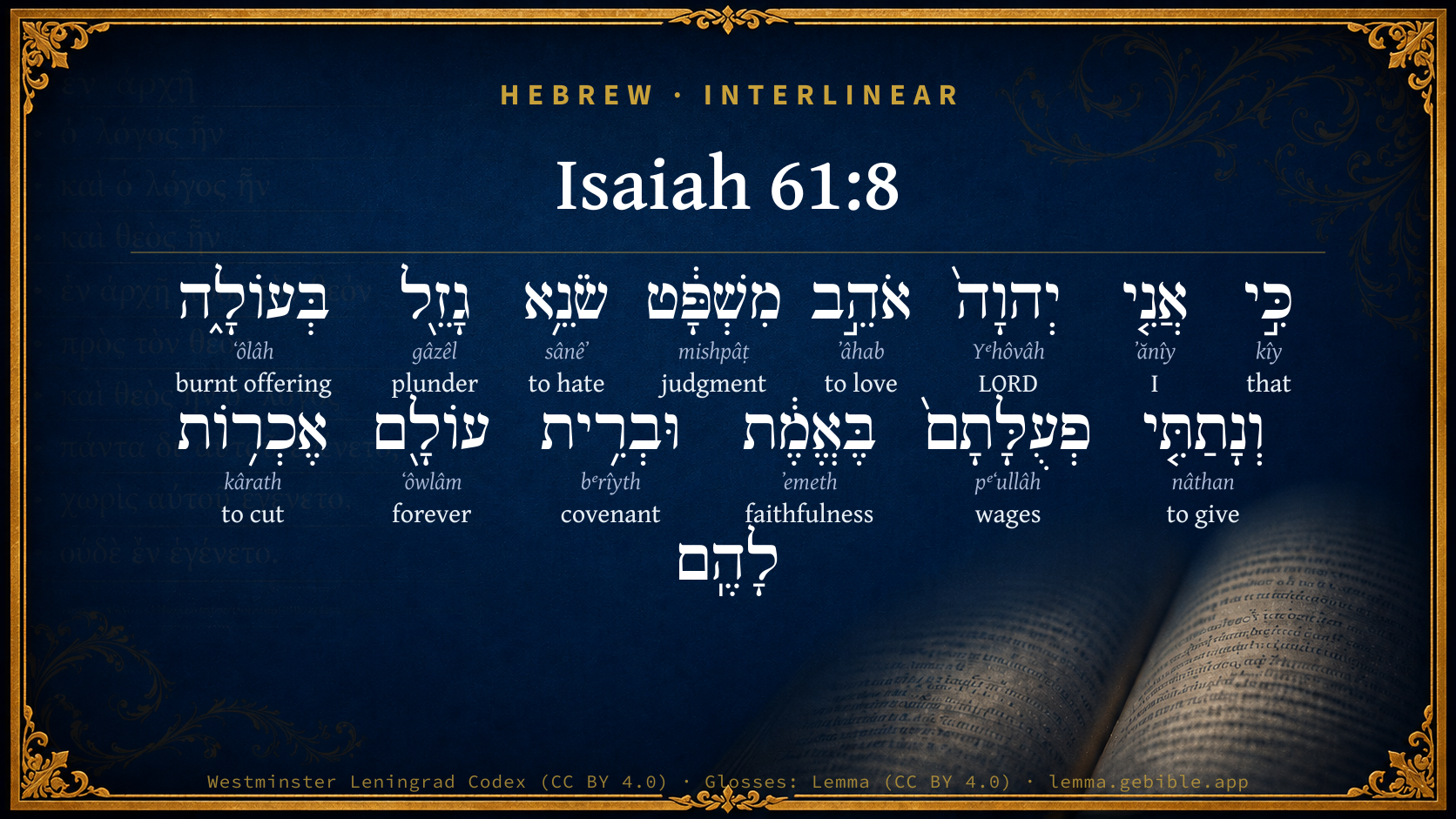
Hebrew (Westminster Leningrad Codex) Isaiah 61:8 appears in the Hebrew Old Testament. The text above is from the Westminster Leningrad Codex. Each word links to its Strong’s number, a concise gloss, and parsing drawn from the Open Scriptures Hebrew Bible morphology. Click any word for its full Brown-Driver-Briggs (BDB) entry.
Download image
Cite this verse

Isaiah 61:8 (World English Bible). Public Domain. Lemma interlinear Bible study tool, https://lemma.gebible.app/v/isaiah/61/8.

Show BibTeX & RIS
BibTeX
RIS
English Translation
For I, Yahweh, love justice, I hate robbery with iniquity; and I will give them their recompense in truth, and I will make an everlasting covenant with them.
World English Bible · Public Domain
Download a study sheet

One document with this verse’s original text, its word-by-word gloss line, the meaning frame, cross-references with their text, attributed commentary, and full source and license credits — printable, and it pastes into notes with its structure intact.

This verse Autodidact and up

Study sheet (.html) Plain text (.txt)

A passage Seminary Student

Up to 50 verses in one chapter. A passage sheet keeps up to 6 commentary sources and 12 cross-references per verse, in the order this page ranks them, and says so on the sheet whenever that leaves anything out. Ask for a single verse and you get the Autodidact verse sheet above.

Everything on this page stays free to read, with no account — the sheet is a download of what is already on screen, not access to it.

Want to remove ads? Support Godless Engineer
Compare translations 3

The same verse in 3 English versions, stacked beneath the original-language interlinear above. Click any original word for its lexicon entry.

Each is an independent rendering of the whole verse — the interlinear is not word-aligned to these translations.

Highlighted words mark where these versions differ — a whole-verse word diff, not a word-by-word alignment.

  • World English Bible Public Domain
    For I, Yahweh, love justice, I hate robbery with iniquity; and I will give them their recompense in truth, and I will make an everlasting covenant with them.
  • King James Version Public Domain
    For I the LORD love judgment, I hate robbery for burnt offering; and I will direct their work in truth, and I will make an everlasting covenant with them.
  • unfoldingWord Literal Text CC BY-SA 4.0
    “For I, Yahweh, am loving justice, hating robbery in burnt offering. And I will give their recompense in truth, and I will cut a covenant of eternity for them.

unfoldingWord Literal Text — © unfoldingWord, licensed CC BY-SA 4.0. Word-aligned USFM3 via Door43 (git.door43.org/unfoldingWord/en_ult).

Versions to compare (up to 4)

3 of 4 selected

Show all 18 translations

Every available English version of this verse, each an independent rendering of the whole verse.

  • World English Bible Public Domain
    For I, Yahweh, love justice, I hate robbery with iniquity; and I will give them their recompense in truth, and I will make an everlasting covenant with them.
  • Berean Standard Bible Public Domain
    For I, the LORD, love justice; I hate robbery and iniquity; in My faithfulness I will give them their recompense and make an everlasting covenant with them.
  • Majority Standard Bible Public Domain
    For I, the LORD, love justice; I hate robbery and iniquity; in My faithfulness I will give them their recompense and make an everlasting covenant with them.
  • King James Version Public Domain
    For I the LORD love judgment, I hate robbery for burnt offering; and I will direct their work in truth, and I will make an everlasting covenant with them.
  • American Standard Version (1901) Public Domain
    For I, Jehovah, love justice, I hate robbery with iniquity; and I will give them their recompense in truth, and I will make an everlasting covenant with them.
  • Revised Version (1885) Public Domain
    For I the LORD love judgment, I hate robbery with iniquity; and I will give them their recompence in truth, and I will make an everlasting covenant with them.
  • Geneva Bible (1599) Public Domain
    For I the Lord loue iudgement and hate robberie for burnt offering, and I wil direct their worke in trueth, and will make an euerlasting couenant with them.
  • Douay-Rheims (1899) Public Domain
    For I am the Lord that love judgment, and hate robbery in a holocaust: and I will make their work in truth, and I will make a perpetual covenant with them.
  • Young's Literal Translation Public Domain
    For I `am' Jehovah, loving judgment, Hating plunder for a burnt-offering, And I have given their wage in truth, And a covenant age-during I make for them.
  • Literal Standard Version CC BY-SA 4.0
    “For I [am] YHWH, loving judgment, || Hating plunder for a burnt-offering, || And I have given their wage in truth, || And I make a perpetual covenant for them.
  • Unlocked Literal Bible CC BY-SA 4.0
    For I, Yahweh, love justice, and I hate robbery and violent injustice. I will faithfully repay them, and I will make an everlasting covenant with them.
  • unfoldingWord Literal Text CC BY-SA 4.0
    “For I, Yahweh, am loving justice, hating robbery in burnt offering. And I will give their recompense in truth, and I will cut a covenant of eternity for them.
  • Darby Bible Public Domain
    For I, Jehovah, love judgment, I hate robbery with wrong; and I will give their recompence in truth, and I will make an everlasting covenant with them.
  • World Messianic Bible Public Domain
    “For I, the LORD, love justice. I hate robbery and iniquity. I will give them their reward in truth and I will make an everlasting covenant with them.
  • Webster's Bible Public Domain
    For I the LORD love judgment, I hate robbery for burnt-offering; and I will direct their work in truth, and I will make an everlasting covenant with them.
  • Free Bible Version CC BY-SA 4.0
    I, the Lord, love what is right. I hate robbery and injustice. I will faithfully reward my people and make an everlasting agreement with them.
  • Bible in Basic English Public Domain
    For I, the Lord, take pleasure in upright judging; I will not put up with the violent taking away of right; and I will certainly give them their reward, and I will make an eternal agreement with them.
  • JPS Tanakh (1917) Public Domain
    For I the LORD love justice, I hate robbery with iniquity; and I will give them their recompense in truth, and I will make an everlasting covenant with them.

Literal Standard Version (2020), Covenant Press — licensed CC BY-SA 4.0. Text via the HelloAO Bible API (eBible.org). Unlocked Literal Bible (unfoldingWord) — licensed CC BY-SA 4.0. Text via the HelloAO Bible API (eBible.org). unfoldingWord Literal Text — © unfoldingWord, licensed CC BY-SA 4.0. Word-aligned USFM3 via Door43 (git.door43.org/unfoldingWord/en_ult). Free Bible Version, Dr. Jonathan Gallagher — licensed CC BY-SA 4.0. Text via the HelloAO Bible API (eBible.org).

Word by word

More ways to search: Search by grammar → Find every occurrence → Compare this word →

Practice this passage: Drill this verse → Learn its vocabulary →

גָזֵ֖ל
gâzêl
H1498
“plunder”
Noun, Common, Masculine, Singular, Absolute
Part of Speech
Noun
Type
Common
Gender
Masculine
Number
Singular
State
Absolute
Full BDB Definition

Origin: from H1497

TWOT: 337a

robbery, something plundered
  1. כִּ֣י kîy H3588 “that” Conjunction
  2. אֲנִ֤י ʼănîy H589 “I” Pronoun, Personal, 1st Person, Common, Singular
  3. יְהוָה֙ Yᵉhôvâh H3068 “LORD” Noun, Proper
  4. אֹהֵ֣ב ʼâhab H157 “loving” Verb, Qal, Participle Active, Masculine, Singular, Absolute
  5. מִשְׁפָּ֔ט mishpâṭ H4941 “judgment” Noun, Common, Masculine, Singular, Absolute
  6. שֹׂנֵ֥א sânêʼ H8130 “hating” Verb, Qal, Participle Active, Masculine, Singular, Absolute
  7. בְּעוֹלָ֑ה ʻôlâh H5930 “in/at · burnt offering” Preposition + Noun, Common, Feminine, Singular, Absolute
  8. וְנָתַתִּ֤י nâthan H5414 “and · to give” Conjunction + Verb, Qal, Sequential Perfect, 1st Person, Common, Singular
  9. פְעֻלָּתָם֙ pᵉʻullâh H6468 “wages · their” Noun, Common, Feminine, Singular, Construct + Suffix, Personal, 3rd Person, Masculine, Plural
  10. בֶּאֱמֶ֔ת ʼemeth H571 “in/at · faithfulness” Preposition + Noun, Common, Feminine, Singular, Absolute
  11. וּבְרִ֥ית bᵉrîyth H1285 “and · covenant of” Conjunction + Noun, Common, Feminine, Singular, Construct
  12. עוֹלָ֖ם ʻôwlâm H5769 “forever” Noun, Common, Masculine, Singular, Absolute
  13. אֶכְר֥וֹת kârath H3772 “to cut” Verb, Qal, Imperfect, 1st Person, Common, Singular

About this verse

These counts appear in no published source. They are computed here, from the morphology-tagged text and Lemma’s own curated glosses. What Lemma adds →

15
words
14
distinct lemmas
Prophets
section

Notable vocabulary

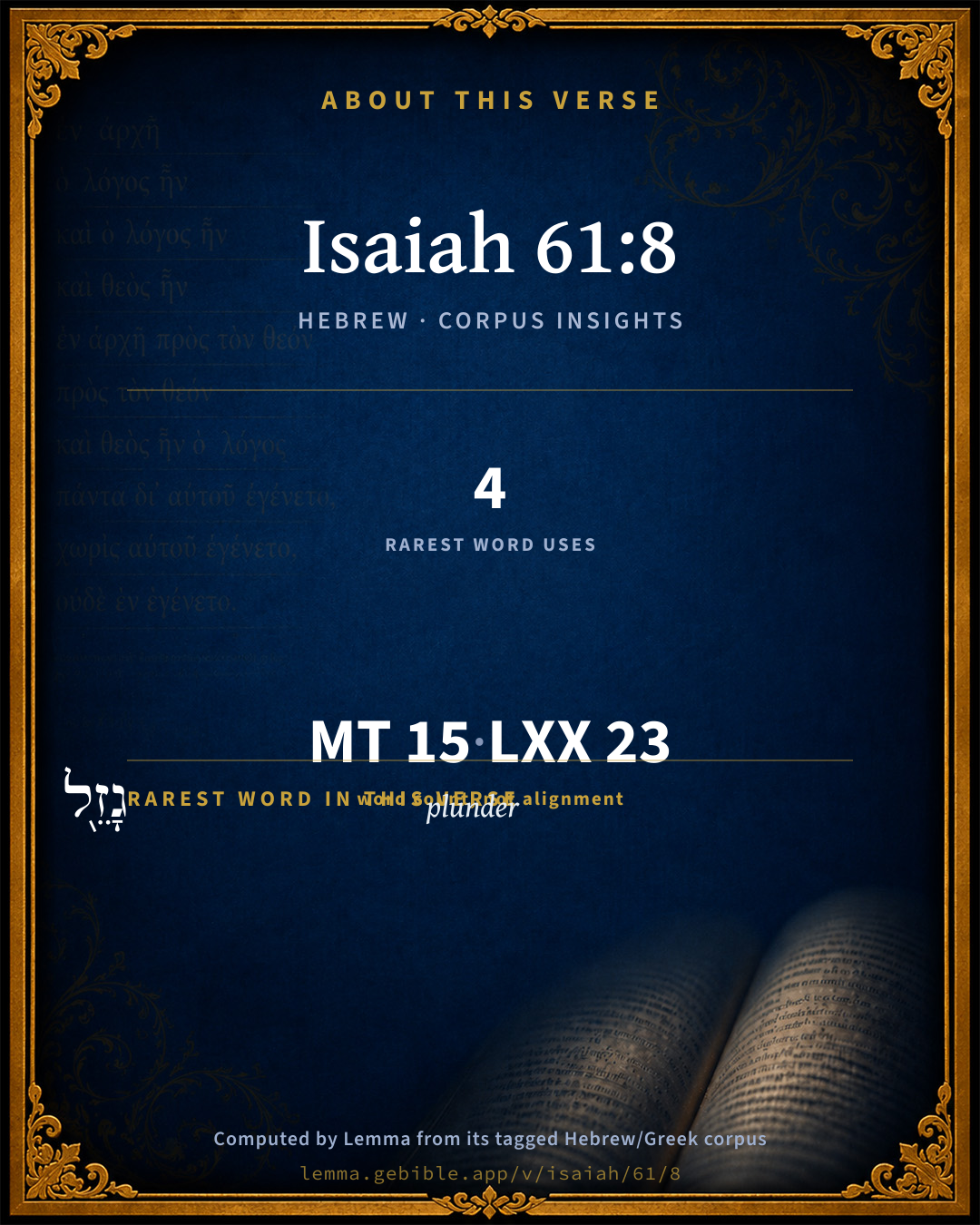
The rarest word here is גָזֵ֖ל plunder H1498 — appearing just 4 times in the whole Hebrew Bible.

Shared distinctive vocabulary

גָזֵ֖ל plunder H1498 occurs in 4 verses of the Hebrew Bible. Also found in:

Grammatical profile

  • 4 verbs
  • 8 nouns
  • 1 pronoun
  • 1 preposition
  • 1 conjunction

Verb forms

  • אֹהֵ֣ב Qal · Participle Active
  • שֹׂנֵ֥א Qal · Participle Active
  • וְנָתַתִּ֤י Qal · Sequential Perfect
  • אֶכְר֥וֹת Qal · Imperfect

Hebrew & Septuagint length

In English translation the verse runs 28 words from the Hebrew and 30 from the Septuagint (LXX English) — closely comparable.

A rough comparison of the two English renderings, which tokenize alike — not a word-level alignment.

Word counts can differ between the Hebrew and the Greek without any difference in meaning — e.g. the Hebrew direct-object marker אֵת has no separate Greek word, and Greek often adds the article ὁ.

In the original languages it is 15 Hebrew tokens and 23 Greek tokens — but the two are counted differently (Hebrew bundles its prefixes and suffixes into one token; the Greek is in lemma form), so that isn’t a like-for-like length.

Cross-references

24

Topical passages linked to Isaiah 61:8 in the Treasury of Scripture Knowledge — connected by theme and wording, ordered by reader-vote popularity; previews shown in the World English Bible.

  • Psalms 11:7 For Yahweh is righteous. He loves righteousness. The upright shall see his face.
  • Jeremiah 9:24 but let him who glories glory in this, that he has understanding, and knows me, that I am Yahweh who exercises loving kindness, justice, and righteousness, in the earth: for in these things I delight, says Yahweh.
  • Zechariah 8:16–17 These are the things that you shall do: speak every man the truth with his neighbor. Execute the judgment of truth and peace in your gates,
  • Genesis 17:7 I will establish my covenant between me and you and your seed after you throughout their generations for an everlasting covenant, to be a God to you and to your seed after you.
  • Isaiah 55:3 Turn your ear, and come to me; hear, and your soul shall live: and I will make an everlasting covenant with you, even the sure mercies of David.
  • Jeremiah 32:40 and I will make an everlasting covenant with them, that I will not turn away from following them, to do them good; and I will put my fear in their hearts, that they may not depart from me.
  • Psalms 25:8–12 Good and upright is Yahweh, Therefore he will instruct sinners in the way.
  • Psalms 37:28 For Yahweh loves justice, And doesn't forsake his saints. They are preserved forever, But the children of the wicked shall be cut off.
  • Psalms 99:4 The King's strength also loves justice. You do establish equity. You execute justice and righteousness in Jacob.
  • Proverbs 8:20 I walk in the way of righteousness, In the midst of the paths of justice;
  • 1 Samuel 15:21–24 But the people took of the spoil, sheep and oxen, the chief of the devoted things, to sacrifice to Yahweh your God in Gilgal.
  • 2 Samuel 23:5 Most assuredly my house is not so with God; Yet he has made with me an everlasting covenant, Ordered in all things, and sure: For it is all my salvation, and all [my] desire, Although he doesn't make it grow.
  • Psalms 33:5 He loves righteousness and justice. The earth is full of the loving kindness of Yahweh.
  • Psalms 45:7 You have loved righteousness, and hated wickedness. Therefore God, your God, has anointed you with the oil of gladness above your fellows.
  • Proverbs 3:6 In all your ways acknowledge him, And he will direct your paths.
  • Psalms 32:8 I will instruct you and teach you in the way which you shall go. I will counsel you with my eye on you.
  • Psalms 50:5 "Gather my saints together to me, Those who have made a covenant with me by sacrifice."
  • Isaiah 5:16 But Yahweh of Hosts is exalted in justice, And God the Holy One is sanctified in righteousness.
  • 2 Thessalonians 3:5 May the Lord direct your hearts into the love of God, and into the patience of Christ.
  • Hebrews 13:20–21 Now may the God of peace, who brought again from the dead the great shepherd of the sheep with the blood of an eternal covenant, our Lord Jesus,
  • Isaiah 1:11–13 "What are the multitude of your sacrifices to me?," says Yahweh. "I have had enough of the burnt offerings of rams, And the fat of fed animals. I don't delight in the blood of bulls, Or of lambs, Or of male goats.
  • Jeremiah 7:8–11 Behold, you trust in lying words, that can't profit.
  • Amos 5:21–24 I hate, I despise your feasts, And I can't stand your solemn assemblies.
  • Matthew 23:13 "Woe to you, scribes and Pharisees, hypocrites! For you devour widows' houses, and as a pretense you make long prayers. Therefore you will receive greater condemnation.

Cross-references courtesy of OpenBible.info (CC BY 4.0).

Hebrew and Greek witnesses Masoretic Hebrew ↔ Greek Septuagint

The same verse in the two great witnesses to the Old Testament, shown verse-for-verse.

These are two independent witnesses, not word-aligned to each other, and the Septuagint is shown in lemma (dictionary) form.

Hebrew Isaiah 61:8 Masoretic · Westminster Leningrad Codex

כִּ֣י אֲנִ֤י יְהוָה֙ אֹהֵ֣ב מִשְׁפָּ֔ט שֹׂנֵ֥א גָזֵ֖ל בְּעוֹלָ֑ה וְנָתַתִּ֤י פְעֻלָּתָם֙ בֶּאֱמֶ֔ת וּבְרִ֥ית עוֹלָ֖ם אֶכְר֥וֹת לָהֶֽם

For I, Yahweh, love justice, I hate robbery with iniquity; and I will give them their recompense in truth, and I will make an everlasting covenant with them.

World English Bible · Public Domain

Greek LXX Isaiah 61:8 Septuagint · lemma form

ἐγώ γάρ εἰμί κύριος ὁ ἀγαπάω δικαιοσύνη καί μισέω ἅρπαγμα ἐκ ἀδικία καί δίδωμι ὁ μόχθος αὐτός δίκαιος καί διαθήκη αἰώνιος διατίθημι αὐτός

For I am the Lord who love righteousness, and hate robberies of injustice; and I will give their labor to the just, and will make an everlasting covenant with them.

LXX2012 (modern English Septuagint) · Public Domain

On this verse, Adam Clarke's Commentary discusses the Septuagint’s reading. Read the note in Commentary ↓

Hebrew: Westminster Leningrad Codex (CC BY 4.0). Greek: Septuagint (public domain); English from LXX2012 (modern English Septuagint) (Public Domain). How the Septuagint differs from the Hebrew →

Targum (Aramaic paraphrase)

1

The Targum is the ancient Jewish Aramaic paraphrase of the Hebrew Scriptures — an interpretive translation, not the Hebrew text itself. Onkelos (literal) and Pseudo-Jonathan (expansive) render the Torah, and Jonathan the Prophets. Coverage is partial: where no permissively-licensed English translation exists for a verse, only the Aramaic is shown. This is verse-level text, not a word-by-word alignment to the Hebrew.

  1. Targum Jonathan Prophets (Joshua–Malachi)
    אֲרֵי אֲנָא יְיָ רָחֵימְנָא דִינָא מְרַחֵק קֳדָמַי שִׁקְרָא וְאוֹנָסָא וְאֶתֵּן אֲגַר עוֹבָדֵיהוֹן בִּקְשׁוֹט וּקְיַם עֲלַם אֶגְזַר לְהוֹן:

    For I, the Lord, love justice; lying and violence are an abomination in my presence; and I will render the reward of their work in truth, and I will make an everlasting covenant with them.

    Targum Jonathan — Aramaic: “Mikraot Gedolot” (public domain). English: “Sefaria Community Translation” (CC0 1.0 (public-domain dedication)); “London "Chaldee Paraphrase," 1871” (public domain). Text via Sefaria.

Commentary

Notes on Isaiah 61:8 from classic Christian and Jewish commentators (each source and its license shown beneath its notes). The classic Christian expositions comment on the surrounding passage and are grouped to its opening verse, so a note may address several verses; the Jewish commentaries on the Tanakh (Rashi and others) are per-verse, so they appear only where the commentator wrote on this verse.

Lemma curates 59 commentaries, every one of them public domain or Creative Commons licensed, each selected and text-cleaned for this edition rather than reprinted as found. About our sources →

Trapp's Complete Commentary

John Trapp

Isa 61:8 For I the LORD love judgment, I hate robbery for burnt offering; and I will direct their work in truth, and I will make an everlasting covenant with them.

Ver. 8. For I the Lord love judgment, &c.] One rendereth it roundly thus, For I the Lord love right; I hate rapine by iniquity - q.d., therefore I will right and repay the wrongs and damages done to my people. Neither is it for any one to think to expiate his bad deeds by his good, to set off with God, and to make him amends. In the times of Popery, indeed, men were taught so to do; they were persuaded that God would accept rapinam in holocaustum, and they practised accordingly: as did the French fury Brunbildis, who founded many colleges; and our King Stephen, who built many monasteries: eo scilicet beneficio maleficia sun expiaverunt, saith mine author. How much better Selymus, the great Turk, who, being on his death bed moved by Pyrrhus, his favourite, to bestow the great wealth taken from the Persian merchants in various places of his empire upon some notable hospital for relief of the poor, refused so to do, and forthwith commanded restitution thereof to be made to the rightful owners. {a}

And I will direct their work in truth,] i.e., In sincerity: there shall be good actions and good aims; which two make a good Christian. Some render the words thus, And I will give them according to their work in truth; making "in truth" to be God’s oath - q.d., truly and without all doubt, I will perform my promises: you have mine oath and my covenant both for your better assurance.

{a} Turkish History, fol. 567.

John Trapp, A Commentary or Exposition upon All the Books of the Old and New Testament (1647–1656) — public domain. Text from a community e-Sword module.

Joseph Benson's Commentary

Isa 61:8-9. For I the Lord love judgment — I will do them right, for I love justice in myself, and in them that practise it. I hate robbery for burnt- offerings — I hate all things gotten by injustice, though they be for sacrifice. As God will not accept of that which cost nothing, so much less of that which is the effect of rapine and oppression. And I will direct their work in truth — I will lead them so, that they shall do all things in sincerity. They shall do good works with good intentions, and to good ends: they shall love truth, and walk in truth, and serve God in spirit and truth. I will make an everlasting covenant with them — Though they have broken covenant with me, yet I will renew my ancient covenant made with their fathers, confirmed with the blood of the Messiah; and it shall be everlasting, never to be abrogated. And their seed shall be known among the Gentiles — That is, eminently; a promise of the increase of the church: such shall be their prosperity and multiplying, that they shall be known abroad by their great increase: or else the meaning is, the church shall have a seed of the Gentiles; whereas the church has been confined to one corner of the world, now it shall remain in one nation alone no more, but shall fill all the nations of the earth. All shall acknowledge they are the seed which the Lord hath blessed — Such shall be the visible characters of God’s love to them, and of God’s grace in them.

Joseph Benson's Commentary on the Old and New Testaments (1811–1818) — public domain. Text from a community e-Sword module.

Tyndale Open Study Notes

Tyndale Open Resources

61:8 Those who belong to the community of God’s people are to imitate the character of God, who loves justice (see Mic 6:8) and hates wrongdoing (Isa 33:15).

Tyndale Open Study Notes — © Tyndale Open Resources, licensed CC BY-SA 4.0. Text via the HelloAO Bible API.

Geneva Bible (1599)

Geneva Bible translators

I will not receive their offerings which are extortioners, deceivers, hypocrites, or that deprive me of my glory.

Geneva Bible (1599) marginal notes — public domain. Text via Bolls.life.

Jamieson, Fausset & Brown

Robert Jamieson, A. R. Fausset & David Brown

judgment--justice, which requires that I should restore My people, and give them double in compensation for their sufferings.

robbery for burnt offering--rather, from a different Hebrew root, the spoil of iniquity [HORSLEY]. So in Job 5:6. Hating, as I do, the rapine, combined with iniquity, perpetrated on My people by their enemies, I will vindicate Israel.

direct . . . work in truth--rather, "I will give them the reward of their work" (compare Isa 40:10, Margin; Isa 49:4, Margin; Isa 62:11, Margin).

Jamieson, Fausset & Brown — Commentary Critical and Explanatory on the Whole Bible (1871) — public domain (CC PDM 1.0). Text via the HelloAO Bible API.

Adam Clarke's Commentary

Verse 8. I hate robbery for burnt-offering - "Who hate rapine and iniquity"] The Syriac, and Chaldee prefix the conjunction ו vau, instead of the preposition ב beth, to עולה olah, which they render iniquity or oppression; and so the Septuagint, αδικιας. The difference lies in the punctuation; בעולה beolah, in a burnt-offering בעולה beavelah, in iniquity. The letters are the same in both words. Five of De Rossi's MSS. confirm this reading.

Adam Clarke's Commentary on the Bible (1810–1826) — public domain. Text from a community e-Sword/MySword module.

Ellicott's Commentary for English Readers

(8) I hate robbery for burnt offering.—The Authorised Version follows the Vulg, and Luther, but the words, commonly applied as condemning the formal sacrifices of the wicked, do not fit in with the context, and it is better to take the rendering of the LXX. and the Targum, I hate robbery with violence, as referring to the spoliation which Israel had suffered at the hands of the Chaldæans.

I will direct their work in truth.—Better—the word for “work” standing, as in Lev_19:13, Eze_29:20, for its reward—I will appoint their recompense in faithfulness.

A Bible Commentary for English Readers, edited by Charles John Ellicott (1878–1897) — public domain. Text from a community e-Sword module.

The Cambridge Bible for Schools and Colleges

gen. ed. J. J. S. Perowne

8. Jehovah’s righteousness demands this reversal of the present relations of Israel and the heathen.

I hate robbery &c.] Render with R.V. I hate robbery with iniquity, and I will give them their recompense in truth (i.e. faithfully). Instead of שׂלָה (= burnt-offering) we must point עו̇לָה (= iniquity). The translation of the A.V. would shut us up to a wrong interpretation of the prophet’s thought. The robbery to which he refers is not that practised by Israelites on God (Mal_3:8-9), but the iniquitous treatment of Israel by its foes.

an everlasting covenant] Cf. ch. Isa_55:3.

The Cambridge Bible for Schools and Colleges (gen. ed. J. J. S. Perowne; Cambridge University Press, 1878–1918) — public domain. Text from a community e-Sword module.

John Gill's Exposition

For I the Lord love judgment,.... To do that which is right and just himself, and to see it done by others, and therefore he will right the wrongs of his people; and whereas the Jews, though they have justly suffered his vengeance for their sins, yet being reproached and abused beyond measure by the Gentiles, among whom they are dispersed; the Lord will look in mercy upon them, and will deliver and save them, and bestow favours plentifully on them, as in the preceding verse: or the Lord loves strict justice and real righteousness, and will not be put off with an imperfect righteousness in the room of a perfect one, and much less an insincere and hypocritical one, such as that of the unbelieving Jews, the pharisaical sect of them; nothing less is acceptable to God than a perfect righteousness, which is adequate to the demands of law and justice; and such a righteousness is not to be found among men, only in his Son Jesus Christ, and with which he is well pleased, Isa 42:21,

I hate robbery for burnt offering; that which is stolen, though it be converted into a burnt offering: or, "with a burnt offering" (c); all immorality, this being put for the whole, along with ceremonial sacrifices; as if it could be atoned for by them, or would be connived at on account of them: or,

by burnt offering; expiation of theft, or any other sin, by the sacrifices of the law, being offered up without faith in Christ; and especially since the great sacrifice, the antitype of them, is offered up; and therefore God will have no more offered up, they are displeasing and hateful to him, Isa 1:12,

and I will direct their work in truth; appoint them work and service of a spiritual nature, and direct them, and enable them to perform it in spirit and in truth, in opposition to the carnal and shadowy ordinances of the ceremonial law; see Joh 4:23,

and I will make an everlasting covenant with them; that is, renew the everlasting covenant of grace with them, make it manifest unto them; apply the grace and bestow the blessings of it to and on them, Rom 11:25.

(c) "rapinam conjunctam holocausto", Junius & Tremellius.

John Gill's Exposition of the Whole Bible (1746–1763) — public domain (CC PDM 1.0). Text via the HelloAO Bible API.

Albert Barnes' Notes on the Bible

For I the Lord love judgment - That is, ‘I shall delight in rendering to my people what is right. It is right that they should enjoy my protection, and be favored with the tokens of my kindness. Loving justice and right, therefore, I will confer on them the privileges and blessings which they ought to enjoy, and which will be a public expression of my favor and love.’

I hate robbery for burnt-offering - There has been great variety in the interpretation of this phrase. Lowth renders it, ‘Who hate rapine and iniquity.’ Noyes, ‘I hate rapine and iniquity.’ Jerome, as in our translation, Et odio habens rapinam in holocausto. The Septuagint, Μισῶν ἁρπάγματα ἐξ ἀδικίας Misōn harpagmata ech adikias - ‘Hating the spoils of injustice.’ The Chaldee, ‘Far from before me be deceit and violence.’ The Syriac, ‘I hate rapine and iniquity.’ This variety of interpretation has arisen from the different views taken of the Hebrew בעולה be‛ôlâh. The Syriac evidently prefixed the conjunction, ו (v), “and,” instead of the preposition, ב (b), “with” or “for”; and, perhaps, also the Septuagint so read it. But this change, though slight, is not necessary in order to give a consistent rendering to the passage. The connection does not necessarily lead us to suppose that any reference would be made to ‘burnt-offering,’ and to the improper manner in which such offerings were made; but the idea is rather, that God hated rapine and sin; he hateth such acts as those by which his people had been removed from their land, and subjected to the evils of a long and painful captivity. And this is undoubtedly the sense of the passage. The Hebrew word עולה ‛ôlâh, usually without the ,ו means properly “a holocaust,” or “what is made to ascend” (from עלה ‛âlâh, to ascend) from an altar. But the word here is the construct form for עולה ‛avı̂lâh, “evil, wickedness”; whence our word “evil” (see Job 24:20; Psa 107:42). And the sense here is, hate rapine or plunder (גזל gāzēl) with iniquity;’ that is, accompanied, as it always is, with iniquity and sin. And hating that as I do, I will vindicate my people who have been plundered in this way; and who have been borne into captivity, accompanied with deeds of violence and sin.

And I will direct their work in truth - literally, ‘I will give them work in truth or faithfulness;’ that is, I will give them the reward of their work faithfully. They shall be amply recompensed for all that they have done and suffered in my cause.

And I will make - (See the notes at Isa 55:3).

Albert Barnes' Notes on the Bible (1834–1885) — public domain. Text from a community e-Sword/MySword module.

Haydock's Catholic Bible Commentary

Holocaust. The pagans saw such things were improper victims. (Eusebius, præp. iv. 14.) --- Septuagint, "hate unjust plunder." (Haydock) --- Therefore will I subject the strangers to you, ver. 5. --- Truth. I will grant a sure reward. --- Covenant. These of Nehemias and the Machabees were soon forgotten: but Christ’s covenant shall abide for ever.

George Leo Haydock (1774–1849), Haydock's Catholic Family Bible and Commentary, 1859 edition — public domain. Excludes Psalms (Douay-Rheims chapter numbering differs from Protestant) and Deuterocanonical books (Catholic canon only).

Matthew Poole's English Annotations

For I the Lord love judgment: q.d. They have suffered a great deal of hardship under their enemies, and I will do them right; for I love justice in myself, and in them that practise it. Or he gives a reason why he will recompense those strangers that did so freely minister to his people.

I hate robbery; all things gotten by injustice, though it be for sacrifice. As God will not accept of that which cost nothing, so much less of that which is the effect of rapine and oppression; a foundation whereon most of our abbeys and monasteries were built, viz. to expiate some great crimes. And thus by making God a receiver, they did interpretatively make him a confederate. I will direct their work in truth; either, I will lead and guide them so that they shall do all things in sincerity; they shall do good works, and to good ends; they shall now love truth, and walk in truth, and serve him in spirit and truth: or, I will reward them: or, I will make their work stable and firm. Truth notes stability; See Poole "Isa 16:5"; work being here put metonymically for the reward of work, proportionably to their work.

I will make an everlasting covenant: q.d. Though you have broken covenant with me, and I have seemed to forsake you in giving you up to captivity; yet I will renew my ancient covenant made with your fathers, confirmed with the blood of Christ, and it shall be everlasting, never to be abrogated, viz. it shall be continued in the Gentiles that shall come in your rooms, that for breach of covenant were broken off.

Matthew Poole's English Annotations on the Holy Bible (1683–1685) — public domain. Text from a community e-Sword/MySword module.

Whedon's Commentary on the Bible

Daniel D. Whedon

8. This verse connects with Isa_61:1-7 by the word for, to show the attitude of Jehovah — who, as God over all, now speaks — toward Israel and his former oppressors.

I the Lord love judgment — That which is right and just in the experience of my people, who have heretofore done evil, and have suffered by the hand of the oppressor. This, on God’s part, was right and just, but no thanks to the oppressor.

I hate robbery — The oppressor has punished with gross injustice, and in sheer selfishness. Burnt offering is, with good critics, now accounted as meaning injustice, (not from the Hebrew root once supposed.) Jehovah avers his hatred of injustice toward his people, whom, and for which injustice, he now compensates with another and glorious estate, as given in Isa_61:1-7.

Hereafter Jehovah will direct their work — their proper estate under Messiah — in truth. Reward shall be the order henceforth.

Daniel D. Whedon (gen. ed.), Commentary on the Old and New Testaments (1874–1909) — public domain. Text from a community e-Sword module.

The Pulpit Commentary

For I the Lord love judgment. Either "the Servant" here identifies himself with Jehovah, or he cites a declaration of Jehovah which he has authority to announce. Jehovah will restore the Israelites to their land because he "loves judgment" (equivalent to "justice") and hates injustice. The Babylonian conquest, though a judgment sent by him, is, so far as the Babylonians are concerned, a wrong and a "robbery." I hate robbery for burnt offering; rather, I hate robbery with wickedness. (Job_5:16 Psa_58:3 Psa_64:7 Psa_92:1-6) The transplantation of nations was a gross abuse of the rights of conquest. I will direct their work in truth; rather, I will give them their recompense faithfully. As they have been wronged, they shall be righted; they shall be faithfully and exactly compensated for what they have suffered. Nay, more over and above this, God will give them the blessing of an "everlasting covenant". (comp. Isa_55:3)

The Pulpit Commentary (1880–1919), ed. H.D.M. Spence-Jones & Joseph S. Exell — public domain. Text from a community e-Sword module.

John Wesley's Explanatory Notes

Love judgment - I will do them right, for I love justice in myself, and in them that practice it. Robbery - All things gotten by injustice, though it be for sacrifice. Direct - I will lead them so, that they shall do all things in sincerity. Everlasting covenant - Though you have broken covenant with me, yet I will renew my ancient covenant made with your fathers, confirmed with the blood of Christ, and it shall be everlasting, never to be abrogated.

John Wesley, Explanatory Notes Upon the Whole Bible (1754–1765) — public domain. Text via the GEBible commentary corpus.

J. A. Alexander on Isaiah

Joseph Addison Alexander

“For I am Jehovah, loving justice, hating (that which is) taken away unjustly, and I will give their hire truly, and an everlasting covenant I strike for them.” This verse is commonly applied to the violence practiced upon Israel by the Babylonians. (Compare Isa 42:24). It is rather an enunciation of the general truth, that the divine justice renders absolutely necessary the destruction of His obstinate enemies, and the deliverance of His people from oppression. (Compare 2Th 1:6-8).

Joseph Addison Alexander, The Prophecies of Isaiah (1846–1847; New York: Scribner, 1870–1878) — public domain. Text from a community e-Sword module.

unfoldingWord translationNotes

Door43 World Missions Community

Their descendants will be known among the nations, and their offspring among the peoples

These two clauses mean the same thing. This can be stated in active form. AT: "People from other nations will know their descendants" (See: Parallelism and Active or Passive)

their offspring among the peoples

This clause assumes the same verb as the previous one. AT: "their offspring will be known among the peoples" (See: Ellipsis)

translationWords

Yahweh

love

just

faithful

eternity

covenant

descend

nation

offspring

people group

bless

unfoldingWord translationNotes — © Distant Shores Media and the Door43 World Missions Community, licensed CC BY-SA 4.0. Source: git.door43.org/Door43/en_tn.

Rashi

Rabbi Shlomo Yitzchaki (Rashi)

For I am the Lord, Who loves justice, hates robbery in a burnt offering Therefore, I do not accept burnt offerings from the heathens (the nations [Parshandatha, K’li Paz]), for they are all results of robbery.

and I will give their wage The wage of Israel, which shall be in truth. Alternatively, I will give the reward for the deeds they performed, for they suffered the derisions of the heathens (the nations [Mss. and K’li Paz]) for My honor in truth.

Rashi on the Tanakh — English translations: “The Judaica Press complete Tanach with Rashi, translated by A. J. Rosenberg” (CC BY 4.0); “Pentateuch with Rashi's commentary by M. Rosenbaum and A.M. Silbermann, 1929-1934” (public domain); “The Metsudah Tanach series, Lakewood, N.J” (CC BY 4.0); and “The Book of Joshua, Metsudah Publications, 1997” (CC BY 4.0). Text via Sefaria.

Ibn Ezra

Rabbi Abraham ibn Ezra

For I, the Lord, love judgment, etc. I shall give them their reward, for I love righteousness; I hate robbing even in the burnt offering that is brought to me; therefore ונתתי פעלתם וגו׳ I will give them their reward, etc. As to פעלתם their reward comp. פעלת the wages (Lev. 19:13).

By these words the expression I hate robbing is explained; as if God said, I shall not rob them; for if I gave them not their reward, I should rob them of their wages.

Ibn Ezra on the Tanakh — English translations: “Sefaria Community Translation” (CC0 1.0 (public-domain dedication)); “Yalkut, Sifsei Chachomim Chumash, Metsudah Publications, 2009” (CC BY 4.0); and “Commentary of Ibn Ezra on Isaiah - trans. by M. Friedlander, 1873” (public domain). Text via Sefaria.

Lesson kit

Teaching starters — assembled from the data on this page, not authored interpretation. Every prompt links to the verse data it draws on. Edit before teaching.

Isaiah, in the Prophets, opens this verse with 15 words (14 distinct Hebrew lemmas). Its most distinctive word is gâzêl (“plunder”). A historical commentator’s framing appears above. Read the whole chapter for the surrounding context.

Discussion questions

  1. The word gâzêl carries the sense “plunder.” How does it shape the verse?
  2. Leviticus 6:2 shares the word «plunder» with this verse. How do the two illuminate each other?
  3. The translations on this page render this verse differently — a whole-verse word diff, not a word-by-word alignment. What might account for the different wordings?
  4. The verb «אֹהֵ֣ב» is Qal Participle Active. How does its form color the action?
  5. Reading how Trapp's Complete Commentary and Joseph Benson's Commentary read this verse, where do the two commentators agree and where do they part?

Things to notice

Reading settings

Reading text

Shown beneath each verse's original-language words.

Old Testament
Old Testament edition

Read the OT as the Masoretic Hebrew (MT) or the Greek Septuagint (LXX).

English shown for the Greek Septuagint (in the Hebrew ↔ Greek comparison).

Comparing translations? Open the Compare panel on any verse page to stack up to four side by side.