
Exodus 34:15

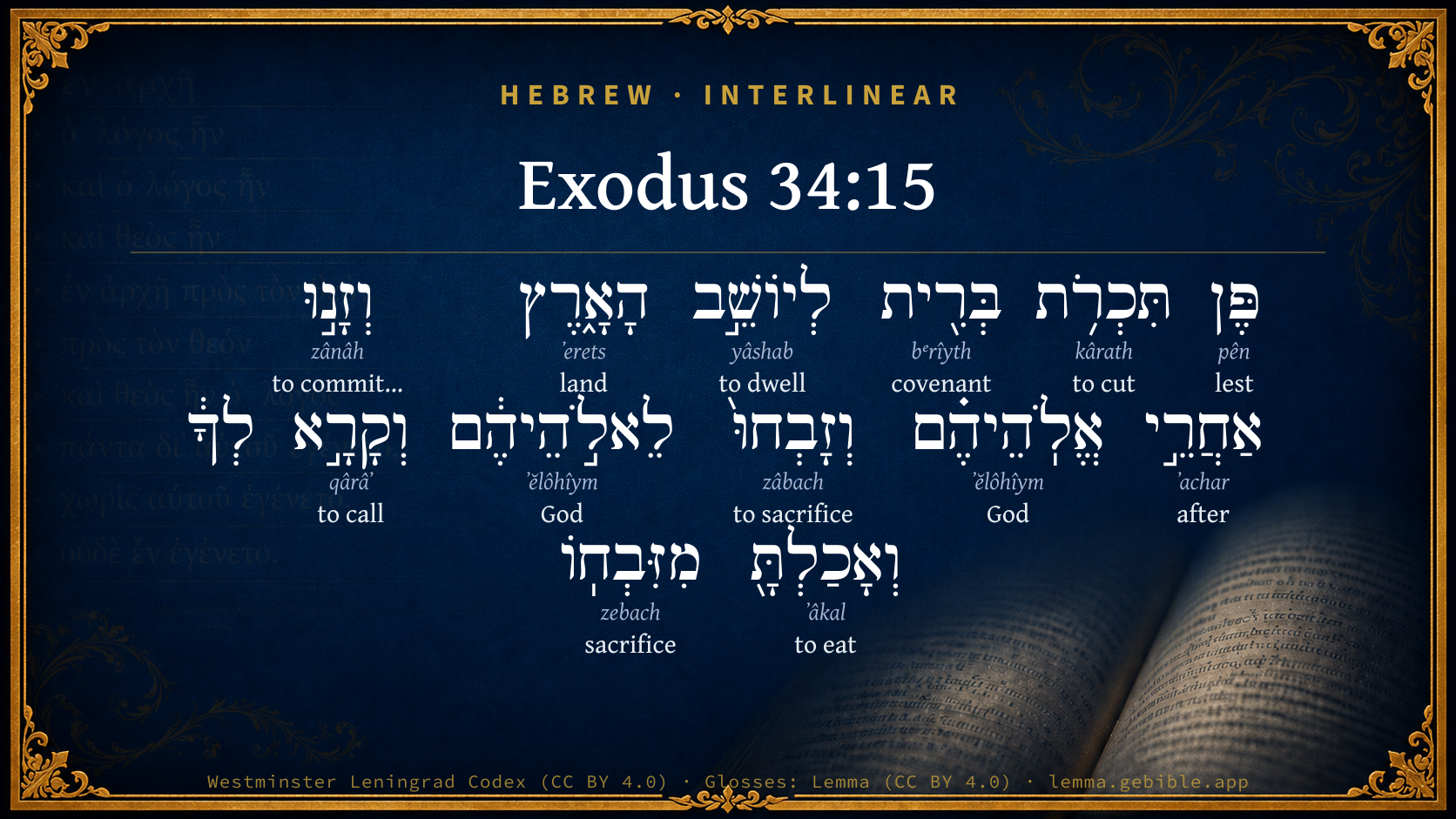
Hebrew (Westminster Leningrad Codex) Exodus 34:15 appears in the Hebrew Old Testament. The text above is from the Westminster Leningrad Codex. Each word links to its Strong’s number, a concise gloss, and parsing drawn from the Open Scriptures Hebrew Bible morphology. Click any word for its full Brown-Driver-Briggs (BDB) entry.
Download image
Cite this verse

Exodus 34:15 (World English Bible). Public Domain. Lemma interlinear Bible study tool, https://lemma.gebible.app/v/exodus/34/15.

Show BibTeX & RIS
BibTeX
RIS
English Translation
Don't make a covenant with the inhabitants of the land, lest they play the prostitute after their gods, and sacrifice to their gods, and one call you and you eat of his sacrifice;
World English Bible · Public Domain
Download a study sheet

One document with this verse’s original text, its word-by-word gloss line, the meaning frame, cross-references with their text, attributed commentary, and full source and license credits — printable, and it pastes into notes with its structure intact.

This verse Autodidact and up

Study sheet (.html) Plain text (.txt)

A passage Seminary Student

Up to 50 verses in one chapter. A passage sheet keeps up to 6 commentary sources and 12 cross-references per verse, in the order this page ranks them, and says so on the sheet whenever that leaves anything out. Ask for a single verse and you get the Autodidact verse sheet above.

Everything on this page stays free to read, with no account — the sheet is a download of what is already on screen, not access to it.

Want to remove ads? Support Godless Engineer
Compare translations 3

The same verse in 3 English versions, stacked beneath the original-language interlinear above. Click any original word for its lexicon entry.

Each is an independent rendering of the whole verse — the interlinear is not word-aligned to these translations.

Highlighted words mark where these versions differ — a whole-verse word diff, not a word-by-word alignment.

  • World English Bible Public Domain
    Don't make a covenant with the inhabitants of the land, lest they play the prostitute after their gods, and sacrifice to their gods, and one call you and you eat of his sacrifice;
  • King James Version Public Domain
    Lest thou make a covenant with the inhabitants of the land, and they go a whoring after their gods, and do sacrifice unto their gods, and one call thee, and thou eat of his sacrifice;
  • unfoldingWord Literal Text CC BY-SA 4.0
    Lest you cut a covenant with the inhabitant of the land, and they prostitute after their gods and sacrifice to their gods, and he invite you, and you eat from his sacrifice

unfoldingWord Literal Text — © unfoldingWord, licensed CC BY-SA 4.0. Word-aligned USFM3 via Door43 (git.door43.org/unfoldingWord/en_ult).

Versions to compare (up to 4)

3 of 4 selected

Show all 18 translations

Every available English version of this verse, each an independent rendering of the whole verse.

  • World English Bible Public Domain
    Don't make a covenant with the inhabitants of the land, lest they play the prostitute after their gods, and sacrifice to their gods, and one call you and you eat of his sacrifice;
  • Berean Standard Bible Public Domain
    Do not make a covenant with the inhabitants of the land, for when they prostitute themselves to their gods and sacrifice to them, they will invite you, and you will eat their sacrifices.
  • Majority Standard Bible Public Domain
    Do not make a covenant with the inhabitants of the land, for when they prostitute themselves to their gods and sacrifice to them, they will invite you, and you will eat their sacrifices.
  • King James Version Public Domain
    Lest thou make a covenant with the inhabitants of the land, and they go a whoring after their gods, and do sacrifice unto their gods, and one call thee, and thou eat of his sacrifice;
  • American Standard Version (1901) Public Domain
    lest thou make a covenant with the inhabitants of the land, and they play the harlot after their gods, and sacrifice unto their gods, and one call thee and thou eat of his sacrifice;
  • Revised Version (1885) Public Domain
    lest thou make a covenant with the inhabitants of the land, and they go a whoring after their gods, and do sacrifice unto their gods, and one call thee and thou eat of his sacrifice;
  • Geneva Bible (1599) Public Domain
    Lest thou make a compact with the inhabitantes of the lande, and when they goe a whoring after their gods, and doe sacrifice vnto their gods, some man call thee, and thou eate of his sacrifice:
  • Douay-Rheims (1899) Public Domain
    Make no covenant with the men of those countries lest, when they have committed fornication with their gods, and have adored their idols, some one call thee to eat of the things sacrificed.
  • Young's Literal Translation Public Domain
    `Lest thou make a covenant with the inhabitant of the land, and they have gone a-whoring after their gods, and have sacrificed to their gods, and `one' hath called to thee, and thou hast eaten of his sacrifice,
  • Literal Standard Version CC BY-SA 4.0
    Lest you make a covenant with the inhabitant of the land, and they have gone whoring after their gods, and have sacrificed to their gods, and [one] has called to you, and you have eaten of his sacrifice,
  • Unlocked Literal Bible CC BY-SA 4.0
    So be careful not to make a covenant with the inhabitants of the land, for they prostitute themselves to their gods, and they sacrifice to their gods. Then one of them will invite you and you will eat some of his sacrifice,
  • unfoldingWord Literal Text CC BY-SA 4.0
    Lest you cut a covenant with the inhabitant of the land, and they prostitute after their gods and sacrifice to their gods, and he invite you, and you eat from his sacrifice
  • Darby Bible Public Domain
    lest thou make a covenant with the inhabitants of the land, and then, when they go a whoring after their gods, and sacrifice unto their gods, thou be invited, and eat of their sacrifice,
  • World Messianic Bible Public Domain
    “Don’t make a covenant with the inhabitants of the land, lest they play the prostitute after their gods, and sacrifice to their gods, and one call you and you eat of his sacrifice;
  • Webster's Bible Public Domain
    Lest thou make a covenant with the inhabitants of the land, and they go astray after their gods, and do sacrifice to their gods, and one call thee, and thou eat of his sacrifice;
  • Free Bible Version CC BY-SA 4.0
    Make sure you don't agree to a peace treaty with the people living in the land, for when they prostitute themselves by worshiping and sacrificing to their gods, they will invite you to join them, and you will eat from their pagan sacrifices.
  • Bible in Basic English Public Domain
    So see that you make no agreement with the people of the land, and do not go after their gods, or take part in their offerings, or be guests at their feasts,
  • JPS Tanakh (1917) Public Domain
    lest thou make a covenant with the inhabitants of the land, and they go astray after their gods, and do sacrifice unto their gods, and they call thee, and thou eat of their sacrifice;

Literal Standard Version (2020), Covenant Press — licensed CC BY-SA 4.0. Text via the HelloAO Bible API (eBible.org). Unlocked Literal Bible (unfoldingWord) — licensed CC BY-SA 4.0. Text via the HelloAO Bible API (eBible.org). unfoldingWord Literal Text — © unfoldingWord, licensed CC BY-SA 4.0. Word-aligned USFM3 via Door43 (git.door43.org/unfoldingWord/en_ult). Free Bible Version, Dr. Jonathan Gallagher — licensed CC BY-SA 4.0. Text via the HelloAO Bible API (eBible.org).

Word by word

More ways to search: Search by grammar → Find every occurrence → Compare this word →

Practice this passage: Drill this verse → Learn its vocabulary →

וְזָנ֣וּ
zânâh
H2181
“and · to commit fornication”
Conjunction + Verb, Qal, Perfect, 3rd Person, Common, Plural
Part of Speech
Conjunction + Verb
Stem
Qal
Form
Perfect
Person
3rd Person
Gender
Common
Number
Plural
Full BDB Definition

Origin: a primitive root [highly-fed and therefore wanton]

TWOT: 563

to commit fornication, be a harlot, play the harlot - (Qal) - to be a harlot, act as a harlot, commit fornication - to commit adultery - to be a cult prostitute - to be unfaithful (to God) (figuratively) - (Pual) to play the harlot - (Hiphil) - to cause to commit adultery - to force into prostitution - to commit fornication
  1. פֶּן pên H6435 “lest” Conjunction
  2. תִּכְרֹ֥ת kârath H3772 “to cut” Verb, Qal, Imperfect, 2nd Person, Masculine, Singular
  3. בְּרִ֖ית bᵉrîyth H1285 “covenant” Noun, Common, Feminine, Singular, Absolute
  4. לְיוֹשֵׁ֣ב yâshab H3427 “to/for · dwelling” Preposition + Verb, Qal, Participle Active, Masculine, Singular, Construct
  5. הָאָ֑רֶץ ʼerets H776 “the · land” Particle, Definite Article + Noun, Common, Both, Singular, Absolute
  6. אַחֲרֵ֣י ʼachar H310 “after” Preposition
  7. אֱלֹֽהֵיהֶ֗ם ʼĕlôhîym H430 “God(s) · their” Noun, Common, Masculine, Plural, Construct + Suffix, Personal, 3rd Person, Masculine, Plural
  8. וְזָבְחוּ֙ zâbach H2076 “and · to sacrifice” Conjunction + Verb, Qal, Sequential Perfect, 3rd Person, Common, Plural
  9. לֵאלֹ֣הֵיהֶ֔ם ʼĕlôhîym H430 “to/for · God(s) · their” Preposition + Noun, Common, Masculine, Plural, Construct + Suffix, Personal, 3rd Person, Masculine, Plural
  10. וְקָרָ֣א qârâʼ H7121 “and · to call” Conjunction + Verb, Qal, Perfect, 3rd Person, Masculine, Singular
  11. וְאָכַלְתָּ֖ ʼâkal H398 “and · to eat” Conjunction + Verb, Qal, Perfect, 2nd Person, Masculine, Singular
  12. מִזִּבְחֽוֹ zebach H2077 “from · sacrifice · his” Preposition + Noun, Common, Masculine, Singular, Construct + Suffix, Personal, 3rd Person, Masculine, Singular

About this verse

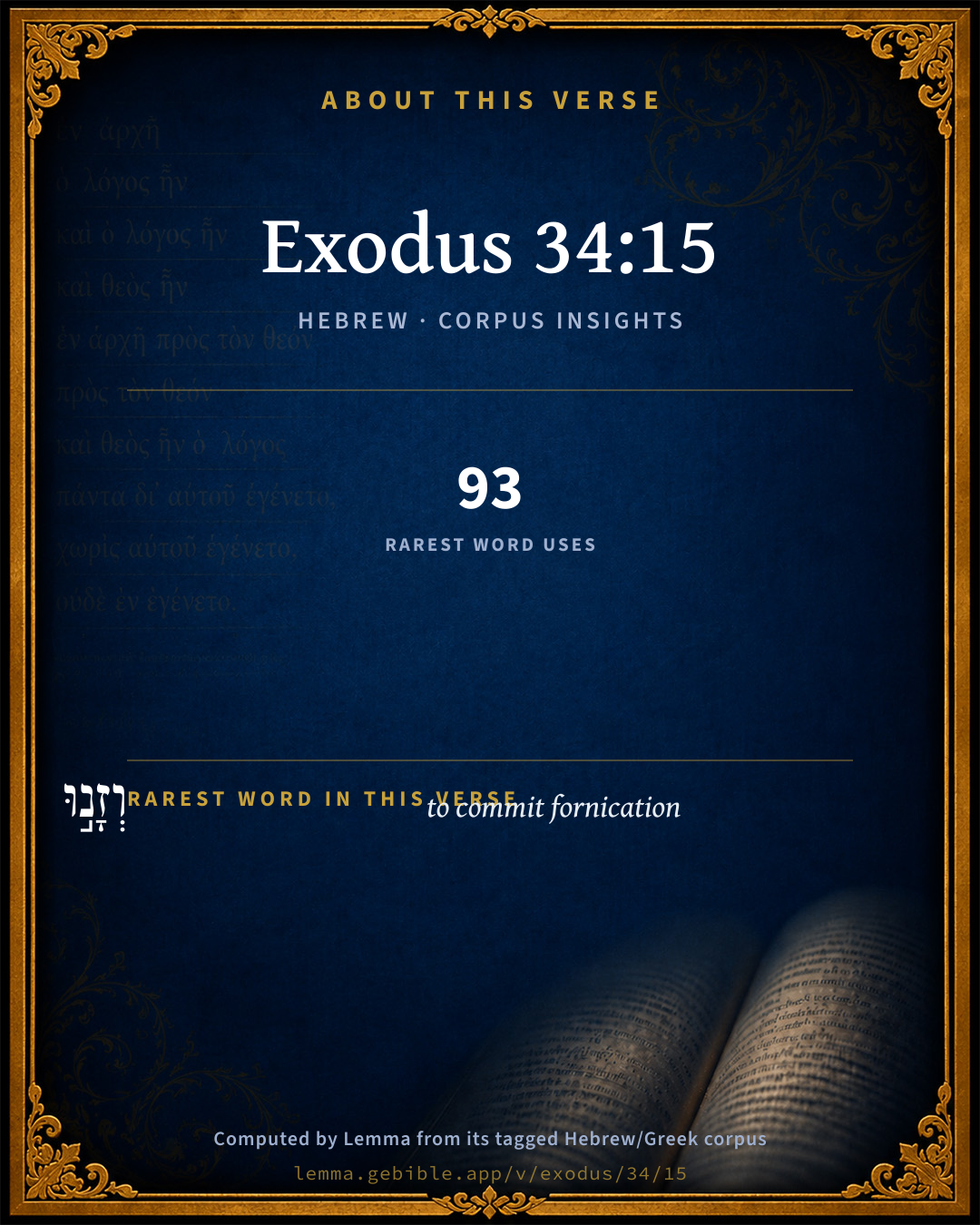
These counts appear in no published source. They are computed here, from the morphology-tagged text and Lemma’s own curated glosses. What Lemma adds →

14
words
12
distinct lemmas
Pentateuch
section

Grammatical profile

  • 6 verbs
  • 5 nouns
  • 2 prepositions
  • 1 conjunction

Verb forms

  • תִּכְרֹ֥ת Qal · Imperfect
  • לְיוֹשֵׁ֣ב Qal · Participle Active
  • וְזָנ֣וּ Qal · Perfect
  • וְזָבְחוּ֙ Qal · Sequential Perfect
  • וְקָרָ֣א Qal · Perfect
  • וְאָכַלְתָּ֖ Qal · Perfect

Repetition

A word recurs within this verse — often emphatic in Hebrew:

  • אֱלֹֽהֵיהֶ֗ם God H430 ×2

Hebrew & Septuagint length

In English translation the verse runs 33 words from the Hebrew and 38 from the Septuagint (LXX English) — closely comparable.

A rough comparison of the two English renderings, which tokenize alike — not a word-level alignment.

Word counts can differ between the Hebrew and the Greek without any difference in meaning — e.g. the Hebrew direct-object marker אֵת has no separate Greek word, and Greek often adds the article ὁ.

Cross-references

23

Topical passages linked to Exodus 34:15 in the Treasury of Scripture Knowledge — connected by theme and wording, ordered by reader-vote popularity; previews shown in the World English Bible.

  • Judges 2:17 Yet they didn't listen to their judges; for they played the prostitute after other gods, and bowed themselves down to them: they turned aside quickly out of the way in which their fathers walked, obeying the commandments of Yahweh; [but] they didn't do so.
  • Numbers 25:2 for they called the people to the sacrifices of their gods; and the people ate, and bowed down to their gods.
  • Deuteronomy 31:16 Yahweh said to Moses, Behold, you shall sleep with your fathers; and this people will rise up, and play the prostitute after the strange gods of the land, where they go to be among them, and will forsake me, and break my covenant which I have made with them.
  • Psalms 106:28 They joined themselves also to Baal Peor, And ate the sacrifices of the dead.
  • 1 Corinthians 8:4 Therefore concerning the eating of things sacrificed to idols, we know that no idol is anything in the world, and that there is no other God but one.
  • 1 Corinthians 8:10 For if a man sees you who have knowledge sitting in an idol's temple, won't his conscience, if he is weak, be emboldened to eat things sacrificed to idols?
  • 1 Corinthians 10:27 But if one of those who don't believe invites you to a meal, and you are inclined to go, eat whatever is set before you, asking no questions for the sake of conscience.
  • Exodus 34:12 Be careful, lest you make a covenant with the inhabitants of the land where you are going, lest it be for a snare in the midst of you:
  • Leviticus 17:7 They shall no more sacrifice their sacrifices to the goat idols, after which they play the prostitute. This shall be a statute forever to them throughout their generations.'
  • Leviticus 20:5–6 then I will set my face against that man, and against his family, and will cut him off, and all who play the prostitute after him, to play the prostitute with Molech, from among their people.
  • Jeremiah 3:9 It happened through the lightness of her prostitution, that the land was polluted, and she committed adultery with stones and with stocks.
  • 1 Corinthians 8:7 However, that knowledge isn't in all men. But some, with consciousness of the idol until now, eat as of a thing sacrificed to an idol, and their conscience, being weak, is defiled.
  • Exodus 23:32 You shall make no covenant with them, nor with their gods.
  • Exodus 34:10 He said, "Behold, I make a covenant: before all your people I will do marvels, such as have not been worked in all the earth, nor in any nation; and all the people among which you are shall see the work of Yahweh; for it is an awesome thing that I do with you.
  • Numbers 15:39 and it shall be to you for a fringe, that you may look on it, and remember all the commandments of Yahweh, and do them; and that you not follow after your own heart and your own eyes, after which you use to play the prostitute;
  • Deuteronomy 7:2 and when Yahweh your God shall deliver them up before you, and you shall strike them; then you shall utterly destroy them: you shall make no covenant with them, nor show mercy to them;
  • Ezra 6:9 That which they have need of, both young bulls, and rams, and lambs, for burnt offerings to the God of heaven; [also] wheat, salt, wine, and oil, according to the word of the priests who are at Jerusalem, let it be given them day by day without fail;
  • Psalms 73:27 For, behold, those who are far from you shall perish. You have destroyed all those who are unfaithful to you.
  • Hosea 4:12 My people consult with their wooded idol, And answer to a stick of wood. Indeed the spirit of prostitution has led them astray, And they have been unfaithful to their God.
  • Hosea 9:1 Don't rejoice, Israel, to jubilation like the nations; For you were unfaithful to your God. You love the wages of a prostitute at every grain threshing floor.
  • 1 Corinthians 10:20–21 But I say that the things which the Gentiles sacrifice, they sacrifice to demons, and not to God, and I don't desire that you would have communion with demons.
  • Revelation 2:20 But I have this against you, that you tolerate your woman, Jezebel, who calls herself a prophetess. She teaches and seduces my servants to commit sexual immorality, and to eat things sacrificed to idols.
  • Revelation 17:1–5 One of the seven angels who had the seven bowls came and spoke with me, saying, "Come here. I will show you the judgment of the great prostitute who sits on many waters,

Cross-references courtesy of OpenBible.info (CC BY 4.0).

Hebrew and Greek witnesses Masoretic Hebrew ↔ Greek Septuagint

The same verse in the two great witnesses to the Old Testament, shown verse-for-verse.

These are two independent witnesses, not word-aligned to each other, and the Septuagint is shown in lemma (dictionary) form.

Hebrew Exodus 34:15 Masoretic · Westminster Leningrad Codex

פֶּן תִּכְרֹ֥ת בְּרִ֖ית לְיוֹשֵׁ֣ב הָאָ֑רֶץ וְזָנ֣וּ אַחֲרֵ֣י אֱלֹֽהֵיהֶ֗ם וְזָבְחוּ֙ לֵאלֹ֣הֵיהֶ֔ם וְקָרָ֣א לְךָ֔ וְאָכַלְתָּ֖ מִזִּבְחֽוֹ

Don't make a covenant with the inhabitants of the land, lest they play the prostitute after their gods, and sacrifice to their gods, and one call you and you eat of his sacrifice;

World English Bible · Public Domain

Greek LXX Exodus 34:15 Septuagint · lemma form

μήποτε τίθημι διαθήκη ὁ ἐν καταἧμαι πρός ἀλλόφυλος ἐπί ὁ γῆ καί ἐκπορνεύω ὀπίσω ὁ θεός αὐτός καί θύω ὁ θεός αὐτός καί καλέω σύ καί ἐσθίω ὁ θῦμα αὐτός

lest at any time you make a covenant with the dwellers on the land, and they go a whoring after their gods, and sacrifice to their gods, and they call you, and you should eat of their feasts,

LXX2012 (modern English Septuagint) · Public Domain

On this verse, Haydock's Catholic Bible Commentary discusses the Septuagint’s reading. Read the note in Commentary ↓

Hebrew: Westminster Leningrad Codex (CC BY 4.0). Greek: Septuagint (public domain); English from LXX2012 (modern English Septuagint) (Public Domain). How the Septuagint differs from the Hebrew →

Targum (Aramaic paraphrase)

2

The Targum is the ancient Jewish Aramaic paraphrase of the Hebrew Scriptures — an interpretive translation, not the Hebrew text itself. Onkelos (literal) and Pseudo-Jonathan (expansive) render the Torah, and Jonathan the Prophets. Coverage is partial: where no permissively-licensed English translation exists for a verse, only the Aramaic is shown. This is verse-level text, not a word-by-word alignment to the Hebrew.

  1. Targum Onkelos Torah (Genesis–Deuteronomy)
    דִילְמָא תִגְזַר קְיַם לְיָתֵב אַרְעָא וְיִטְּעוּן בָּתַר טַּעֲוַתְהוֹן וְיִדְבְּחוּן לְטַּעֲוַתְהוֹן וְיִקְרוּן לָךְ וְתֵיכוּל מִדִבְחֵיהוֹן:

    (no public-domain English translation for this verse)

    Targum Onkelos — Aramaic: “Onkelos Genesis” (public domain); “Onkelos Exodus” (public domain); “Onkelos Leviticus” (public domain); “Onkelos Numbers” (public domain); “Onkelos Deuteronomy” (public domain). English: “Sefaria Community Translation” (CC0 1.0 (public-domain dedication)); “J.W. Etheridge. The Targums of Onkelos and Jonathan Ben Uzziel on the Pentateuch. London: Longmans, Green, 1862” (public domain). Text via Sefaria.

  2. Targum Pseudo-Jonathan Torah (Genesis–Deuteronomy)
    דִּילְמָא תִגְזוֹר קְיַים לְיָתֵיב אַרְעָא וְיִטְעוּן בָּתַר טַעֲוַותְהוֹן וְיִדְבְּחוּן לְטַעֲוַותְהוֹן וִיזַמְנוּן לָךְ וְתֵיכוֹל מִן דִּיבְחֵי טַעֲוַותְהוֹן

    Lest thou strike covenant with the dwellers in the land, and they draw thee astray after their idols, and they sacrifice to their idols, and invite thee, and thou eat of the sacrifices of their idols

    Targum Pseudo-Jonathan — Aramaic: “Targum Jonathan on Genesis” (public domain); “Targum Jonathan on Exodus” (public domain); “Targum Jonathan on Leviticus” (public domain); “Targum Jonathan on Numbers” (public domain); “Targum Jonathan on Deuteronomy” (public domain). English: “The Targum of Jonathan ben Uzziel, trans. J. W. Etheridge, London, 1862” (public domain). Text via Sefaria.

Commentary

Notes on Exodus 34:15 from classic Christian and Jewish commentators (each source and its license shown beneath its notes). The classic Christian expositions comment on the surrounding passage and are grouped to its opening verse, so a note may address several verses; the Jewish commentaries on the Tanakh (Rashi and others) are per-verse, so they appear only where the commentator wrote on this verse.

Lemma curates 59 commentaries, every one of them public domain or Creative Commons licensed, each selected and text-cleaned for this edition rather than reprinted as found. About our sources →

Trapp's Complete Commentary

John Trapp

Exo 34:15 Lest thou make a covenant with the inhabitants of the land, and they go a whoring after their gods, and do sacrifice unto their gods, and [one] call thee, and thou eat of his sacrifice;

Ver. 15. And one call thee.] Any one of the idolatrous rout, if he do but hold up his finger to thee, thou wilt easily follow him. Cereus in vitium flecti. {a}

{a} Horat.

John Trapp, A Commentary or Exposition upon All the Books of the Old and New Testament (1647–1656) — public domain. Text from a community e-Sword module.

Ellicott's Commentary for English Readers

(15, 16) Lest thou make a covenant with the inhabitants.—If a covenant were made with the idolatrous nations of Canaan, and they were allowed to dwell in the land together with the Israelites (Exo_23:33), the danger would be, in the first place, that Israel would be induced to partake in the idol-feasts; secondly, that intermarriages would take place; and thirdly, that such Israelites as married idolatrous wives would be persuaded by them to join in their worship, and would thus be seduced into actual idolatry. Solomon’s example shows the reality of the peril. (See 1Ki_11:1-8.)

A Bible Commentary for English Readers, edited by Charles John Ellicott (1878–1897) — public domain. Text from a community e-Sword module.

The Cambridge Bible for Schools and Colleges

gen. ed. J. J. S. Perowne

15. go a whoring after] a term of disparagement for, ‘desert Jehovah for.’ The same expression, v. 16, Deu_31:16 (J); Lev_17:7; Lev_20:5 (Heb. ‘after Molech’), both H; Jdg_2:17; Jdg_8:27; Jdg_8:33 (all the Deut. compiler); Eze_20:30; 1Ch_5:25 : also, more generally, of following an unworthy object, Lev_20:6, Num_15:39 (both H); Eze_6:9.

and thou eat, &c.] See on Exo_18:12; and comp. esp. Num_25:2.

15, 16. The consequences likely to follow from any alliance with the Canaanites: participation in their rites, and intermarriage with them, leading (v. 16b) to still further idolatry.

The Cambridge Bible for Schools and Colleges (gen. ed. J. J. S. Perowne; Cambridge University Press, 1878–1918) — public domain. Text from a community e-Sword module.

John Gill's Exposition

Lest thou make a covenant with the inhabitants of the land,.... A marriage covenant, taking their daughters in marriage to their sons, and "vice versa", as the following words show; here the caution is to be understood and the words supplied from Exo 34:12 and inserted and connected thus, "take heed to thyself, lest thou make", &c.

and they go a whoring after their gods; that is, the inhabitants of the land, and particularly those with whom the Israelites made a covenant, and entered into a marriage relation with, and perhaps on this condition, that they would abstain from idolatry; and yet, contrary to the obligation they laid themselves under, lust after their idols, and commit spiritual fornication or adultery with them, which is explained by the next clause:

and do sacrifice unto their gods; such as the first institutors of their idolatry enjoined, and their ancestors had observed, and were according to the rites and customs of the country:

and one call thee, and thou eat of his sacrifice; invite to eat of what remained, that was offered to the idol: hence it appears, that having feasts at sacrifices, and eating things offered to idols in a festival way, are very ancient practices; see Co1 10:27.

John Gill's Exposition of the Whole Bible (1746–1763) — public domain (CC PDM 1.0). Text via the HelloAO Bible API.

Haydock's Catholic Bible Commentary

Covenant. The same word occurs here, as (ver. 12,) in Hebrew and Septuagint. (Haydock) --- It relates chiefly to contracts of marriage, which God forbids the faithful to enter into with the Chanaanites, and with other idolatrous nations, lest they should follow their example. Solomon is reprehended for transgressing this law, (3 Kings xi. 1,) and such marriages are called abominations. (1 Esdras ix. 1.; x. 2, 10.; Josephus) But if any of those people became converts, the reason of the prohibition ceased. Hence a captive woman might be married, (Deuteronomy xxi. 11,) and Salmon took Rahab to wife. If Samson and Esther married with heathens, it might be done by God’s dispensation, for weighty reasons. (Tirinus) --- Fornication. On account of the dissolute behaviour of those idolater, their worship is often condemned under this name, Jeremias ii. and iii.; Ezechiel xvi. (Calmet) --- Sacrificed, and thus thou be drawn into a participation in his guilt. The other laws are here repeated from chap. xxiii. (Menochius)

George Leo Haydock (1774–1849), Haydock's Catholic Family Bible and Commentary, 1859 edition — public domain. Excludes Psalms (Douay-Rheims chapter numbering differs from Protestant) and Deuterocanonical books (Catholic canon only).

Matthew Poole's English Annotations

A covenant, for cohabitation, or to suffer them quietly to live among you, whom you should drive out.

Go a whoring, i.e. commit idolatry, which is oft called and compared to spiritual whoredom. See Jer 2; Jer 3; Eze 16.

And thou eat of his sacrifice to wit of the parts or remainders of his sacrifice, whereby thou wilt partake with him in an idolatrous worship; because such feasts were a part of the worship offered to the idol, and were accompanied with solemn benedictions and thanksgivings to the idol. See Num 25:2; Psa 106:28; Eze 18:6; 22:9; 1Co 10:20; Rev 2:20.

Matthew Poole's English Annotations on the Holy Bible (1683–1685) — public domain. Text from a community e-Sword/MySword module.

The Pulpit Commentary

Vers. 15, 16. The probable consequences of making treaties with the Canaanite nations, alluded to in ver. 12, and in Exo_23:33, are here fully set forth. They include

1. Joining in their idol-feasts;

2. Intermarriages;

3. The actual apostasy of. those who married idolatrous wives.

The event fully justified the warning here given. See Jud_1:2:2, 11-13, 17 6:25 10:6, etc. They go a whoring. This expression, so common in the later books, is here used for the first time It implies that the relation between man and God is analogous to that of the marriage-bond, so that deserting him for other gods is a species of adultery. Compare the frequent representations in the New Testament of Christ as the "Bridegroom" and the Church as his "Bride."

The Pulpit Commentary (1880–1919), ed. H.D.M. Spence-Jones & Joseph S. Exell — public domain. Text from a community e-Sword module.

unfoldingWord translationNotes

Door43 World Missions Community

Connecting Statement:

Yahweh continues to tell Moses how his people are to behave towards outsiders.

for they prostitute themselves to their gods

God speaks of people worshiping other gods as if they were prostitutes going to other men. AT: "for they worship other gods" or "because they worship other gods like prostitutes who go to other men" (See: Metaphor)

you will eat some of his sacrifice

The consequence of eating food that is sacrificed to another god can be stated clearly. AT: "you will eat some of his sacrifice and become guilty of worshiping his gods" or "and you will prostitute yourself to his god by eating some of his sacrifice" (See: Assumed Knowledge and Implicit Information)

translationWords

covenant

prostitute

false god

sacrifice

unfoldingWord translationNotes — © Distant Shores Media and the Door43 World Missions Community, licensed CC BY-SA 4.0. Source: git.door43.org/Door43/en_tn.

Rashi

Rabbi Shlomo Yitzchaki (Rashi)

ואכלת מזבחו AND THOU EAT OF HIS SACRIFICE — You might perhaps think that there is no punishable offence in eating of it, this is not so, but I will account it unto you as though you consent to his idolatrous worship because through this (through partaking of his meals) you will be induced to take your daughters unto your sons (cf. Avodah Zarah 8a).

Rashi on the Tanakh — English translations: “The Judaica Press complete Tanach with Rashi, translated by A. J. Rosenberg” (CC BY 4.0); “Pentateuch with Rashi's commentary by M. Rosenbaum and A.M. Silbermann, 1929-1934” (public domain); “The Metsudah Tanach series, Lakewood, N.J” (CC BY 4.0); and “The Book of Joshua, Metsudah Publications, 1997” (CC BY 4.0). Text via Sefaria.

Ramban (Nachmanides)

Rabbi Moshe ben Nachman (Ramban / Nachmanides)

AND THOU EAT OF THEIR SACRIFICE. “You might think that there is no punishment for eating thereof, but I will account it to you as if you agreed to its idolatrous worship.” This is Rashi’s language. But I say in accordance with the opinion of our Rabbis that this constitutes an admonition against eating of the sacrifices to idols, which they said is forbidden by law of the Torah, and we find no verse concerning it except this one. And the following is the meaning of the verse: “Lest thou make a covenant with the inhabitants of the land, and they go astray after their gods, for they will always be sacrificing to them, and lest they call thee and thou eat of their sacrifice, which he will sacrifice to his gods in his going astray after them, and lest thou take of their daughters unto thy sons.” Thus they are all admonitions following the first prohibition, concerning which He said, lest thou make a covenant.

Ramban (Nachmanides) on the Tanakh — English translation: “Commentary on the Torah by Ramban (Nachmanides). Translated and annotated by Charles B. Chavel. New York, Shilo Pub. House, 1971-1976” (CC BY 4.0). Text via Sefaria.

Lesson kit

Teaching starters — assembled from the data on this page, not authored interpretation. Every prompt links to the verse data it draws on. Edit before teaching.

Exodus, in the Pentateuch, opens this verse with 14 words (12 distinct Hebrew lemmas). Its most distinctive word is zânâh (“to commit fornication”). A historical commentator’s framing appears above. Read the whole chapter for the surrounding context.

Discussion questions

  1. How does “to commit fornication” (zânâh) shape what this verse is saying?
  2. How does Judges 2:17, which shares this passage’s theme, read alongside this verse?
  3. What does the repetition of “God” (2× in this one verse) do in this verse?
  4. These translations render this verse differently; the difference is in the English rendering, not the original. What questions does that raise?
  5. «תִּכְרֹ֥ת» is a Qal Imperfect verb. How does that grammatical form shape the action described?
  6. Compare how Trapp's Complete Commentary and Ellicott's Commentary for English Readers read this verse. Where do they agree or differ?

Things to notice

Reading settings

Reading text

Shown beneath each verse's original-language words.

Old Testament
Old Testament edition

Read the OT as the Masoretic Hebrew (MT) or the Greek Septuagint (LXX).

English shown for the Greek Septuagint (in the Hebrew ↔ Greek comparison).

Comparing translations? Open the Compare panel on any verse page to stack up to four side by side.