
Isaiah 18:5

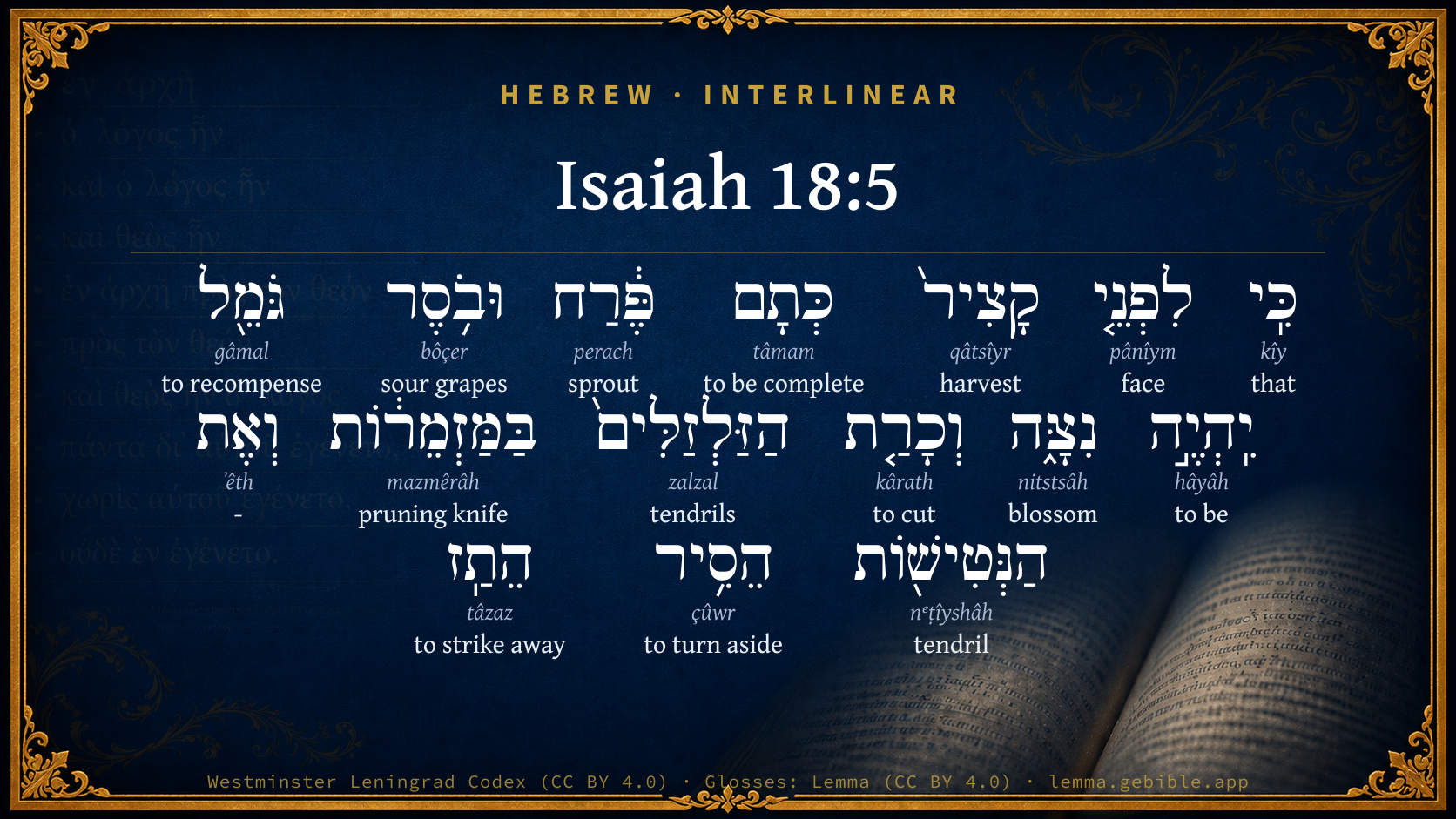
Hebrew (Westminster Leningrad Codex) Isaiah 18:5 appears in the Hebrew Old Testament. The text above is from the Westminster Leningrad Codex. Each word links to its Strong’s number, a concise gloss, and parsing drawn from the Open Scriptures Hebrew Bible morphology. Click any word for its full Brown-Driver-Briggs (BDB) entry.
Download image
Cite this verse

Isaiah 18:5 (World English Bible). Public Domain. Lemma interlinear Bible study tool, https://lemma.gebible.app/v/isaiah/18/5.

Show BibTeX & RIS
BibTeX
RIS
English Translation
For before the harvest, when the blossom is over, and the flower becomes a ripening grape, he will cut off the sprigs with pruning-hooks, and the spreading branches will he take away [and] cut down.
World English Bible · Public Domain
Highlights
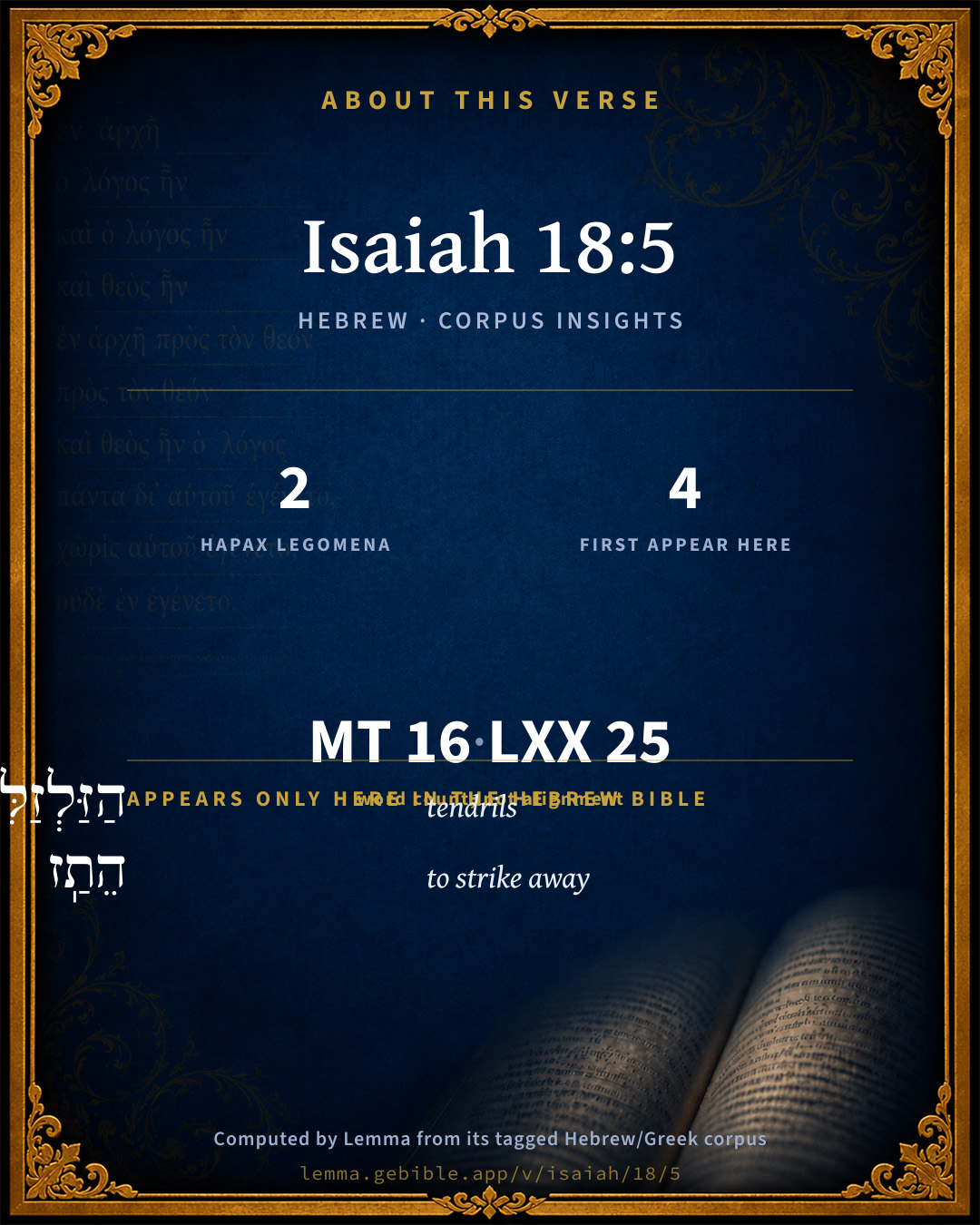
  • 2 hapax legomena — only here in the Hebrew Bible
  • 4 first appearances in the Hebrew Bible
Full analysis ↓
Download a study sheet

One document with this verse’s original text, its word-by-word gloss line, the meaning frame, cross-references with their text, attributed commentary, and full source and license credits — printable, and it pastes into notes with its structure intact.

This verse Autodidact and up

Study sheet (.html) Plain text (.txt)

A passage Seminary Student

Up to 50 verses in one chapter. A passage sheet keeps up to 6 commentary sources and 12 cross-references per verse, in the order this page ranks them, and says so on the sheet whenever that leaves anything out. Ask for a single verse and you get the Autodidact verse sheet above.

Everything on this page stays free to read, with no account — the sheet is a download of what is already on screen, not access to it.

Want to remove ads? Support Godless Engineer
Compare translations 3

The same verse in 3 English versions, stacked beneath the original-language interlinear above. Click any original word for its lexicon entry.

Each is an independent rendering of the whole verse — the interlinear is not word-aligned to these translations.

Highlighted words mark where these versions differ — a whole-verse word diff, not a word-by-word alignment.

  • World English Bible Public Domain
    For before the harvest, when the blossom is over, and the flower becomes a ripening grape, he will cut off the sprigs with pruning-hooks, and the spreading branches will he take away [and] cut down.
  • King James Version Public Domain
    For afore the harvest, when the bud is perfect, and the sour grape is ripening in the flower, he shall both cut off the sprigs with pruning hooks, and take away and cut down the branches.
  • unfoldingWord Literal Text CC BY-SA 4.0
    For to the face of the harvest, when the blossom is complete and the grape is ripening the flower, then he will cut off the shoots with pruning hooks, and the spreading branches, he will remove, he will cut off.

unfoldingWord Literal Text — © unfoldingWord, licensed CC BY-SA 4.0. Word-aligned USFM3 via Door43 (git.door43.org/unfoldingWord/en_ult).

Versions to compare (up to 4)

3 of 4 selected

Show all 18 translations

Every available English version of this verse, each an independent rendering of the whole verse.

  • World English Bible Public Domain
    For before the harvest, when the blossom is over, and the flower becomes a ripening grape, he will cut off the sprigs with pruning-hooks, and the spreading branches will he take away [and] cut down.
  • Berean Standard Bible Public Domain
    For before the harvest, when the blossom is gone and the flower becomes a ripening grape, He will cut off the shoots with a pruning knife and remove and discard the branches.
  • Majority Standard Bible Public Domain
    For before the harvest, when the blossom is gone and the flower becomes a ripening grape, He will cut off the shoots with a pruning knife and remove and discard the branches.
  • King James Version Public Domain
    For afore the harvest, when the bud is perfect, and the sour grape is ripening in the flower, he shall both cut off the sprigs with pruning hooks, and take away and cut down the branches.
  • American Standard Version (1901) Public Domain
    For before the harvest, when the blossom is over, and the flower becometh a ripening grape, he will cut off the sprigs with pruning-hooks, and the spreading branches will he take away `and' cut down.
  • Revised Version (1885) Public Domain
    For afore the harvest, when the blossom is over, and the flower becometh a ripening grape, he shall cut off the sprigs with pruning-hooks, and the spreading branches shall he take away and cut down.
  • Geneva Bible (1599) Public Domain
    For afore the haruest when the floure is finished, and the fruite is riping in the floure, then he shall cut downe the branches with hookes, and shall take away, and cut off the boughes:
  • Douay-Rheims (1899) Public Domain
    For before the harvest it was all flourishing, and it shall bud without perfect ripeness, and the sprigs thereof shall be cut off with pruning hooks: and what is left shall be cut away and shaken out.
  • Young's Literal Translation Public Domain
    For before harvest, when the flower is perfect, And the blossom is producing unripe fruit, Then hath `one' cut the sprigs with pruning hooks, And the branches he hath turned aside, cut down.
  • Literal Standard Version CC BY-SA 4.0
    For before harvest, when the flower is perfect, || And the blossom is producing unripe fruit, || Then [One] has cut the sprigs with pruning hooks, || And the branches He has turned aside, cut down.
  • Unlocked Literal Bible CC BY-SA 4.0
    Before the harvest, when the blossoming is over, and the flower is ripening into a grape, he will cut off the sprigs with pruning hooks, and he will cut down and take away the spreading branches.
  • unfoldingWord Literal Text CC BY-SA 4.0
    For to the face of the harvest, when the blossom is complete and the grape is ripening the flower, then he will cut off the shoots with pruning hooks, and the spreading branches, he will remove, he will cut off.
  • Darby Bible Public Domain
    For before the harvest, when the blossoming is over, and the flower becometh a ripening grape, he shall both cut off the sprigs with pruning-knives, and take away [and] cut down the branches.
  • World Messianic Bible Public Domain
    For before the harvest, when the blossom is over, and the flower becomes a ripening grape, he will cut off the sprigs with pruning hooks, and he will cut down and take away the spreading branches.
  • Webster's Bible Public Domain
    For before the harvest, when the bud is perfect, and the sour grape is ripening in the flower, he shall both cut off the sprigs with pruning-hooks, and take away and cut down the branches.
  • Free Bible Version CC BY-SA 4.0
    For before the harvest, after the flower is gone and becomes an unripe grape, he prunes the vine with a knife to take out the shoots and branches.
  • Bible in Basic English Public Domain
    For before the time of getting in the grapes, after the opening of the bud, when the flower has become a grape ready for crushing, he will take away the small branches with knives, cutting down and taking away the wide-stretching branches.
  • JPS Tanakh (1917) Public Domain
    For before the harvest, when the blossom is over, and the bud becometh a ripening grape, He will cut off the sprigs with pruning-hooks, and the shoots will He take away and lop off.

Literal Standard Version (2020), Covenant Press — licensed CC BY-SA 4.0. Text via the HelloAO Bible API (eBible.org). Unlocked Literal Bible (unfoldingWord) — licensed CC BY-SA 4.0. Text via the HelloAO Bible API (eBible.org). unfoldingWord Literal Text — © unfoldingWord, licensed CC BY-SA 4.0. Word-aligned USFM3 via Door43 (git.door43.org/unfoldingWord/en_ult). Free Bible Version, Dr. Jonathan Gallagher — licensed CC BY-SA 4.0. Text via the HelloAO Bible API (eBible.org).

Word by word

More ways to search: Search by grammar → Find every occurrence → Compare this word →

Practice this passage: Drill this verse → Learn its vocabulary →

הַזַּלְזַלִּים֙
zalzal
H2150
“the · tendrils”
Particle, Definite Article + Noun, Common, Masculine, Plural, Absolute
Part of Speech
Particle + Noun
Type
Common
Gender
Masculine
Number
Plural
State
Absolute
Full BDB Definition

Origin: by reduplication from H2151

TWOT: 553a

(quivering) tendrils, twig, shoot, tendrils
  1. כִּֽי kîy H3588 “that” Conjunction
  2. לִפְנֵ֤י pânîym H6440 “to/for · face(s) of” Preposition + Noun, Common, Both, Plural, Construct
  3. קָצִיר֙ qâtsîyr H7105 “harvest” Noun, Common, Masculine, Singular, Absolute
  4. כְּתָם tâmam H8552 “like/as · to be complete” Preposition + Verb, Qal, Infinitive Construct
  5. פֶּ֔רַח perach H6525 “sprout” Noun, Common, Masculine, Singular, Absolute
  6. וּבֹ֥סֶר bôçer H1155 “and · sour grapes” Conjunction + Noun, Common, Masculine, Singular, Absolute
  7. גֹּמֵ֖ל gâmal H1580 “recompensing” Verb, Qal, Participle Active, Masculine, Singular, Absolute
  8. יִֽהְיֶ֣ה hâyâh H1961 “to be” Verb, Qal, Imperfect, 3rd Person, Masculine, Singular
  9. נִצָּ֑ה nitstsâh H5328 “blossom” Noun, Common, Feminine, Singular, Absolute
  10. וְכָרַ֤ת kârath H3772 “and · to cut” Conjunction + Verb, Qal, Perfect, 3rd Person, Masculine, Singular
  11. בַּמַּזְמֵר֔וֹת mazmêrâh H4211 “in/at the · pruning knives” Preposition, Determined + Noun, Common, Feminine, Plural, Absolute
  12. וְאֶת ʼêth H853 “and · -” Conjunction + Particle, Direct Object
  13. הַנְּטִישׁ֖וֹת nᵉṭîyshâh H5189 “the · tendrils” Particle, Definite Article + Noun, Common, Feminine, Plural, Absolute
  14. הֵסִ֥יר çûwr H5493 “to turn aside” Verb, Hiphil, Perfect, 3rd Person, Masculine, Singular
  15. הֵתַֽז tâzaz H8456 “to strike away” Verb, Hiphil, Perfect, 3rd Person, Masculine, Singular

About this verse

These counts appear in no published source. They are computed here, from the morphology-tagged text and Lemma’s own curated glosses. What Lemma adds →

16
words
16
distinct lemmas
Prophets
section

Notable vocabulary

2 hapax legomena — words that appear only here in the entire Hebrew Bible:

  • הַזַּלְזַלִּים֙ tendrils H2150
  • הֵתַֽז to strike away H8456

First appearance in Scripture

These words make their first canonical appearance in the Hebrew Bible here:

  • וּבֹ֥סֶר sour grapes H1155
  • הַזַּלְזַלִּים֙ tendrils H2150
  • הַנְּטִישׁ֖וֹת tendril H5189
  • הֵתַֽז to strike away H8456

Shared distinctive vocabulary

נִצָּ֑ה blossom H5328 occurs in 2 verses of the Hebrew Bible. Also found in:

Grammatical profile

  • 6 verbs
  • 8 nouns
  • 1 conjunction
  • 1 particle

Verb forms

  • כְּתָם Qal · Infinitive Construct
  • גֹּמֵ֖ל Qal · Participle Active
  • יִֽהְיֶ֣ה Qal · Imperfect
  • וְכָרַ֤ת Qal · Perfect
  • הֵסִ֥יר Hiphil · Perfect
  • הֵתַֽז Hiphil · Perfect

Hebrew & Septuagint length

In English translation the verse runs 35 words from the Hebrew and 43 from the Septuagint (LXX English) — closely comparable.

A rough comparison of the two English renderings, which tokenize alike — not a word-level alignment.

Word counts can differ between the Hebrew and the Greek without any difference in meaning — e.g. the Hebrew direct-object marker אֵת has no separate Greek word, and Greek often adds the article ὁ.

In the original languages it is 16 Hebrew tokens and 25 Greek tokens — but the two are counted differently (Hebrew bundles its prefixes and suffixes into one token; the Greek is in lemma form), so that isn’t a like-for-like length.

Cross-references

4

Topical passages linked to Isaiah 18:5 in the Treasury of Scripture Knowledge — connected by theme and wording, ordered by reader-vote popularity; previews shown in the World English Bible.

  • Isaiah 17:10–11 For you have forgotten the God of your salvation, and have not been mindful of the rock of your strength; therefore you plant pleasant plants, and set it with strange slips.
  • Song of Solomon 2:13 The fig tree ripens her green figs. The vines are in blossom; They give forth their fragrance. Arise, my love, my beautiful one, And come away. Lover
  • Song of Solomon 2:15 Catch for us the foxes, The little foxes that spoil the vineyards; For our vineyards are in blossom. Beloved
  • Ezekiel 17:6–10 It grew, and became a spreading vine of low stature, whose branches turned toward him, and the roots of it were under him: so it became a vine, and brought forth branches, and shot forth sprigs.

Cross-references courtesy of OpenBible.info (CC BY 4.0).

Hebrew and Greek witnesses Masoretic Hebrew ↔ Greek Septuagint

The same verse in the two great witnesses to the Old Testament, shown verse-for-verse.

These are two independent witnesses, not word-aligned to each other, and the Septuagint is shown in lemma (dictionary) form.

Hebrew Isaiah 18:5 Masoretic · Westminster Leningrad Codex

כִּֽי לִפְנֵ֤י קָצִיר֙ כְּתָם פֶּ֔רַח וּבֹ֥סֶר גֹּמֵ֖ל יִֽהְיֶ֣ה נִצָּ֑ה וְכָרַ֤ת הַזַּלְזַלִּים֙ בַּמַּזְמֵר֔וֹת וְאֶת הַנְּטִישׁ֖וֹת הֵסִ֥יר הֵתַֽז

For before the harvest, when the blossom is over, and the flower becomes a ripening grape, he will cut off the sprigs with pruning-hooks, and the spreading branches will he take away [and] cut down.

World English Bible · Public Domain

Greek LXX Isaiah 18:5 Septuagint · lemma form

πρό ὁ θερισμός ὅταν συντελέω ἄνθος καί ὄμφαξ ἀνθέω ἄνθος ὀμφακίζω καί ἀποαἱρέω ὁ βοτρύδιον ὁ μικρός ὁ δρέπανον καί ὁ κληματίς ἀποαἱρέω καί κατακόπτω

Before the reaping time, when the flower has been completely formed, and the unripe grape has put forth its flower and blossomed, then shall he take away the little clusters with pruning-hooks, and shall take away the small branches, and cut them off;

LXX2012 (modern English Septuagint) · Public Domain

Hebrew: Westminster Leningrad Codex (CC BY 4.0). Greek: Septuagint (public domain); English from LXX2012 (modern English Septuagint) (Public Domain). How the Septuagint differs from the Hebrew →

Targum (Aramaic paraphrase)

1

The Targum is the ancient Jewish Aramaic paraphrase of the Hebrew Scriptures — an interpretive translation, not the Hebrew text itself. Onkelos (literal) and Pseudo-Jonathan (expansive) render the Torah, and Jonathan the Prophets. Coverage is partial: where no permissively-licensed English translation exists for a verse, only the Aramaic is shown. This is verse-level text, not a word-by-word alignment to the Hebrew.

  1. Targum Jonathan Prophets (Joshua–Malachi)
    אֲרֵי עַד לָא יִמְטֵי זְמַן חַצְדָא אִלָנָא לְאַפְרָחָא וּבִסְרָא מִנֵהּ סְמָדָר וְיִקְטוֹל שִׁלְטוֹנֵי עַמְמַיָא בְּחַרְבָּא וְיַת תַּקִיפֵיהוֹן יַעְדֵי וְיֶעְבַּר:

    Before the time of harvest cometh the tree is ready to bud, and the unripe grape bursts forth into a flower: He shall slay the rulers of the nations with the sword, and their mighty ones He shall remove, and cause to pass away.

    Targum Jonathan — Aramaic: “Mikraot Gedolot” (public domain). English: “Sefaria Community Translation” (CC0 1.0 (public-domain dedication)); “London "Chaldee Paraphrase," 1871” (public domain). Text via Sefaria.

Commentary

Notes on Isaiah 18:5 from classic Christian and Jewish commentators (each source and its license shown beneath its notes). The classic Christian expositions comment on the surrounding passage and are grouped to its opening verse, so a note may address several verses; the Jewish commentaries on the Tanakh (Rashi and others) are per-verse, so they appear only where the commentator wrote on this verse.

Lemma curates 59 commentaries, every one of them public domain or Creative Commons licensed, each selected and text-cleaned for this edition rather than reprinted as found. About our sources →

Trapp's Complete Commentary

John Trapp

Isa 18:5 For afore the harvest, when the bud is perfect, and the sour grape is ripening in the flower, he shall both cut off the sprigs with pruning hooks, and take away [and] cut down the branches.

Ver. 5. For afore the harvest.] Or, Vintage.

When the bud is perfect, &c.] When the Assyrian, fleshed with his former victory, maketh full account that all is his own, God shall make his hopes to hop headless. He shall slaughter his forces, {as Isa 18:6} branches and sprigs, great and small.

John Trapp, A Commentary or Exposition upon All the Books of the Old and New Testament (1647–1656) — public domain. Text from a community e-Sword module.

Joseph Benson's Commentary

Isa 18:5. For afore the harvest — Here the Lord informs his people how he would act toward those of their adversaries, for whom he had prepared this great slaughter. He compares them to a vine, which, after it hath sent forth its buds, then its flowers, and the flowers the sour grapes, which too were beginning to ripen, is suddenly stripped of its shoots and branches by the pruning-hook of the vine-dresser, who leaves them, burdened with grapes, a prey to the fowls of heaven, and the beasts of the earth. By which allegory, continued through this and the sixth verse, the prophet means, that, when every thing respecting the Assyrians was in the most promising situation, when Sennacherib’s great designs seemed almost mature, and just ready to be crowned with success, his mighty efforts should be in a moment frustrated, his vast expectations rendered abortive, and the chief part of his immense army made a prey to the beasts and birds.

Joseph Benson's Commentary on the Old and New Testaments (1811–1818) — public domain. Text from a community e-Sword module.

Tyndale Open Study Notes

Tyndale Open Resources

18:5 your plans are ripening: Ethiopia had made every effort to form alliances to protect itself against Assyria, but its alliance with Judah would not help.

Tyndale Open Study Notes — © Tyndale Open Resources, licensed CC BY-SA 4.0. Text via the HelloAO Bible API.

Jamieson, Fausset & Brown

Robert Jamieson, A. R. Fausset & David Brown

For--rather, "But."

perfect--perfected. When the enemy's plans are on the verge of completion.

sour grape . . . flower--rather, "when the flower shall become the ripening grape" [MAURER].

sprigs--the shoots with the grapes on them. God will not only disconcert their present plans, but prevent them forming any future ones. HORSLEY takes the "harvest" and vintage here as referring to purifying judgments which cause the excision of the ungodly from the earth, and the placing of the faithful in a state of peace on the earth: not the last judgment (Joh 15:2; Rev 14:15-20).

Jamieson, Fausset & Brown — Commentary Critical and Explanatory on the Whole Bible (1871) — public domain (CC PDM 1.0). Text via the HelloAO Bible API.

Adam Clarke's Commentary

Verse 5. The flower - "The blossom"] Heb. her blossom; נצה nitstsah, that is, the blossom of the vine, גפן gephen, vine, understood, which is of the common gender. See Ge 40:10. Note, that by the defective punctuation of this word, many interpreters, and our translators among the rest, have been led into a grievous mistake, (for how can the swelling grape become a blossom?) taking the word נצה nitstsah for the predicate; whereas it is the subject of the proposition, or the nominative case to the verb.

Adam Clarke's Commentary on the Bible (1810–1826) — public domain. Text from a community e-Sword/MySword module.

The Cambridge Bible for Schools and Colleges

gen. ed. J. J. S. Perowne

5. Assyria is here compared to a vine, ripening its grapes under the favourable influences indicated in Isa_18:4. The word for harvest does not strictly denote “vintage” (see on ch. Isa_16:9); either the more general term is employed for the particular, or the vine is conceived as cut down at that stage of its growth which coincides with the (wheat-) harvest.

Continue as in R.V., when the blossom is over and the flower becometh a ripening grape, &c.

take away and cut down] Rather (to avoid a hysteron-proteron) new away, the first verb having merely adverbial force.

The Cambridge Bible for Schools and Colleges (gen. ed. J. J. S. Perowne; Cambridge University Press, 1878–1918) — public domain. Text from a community e-Sword module.

John Gill's Exposition

For afore the harvest,.... Or vintage: the above metaphor is carried on; before the designs and schemes of the people above described are ripe for execution, who promised themselves a large harvest of their neighbours:

when the bud is perfect; when the bud of the vine is become a perfect grape, though unripe; when the scheme was fully laid, and with perfect and consummate wisdom as imagined, though not brought into execution:

and the sour grape is ripening in the flower; things go on and promise well, as if the issue would be according to expectation, and there would be a good vintage. The sour grape may denote the temper and disposition of the above people against their enemies, their ill nature, and enmity to them; or the sins and transgressions, for which the judgment denounced came upon them:

he shall both cut off the sprigs with pruning hooks, and take away and cut down the branches; as the vinedresser; or rather as one that has no good will to the vine, cuts it with pruning hooks, not to make it better, but worse, and cuts off, not the dead withered and useless parts of it, but the sprigs that have buds and flowers, or unripe grapes, upon them, and even whole branches that have clusters on them, and takes them and casts them away, to be trodden under foot, or cast into the fire; so the Lord, or the king of Assyria, the instrument in the hand of God, should cut off the Ethiopians, or the Egyptians, with the sword, both small and great, when their enterprise should fail, and their promised success: or this is to be understood of the destruction of Sennacherib's army by the angel, when he was full of expectation of taking Jerusalem, and plundering that rich city. Jarchi and Kimchi interpret it of the destruction of the armies of Gog and Magog. The Targum is,

"and he shall kill the princes of the people with the sword, and their mighty ones he shall remove and cause to pass over.''

John Gill's Exposition of the Whole Bible (1746–1763) — public domain (CC PDM 1.0). Text via the HelloAO Bible API.

Albert Barnes' Notes on the Bible

For afore the harvest - This verse is evidently figurative, and the image is drawn from that which is commenced in the previous verse. There, God is represented as calmly regarding the plans of the people here referred to - as the sun shines serenely on the herb, or the dew falls on the grass. “That” figure supposes that they had “formed” plans, and that they were advancing to maturity, like a growing harvest, while God surveyed them without interposition. This verse continues the figure, and affirms “that those plans shall not be mature;” that God will interpose and defeat them “while” they are maturing - as if a man should enter the harvest field and cut it down after it had been sown, or go into the vineyard, and cut down the vines while the green grape was beginning to ripen. It is, therefore, a most beautiful and expressive figure, intimating that all their plans would be foiled even when they had the prospect of a certain accomplishment.

When the bud is perfect - The word ‘bud’ here (פרח perach) denotes either a “blossom,” or a sprout, shoot, branch. Here it denotes probably the “blossom” of the grain; or it may be the grain when it is “set.” Its meaning is, when their plans are maturing, and there is every human prospect that they will be successful.

And the sour grape is ripening - Begins to turn; or is becoming mature.

In the flower - (נצה netsâh). The blossom. This should be read rather, ‘and the flower is becoming a ripening grape.’ The common version does not make sense; but with this translation the idea is clear. The sense is the same as in the former phrase - when their plans are maturing.

He shall cut off the sprigs - The shoots; the small limbs on which the grape is hanging, as if a man should enter a vineyard, and, while the grape is ripening, should not only cut off the grape, but the small branches that bore it, thus preventing it from bearing again. The idea is, not only that God would disconcert their “present” plans, but that he would prevent them from forming any in future. Before their plans were matured, and they obtained the anticipated triumph, he would effectually prevent them from forming such plans again.

Albert Barnes' Notes on the Bible (1834–1885) — public domain. Text from a community e-Sword/MySword module.

Matthew Poole's English Annotations

Afore the harvest; before they receive the end of their hopes, and finish the work which they have designed and begun.

When the bud is perfect, and the sour grape is ripening in the flower; when the bud or flower is turned into a perfect but unripe grape, which gives hopes of a good vintage. The body of this people are compared to a vine tree.

He; the Lord, who is easily understood from the foregoing verse, and who is here represented under the notion of a husbandman or vine-dresser.

Take away and cut down the branches; instead of the gathering of the grapes, he shall cut down the body and branches of the tree, and throw it into the fire.

Matthew Poole's English Annotations on the Holy Bible (1683–1685) — public domain. Text from a community e-Sword/MySword module.

Whedon's Commentary on the Bible

Daniel D. Whedon

5. But God does interfere at the last and right moment.

For afore the harvest — In this case the grape harvest, as the defining terms following indicate. In the interval between the two harvests God has looked calmly on. The Assyrian’s answer to the figure of the “grape harvest” — the pruning and nipping off of shoots to facilitate ripening by letting in of sunheat — symbolizes God’s own forwarding of the enemy and his plans unto destruction.

Daniel D. Whedon (gen. ed.), Commentary on the Old and New Testaments (1874–1909) — public domain. Text from a community e-Sword module.

The Pulpit Commentary

For afore the harvest. God can rest thus tranquil, because he can step in at any time; and this he is about to do, before Assyria reaps her harvest. When the bud is perfect, etc.; rather, when the blossom is past , and the green grape is becoming a ripening bunch. He shall cut off. (Isa_10:33, Isa_10:34) The metaphor is slightly varied in this place, to suit the imagery of the preceding clause, where Assyria has been represented as a vine-stock. Formerly her "boughs" were to be "lopped;" now her "branches" and "sprigs" or "sprouts" are to be cut away with pruning-hooks.

Vers. 5, 6. God can work.

When his time has come. Then, before man can do his harvesting work; when the blossoming and the growing times are over, through which God had waited; when the fruit becomes the full ripe grape, then God will show how he can work, putting in his implements, and proving himself to be a Deliverer and a Judge. God"s working here referred to is doubtless the sudden, unexpected, and complete overthrow of the Assyrian army under Sennacherib, which came at the time when it would prove absolutely overwhelming, and perfectly effective as a deliverance. Matthew Henry states the case in this way: "When the Assyrian army promises itself a plentiful harvest in the taking of Jerusalem and the plundering of that rich city, when the bud of that project is perfect, before the harvest is gathered in, while the sour grape of their enmity to Hezekiah and his people is ripening in the flower, and the design is just ready to be put into execution, God shall destroy that army as easily as the husbandman cuts off the vine with pruning-hooks, or because the grape is sour and good for nothing, and will not be cured, takes away and cuts down the branches. This seems to point at the overthrow of the Assyrian army by a destroying angel, when the dead bodies of the soldiers were scattered like the branches and sprigs of a wild vine, which the husbandman has cut to pieces.

I GOD"S WORKING IS WELL-TIMED. This is the point made specially prominent here. What was needed, for the due impression of Judah and the surrounding nations, was some startling deliverance; something that should be at once complete, and yet should be manifestly beyond man"s accomplishing. Such a working must be exactly timed. When the success of Assyria seemed assured, when its prey seemed within its grasp, and when men"s hearts were failing them for fear, just then the wild hot Simoom blast swept over the army, and as in a moment there were heaps of dead men, and few escaped to tell the awful story. For the timeliness of God"s judgment-workings find illustration in the Flood, the destruction of Sodom, the extirpation of the Canaanites, the captivities, and the final siege of Jerusalem.

II GOD"S WORKING IS FULL OF ENERGY. Ever setting before us the example of thoroughness in the doing of whatever work has to be done. This is in great part the reason why, in making Israel his executioner, God required Israel to treat everything belonging to the Canaanites as accursed, and doomed to destruction. It was, for the first ages, a Divine lesson in thoroughness, energy, and promptitude. God never works with a slack hand, and his servants must not.

III GOD"S WORKING IS ALWAYS EFFECTIVE TO ITS END. And that, not because it is almighty working, so much as because it is all-wise working. Power is quite a secondary thing to adaptation. A thing fitted to its end will accomplish it, and it will be accomplished better through the fitness than by any displays of power. The end here designed was an adequate impression of the sole and sovereign rights of Jehovah, and a loud call to the nations to put their trust in him. The overthrow of a mighty army, in the fullness of its pride, by purely natural which are purely Divine forces, was exactly adapted to secure this end. Illustrate by the moral impression produced by great and destructive earthquakes. When the end of God"s working is the persuasion of his fatherly love, then we find his means marvelously adapted and effective. "He gave his Son, his only begotten Son." And herein we say is love, "not that we loved God, but that lie loved us, and sent his Son to be the Propitiation for our sins." Be it work of judgment or work of mercy, of this we may be quite sure God accomplishes that which he pleases, and his work prospers in that to which he sends it. R.T.

The Pulpit Commentary (1880–1919), ed. H.D.M. Spence-Jones & Joseph S. Exell — public domain. Text from a community e-Sword module.

John Wesley's Explanatory Notes

For - Before they receive the end of their hopes. When - When the bud or flower is turned into a grape, which gives hopes of good vintage. He - The Lord. The branches - Instead of gathering the grapes, shall cut down the tree, and throw it into the fire.

John Wesley, Explanatory Notes Upon the Whole Bible (1754–1765) — public domain. Text via the GEBible commentary corpus.

J. A. Alexander on Isaiah

Joseph Addison Alexander

“For before the harvest, as the bloom is finished, and the fewer becomes a ripening grape, He cuts down the branches with the pruning knives, and the tendrils He removes, He cuts away.” The obvious meaning of the figures is, that although God would suffer the designs of the enemy to approach completion, He would nevertheless interfere at the last moment and destroy both him and them. As if He had said, ‘let all the world await the great catastrophe, for I will let the enemy almost attain his end, but let them still attend, for before it is attained, I will destroy him.’ The verbs in the last clause may either be referred directly to Jehovah as their subject, or construed indefinitely, one shall cut them down.

Joseph Addison Alexander, The Prophecies of Isaiah (1846–1847; New York: Scribner, 1870–1878) — public domain. Text from a community e-Sword module.

Rashi

Rabbi Shlomo Yitzchaki (Rashi)

For before the ripening of the harvest of Amalek and of Gog, when he has not yet filled his desire and his hope, that he plans to destroy his brothers.

when the blossom is past i.e., when its blossom is past and the grain is close to becoming ripe in its ears and before the buds of his vine become ripening grapes, ripened to the extent of being בֹּסֶר, i.e., when the grapes become as big as a white bean. This is called בֹּסֶר and also גֵּרוּעַ.

and he shall cut off i.e., the cutter shall cut off the tendrils; these are the branches and the boughs.

with pruning hooks sarpes in O.F. [serpes in Modern French].

and the roots These are the roots of the vines, called ceps in O.F.

he cut [them] off Heb. הֵתַּז. i.e., to say that He shall slay the officers and the rulers of Esau and of Gog and his armies and his allies.

Rashi on the Tanakh — English translations: “The Judaica Press complete Tanach with Rashi, translated by A. J. Rosenberg” (CC BY 4.0); “Pentateuch with Rashi's commentary by M. Rosenbaum and A.M. Silbermann, 1929-1934” (public domain); “The Metsudah Tanach series, Lakewood, N.J” (CC BY 4.0); and “The Book of Joshua, Metsudah Publications, 1997” (CC BY 4.0). Text via Sefaria.

Ibn Ezra

Rabbi Abraham ibn Ezra

גומל Ripening, Comp. ויגמל And it ripened (Num. 17:23). יהיה נצה Will still be in the flower.

And He will cut off. The pronoun refers to God.

הזלזלים The sprigs. The branches which are joined to the root; the word is hap. leg.

הנטישות The large branches, that spread (נטש) widely.

כרת ═ התז He cut. This verb is often met with in Rabbinical Hebrew. The two verbs in the past follow each other without a conjunction, like חמק עבר Hath gone, passed by (Song 5:6). The meaning of the verse is: The Assyrians will perish before the fruit of their devices will be ripe.

Ibn Ezra on the Tanakh — English translations: “Sefaria Community Translation” (CC0 1.0 (public-domain dedication)); “Yalkut, Sifsei Chachomim Chumash, Metsudah Publications, 2009” (CC BY 4.0); and “Commentary of Ibn Ezra on Isaiah - trans. by M. Friedlander, 1873” (public domain). Text via Sefaria.

Lesson kit

Teaching starters — assembled from the data on this page, not authored interpretation. Every prompt links to the verse data it draws on. Edit before teaching.

Isaiah, in the Prophets, opens this verse with 16 words (16 distinct Hebrew lemmas). Its most distinctive word is zalzal (“tendrils”). A historical commentator’s framing appears above. Read the whole chapter for the surrounding context.

Discussion questions

  1. What does “tendrils” (zalzal) contribute to the verse as a whole?
  2. 2 words here appear nowhere else in the Hebrew Bible. Why might the author reach for such rare wording?
  3. 4 words make their first appearance in Scripture here. What does this debut establish?
  4. How does Job 15:33, which shares the word «blossom», read alongside this verse?
  5. These translations render this verse differently. What is at stake in choosing one wording over another?
  6. «כְּתָם» is a Qal Infinitive Construct verb. How does that grammatical form shape the action described?
  7. Compare how Trapp's Complete Commentary and Joseph Benson's Commentary read this verse. Where do they agree or differ?

Things to notice

Reading settings

Reading text

Shown beneath each verse's original-language words.

Old Testament
Old Testament edition

Read the OT as the Masoretic Hebrew (MT) or the Greek Septuagint (LXX).

English shown for the Greek Septuagint (in the Hebrew ↔ Greek comparison).

Comparing translations? Open the Compare panel on any verse page to stack up to four side by side.