
Psalms 34:16

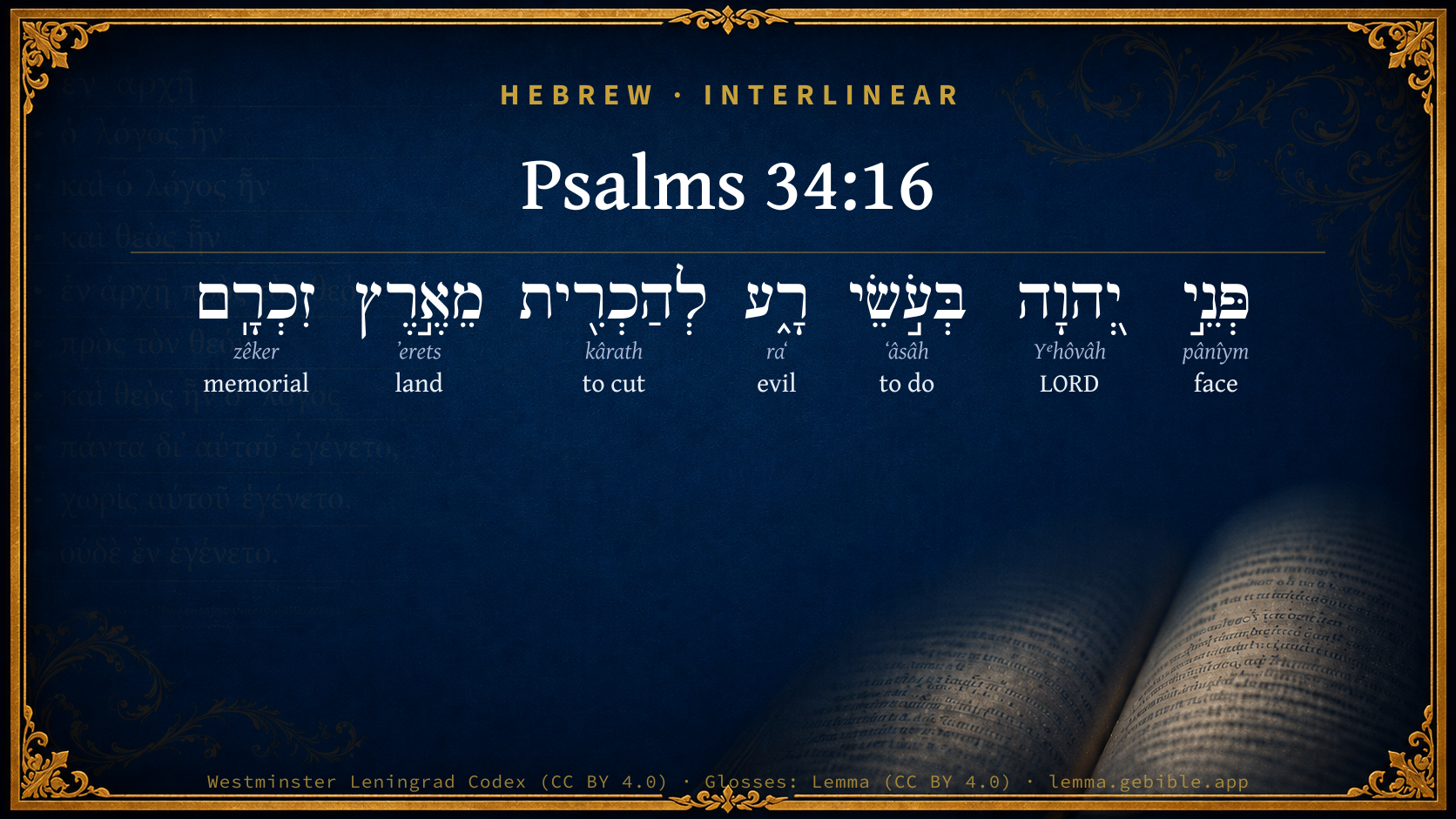
Hebrew (Westminster Leningrad Codex) Psalms 34:16 appears in the Hebrew Old Testament. The text above is from the Westminster Leningrad Codex. Each word links to its Strong’s number, a concise gloss, and parsing drawn from the Open Scriptures Hebrew Bible morphology. Click any word for its full Brown-Driver-Briggs (BDB) entry.
Download image
Cite this verse

Psalms 34:16 (World English Bible). Public Domain. Lemma interlinear Bible study tool, https://lemma.gebible.app/v/psalms/34/16.

Show BibTeX & RIS
BibTeX
RIS
English Translation
Yahweh's face is against those who do evil, To cut off the memory of them from the earth.
World English Bible · Public Domain
Download a study sheet

One document with this verse’s original text, its word-by-word gloss line, the meaning frame, cross-references with their text, attributed commentary, and full source and license credits — printable, and it pastes into notes with its structure intact.

This verse Autodidact and up

Study sheet (.html) Plain text (.txt)

A passage Seminary Student

Up to 50 verses in one chapter. A passage sheet keeps up to 6 commentary sources and 12 cross-references per verse, in the order this page ranks them, and says so on the sheet whenever that leaves anything out. Ask for a single verse and you get the Autodidact verse sheet above.

Everything on this page stays free to read, with no account — the sheet is a download of what is already on screen, not access to it.

Want to remove ads? Support Godless Engineer
Compare translations 3

The same verse in 3 English versions, stacked beneath the original-language interlinear above. Click any original word for its lexicon entry.

Each is an independent rendering of the whole verse — the interlinear is not word-aligned to these translations.

Highlighted words mark where these versions differ — a whole-verse word diff, not a word-by-word alignment.

  • World English Bible Public Domain
    Yahweh's face is against those who do evil, To cut off the memory of them from the earth.
  • King James Version Public Domain
    The face of the LORD is against them that do evil, to cut off the remembrance of them from the earth.
  • unfoldingWord Literal Text CC BY-SA 4.0
    The face of Yahweh against the doers of evil, to cut off their remembrance from the earth.

unfoldingWord Literal Text — © unfoldingWord, licensed CC BY-SA 4.0. Word-aligned USFM3 via Door43 (git.door43.org/unfoldingWord/en_ult).

Versions to compare (up to 4)

3 of 4 selected

Show all 18 translations

Every available English version of this verse, each an independent rendering of the whole verse.

  • World English Bible Public Domain
    Yahweh's face is against those who do evil, To cut off the memory of them from the earth.
  • Berean Standard Bible Public Domain
    But the face of the LORD is against those who do evil, to wipe out all memory of them from the earth.
  • Majority Standard Bible Public Domain
    But the face of the LORD is against those who do evil, to wipe out all memory of them from the earth.
  • King James Version Public Domain
    The face of the LORD is against them that do evil, to cut off the remembrance of them from the earth.
  • American Standard Version (1901) Public Domain
    The face of Jehovah is against them that do evil, To cut off the remembrance of them from the earth.
  • Revised Version (1885) Public Domain
    The face of the LORD is against them that do evil, to cut off the remembrance of them from the earth.
  • Geneva Bible (1599) Public Domain
    But the face of the Lord is against them that doe euill, to cut off their remembrance from the earth.
  • Douay-Rheims (1899) Public Domain
    The eyes of the Lord are upon the just: and his ears unto their prayers.
  • Young's Literal Translation Public Domain
    (The face of Jehovah `is' on doers of evil, To cut off from earth their memorial.)
  • Literal Standard Version CC BY-SA 4.0
    (The face of YHWH [is] on doers of evil, || To cut off their memorial from earth.)
  • Unlocked Literal Bible CC BY-SA 4.0
    The face of Yahweh is against those who do evil, to cut off the memory of them from the earth.
  • unfoldingWord Literal Text CC BY-SA 4.0
    The face of Yahweh against the doers of evil, to cut off their remembrance from the earth.
  • Darby Bible Public Domain
    The face of Jehovah is against them that do evil, to cutoff the remembrance of them from the earth:
  • World Messianic Bible Public Domain
    The LORD’s face is against those who do evil, to cut off their memory from the earth.
  • Webster's Bible Public Domain
    \\34:15\\The eyes of the LORD are upon the righteous, and his ears are open to their cry.
  • Free Bible Version CC BY-SA 4.0
    The Lord sets himself against those who do evil. He will wipe out even the memory of them from the earth.
  • Bible in Basic English Public Domain
    The face of the Lord is against those who do evil, to take away the memory of them from the earth.
  • JPS Tanakh (1917) Public Domain
    (34-17) The face of the LORD is against them that do evil, to cut off the remembrance of them from the earth.

Literal Standard Version (2020), Covenant Press — licensed CC BY-SA 4.0. Text via the HelloAO Bible API (eBible.org). Unlocked Literal Bible (unfoldingWord) — licensed CC BY-SA 4.0. Text via the HelloAO Bible API (eBible.org). unfoldingWord Literal Text — © unfoldingWord, licensed CC BY-SA 4.0. Word-aligned USFM3 via Door43 (git.door43.org/unfoldingWord/en_ult). Free Bible Version, Dr. Jonathan Gallagher — licensed CC BY-SA 4.0. Text via the HelloAO Bible API (eBible.org).

Word by word

More ways to search: Search by grammar → Find every occurrence → Compare this word →

Practice this passage: Drill this verse → Learn its vocabulary →

About this verse

These counts appear in no published source. They are computed here, from the morphology-tagged text and Lemma’s own curated glosses. What Lemma adds →

7
words
7
distinct lemmas
Wisdom
section

Notable vocabulary

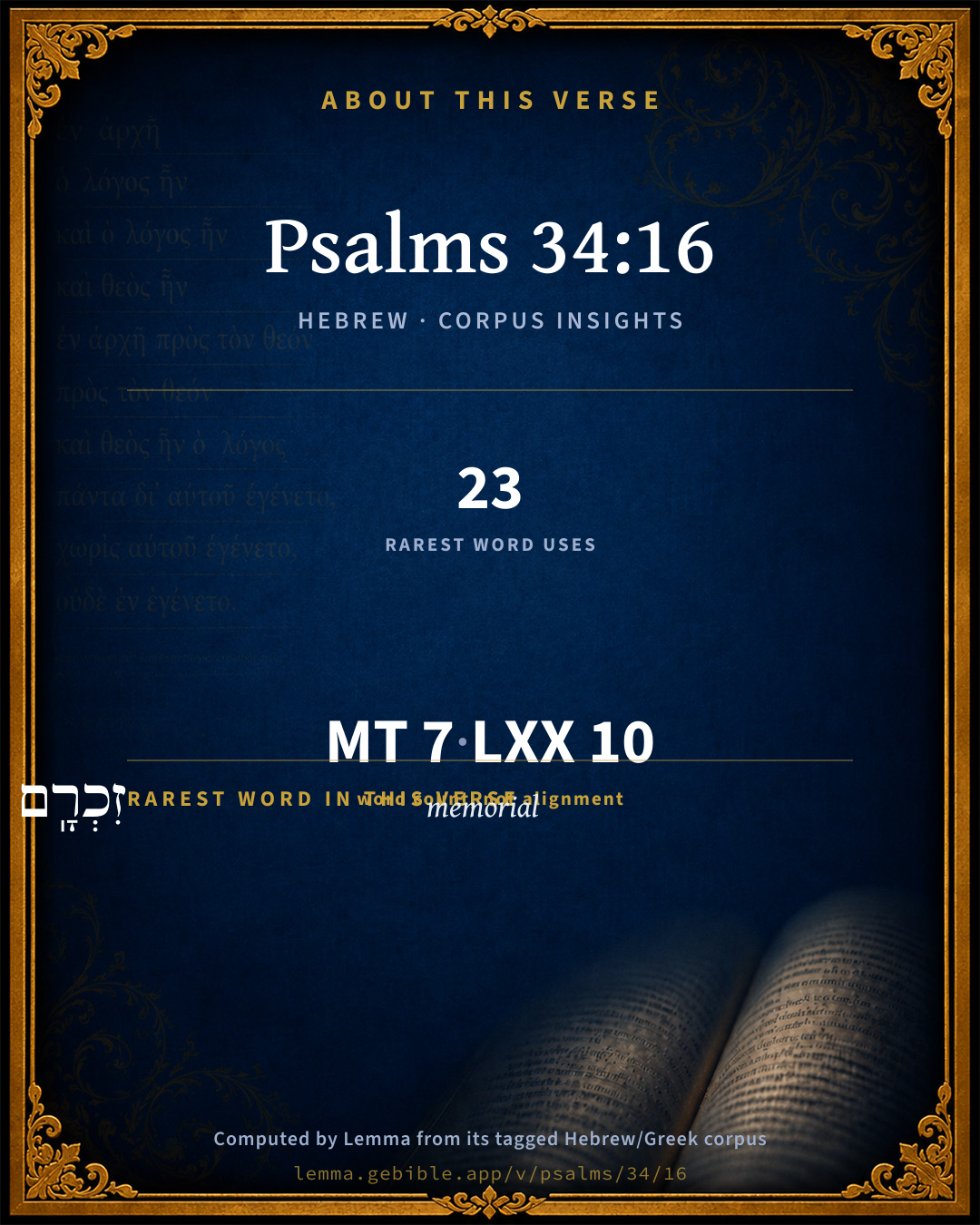
The rarest word here is זִכְרָֽם memorial H2143 — appearing just 23 times in the whole Hebrew Bible.

Shared distinctive vocabulary

זִכְרָֽם memorial H2143 occurs in 23 verses of the Hebrew Bible. Also found in:

Grammatical profile

  • 2 verbs
  • 4 nouns
  • 1 adjective

Verb forms

  • בְּעֹ֣שֵׂי Qal · Participle Active
  • לְהַכְרִ֖ית Hiphil · Infinitive Construct

Hebrew & Septuagint length

In English translation the verse runs 18 words from the Hebrew and 28 from the Septuagint (LXX English) — closely comparable.

A rough comparison of the two English renderings, which tokenize alike — not a word-level alignment.

Word counts can differ between the Hebrew and the Greek without any difference in meaning — e.g. the Hebrew direct-object marker אֵת has no separate Greek word, and Greek often adds the article ὁ.

In the original languages it is 7 Hebrew tokens and 10 Greek tokens — but the two are counted differently (Hebrew bundles its prefixes and suffixes into one token; the Greek is in lemma form), so that isn’t a like-for-like length.

Cross-references

10

Topical passages linked to Psalms 34:16 in the Treasury of Scripture Knowledge — connected by theme and wording, ordered by reader-vote popularity; previews shown in the World English Bible.

  • Proverbs 10:7 The memory of the righteous is blessed, But the name of the wicked will rot.
  • Jeremiah 17:13 Yahweh, the hope of Israel, all who forsake you shall be disappointed. Those who depart from me shall be written in the earth, because they have forsaken Yahweh, the spring of living waters.
  • Jeremiah 44:11 Therefore thus says Yahweh of Hosts, the God of Israel: Behold, I will set my face against you for evil, even to cut off all Judah.
  • Leviticus 17:10 "'Any man of the house of Israel, or of the strangers who live as foreigners among them, who eats any kind of blood, I will set my face against that soul who eats blood, and will cut him off from among his people.
  • Job 18:17 His memory shall perish from the earth. He shall have no name in the street.
  • Amos 9:4 Though they go into captivity before their enemies, there I will command the sword, and it will kill them. I will set my eyes on them for evil, and not for good.
  • Leviticus 26:17 I will set my face against you, and you will be struck before your enemies. Those who hate you will rule over you; and you will flee when no one pursues you.
  • Psalms 10:16 Yahweh is King forever and ever! The nations will perish out of his land.
  • Ecclesiastes 8:10 So I saw the wicked buried. Indeed they came also from holiness. They went and were forgotten in the city where they did this. This also is vanity.
  • Ezekiel 14:7–8 For everyone of the house of Israel, or of the strangers who sojourn in Israel, who separates himself from me, and takes his idols into his heart, and puts the stumbling block of his iniquity before his face, and comes to the prophet to inquire for himself of me; I Yahweh will answer him by myself:

Cross-references courtesy of OpenBible.info (CC BY 4.0).

Hebrew and Greek witnesses Masoretic Hebrew ↔ Greek Septuagint

The same verse in the two great witnesses to the Old Testament, shown verse-for-verse.

You’re reading Greek Psalm 33 (Hebrew Psalm 34). The Septuagint counts the superscription, so verse numbers can differ from the Hebrew — chapter-level alignment, not verse-by-verse. Numbering follows Rahlfs.

These are two independent witnesses, not word-aligned to each other, and the Septuagint is shown in lemma (dictionary) form.

Hebrew Psalms 34:16 Masoretic · Westminster Leningrad Codex

פְּנֵ֣י יְ֭הוָה בְּעֹ֣שֵׂי רָ֑ע לְהַכְרִ֖ית מֵאֶ֣רֶץ זִכְרָֽם

Yahweh's face is against those who do evil, To cut off the memory of them from the earth.

World English Bible · Public Domain

Greek LXX Greek Psalm 33:16 Septuagint · lemma form

ὀφθαλμός κύριος ἐπί δίκαιος καί οὖς αὐτός εἰς δέησις αὐτός

but the face of the Lord is against them that do evil, to destroy their memorial from the earth. The righteous cried, and the Lord listened to them,

LXX2012 (modern English Septuagint) · Public Domain

Hebrew: Westminster Leningrad Codex (CC BY 4.0). Greek: Septuagint (public domain); English from LXX2012 (modern English Septuagint) (Public Domain). How the Septuagint differs from the Hebrew →

Commentary

Notes on Psalms 34:16 from classic Christian and Jewish commentators (each source and its license shown beneath its notes). The classic Christian expositions comment on the surrounding passage and are grouped to its opening verse, so a note may address several verses; the Jewish commentaries on the Tanakh (Rashi and others) are per-verse, so they appear only where the commentator wrote on this verse.

Lemma curates 59 commentaries, every one of them public domain or Creative Commons licensed, each selected and text-cleaned for this edition rather than reprinted as found. About our sources →

Trapp's Complete Commentary

John Trapp

Psa 34:16 The face of the LORD [is] against them that do evil, to cut off the remembrance of them from the earth.

Ver. 16. The face of the Lord is against them that do evil] Let not such dream of a long and happy life, as Psa 34:12. This they are apt to do; but shall be carried from a fool’s paradise to a true prison. For that people may not imagine God to be μονοφθαλμαν, and so made up of mercy as to forget his judgments, the wicked are here assured, that the face of the Lord is against them, that he beholdeth them from heaven with a terrible countenance, that he is grievously angry with them, and will surely and severely punish them, and theirs after them.

To cut off the remembrance of them from the earth] And so to cross them in the thing that they most coveted, viz. to renown themselves among men. God writeth them in the earth in opposition to those whose names are written in heaven, Luk 10:20, because they forsook the Lord, the fountain of living waters, Jer 17:13.

John Trapp, A Commentary or Exposition upon All the Books of the Old and New Testament (1647–1656) — public domain. Text from a community e-Sword module.

Keil & Delitzsch

C. F. Keil & F. Delitzsch

(Heb.: 34:17-22) The poet now recommends the fear of God, to which he has given a brief direction, by setting forth its reward in contrast with the punishment of the ungodly. The prepositions אל and בּ, in Psa 34:16 and Psa 34:17, are a well considered interchange of expression: the former, of gracious inclination (Psa 33:18), the latter, of hostile intention or determining, as in Job 7:8; Jer 21:10; Jer 44:11, after the phrase in Lev 17:10. The evil doers are overwhelmed by the power of destruction that proceeds from the countenance of Jahve, which is opposed to them, until there is not the slightest trace of their earthly existence left. The subjects to Psa 34:18 are not, according to Psa 107:17-19, the עשׁי רע (evil doers), since the indispensable characteristic of penitence is in this instance wanting, but the צדיקים (the righteous). Probably the פ strophe stood originally before the ע strophe, just as in Lam 2-4 the פ precedes the ע (Hitzig). In connection with the present sequence of the thoughts, the structure of Psa 34:18 is just like Psa 34:6 : Clamant et Dominus audit = si qui (quicunque) clamant. What is meant is the cry out of the depth of a soul that despairs of itself. Such crying meets with a hearing with God, and in its realisation, an answer that bears its own credentials. "The broken in heart" are those in whom the egotistical, i.e., self-loving life, which encircles its own personality, is broken at the very root; "the crushed or contrite (דּכּאי, from דּכּא, with a changeable ā, after the form אילות from איּל) in spirit" are those whom grievous experiences, leading to penitence, of the false eminence to which their proud self-consciousness has raised them, have subdued and thoroughly humbled. To all such Jahve is nigh, He preserves them from despair, He is ready to raise up in them a new life upon the ruins of the old and to cover or conceal their infinitive deficiency; and, they, on their part, being capable of receiving, and desirous of, salvation, He makes them partakers of His salvation. It is true these afflictions come upon the righteous, but Jahve rescues him out of them all, מכּלּם = מּכּלּן (the same enallage generis as in Rut 1:19; Rut 4:11). He is under the most special providence, "He keepeth all his bones, not one of them (ne unum quidem) is broken" - a pictorial exemplification of the thought that God does not suffer the righteous to come to the extremity, that He does not suffer him to be severed from His almighty protecting love, nor to become the sport of the oppressors. Nevertheless we call to mind the literal fulfilment which these words of the psalmist received in the Crucified One; for the Old Testament prophecy, which is quoted in Joh 19:33-37, may be just as well referred to our Psalm as to Exo 12:46. Not only the Paschal lamb, but in a comparative sense even every affliction of the righteous, is a type. Not only is the essence of the symbolism of the worship of the sanctuary realised in Jesus Christ, not only is the history of Israel and of David repeated in Him, not only does human suffering attain in connection with Him its utmost intensity, but all the promises given to the righteous are fulfilled in Him κατ ̓ ἐξοχήν; because He is the righteous One in the most absolute sense, the Holy One of God in a sense altogether unique (Isa 53:11; Jer 23:5, Zac 9:9; Act 3:14; Act 22:14). - The righteous is always preserved from extreme peril, whereas evil (רעה) slays (מותת stronger than המית) the ungodly: evil, which he loved and cherished, becomes the executioner's power, beneath which he falls. And they that hate the righteous must pay the penalty. Of the meanings to incur guilt, to feel one's self guilty, and to undergo punishment as being guilty, אשׁם (vid., on Sa1 14:13) has the last in this instance.

Keil & Delitzsch — Biblical Commentary on the Old Testament (1861–1891) — public domain (CC PDM 1.0). Text via the HelloAO Bible API. (Old Testament only.)

J. A. Alexander on Psalms

Joseph Addison Alexander

17. (Psa 34:16). The face of Jehovah (is) with evil-doers, to destroy from the earth their memory. The same unsleeping vigilance is exercised towards others also, but for a very different purpose. The face of the Lord is with evil-doers, i.e. visible or present to them, no less than to good men. The preposition before evil-doers is not the same that occurs twice in the verse preceding, and which properly denotes direction, but another meaning in, or with. The unfavourable sense, against, which it may seem to have both here and elsewhere (e. g. Jer 21:10; Jer 44:11), is suggested by the context. In all these cases some interpreters suppose the sense to be that the eyes or face of God penetrate, as it were, and rest in the object.—The design with which Jehovah watches evil-doers is not to interpose for their deliverance or relief, but to destroy from the earth their very memory, a strong expression for entire extirpation. Compare Exo 17:14, Deu 25:19, Isa 26:14, and see above, on Psa 9:6-7 (5, 6).

Joseph Addison Alexander, The Psalms Translated and Explained (1850) — public domain. Text from a community e-Sword module.

Geneva Bible (1599)

Geneva Bible translators

The anger of God doth not only destroy the wicked, but also abolisheth their name forever.

Geneva Bible (1599) marginal notes — public domain. Text via Bolls.life.

Jamieson, Fausset & Brown

Robert Jamieson, A. R. Fausset & David Brown

face . . . against--opposed to them (Lev 17:10; Lev 20:3).

cut off the remembrance--utterly destroy (Psa 109:13).

Jamieson, Fausset & Brown — Commentary Critical and Explanatory on the Whole Bible (1871) — public domain (CC PDM 1.0). Text via the HelloAO Bible API.

Ellicott's Commentary for English Readers

(16) To cut off.—Notice the fear, so intense and recurring to the Semitic mind, of the extinction of race. (Comp. Psa_21:10; Job_18:17, &c)

This verse, according to the sense, should certainly change places with Psa_34:15. This would disarrange the acrostic, bringing pe before ayin; but, as in Lamentations 2, 3, 4 the same sequence of letters occurs, we are led to the conclusion that the order of the alphabet was not definitely or invariably fixed in respect of these two letters, a license intelligible enough when we remember that tsadde, which follows pe, was often interchanged with ayin, which precedes it.

A Bible Commentary for English Readers, edited by Charles John Ellicott (1878–1897) — public domain. Text from a community e-Sword module.

The Cambridge Bible for Schools and Colleges

gen. ed. J. J. S. Perowne

16. The face of the Lord means the manifestation of His Presence, either as here in wrath (cp. Psa_9:3), or as in Num_6:25, in blessing. See Oehler’s O.T. Theology, § 57. Comp. “The Lord looked forth upon the host of the Egyptians … and discomfited them” (Exo_14:24).

the remembrance of them] Or, their memorial; even the name by which they might be remembered. Cp. Psa_9:5-6; Job_18:17. Contrast Psa_112:6.

The Cambridge Bible for Schools and Colleges (gen. ed. J. J. S. Perowne; Cambridge University Press, 1878–1918) — public domain. Text from a community e-Sword module.

John Gill's Exposition

The face of the Lord is against them that do evil,.... Not against everyone that sins; for the righteous are not without sin; they have sin in them, and they do no good without it; but against them that live in sin, whose course of life is a series of wickedness, and they are workers of iniquity; and have no sense of sin, nor sorrow for it, go on in it without shame or fear; against these the face of the Lord is, he shows his resentment, and stirs up his wrath. For the Lord to be against a man is dreadful; a fearful thing it is to fill into his hands as a God of vengeance; there is no standing before him when once he is angry: and to have the face of God against a man is intolerable, when it is to destroy, and

to cut off the remembrance of them from the earth; so that they shall be no more thought of, nor spoken of, but with contempt and reproach; an everlasting mark of infamy being upon their names; see Pro 10:7.

John Gill's Exposition of the Whole Bible (1746–1763) — public domain (CC PDM 1.0). Text via the HelloAO Bible API.

Albert Barnes' Notes on the Bible

The face of the Lord - This phrase is synonymous with that in the previous verse: “The eyes of the Lord.” The meaning is, that the righteous and the wicked are alike under the eye of God; the one for protection, the other for punishment. Neither of them can escape His notice; but at all times, and in all circumstances, they are equally seen by Him.

Is against them that do evil - The wicked; all that do wrong. In the former verse the statement is, that the eyes of the Lord are upon the righteous, that is, for their protection; in this case, by a change of the preposition in the original, the statement is, that His face is “against” them that do evil, that is, He observes them to bring judgment upon them.

To cut off the remembrance of them from the earth - To cut off themselves, - their families - and all memorials of them, so that they shall utterly be forgotten among people. Compare Psa 109:13-15. So, in Pro 10:7, it is said, “The memory of the just is blessed; but the name of the wicked shall rot.” Two things are implied here:

(1) That it is “desirable” to be remembered after we are dead. There is in us a deep-rooted principle, of great value to the cause of virtue, which prompts us to “desire” that we may be held in grateful recollection by mankind after we have passed away; that is, which prompts us to do something in our lives, the remembrance of which the world will not “willingly let die.” - Milton.

(2) The other idea is, that there is a state of things on earth which has a tendency to cause the remembrance of the wicked to die out, or to make people forget them. There is nothing to make men desire to retain their recollection, or to rear monuments to them. People are indeed remembered who are of bad eminence in crime; but the world will forget a wicked man just as soon as it can. This is stated here as a reason particularly addressed to the young Psa 34:11 why they should seek God, and pursue the ways of righteousness. The motive is, that men will “gladly” retain the remembrance of those who are good; of those who have done anything worthy to be remembered, but that a life of sin will make men desire to forget as soon as possible all those who practice it. This is not a low and base motive to be addressed to the young. That is a high and honorable principle which makes us wish that our names should be cherished by those who are to live after us, and is one of the original principles by which God keeps up virtue in the world - one of those arrangements, those safeguards of virtue, by which we are prompted to do right, and to abstain from that which is wrong. It is greatly perverted, indeed, to purposes of ambition, but, in itself, the desire not to be forgotten when we are dead contributes much to the industry, the enterprise, and the benevolence of the world, and is one of the most efficacious means for preserving us from sin.

Albert Barnes' Notes on the Bible (1834–1885) — public domain. Text from a community e-Sword/MySword module.

Matthew Poole's English Annotations

The face of the Lord, i.e. his anger, oft called his face, as Lev 17:10; 20:5; Jer 44:11; Lam 4:16, because anger discovers itself in the face.

Them that do evil, i.e. whose common course, and study, arid business it is to do evil; for else there is not a just man upon earth, that doeth good, and sinneth not, Ecc 7:20. To cut off the remembrance of them from the earth; utterly to deprive both them and their children of that worldly happiness, which is the only thing that they desire, and seek by their wicked courses.

Matthew Poole's English Annotations on the Holy Bible (1683–1685) — public domain. Text from a community e-Sword/MySword module.

The Treasury of David

Charles H. Spurgeon

Ver. 16. The face of the Lord is against them that do evil. God is not indifferent to the deeds of sinners, but he sets his face against them, as we say, being determined that they shall have no countenance and support, but shall be thwarted and defeated. He is determinately resolved that the ungodly shall not prosper; he sets himself with all his might to overthrow them. To cut off the remembrance of them from the earth. He will stamp out their fires, their honour shall be turned into shame, their names forgotten or accursed. Utter destruction shall be the lot of all the ungodly.

Ver. 16. The evil man checkmated in life, and forgotten in death.

Psalms 34:17*

Charles H. Spurgeon's The Treasury of David (1869–1885) — public domain. Psalms only. Text from a community e-Sword/MySword module.

The Pulpit Commentary

The face of the Lord is against them that do evil, to cut off the remembrance of them from the earth. Conversely, God turns away his face from the wicked, anti punishes them by causing their very memory to perish from among men. (comp. Job_18:17 Psa_109:13 Pro_10:7) The natural wish for continuance, which causes men to build themselves monuments, and erect other great works, and delight in offspring, and seek to establish their families, and create entails, and have their portraits taken, and "call the lands after their own names", (Psa_49:11) was especially strong in the Hebrew race, and made the threat that their remembrance should be cut off peculiarly terrible to them.

God"s face.

"The face" is the organ of expression. The thoughts, the feelings, the inward movements of the soul, show themselves by the face. Therefore "the lace" stands for the man; (Gen_48:11) and when God is spoken of after the manner of men, his face is put for himself. (Exo_33:14) The text is like the mystic pillar of the wilderness. It has two aspects. While God looks forth with love and favour towards his people, he shows himself as terrible to his enemies. (Exo_14:24) His face, wherever seen, is always against those who wilfully and wickedly persist in doing evil.

I GOD"S FACE IN NATURE IS AGAINST THEM THAT DO EVIL. There is law in nature. To obey the law is to conquer, to disobey is to suffer. As to transgressors, there is neither exception nor immunity. We see the stern, unbending severity of law in the awful passage, Pro_1:24-31.

II GOD"S FACE IN THE HOLY SCRIPTURES IS AGAINST THEM THAT DO EVIL. Take the ten commandments, and from the first to the last it is the same. The Law is holy and just and good. It demands obedience from all, and denounces condemnation and wrath against transgressors, without respect of persons. The recorded judgments of God may be held as expressing the same thing. All through, from Genesis to Malachi, whether as respects nations or individuals, God"s face is against the evil-doer. In no part of Scripture is this brought out more vividly and forcibly than in the Psalms.

III GOD"S FACE, IN THE PERSON OF HIS SON AND OUR SAVIOUR, IS AGAINST THEM THAT DO EVIL. Christ, in his doctrine, his precepts, his example, and in his redemptive work, is wholly and for ever against sin. His object is to "take away sin," and to bring them that do evil to do good and to be the loving and obedient children of God, that they may walk in the light of God"s favour for ever. W.F.

The Pulpit Commentary (1880–1919), ed. H.D.M. Spence-Jones & Joseph S. Exell — public domain. Text from a community e-Sword module.

John Wesley's Explanatory Notes

The face - His anger, which discovers itself in the face.

John Wesley, Explanatory Notes Upon the Whole Bible (1754–1765) — public domain. Text via the GEBible commentary corpus.

Lesson kit

Teaching starters — assembled from the data on this page, not authored interpretation. Every prompt links to the verse data it draws on. Edit before teaching.

Psalms, in the Wisdom, opens this verse with 7 words (7 distinct Hebrew lemmas). Its most distinctive word is zêker (“memorial”). A historical commentator’s framing appears above. Read the whole chapter for the surrounding context.

Discussion questions

  1. How does “memorial” (zêker) shape what this verse is saying?
  2. Exodus 3:15 shares the word «memorial» with this verse. How do the two illuminate each other?
  3. These translations render this verse differently; the difference is in the English rendering, not the original. What questions does that raise?
  4. The verb «בְּעֹ֣שֵׂי» is Qal Participle Active. How does its form color the action?
  5. Reading how Trapp's Complete Commentary and Keil & Delitzsch read this verse, where do the two commentators agree and where do they part?

Things to notice

Reading settings

Reading text

Shown beneath each verse's original-language words.

Old Testament
Old Testament edition

Read the OT as the Masoretic Hebrew (MT) or the Greek Septuagint (LXX).

English shown for the Greek Septuagint (in the Hebrew ↔ Greek comparison).

Comparing translations? Open the Compare panel on any verse page to stack up to four side by side.