
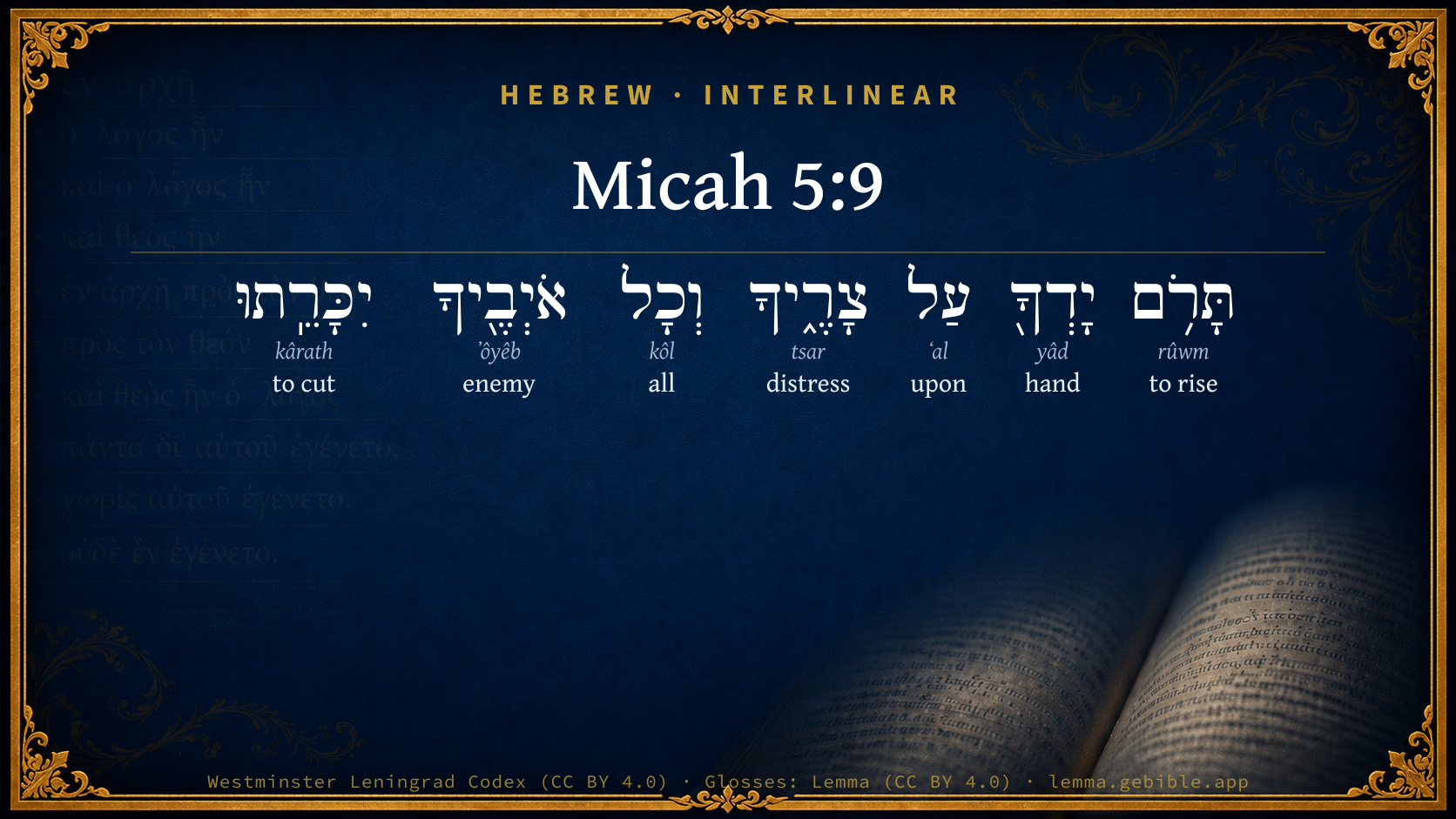
Micah 5:9

Hebrew (Westminster Leningrad Codex) Micah 5:9 appears in the Hebrew Old Testament. The text above is from the Westminster Leningrad Codex. Each word links to its Strong’s number, a concise gloss, and parsing drawn from the Open Scriptures Hebrew Bible morphology. Click any word for its full Brown-Driver-Briggs (BDB) entry.
Download image
Cite this verse

Micah 5:9 (World English Bible). Public Domain. Lemma interlinear Bible study tool, https://lemma.gebible.app/v/micah/5/9.

Show BibTeX & RIS
BibTeX
RIS
English Translation
Let your hand be lifted up above your adversaries, And let all of your enemies be cut off.
World English Bible · Public Domain
Download a study sheet

One document with this verse’s original text, its word-by-word gloss line, the meaning frame, cross-references with their text, attributed commentary, and full source and license credits — printable, and it pastes into notes with its structure intact.

This verse Autodidact and up

Study sheet (.html) Plain text (.txt)

A passage Seminary Student

Up to 50 verses in one chapter. A passage sheet keeps up to 6 commentary sources and 12 cross-references per verse, in the order this page ranks them, and says so on the sheet whenever that leaves anything out. Ask for a single verse and you get the Autodidact verse sheet above.

Everything on this page stays free to read, with no account — the sheet is a download of what is already on screen, not access to it.

Want to remove ads? Support Godless Engineer
Compare translations 3

The same verse in 3 English versions, stacked beneath the original-language interlinear above. Click any original word for its lexicon entry.

Each is an independent rendering of the whole verse — the interlinear is not word-aligned to these translations.

Highlighted words mark where these versions differ — a whole-verse word diff, not a word-by-word alignment.

  • World English Bible Public Domain
    Let your hand be lifted up above your adversaries, And let all of your enemies be cut off.
  • King James Version Public Domain
    Thine hand shall be lifted up upon thine adversaries, and all thine enemies shall be cut off.
  • unfoldingWord Literal Text CC BY-SA 4.0
    Your hand will rise over your adversaries, and all your enemies will be cut off.

unfoldingWord Literal Text — © unfoldingWord, licensed CC BY-SA 4.0. Word-aligned USFM3 via Door43 (git.door43.org/unfoldingWord/en_ult).

Versions to compare (up to 4)

3 of 4 selected

Show all 18 translations

Every available English version of this verse, each an independent rendering of the whole verse.

  • World English Bible Public Domain
    Let your hand be lifted up above your adversaries, And let all of your enemies be cut off.
  • Berean Standard Bible Public Domain
    Your hand will be lifted over your foes, and all your enemies will be cut off.
  • Majority Standard Bible Public Domain
    Your hand will be lifted over your foes, and all your enemies will be cut off.
  • King James Version Public Domain
    Thine hand shall be lifted up upon thine adversaries, and all thine enemies shall be cut off.
  • American Standard Version (1901) Public Domain
    Let thy hand be lifted up above thine adversaries, and let all thine enemies be cut off.
  • Revised Version (1885) Public Domain
    Let thine hand be lifted up above thine adversaries, and let all thine enemies be cut off.
  • Geneva Bible (1599) Public Domain
    Thine hand shall bee lift vp vpon thine aduersaries, and all thine enemies shalbe cut off.
  • Douay-Rheims (1899) Public Domain
    Thy hand shall be lifted up over thy enemies, and all thy enemies shall be cut off.
  • Young's Literal Translation Public Domain
    High is thy hand above thine adversaries, And all thine enemies are cut off.
  • Literal Standard Version CC BY-SA 4.0
    High is your hand above your adversaries, || And all your enemies are cut off.
  • Unlocked Literal Bible CC BY-SA 4.0
    Your hand will be lifted against your enemies, and it will destroy them.
  • unfoldingWord Literal Text CC BY-SA 4.0
    Your hand will rise over your adversaries, and all your enemies will be cut off.
  • Darby Bible Public Domain
    Thy hand shall be lifted up upon thine adversaries, and all thine enemies shall be cut off.
  • World Messianic Bible Public Domain
    Let your hand be lifted up above your adversaries, and let all of your enemies be cut off.
  • Webster's Bible Public Domain
    \\5:10\\And it shall come to pass in that day, saith the LORD, that I will cut off thy horses out of the midst of thee, and I will destroy thy chariots:
  • Free Bible Version CC BY-SA 4.0
    Lift your hand in triumph against your enemies; all of them will be destroyed.
  • Bible in Basic English Public Domain
    And it will come about in that day, says the Lord, that I will take away your horses from you, and will give your war-carriages to destruction:
  • JPS Tanakh (1917) Public Domain
    (5-8) Let Thy hand be lifted up above Thine adversaries, and let all Thine enemies be cut off.

Literal Standard Version (2020), Covenant Press — licensed CC BY-SA 4.0. Text via the HelloAO Bible API (eBible.org). Unlocked Literal Bible (unfoldingWord) — licensed CC BY-SA 4.0. Text via the HelloAO Bible API (eBible.org). unfoldingWord Literal Text — © unfoldingWord, licensed CC BY-SA 4.0. Word-aligned USFM3 via Door43 (git.door43.org/unfoldingWord/en_ult). Free Bible Version, Dr. Jonathan Gallagher — licensed CC BY-SA 4.0. Text via the HelloAO Bible API (eBible.org).

Word by word

More ways to search: Search by grammar → Find every occurrence → Compare this word →

Practice this passage: Drill this verse → Learn its vocabulary →

About this verse

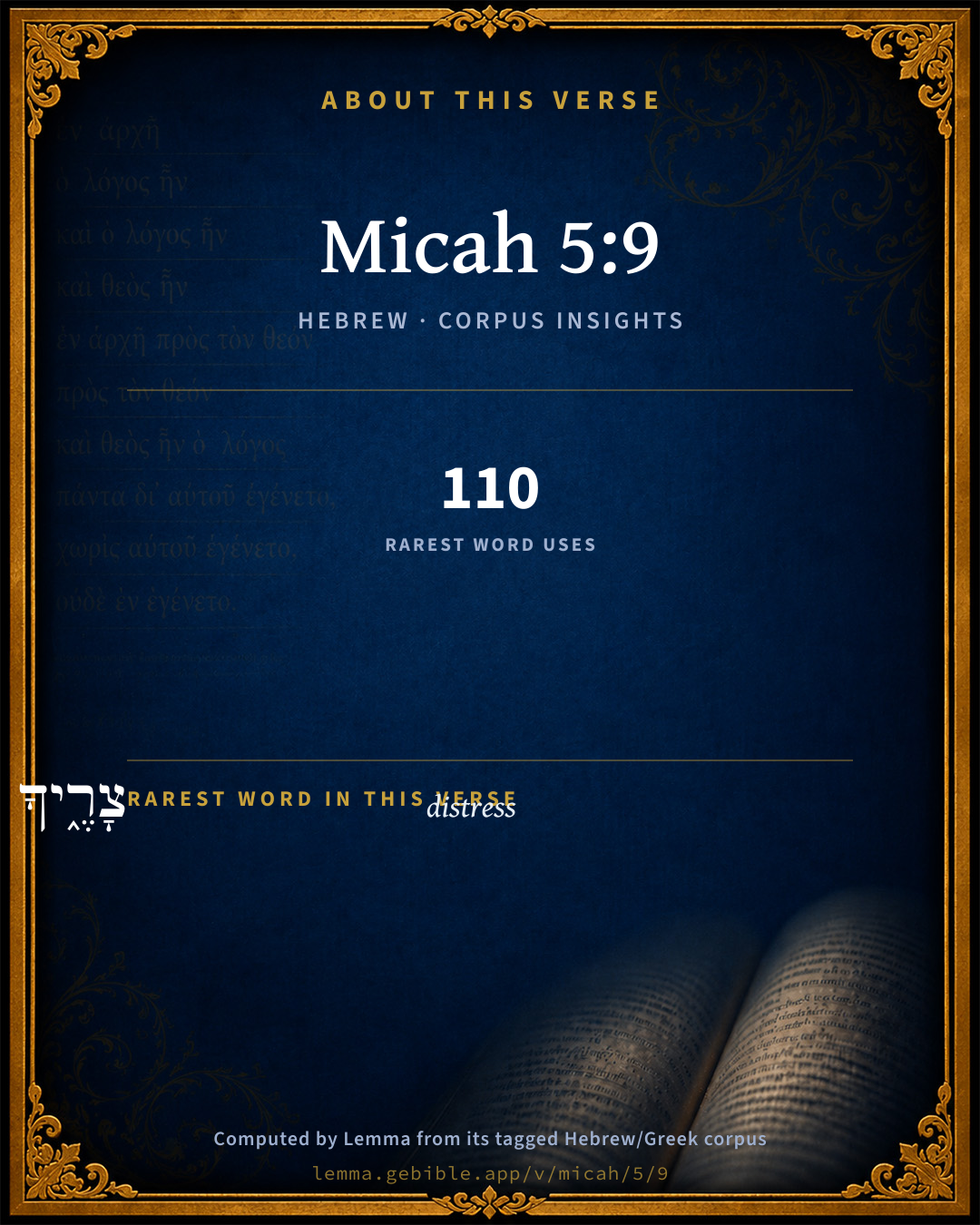
These counts appear in no published source. They are computed here, from the morphology-tagged text and Lemma’s own curated glosses. What Lemma adds →

7
words
7
distinct lemmas
Prophets
section

Grammatical profile

  • 3 verbs
  • 3 nouns
  • 1 preposition

Verb forms

  • תָּרֹ֥ם Qal · Imperfect
  • אֹיְבֶ֖יךָ Qal · Participle Active
  • יִכָּרֵֽתוּ Niphal · Imperfect

Hebrew & Septuagint length

In English translation the verse runs 18 words from the Hebrew and 19 from the Septuagint (LXX English) — closely comparable.

A rough comparison of the two English renderings, which tokenize alike — not a word-level alignment.

Word counts can differ between the Hebrew and the Greek without any difference in meaning — e.g. the Hebrew direct-object marker אֵת has no separate Greek word, and Greek often adds the article ὁ.

Cross-references

12

Topical passages linked to Micah 5:9 in the Treasury of Scripture Knowledge — connected by theme and wording, ordered by reader-vote popularity; previews shown in the World English Bible.

  • Psalms 21:8 Your hand will find out all of your enemies. Your right hand will find out those who hate you.
  • Isaiah 26:11 Yahweh, your hand is lifted up, yet they don't see: but they shall see [your] zeal for the people, and be disappointed; yes, fire shall devour your adversaries.
  • Psalms 10:12 Arise, Yahweh! God, lift up your hand! Don't forget the helpless.
  • Isaiah 11:14 They shall fly down on the shoulder of the Philistines on the west; together shall they despoil the children of the east: they shall put forth their hand on Edom and Moab; and the children of Ammon shall obey them.
  • Isaiah 14:2–4 The peoples shall take them, and bring them to their place; and the house of Israel shall possess them in the land of Yahweh for servants and for handmaids: and they shall take them captive whose captives they were; and they shall rule over their oppressors.
  • Isaiah 1:25 And I will turn my hand on you, Thoroughly purge away your dross, And will take away all your tin.
  • Isaiah 33:10 Now will I arise, says Yahweh; now will I lift up myself; now will I be exalted.
  • Isaiah 37:36 The angel of Yahweh went forth, and struck in the camp of the Assyrians one hundred and eighty-five thousand; and when men arose early in the morning, behold, these were all dead bodies.
  • Luke 19:27 But bring those enemies of mine who didn't want me to reign over them here, and kill them before me.'"
  • 1 Corinthians 15:25 For he must reign until he has put all his enemies under his feet.
  • Revelation 19:13–21 He is clothed in a garment sprinkled with blood. His name is called "The Word of God."
  • Revelation 20:8–9 and he will come out to deceive the nations which are in the four corners of the earth, Gog and Magog, to gather them together to the war; the number of whom is as the sand of the sea.

Cross-references courtesy of OpenBible.info (CC BY 4.0).

Hebrew and Greek witnesses Masoretic Hebrew ↔ Greek Septuagint

The same verse in the two great witnesses to the Old Testament, shown verse-for-verse.

These are two independent witnesses, not word-aligned to each other, and the Septuagint is shown in lemma (dictionary) form.

Hebrew Micah 5:9 Masoretic · Westminster Leningrad Codex

תָּרֹ֥ם יָדְךָ֖ עַל צָרֶ֑יךָ וְכָל אֹיְבֶ֖יךָ יִכָּרֵֽתוּ

Let your hand be lifted up above your adversaries, And let all of your enemies be cut off.

World English Bible · Public Domain

Greek LXX Micah 5:9 Septuagint · lemma form

καί εἰμί ἐν ἐκεῖνος ὁ ἡμέρα λέγω κύριος ἐκὀλεθρεύω ὁ ἵππος σύ ἐκ μέσος σύ καί ἀποὀλλύω ὁ ἅρμα σύ

Your hand shall be lifted up against them that afflict you, and all your enemies shall be utterly destroyed.

LXX2012 (modern English Septuagint) · Public Domain

Hebrew: Westminster Leningrad Codex (CC BY 4.0). Greek: Septuagint (public domain); English from LXX2012 (modern English Septuagint) (Public Domain). How the Septuagint differs from the Hebrew →

Targum (Aramaic paraphrase)

1

The Targum is the ancient Jewish Aramaic paraphrase of the Hebrew Scriptures — an interpretive translation, not the Hebrew text itself. Onkelos (literal) and Pseudo-Jonathan (expansive) render the Torah, and Jonathan the Prophets. Coverage is partial: where no permissively-licensed English translation exists for a verse, only the Aramaic is shown. This is verse-level text, not a word-by-word alignment to the Hebrew.

  1. Targum Jonathan Prophets (Joshua–Malachi)
    וִיהֵי בְעִדָנָא הַהִיא אֲמַר יְיָ וֶאֱשֵׁיצֵי סוּסְוַת עַמְמַיָא מִבֵּינָךְ וְאוֹבֵיד רְתִיכֵיהוֹן:

    (no public-domain English translation for this verse)

    Targum Jonathan — Aramaic: “Mikraot Gedolot” (public domain). English: “Sefaria Community Translation” (CC0 1.0 (public-domain dedication)); “London "Chaldee Paraphrase," 1871” (public domain). Text via Sefaria.

Commentary

Notes on Micah 5:9 from classic Christian and Jewish commentators (each source and its license shown beneath its notes). The classic Christian expositions comment on the surrounding passage and are grouped to its opening verse, so a note may address several verses; the Jewish commentaries on the Tanakh (Rashi and others) are per-verse, so they appear only where the commentator wrote on this verse.

Lemma curates 59 commentaries, every one of them public domain or Creative Commons licensed, each selected and text-cleaned for this edition rather than reprinted as found. About our sources →

Trapp's Complete Commentary

John Trapp

Mic 5:9 Thine hand shall be lifted up upon thine adversaries, and all thine enemies shall be cut off.

Ver. 9. Thine hand shall be lift up upon thine adversaries] q.d. Adversaries thou shalt be sure of, O my Church, but thou shalt have the better of them. Thou shalt keep footing still under the standard of the cross, and prevail, Sub militia crucis (Calv.). The mountain of the house of the Lord shall overtop all other mountains of worldly power, Mic 4:1. It shall be as that mountain not far from Arbela (where the empire of the world was won and lost in one day), called Nicatorium by Alexander the Great, as a constant trophy of that famous victory he there got over Darius, νικατοριον ορος (Strabo). As she is highest in the favour of God, so she shall be highest in herself; and her enemies shall be found liars unto her. Her hand shall be lifted up, and fall very heavily upon her adversaries: if not sooner, yet at utmost at the resurrection. The upright shall have dominion over them in that morning, Psa 49:14, the Church shall shine as the sun in his strength, when her enemies shall be in that place that is fittest for them, even the lowest place, the footstool of Christ. Meanwhile she conquereth then when she is conquered (as Christ overcame as well by patience as by power), and is sure not to be shivered though shaken, not to be drowned though doused over head and ears in the waters of affliction.

“ Niteris incassum Christi submergere navem:

Fluctuat, at nunquam mergitur illa ratis. ”

That ship may be tossed, saith one, not shipwrecked, whereof Christ is the pilot, the Scripture the compass, the promise the tacklings, hope the anchor, faith the cable, the Holy Ghost the winds, and holy affections the sails, filled with heavenly graces. Such a soul sails safely, and will neither fall upon the soft sands of presumption nor hard rocks of despair.

John Trapp, A Commentary or Exposition upon All the Books of the Old and New Testament (1647–1656) — public domain. Text from a community e-Sword module.

Jamieson, Fausset & Brown

Robert Jamieson, A. R. Fausset & David Brown

Thine hand shall be lifted up--In Isa 26:11 it is Jehovah's hand that is lifted up; here Israel's as Mic 5:8 implies, just as "Zion" is addressed and directed to "beat in pieces many people" (Mic 4:13; compare Isa 54:15, Isa 54:17). For Israel's foes are Jehovah's foes. When her hand is said to be lifted up, it is Jehovah's hand that strikes the foe by her (compare Exo 13:9, with Exo 14:8).

Jamieson, Fausset & Brown — Commentary Critical and Explanatory on the Whole Bible (1871) — public domain (CC PDM 1.0). Text via the HelloAO Bible API.

Adam Clarke's Commentary

Verse 9. All thine enemies shall be cut off.] The Assyrians, who had destroyed Israel; and the Babylonians, who had ruined Judah.

Adam Clarke's Commentary on the Bible (1810–1826) — public domain. Text from a community e-Sword/MySword module.

John Calvin's Commentaries

He confirms what is said in the last verse, and expresses in other words what he meant, and what we have explained, — that though the Church must contend with many strong and violent enemies, it will not yet fail, for the Lord will supply it with strength from heaven. Exalted, he says, shall be thy hand, that all thine enemies may be cut off He promises not that the Church shall be in a quiet state, but victorious, and declares also that there will never be wanting enemies. This promise, then, ought to arm us for enduring patiently, as we cannot conquer except by fighting. As then there will be always enemies to oppose the Church of God; yea, to attempt its ruin, the Prophet says here, Exalted shall be thy hand above thine enemies.

But it may be asked, When has this promise been fulfilled? For we know that since the people had been led away into the Babylonian exile, they had always been either tributaries, or kept under cruel tyranny, or at least had been unequal to their enemies. But this principle ought ever to be remembered, — that the faithful ought to be satisfied with victory, — that however hard they may be pressed, and however constant may be the contests which they have to carry on, and however wearisome, this one thing ought still to be sufficient for them — that they shall not wholly perish. And it appears evident, that God’s people have always been preserved by his invincible hand, however numerous have been their opposing enemies. We must also keep in mind what we have just heard, — that the promise here is not made to the whole people, but to a residue only. And it surpasses the expectation of the whole world, that even a small member could have survived so many slaughters, by which they might have been swallowed up a hundred times. Now then we see that it had not been without reason promised to the faithful, that they should be made conquerors over all their enemies. But this has not been really fulfilled, except under the conflict of the cross. It now follows —

John Calvin's Commentaries (1540-1563) — public domain. Text from the Calvin Translation Society English edition (1840s-50s) via the Christian Classics Ethereal Library (ccel.org). Calvin's coverage is partial (roughly two-thirds of the Bible); uncommented books and verses are honest gaps, never fabricated. The 19th-century editor's footnotes and remarks are omitted so the notes are faithfully Calvin's own voice.

The Cambridge Bible for Schools and Colleges

gen. ed. J. J. S. Perowne

9. An exulting address to Israel marching forth against his enemies.

Thine hand shall be …] Rather, ‘let thine hand be;’ similarly in the next clause.

The Cambridge Bible for Schools and Colleges (gen. ed. J. J. S. Perowne; Cambridge University Press, 1878–1918) — public domain. Text from a community e-Sword module.

John Gill's Exposition

Thine hand shall be lifted up upon thine adversaries,.... O remnant of Jacob or Israel, as the Targum; the church of God; now will be the time that it shall prevail over all the antichristian states; now will the Christian princes pour out the vials of God's wrath upon them; and they shall feel the strength and weight of their hand; which will fall heavy upon them, even to their utter destruction: or thine hand, O Messiah, the ruler in Israel, the man the peace that shall deliver from the Assyrian; and who will be at the head of his church and people, the remnant of Jacob, and destroy their enemies with the sword that proceeds out of his mouth:

and all thine enemies shall be cut off; all the enemies of Christ and his church; all the kings of the earth that shall gather against them, the beast and false prophet, with all their followers; see Rev 19:19.

John Gill's Exposition of the Whole Bible (1746–1763) — public domain (CC PDM 1.0). Text via the HelloAO Bible API.

Albert Barnes' Notes on the Bible

Their hand shall be lifted up upon their adversaries - The might of the Church is the Might of Christ in her, and the glory of the Church is His from whom it comes and to whom it returns. It is all one, whether this be said to Christ or to the “remnant of Jacob, that is, His Church. Her “enemies” are His, and her’s only because they are His, and hate her as belonging to Him. They “shall be cut off,” either ceasing to be His enemies, or ceasing to be, as Julian or Arius or antichrist, “whom the Lord shall consume with the spirit of His Mouth and shall destroy with the brightness of His Coming” 2Th 2:8. And in the end, Satan also, over whom Christ gave the Apostles “power to tread on all the power of the Enemy” Luk 10:19, shall be “bruised under our feet” Rom 16:20.

Albert Barnes' Notes on the Bible (1834–1885) — public domain. Text from a community e-Sword/MySword module.

Matthew Poole's English Annotations

Thine; Messiah, or a people of God, nay both, forasmuch as whatever these can do, they do it, not in their own power, but in Christ’s power.

Thine hand; thy strength and power, for so does the Scripture usually express strength or might.

Shall be lifted up upon thine adversaries; shall be greatly exalted, and shall be wonderfully successful against enemies, who in great multitudes did set upon the people of God; such were those who fought the Maccabees, and were defeated by them.

All thine enemies, who do obstinately hold on in the enmity of their natures, ways, and doings,

shall be cut off; finally, certainly, eternally, and dreadfully perish. This hath a partial fulfilling now, but its full completion will be when Christ will appear the Judge of quick and dead, when all his enemies shall be made his footstool, Psa 110:1.

Matthew Poole's English Annotations on the Holy Bible (1683–1685) — public domain. Text from a community e-Sword/MySword module.

The Pulpit Commentary

The prophet"s exulting prayer for the success of his people. Thine band shall be, etc.; rather, let thine hand be lifted up; and so in the next clause, "let thine enemies be out off." The phrase, "high be thy hand upon, or over," recalls the expression in Exo_14:8, "The children of Israel went out with a high hand". (comp. Num_33:3 Isa_26:11; and our idiom, "to get the upper hand (For the promise contained in the prayer, see Isa_60:12)

The Pulpit Commentary (1880–1919), ed. H.D.M. Spence-Jones & Joseph S. Exell — public domain. Text from a community e-Sword module.

John Wesley's Explanatory Notes

Thine hand - Thou people of God.

John Wesley, Explanatory Notes Upon the Whole Bible (1754–1765) — public domain. Text via the GEBible commentary corpus.

Rashi

Rabbi Shlomo Yitzchaki (Rashi)

that I will cut your horses—the Egyptian aid upon which you rely to supply you with horses.

Rashi on the Tanakh — English translations: “The Judaica Press complete Tanach with Rashi, translated by A. J. Rosenberg” (CC BY 4.0); “Pentateuch with Rashi's commentary by M. Rosenbaum and A.M. Silbermann, 1929-1934” (public domain); “The Metsudah Tanach series, Lakewood, N.J” (CC BY 4.0); and “The Book of Joshua, Metsudah Publications, 1997” (CC BY 4.0). Text via Sefaria.

Lesson kit

Teaching starters — assembled from the data on this page, not authored interpretation. Every prompt links to the verse data it draws on. Edit before teaching.

Micah, in the Prophets, opens this verse with 7 words (7 distinct Hebrew lemmas). Its most distinctive word is tsar (“distress”). A historical commentator’s framing appears above. Read the whole chapter for the surrounding context.

Discussion questions

  1. What does “distress” (tsar) contribute to the verse as a whole?
  2. Psalms 21:8 shares this passage’s theme. How do the two illuminate each other?
  3. These translations render this verse differently. What is at stake in choosing one wording over another?
  4. The verb «תָּרֹ֥ם» is Qal Imperfect. How does its form color the action?
  5. Reading how Trapp's Complete Commentary and Jamieson, Fausset & Brown read this verse, where do the two commentators agree and where do they part?

Things to notice

Reading settings

Reading text

Shown beneath each verse's original-language words.

Old Testament
Old Testament edition

Read the OT as the Masoretic Hebrew (MT) or the Greek Septuagint (LXX).

English shown for the Greek Septuagint (in the Hebrew ↔ Greek comparison).

Comparing translations? Open the Compare panel on any verse page to stack up to four side by side.