
Ezekiel 25:16

Hebrew (Westminster Leningrad Codex) Ezekiel 25:16 appears in the Hebrew Old Testament. The text above is from the Westminster Leningrad Codex. Each word links to its Strong’s number, a concise gloss, and parsing drawn from the Open Scriptures Hebrew Bible morphology. Click any word for its full Brown-Driver-Briggs (BDB) entry.
Download image
Cite this verse

Ezekiel 25:16 (World English Bible). Public Domain. Lemma interlinear Bible study tool, https://lemma.gebible.app/v/ezekiel/25/16.

Show BibTeX & RIS
BibTeX
RIS
English Translation
therefore thus says the Lord Yahweh, Behold, I will stretch out my hand on the Philistines, and I will cut off the Cherethites, and destroy the remnant of the sea coast.
World English Bible · Public Domain
Download a study sheet

One document with this verse’s original text, its word-by-word gloss line, the meaning frame, cross-references with their text, attributed commentary, and full source and license credits — printable, and it pastes into notes with its structure intact.

This verse Autodidact and up

Study sheet (.html) Plain text (.txt)

A passage Seminary Student

Up to 50 verses in one chapter. A passage sheet keeps up to 6 commentary sources and 12 cross-references per verse, in the order this page ranks them, and says so on the sheet whenever that leaves anything out. Ask for a single verse and you get the Autodidact verse sheet above.

Everything on this page stays free to read, with no account — the sheet is a download of what is already on screen, not access to it.

Want to remove ads? Support Godless Engineer
Compare translations 3

The same verse in 3 English versions, stacked beneath the original-language interlinear above. Click any original word for its lexicon entry.

Each is an independent rendering of the whole verse — the interlinear is not word-aligned to these translations.

Highlighted words mark where these versions differ — a whole-verse word diff, not a word-by-word alignment.

  • World English Bible Public Domain
    therefore thus says the Lord Yahweh, Behold, I will stretch out my hand on the Philistines, and I will cut off the Cherethites, and destroy the remnant of the sea coast.
  • King James Version Public Domain
    Therefore thus saith the Lord GOD; Behold, I will stretch out mine hand upon the Philistines, and I will cut off the Cherethims, and destroy the remnant of the sea coast.
  • unfoldingWord Literal Text CC BY-SA 4.0
    So this is what the Lord Yahweh says: Behold! I will reach out with my hand against the Philistines, and I will cut off the Cherethites and destroy the remnant who are along the seacoast.

unfoldingWord Literal Text — © unfoldingWord, licensed CC BY-SA 4.0. Word-aligned USFM3 via Door43 (git.door43.org/unfoldingWord/en_ult).

Versions to compare (up to 4)

3 of 4 selected

Show all 18 translations

Every available English version of this verse, each an independent rendering of the whole verse.

  • World English Bible Public Domain
    therefore thus says the Lord Yahweh, Behold, I will stretch out my hand on the Philistines, and I will cut off the Cherethites, and destroy the remnant of the sea coast.
  • Berean Standard Bible Public Domain
    therefore this is what the Lord GOD says: Behold, I will stretch out My hand against the Philistines, and I will cut off the Cherethites and destroy the remnant along the coast.
  • Majority Standard Bible Public Domain
    therefore this is what the Lord GOD says: Behold, I will stretch out My hand against the Philistines, and I will cut off the Cherethites and destroy the remnant along the coast.
  • King James Version Public Domain
    Therefore thus saith the Lord GOD; Behold, I will stretch out mine hand upon the Philistines, and I will cut off the Cherethims, and destroy the remnant of the sea coast.
  • American Standard Version (1901) Public Domain
    therefore thus saith the Lord Jehovah, Behold, I will stretch out my hand upon the Philistines, and I will cut off the Cherethites, and destroy the remnant of the sea coast.
  • Revised Version (1885) Public Domain
    therefore thus saith the Lord GOD, Behold, I will stretch out mine hand upon the Philistines, and I will cut off the Cherethites, and destroy the remnant of the sea coast.
  • Geneva Bible (1599) Public Domain
    Therefore thus sayth the Lord God, Behold, I will stretche out mine hand vpon the Philistims, and I will cut off the Cherethims, and destroy the remnant of the sea coast.
  • Douay-Rheims (1899) Public Domain
    Therefore thus saith the Lord God: Behold I will stretch forth my hand upon the Philistines, and will kill the killers, and will destroy the remnant of the sea coast.
  • Young's Literal Translation Public Domain
    Therefore, thus said the Lord Jehovah: Lo, I am stretching out My hand against the Philistines, And I have cut off the Cherethim, And destroyed the remnant of the haven of the sea,
  • Literal Standard Version CC BY-SA 4.0
    Therefore, thus said Lord YHWH: Behold, I am stretching out My hand against the Philistines, || And I have cut off the Cherethim, || And destroyed the remnant of the haven of the sea,
  • Unlocked Literal Bible CC BY-SA 4.0
    So this is what the Lord Yahweh says: Behold! I will reach out with my hand against the Philistines, and I will cut off the Kerethites and destroy the remnant who are along the seacoast.
  • unfoldingWord Literal Text CC BY-SA 4.0
    So this is what the Lord Yahweh says: Behold! I will reach out with my hand against the Philistines, and I will cut off the Cherethites and destroy the remnant who are along the seacoast.
  • Darby Bible Public Domain
    therefore thus saith the Lord Jehovah: Behold, I stretch out my hands upon the Philistines, and I will cut off the Kerethites, and cause the remnant of the sea-coast to perish.
  • World Messianic Bible Public Domain
    therefore the Lord GOD says, “Behold, I will stretch out my hand on the Philistines, and I will cut off the Cherethites, and destroy the remnant of the sea coast.
  • Webster's Bible Public Domain
    Therefore thus saith the Lord GOD; Behold, I will stretch out my hand upon the Philistines, and I will cut off the Cherethims, and destroy the remnant of the sea coast.
  • Free Bible Version CC BY-SA 4.0
    this is why the Lord God says: Watch out! I'm going to reach out to attack the Philistines, and I will wipe out the Kerethites and destroy those who are left along the coast.
  • Bible in Basic English Public Domain
    The Lord has said, See, my hand will be stretched out against the Philistines, cutting off the Cherethites and sending destruction on the rest of the sea-land.
  • JPS Tanakh (1917) Public Domain
    therefore thus saith the Lord GOD: Behold, I will stretch out My hand upon the Philistines, and I will cut off the Cherethites, and destroy the remnant of the sea-coast.

Literal Standard Version (2020), Covenant Press — licensed CC BY-SA 4.0. Text via the HelloAO Bible API (eBible.org). Unlocked Literal Bible (unfoldingWord) — licensed CC BY-SA 4.0. Text via the HelloAO Bible API (eBible.org). unfoldingWord Literal Text — © unfoldingWord, licensed CC BY-SA 4.0. Word-aligned USFM3 via Door43 (git.door43.org/unfoldingWord/en_ult). Free Bible Version, Dr. Jonathan Gallagher — licensed CC BY-SA 4.0. Text via the HelloAO Bible API (eBible.org).

Word by word

More ways to search: Search by grammar → Find every occurrence → Compare this word →

Practice this passage: Drill this verse → Learn its vocabulary →

ח֥וֹף
chôwph
H2348
“seashore of”
Noun, Common, Masculine, Singular, Construct
Part of Speech
Noun
Type
Common
Gender
Masculine
Number
Singular
State
Construct
Full BDB Definition

Origin: from an unused root meaning to cover

TWOT: 710a

seashore, coast, shore
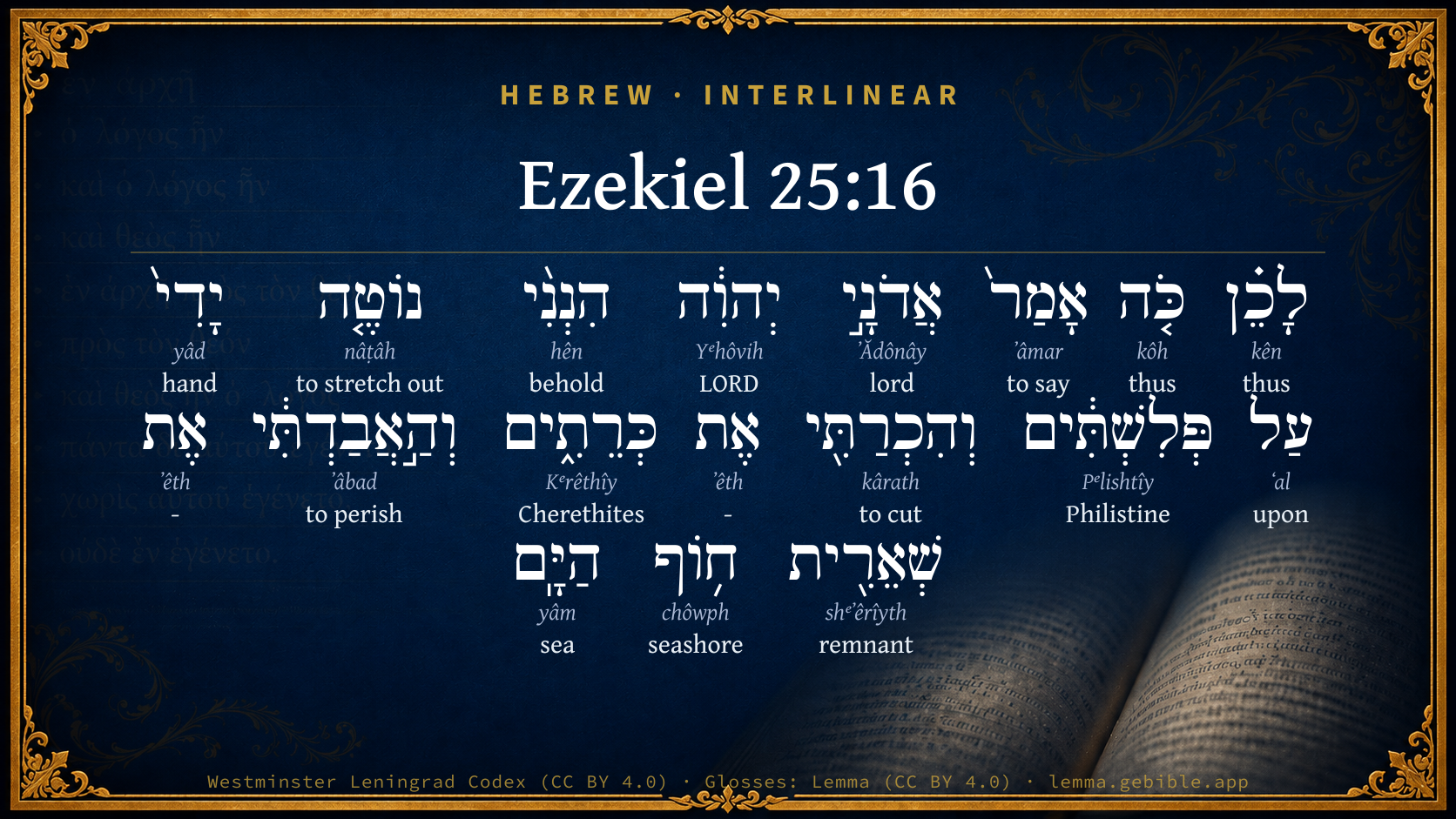
  1. לָכֵ֗ן kên H3651 “to/for · thus” Preposition + Adverb
  2. כֹּ֤ה kôh H3541 “thus” Adverb
  3. אָמַר֙ ʼâmar H559 “to say” Verb, Qal, Perfect, 3rd Person, Masculine, Singular
  4. אֲדֹנָ֣י ʼĂdônây H136 “Lord · my” Noun, Common, Masculine, Plural, Construct + Suffix, Personal, 1st Person, Common, Singular
  5. יְהוִ֔ה Yᵉhôvih H3069 “LORD” Noun, Proper
  6. הִנְנִ֨י hên H2005 “behold · me” Particle, Demonstrative + Suffix, Personal, 1st Person, Common, Singular
  7. נוֹטֶ֤ה nâṭâh H5186 “stretching out” Verb, Qal, Participle Active, Masculine, Singular, Absolute
  8. יָדִי֙ yâd H3027 “hand · my” Noun, Common, Both, Singular, Construct + Suffix, Personal, 1st Person, Common, Singular
  9. עַל ʻal H5921 “upon” Preposition
  10. פְּלִשְׁתִּ֔ים Pᵉlishtîy H6430 “Philistines” Noun, Gentilic, Masculine, Plural, Absolute
  11. וְהִכְרַתִּ֖י kârath H3772 “and · to cut” Conjunction + Verb, Hiphil, Sequential Perfect, 1st Person, Common, Singular
  12. אֶת ʼêth H853 “-” Particle, Direct Object
  13. כְּרֵתִ֑ים Kᵉrêthîy H3774 “Cherethites” Noun, Gentilic, Masculine, Plural, Absolute
  14. וְהַ֣אֲבַדְתִּ֔י ʼâbad H6 “and · to perish” Conjunction + Verb, Hiphil, Sequential Perfect, 1st Person, Common, Singular
  15. אֶת ʼêth H853 “-” Particle, Direct Object
  16. שְׁאֵרִ֖ית shᵉʼêrîyth H7611 “remnant of” Noun, Common, Feminine, Singular, Construct
  17. הַיָּֽם yâm H3220 “the · sea” Particle, Definite Article + Noun, Common, Masculine, Singular, Absolute

About this verse

These counts appear in no published source. They are computed here, from the morphology-tagged text and Lemma’s own curated glosses. What Lemma adds →

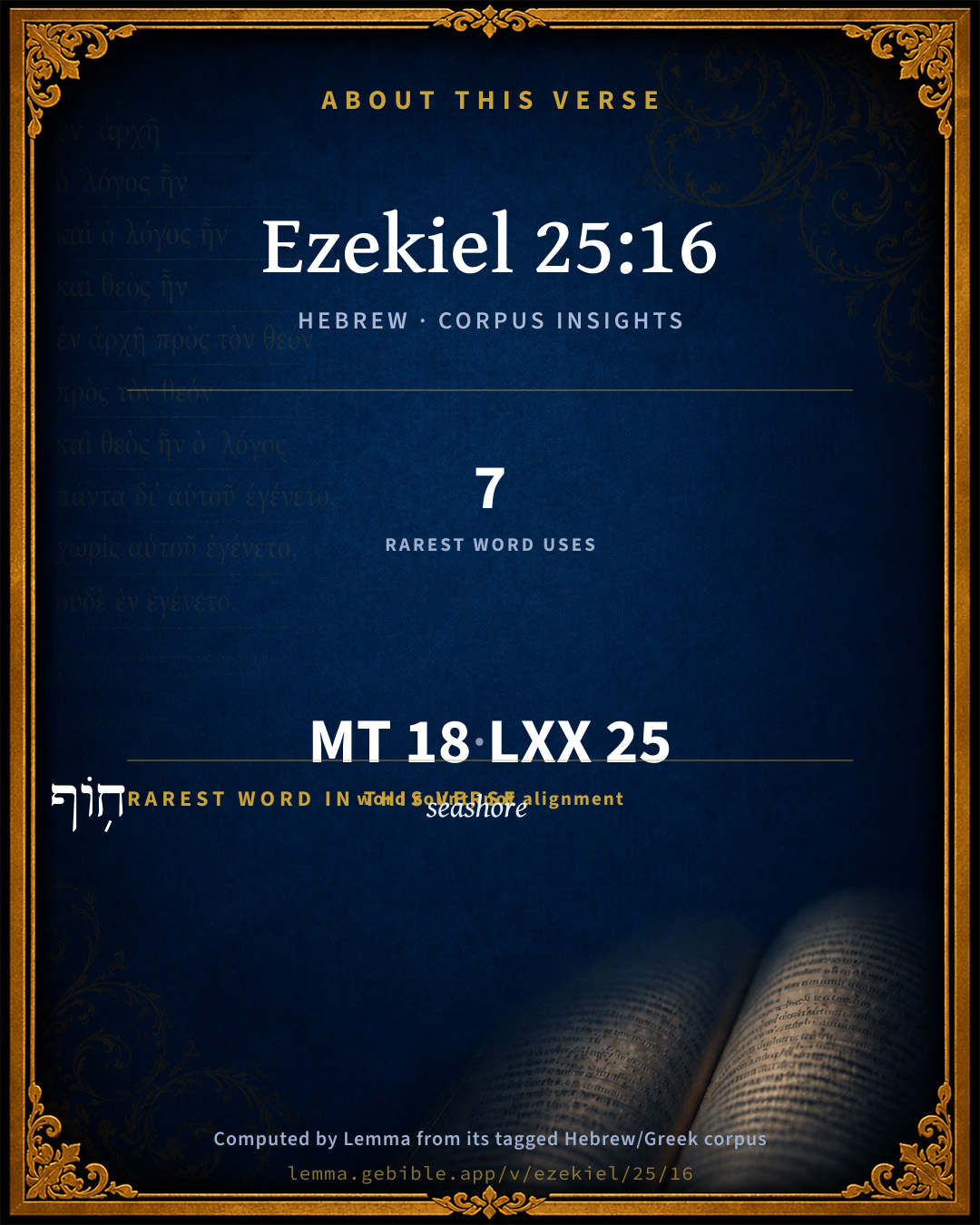
18
words
17
distinct lemmas
Prophets
section

Notable vocabulary

The rarest word here is ח֥וֹף seashore H2348 — appearing just 7 times in the whole Hebrew Bible.

Shared distinctive vocabulary

ח֥וֹף seashore H2348 occurs in 6 verses of the Hebrew Bible. Also found in:

Grammatical profile

  • 4 verbs
  • 8 nouns
  • 1 preposition
  • 2 adverbs
  • 3 particles

Verb forms

  • אָמַר֙ Qal · Perfect
  • נוֹטֶ֤ה Qal · Participle Active
  • וְהִכְרַתִּ֖י Hiphil · Sequential Perfect
  • וְהַ֣אֲבַדְתִּ֔י Hiphil · Sequential Perfect

Hebrew & Septuagint length

In English translation the verse runs 31 words from the Hebrew and 32 from the Septuagint (LXX English) — closely comparable.

A rough comparison of the two English renderings, which tokenize alike — not a word-level alignment.

Word counts can differ between the Hebrew and the Greek without any difference in meaning — e.g. the Hebrew direct-object marker אֵת has no separate Greek word, and Greek often adds the article ὁ.

In the original languages it is 18 Hebrew tokens and 25 Greek tokens — but the two are counted differently (Hebrew bundles its prefixes and suffixes into one token; the Greek is in lemma form), so that isn’t a like-for-like length.

Cross-references

6

Topical passages linked to Ezekiel 25:16 in the Treasury of Scripture Knowledge — connected by theme and wording, ordered by reader-vote popularity; previews shown in the World English Bible.

  • 1 Samuel 30:14 We made a raid on the South of the Cherethites, and on that which belongs to Judah, and on the South of Caleb; and we burned Ziklag with fire.
  • Zephaniah 2:4–15 For Gaza will be forsaken, and Ashkelon a desolation. They will drive out Ashdod at noonday, and Ekron will be rooted up.
  • Jeremiah 47:1–7 The word of Yahweh that came to Jeremiah the prophet concerning the Philistines, before that Pharaoh struck Gaza.
  • Ezekiel 25:13 therefore thus says the Lord Yahweh, I will stretch out my hand on Edom, and will cut off man and animal from it; and I will make it desolate from Teman; even to Dedan shall they fall by the sword.
  • 2 Samuel 15:18 All his servants passed on beside him; and all the Cherethites, and all the Pelethites, and all the Gittites, six hundred men who came after him from Gath, passed on before the king.
  • Ezekiel 25:7 therefore, behold, I have stretched out my hand on you, and will deliver you for a spoil to the nations; and I will cut you off from the peoples, and I will cause you to perish out of the countries: I will destroy you; and you shall know that I am Yahweh.

Cross-references courtesy of OpenBible.info (CC BY 4.0).

Hebrew and Greek witnesses Masoretic Hebrew ↔ Greek Septuagint

The same verse in the two great witnesses to the Old Testament, shown verse-for-verse.

These are two independent witnesses, not word-aligned to each other, and the Septuagint is shown in lemma (dictionary) form.

Hebrew Ezekiel 25:16 Masoretic · Westminster Leningrad Codex

לָכֵ֗ן כֹּ֤ה אָמַר֙ אֲדֹנָ֣י יְהוִ֔ה הִנְנִ֨י נוֹטֶ֤ה יָדִי֙ עַל פְּלִשְׁתִּ֔ים וְהִכְרַתִּ֖י אֶת כְּרֵתִ֑ים וְהַ֣אֲבַדְתִּ֔י אֶת שְׁאֵרִ֖ית ח֥וֹף הַיָּֽם

therefore thus says the Lord Yahweh, Behold, I will stretch out my hand on the Philistines, and I will cut off the Cherethites, and destroy the remnant of the sea coast.

World English Bible · Public Domain

Greek LXX Ezekiel 25:16 Septuagint · lemma form

διά οὗτος ὅδε λέγω κύριος ἰδού ἐγώ ἐκτείνω ὁ χείρ ἐγώ ἐπί ὁ ἀλλόφυλος καί ἐκὀλεθρεύω κρῆτες καί ἀποὀλλύω ὁ κατάλοιπος ὁ καταοἰκέω ὁ παραλίαν

therefore thus says the Lord; Behold, I will stretch out my hand upon the Philistines, and will utterly destroy the Cretans, and will cut off the remnant that dwell by the sea-coast.

LXX2012 (modern English Septuagint) · Public Domain

On this verse, Haydock's Catholic Bible Commentary discusses the Septuagint’s reading. Read the note in Commentary ↓

Hebrew: Westminster Leningrad Codex (CC BY 4.0). Greek: Septuagint (public domain); English from LXX2012 (modern English Septuagint) (Public Domain). How the Septuagint differs from the Hebrew →

Targum (Aramaic paraphrase)

1

The Targum is the ancient Jewish Aramaic paraphrase of the Hebrew Scriptures — an interpretive translation, not the Hebrew text itself. Onkelos (literal) and Pseudo-Jonathan (expansive) render the Torah, and Jonathan the Prophets. Coverage is partial: where no permissively-licensed English translation exists for a verse, only the Aramaic is shown. This is verse-level text, not a word-by-word alignment to the Hebrew.

  1. Targum Jonathan Prophets (Joshua–Malachi)
    בְּכֵן כִּדְנַן אֲמַר יְיָ אֱלֹהִים הָא אֲנָא מְרִים יַת מְחַת גְבוּרְתִּי עַל פְּלִשְׁתָּאֵי וֶאֱשֵׁיצֵי יַת עַמָא דְחַיָבִין לְאִשְׁתֵּיצָאָה וְאוֹבִיד יַת שְׁאַר סְפַר יַמָא:

    (no public-domain English translation for this verse)

    Targum Jonathan — Aramaic: “Mikraot Gedolot” (public domain). English: “Sefaria Community Translation” (CC0 1.0 (public-domain dedication)); “London "Chaldee Paraphrase," 1871” (public domain). Text via Sefaria.

Commentary

Notes on Ezekiel 25:16 from classic Christian and Jewish commentators (each source and its license shown beneath its notes). The classic Christian expositions comment on the surrounding passage and are grouped to its opening verse, so a note may address several verses; the Jewish commentaries on the Tanakh (Rashi and others) are per-verse, so they appear only where the commentator wrote on this verse.

Lemma curates 59 commentaries, every one of them public domain or Creative Commons licensed, each selected and text-cleaned for this edition rather than reprinted as found. About our sources →

Trapp's Complete Commentary

John Trapp

Eze 25:16 Therefore thus saith the Lord GOD; Behold, I will stretch out mine hand upon the Philistines, and I will cut off the Cherethims, and destroy the remnant of the sea coast.

Ver. 16. I will cut off the Cherethims.] These were a part of the Philistines. {Zep 2:5} There is an elegance in the original: q.d., Exscindam exscissores, I will cut off the cutters.

And destroy the remnant of the sea coast.] Palestina lay upon the midland sea. {Zep 3:5}

John Trapp, A Commentary or Exposition upon All the Books of the Old and New Testament (1647–1656) — public domain. Text from a community e-Sword module.

Geneva Bible (1599)

Geneva Bible translators

Which were certain garrisons of Philistines, whereby they ofttimes molested the Jews, of the Cherethims David also had a guard, 2 Sam. 8:18.

Geneva Bible (1599) marginal notes — public domain. Text via Bolls.life.

Jamieson, Fausset & Brown

Robert Jamieson, A. R. Fausset & David Brown

cut off the Cherethims--There is a play on similar sounds in the Hebrew, hichratti cherethim, "I will slay the slayers." The name may have been given to a section of the Philistines from their warlike disposition (Sa1 30:14; Sa1 31:3). They excelled in archery, whence David enrolled a bodyguard from them (Sa2 8:18; Sa2 15:18; Sa2 20:7). They sprang from Caphtor, identified by many with Crete, which was famed for archery, and to which the name Cherethim seems akin. Though in emigration, which mostly tended westwards, Crete seems more likely to be colonized from Philistia than Philistia from Crete, a section of Cretans may have settled at Chere thim in South Philistia, while the Philistines, as a nation, may have come originally from the east (compare Deu 2:23; Jer 47:4; Amo 9:7; Zep 2:5). In Gen 10:14 the Philistines are made distinct from the Caphtorim, and are said to come from the Casluhim; so that the Cherethim were but a part of the Philistines, which Sa1 30:14 confirms.

remnant of--that is, "on the seacoast" of the Mediterranean: those left remaining after the former overthrows inflicted by Samuel, David, Hezekiah, and Psammetichus of Egypt, father of Pharaoh-necho (Jer 25:20).

Jamieson, Fausset & Brown — Commentary Critical and Explanatory on the Whole Bible (1871) — public domain (CC PDM 1.0). Text via the HelloAO Bible API.

Ellicott's Commentary for English Readers

(16) Cherethims.—The Cherethim were a portion of the Philistines living on their southern coast (1Sa_30:14; Zep_2:5), and are sometimes put for the whole nation. The name is supposed by many to be equivalent to Cretans, and to indicate the origin of the Philistines from the island of Crete; but the etymology is doubtful. The reason for the introduction of their name here was probably a paronomasia in the original, the phrase “I will cut off the Cherethim” reading I will slay the slayers.

A Bible Commentary for English Readers, edited by Charles John Ellicott (1878–1897) — public domain. Text from a community e-Sword module.

The Cambridge Bible for Schools and Colleges

gen. ed. J. J. S. Perowne

16. the Cherethims] the Cherethites. The name was given to the inhabitants of the Philistine coast, Zep_2:5, “woe to the inhabitants of the sea-coast, the nation of the Cherethites … the land of the Philistines.” Cf. 1Sa_30:14; 2Sa_8:18; Jer_47:4.

the remnant] Cf. Amo_1:8; Isa_14:30; Zep_1:4.

The Cambridge Bible for Schools and Colleges (gen. ed. J. J. S. Perowne; Cambridge University Press, 1878–1918) — public domain. Text from a community e-Sword module.

John Gill's Exposition

Therefore thus saith the Lord God,.... Because of such wretched malice and despiteful usage:

behold, I will stretch out mine hand upon the Philistines; as is foretold, Jer 47:1,

and I will cut off the Cherethims: one of the tribes of the Philistines, a principal part of their country, which lay to the south, Sa1 30:14, there is a beautiful play on words (i) in the Hebrew:

and destroy the remnant of the seacoast; as that of Ashdod, Caphtor, and Ashkelon, formerly spoiled by other persons; what they left should now be utterly destroyed; see Isa 20:1.

(a) .

John Gill's Exposition of the Whole Bible (1746–1763) — public domain (CC PDM 1.0). Text via the HelloAO Bible API.

Haydock's Catholic Bible Commentary

Killers. Hebrew, "Ceretheans." David’s guards were of this nation, 2 Kings viii. 18. They came originally from Crete; and the Septuagint have here, "Cretans;" (Calmet) as Grabe substitutes for "Judges of Sidon." (Haydock) --- Chaldean, "archers." --- Remnant. They deserve not the name of a nation, having been much reduced by Egypt and the Chaldeans. (Calmet)

George Leo Haydock (1774–1849), Haydock's Catholic Family Bible and Commentary, 1859 edition — public domain. Excludes Psalms (Douay-Rheims chapter numbering differs from Protestant) and Deuterocanonical books (Catholic canon only).

Matthew Poole's English Annotations

The Cherethims; either a name for all the Philistines, 1Sa 30:14, or else the principal soldiers, expert bowmen, the strength of Philistia.

The remnant, which had escaped the sword of Samuel, David, Hezekiah, and of Psammeticus king of Egypt.

Of the sea-coast; the Mediterranean about Azotus.

Matthew Poole's English Annotations on the Holy Bible (1683–1685) — public domain. Text from a community e-Sword/MySword module.

The Pulpit Commentary

The Cherethims. The name appears, coupled with the Philistines, in Zep_2:5, and has been supposed to be connected with Crete as the region from which they came, or in which they afterwards settled. By many writers both names are identified with the Cherethites and Pelethites, who appear as David"s body-guard in 2Sa_8:18 2Sa_15:18, et al., and who are supposed to represent a body of mercenary or subject troops formed out of the two nations. Both Ezekiel and Zephaniah connect the Cherethims with a paronomasia, the verb I will cut off being almost identical in sound with it. (For other prophecies, see Isa_11:14 Isa_14:29-31 Jer 47; Joe_3:4 Amo_1:6-8; Zep_2:4-7; Zec_9:4-7)

The Pulpit Commentary (1880–1919), ed. H.D.M. Spence-Jones & Joseph S. Exell — public domain. Text from a community e-Sword module.

John Wesley's Explanatory Notes

The Cherethim - The bowmen, the strength of Philistia. The remnant - Who had escaped the sword of Samuel, David, Hezekiah, and of Psammetichus king of Egypt.

John Wesley, Explanatory Notes Upon the Whole Bible (1754–1765) — public domain. Text via the GEBible commentary corpus.

Rashi

Rabbi Shlomo Yitzchaki (Rashi)

the Cherethites [Heb. כְּרֵתִים,] a nation deserving of being cut off (Targum). But I say, because I saw elsewhere that Scripture calls the Philistines כְּרֵתִים (Zeph. 2:5): “Woe to the inhabitants of the seacoast, the nation of (כְּרֵתִים),” and it does not give any other nation this appellation, it appears to me that there is a region of Philistia called Chereth, and so I find in the Book of (I) Samuel (30:14), concerning the group that set fire to Ziklag: “We made a raid on the south of the Cherethites.”

the seacoast [Heb. חוֹף הַיָם,] marche in Old French, frontier, borderland. They are Philistines, who live in the southwestern corner of the land of Israel on the Western (Mediterranean) Sea.

Rashi on the Tanakh — English translations: “The Judaica Press complete Tanach with Rashi, translated by A. J. Rosenberg” (CC BY 4.0); “Pentateuch with Rashi's commentary by M. Rosenbaum and A.M. Silbermann, 1929-1934” (public domain); “The Metsudah Tanach series, Lakewood, N.J” (CC BY 4.0); and “The Book of Joshua, Metsudah Publications, 1997” (CC BY 4.0). Text via Sefaria.

Lesson kit

Teaching starters — assembled from the data on this page, not authored interpretation. Every prompt links to the verse data it draws on. Edit before teaching.

Ezekiel, in the Prophets, opens this verse with 18 words (17 distinct Hebrew lemmas). Its most distinctive word is chôwph (“seashore”). A historical commentator’s framing appears above. Read the whole chapter for the surrounding context.

Discussion questions

  1. The word chôwph carries the sense “seashore.” How does it shape the verse?
  2. How does Genesis 49:13, which shares the word «seashore», read alongside this verse?
  3. The translations on this page render this verse differently — a whole-verse word diff, not a word-by-word alignment. What might account for the different wordings?
  4. «אָמַר֙» is a Qal Perfect verb. How does that grammatical form shape the action described?
  5. Compare how Trapp's Complete Commentary and Geneva Bible (1599) read this verse. Where do they agree or differ?

Things to notice

Reading settings

Reading text

Shown beneath each verse's original-language words.

Old Testament
Old Testament edition

Read the OT as the Masoretic Hebrew (MT) or the Greek Septuagint (LXX).

English shown for the Greek Septuagint (in the Hebrew ↔ Greek comparison).

Comparing translations? Open the Compare panel on any verse page to stack up to four side by side.