
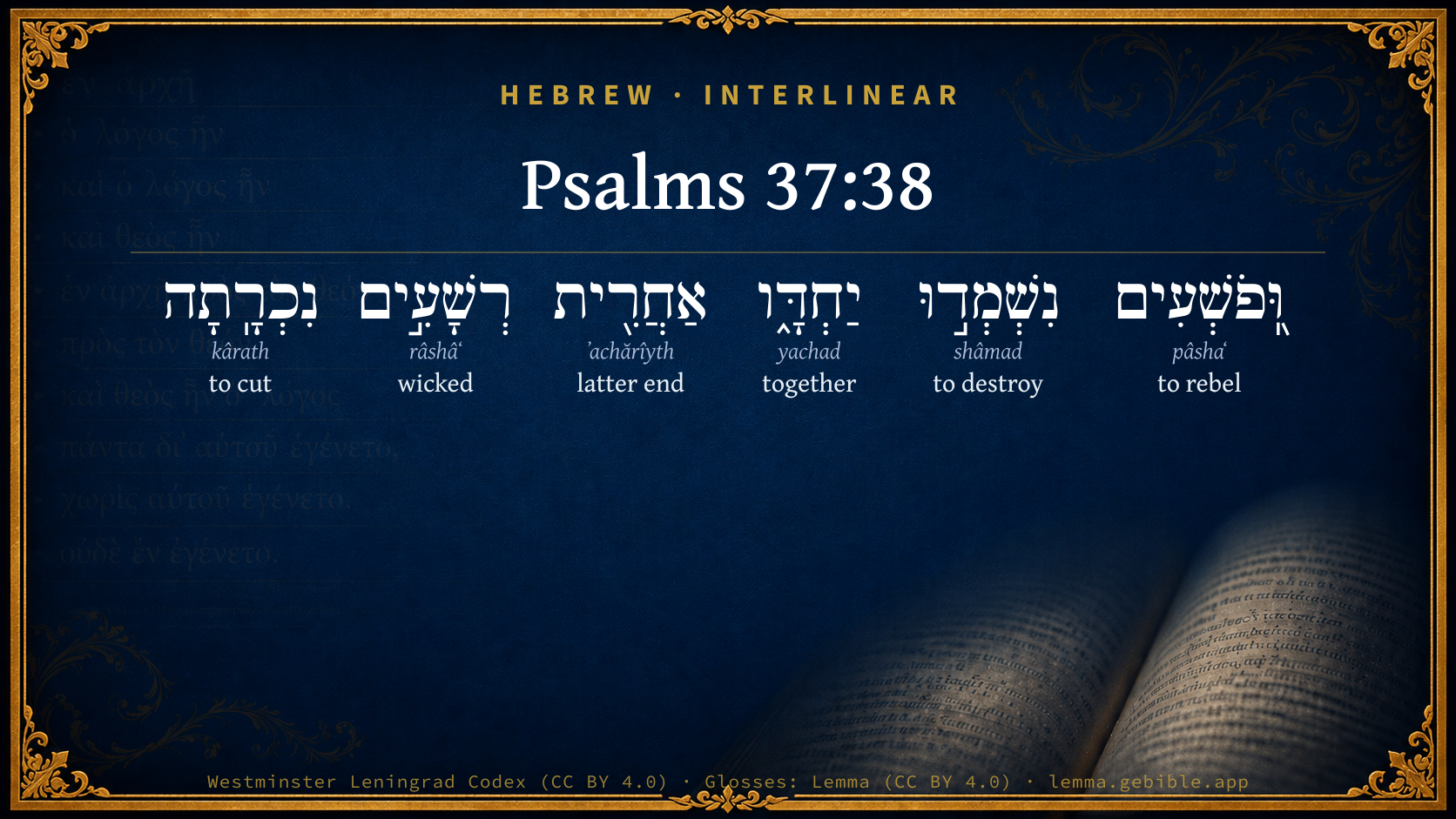
Psalms 37:38

Hebrew (Westminster Leningrad Codex) Psalms 37:38 appears in the Hebrew Old Testament. The text above is from the Westminster Leningrad Codex. Each word links to its Strong’s number, a concise gloss, and parsing drawn from the Open Scriptures Hebrew Bible morphology. Click any word for its full Brown-Driver-Briggs (BDB) entry.
Download image
Cite this verse

Psalms 37:38 (World English Bible). Public Domain. Lemma interlinear Bible study tool, https://lemma.gebible.app/v/psalms/37/38.

Show BibTeX & RIS
BibTeX
RIS
English Translation
As for transgressors, they shall be destroyed together. The future of the wicked shall be cut off.
World English Bible · Public Domain
Download a study sheet

One document with this verse’s original text, its word-by-word gloss line, the meaning frame, cross-references with their text, attributed commentary, and full source and license credits — printable, and it pastes into notes with its structure intact.

This verse Autodidact and up

Study sheet (.html) Plain text (.txt)

A passage Seminary Student

Up to 50 verses in one chapter. A passage sheet keeps up to 6 commentary sources and 12 cross-references per verse, in the order this page ranks them, and says so on the sheet whenever that leaves anything out. Ask for a single verse and you get the Autodidact verse sheet above.

Everything on this page stays free to read, with no account — the sheet is a download of what is already on screen, not access to it.

Want to remove ads? Support Godless Engineer
Compare translations 3

The same verse in 3 English versions, stacked beneath the original-language interlinear above. Click any original word for its lexicon entry.

Each is an independent rendering of the whole verse — the interlinear is not word-aligned to these translations.

Highlighted words mark where these versions differ — a whole-verse word diff, not a word-by-word alignment.

  • World English Bible Public Domain
    As for transgressors, they shall be destroyed together. The future of the wicked shall be cut off.
  • King James Version Public Domain
    But the transgressors shall be destroyed together: the end of the wicked shall be cut off.
  • unfoldingWord Literal Text CC BY-SA 4.0
    But the transgressors are destroyed together; the future of the wicked is cut off.

unfoldingWord Literal Text — © unfoldingWord, licensed CC BY-SA 4.0. Word-aligned USFM3 via Door43 (git.door43.org/unfoldingWord/en_ult).

Versions to compare (up to 4)

3 of 4 selected

Show all 18 translations

Every available English version of this verse, each an independent rendering of the whole verse.

  • World English Bible Public Domain
    As for transgressors, they shall be destroyed together. The future of the wicked shall be cut off.
  • Berean Standard Bible Public Domain
    But the transgressors will all be destroyed; the future of the wicked will be cut off.
  • Majority Standard Bible Public Domain
    But the transgressors will all be destroyed; the future of the wicked will be cut off.
  • King James Version Public Domain
    But the transgressors shall be destroyed together: the end of the wicked shall be cut off.
  • American Standard Version (1901) Public Domain
    As for transgressors, they shall be destroyed together; The end of the wicked shall be cut off.
  • Revised Version (1885) Public Domain
    As for transgressors, they shall be destroyed together: the latter end of the wicked shall be cut off.
  • Geneva Bible (1599) Public Domain
    But the transgressours shall be destroyed together, and the ende of the wicked shall bee cut off.
  • Douay-Rheims (1899) Public Domain
    But the unjust shall be destroyed together: the remnants of the wicked shall perish.
  • Young's Literal Translation Public Domain
    And transgressors were destroyed together, The latter end of the wicked was cut off.
  • Literal Standard Version CC BY-SA 4.0
    And transgressors were destroyed together, || The latter end of the wicked was cut off.
  • Unlocked Literal Bible CC BY-SA 4.0
    Sinners will be totally destroyed; the future for the wicked man is cut off.
  • unfoldingWord Literal Text CC BY-SA 4.0
    But the transgressors are destroyed together; the future of the wicked is cut off.
  • Darby Bible Public Domain
    but the transgressors shall be destroyed together; the future of the wicked shall be cut off.
  • World Messianic Bible Public Domain
    As for transgressors, they shall be destroyed together. The future of the wicked shall be cut off.
  • Webster's Bible Public Domain
    But the transgressors shall be destroyed together: the end of the wicked shall be cut off.
  • Free Bible Version CC BY-SA 4.0
    But those who are rebellious will be altogether destroyed; the wicked have no future.
  • Bible in Basic English Public Domain
    But as for the sinners, they will be cut off together; the end of the wrongdoers is destruction.
  • JPS Tanakh (1917) Public Domain
    But transgressors shall be destroyed together; the future of the wicked shall be cut off.

Literal Standard Version (2020), Covenant Press — licensed CC BY-SA 4.0. Text via the HelloAO Bible API (eBible.org). Unlocked Literal Bible (unfoldingWord) — licensed CC BY-SA 4.0. Text via the HelloAO Bible API (eBible.org). unfoldingWord Literal Text — © unfoldingWord, licensed CC BY-SA 4.0. Word-aligned USFM3 via Door43 (git.door43.org/unfoldingWord/en_ult). Free Bible Version, Dr. Jonathan Gallagher — licensed CC BY-SA 4.0. Text via the HelloAO Bible API (eBible.org).

Word by word

More ways to search: Search by grammar → Find every occurrence → Compare this word →

Practice this passage: Drill this verse → Learn its vocabulary →

About this verse

These counts appear in no published source. They are computed here, from the morphology-tagged text and Lemma’s own curated glosses. What Lemma adds →

6
words
6
distinct lemmas
Wisdom
section

Shared distinctive vocabulary

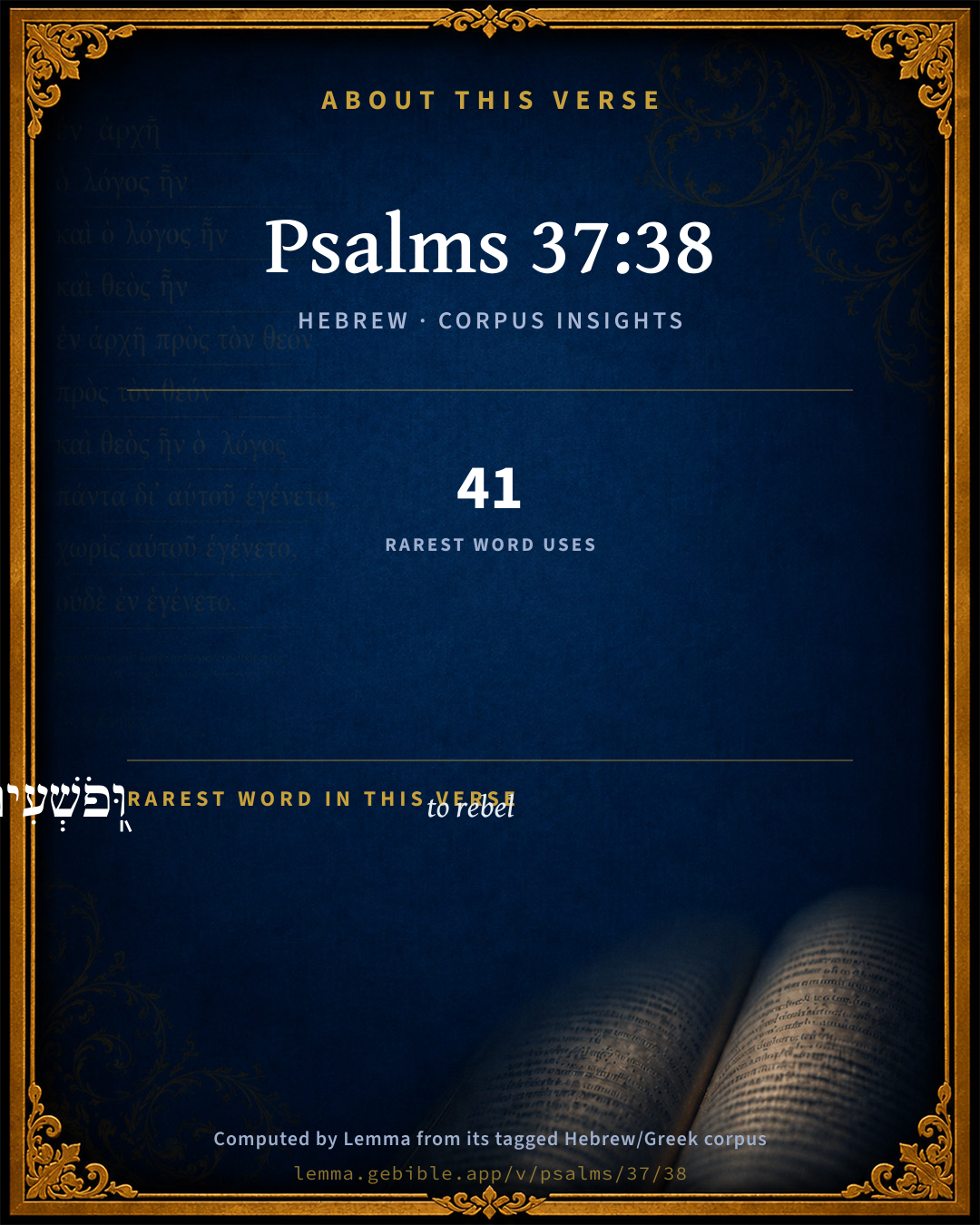
וּֽ֭פֹשְׁעִים to rebel H6586 occurs in 37 verses of the Hebrew Bible. Also found in:

Grammatical profile

  • 3 verbs
  • 1 noun
  • 1 adjective
  • 1 adverb

Verb forms

  • וּֽ֭פֹשְׁעִים Qal · Participle Active
  • נִשְׁמְד֣וּ Niphal · Perfect
  • נִכְרָֽתָה Niphal · Perfect

Hebrew & Septuagint length

In English translation the verse runs 17 words from the Hebrew and 17 from the Septuagint (LXX English) — the same length.

A rough comparison of the two English renderings, which tokenize alike — not a word-level alignment.

Word counts can differ between the Hebrew and the Greek without any difference in meaning — e.g. the Hebrew direct-object marker אֵת has no separate Greek word, and Greek often adds the article ὁ.

Cross-references

9

Topical passages linked to Psalms 37:38 in the Treasury of Scripture Knowledge — connected by theme and wording, ordered by reader-vote popularity; previews shown in the World English Bible.

  • Proverbs 14:32 The wicked is brought down in his calamity, But in death, the righteous has a refuge.
  • Psalms 52:5 God will likewise destroy you forever. He will take you up, and pluck you out of your tent, And root you out of the land of the living. Selah.
  • Psalms 1:4–6 The wicked are not so, But are like the chaff which the wind drives away.
  • Psalms 9:17 The wicked shall be turned back to Sheol, Even all the nations that forget God.
  • Matthew 13:49–50 So will it be in the end of the world. The angels will come forth, and separate the wicked from among the righteous,
  • 2 Thessalonians 1:8–9 giving vengeance to those who don't know God, and to those who don't obey the Gospel of our Lord Jesus,
  • Psalms 73:17 Until I entered God's sanctuary, And considered their latter end.
  • Matthew 13:30 Let both grow together until the harvest, and in the harvest time I will tell the reapers, "First, gather up the darnel, and bind them in bundles to burn them; but gather the wheat into my barn."'"
  • Matthew 25:46 These will go away into eternal punishment, but the righteous into eternal life."

Cross-references courtesy of OpenBible.info (CC BY 4.0).

Hebrew and Greek witnesses Masoretic Hebrew ↔ Greek Septuagint

The same verse in the two great witnesses to the Old Testament, shown verse-for-verse.

You’re reading Greek Psalm 36 (Hebrew Psalm 37). The Septuagint counts the superscription, so verse numbers can differ from the Hebrew — chapter-level alignment, not verse-by-verse. Numbering follows Rahlfs.

These are two independent witnesses, not word-aligned to each other, and the Septuagint is shown in lemma (dictionary) form.

Hebrew Psalms 37:38 Masoretic · Westminster Leningrad Codex

וּֽ֭פֹשְׁעִים נִשְׁמְד֣וּ יַחְדָּ֑ו אַחֲרִ֖ית רְשָׁעִ֣ים נִכְרָֽתָה

As for transgressors, they shall be destroyed together. The future of the wicked shall be cut off.

World English Bible · Public Domain

Greek LXX Greek Psalm 36:38 Septuagint · lemma form

ὁ δέ παράνομος ἐκὀλεθρεύω ἐπί ὁ αὐτός ὁ ἐγκατάλειμμα ὁ ἀσεβής ἐκὀλεθρεύω

But the transgressors shall be utterly destroyed together: the remnants of the ungodly shall be utterly destroyed.

LXX2012 (modern English Septuagint) · Public Domain

Hebrew: Westminster Leningrad Codex (CC BY 4.0). Greek: Septuagint (public domain); English from LXX2012 (modern English Septuagint) (Public Domain). How the Septuagint differs from the Hebrew →

Commentary

Notes on Psalms 37:38 from classic Christian and Jewish commentators (each source and its license shown beneath its notes). The classic Christian expositions comment on the surrounding passage and are grouped to its opening verse, so a note may address several verses; the Jewish commentaries on the Tanakh (Rashi and others) are per-verse, so they appear only where the commentator wrote on this verse.

Lemma curates 59 commentaries, every one of them public domain or Creative Commons licensed, each selected and text-cleaned for this edition rather than reprinted as found. About our sources →

Trapp's Complete Commentary

John Trapp

Psa 37:38 But the transgressors shall be destroyed together: the end of the wicked shall be cut off.

Ver. 38. But the transgressors, &c.] Here the end is worse than the beginning. Sin ever ends tragically.

The end of the wicked shall be cut off] Their end is not death, but destruction; they are killed with death, Rev 2:23, life and hope end together.

John Trapp, A Commentary or Exposition upon All the Books of the Old and New Testament (1647–1656) — public domain. Text from a community e-Sword module.

The Biblical Illustrator

Joseph S. Exell

Psa_37:38

The end of the wicked shall be cut off.

The end of the wicked

The condition of the sinner is an awful one notwithstanding things may seem lovely and fair to him now. He resembles the man who lives in a magnificent mansion on the brow of a volcano, the situation is beautiful, the scenery is beautiful, the sky is beautiful, the air is beautiful, but there are fires that work beneath. These will one day rive the mountain, blacken the sky, and engulf the mansion and its proprietor. (R. Venting.)

The Biblical Illustrator, edited by Joseph S. Exell (c. 1880s–1900s) — public domain. Text from a community e-Sword module.

J. A. Alexander on Psalms

Joseph Addison Alexander

38. (Psa 37:38) And the rebels (transgressors) against God, those who revolt from his authority, and cast off their allegiance to their rightful sovereign, a common scriptural description of the wicked, are destroyed together, or at once. See the use of the same adverb in Psa 34:9. This certain issue is referred to, as already past or present. See above, on Psa 37:28. The end, futurity, or hope, of the wicked is cut off. The futurity meant is one of happiness, as in Psa 37:37, the true sense of which is thus determined. The contrast presented is, that one has an end or a futurity, the other none.

Joseph Addison Alexander, The Psalms Translated and Explained (1850) — public domain. Text from a community e-Sword module.

Jamieson, Fausset & Brown

Robert Jamieson, A. R. Fausset & David Brown

together--at once; entirely (Psa 4:8).

Jamieson, Fausset & Brown — Commentary Critical and Explanatory on the Whole Bible (1871) — public domain (CC PDM 1.0). Text via the HelloAO Bible API.

The Cambridge Bible for Schools and Colleges

gen. ed. J. J. S. Perowne

38. But transgressors are destroyed together:

The posterity of the wicked is cut off.

Cp. Psa_37:28; Psa_109:13; Job_18:13-21. To the Israelite, with his strong sense of the continuity of life in the family, childlessness or the loss of posterity was a virtual annihilation. In the light of N.T. revelation the contrast between the ‘after’ of the righteous and the wicked is still more solemn and significant.

The Cambridge Bible for Schools and Colleges (gen. ed. J. J. S. Perowne; Cambridge University Press, 1878–1918) — public domain. Text from a community e-Sword module.

John Gill's Exposition

But the salvation of the righteous is of the Lord,.... Both their temporal, spiritual, and eternal salvation; particularly the latter, which is originally of the Lord, and springs from the thoughts, purposes, and resolutions of his heart: it is of him freely, of his rich grace and abundant mercy; and it is of him fully and completely; it is an entire salvation of soul and body; includes all blessings of grace and glory in it; it is to the uttermost, and from all sin, and every enemy; and it is of him only; there is no salvation in any other; and the glory of it is to be ascribed to him, even to Jehovah, Father, Son, and Spirit; for all the three divine Persons have a concern in it: the determination, contrivance, and settlement of it, is of Jehovah the Father; the impetration or effecting of it is of Jehovah the Son; and the application of it is of Jehovah the Spirit; See Gill on Psa 3:8;

he is their strength in the time of trouble; by reason of the hidings of God's face, the temptations of Satan, the prevalence of corruptions, the weakness of grace, and the many afflictions that befall them from God and men; the Lord he is their strong hold and munition of rocks, whither they, betake themselves, and find help, protection, and safety; he puts underneath everlasting arms, bears them up, and upholds them with the right hand of his righteousness; and is the strength of their hearts, of their lives, and of their salvation.

John Gill's Exposition of the Whole Bible (1746–1763) — public domain (CC PDM 1.0). Text via the HelloAO Bible API.

Albert Barnes' Notes on the Bible

But the transgressors - Sinners; violators of the law of God.

Shall be destroyed together - The word “together” here - יחדּו yachedâh - means properly “a union of them;” then, together - either:

(a) in one place, Gen 13:6 - or

(b) at one time, Psa 4:8; or

(c) all as one, Psa 14:3 - or

(d) mutually with one another, as when men strive together, Deu 25:11.

The idea here is, that one would be destroyed as well as another; that there would be no exception; that they would go to the same ruin. They might be destroyed at different times, or in different modes, but it would be the same destruction in the end.

The end of the wicked - The future of the wicked. The same word is used here which occurs in Psa 37:37, as applied to the righteous. The meaning is, that while the “future” of the one would be peace, the future of the other would be a “cutting off,” or destruction.

Shall be cut off - That is, they shall be cut off; or, there will be a cutting off. This means here, evidently:

(a) that as an ordinary fact they would be cut down before they had reached the full limit of their course, Psa 37:35-36;

(b) in the future world they would be cut off from hope and happiness forever.

Albert Barnes' Notes on the Bible (1834–1885) — public domain. Text from a community e-Sword/MySword module.

Matthew Poole's English Annotations

Together; or, alike, one as well as another; all, without any exception or respect of persons.

The end of the wicked shall be cut off, i. e. he shall be cut off at last, or in the end. His prosperity shall end in destruction. Or, the posterity (as this word signifies, Psa 109:13; Jer 31:17; Eze 23:25; Dan 11:4) of the wicked, &c.

Matthew Poole's English Annotations on the Holy Bible (1683–1685) — public domain. Text from a community e-Sword/MySword module.

The Treasury of David

Charles H. Spurgeon

Ver. 38. But the transgressors shall be destroyed together. A common ruin awaits those who are joined in common rebellion. The end of the wicked shall be cut off. Their time shall be shortened, their happiness shall be ended, their hopes for ever blasted, their execution hastened on. Their present is shortened by their sins; they shall not live out half their days. They have no future worth having, while the righteous count their future as their true heritage.

Ver. 38. The end of the wicked shall be cut off. The wicked in this world do easily run up without rub or interruption, many times with acclamations and applause, all the golden steps of honours and preferments; but upon the highest stair they find the most slippery standing, and the top of their earthly felicity is the most immediate and certain descent unto the greatest downfall. They are royally mounted here upon earth, and gallop swiftly over the fair and green plains of plenty and pleasures; but at the end of their race they are overturned horse and man, and tumbled headlong into the pit of destruction. They fairly glide over the sea of this world with full sail, with much calmness and serenity, and richly laden; but in the brightest sunshine, and when they least suspect it, they suddenly and without recovery, sink into the gulf of darkness and desolation. Robert Bolton.

None.

Psalms 37:39*

Charles H. Spurgeon's The Treasury of David (1869–1885) — public domain. Psalms only. Text from a community e-Sword/MySword module.

Whedon's Commentary on the Bible

Daniel D. Whedon

38. But—The sharp disjunctive sense of vauv, (ו, but,) which the antithesis requires, brings out the latter end of the wicked in contrast with that of the righteous.

The end of the wicked shall be cut off— “Cut off” from God, and from the object of their hopes and aims. No words could better define complete separation from the lot of the righteous as given Psa_37:37. The contrast is complete.

Daniel D. Whedon (gen. ed.), Commentary on the Old and New Testaments (1874–1909) — public domain. Text from a community e-Sword module.

The Pulpit Commentary

But the transgressors shall be destroyed together (comp. vers. 2, 9, 10, 15, 20, and 34). The end of the wicked shall be cut off. If achargth be taken to mean "posterity" in the preceding verse, it must be given the same signification here.

The Pulpit Commentary (1880–1919), ed. H.D.M. Spence-Jones & Joseph S. Exell — public domain. Text from a community e-Sword module.

John Wesley's Explanatory Notes

Together - All without exception.

John Wesley, Explanatory Notes Upon the Whole Bible (1754–1765) — public domain. Text via the GEBible commentary corpus.

Lesson kit

Teaching starters — assembled from the data on this page, not authored interpretation. Every prompt links to the verse data it draws on. Edit before teaching.

Psalms, in the Wisdom, opens this verse with 6 words (6 distinct Hebrew lemmas). Its most distinctive word is pâshaʻ (“to rebel”). A historical commentator’s framing appears above. Read the whole chapter for the surrounding context.

Discussion questions

  1. How does “to rebel” (pâshaʻ) shape what this verse is saying?
  2. How does 1 Kings 8:50, which shares the word «to rebel», read alongside this verse?
  3. These translations render this verse differently; the difference is in the English rendering, not the original. What questions does that raise?
  4. «וּֽ֭פֹשְׁעִים» is a Qal Participle Active verb. How does that grammatical form shape the action described?
  5. Compare how Trapp's Complete Commentary and The Biblical Illustrator read this verse. Where do they agree or differ?

Things to notice

Reading settings

Reading text

Shown beneath each verse's original-language words.

Old Testament
Old Testament edition

Read the OT as the Masoretic Hebrew (MT) or the Greek Septuagint (LXX).

English shown for the Greek Septuagint (in the Hebrew ↔ Greek comparison).

Comparing translations? Open the Compare panel on any verse page to stack up to four side by side.