
Deuteronomy 4:23

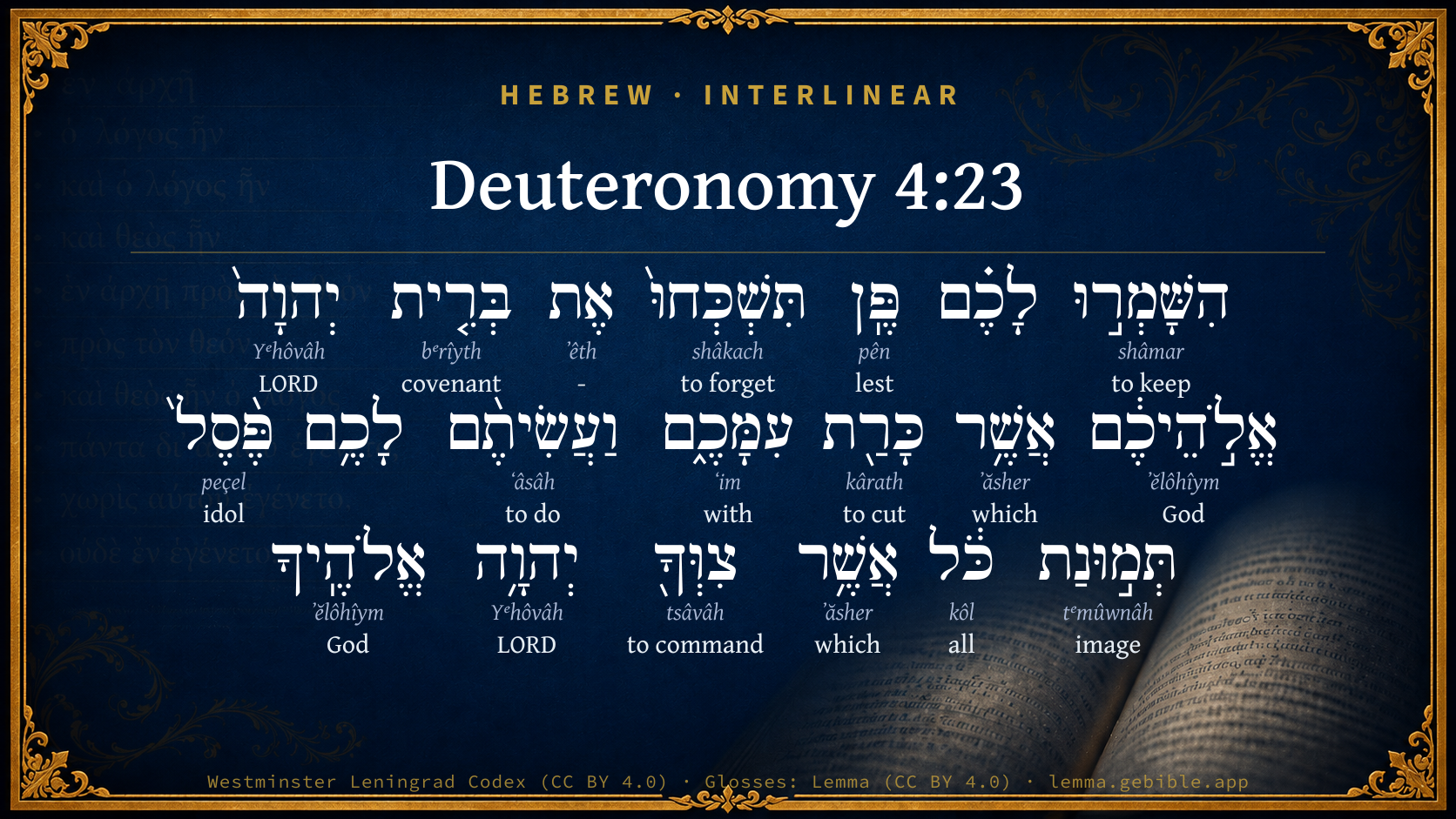
Hebrew (Westminster Leningrad Codex) Deuteronomy 4:23 appears in the Hebrew Old Testament. The text above is from the Westminster Leningrad Codex. Each word links to its Strong’s number, a concise gloss, and parsing drawn from the Open Scriptures Hebrew Bible morphology. Click any word for its full Brown-Driver-Briggs (BDB) entry.
Download image
Cite this verse

Deuteronomy 4:23 (World English Bible). Public Domain. Lemma interlinear Bible study tool, https://lemma.gebible.app/v/deuteronomy/4/23.

Show BibTeX & RIS
BibTeX
RIS
English Translation
Take heed to yourselves, lest you forget the covenant of Yahweh your God, which he made with you, and make you an engraved image in the form of anything which Yahweh your God has forbidden you.
World English Bible · Public Domain
Download a study sheet

One document with this verse’s original text, its word-by-word gloss line, the meaning frame, cross-references with their text, attributed commentary, and full source and license credits — printable, and it pastes into notes with its structure intact.

This verse Autodidact and up

Study sheet (.html) Plain text (.txt)

A passage Seminary Student

Up to 50 verses in one chapter. A passage sheet keeps up to 6 commentary sources and 12 cross-references per verse, in the order this page ranks them, and says so on the sheet whenever that leaves anything out. Ask for a single verse and you get the Autodidact verse sheet above.

Everything on this page stays free to read, with no account — the sheet is a download of what is already on screen, not access to it.

Want to remove ads? Support Godless Engineer
Compare translations 3

The same verse in 3 English versions, stacked beneath the original-language interlinear above. Click any original word for its lexicon entry.

Each is an independent rendering of the whole verse — the interlinear is not word-aligned to these translations.

Highlighted words mark where these versions differ — a whole-verse word diff, not a word-by-word alignment.

  • World English Bible Public Domain
    Take heed to yourselves, lest you forget the covenant of Yahweh your God, which he made with you, and make you an engraved image in the form of anything which Yahweh your God has forbidden you.
  • King James Version Public Domain
    Take heed unto yourselves, lest ye forget the covenant of the LORD your God, which he made with you, and make you a graven image, or the likeness of any thing, which the LORD thy God hath forbidden thee.
  • unfoldingWord Literal Text CC BY-SA 4.0
    Guard yourselves, lest you forget the covenant of Yahweh your God, which he cut with you, and make for yourselves an idol a form of anything that Yahweh your God has commanded you.

unfoldingWord Literal Text — © unfoldingWord, licensed CC BY-SA 4.0. Word-aligned USFM3 via Door43 (git.door43.org/unfoldingWord/en_ult).

Versions to compare (up to 4)

3 of 4 selected

Show all 18 translations

Every available English version of this verse, each an independent rendering of the whole verse.

  • World English Bible Public Domain
    Take heed to yourselves, lest you forget the covenant of Yahweh your God, which he made with you, and make you an engraved image in the form of anything which Yahweh your God has forbidden you.
  • Berean Standard Bible Public Domain
    Be careful that you do not forget the covenant of the LORD your God that He made with you; do not make an idol for yourselves in the form of anything He has forbidden you.
  • Majority Standard Bible Public Domain
    Be careful that you do not forget the covenant of the LORD your God that He made with you; do not make an idol for yourselves in the form of anything He has forbidden you.
  • King James Version Public Domain
    Take heed unto yourselves, lest ye forget the covenant of the LORD your God, which he made with you, and make you a graven image, or the likeness of any thing, which the LORD thy God hath forbidden thee.
  • American Standard Version (1901) Public Domain
    Take heed unto yourselves, lest ye forget the covenant of Jehovah your God, which he made with you, and make you a graven image in the form of anything which Jehovah thy God hath forbidden thee.
  • Revised Version (1885) Public Domain
    Take heed unto yourselves, lest ye forget the covenant of the LORD your God, which he made with you, and make you a graven image in the form of any thing which the LORD thy God hath forbidden thee.
  • Geneva Bible (1599) Public Domain
    Take heede vnto your selues, least ye forget the couenant of the Lord your God which hee made with you, and least ye make you any grauen image, or likenes of any thing, as the Lord thy God hath charged thee.
  • Douay-Rheims (1899) Public Domain
    Beware lest thou ever forget the covenant of the Lord thy God, which he hath made with thee: and make to thyself a graven likeness of those things which the Lord hath forbid to be made:
  • Young's Literal Translation Public Domain
    `Take heed to yourselves, lest ye forget the covenant of Jehovah your God, which He hath made with you, and have made to yourselves a graven image, a similitude of anything `concerning' which Jehovah thy God hath charged thee:
  • Literal Standard Version CC BY-SA 4.0
    Take heed to yourselves lest you forget the covenant of your God YHWH which He has made with you, and have made a carved image for yourselves, a likeness of anything [concerning] which your God YHWH has charged you;
  • Unlocked Literal Bible CC BY-SA 4.0
    Pay attention to yourselves, so that you do not forget the covenant of Yahweh your God, which he made with you, and make for yourselves a carved image in the form of anything that Yahweh your God has forbidden you to make.
  • unfoldingWord Literal Text CC BY-SA 4.0
    Guard yourselves, lest you forget the covenant of Yahweh your God, which he cut with you, and make for yourselves an idol a form of anything that Yahweh your God has commanded you.
  • Darby Bible Public Domain
    Take heed to yourselves lest ye forget the covenant of Jehovah your God, which he made with you, and make yourselves a graven image, the form of anything which Jehovah thy God hath forbidden thee.
  • World Messianic Bible Public Domain
    Be careful, lest you forget the covenant of the LORD your God, which he made with you, and make yourselves a carved image in the form of anything which the LORD your God has forbidden you.
  • Webster's Bible Public Domain
    Take heed to yourselves, lest ye forget the covenant of the LORD your God, which he made with you, and make you a graven image, or the likeness of any thing which the LORD thy God hath forbidden thee.
  • Free Bible Version CC BY-SA 4.0
    However, be careful not to forget the agreement of the Lord your God that he made with you. Don't make an idol for yourselves in the form of anything, because he has forbidden you to do this.
  • Bible in Basic English Public Domain
    Take care that you do not let the agreement of the Lord your God, which he has made with you, go out of your mind, or make for yourselves images of any sort, against the orders which the Lord your God has given you.
  • JPS Tanakh (1917) Public Domain
    Take heed unto yourselves, lest ye forget the covenant of the LORD your God, which He made with you, and make you a graven image, even the likeness of any thing which the LORD thy God hath forbidden thee.

Literal Standard Version (2020), Covenant Press — licensed CC BY-SA 4.0. Text via the HelloAO Bible API (eBible.org). Unlocked Literal Bible (unfoldingWord) — licensed CC BY-SA 4.0. Text via the HelloAO Bible API (eBible.org). unfoldingWord Literal Text — © unfoldingWord, licensed CC BY-SA 4.0. Word-aligned USFM3 via Door43 (git.door43.org/unfoldingWord/en_ult). Free Bible Version, Dr. Jonathan Gallagher — licensed CC BY-SA 4.0. Text via the HelloAO Bible API (eBible.org).

Word by word

More ways to search: Search by grammar → Find every occurrence → Compare this word →

Practice this passage: Drill this verse → Learn its vocabulary →

תְּמ֣וּנַת
tᵉmûwnâh
H8544
“image of”
Noun, Common, Feminine, Singular, Construct
Part of Speech
Noun
Type
Common
Gender
Feminine
Number
Singular
State
Construct
Full BDB Definition

Origin: from H4327

TWOT: 1191b

form, image, likeness, representation, semblance
  1. הִשָּׁמְר֣וּ shâmar H8104 “keep” Verb, Niphal, Imperative, 2nd Person, Masculine, Plural
  2. פֶּֽן pên H6435 “lest” Conjunction
  3. תִּשְׁכְּחוּ֙ shâkach H7911 “to forget” Verb, Qal, Imperfect, 2nd Person, Masculine, Plural
  4. אֶת ʼêth H853 “-” Particle, Direct Object
  5. בְּרִ֤ית bᵉrîyth H1285 “covenant of” Noun, Common, Feminine, Singular, Construct
  6. יְהוָה֙ Yᵉhôvâh H3068 “LORD” Noun, Proper
  7. אֱלֹ֣הֵיכֶ֔ם ʼĕlôhîym H430 “God(s) · your” Noun, Common, Masculine, Plural, Construct + Suffix, Personal, 2nd Person, Masculine, Plural
  8. אֲשֶׁ֥ר ʼăsher H834 “which” Particle, Relative
  9. כָּרַ֖ת kârath H3772 “to cut” Verb, Qal, Perfect, 3rd Person, Masculine, Singular
  10. עִמָּכֶ֑ם ʻim H5973 “with · you” Preposition + Suffix, Personal, 2nd Person, Masculine, Plural
  11. וַעֲשִׂיתֶ֨ם ʻâsâh H6213 “and · to do” Conjunction + Verb, Qal, Sequential Perfect, 2nd Person, Masculine, Plural
  12. פֶּ֨סֶל֙ peçel H6459 “idol” Noun, Common, Masculine, Singular, Absolute
  13. כֹּ֔ל kôl H3605 “all” Noun, Common, Masculine, Singular, Absolute
  14. אֲשֶׁ֥ר ʼăsher H834 “which” Particle, Relative
  15. צִוְּךָ֖ tsâvâh H6680 “to command · you” Verb, Piel, Perfect, 3rd Person, Masculine, Singular + Suffix, Personal, 2nd Person, Masculine, Singular
  16. יְהוָ֥ה Yᵉhôvâh H3068 “LORD” Noun, Proper
  17. אֱלֹהֶֽיךָ ʼĕlôhîym H430 “God(s) · your” Noun, Common, Masculine, Plural, Construct + Suffix, Personal, 2nd Person, Masculine, Singular

About this verse

These counts appear in no published source. They are computed here, from the morphology-tagged text and Lemma’s own curated glosses. What Lemma adds →

20
words
15
distinct lemmas
Pentateuch
section

Notable vocabulary

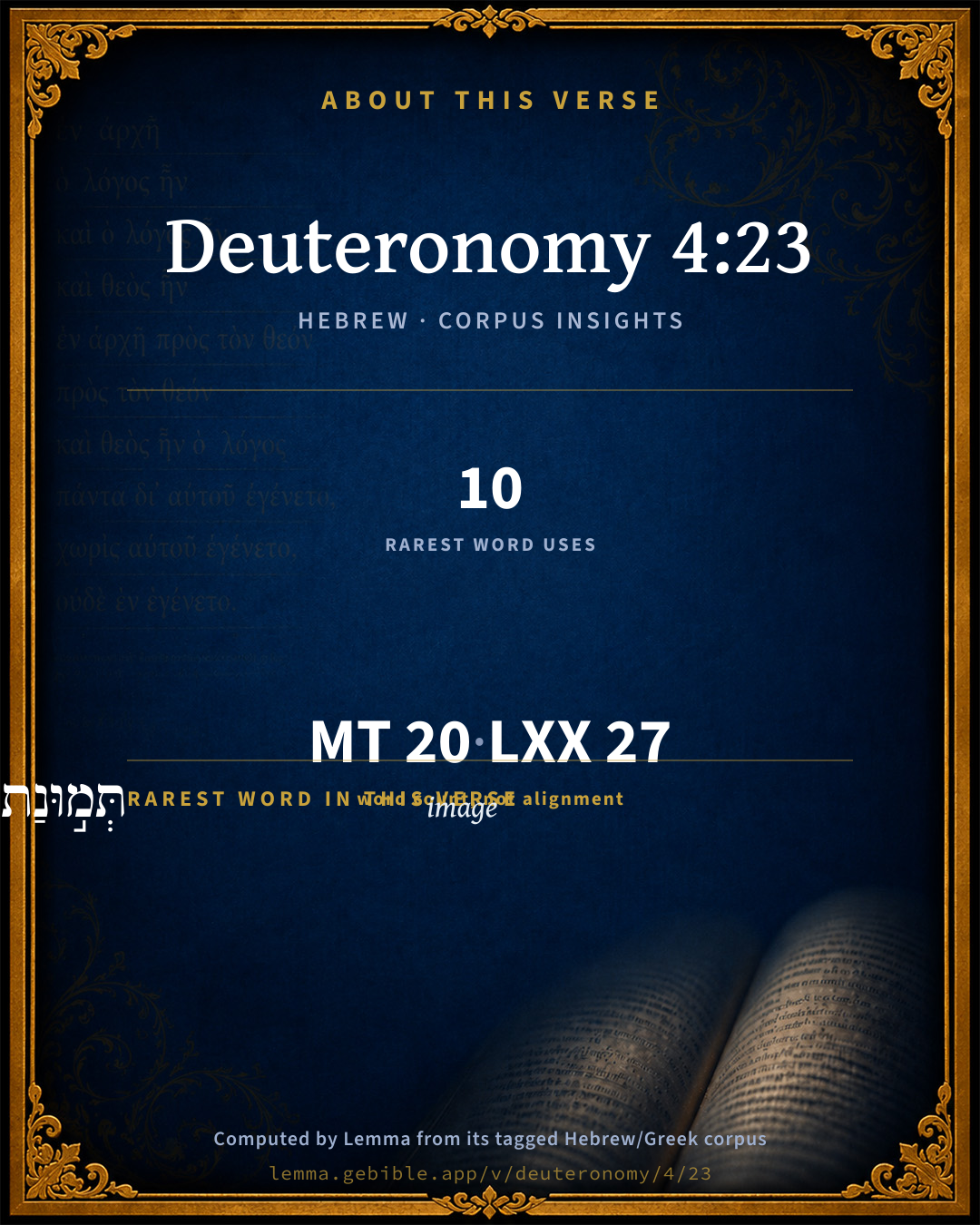
The rarest word here is תְּמ֣וּנַת image H8544 — appearing just 10 times in the whole Hebrew Bible.

Shared distinctive vocabulary

תְּמ֣וּנַת image H8544 occurs in 10 verses of the Hebrew Bible. Also found in:

Grammatical profile

  • 5 verbs
  • 8 nouns
  • 3 prepositions
  • 1 conjunction
  • 3 particles

Verb forms

  • הִשָּׁמְר֣וּ Niphal · Imperative
  • תִּשְׁכְּחוּ֙ Qal · Imperfect
  • כָּרַ֖ת Qal · Perfect
  • וַעֲשִׂיתֶ֨ם Qal · Sequential Perfect
  • צִוְּךָ֖ Piel · Perfect

Repetition

Words recur within this verse — often emphatic in Hebrew:

  • יְהוָה֙ LORD H3068 ×2
  • אֱלֹ֣הֵיכֶ֔ם God H430 ×2
  • אֲשֶׁ֥ר which H834 ×2

Hebrew & Septuagint length

In English translation the verse runs 36 words from the Hebrew and 42 from the Septuagint (LXX English) — closely comparable.

A rough comparison of the two English renderings, which tokenize alike — not a word-level alignment.

Word counts can differ between the Hebrew and the Greek without any difference in meaning — e.g. the Hebrew direct-object marker אֵת has no separate Greek word, and Greek often adds the article ὁ.

In the original languages it is 20 Hebrew tokens and 27 Greek tokens — but the two are counted differently (Hebrew bundles its prefixes and suffixes into one token; the Greek is in lemma form), so that isn’t a like-for-like length.

Cross-references

17

Topical passages linked to Deuteronomy 4:23 in the Treasury of Scripture Knowledge — connected by theme and wording, ordered by reader-vote popularity; previews shown in the World English Bible.

  • Deuteronomy 4:9 Only take heed to yourself, and keep your soul diligently, lest you forget the things which your eyes saw, and lest they depart from your heart all the days of your life; but make them known to your children and your children's children;
  • Deuteronomy 29:25 Then men shall say, Because they forsook the covenant of Yahweh, the God of their fathers, which he made with them when he brought them forth out of the land of Egypt,
  • Deuteronomy 31:20 For when I shall have brought them into the land which I swore to their fathers, flowing with milk and honey, and they shall have eaten and filled themselves, and grown fat; then will they turn to other gods, and serve them, and despise me, and break my covenant.
  • Joshua 23:16 When you disobey the covenant of Yahweh your God, which he commanded you, and go and serve other gods, and bow down yourselves to them; then will the anger of Yahweh be kindled against you, and you shall perish quickly from off the good land which he has given to you.
  • 1 Chronicles 16:15 Remember his covenant forever, The word which he commanded to a thousand generations,
  • Isaiah 24:5 The earth also is polluted under the inhabitants of it; because they have transgressed the laws, violated the statutes, broken the everlasting covenant.
  • Ezekiel 16:59 For thus says the Lord Yahweh: I will also deal with you as you have done, who have despised the oath in breaking the covenant.
  • Matthew 24:4 Jesus answered them, "Be careful that no one leads you astray.
  • Hebrews 3:12 Beware, brothers, lest perhaps there be in any one of you an evil heart of unbelief, in falling away from the living God;
  • Exodus 20:4–5 "You shall not make for yourselves an idol, nor any image of anything that is in the heavens above, or that is in the earth beneath, or that is in the water under the earth:
  • Deuteronomy 4:15–16 Take therefore good heed to yourselves; for you saw no manner of form on the day that Yahweh spoke to you in Horeb out of the midst of the fire.
  • Deuteronomy 6:12 then beware lest you forget Yahweh, who brought you forth out of the land of Egypt, out of the house of bondage.
  • Deuteronomy 27:9 Moses and the priests the Levites spoke to all Israel, saying, Keep silence, and listen, Israel: this day you are become the people of Yahweh your God.
  • Joshua 23:11 Take good heed therefore to yourselves, that you love Yahweh your God.
  • Jeremiah 31:22 How long will you go here and there, you backsliding daughter? for Yahweh has created a new thing in the earth: a woman shall encompass a man.
  • Luke 12:15 He said to them, "Beware! Keep yourselves from covetousness, for a man's life doesn't consist of the abundance of the things which he possesses."
  • Luke 21:8 He said, "Watch out that you don't get led astray, for many will come in my name, saying, 'I AM,' and, 'The time is at hand.' Therefore don't follow them.

Cross-references courtesy of OpenBible.info (CC BY 4.0).

Hebrew and Greek witnesses Masoretic Hebrew ↔ Greek Septuagint

The same verse in the two great witnesses to the Old Testament, shown verse-for-verse.

These are two independent witnesses, not word-aligned to each other, and the Septuagint is shown in lemma (dictionary) form.

Hebrew Deuteronomy 4:23 Masoretic · Westminster Leningrad Codex

הִשָּׁמְר֣וּ לָכֶ֗ם פֶּֽן תִּשְׁכְּחוּ֙ אֶת בְּרִ֤ית יְהוָה֙ אֱלֹ֣הֵיכֶ֔ם אֲשֶׁ֥ר כָּרַ֖ת עִמָּכֶ֑ם וַעֲשִׂיתֶ֨ם לָכֶ֥ם פֶּ֨סֶל֙ תְּמ֣וּנַת כֹּ֔ל אֲשֶׁ֥ר צִוְּךָ֖ יְהוָ֥ה אֱלֹהֶֽיךָ

Take heed to yourselves, lest you forget the covenant of Yahweh your God, which he made with you, and make you an engraved image in the form of anything which Yahweh your God has forbidden you.

World English Bible · Public Domain

Greek LXX Deuteronomy 4:23 Septuagint · lemma form

προςἔχω σύ μή ἐπιλανθάνω ὁ διαθήκη κύριος ὁ θεός σύ ὅς διατίθημι πρός σύ καί ποιέω σύ ἑαυτοῦ γλυπτός ὁμοίωμα πᾶς ὅς συντάσσω κύριος ὁ θεός σύ

Take heed to yourselves, lest you⌃ forget the covenant of the Lord our God, which he made with you, and you⌃ transgress, and make to yourselves a graven image of any of the things concerning which the Lord your God commanded you.

LXX2012 (modern English Septuagint) · Public Domain

Hebrew: Westminster Leningrad Codex (CC BY 4.0). Greek: Septuagint (public domain); English from LXX2012 (modern English Septuagint) (Public Domain). How the Septuagint differs from the Hebrew →

Targum (Aramaic paraphrase)

2

The Targum is the ancient Jewish Aramaic paraphrase of the Hebrew Scriptures — an interpretive translation, not the Hebrew text itself. Onkelos (literal) and Pseudo-Jonathan (expansive) render the Torah, and Jonathan the Prophets. Coverage is partial: where no permissively-licensed English translation exists for a verse, only the Aramaic is shown. This is verse-level text, not a word-by-word alignment to the Hebrew.

  1. Targum Onkelos Torah (Genesis–Deuteronomy)
    אִסְתַּמָרוּ לְכוֹן דִילְמָא תִתְנְשׁוּן יָת קְיָמָא דַיְיָ אֱלָהֲכוֹן דִי גְזַר עִמְכוֹן וְתַעְבְּדוּן לְכוֹן צֶלֶם דְמוּת כֹּלָא דִי פַקְדָךְ יְיָ אֱלָהָךְ

    (no public-domain English translation for this verse)

    Targum Onkelos — Aramaic: “Onkelos Genesis” (public domain); “Onkelos Exodus” (public domain); “Onkelos Leviticus” (public domain); “Onkelos Numbers” (public domain); “Onkelos Deuteronomy” (public domain). English: “Sefaria Community Translation” (CC0 1.0 (public-domain dedication)); “J.W. Etheridge. The Targums of Onkelos and Jonathan Ben Uzziel on the Pentateuch. London: Longmans, Green, 1862” (public domain). Text via Sefaria.

  2. Targum Pseudo-Jonathan Torah (Genesis–Deuteronomy)
    אִסְתַּמְרוּ לְכוֹן דִּלְמָא תִתְנְשׁוּן יַת קְיָמָא דַיְיָ אֱלָהָכוֹן דִּגְזַר עִמְכוֹן וְתַעַבְדוּן לְכוֹן צְלַם דְּמוּת כּוֹלָא דְפַקְדִינְכוֹן יְיָ אֱלָהָכוֹן דְּלָא לְמֶעֱבַד

    Beware, then, that you forget not the covenant of the Lord your God which He hath confirmed with you, or make to you an image, the likeness of any thing of which the Lord your God hath commanded that you should not make it.

    Targum Pseudo-Jonathan — Aramaic: “Targum Jonathan on Genesis” (public domain); “Targum Jonathan on Exodus” (public domain); “Targum Jonathan on Leviticus” (public domain); “Targum Jonathan on Numbers” (public domain); “Targum Jonathan on Deuteronomy” (public domain). English: “The Targum of Jonathan ben Uzziel, trans. J. W. Etheridge, London, 1862” (public domain). Text via Sefaria.

Commentary

Notes on Deuteronomy 4:23 from classic Christian and Jewish commentators (each source and its license shown beneath its notes). The classic Christian expositions comment on the surrounding passage and are grouped to its opening verse, so a note may address several verses; the Jewish commentaries on the Tanakh (Rashi and others) are per-verse, so they appear only where the commentator wrote on this verse.

Lemma curates 59 commentaries, every one of them public domain or Creative Commons licensed, each selected and text-cleaned for this edition rather than reprinted as found. About our sources →

Joseph Benson's Commentary

Deu 4:23. Lest you forget the covenant of the Lord your God — Lest you either disregard the knowledge of God’s law, or wilfully disobey it, now it is declared to you, and thereby bring misery and destruction upon yourselves.

Joseph Benson's Commentary on the Old and New Testaments (1811–1818) — public domain. Text from a community e-Sword module.

The Cambridge Bible for Schools and Colleges

gen. ed. J. J. S. Perowne

23. Take heed unto yourselves] See on Deu_4:9; Deu_4:15; covenant, see on Deu_4:13; and for the rest Deu_4:16.

The Cambridge Bible for Schools and Colleges (gen. ed. J. J. S. Perowne; Cambridge University Press, 1878–1918) — public domain. Text from a community e-Sword module.

John Gill's Exposition

Take heed unto yourselves,.... Since he should not be long with them, to advise, instruct, and caution them:

lest ye forget the covenant of the Lord your God, which he made with you; what that required of them, and what was promised unto them on the performance of it, and what they must expect should they break it, and particularly be so forgetful of it, and the first articles in it, as follows:

and make you a graven image, or the likeness of anything which the Lord thy God hath forbidden thee; a graven image in the likeness of men or women, of any beast on the earth, or fowl in heaven, or fish in the sea.

John Gill's Exposition of the Whole Bible (1746–1763) — public domain (CC PDM 1.0). Text via the HelloAO Bible API.

Haydock's Catholic Bible Commentary

Made. Hebrew, "and make to thyself a sculpture, the likeness of any thing which the Lord thy God commanded thee." He ordered them to abstain from idolatry. (Du Hamel)

George Leo Haydock (1774–1849), Haydock's Catholic Family Bible and Commentary, 1859 edition — public domain. Excludes Psalms (Douay-Rheims chapter numbering differs from Protestant) and Deuterocanonical books (Catholic canon only).

Matthew Poole's English Annotations

Or, commanded thee, to wit, not to do, which is easily understood by comparing this place with Exo 20:4,5, and with Gen 3:11, where this phrase is fully expressed. See more on Lev 4:2; Deu 2:37.

Matthew Poole's English Annotations on the Holy Bible (1683–1685) — public domain. Text from a community e-Sword/MySword module.

The Pulpit Commentary

A graven image, or the likeness of any thing, etc. literally, a graven (sculptured) image of a form of all that Jehovah thy God hath commanded thee; s.c. not to make (cf. Deuteronomy 16-18 and 2:37).

HOMILIES BY J. ORR. Vers. 23-32. National backsliding.

The history of the Jews is an unanswerable argument in favor of the truth of prophecy and the reality of Divine revelation. The singularity of that history is such as can only be fully accounted for on the idea of a supernatural Providence interesting itself in their fortunes; but the strangest fact is in that, their own sacred books, this wonderful history is predicted with minute precision. The Book of Deuteronomy furnishes a series of these predictions, the extraordinary character of which is not removed by any date to which the book may be assigned. We may read this passage first as a prophecy, then as a warning.

I A PROPHECY. It does not, as several later passages do, put the backsliding of the Jews hypothetically, but states the fact plainly that they will backslide takes it for granted (ver. 25). There is a prediction:

1. Of national apostasy. The whole history of Israel, beginning with the time of the judges, (Jud_1:2:19) is a commentary on this statement.

2. Of national rejection (vers. 26-29). How remarkably has this testimony been fulfilled in the rooting out of both Judah and Israel from their own land; in their scattering throughout the nations, in every region and country under heaven; in their preservation amidst all vicissitudes as a distinct people; in the conformity to alien worships, customs, and beliefs, to which they have so often been compelled; in the miseries and indignities which they have endured! Surely we are entitled to ask from the unbeliever that he should give us, when rejecting revelation, some satisfactory explanation of these coincidences.

3. Of national repentance (vers. 29-32; cf. De 30). Though yet unfulfilled, there can be little doubt in the minds of any who study past fulfillments, that this prophecy of the repentance of Israel will in God"s good time receive its accomplishment also. (Zec_12:10; Rom_11:26)

II A WARNING. We learn the truths:

1. That backsliding is possible from a state of high attainment.

2. That backsliding is commonly of gradual development (ver. 25).

3. That backsliding may assume very aggravated forms.

4. That backsliding exposes to severe punishment from God. But, finally, and for our encouragement:

5. That backsliding, if repented of, will be graciously forgiven. J.O.

The Pulpit Commentary (1880–1919), ed. H.D.M. Spence-Jones & Joseph S. Exell — public domain. Text from a community e-Sword module.

unfoldingWord translationNotes

Door43 World Missions Community

Pay attention to yourselves

"Pay careful attention"

Yahweh your God has forbidden you ... Yahweh your God

Moses speaks to the Israelites as if they were one person, so the words "you" and "your" are singular. (See: Forms of You)

Yahweh your God is a devouring fire, a jealous God

Moses compares how Yahweh acts when he is angry to the way a fire destroys things. AT: "Yahweh your God will severely punish and destroy you like a fire does because he does not want you to worship other gods" (See: Metaphor)

translationWords

covenant

image

devour

fire

jealous

unfoldingWord translationNotes — © Distant Shores Media and the Door43 World Missions Community, licensed CC BY-SA 4.0. Source: git.door43.org/Door43/en_tn.

Rashi

Rabbi Shlomo Yitzchaki (Rashi)

תמונת כל means, THE LIKENESS OF ANYTHING.

אשר צוך WHICH THE LORD [THY GOD] COMMANDED THEE — i.e. which He commanded you not to make.

Rashi on the Tanakh — English translations: “The Judaica Press complete Tanach with Rashi, translated by A. J. Rosenberg” (CC BY 4.0); “Pentateuch with Rashi's commentary by M. Rosenbaum and A.M. Silbermann, 1929-1934” (public domain); “The Metsudah Tanach series, Lakewood, N.J” (CC BY 4.0); and “The Book of Joshua, Metsudah Publications, 1997” (CC BY 4.0). Text via Sefaria.

Lesson kit

Teaching starters — assembled from the data on this page, not authored interpretation. Every prompt links to the verse data it draws on. Edit before teaching.

Deuteronomy, in the Pentateuch, opens this verse with 20 words (15 distinct Hebrew lemmas). Its most distinctive word is tᵉmûwnâh (“image”). A historical commentator’s framing appears above. Read the whole chapter for the surrounding context.

Discussion questions

  1. What does “image” (tᵉmûwnâh) contribute to the verse as a whole?
  2. Exodus 20:4 shares the word «image» with this verse. How do the two illuminate each other?
  3. “LORD” occurs 2× in this one verse. What is the effect of the repetition?
  4. These translations render this verse differently; the difference is in the English rendering, not the original. What questions does that raise?
  5. The verb «הִשָּׁמְר֣וּ» is Niphal Imperative. How does its form color the action?
  6. Reading how Joseph Benson's Commentary and The Cambridge Bible for Schools and Colleges read this verse, where do the two commentators agree and where do they part?

Things to notice

Reading settings

Reading text

Shown beneath each verse's original-language words.

Old Testament
Old Testament edition

Read the OT as the Masoretic Hebrew (MT) or the Greek Septuagint (LXX).

English shown for the Greek Septuagint (in the Hebrew ↔ Greek comparison).

Comparing translations? Open the Compare panel on any verse page to stack up to four side by side.