Micah 5:10

Hebrew (Westminster Leningrad Codex) Micah 5:10 appears in the Hebrew Old Testament. The text above is from the Westminster Leningrad Codex. Each word links to its Strong’s number, a concise gloss, and parsing drawn from the Open Scriptures Hebrew Bible morphology. Click any word for its full Brown-Driver-Briggs (BDB) entry.
Download image
Cite this verse

Micah 5:10 (World English Bible). Public Domain. Lemma interlinear Bible study tool, https://lemma.gebible.app/v/micah/5/10.

Show BibTeX & RIS
BibTeX
RIS
English Translation
"It will happen in that day," says Yahweh, "That I will cut off your horses out of the midst of you, And will destroy your chariots.
World English Bible · Public Domain
Download a study sheet

One document with this verse’s original text, its word-by-word gloss line, the meaning frame, cross-references with their text, attributed commentary, and full source and license credits — printable, and it pastes into notes with its structure intact.

This verse Autodidact and up

Study sheet (.html) Plain text (.txt)

A passage Seminary Student

Up to 50 verses in one chapter. A passage sheet keeps up to 6 commentary sources and 12 cross-references per verse, in the order this page ranks them, and says so on the sheet whenever that leaves anything out. Ask for a single verse and you get the Autodidact verse sheet above.

Everything on this page stays free to read, with no account — the sheet is a download of what is already on screen, not access to it.

Want to remove ads? Support Godless Engineer
Compare translations 3

The same verse in 3 English versions, stacked beneath the original-language interlinear above. Click any original word for its lexicon entry.

Each is an independent rendering of the whole verse — the interlinear is not word-aligned to these translations.

Highlighted words mark where these versions differ — a whole-verse word diff, not a word-by-word alignment.

  • World English Bible Public Domain
    "It will happen in that day," says Yahweh, "That I will cut off your horses out of the midst of you, And will destroy your chariots.
  • King James Version Public Domain
    And it shall come to pass in that day, saith the LORD, that I will cut off thy horses out of the midst of thee, and I will destroy thy chariots:
  • unfoldingWord Literal Text CC BY-SA 4.0
    “And it will be on that day”—the declaration of Yahweh— “that I will cut off your horses from your midst, and I will destroy your chariots.

unfoldingWord Literal Text — © unfoldingWord, licensed CC BY-SA 4.0. Word-aligned USFM3 via Door43 (git.door43.org/unfoldingWord/en_ult).

Versions to compare (up to 4)

3 of 4 selected

Show all 18 translations

Every available English version of this verse, each an independent rendering of the whole verse.

  • World English Bible Public Domain
    "It will happen in that day," says Yahweh, "That I will cut off your horses out of the midst of you, And will destroy your chariots.
  • Berean Standard Bible Public Domain
    “In that day,” declares the LORD, “I will remove your horses from among you and wreck your chariots.
  • Majority Standard Bible Public Domain
    “In that day,” declares the LORD, “I will remove your horses from among you and wreck your chariots.
  • King James Version Public Domain
    And it shall come to pass in that day, saith the LORD, that I will cut off thy horses out of the midst of thee, and I will destroy thy chariots:
  • American Standard Version (1901) Public Domain
    And it shall come to pass in that day, saith Jehovah, that I will cut off thy horses out of the midst of thee, and will destroy thy chariots:
  • Revised Version (1885) Public Domain
    And it shall come to pass in that day, saith the LORD, that I will cut off thy horses out of the midst of thee, and will destroy thy chariots:
  • Geneva Bible (1599) Public Domain
    And it shall come to passe in that day, sayth the Lord, that I will cut off thine horses out of the middes of thee, and I will destroy thy charets.
  • Douay-Rheims (1899) Public Domain
    And it shall come to pass in that day, saith the Lord, that I will take away thy horses out of the midst of thee, and will destroy thy chariots.
  • Young's Literal Translation Public Domain
    And it hath come to pass in that day, An affirmation of Jehovah, I have cut off thy horses from thy midst, And I have destroyed thy chariots,
  • Literal Standard Version CC BY-SA 4.0
    “And it has come to pass in that day,” || A declaration of YHWH, || “I have cut off your horses from your midst, || And I have destroyed your chariots,
  • Unlocked Literal Bible CC BY-SA 4.0
    “It will happen in that day”—this is Yahweh's declaration— “that I will destroy your horses from among you and will demolish your chariots.
  • unfoldingWord Literal Text CC BY-SA 4.0
    “And it will be on that day”—the declaration of Yahweh— “that I will cut off your horses from your midst, and I will destroy your chariots.
  • Darby Bible Public Domain
    And it shall come to pass in that day, saith Jehovah, that I will cut off thy horses out of the midst of thee, and I will destroy thy chariots.
  • World Messianic Bible Public Domain
    “It will happen in that day”, says the LORD, “that I will cut off your horses from among you and will destroy your chariots.
  • Webster's Bible Public Domain
    \\5:11\\And I will cut off the cities of thy land, and throw down all thy strong holds:
  • Free Bible Version CC BY-SA 4.0
    On that day, says the Lord, I will kill your horses and break your chariots.
  • Bible in Basic English Public Domain
    I will have the towns of your land cut off and all your strong places pulled down:
  • JPS Tanakh (1917) Public Domain
    (5-9) And it shall come to pass in that day, saith the LORD, that I will cut off thy horses out of the midst of thee, and will destroy thy chariots;

Literal Standard Version (2020), Covenant Press — licensed CC BY-SA 4.0. Text via the HelloAO Bible API (eBible.org). Unlocked Literal Bible (unfoldingWord) — licensed CC BY-SA 4.0. Text via the HelloAO Bible API (eBible.org). unfoldingWord Literal Text — © unfoldingWord, licensed CC BY-SA 4.0. Word-aligned USFM3 via Door43 (git.door43.org/unfoldingWord/en_ult). Free Bible Version, Dr. Jonathan Gallagher — licensed CC BY-SA 4.0. Text via the HelloAO Bible API (eBible.org).

Word by word

More ways to search: Search by grammar → Find every occurrence → Compare this word →

Practice this passage: Drill this verse → Learn its vocabulary →

מַרְכְּבֹתֶֽיךָ
merkâbâh
H4818
“chariots · your”
Noun, Common, Feminine, Plural, Construct + Suffix, Personal, 2nd Person, Masculine, Singular
Part of Speech
Noun
Type
Common
Gender
Feminine
Number
Plural
State
Construct
Full BDB Definition

Origin: from H4817

TWOT: 2163f

chariot
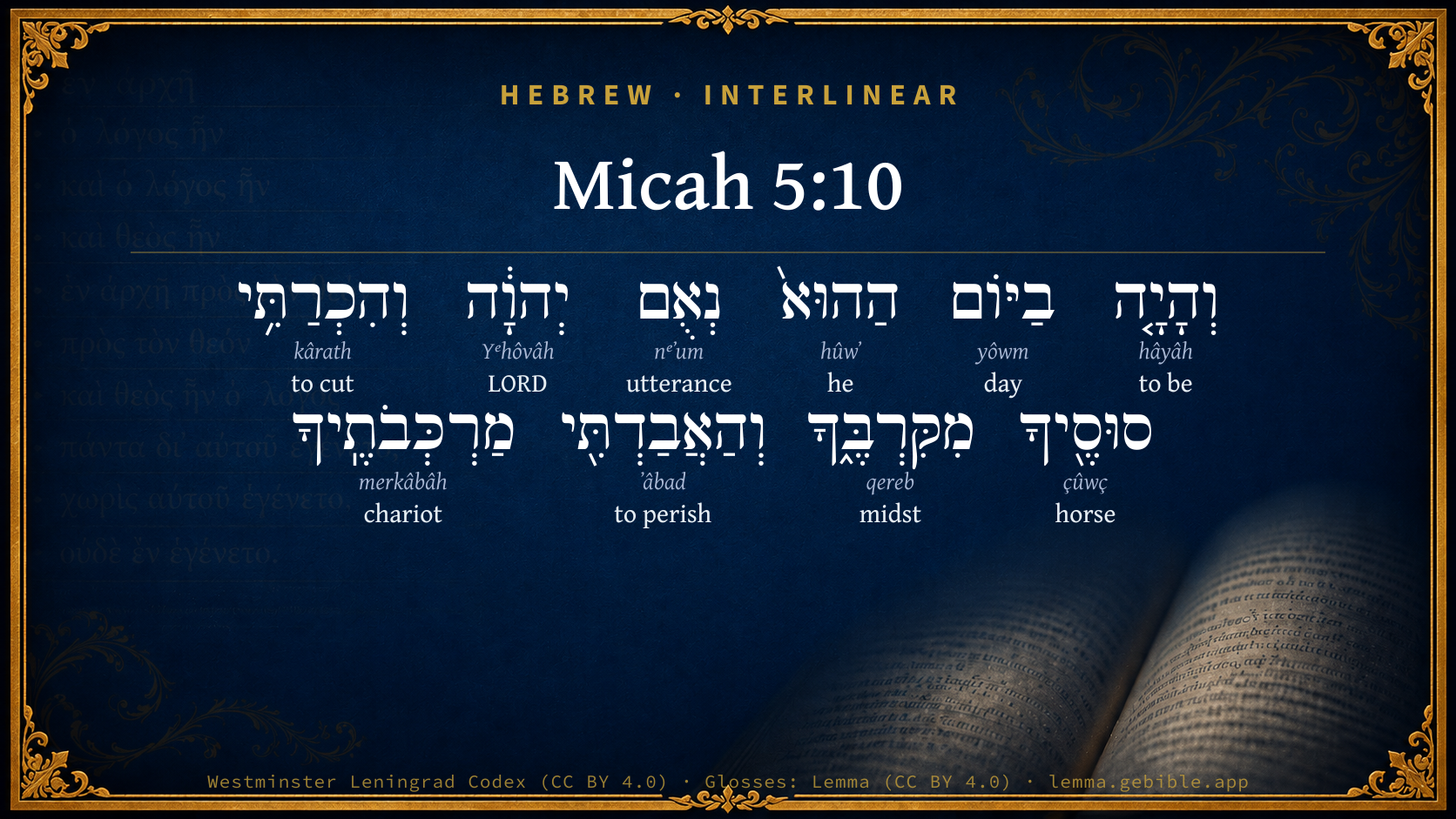
  1. וְהָיָ֤ה hâyâh H1961 “and · to be” Conjunction + Verb, Qal, Sequential Perfect, 3rd Person, Masculine, Singular
  2. בַיּוֹם yôwm H3117 “in/at the · day” Preposition, Determined + Noun, Common, Masculine, Singular, Absolute
  3. הַהוּא֙ hûwʼ H1931 “the · he” Particle, Definite Article + Pronoun, Personal, 3rd Person, Masculine, Singular
  4. נְאֻם nᵉʼum H5002 “utterance of” Noun, Common, Masculine, Singular, Construct
  5. יְהוָ֔ה Yᵉhôvâh H3068 “LORD” Noun, Proper
  6. וְהִכְרַתִּ֥י kârath H3772 “and · to cut” Conjunction + Verb, Hiphil, Sequential Perfect, 1st Person, Common, Singular
  7. סוּסֶ֖יךָ çûwç H5483 “horses · your” Noun, Common, Masculine, Plural, Construct + Suffix, Personal, 2nd Person, Masculine, Singular
  8. מִקִּרְבֶּ֑ךָ qereb H7130 “from · midst · your” Preposition + Noun, Common, Masculine, Singular, Construct + Suffix, Personal, 2nd Person, Masculine, Singular
  9. וְהַאֲבַדְתִּ֖י ʼâbad H6 “and · to perish” Conjunction + Verb, Hiphil, Sequential Perfect, 1st Person, Common, Singular

About this verse

These counts appear in no published source. They are computed here, from the morphology-tagged text and Lemma’s own curated glosses. What Lemma adds →

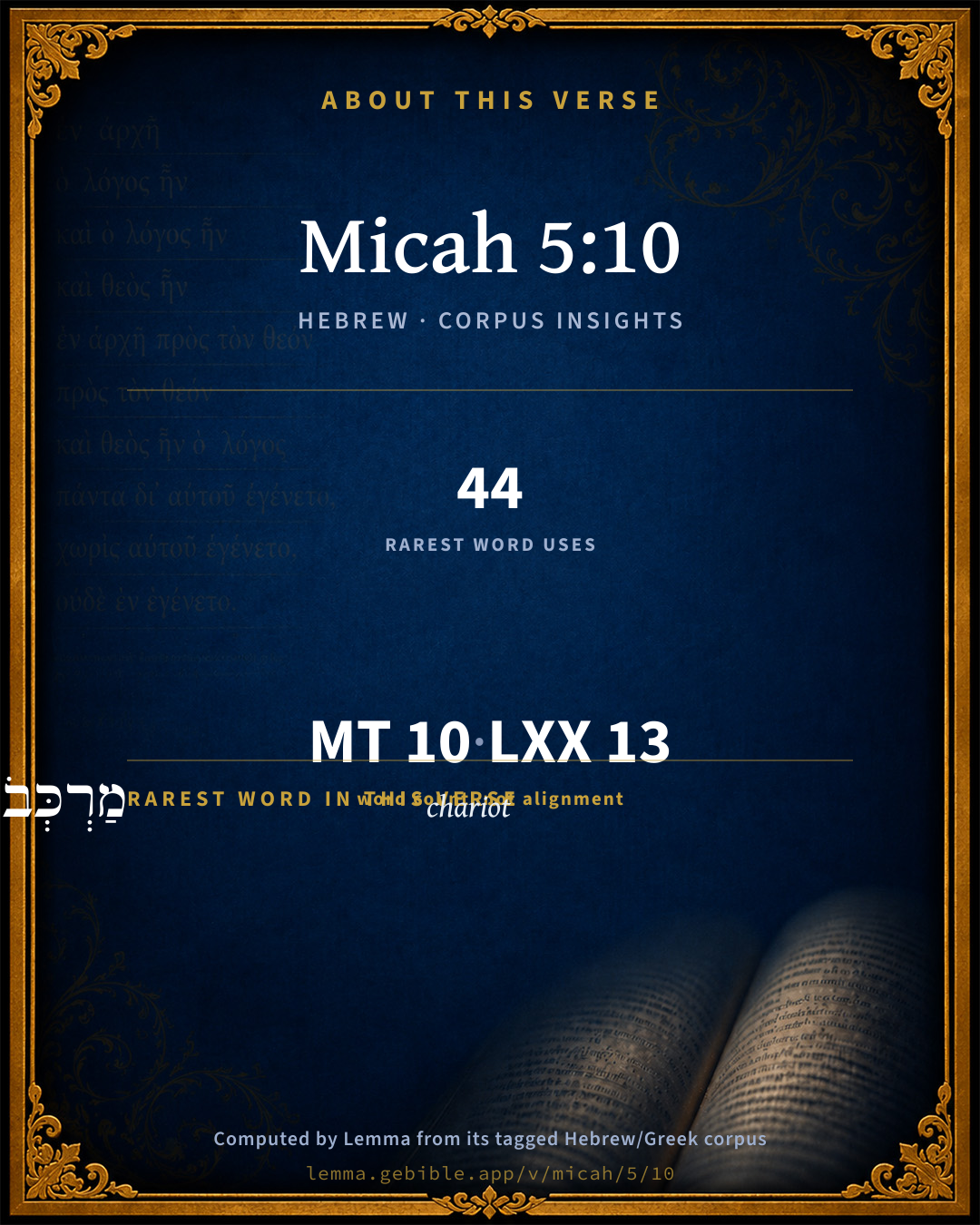
10
words
10
distinct lemmas
Prophets
section

Shared distinctive vocabulary

מַרְכְּבֹתֶֽיךָ chariot H4818 occurs in 41 verses of the Hebrew Bible. Also found in:

Grammatical profile

  • 3 verbs
  • 6 nouns
  • 1 pronoun

Verb forms

  • וְהָיָ֤ה Qal · Sequential Perfect
  • וְהִכְרַתִּ֥י Hiphil · Sequential Perfect
  • וְהַאֲבַדְתִּ֖י Hiphil · Sequential Perfect

Hebrew & Septuagint length

In English translation the verse runs 26 words from the Hebrew and 29 from the Septuagint (LXX English) — closely comparable.

A rough comparison of the two English renderings, which tokenize alike — not a word-level alignment.

Word counts can differ between the Hebrew and the Greek without any difference in meaning — e.g. the Hebrew direct-object marker אֵת has no separate Greek word, and Greek often adds the article ὁ.

In the original languages it is 10 Hebrew tokens and 13 Greek tokens — but the two are counted differently (Hebrew bundles its prefixes and suffixes into one token; the Greek is in lemma form), so that isn’t a like-for-like length.

Cross-references

7

Topical passages linked to Micah 5:10 in the Treasury of Scripture Knowledge — connected by theme and wording, ordered by reader-vote popularity; previews shown in the World English Bible.

  • Zechariah 9:10 I will cut off the chariot from Ephraim, And the horse from Jerusalem; And the battle bow will be cut off; And he will speak peace to the nations: And his dominion will be from sea to sea, And from the River to the ends of the earth.
  • Hosea 14:3 Assyria can't save us. We won't ride on horses; Neither will we say any more to the work of our hands, 'Our gods!' For in you the fatherless finds mercy."
  • Psalms 20:7–8 Some trust in chariots, and some in horses, But we trust the name of Yahweh our God.
  • Psalms 33:16–17 There is no king saved by the multitude of a host. A mighty man is not delivered by great strength.
  • Isaiah 2:7 Their land is full of silver and gold, Neither is there any end of their treasures. Their land also is full of horses, Neither is there any end of their chariots.
  • Jeremiah 3:23 Truly in vain is [the help that is looked for] from the hills, the tumult on the mountains: truly in Yahweh our God is the salvation of Israel.
  • Hosea 1:7 But I will have mercy on the house of Judah, and will save them by Yahweh their God, and will not save them by bow, nor by sword, nor by battle, by horses, nor by horsemen."

Cross-references courtesy of OpenBible.info (CC BY 4.0).

Hebrew and Greek witnesses Masoretic Hebrew ↔ Greek Septuagint

The same verse in the two great witnesses to the Old Testament, shown verse-for-verse.

These are two independent witnesses, not word-aligned to each other, and the Septuagint is shown in lemma (dictionary) form.

Hebrew Micah 5:10 Masoretic · Westminster Leningrad Codex

וְהָיָ֤ה בַיּוֹם הַהוּא֙ נְאֻם יְהוָ֔ה וְהִכְרַתִּ֥י סוּסֶ֖יךָ מִקִּרְבֶּ֑ךָ וְהַאֲבַדְתִּ֖י מַרְכְּבֹתֶֽיךָ

"It will happen in that day," says Yahweh, "That I will cut off your horses out of the midst of you, And will destroy your chariots.

World English Bible · Public Domain

Greek LXX Micah 5:10 Septuagint · lemma form

καί ἐκὀλεθρεύω ὁ πόλις ὁ γῆ σύ καί ἐκαἴρω πᾶς ὁ ὀχύρωμα σύ

And it shall come to pass in that day, says the Lord, that I will utterly destroy the horses out of the midst of you, and destroy your chariots;

LXX2012 (modern English Septuagint) · Public Domain

Hebrew: Westminster Leningrad Codex (CC BY 4.0). Greek: Septuagint (public domain); English from LXX2012 (modern English Septuagint) (Public Domain). How the Septuagint differs from the Hebrew →

Targum (Aramaic paraphrase)

1

The Targum is the ancient Jewish Aramaic paraphrase of the Hebrew Scriptures — an interpretive translation, not the Hebrew text itself. Onkelos (literal) and Pseudo-Jonathan (expansive) render the Torah, and Jonathan the Prophets. Coverage is partial: where no permissively-licensed English translation exists for a verse, only the Aramaic is shown. This is verse-level text, not a word-by-word alignment to the Hebrew.

  1. Targum Jonathan Prophets (Joshua–Malachi)
    וֶאֱשֵׁיצֵי קִרְוֵי עַמְמַיָא מֵאַרְעָךְ וַאֲפַגֵיר כָּל כְּרַכֵּיהוֹן תַּקִיפַיָא:

    (no public-domain English translation for this verse)

    Targum Jonathan — Aramaic: “Mikraot Gedolot” (public domain). English: “Sefaria Community Translation” (CC0 1.0 (public-domain dedication)); “London "Chaldee Paraphrase," 1871” (public domain). Text via Sefaria.

Commentary

Notes on Micah 5:10 from classic Christian and Jewish commentators (each source and its license shown beneath its notes). The classic Christian expositions comment on the surrounding passage and are grouped to its opening verse, so a note may address several verses; the Jewish commentaries on the Tanakh (Rashi and others) are per-verse, so they appear only where the commentator wrote on this verse.

Lemma curates 59 commentaries, every one of them public domain or Creative Commons licensed, each selected and text-cleaned for this edition rather than reprinted as found. About our sources →

Trapp's Complete Commentary

John Trapp

Mic 5:10 And it shall come to pass in that day, saith the LORD, that I will cut off thy horses out of the midst of thee, and I will destroy thy chariots:

Ver. 10. And it shall come to pass in that day] viz. Of Christ’s power and kingdom, Psa 110:3. The word day here signifies non spatium diurnum, sed diuturnum, ac a Deo destinatum, saith Danaeus, not the space of twenty-four hours, but a long time, yet certain and set by God.

That I will cut off thy horses out of thee] For the which thou hast been trading with Egypt: and in which thou trustest more than in me. "Some trust in horses, and some in chariots," &c. I will therefore cut off both, I will take away thine earthly idol; and that in much mercy to thee, that in quietness and confidence may be thy strength, Isa 30:15 Mic 5:7 : your strength is to sit still, or your Egypt is to sit still, q.d. by sitting still you shall have an Egypt (the same word Rahab signifieth strength and Egypt); by being without their horses, you shall do better than when you had them, and thought yourselves simply the better or safer for them. See Zec 9:10.

And I will destroy thy chariots] That other prop and supposed help I will pull from thee: that thou mayest not trust to such uncertainties that cannot save; but in the "living God, who giveth us all things richly to enjoy," 1Ti 6:17. Trust is God’s jewel; and of all things he cannot endure to be robbed of it, or wronged in it by creature confidence, for it giveth him the sovereignty, Jdg 9:15, and sets the crown on his head, and the contrary.

John Trapp, A Commentary or Exposition upon All the Books of the Old and New Testament (1647–1656) — public domain. Text from a community e-Sword module.

The Biblical Illustrator

Joseph S. Exell

Mic_5:10-14

I will cut off thy horses out of the midst of thee

Gods depriving dispensation towards men

Here the Almighty is represented as taking away from Israel many things they greatly valued.

Gods providence deprives as well as bestows. Depriving dispensations are--

I. Very painful. The things He takes away are--

1. The temporally valuable. Whatever is dearest to the heart--property, friends, health, fame--is the most painful to lose. The other class of things He takes away are--

2. The morally vile. Here are witchcrafts, soothsayers, graven images, etc. Whatever man indulges in that is wrong--false worship, all the sorceries of intellectual or physical pleasure--must go, the sooner the better.

II. They are very useful. God takes away temporal property from a man in order that he may get spiritual wealth; and often does a mans secular fall lead to his spiritual rise. He takes away physical health from a man in order that he may get spiritual; and often do the diseases of the body lead to the care of the soul. (Homilist.)

.

The Biblical Illustrator, edited by Joseph S. Exell (c. 1880s–1900s) — public domain. Text from a community e-Sword module.

Joseph Benson's Commentary

Mic 5:10-11. And in that day — Namely, in that time when the threatenings against the enemies, and the promises to the people of God shall be made good; I will cut off thy horses, &c. — Not in judgment, but in mercy, for there shall be no need of them, nor shall the church of God any more rely on them. And will destroy thy chariots — Chariots prepared for war. And I will cut off the cities, &c. — Cut off the occasion of fortifying thy cities: thou shalt need no other defence than what I will be to thee. And throw down all thy strong holds — Demolish thy forts, watch- towers, and garrisons. In the preceding verse, offensive preparations for annoying the enemy are intended; here, means of defence against the assaults of the enemy; in both which Israel had too much trusted. But in that time of peace and safety here spoken of, as there would be no enemy to invade the Israel of God, or put them on their defence; so neither should they have any need to make an attack upon any enemies.

Joseph Benson's Commentary on the Old and New Testaments (1811–1818) — public domain. Text from a community e-Sword module.

Whedon's Commentary on the Bible

Daniel D. Whedon

Jehovah’s achievements on behalf of the redeemed remnant, Mic_5:10-15.

10, 11. The passing away of human defenses. From the relation of the remnant to the nations without the prophet turns to the perfecting of the kingdom of God within.

In that day — The day of triumph pictured in Mic_5:8-9. The wonderful experiences of the people will convince them that Jehovah is their real helper, not the chariots and horses in which they were putting their trust in Micah’s day (compare Isa_2:7; Isa_30:16; Isa_31:1); hence they will turn to him in confidence and faith. As a result all human defenses may be destroyed (compare Hos_8:14; Isa_9:4 ff; Isa_11:1 ff.; Eze_38:11). Should any foreign nations dare to rise against the people of Jehovah, he himself will smite them.

Daniel D. Whedon (gen. ed.), Commentary on the Old and New Testaments (1874–1909) — public domain. Text from a community e-Sword module.

The Preacher's Complete Homiletical Commentary

Joseph S. Exell (gen. ed.)

CRITICAL NOTES.

Mic_5:10. Horses] All human resources on which to depend (Isa_2:6-8; Psa_20:7). “The Church will never be safe till she is stripped of all creature-trusts, and rests on Jehovah alone” [Calvin].

Mic_5:11. Cities] Salvation so complete that neither forces nor strongholds would be wanted.

Mic_5:12. Witch.] Such offences would be no more found amongst them (cf. Isa_2:6-8) Sooth.] Signmongers by hand and observations of the sky.

Mic_5:13. Images] Graven idols made of wood or metal. Stand.] Statues, stone images, or stones dedicated to idols (1Ki_14:23). “Thou shalt no more be an idolatrous people” [A. Clarke].

Mic_5:14. Groves] Lit. “Stems of trees, or posts standing upright, or set up as idols, which were dedicated to the Canaanitish goddess of nature” (cf. Exo_34:13) [Keil]. Cities] In or near which idolatrous groves were planted (2Ki_10:25). “These two rather subordinate objects are mentioned instar omnium, to express the entire abolition of war and idolatry” [Keil].

Mic_5:15.] The Lord will take vengeance upon nations that have not heard, i.e. not hearkened or obeyed his voice. “In other words, he will exterminate every ungodly power by a fierce judgment, so that nothing will ever be able to disturb the peace of his people and kingdom again” [Keil].

EXTERMINATION OF WAR AND IDOLATRY.—Mic_5:10-15

Jehovah will secure the peace of his people by the destruction of war instruments, the extermination of idolatry, and the infliction of judgment upon resisting nations. Appliances of war will not be required in universal peace and security.

I. War abolished. God will deprive them of everything to make war, that they may depend upon him alone.

1. Human aids will be taken away. Men multiply horses and chariots, and trust in them (Psa_20:7). Israel was accustomed to rely on Egypt and Assyria (cf. Isa_31:1-3; Hos_14:3), but the time will come when the Church of God will not lean on an arm of flesh.

2. Outward defences will be destroyed. Strongholds and fortified cities will be demolished. “And throw down all thy strongholds.” God will teach his people not to look to war-chariots and secular allies, not to seek refuge in temporal support. He will be their garrison and deliverer. Cities have been provisioned and besieged for years and yet have fallen: but God defends his people, “all of them dwelling without walls, and having neither bars nor gates.”

II. Idolatry destroyed. In the Church of God there may be illicit intercourse with idols. When men are impatient in affliction, restless in their mind, and curious to know the future, they set up gods and groves of their own.

1. Systems of divination will be destroyed. Witchcraft, conjuring, and fortune-telling will be cut off. The work of men’s hands shall not be worshipped. Necromancy, pyromancy, and astrology are diabolical arts. Such tricks are abomination to God, who will judge them in his wrath.

2. Idolatrous worship destroyed. Graven images will be demolished. Groves and plantations will be plucked up, and not a remnant of idolatry left behind. God will cut off whatever hinders his purpose and corrupts his people. Confidence in creatures is idolatry. Holiness before God is essential to victory over the foe. Every curious art and devilish practice is destined to fall before the preaching of the cross (Act_19:19).

HOMILETIC HINTS AND OUTLINES

Mic_5:10-14. The purification of the Church. Everything of an ungodly and idolatrous nature must be taken away before it can conquer the world and be fit for God’s residence. This is,

1. A necessary work.

2. A painful work.

3. A Divine work. “The greater the glory and purity of the Church, the less it needs or hangs upon human aid. The more it is reft of human aid, the more it hangs upon God. So God promises, as a blessing, that he will remove from her all mere human resources, both what was in itself evil and what, although good, had been abused” [Pusey].

Mic_5:15. The doom of heathen nations and ungodly opponents.

1. Vengeance without mercy.

2. Vengeance unprecedented. “Such as they have not heard.” “In like way, the woe on those who obey not the truth, also looks on to the end. It too is final. There is nothing to soften it. Punishments in the course of life are medicinal. Here no mention is made of mercy, but only of executing vengeance; and that with wrath and fury; and that such as they have not heard. For as eye hath not seen, nor heart conceived, the good things laid up in store for those who love God, so neither the evil things prepared for those who in act show that they hate him” [Pusey].

The Prince of peace.

1. His coming, (a) In lowly guise, Mic_5:1; humble. (b) And yet to the throne, Mic_5:1; glorious. (c) Because he was appointed to this form of old; eternal. (d) At the appointed fulness of time, Mic_5:2; temporal.

2. His work. (a) To seek and save that which was lost, Mic_5:2. (b) To be a shepherd in truth, Mic_5:3. (c) To prepare God’s kingdom even to the ends of the world, Mic_5:3. (d) To give peace to his followers through the protection which he will afford and the bestowment of power, Mic_5:4. (e) To judge the world, Mic_5:5; Mic_5:14.

3. His congregation. (a) A spiritual congregation, Mic_5:6. (b) A powerful congregation, Mic_5:7-8. (c) A holy congregation:

(1) trusts in God alone, Mic_5:9-10;

(2) inquires after God’s will alone, Mic_5:11;

(3) fears God alone, Mic_5:12-13 [Lange].

ILLUSTRATIONS TO CHAPTER 5

Mic_5:10-15. Christianity is by its nature adapted to effect these and similar changes in the physical, intellectual, and social state of our world, and by the decree of the Eternal it is hastening their accomplishment. It came into the world not only to reinstate man in his proper relationship to God, but to restore to him the forfeited inheritance of earth. It has already done much. Europe has been indebted to it for most of its civilization. England owes to it most of its elements of happiness and security. Within our own time it has achieved much good in the enfranchisement of the slave, in the partial civilization of Polynesia, in a thousand instrumentalities of blessing that are now at work in almost every quarter of the globe. It shall go on until it has attained all its happy and benign results. It shall yet enter, penetrate, and suffuse the entire frame of mind and existence. The Church shall become an eternal excellence, and a joy of many generations. The field of the world shall present the aspect as of a paradise regained. The race of man shall appear as the ransomed of the Lord, joy and gladness on their heads, sorrow and sighing for ever fled away [Legge].

“O Scenes surpassing fable and yet true,

Scenes of accomplished bliss, which who can see,

Though but in distant prospect, and not feel

The soul refreshed with foretaste of the joy,—

The joy of an assembly such as earth

Saw never; such as heaven stoops down to see! [Cowper.]

The Preacher's Complete Homiletical Commentary (gen. ed. Joseph S. Exell; Funk & Wagnalls, c. 1892) — public domain (pre-1929). A full-Bible homiletical/sermon-outline anthology covering 65 of 66 books (2 John is absent from the source module). Text from a community e-Sword module.

Keil & Delitzsch

C. F. Keil & F. Delitzsch

But if Israel conquer the nations in such a way as this, then will Jehovah fulfil the peace of His people by the destruction of all the instruments of war, and the extermination of everything of an idolatrous nature, as well as by the judgment of wrath upon all resisting nations. Mic 5:10. "And it comes to pass in that day, is the saying of Jehovah, that I will destroy thy horses out of the midst of thee, and annihilate thy chariots. Mic 5:11. And I shall destroy the cities of thy land, and throw down all thy fortresses. Mic 5:12. And I shall destroy the witchcrafts out of thy hand; and cloud-interpreters shall not be left to thee. Mic 5:13. And I shall destroy thy graven images and thy statutes out of the midst of thee; and thou wilt no more worship the work of thy hands. Mic 5:14. And I shall root out thine idol-groves out of the midst of thee, and destroy thy cities. Mic 5:15. And I shall execute vengeance in wrath and fury upon the nations which have not heard." These verses do not explain Mic 5:8, or state how the extermination of the enemy is to take place, or how Israel is made into a lion destroying the nations that are hostile to it, namely, by the fact that the Lord eradicates from its heart all confidence in horses, chariots, and fortifications, in witchcraft and idolatry (Caspari). This assumption is at variance with the words themselves, and with the strophic arrangement of the chapter. There is nothing about trust in horses, etc., but simply about the extermination of the horses, and everything else in which the idolatrous nation had sought its strength. Moreover, the expression והיה ביּום ההוּא, when compared with והיה in Mic 5:4 and Mic 5:6, shows at once that these verses are intended to depict the last and greatest effect produced by the coming of the Prince of peace in Israel, and overthrows Hengstenberg's assumption, that the prophet here foretels the destructive work of the Lord in Israel, which will precede the destruction of the enemy predicted in Mic 5:10. In that case בּיּום ההוּא would mean "before that day," a meaning which it can never have. The prophet passes rather from the attitude of Israel among the nations, to the description of the internal perfection of the kingdom of God, which does indeed stand in a reciprocal relation to the former and proceed simultaneously with it, but which will not be completed till after the victorious suppression of the foe. Only when the people of God shall have gained the supremacy over all their enemies, will the time have arrived for all the instruments of war to be destroyed. When the world shall be overcome, then will all war cease. The ancient Israel did indeed put its trust in war-horses, and war-chariots, and fortifications (cf. Isa 2:7); but the Messianic Israel, or the true people of the Lord, will only put its trust in such things so far as it is not yet pervaded by the power of the peace brought by the Messiah. And the more it appropriates the spiritual power of the Prince of peace, the more will the trust in horses and chariots disappear; so that they will be destroyed, because all war comes to an end (compare Isa 9:4-6). And the extermination of everything of an idolatrous nature will go hand in hand with this. Two kinds are mentioned in Mic 5:12 and Mic 5:13, viz., witchcraft and the worship of idols of their own making. As objects of witchcraft there are mentioned keshâphı̄m, lit., witchcrafts of different kinds, but the expression מיּדך limits them to such as are performed with the hand, and me‛ōnenı̄m (= ‛ōnenı̄m in Isa 2:6), lit., cloud-interpreters, or cloud, i.e., storm makers, from ‛ânan, a kind of witchcraft which cannot be more precisely defined (see Delitzsch on Isaiah, l.c.). Of the objects of the idolatrous worship there are mentioned (after Lev 26:1) pesı̄lı̄m, idols made of wood or metal; and מצּבות, stone-images, or stones dedicated to idols (see at Kg1 14:23). For Mic 5:12, compare Isa 2:8.

Keil & Delitzsch — Biblical Commentary on the Old Testament (1861–1891) — public domain (CC PDM 1.0). Text via the HelloAO Bible API. (Old Testament only.)

Tyndale Open Study Notes

Tyndale Open Resources

5:10-14 The Lord’s actions for and against his people purify them. The Lord removed several abominable things imported from the pagan cultures of Mesopotamia and Canaan.

Tyndale Open Study Notes — © Tyndale Open Resources, licensed CC BY-SA 4.0. Text via the HelloAO Bible API.

Geneva Bible (1599)

Geneva Bible translators

I will destroy all things wherein thou puttest thy confidence, as thy vain confidence and idolatry, and so will help thee.

Geneva Bible (1599) marginal notes — public domain. Text via Bolls.life.

Jamieson, Fausset & Brown

Robert Jamieson, A. R. Fausset & David Brown

cut off thy horses . . . chariots--namely, those used for the purposes of war. Israel had been forbidden the use of cavalry, or to go to Egypt for horses (Deu 17:16), lest they should trust in worldly forces, rather than in God (Psa 20:7). Solomon had disregarded this command (Kg1 10:26, Kg1 10:28). Hereafter, saith God, I will remove these impediments to the free course of My grace: horses, chariots, &c., on which ye trust. The Church will never be safe, till she is stripped of all creature trusts, and rests on Jehovah alone [CALVIN]. The universal peace given by God shall cause warlike instruments to be needless. He will cut them off from Israel (Zac 9:10); as she will cut them off from Babylon, the representative of the nations (Jer 50:37; Jer 51:21).

Jamieson, Fausset & Brown — Commentary Critical and Explanatory on the Whole Bible (1871) — public domain (CC PDM 1.0). Text via the HelloAO Bible API.

Adam Clarke's Commentary

Verse 10. I will cut off thy horses] Thou shalt have no need of cavalry in thine armies; God will fight for you.

Adam Clarke's Commentary on the Bible (1810–1826) — public domain. Text from a community e-Sword/MySword module.

John Calvin's Commentaries

There is introduced here a most necessary admonition, in order that the faithful may know, how they are to be preserved by the hand and favor of God, even when they shall be stripped of all their helps, yea, even when God shall take away all those impediments, which would otherwise close up the way against his favor. The sum of the whole then is, — that the Church shall not otherwise be saved by God’s kindness than by being deprived of all her strength and defenses, and also by having her obstacles removed by God, even those which in a manner prevented his hand from being put forth to save his people. For the Prophet mentions here cities, then fortified places, he mentions horses and chariots. These, we know, are not in themselves to be condemned: but he means, that as the people foolishly placed confidence in earthly things, the salvation of God could not otherwise come to them than by stripping them of all vain and false confidence. This is one thing. Then, on the other hand, he mentions groves, he mentions carved images and statues, he mentions augurs and diviners: these were corruptions, which closed the door against the favor of God; for a people, given to idolatry, could not call upon God nor hope in him as the author of salvation. We now then perceive the Prophet’s design. It now remains for me to run over the words.

He says first, It shall be in that day, saith Jehovah, that I will cut off thine horses Here the Prophet enumerates those things which could not in themselves be ascribed to any thing wrong: for as God has created horses for the use of men, so also he allows them to be for our service. Why then does the Prophet say, that the Church could not be delivered, except horses were taken away? It was owing to an accidental fault; for when men abound in forces, they instantly fix their hope on them. As then such an abuse of God’s gifts had prevailed among the people of Israel, it was necessary that horses should be taken away. God indeed could have humbled their minds or withdrawn their confidence from their horses and chariots: but it hence appears how deep are the roots of presumption in the hearts of men, that they cannot be otherwise torn up, than by having the things themselves cut off. To have horses and to have chariots is the bounty of God: for how can we have chariots and horses and other things, except through God’s kindness? And yet God cannot find a way by which he can do us good, except by taking away his former gifts. Here then Micah touches the hearts of the people much more sharply than before, when he says, that salvation cannot proceed from the Lord, except their horses were destroyed; as though he said, — “Ye see how great is your wickedness; God has hitherto dealt bountifully with you, since he has enriched you, and has also given you horses. Now as he sees that you abuse these gifts, he complains that all ways of access to you are closed up, as ye do not receive his kindness. Inasmuch as your horses and your chariots engross your attention, ye in a manner drive God far away from you. That he may therefore come to you, he will open a way for himself by removing all the obstacles and hindrances.”

We hence learn, that though all God’s benefits ought to raise us up to heaven, serving as kinds of vehicles, they are yet turned, through our wickedness, to another purpose, and are made intervening obstacles between us and God. Hereby then is our ingratitude proved; and hence it comes, that God, when he intends to make his salvation known to us is in a manner constrained to take away and remove from us his benefits. We now then understand what the Prophet had in view when he mentioned horses and chariots. For he does not threaten here, as some think, that the people would be merely deprived of all God’s gifts that they might see in their destitution and want only signs of a curse; by no means, but it is rather a promise, that is, that God will turn aside all impediments by which he was for a time prevented from bringing help to his people. This doctrine ought at the same time to avail for bringing no ordinary comfort. It is hard and bitter to the flesh to be brought down. Hence the people of Israel were little able at first to bear their lot with submission, when they saw themselves stripped of God’s benefits: but the Prophet sets before them a compensations which was capable of soothing all their grief, — “This,” he says, “shall be for your chief good — that God will deprive you of horses and chariots; for the way which your horses and chariots now occupy shall be cleared. While ye are replenished with abundant forces, ye drive away God far from you, and there is no way open for him. He will therefore prepare a way for himself; and this will be the case when your land shall be made naked, when nothing will intervene to prevent him from coming to you.”

John Calvin's Commentaries (1540-1563) — public domain. Text from the Calvin Translation Society English edition (1840s-50s) via the Christian Classics Ethereal Library (ccel.org). Calvin's coverage is partial (roughly two-thirds of the Bible); uncommented books and verses are honest gaps, never fabricated. The 19th-century editor's footnotes and remarks are omitted so the notes are faithfully Calvin's own voice.

Ellicott's Commentary for English Readers

(10) It shall come to pass in that day.—The prophet now passes on to the purification of the Church from the defilements mentioned by Isaiah (Isa_2:3-10), with reference to the ultimate holiness which shall be established “in that day.”

I will cut off thy horses.—The possession of horses was imperatively forbidden to the Jewish king (Deu_17:16), and Isaiah describes the land as at this time “full of horses, neither is there any end of their chariots.” As symbolising the power of man, these horses shall be cut off, and the reliance of the Church shall be on God alone. “Some trust in chariots, and some in horses, but we will remember the name of the Lord our God” (Psa_20:7).

A Bible Commentary for English Readers, edited by Charles John Ellicott (1878–1897) — public domain. Text from a community e-Sword module.

The Cambridge Bible for Schools and Colleges

gen. ed. J. J. S. Perowne

10–15. The destruction of warlike implements and of idolatry

10. I will cut off thy horses …] Isaiah, too, speaks of war-horses and war-chariots as equally hateful to God with idolatry, Mic_2:7. Horses were first imported from Egypt by the worldly-minded Solomon, 1Ki_4:26; 1Ki_10:28-29.

The Cambridge Bible for Schools and Colleges (gen. ed. J. J. S. Perowne; Cambridge University Press, 1878–1918) — public domain. Text from a community e-Sword module.

John Gill's Exposition

And it shall come to pass in that day, saith the Lord,.... When the above things shall be accomplished, even in the Gospel day, made so by the rising of the sun of righteousness; the Gospel dispensation, the latter part of it:

that I will cut off thy horses out of the midst of thee, and I will destroy thy chariots; which some take to be an apostrophe to literal Babylon, and to be fulfilled when Cyrus took possession of it; but rather it respects mystical Babylon, and the destruction of that by Christ; but it is best of all to interpret it of the church of Christ, all whose carnal confidences and dependences shall be cut off, and shall trust alone in Christ for salvation; particularly the Jews now converted, who have been used to put their trust in the flesh, and in such things as are here mentioned; but now shall be made to see the folly and vanity of such things, and shall renounce and disclaim them; see Hos 14:3; or the sense is, there shall be no more war; horses and chariots shall be no more used in a hostile way; but there shall be perfect peace, all enemies being destroyed, which agrees with Mic 2:3 Zac 9:10. The Targum is,

"I will cut off the horses of the people from the midst of thee, and destroy their chariots?''

John Gill's Exposition of the Whole Bible (1746–1763) — public domain (CC PDM 1.0). Text via the HelloAO Bible API.

Albert Barnes' Notes on the Bible

And it shall come to pass in that day - Of grace in the kingdom of Christ and of His Presence in the Apostles and with the Church; “I will cut off thy horses out of the midst of thee.” The greater the glory and purity of the church, the less it needs or hangs upon human aid. The more it is reft of human aid, the more it hangs upon God. So God promises, as a blessing, that He will remove from her all mere human resources, both what was in itself evil, and what, although good, had been abused. Most of these things, whose removal is here promised, are spoken of at the same time by Isaiah, as sin, or the occasion of sin, and of God’s judgments to Judah. “Soothsayers,” (the same word) “horses, chariots, idols the work of their hands; high towers, fenced walls” Isa 2:6-8, Isa 2:15. Rib. Lap.: “I will take, from thee all arms wherewith, while unconverted, thou opposedst the faith,” all which thou settest up as idols in place of God. (Such are witchcrafts, soothsayers, graven images, images of Ashtaroth.) “I will take from thee all outward means and instruments of defense which aforetime were turned into pride and sin;” as horses and chariots. Not such shall be the arms of the Church, not such her strongholds. A horse is a vain thing to save a man. Her arms shall be the despised Cross of shame; her warriors, they who bear it; their courage, to endure in holy patience and meekness; their might, the Holy Spirit within them; their victories, through death, not of others, but their Master’s and, in His, their own. They shall overcome the world, as He overcame it, and through Him alone and His Merits who overcame it by suffering.

Albert Barnes' Notes on the Bible (1834–1885) — public domain. Text from a community e-Sword/MySword module.

Haydock's Catholic Bible Commentary

Horses. Some understand this, and all that follows to the end of the chapter, as addressed to the enemies of the Church. But it may as well be understood of the converts to the Church, who should no longer put their trust in any of these things. (Challoner) --- God will protect his people, so that horses and fortifications will be unnecessary.

George Leo Haydock (1774–1849), Haydock's Catholic Family Bible and Commentary, 1859 edition — public domain. Excludes Psalms (Douay-Rheims chapter numbering differs from Protestant) and Deuterocanonical books (Catholic canon only).

Matthew Poole's English Annotations

In that day; when the threats against the enemies, and the promises to the people of God, shall be made good.

Saith the Lord: this is added for assuring the performance of the things foretold.

I will cut off thy horses; not in judgment, but in mercy, for there shall be no such need of them, nor shall the church of God any more rely on them: so Hos 14:3, We will not ride upon horses; though we have put confidence in them, we will do so no more.

I will destroy thy chariots; warlike chariots, prepared for war: as God alone is, so they will make him, their only trust.

Matthew Poole's English Annotations on the Holy Bible (1683–1685) — public domain. Text from a community e-Sword/MySword module.

The Pulpit Commentary

Vers. 10-15. Messiah shall destroy all the instruments of war, and put down all idolatry, having taught his people to rely upon him alone.

In that day. When Messiah"s kingdom is established. Micah depicts the interior perfection of the Church, as he had before explained its relation to external nations. Horses... chariots. The things most used in attack and defence, and forbidden by God as betraying distrust in his providence. (comp. Deu_17:16 Isa_2:7 Zec_9:10) In the reign of the Prince of Peace all war shall cease. (Isa_9:4-6)

Vers. 10-15. God"s depriving dispensation towards men.

"And it shall come to pass in that day, saith the Lord, that I will cut off thy horses out of the midst of thee, and I will destroy thy chariots: and I will cut off the cities of thy land, and throw down all thy strong holds." "The prophet now returns to times near his own, and predicts the beneficial moral changes that were to be effected in the condition of his countrymen by the Babylonish conquest and captivity. They had, contrary to the express command of the Lord, (Deu_17:16) kept up a formidable body of cavalry and war chariots, trusted in their fortified cities, encouraged sorcery, and indulged in abominable idolatry. These were all to be removed when the Jewish state was broken up; and after God had employed the heathen in punishing his apostate people, they in their turn should be punished for their obstinate adherence to idol worship, notwithstanding the testimony borne against their conduct by the Jews who lived among them." The grand subject of these words is Gods depriving dispensation towards men. Here the Almighty is represented as taking away from Israel many things they greatly valued chariots, cities, soothsayers, witchcrafts, graven images, groves," etc. God"s providence deprives as well as bestows. "The Lord gave, the Lord hath taken away." He is constantly taking away from men. In relation to his depriving dispensations I offer two remarks.

I THEY ARE VERY PAINFUL. The things here referred to were the dearest things to the hearts of Israel. They loved them, they trusted in them, and they would feel life to be perilous, if not intolerable, without them; yet they were to be taken away. The thugs he takes away are of two classes.

1. The temporally valuable. Here chariots and horses and cities are taken away. These are valuable. Whatever is dearest to the heart property, friends, health, fame is the most painful to lose. And is not the Almighty constantly, in his providence, taking these things from men? He takes from the rich man his property, the strong man his health, the ambitious man his power, the social man his dearest friends. And such deprivations are the constant sources of human sorrow and anguish. All temporal good must go chariots, horses, cities, etc. The other class of things he takes away are:

2. The morally vile. Here are "witchcrafts, soothsayers, graven images," etc. Whatever man indulges in that is wrong false worship, all the sorceries of intellectual or physical pleasure must go, the sooner the better. It is well when all that is morally wrong is taken from us in this world.

II THEY ARE VERY USEFUL. It is often well to be stripped of temporary good; it is always necessary to be stripped of the morally wrong. All is done in mercy for the soul. God takes away temporal property from a man in order that he may get spiritual wealth; and often does a man"s secular fall lead to his spiritual life. He takes away physical health from a man in order that he may get spiritual; and often do the diseases of the body lead to the cure of the soul. Did we understand things thoroughly, see them as we shall when we have done with this mundane system, we should often acknowledge more mercy in God"s depriving than in his bestowing providences. Ever should we remember that the great end of all his dealings with us is our spiritual advancement in intelligence, holiness, power, and blessedness. "Lo, all these things worketh God with man, that he may bring him back from the pit in order to enlighten him with the light of the living". (Job_33:30)

CONCLUSION. Though I know not the future and no one does I know that severe depriving providences are ahead, but that mercy underlies the whole. "And so beside the silent sea I wait the muffled oar; No harm from him can come to me On ocean or on shore. "I know not where his islands lift Their fronded palms in air; I only know I cannot drift Beyond his love and care. And thou, O Lord, by whom are seen Thy creatures as they be, Forgive me if too close I lean My human heart on thee. (J.G. Whittier.) D.T.

The Pulpit Commentary (1880–1919), ed. H.D.M. Spence-Jones & Joseph S. Exell — public domain. Text from a community e-Sword module.

John Wesley's Explanatory Notes

I will cut off - Not in judgment, but in mercy, for there shall be no need of them, nor shall the church of God any more rely on them. Thy chariots - Chariots prepared for war.

John Wesley, Explanatory Notes Upon the Whole Bible (1754–1765) — public domain. Text via the GEBible commentary corpus.

unfoldingWord translationNotes

Door43 World Missions Community

in that day

"at that time" or "when I do those things." These words refer to "the last days" (Micah 4:1). The word "day" can refer to a period of days or even years.

I will destroy your horses from among you and will demolish your chariots

The people of Israel used horses and chariots only in battle, and they may have traded for them with the godless nations around them. God did not want the people to trust in their weapons of war to protect them more than they trusted in him. (See: Assumed Knowledge and Implicit Information)

your horses ... among you ... your chariots ... your land ... your strongholds

Yahweh is speaking to the people of Israel as if they were one man. (See: Forms of You)

translationWords

Yahweh

horse

chariot

stronghold

unfoldingWord translationNotes — © Distant Shores Media and the Door43 World Missions Community, licensed CC BY-SA 4.0. Source: git.door43.org/Door43/en_tn.

Rashi

Rabbi Shlomo Yitzchaki (Rashi)

And I will destroy your cities—And you will no longer need fortified cities.

Rashi on the Tanakh — English translations: “The Judaica Press complete Tanach with Rashi, translated by A. J. Rosenberg” (CC BY 4.0); “Pentateuch with Rashi's commentary by M. Rosenbaum and A.M. Silbermann, 1929-1934” (public domain); “The Metsudah Tanach series, Lakewood, N.J” (CC BY 4.0); and “The Book of Joshua, Metsudah Publications, 1997” (CC BY 4.0). Text via Sefaria.

Lesson kit

Teaching starters — assembled from the data on this page, not authored interpretation. Every prompt links to the verse data it draws on. Edit before teaching.

Micah, in the Prophets, opens this verse with 10 words (10 distinct Hebrew lemmas). Its most distinctive word is merkâbâh (“chariot”). A historical commentator’s framing appears above. Read the whole chapter for the surrounding context.

Discussion questions

  1. The word merkâbâh carries the sense “chariot.” How does it shape the verse?
  2. Genesis 41:43 shares the word «chariot» with this verse. How do the two illuminate each other?
  3. These translations render this verse differently; the difference is in the English rendering, not the original. What questions does that raise?
  4. The verb «וְהָיָ֤ה» is Qal Sequential Perfect. How does its form color the action?
  5. Reading how Trapp's Complete Commentary and The Biblical Illustrator read this verse, where do the two commentators agree and where do they part?

Things to notice

Reading settings

Reading text

Shown beneath each verse's original-language words.

Old Testament
Old Testament edition

Read the OT as the Masoretic Hebrew (MT) or the Greek Septuagint (LXX).

English shown for the Greek Septuagint (in the Hebrew ↔ Greek comparison).

Comparing translations? Open the Compare panel on any verse page to stack up to four side by side.