Numbers 15:31

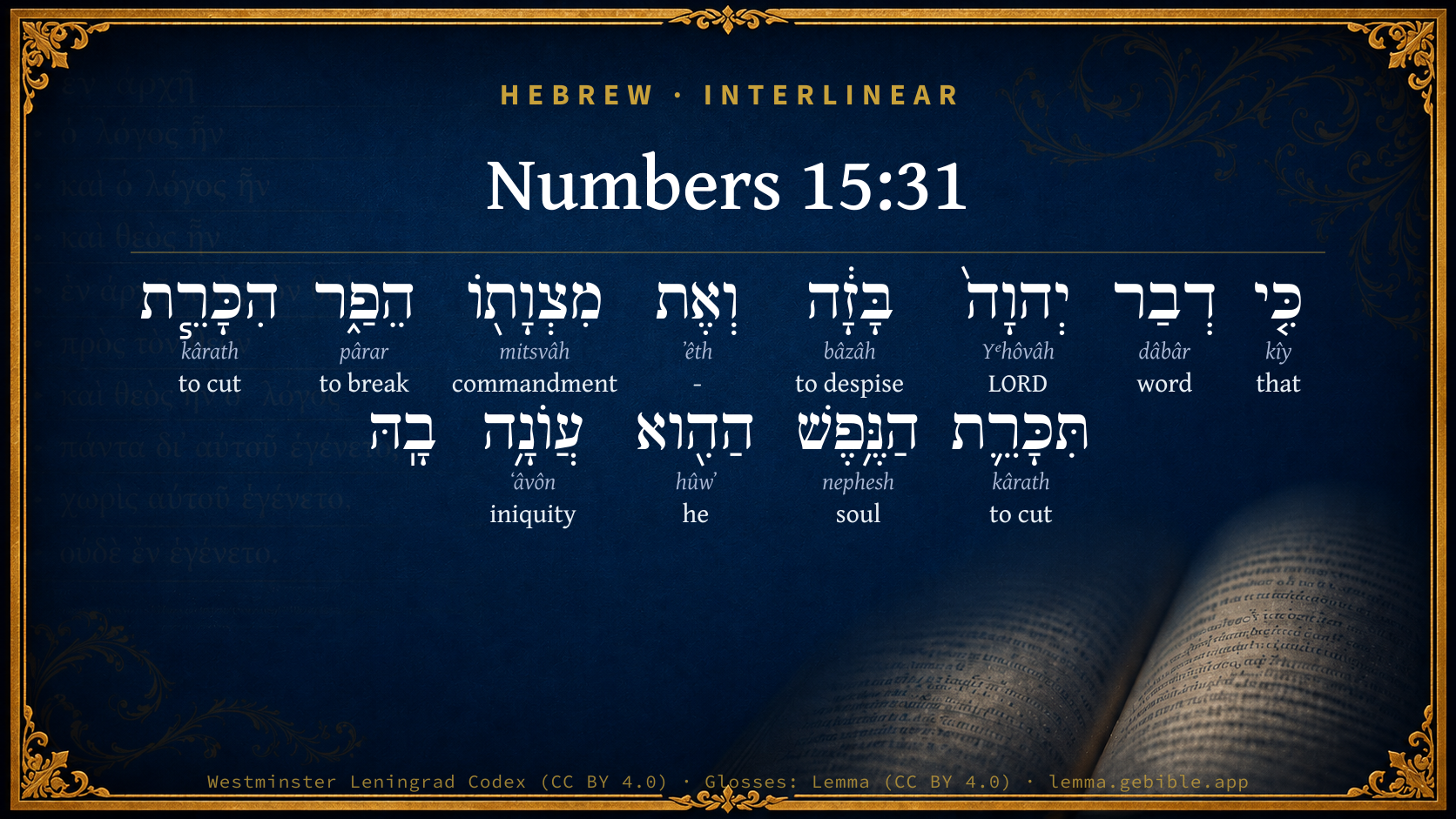
Hebrew (Westminster Leningrad Codex) Numbers 15:31 appears in the Hebrew Old Testament. The text above is from the Westminster Leningrad Codex. Each word links to its Strong’s number, a concise gloss, and parsing drawn from the Open Scriptures Hebrew Bible morphology. Click any word for its full Brown-Driver-Briggs (BDB) entry.
Download image
Cite this verse

Numbers 15:31 (World English Bible). Public Domain. Lemma interlinear Bible study tool, https://lemma.gebible.app/v/numbers/15/31.

Show BibTeX & RIS
BibTeX
RIS
English Translation
Because he has despised the word of Yahweh, and has broken his commandment, that soul shall utterly be cut off; his iniquity shall be on him.
World English Bible · Public Domain
Download a study sheet

One document with this verse’s original text, its word-by-word gloss line, the meaning frame, cross-references with their text, attributed commentary, and full source and license credits — printable, and it pastes into notes with its structure intact.

This verse Autodidact and up

Study sheet (.html) Plain text (.txt)

A passage Seminary Student

Up to 50 verses in one chapter. A passage sheet keeps up to 6 commentary sources and 12 cross-references per verse, in the order this page ranks them, and says so on the sheet whenever that leaves anything out. Ask for a single verse and you get the Autodidact verse sheet above.

Everything on this page stays free to read, with no account — the sheet is a download of what is already on screen, not access to it.

Want to remove ads? Support Godless Engineer
Compare translations 3

The same verse in 3 English versions, stacked beneath the original-language interlinear above. Click any original word for its lexicon entry.

Each is an independent rendering of the whole verse — the interlinear is not word-aligned to these translations.

Highlighted words mark where these versions differ — a whole-verse word diff, not a word-by-word alignment.

  • World English Bible Public Domain
    Because he has despised the word of Yahweh, and has broken his commandment, that soul shall utterly be cut off; his iniquity shall be on him.
  • King James Version Public Domain
    Because he hath despised the word of the LORD, and hath broken his commandment, that soul shall utterly be cut off; his iniquity shall be upon him.
  • unfoldingWord Literal Text CC BY-SA 4.0
    for he despised the word of Yahweh and broke his commandment. Being cut off, that person shall be cut off. His iniquity on him.’”

unfoldingWord Literal Text — © unfoldingWord, licensed CC BY-SA 4.0. Word-aligned USFM3 via Door43 (git.door43.org/unfoldingWord/en_ult).

Versions to compare (up to 4)

3 of 4 selected

Show all 18 translations

Every available English version of this verse, each an independent rendering of the whole verse.

  • World English Bible Public Domain
    Because he has despised the word of Yahweh, and has broken his commandment, that soul shall utterly be cut off; his iniquity shall be on him.
  • Berean Standard Bible Public Domain
    He shall certainly be cut off, because he has despised the word of the LORD and broken His commandment; his guilt remains on him.”
  • Majority Standard Bible Public Domain
    He shall certainly be cut off, because he has despised the word of the LORD and broken His commandment; his guilt remains on him.”
  • King James Version Public Domain
    Because he hath despised the word of the LORD, and hath broken his commandment, that soul shall utterly be cut off; his iniquity shall be upon him.
  • American Standard Version (1901) Public Domain
    Because he hath despised the word of Jehovah, and hath broken his commandment, that soul shall utterly be cut off; his iniquity shall be upon him.
  • Revised Version (1885) Public Domain
    Because he hath despised the word of the LORD, and hath broken his commandment; that soul shall utterly be cut off; his iniquity shall be upon him.
  • Geneva Bible (1599) Public Domain
    Because he hath despised the worde of the Lord, and hath broken his commandement: that person shalbe vtterly cut off: his iniquitie shalbe vpon him.
  • Douay-Rheims (1899) Public Domain
    For he hath contemned the word the Lord, and made void his precept: therefore shall he be destroyed, and shall bear his iniquity.
  • Young's Literal Translation Public Domain
    because the word of Jehovah he despised, and His command hath broken -- that person is certainly cut off; his iniquity `is' on him.'
  • Literal Standard Version CC BY-SA 4.0
    because he despised the word of YHWH and has broken His command, that person is certainly cut off; his iniquity [is] on him.”
  • Unlocked Literal Bible CC BY-SA 4.0
    Because he has despised my word and has broken my commandment, that person must be cut off completely. His sin will be on him.'”
  • unfoldingWord Literal Text CC BY-SA 4.0
    for he despised the word of Yahweh and broke his commandment. Being cut off, that person shall be cut off. His iniquity on him.’”
  • Darby Bible Public Domain
    For he hath despised the word of Jehovah, and hath broken his commandment: that soul shall surely be cut off; his iniquity is upon him.
  • World Messianic Bible Public Domain
    Because he has despised the LORD’s word, and has broken his commandment, that soul shall be utterly cut off. His iniquity shall be on him.’”
  • Webster's Bible Public Domain
    Because he hath despised the word of the LORD, and hath broken his commandment, that soul shall utterly be cut off; his iniquity shall be upon him.
  • Free Bible Version CC BY-SA 4.0
    They have to be expelled, because they have treated the word of the Lord with contempt and broken his commandment. They are responsible for the consequences of their own guilt.’”
  • Bible in Basic English Public Domain
    Because he had no respect for the word of the Lord, and did not keep his law, that man will be cut off without mercy and his sin will be on him.
  • JPS Tanakh (1917) Public Domain
    Because he hath despised the word of the LORD, and hath broken His commandment; that soul shall utterly be cut off, his iniquity shall be upon him.

Literal Standard Version (2020), Covenant Press — licensed CC BY-SA 4.0. Text via the HelloAO Bible API (eBible.org). Unlocked Literal Bible (unfoldingWord) — licensed CC BY-SA 4.0. Text via the HelloAO Bible API (eBible.org). unfoldingWord Literal Text — © unfoldingWord, licensed CC BY-SA 4.0. Word-aligned USFM3 via Door43 (git.door43.org/unfoldingWord/en_ult). Free Bible Version, Dr. Jonathan Gallagher — licensed CC BY-SA 4.0. Text via the HelloAO Bible API (eBible.org).

Word by word

More ways to search: Search by grammar → Find every occurrence → Compare this word →

Practice this passage: Drill this verse → Learn its vocabulary →

בָּזָ֔ה
bâzâh
H959
“to despise”
Verb, Qal, Perfect, 3rd Person, Masculine, Singular
Part of Speech
Verb
Stem
Qal
Form
Perfect
Person
3rd Person
Gender
Masculine
Number
Singular
Full BDB Definition

Origin: a primitive root

TWOT: 224

to despise, hold in contempt, disdain - (Qal) to despise, regard with contempt - (Niphal) - to be despised - to be despicable - to be vile, worthless - (Hiphil) to cause to despise
  1. כִּ֤י kîy H3588 “that” Conjunction
  2. דְבַר dâbâr H1697 “word of” Noun, Common, Masculine, Singular, Construct
  3. יְהוָה֙ Yᵉhôvâh H3068 “LORD” Noun, Proper
  4. וְאֶת ʼêth H853 “and · -” Conjunction + Particle, Direct Object
  5. מִצְוָת֖וֹ mitsvâh H4687 “commandment · his” Noun, Common, Feminine, Singular, Construct + Suffix, Personal, 3rd Person, Masculine, Singular
  6. הֵפַ֑ר pârar H6565 “to break” Verb, Hiphil, Perfect, 3rd Person, Masculine, Singular
  7. הִכָּרֵ֧ת kârath H3772 “to cut” Verb, Niphal, Infinitive Absolute
  8. תִּכָּרֵ֛ת kârath H3772 “to cut” Verb, Niphal, Imperfect, 3rd Person, Feminine, Singular
  9. הַנֶּ֥פֶשׁ nephesh H5315 “the · soul” Particle, Definite Article + Noun, Common, Both, Singular, Absolute
  10. הַהִ֖וא hûwʼ H1931 “the · he” Particle, Definite Article + Pronoun, Personal, 3rd Person, Feminine, Singular
  11. עֲוֺנָ֥ה ʻâvôn H5771 “iniquity · her” Noun, Common, Both, Singular, Construct + Suffix, Personal, 3rd Person, Feminine, Singular

About this verse

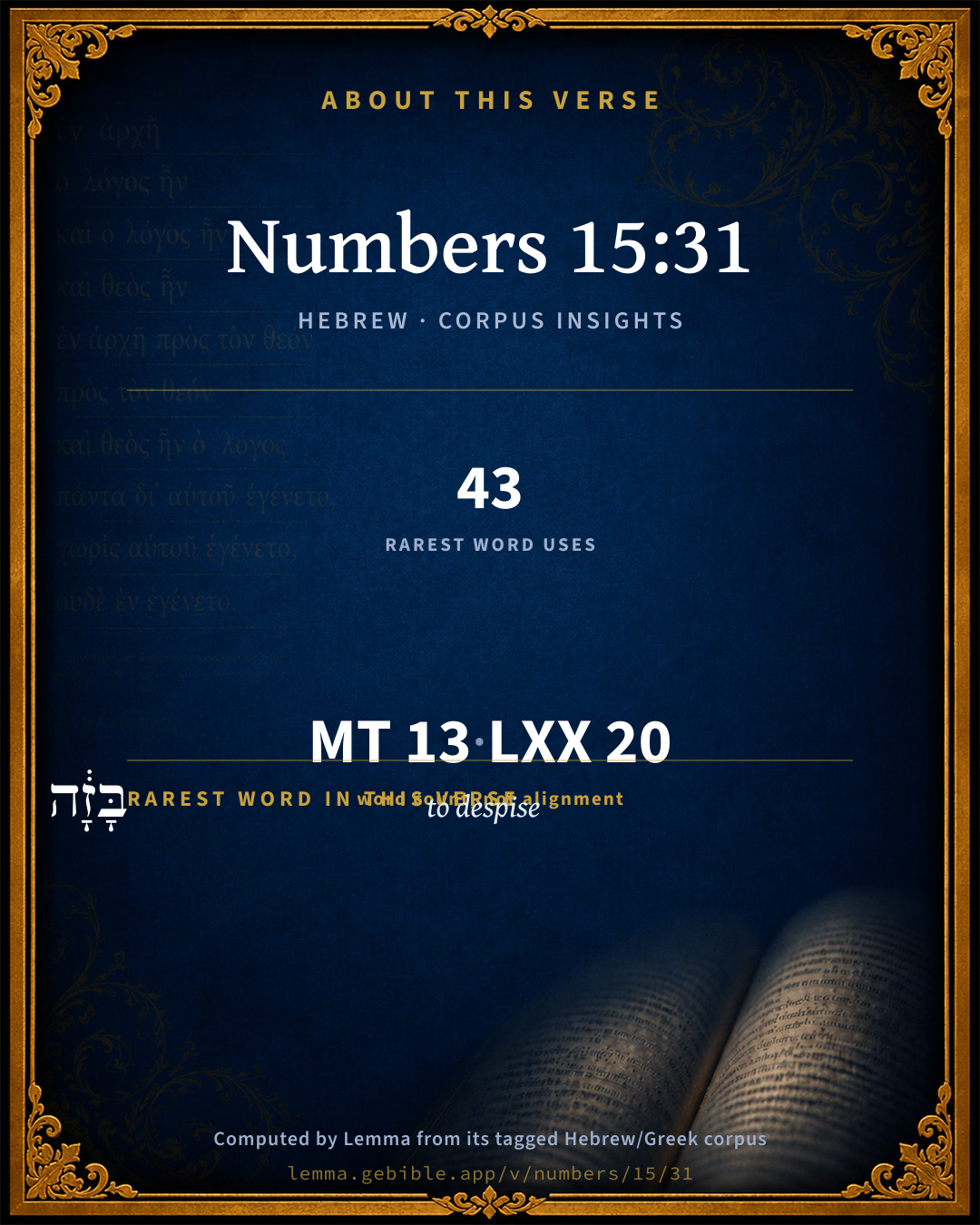
These counts appear in no published source. They are computed here, from the morphology-tagged text and Lemma’s own curated glosses. What Lemma adds →

13
words
11
distinct lemmas
Pentateuch
section

Shared distinctive vocabulary

בָּזָ֔ה to despise H959 occurs in 41 verses of the Hebrew Bible. Also found in:

Grammatical profile

  • 4 verbs
  • 5 nouns
  • 1 pronoun
  • 1 preposition
  • 1 conjunction
  • 1 particle

Verb forms

  • בָּזָ֔ה Qal · Perfect
  • הֵפַ֑ר Hiphil · Perfect
  • הִכָּרֵ֧ת Niphal · Infinitive Absolute
  • תִּכָּרֵ֛ת Niphal · Imperfect

Repetition

A word recurs within this verse — often emphatic in Hebrew:

  • הִכָּרֵ֧ת to cut H3772 ×2

Hebrew & Septuagint length

In English translation the verse runs 26 words from the Hebrew and 26 from the Septuagint (LXX English) — the same length.

A rough comparison of the two English renderings, which tokenize alike — not a word-level alignment.

Word counts can differ between the Hebrew and the Greek without any difference in meaning — e.g. the Hebrew direct-object marker אֵת has no separate Greek word, and Greek often adds the article ὁ.

In the original languages it is 13 Hebrew tokens and 20 Greek tokens — but the two are counted differently (Hebrew bundles its prefixes and suffixes into one token; the Greek is in lemma form), so that isn’t a like-for-like length.

Cross-references

14

Topical passages linked to Numbers 15:31 in the Treasury of Scripture Knowledge — connected by theme and wording, ordered by reader-vote popularity; previews shown in the World English Bible.

  • 2 Samuel 12:9 Why have you despised the word of Yahweh, to do that which is evil in his sight? You have struck Uriah the Hittite with the sword, and have taken his wife to be your wife, and have slain him with the sword of the children of Ammon.
  • Proverbs 13:13 Whoever despises instruction will pay for it, But he who respects a command will be rewarded.
  • Ezekiel 18:20 The soul who sins, he shall die: the son shall not bear the iniquity of the father, neither shall the father bear the iniquity of the son; the righteousness of the righteous shall be on him, and the wickedness of the wicked shall be on him.
  • Leviticus 5:1 "'If anyone sins, in that he hears the voice of adjuration, he being a witness, whether he has seen or known, if he doesn't report it, then he shall bear his iniquity.
  • Psalms 119:126 It is time to act, Yahweh, For they break your law.
  • 1 Thessalonians 4:8 Therefore he who rejects doesn't reject man, but God, who has also given his Holy Spirit to you.
  • Leviticus 26:15 and if you shall reject my statutes, and if your soul abhors my ordinances, so that you will not do all my commandments, but break my covenant;
  • Leviticus 26:43 The land also will be left by them, and will enjoy its sabbaths while it lies desolate without them: and they will accept the punishment of their iniquity; because, even because they rejected my ordinances, and their soul abhorred my statutes.
  • Psalms 38:4 For my iniquities have gone over my head. As a heavy burden, they are too heavy for me.
  • Isaiah 30:12 Therefore thus says the Holy One of Israel, "Because you despise this word, and trust in oppression and perverseness, and rely thereon;
  • Isaiah 53:6 All we like sheep have gone astray; everyone has turned to his own way; and Yahweh has laid on him the iniquity of us all.
  • Hebrews 10:28–29 A man who disregards Moses' law dies without compassion on the word of two or three witnesses.
  • 1 Peter 2:24 who his own self bore our sins in his body on the tree, that we, having died to sins, might live to righteousness; by whose stripes you were healed.
  • 2 Peter 2:21 For it would be better for them not to have known the way of righteousness, than, after knowing it, to turn back from the holy commandment delivered to them.

Cross-references courtesy of OpenBible.info (CC BY 4.0).

Hebrew and Greek witnesses Masoretic Hebrew ↔ Greek Septuagint

The same verse in the two great witnesses to the Old Testament, shown verse-for-verse.

These are two independent witnesses, not word-aligned to each other, and the Septuagint is shown in lemma (dictionary) form.

Hebrew Numbers 15:31 Masoretic · Westminster Leningrad Codex

כִּ֤י דְבַר יְהוָה֙ בָּזָ֔ה וְאֶת מִצְוָת֖וֹ הֵפַ֑ר הִכָּרֵ֧ת תִּכָּרֵ֛ת הַנֶּ֥פֶשׁ הַהִ֖וא עֲוֺנָ֥ה בָֽהּ

Because he has despised the word of Yahweh, and has broken his commandment, that soul shall utterly be cut off; his iniquity shall be on him.

World English Bible · Public Domain

Greek LXX Numbers 15:31 Septuagint · lemma form

ὅτι ὁ ῥῆμα κύριος φαυλίζω καί ὁ ἐντολή αὐτός διασκεδάζω ἐκτρίβω ἐκτρίβω ὁ ψυχή ἐκεῖνος ὁ ἁμαρτία αὐτός ἐν αὐτός

for he has set at nothing the word of the Lord and broken his commands: that soul shall be utterly destroyed, his sin is upon him.

LXX2012 (modern English Septuagint) · Public Domain

Hebrew: Westminster Leningrad Codex (CC BY 4.0). Greek: Septuagint (public domain); English from LXX2012 (modern English Septuagint) (Public Domain). How the Septuagint differs from the Hebrew →

Targum (Aramaic paraphrase)

2

The Targum is the ancient Jewish Aramaic paraphrase of the Hebrew Scriptures — an interpretive translation, not the Hebrew text itself. Onkelos (literal) and Pseudo-Jonathan (expansive) render the Torah, and Jonathan the Prophets. Coverage is partial: where no permissively-licensed English translation exists for a verse, only the Aramaic is shown. This is verse-level text, not a word-by-word alignment to the Hebrew.

  1. Targum Onkelos Torah (Genesis–Deuteronomy)
    אֲרֵי עַל מֵימְרָא דַיְיָ בְּסַר וְיָת פִּקוּדוֹהִי אַשְׁנֵי אִשְׁתֵּצָאָה תִשְׁתֵּצֵי אֲנָשָׁא הַהִיא חוֹבֵיהּ בֵּיהּ

    (no public-domain English translation for this verse)

    Targum Onkelos — Aramaic: “Onkelos Genesis” (public domain); “Onkelos Exodus” (public domain); “Onkelos Leviticus” (public domain); “Onkelos Numbers” (public domain); “Onkelos Deuteronomy” (public domain). English: “Sefaria Community Translation” (CC0 1.0 (public-domain dedication)); “J.W. Etheridge. The Targums of Onkelos and Jonathan Ben Uzziel on the Pentateuch. London: Longmans, Green, 1862” (public domain). Text via Sefaria.

  2. Targum Pseudo-Jonathan Torah (Genesis–Deuteronomy)
    אֲרוּם עַל פִּתְגָמָא קַדְמָאָה דְפַקֵיד יְיָ בְּסִינַי בָּסַר וְיַת תַּפְקִידַת מְהוּלְתָּא בָּטִיל אִישְׁתֵּיצָאָה בְּעַלְמָא הָדֵין יִשְׁתֵּיצֵי בַר נְשָׁא הַהוּא בְּעַלְמָא דְאָתֵי דְעָתִיד לְמִתַּן חוּשְׁבַּן חוֹבָתֵיהּ לְיוֹם דִינָא רַבָּא

    for, the primal word which the Lord commanded on Sinai he hath despised, and hath made the commandment of circumcision vain; with destruction in this world shall that man be destroyed; in the world that cometh shall he give account of his sin at the great day of judgment.

    Targum Pseudo-Jonathan — Aramaic: “Targum Jonathan on Genesis” (public domain); “Targum Jonathan on Exodus” (public domain); “Targum Jonathan on Leviticus” (public domain); “Targum Jonathan on Numbers” (public domain); “Targum Jonathan on Deuteronomy” (public domain). English: “The Targum of Jonathan ben Uzziel, trans. J. W. Etheridge, London, 1862” (public domain). Text via Sefaria.

Commentary

Notes on Numbers 15:31 from classic Christian and Jewish commentators (each source and its license shown beneath its notes). The classic Christian expositions comment on the surrounding passage and are grouped to its opening verse, so a note may address several verses; the Jewish commentaries on the Tanakh (Rashi and others) are per-verse, so they appear only where the commentator wrote on this verse.

Lemma curates 59 commentaries, every one of them public domain or Creative Commons licensed, each selected and text-cleaned for this edition rather than reprinted as found. About our sources →

Trapp's Complete Commentary

John Trapp

Num 15:31 Because he hath despised the word of the LORD, and hath broken his commandment, that soul shall utterly be cut off; his iniquity [shall be] upon him.

Ver. 31. That gathered sticks upon the Sabbath day.] This he did with a high hand, as Num 15:30, in contempt of God and his law. The baser sort of people in Sweden do always break the Sabbath day, saying, that it is only for gentlemen to keep that day. {a} How much better that poor Indian in New England, who, coming by, and seeing one of the English profaning of the Lord’s day, by felling of a tree, said unto him, Do you not know that this is the Lord’s day? Much machet man, i.e., very wicked man, what! break you God’s day? {b} The best and wealthiest of the Jews, to prevent servile work on the Sabbath day, with their own hands chop the herbs, sweep the house, cleave wood, kindle the fire, &c., on the day before. {c}

{a} Mr Abbot’s Sermons.

{b} New England’s Firstfruits, p. 4.

{c} Buxtorf. Synagog.

John Trapp, A Commentary or Exposition upon All the Books of the Old and New Testament (1647–1656) — public domain. Text from a community e-Sword module.

Geneva Bible (1599)

Geneva Bible translators

He shall sustain the punishment of his sin.

Geneva Bible (1599) marginal notes — public domain. Text via Bolls.life.

Jamieson, Fausset & Brown

Robert Jamieson, A. R. Fausset & David Brown

his iniquity shall be upon him--The punishment of his sins shall fall on himself individually; no guilt shall be incurred by the nation, unless there be a criminal carelessness in overlooking the offense.

Jamieson, Fausset & Brown — Commentary Critical and Explanatory on the Whole Bible (1871) — public domain (CC PDM 1.0). Text via the HelloAO Bible API.

The Cambridge Bible for Schools and Colleges

gen. ed. J. J. S. Perowne

31. his iniquity shall be upon him] with his iniquity upon him. The sinner shall be ‘cut off’ (see on Num_9:13) with the burden of his sin still attaching to him, and unatoned for. In the Christian dispensation the one great Sacrifice has procured atonement for all sinners who repent, even though, like the crucified robber, they have sinned with an high hand.

The Cambridge Bible for Schools and Colleges (gen. ed. J. J. S. Perowne; Cambridge University Press, 1878–1918) — public domain. Text from a community e-Sword module.

John Gill's Exposition

And while the children of Israel were in the wilderness,.... According to Aben Ezra, in the wilderness of Sinai; for it is a common notion of the Jews, that though this fact is recorded here, yet was committed the first year the Israelites came out of Egypt, quickly after the giving the law of the sabbath: hence Jarchi remarks, that the Scripture speaks of this to the reproach of the Israelites, that they kept only the first sabbath, and on the second this man came and profaned it; but it seems rather to be in the wilderness of Paran where this fact was committed, after the business of the spies and the discomfiture of Israel, and the above laws were given; and stands here in its proper place as an instance of a presumptuous sinner, cut off from his people, according to the above law, which it immediately follows:

they found a man that gathered sticks on the sabbath day; plucking them up by the roots, as the Targum of Jonathan, as stubble and the like; for the word signifies gathering straw or stubble, or such like light things, as Ben Melech observes, and binding them in bundles for fuel; and this was done on the sabbath day, by which it appears that that was to be kept in the wilderness, though the laws before mentioned concerning sacrifices, and the cake of the first dough, were not to be put in execution until Israel came into the land of Canaan; and according to the Targum of Jonathan this man was of the house of Joseph, and in the Talmud (y) it is expressly said that he was Zelophehad, who was a descendant of Joseph.

(y) T. Bab. Sabbat, fol. 96. 2.

John Gill's Exposition of the Whole Bible (1746–1763) — public domain (CC PDM 1.0). Text via the HelloAO Bible API.

Matthew Poole's English Annotations

i.e. The punishment shall be confined to himself, and not fall upon the congregation, as it will do, if they neglect to cut him off.

Matthew Poole's English Annotations on the Holy Bible (1683–1685) — public domain. Text from a community e-Sword/MySword module.

Whedon's Commentary on the Bible

Daniel D. Whedon

31. Utterly be cut off — See Lev_7:20, note. This excision from the living is a foreshadowing of the capital punishment of all who have rejected Jesus Christ, the Son of God and King of angels and men. See Mat_25:46, note.

His iniquity — The punishment of his iniquity shall be upon him.

Daniel D. Whedon (gen. ed.), Commentary on the Old and New Testaments (1874–1909) — public domain. Text from a community e-Sword module.

The Pulpit Commentary

His iniquity... upon him. Hb hnwO, "its crime upon it," i.e., the sin of that soul must come upon it in punishment.

The Pulpit Commentary (1880–1919), ed. H.D.M. Spence-Jones & Joseph S. Exell — public domain. Text from a community e-Sword module.

Rashi

Rabbi Shlomo Yitzchaki (Rashi)

דבר ה׳ [BECAUSE HE HATH SCORNED] THE WORD OF THE LORD — The prohibition of idolatry (אנכי and לא יהיה לך) the people heard from the mouth of the Lord but all the other commandments from the mouth of Moses (therefore the prohibition of idolatry is called דבר ה׳ “the utterance of the Lord”) (cf. Sifrei Bamidbar 112:2; Sanhedrin 99a).

עונה בה [THAT PERSON SHALL UTTERLY BE CUT OFF] HIS INIQUITY IS UPON HIM — only at the time when (under the circumstances that) his iniquity is upon him shall he be cut off, i.e., in the case that he has not repented (Sanhedrin 90b).

Rashi on the Tanakh — English translations: “The Judaica Press complete Tanach with Rashi, translated by A. J. Rosenberg” (CC BY 4.0); “Pentateuch with Rashi's commentary by M. Rosenbaum and A.M. Silbermann, 1929-1934” (public domain); “The Metsudah Tanach series, Lakewood, N.J” (CC BY 4.0); and “The Book of Joshua, Metsudah Publications, 1997” (CC BY 4.0). Text via Sefaria.

Ramban (Nachmanides)

Rabbi Moshe ben Nachman (Ramban / Nachmanides)

HIS INIQUITY SHALL BE UPON HIM. “This means only as long as his iniquity is upon him, but not after he has repented.” This is Rashi’s language, from the words of our Rabbis. According to the plain meaning of Scripture, this expression [his iniquity shall be upon him] is like: their blood shall be upon them; they shall bear their sin; they shall die childless;, Verse 20. he hath uncovered his sister’s nakedness; he shall bear his iniquity, Verse 17. [the meaning of all these verses being that the guilty have brought the punishment upon themselves]. Now I have seen in the Pirkei Derech Eretz [the following text]: “What is [the meaning of the expression], his iniquity shall be upon him? It teaches us that the soul is cut off, and [yet] its iniquity is upon it.” That is to say, the sin attaches to it [the soul] even after it is cut off, and it is punished in suffering forever, similar to [the verse], for their worm shall not die, neither shall their fire be quenched.

Ramban (Nachmanides) on the Tanakh — English translation: “Commentary on the Torah by Ramban (Nachmanides). Translated and annotated by Charles B. Chavel. New York, Shilo Pub. House, 1971-1976” (CC BY 4.0). Text via Sefaria.

Lesson kit

Teaching starters — assembled from the data on this page, not authored interpretation. Every prompt links to the verse data it draws on. Edit before teaching.

Numbers, in the Pentateuch, opens this verse with 13 words (11 distinct Hebrew lemmas). Its most distinctive word is bâzâh (“to despise”). A historical commentator’s framing appears above. Read the whole chapter for the surrounding context.

Discussion questions

  1. What does “to despise” (bâzâh) contribute to the verse as a whole?
  2. Genesis 25:34 shares the word «to despise» with this verse. How do the two illuminate each other?
  3. “to cut” occurs 2× in this one verse. What is the effect of the repetition?
  4. The translations on this page render this verse differently — a whole-verse word diff, not a word-by-word alignment. What might account for the different wordings?
  5. The verb «בָּזָ֔ה» is Qal Perfect. How does its form color the action?
  6. Reading how Trapp's Complete Commentary and Geneva Bible (1599) read this verse, where do the two commentators agree and where do they part?

Things to notice

Reading settings

Reading text

Shown beneath each verse's original-language words.

Old Testament
Old Testament edition

Read the OT as the Masoretic Hebrew (MT) or the Greek Septuagint (LXX).

English shown for the Greek Septuagint (in the Hebrew ↔ Greek comparison).

Comparing translations? Open the Compare panel on any verse page to stack up to four side by side.