
Jeremiah 34:18

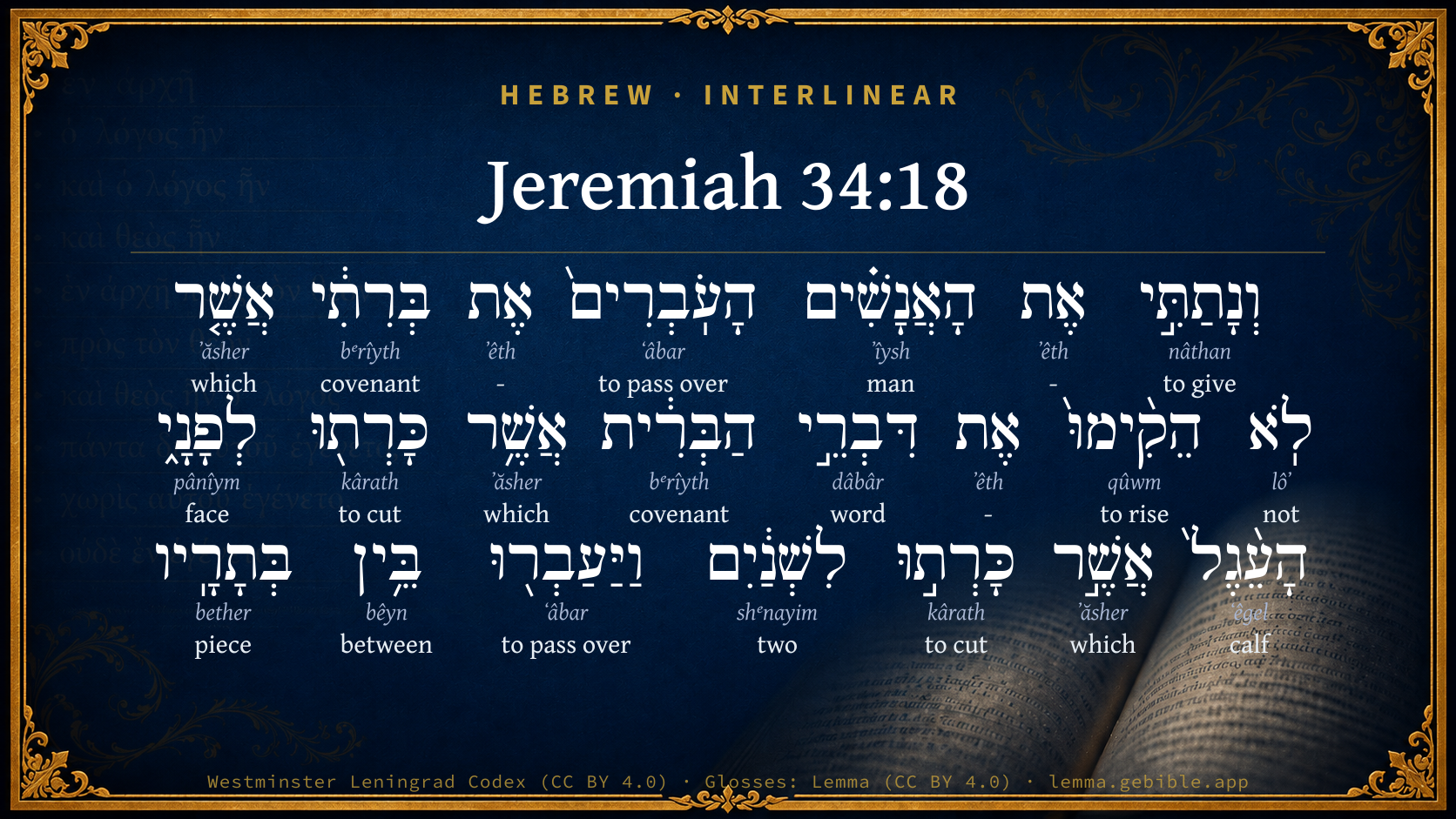
Hebrew (Westminster Leningrad Codex) Jeremiah 34:18 appears in the Hebrew Old Testament. The text above is from the Westminster Leningrad Codex. Each word links to its Strong’s number, a concise gloss, and parsing drawn from the Open Scriptures Hebrew Bible morphology. Click any word for its full Brown-Driver-Briggs (BDB) entry.
Download image
Cite this verse

Jeremiah 34:18 (World English Bible). Public Domain. Lemma interlinear Bible study tool, https://lemma.gebible.app/v/jeremiah/34/18.

Show BibTeX & RIS
BibTeX
RIS
English Translation
I will give the men who have transgressed my covenant, who have not performed the words of the covenant which they made before me, when they cut the calf in two and passed between the parts of it;
World English Bible · Public Domain
Download a study sheet

One document with this verse’s original text, its word-by-word gloss line, the meaning frame, cross-references with their text, attributed commentary, and full source and license credits — printable, and it pastes into notes with its structure intact.

This verse Autodidact and up

Study sheet (.html) Plain text (.txt)

A passage Seminary Student

Up to 50 verses in one chapter. A passage sheet keeps up to 6 commentary sources and 12 cross-references per verse, in the order this page ranks them, and says so on the sheet whenever that leaves anything out. Ask for a single verse and you get the Autodidact verse sheet above.

Everything on this page stays free to read, with no account — the sheet is a download of what is already on screen, not access to it.

Want to remove ads? Support Godless Engineer
Compare translations 3

The same verse in 3 English versions, stacked beneath the original-language interlinear above. Click any original word for its lexicon entry.

Each is an independent rendering of the whole verse — the interlinear is not word-aligned to these translations.

Highlighted words mark where these versions differ — a whole-verse word diff, not a word-by-word alignment.

  • World English Bible Public Domain
    I will give the men who have transgressed my covenant, who have not performed the words of the covenant which they made before me, when they cut the calf in two and passed between the parts of it;
  • King James Version Public Domain
    And I will give the men that have transgressed my covenant, which have not performed the words of the covenant which they had made before me, when they cut the calf in twain, and passed between the parts thereof,
  • unfoldingWord Literal Text CC BY-SA 4.0
    Then I will deal with the people who have broken my covenant, who did not keep the words of the covenant that they established before me when they cut a bull in two and walked between its parts,

unfoldingWord Literal Text — © unfoldingWord, licensed CC BY-SA 4.0. Word-aligned USFM3 via Door43 (git.door43.org/unfoldingWord/en_ult).

Versions to compare (up to 4)

3 of 4 selected

Show all 18 translations

Every available English version of this verse, each an independent rendering of the whole verse.

  • World English Bible Public Domain
    I will give the men who have transgressed my covenant, who have not performed the words of the covenant which they made before me, when they cut the calf in two and passed between the parts of it;
  • Berean Standard Bible Public Domain
    And those who have transgressed My covenant and have not fulfilled the terms of the covenant they made before Me, I will treat like the calf they cut in two in order to pass between its pieces.
  • Majority Standard Bible Public Domain
    And those who have transgressed My covenant and have not fulfilled the terms of the covenant they made before Me, I will treat like the calf they cut in two in order to pass between its pieces.
  • King James Version Public Domain
    And I will give the men that have transgressed my covenant, which have not performed the words of the covenant which they had made before me, when they cut the calf in twain, and passed between the parts thereof,
  • American Standard Version (1901) Public Domain
    And I will give the men that have transgressed my covenant, that have not performed the words of the covenant which they made before me, when they cut the calf in twain and passed between the parts thereof;
  • Revised Version (1885) Public Domain
    And I will give the men that have transgressed my covenant, which have not performed the words of the covenant which they made before me, when they cut the calf in twain and passed between the parts thereof;
  • Geneva Bible (1599) Public Domain
    And I will giue those men that haue broken my couenant, and haue not kept the wordes of the couenant, which they had made before me, when they cut the calfe in twaine, and passed betweene the partes thereof:
  • Douay-Rheims (1899) Public Domain
    And I will give the men that have transgressed my covenant, and have not performed the words of the covenant which they agreed to in my presence, when they cut the calf in two and passed between the parts thereof:
  • Young's Literal Translation Public Domain
    `And I have given the men who are transgressing My covenant, who have not established the words of the covenant that they have made before Me, by the calf, that they have cut in two, and pass through between its pieces --
  • Literal Standard Version CC BY-SA 4.0
    And I have given the men who are transgressing My covenant, who have not established the words of the covenant that they have made before Me, by the calf, that they have cut in two, and pass through between its pieces—
  • Unlocked Literal Bible CC BY-SA 4.0
    Then I will deal with the people who have broken my covenant, who did not keep the words of the covenant that they established before me when they cut a bull in two and walked between its parts,
  • unfoldingWord Literal Text CC BY-SA 4.0
    Then I will deal with the people who have broken my covenant, who did not keep the words of the covenant that they established before me when they cut a bull in two and walked between its parts,
  • Darby Bible Public Domain
    And I will give the men that have transgressed my covenant, who have not performed the words of the covenant which they had made before me, -- the calf which they cut in twain, and passed between the parts thereof,
  • World Messianic Bible Public Domain
    I will give the men who have transgressed my covenant, who have not performed the words of the covenant which they made before me when they cut the calf in two and passed between its parts:
  • Webster's Bible Public Domain
    And I will give the men that have transgressed my covenant, who have not performed the words of the covenant which they had made before me, when they cut the calf in two, and passed between the parts of it,
  • Free Bible Version CC BY-SA 4.0
    They have broken my agreement, and have not kept the terms of the agreement they promised before me. So I'm going to cut them up just like the calf they cut in half to pass between its two pieces.
  • Bible in Basic English Public Domain
    And I will give the men who have gone against my agreement and have not given effect to the words of the agreement which they made before me, when the ox was cut in two and they went between the parts of it,
  • JPS Tanakh (1917) Public Domain
    And I will give the men that have transgressed My covenant, that have not performed the words of the covenant which they made before Me, when they cut the calf in twain and passed between the parts thereof;

Literal Standard Version (2020), Covenant Press — licensed CC BY-SA 4.0. Text via the HelloAO Bible API (eBible.org). Unlocked Literal Bible (unfoldingWord) — licensed CC BY-SA 4.0. Text via the HelloAO Bible API (eBible.org). unfoldingWord Literal Text — © unfoldingWord, licensed CC BY-SA 4.0. Word-aligned USFM3 via Door43 (git.door43.org/unfoldingWord/en_ult). Free Bible Version, Dr. Jonathan Gallagher — licensed CC BY-SA 4.0. Text via the HelloAO Bible API (eBible.org).

Word by word

More ways to search: Search by grammar → Find every occurrence → Compare this word →

Practice this passage: Drill this verse → Learn its vocabulary →

בְּתָרָֽיו
bether
H1335
“pieces · his”
Noun, Common, Masculine, Plural, Construct + Suffix, Personal, 3rd Person, Masculine, Singular
Part of Speech
Noun
Type
Common
Gender
Masculine
Number
Plural
State
Construct
Full BDB Definition

Origin: from H1334

TWOT: 297a

part, piece - of the parts of an animal cut in half for a sacrifice
  1. וְנָתַתִּ֣י nâthan H5414 “and · to give” Conjunction + Verb, Qal, Sequential Perfect, 1st Person, Common, Singular
  2. אֶת ʼêth H853 “-” Particle, Direct Object
  3. הָאֲנָשִׁ֗ים ʼîysh H376 “the · men” Particle, Definite Article + Noun, Common, Masculine, Plural, Absolute
  4. הָעֹֽבְרִים֙ ʻâbar H5674 “the · passing over” Particle, Definite Article + Verb, Qal, Participle Active, Masculine, Plural, Absolute
  5. אֶת ʼêth H853 “-” Particle, Direct Object
  6. בְּרִתִ֔י bᵉrîyth H1285 “covenant · my” Noun, Common, Feminine, Singular, Construct + Suffix, Personal, 1st Person, Common, Singular
  7. אֲשֶׁ֤ר ʼăsher H834 “which” Particle, Relative
  8. לֹֽא lôʼ H3808 “not” Particle, Negative
  9. הֵקִ֨ימוּ֙ qûwm H6965 “to rise” Verb, Hiphil, Perfect, 3rd Person, Common, Plural
  10. אֶת ʼêth H853 “-” Particle, Direct Object
  11. דִּבְרֵ֣י dâbâr H1697 “words of” Noun, Common, Masculine, Plural, Construct
  12. הַבְּרִ֔ית bᵉrîyth H1285 “the · covenant” Particle, Definite Article + Noun, Common, Feminine, Singular, Absolute
  13. אֲשֶׁ֥ר ʼăsher H834 “which” Particle, Relative
  14. כָּרְת֖וּ kârath H3772 “to cut” Verb, Qal, Perfect, 3rd Person, Common, Plural
  15. לְפָנָ֑י pânîym H6440 “to/for · face(s) · my” Preposition + Noun, Common, Both, Plural, Construct + Suffix, Personal, 1st Person, Common, Singular
  16. הָעֵ֨גֶל֙ ʻêgel H5695 “the · calf” Particle, Definite Article + Noun, Common, Masculine, Singular, Absolute
  17. אֲשֶׁ֣ר ʼăsher H834 “which” Particle, Relative
  18. כָּרְת֣וּ kârath H3772 “to cut” Verb, Qal, Perfect, 3rd Person, Common, Plural
  19. לִשְׁנַ֔יִם shᵉnayim H8147 “to/for · two” Preposition + Adjective, Cardinal number, Masculine, Dual, Absolute
  20. וַיַּעַבְר֖וּ ʻâbar H5674 “and · to pass over” Conjunction + Verb, Qal, Sequential Imperfect, 3rd Person, Masculine, Plural
  21. בֵּ֥ין bêyn H996 “between” Preposition

About this verse

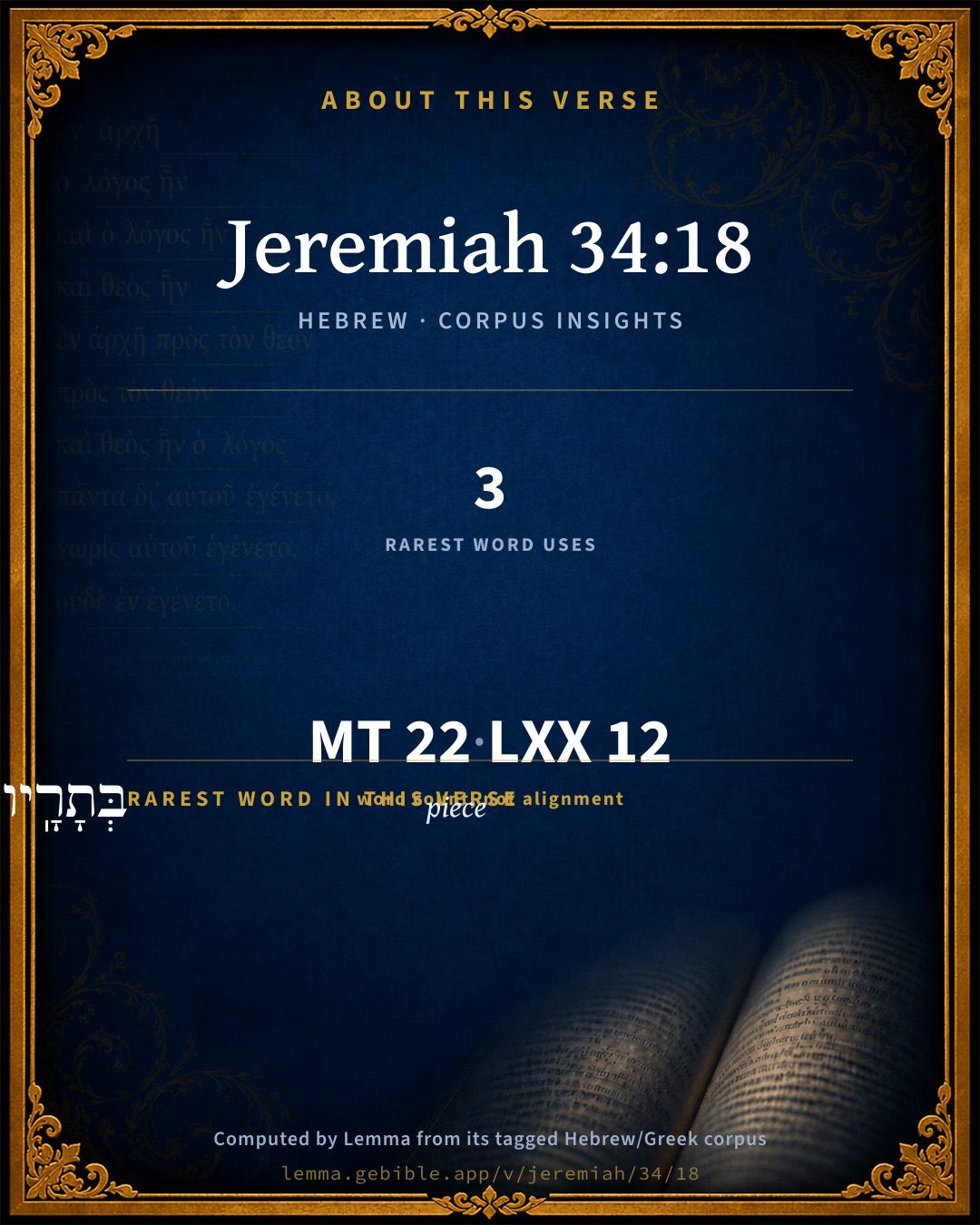
These counts appear in no published source. They are computed here, from the morphology-tagged text and Lemma’s own curated glosses. What Lemma adds →

22
words
15
distinct lemmas
Prophets
section

Notable vocabulary

The rarest word here is בְּתָרָֽיו piece H1335 — appearing just 3 times in the whole Hebrew Bible.

Shared distinctive vocabulary

בְּתָרָֽיו piece H1335 occurs in 3 verses of the Hebrew Bible. Also found in:

Grammatical profile

  • 6 verbs
  • 7 nouns
  • 1 adjective
  • 1 preposition
  • 7 particles

Verb forms

  • וְנָתַתִּ֣י Qal · Sequential Perfect
  • הָעֹֽבְרִים֙ Qal · Participle Active
  • הֵקִ֨ימוּ֙ Hiphil · Perfect
  • כָּרְת֖וּ Qal · Perfect
  • כָּרְת֣וּ Qal · Perfect
  • וַיַּעַבְר֖וּ Qal · Sequential Imperfect

Repetition

Words recur within this verse — often emphatic in Hebrew:

  • הָעֹֽבְרִים֙ to pass over H5674 ×2
  • בְּרִתִ֔י covenant H1285 ×2
  • כָּרְת֖וּ to cut H3772 ×2
  • אֲשֶׁ֤ר which H834 ×3

Hebrew & Septuagint length

In the original languages it is 22 Hebrew tokens and 12 Greek tokens — but the two are counted differently (Hebrew bundles its prefixes and suffixes into one token; the Greek is in lemma form), so that isn’t a like-for-like length.

Cross-references

8

Topical passages linked to Jeremiah 34:18 in the Treasury of Scripture Knowledge — connected by theme and wording, ordered by reader-vote popularity; previews shown in the World English Bible.

  • Genesis 15:10 He took him all these, and divided them in the middle, and laid each half opposite the other; but he didn't divide the birds.
  • Genesis 15:17–18 It came to pass that, when the sun went down, and it was dark, behold, a smoking furnace, and a flaming torch passed between these pieces.
  • Deuteronomy 17:2 If there be found in the midst of you, within any of your gates which Yahweh your God gives you, man or woman, who does that which is evil in the sight of Yahweh your God, in transgressing his covenant,
  • Joshua 23:16 When you disobey the covenant of Yahweh your God, which he commanded you, and go and serve other gods, and bow down yourselves to them; then will the anger of Yahweh be kindled against you, and you shall perish quickly from off the good land which he has given to you.
  • Psalms 50:1 The Mighty One, God, Yahweh, speaks, And calls the earth from sunrise to sunset.
  • Hosea 6:7 But they, like Adam, have broken the covenant. They were unfaithful to me, there.
  • Hosea 8:1 "Put the trumpet to your lips! Something like an eagle is over Yahweh's house, Because they have broken my covenant, And rebelled against my law.
  • Joshua 7:11 Israel has sinned; yes, they have even transgressed my covenant which I commanded them: yes, they have even taken of the devoted thing, and have also stolen, and dissembled also; and they have even put it among their own stuff.

Cross-references courtesy of OpenBible.info (CC BY 4.0).

Hebrew and Greek witnesses Masoretic Hebrew ↔ Greek Septuagint

The same verse in the two great witnesses to the Old Testament, shown verse-for-verse.

These are two independent witnesses, not word-aligned to each other, and the Septuagint is shown in lemma (dictionary) form.

Hebrew Jeremiah 34:18 Masoretic · Westminster Leningrad Codex

וְנָתַתִּ֣י אֶת הָאֲנָשִׁ֗ים הָעֹֽבְרִים֙ אֶת בְּרִתִ֔י אֲשֶׁ֤ר לֹֽא הֵקִ֨ימוּ֙ אֶת דִּבְרֵ֣י הַבְּרִ֔ית אֲשֶׁ֥ר כָּרְת֖וּ לְפָנָ֑י הָעֵ֨גֶל֙ אֲשֶׁ֣ר כָּרְת֣וּ לִשְׁנַ֔יִם וַיַּעַבְר֖וּ בֵּ֥ין בְּתָרָֽיו

I will give the men who have transgressed my covenant, who have not performed the words of the covenant which they made before me, when they cut the calf in two and passed between the parts of it;

World English Bible · Public Domain

Greek LXX Structure differs

In the Septuagint, Jeremiah is about an eighth shorter than the Hebrew and arranges its material differently — the Oracles Against the Nations (Hebrew chapters 46–51) appear in the middle of the Greek book, after 25:13. Because the chapter and verse boundaries do not line up, a verse-for-verse comparison with the Hebrew is not shown.

A verse-for-verse comparison isn’t shown here because the chapters and verses don’t line up. Switch to the LXX edition with the MT / LXX toggle above to read the Greek directly.

Hebrew: Westminster Leningrad Codex (CC BY 4.0). Greek: Septuagint (public domain); English from a public-domain English Septuagint. How the Septuagint differs from the Hebrew →

Targum (Aramaic paraphrase)

1

The Targum is the ancient Jewish Aramaic paraphrase of the Hebrew Scriptures — an interpretive translation, not the Hebrew text itself. Onkelos (literal) and Pseudo-Jonathan (expansive) render the Torah, and Jonathan the Prophets. Coverage is partial: where no permissively-licensed English translation exists for a verse, only the Aramaic is shown. This is verse-level text, not a word-by-word alignment to the Hebrew.

  1. Targum Jonathan Prophets (Joshua–Malachi)
    וְאֶתֵּן יַת גַבְרַיָא דַעֲבָרוּ עַל קְיָמִי דְלָא קַיִמוּ יַת פִּתְגָמֵי קְיָמָא דִגְזָרוּ קֳדָמַי עִגְלָא דִפְסָקוּ לִתְרֵין וַעֲבָרוּ בֵּין פַּלְגוֹהִי:

    (no public-domain English translation for this verse)

    Targum Jonathan — Aramaic: “Mikraot Gedolot” (public domain). English: “Sefaria Community Translation” (CC0 1.0 (public-domain dedication)); “London "Chaldee Paraphrase," 1871” (public domain). Text via Sefaria.

Commentary

Notes on Jeremiah 34:18 from classic Christian and Jewish commentators (each source and its license shown beneath its notes). The classic Christian expositions comment on the surrounding passage and are grouped to its opening verse, so a note may address several verses; the Jewish commentaries on the Tanakh (Rashi and others) are per-verse, so they appear only where the commentator wrote on this verse.

Lemma curates 59 commentaries, every one of them public domain or Creative Commons licensed, each selected and text-cleaned for this edition rather than reprinted as found. About our sources →

Trapp's Complete Commentary

John Trapp

Jer 34:18 And I will give the men that have transgressed my covenant, which have not performed the words of the covenant which they had made before me, when they cut the calf in twain, and passed between the parts thereof,

Ver. 18. That have transgressed my covenant.] His covenant he calleth it by a weighty emphasis, because about a business by him commanded, and wherein he was engaged, not as a bare spectator, but as a severe avenger of their perjury.

When they cut the calf in twain.] To show the correspondence of wills whereunto the contractors did bind themselves, and the punishment of dissection or other violent death whereunto they submitted themselves, in case they broke promise. The rise of this rite in covenanting, see Gen 15:9-10; Gen 15:17. The heathens {a} used the like ceremony, {b} as is to be seen in Homer, Cicero, Livy, Virgil:

“ Et caesa iungebant faedera porea. ”

The Romans cut a sow in twain; and when it was divided, the Faeciales or heralds gave one half to one party, and the other half to the other, and said, So God divide you asunder if you break this covenant; and let God do this so much the more as he is more able.

{a} Hom. Il., lib. iii; Tul. de Invent.; Liv., lib. i.; Virg. Aeneid, 8.

{b} Hinc faedus a faedo animali diviso.

John Trapp, A Commentary or Exposition upon All the Books of the Old and New Testament (1647–1656) — public domain. Text from a community e-Sword module.

Matthew Poole's English Annotations

This was a ceremony which they used in making of covenants, not without something of a warrant from a Divine precedent, Gen 15:9,10; it is said, Jer 34:18, that same day the Lord made a covenant with Abraham (that covenant was a promise that Abraham’s seed should possess the land of Canaan). Gen 15:8. Abraham said unto God, Whereby shall I know that I shall inherit it? Gen 15:9, God bids him take an heifer of three years old, and a she goat of three years old, and a ram of three years old, &c. Gen 15:10, it is said, that he took them, and divided them in the midst, and laid each piece one against another. Indeed we read nothing there of the parties covenanting passing betwixt the parts of the beasts so divided, but this was afterwards used in making covenants betwixt men, which had in it a secret imprecation or wishing that they might be cut in pieces like those beasts, if they did not keep the covenants which they made. It should seem that these Jews, in the making of their solemn promise or covenant with God about releasing their servants, used this rite; they caused a calf or heifer to be cut in pieces, and the parts to be laid in the temple right over against one another, then they recited this covenant, and in the way of a solemn promise, or confirmation of their resolution to make their promise good, they passed betwixt the parts of the calf or heifer so cut; silently agreeing that God should cut them in pieces like that beast if they did not make their words good. Hence is the Hebrew phrase of cutting a covenant, for making it. This was a ceremony ordinarily used also amongst the heathens, as we are informed by Cicero, Livy, and others.

Matthew Poole's English Annotations on the Holy Bible (1683–1685) — public domain. Text from a community e-Sword/MySword module.

Joseph Benson's Commentary

Jer 34:18. When they cut the calf in twain, and passed between the parts — In order to ratify the covenant, they killed a calf, or young bullock, which they cut in two, and placing the two parts at some distance from each other, they passed between them; signifying by this rite that they consented to be served in the like manner, in case they violated their part of the covenant. We learn from the Holy Scriptures, and from heathen authors, that the same or similar ceremonies were in use in making and ratifying covenants and treaties in ancient times. In this way Abraham’s covenant with God was confirmed, Gen 15:10. And, according to Livy, lib. 1. cap. 24; and lib. 21. cap. 45, rites of a similar kind were in use among the old Romans; as we find from Homer they were also among the Greeks. Thus he tells us, when they had entered into a solemn agreement with the Trojans to put an end to the war, by the single combat of Paris and Menelaus, at the pouring out of their wine upon their sacrifice, they made the following imprecation upon those who should not observe their part of the treaty, Iliad, 3. l, 298.

Οπποτεροι προτεροι υπερ ορκια πημηνειαν,

Ωδε σφ’ εγκεφαλος χαμαδις ρεοι, ως οδε οινος.

“So may their blood who first the league confound. Shed, like this wine, distain the thirsty ground.” POPE.

Joseph Benson's Commentary on the Old and New Testaments (1811–1818) — public domain. Text from a community e-Sword module.

Geneva Bible (1599)

Geneva Bible translators

As touching this manner of solemn covenant which the ancients used by passing between the two parts of a beast, to signify that the transgressor of the same covenant should be so divided in pieces, read Gen. 15:10.

Geneva Bible (1599) marginal notes — public domain. Text via Bolls.life.

Jamieson, Fausset & Brown

Robert Jamieson, A. R. Fausset & David Brown

passed between the parts thereof--The contracting parties in the "covenant" (not here the law in general, but their covenant made before God in His house to emancipate their slaves, Jer 34:8-9) passed through the parts of the animal cut in two, implying that they prayed so to be cut in sunder (Mat 24:51; Greek, "cut in two") if they should break the covenant (Gen 15:10, Gen 15:17).

Jamieson, Fausset & Brown — Commentary Critical and Explanatory on the Whole Bible (1871) — public domain (CC PDM 1.0). Text via the HelloAO Bible API.

Adam Clarke's Commentary

Verse 18. When they cut the calf in twain, and passed between the parts thereof] This was the ancient and most solemn way of making a covenant.

1. A calf as sacrifice was offered to God to secure his approbation and support.

2. The victim was then exactly divided from the nose to the rump; the spinal marrow being divided longitudinally, in the most careful manner, that the half of it might remain on each side.

3. These divided parts were laid opposite to each other, a passage being left between them.

4. The contracting parties entered this passage at each end, met in the middle, and there took the covenant oath; adjudging themselves to death should they break this covenant.

5. Then they both feasted on the victim. In reference to this last circumstance, God says he will give their bodies for meat to the fowls of heaven and to the beasts. This is a farther conformity between the crime and the punishment. See my notes on Ge 15:9-17.

Adam Clarke's Commentary on the Bible (1810–1826) — public domain. Text from a community e-Sword/MySword module.

John Calvin's Commentaries

He pursues the same subject, — that perjury would not be unpunished. But here is described the manner of making an oath, even that they cut a calf into two parts, and passed between these parts Now we know that this was the custom in the time of Abraham, for it is said that he offered a sacrifice to God as a symbol of the covenant, and cut the victim, and passed between the parts. Historians also relate that the Macedonians in mustering an army observed the same ceremony; and it was probably a custom which prevailed among all nations. When the Romans made a covenant, they sacrificed a sow; they did not divide it into parts, but killed it with a stone; and this was the form of execration, — “So may Jupiter smite him who will violate this covenant; if I violate this covenant, may Jupiter thus smite me, as I now kill this sow.” But we see that among the Orientals, the victims were cut in two, and there was another form of execration, even that he might be thus cut asunder, who unjustly and in bad faith violated the given promise or engagement.

It is to this custom the Prophet refers here, and says, I will give the men who have transgressed my covenant, which they made before me by the calf which they cut into two parts, and passed between the parts, etc. But God assigns a reason why he resolved to inflict so dreadful punishment on perjury: he said before, that his name was profaned, and now he adds, that his covenant was violated. He does not speak here of the Law; the covenant of God is called the law for the most part in Scripture; but Jeremiah takes it here in a different sense, even the covenant in which God’s name was interposed, or what was sanctioned by an appeal to God, as by way of excellence, marriage is called by Solomon the covenant of God, because it is the principal contract among men. But as the Jews had promised in God’s presence that they were ready to obey, when Jeremiah commanded the servants to be made free, and as the agreement was confirmed by a solemn rite, hence the promise given to men is said to be the covenant of God, even on account of the sanction which we have mentioned.

Let us then remember, that whenever we perform not what we have pledged, not only wrong is done to men, but also to God himself, and that it is a sacrilege, and what is much more atrocious than theft, or fraud, or cruelty. Let us, therefore, learn from this passage to act in good faith, especially when the name of God is invoked, when he is appealed to as a witness and judge.

He adds afterwards, that they had transgressed his covenant; and he immediately explains himself, because they have not confirmed the words of the covenant which they had made before him. To confirm or establish the words, was to persevere in what they had promised. For the Jews gave a proof of humanity for a short time; but it was a mere falacious show and pretense. It was for this reason, then, that the Prophet says that they had not confirmed or ratified the words of the covenant which they had made Then follows the outward ceremony, the calf which they had cut into two parts; and they passed between them, in order that this very passing might produce a deep impression on their hearts, and make them dread the violation of their faith. For we know that external signs are intended for this end, — that men may be kept awake, who would otherwise be tardy and slothful. The same also is the use of sacred symbols, by which God intends to touch and move all our senses. It hence appears how great must have been the insensibility of the people, when they afterwards disregarded that awful protest, for they had passed between the parts, and imprecated such a death on themselves if they failed in what they promised. They afterwards hesitated not to violate their promise. We hence see that they were under the power of a diabolical madness, when they disregarded God’s judgment.

John Calvin's Commentaries (1540-1563) — public domain. Text from the Calvin Translation Society English edition (1840s-50s) via the Christian Classics Ethereal Library (ccel.org). Calvin's coverage is partial (roughly two-thirds of the Bible); uncommented books and verses are honest gaps, never fabricated. The 19th-century editor's footnotes and remarks are omitted so the notes are faithfully Calvin's own voice.

Ellicott's Commentary for English Readers

(18) When they cut the calf in twain . . .—The passage is interesting, as showing the survival of one of the oldest rites of Patriarchal times. So, when Jehovah made a covenant with Abraham, the victims that had been slain were cut up and arranged opposite each other, and when the “burning lamp” passed between the pieces it was the token that Jehovah had completed the covenant, even as men complete it (Gen_15:10-17). The implied thought thus symbolised was that the parties to the contract prayed, as in the analogous case of 1Sa_11:7, that they might be torn limb from limb like the victims if they broke the covenant, The antiquity and wide extent of the symbolism is shown by its appearing in the ritual of Greece, as in the phrase ὅρκια τέμνον —to ratify (literally, to cut) oaths, in Homer (Iliad, ii. 124, Od. xxiv. 483, and elsewhere), and the Latin fœdus ferire. In Livy (i. 24) we have both the phrase, the act which it implied, and the prayer which accompanied it, that if the Roman people proved unfaithful to their covenant Jupiter would slay them as the priest slew the victim. “Tu illo die, Jupiter, populum Romanum sic ferito, ut ego hunc porcum hic hodie feriam, tantoque magis ferito, quanto magis potes pollesque.” (“Do thou, Jupiter, on that day so smite the Roman people [if they break the covenant] as I this day smite this swine—yea, so much the more smite them as thou art mightier and more prevailing.”)

A Bible Commentary for English Readers, edited by Charles John Ellicott (1878–1897) — public domain. Text from a community e-Sword module.

The Cambridge Bible for Schools and Colleges

gen. ed. J. J. S. Perowne

18. when they cut the calf in twain] This rendering, which simplifies the construction, is obtained from the literal Heb. as given in mg. by transposing two words of the clause in the original. See Gen_15:10 for a ceremony of this kind as attendant upon a covenant. Its significance is probably that “the parties to the covenant are united by being taken within the life of the same sacred victim.” Pe., who compares the eating of the same sacrifice by the two parties to a covenant.

The Cambridge Bible for Schools and Colleges (gen. ed. J. J. S. Perowne; Cambridge University Press, 1878–1918) — public domain. Text from a community e-Sword module.

John Gill's Exposition

And I will give the men that have transgressed my covenant,.... The covenant the king, princes, and all the people made, to let their servants go free, is called the Lord's covenant, because made in his name, in his presence, and before him as a witness; and very probably the calf that was cut in pieces on this occasion, after mentioned, was sacrificed to him, which made him a party concerned; unless this is to be understood of the covenant of God in general made with Israel on Mount Sinai; and so is distinct from the other covenant, which may be more especially designed in the next clause:

which have not performed the words of the covenant made before me; did not perform what they promised to do in the presence of the Lord, as in Jer 34:15;

when they cut the calf in twain, and passed between the parts thereof; which was a rite or custom used in making and confirming covenants; a calf, or some other creature, were cut in pieces, and the parts laid in order, and the covenantees passed between these parts; signifying thereby, that if they did not fulfil the engagements they entered into, they imprecated to be cut to pieces as that creature was. Some footsteps of this practice are to be seen as early as the times of Abraham, Gen 15:9; upon which place Jarchi observes, that it was the way of making a covenant to divide a beast, and pass between the parts of it; and this custom obtained among the Chaldeans, Greeks, and Romans; or what was very similar to it. Cyril (u) says this custom was by the Chaldeans, who might take it from Abraham. A people called Molotti had something of this kind among them: for they confirmed the covenants they swore to by cutting oxen into little pieces (w); and Homer seems to have a respect to such a practice when he says that the priest, after he had prayed to Apollo, slew the sacrifice, and flayed it, and cut it in pieces, making duplicates (x), alike to one another. Cicero (y) is thought to have the same custom in view; and likewise Virgil (z), when he speaks of the covenant made between Romulus and Tatius king of the Sabines, whom he represents as standing armed before the altar of Jupiter, holding caps, and joining in covenant by killing a swine, and cutting it in pieces; in like manner Livy (a) describes the covenant made between the Romans and Albanians, when the herald at arms, reciting the conditions, called aloud

""hear, O Jupiter", &c.''

if the Roman people first fail in observing these,

"strike them as I now strike this hog; and so much the more, as thou art more able and mighty;''

which being said, he struck it with a flint stone; hence the phrase, "ferire foedus", to strike or make a covenant; and, in allusion to the above custom, making a covenant is commonly called, in the Old Testament, "cutting a covenant". Some versions, as the Syriac interpreter, render it, "I will make the men as the calf they cut in twain", &c. they shall be cut in pieces as that is; see Mat 24:51.

(u) Contra Julian, l. 10. apud Grotium in Gen. xv. 17. (w) Zenobius apud 10. (x) ' ------ , ' ' . Iliad 1. v. 461, 462. (y) De Inventione, l. 2. sect. 20. (z) "Armati Jovis ante aram, paterasque tenentes Stabant, et caesa jungebant foedera porea". Aeneid. l. 8. (a) Hist. l. 1. p. 14.

John Gill's Exposition of the Whole Bible (1746–1763) — public domain (CC PDM 1.0). Text via the HelloAO Bible API.

Haydock's Catholic Bible Commentary

Parts. This was done to signify that if they transgressed, they consented to be slain, Genesis xv. 9, 17. It seems Sedecias and his subjects had solemnly ratified the covenant made at Sinai, being impressed with fear of the enemy.

George Leo Haydock (1774–1849), Haydock's Catholic Family Bible and Commentary, 1859 edition — public domain. Excludes Psalms (Douay-Rheims chapter numbering differs from Protestant) and Deuterocanonical books (Catholic canon only).

Whedon's Commentary on the Bible

Daniel D. Whedon

18. Passed between the parts thereof — The construction of the latter part of this verse is difficult. The following are the two leading constructions proposed. I will make the men like the calf which they cut in two. (Keil.) The words of the covenant… even of the calf, etc. (Ewald, Smith, et.al.) In the former the men are identified with or likened to the calf; in the latter, the calf and the covenant are used as synonymes. The last gives the most satisfactory sense, but the Hebrew construction with difficulty admits of it. The contracting parties passed between the parts of the animal cut in two, implying an imprecation upon themselves, so to be cut in sunder should they fail to keep the covenant. In the New Testament “cut him asunder” (Mat_24:51) may possibly retain a shadow of this meaning. We find God himself conforming to this usage in Gen_15:9, etc.

Daniel D. Whedon (gen. ed.), Commentary on the Old and New Testaments (1874–1909) — public domain. Text from a community e-Sword module.

The Pulpit Commentary

When they out the calf in twain, etc. This clause should be translated differently, and placed, for clearness, in a parenthesis (the calf which they cut in twain, and between the parts of which they passed). The division of the calf might, in fact, be called in Hebrew either "the covenant" or "the token of the covenant". (comp. Gen_17:10, Gen_17:11) It was a solemn assurance that he who should transgress God"s Law should share the same fate as the victim. The same idea seems to have dictated the Hebrew phrase, "to cut a covenant," and the Greek and Latin equivalents (orkia temnein : foedus icere); comp. the parallel narrative in Gen_15:10.

The Pulpit Commentary (1880–1919), ed. H.D.M. Spence-Jones & Joseph S. Exell — public domain. Text from a community e-Sword module.

John Wesley's Explanatory Notes

Cut the calf - It seems these Jews in their making of the solemn covenant with God about releasing their servants used this rite; they caused a calf, or heifer to be cut in pieces, and the parts to be laid in the temple, right over-against one another; then they recited this covenant, and passed between the parts of the heifer so cut; silently agreeing that God should cut them in pieces like that beast if they did not make their words good.

John Wesley, Explanatory Notes Upon the Whole Bible (1754–1765) — public domain. Text via the GEBible commentary corpus.

Rashi

Rabbi Shlomo Yitzchaki (Rashi)

when they cut the calf in two Whey they returned and forced them to be slaves, they all made a covenant to rebel against the Omnipresent and cut a calf in two and passed between its parts to rebel against Him, and that was a strong covenant and a final one, saying, So shall the one who transgresses be cut and divided.

Rashi on the Tanakh — English translations: “The Judaica Press complete Tanach with Rashi, translated by A. J. Rosenberg” (CC BY 4.0); “Pentateuch with Rashi's commentary by M. Rosenbaum and A.M. Silbermann, 1929-1934” (public domain); “The Metsudah Tanach series, Lakewood, N.J” (CC BY 4.0); and “The Book of Joshua, Metsudah Publications, 1997” (CC BY 4.0). Text via Sefaria.

Lesson kit

Teaching starters — assembled from the data on this page, not authored interpretation. Every prompt links to the verse data it draws on. Edit before teaching.

Jeremiah, in the Prophets, opens this verse with 22 words (15 distinct Hebrew lemmas). Its most distinctive word is bether (“piece”). A historical commentator’s framing appears above. Read the whole chapter for the surrounding context.

Discussion questions

  1. How does “piece” (bether) shape what this verse is saying?
  2. How does Genesis 15:10, which shares the word «piece», read alongside this verse?
  3. What does the repetition of “to pass over” (2× in this one verse) do in this verse?
  4. The translations on this page render this verse differently — a whole-verse word diff, not a word-by-word alignment. What might account for the different wordings?
  5. «וְנָתַתִּ֣י» is a Qal Sequential Perfect verb. How does that grammatical form shape the action described?
  6. Compare how Trapp's Complete Commentary and Matthew Poole's English Annotations read this verse. Where do they agree or differ?

Things to notice

Reading settings

Reading text

Shown beneath each verse's original-language words.

Old Testament
Old Testament edition

Read the OT as the Masoretic Hebrew (MT) or the Greek Septuagint (LXX).

English shown for the Greek Septuagint (in the Hebrew ↔ Greek comparison).

Comparing translations? Open the Compare panel on any verse page to stack up to four side by side.