
Hosea 8:4

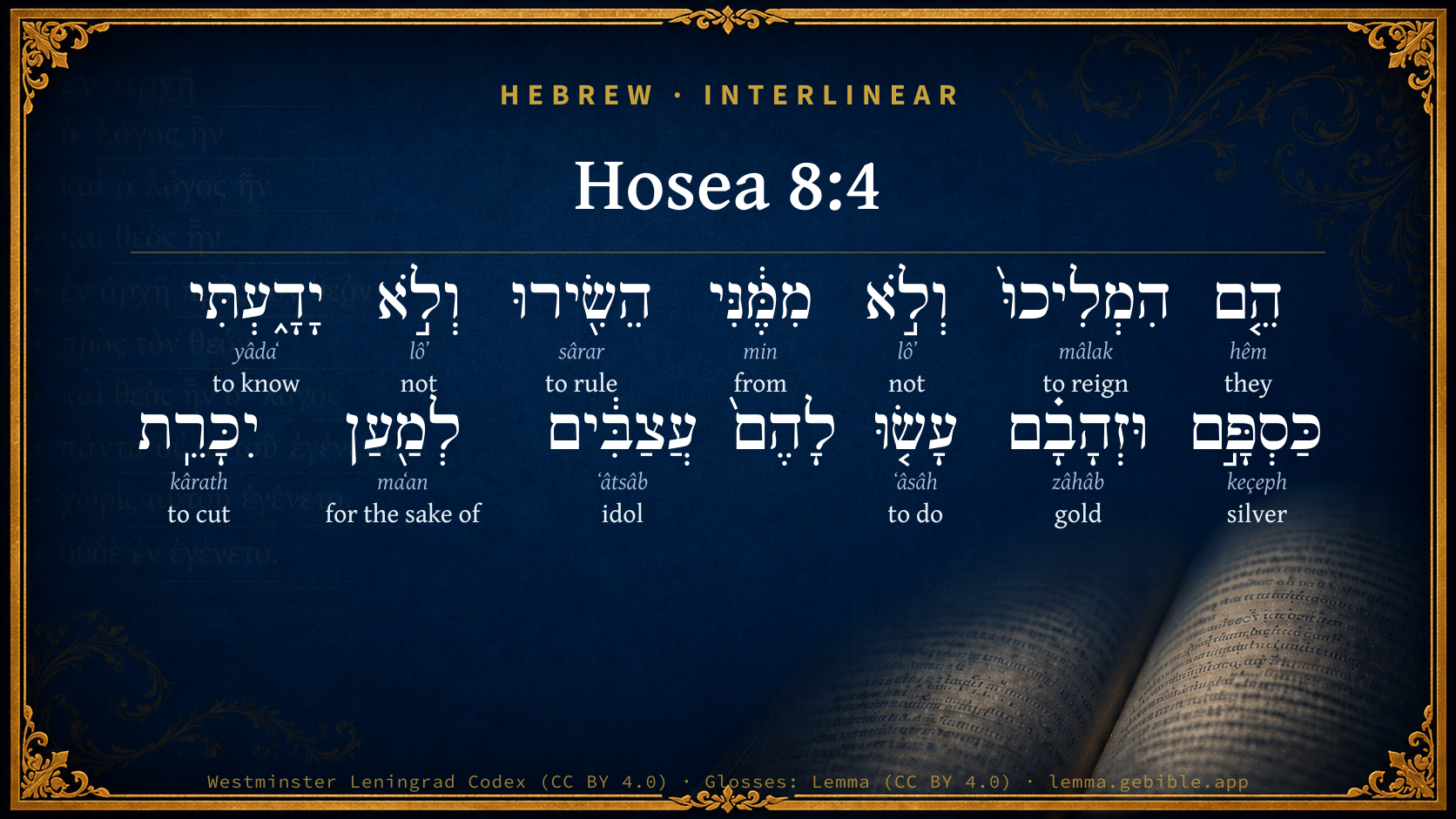
Hebrew (Westminster Leningrad Codex) Hosea 8:4 appears in the Hebrew Old Testament. The text above is from the Westminster Leningrad Codex. Each word links to its Strong’s number, a concise gloss, and parsing drawn from the Open Scriptures Hebrew Bible morphology. Click any word for its full Brown-Driver-Briggs (BDB) entry.
Download image
Cite this verse

Hosea 8:4 (World English Bible). Public Domain. Lemma interlinear Bible study tool, https://lemma.gebible.app/v/hosea/8/4.

Show BibTeX & RIS
BibTeX
RIS
English Translation
They have set up kings, but not by me. They have made princes, and I didn't approve. Of their silver and their gold they have made themselves idols, That they may be cut off.
World English Bible · Public Domain
Download a study sheet

One document with this verse’s original text, its word-by-word gloss line, the meaning frame, cross-references with their text, attributed commentary, and full source and license credits — printable, and it pastes into notes with its structure intact.

This verse Autodidact and up

Study sheet (.html) Plain text (.txt)

A passage Seminary Student

Up to 50 verses in one chapter. A passage sheet keeps up to 6 commentary sources and 12 cross-references per verse, in the order this page ranks them, and says so on the sheet whenever that leaves anything out. Ask for a single verse and you get the Autodidact verse sheet above.

Everything on this page stays free to read, with no account — the sheet is a download of what is already on screen, not access to it.

Want to remove ads? Support Godless Engineer
Compare translations 3

The same verse in 3 English versions, stacked beneath the original-language interlinear above. Click any original word for its lexicon entry.

Each is an independent rendering of the whole verse — the interlinear is not word-aligned to these translations.

Highlighted words mark where these versions differ — a whole-verse word diff, not a word-by-word alignment.

  • World English Bible Public Domain
    They have set up kings, but not by me. They have made princes, and I didn't approve. Of their silver and their gold they have made themselves idols, That they may be cut off.
  • King James Version Public Domain
    They have set up kings, but not by me: they have made princes, and I knew it not: of their silver and their gold have they made them idols, that they may be cut off.
  • unfoldingWord Literal Text CC BY-SA 4.0
    They, they have made kings, but not from me. They have appointed princes, but I did not know. Their silver and their gold they have made for themselves idols, so that he might be cut off.

unfoldingWord Literal Text — © unfoldingWord, licensed CC BY-SA 4.0. Word-aligned USFM3 via Door43 (git.door43.org/unfoldingWord/en_ult).

Versions to compare (up to 4)

3 of 4 selected

Show all 18 translations

Every available English version of this verse, each an independent rendering of the whole verse.

  • World English Bible Public Domain
    They have set up kings, but not by me. They have made princes, and I didn't approve. Of their silver and their gold they have made themselves idols, That they may be cut off.
  • Berean Standard Bible Public Domain
    They set up kings, but not by Me. They make princes, but without My approval. With their silver and gold they make themselves idols, to their own destruction.
  • Majority Standard Bible Public Domain
    They set up kings, but not by Me. They make princes, but without My approval. With their silver and gold they make themselves idols, to their own destruction.
  • King James Version Public Domain
    They have set up kings, but not by me: they have made princes, and I knew it not: of their silver and their gold have they made them idols, that they may be cut off.
  • American Standard Version (1901) Public Domain
    They have set up kings, but not by me; they have made princes, and I knew it not: of their silver and their gold have they made them idols, that they may be cut off.
  • Revised Version (1885) Public Domain
    They have set up kings, but not by me; they have made princes, and I knew it not: of their silver and their gold have they made them idols, that they may be cut off.
  • Geneva Bible (1599) Public Domain
    They haue set vp a King, but not by me: they haue made princes, and I knew it not: of their siluer and their gold haue they made them idoles: therefore shall they be destroyed.
  • Douay-Rheims (1899) Public Domain
    They have reigned, but not by me: they have been princes, and I knew not: of their silver, and their gold they have made idols to themselves, that they might perish.
  • Young's Literal Translation Public Domain
    They have made kings, and not by Me, They have made princes, and I have not known, Their silver and their gold they have made to them idols, So that they are cut off.
  • Literal Standard Version CC BY-SA 4.0
    They have made kings, and not by Me, || They have made princes, and I have not known, || Their silver and their gold they have made to them idols, || So that they are cut off.
  • Unlocked Literal Bible CC BY-SA 4.0
    They have set up kings, but not by me. They have made princes, but without my knowledge. With their silver and gold they have made idols for themselves, but it was only so they might be cut off.”
  • unfoldingWord Literal Text CC BY-SA 4.0
    They, they have made kings, but not from me. They have appointed princes, but I did not know. Their silver and their gold they have made for themselves idols, so that he might be cut off.
  • Darby Bible Public Domain
    They have set up kings, but not by me; they have made princes, and I knew it not; of their silver and their gold have they made them idols, that they may be cut off.
  • World Messianic Bible Public Domain
    They have set up kings, but not by me. They have made princes, and I didn’t approve. Of their silver and their gold they have made themselves idols, that they may be cut off.
  • Webster's Bible Public Domain
    They have set up kings, but not by me: they have made princes, and I knew it not: of their silver and their gold have they made for themselves idols, that they may be cut off.
  • Free Bible Version CC BY-SA 4.0
    They appointed kings without my consent and chose princes without my knowledge. With their silver and gold they made idols for their own destruction.
  • Bible in Basic English Public Domain
    They have put up kings, but not by me; they have made princes, but I had no knowledge of it; they have made images of silver and gold, so that they may be cut off.
  • JPS Tanakh (1917) Public Domain
    They have set up kings, but not from Me, they have made princes, and I knew it not; of their silver and their gold have they made them idols, that they may be cut off.

Literal Standard Version (2020), Covenant Press — licensed CC BY-SA 4.0. Text via the HelloAO Bible API (eBible.org). Unlocked Literal Bible (unfoldingWord) — licensed CC BY-SA 4.0. Text via the HelloAO Bible API (eBible.org). unfoldingWord Literal Text — © unfoldingWord, licensed CC BY-SA 4.0. Word-aligned USFM3 via Door43 (git.door43.org/unfoldingWord/en_ult). Free Bible Version, Dr. Jonathan Gallagher — licensed CC BY-SA 4.0. Text via the HelloAO Bible API (eBible.org).

Word by word

More ways to search: Search by grammar → Find every occurrence → Compare this word →

Practice this passage: Drill this verse → Learn its vocabulary →

הֵשִׂ֖ירוּ
sârar
H8323
“to rule”
Verb, Hiphil, Perfect, 3rd Person, Common, Plural
Part of Speech
Verb
Stem
Hiphil
Form
Perfect
Person
3rd Person
Gender
Common
Number
Plural
Full BDB Definition

Origin: a primitive root

TWOT: 2295

to be or act as prince, rule, contend, have power, prevail over, reign, govern - (Qal) to rule over, govern - (Hithpael) to lord it over
  1. הֵ֤ם hêm H1992 “they” Pronoun, Personal, 3rd Person, Masculine, Plural
  2. הִמְלִיכוּ֙ mâlak H4427 “to reign” Verb, Hiphil, Perfect, 3rd Person, Common, Plural
  3. וְלֹ֣א lôʼ H3808 “and · not” Conjunction + Particle, Negative
  4. מִמֶּ֔נִּי min H4480 “from · me” Preposition + Suffix, Personal, 1st Person, Common, Singular
  5. וְלֹ֣א lôʼ H3808 “and · not” Conjunction + Particle, Negative
  6. יָדָ֑עְתִּי yâdaʻ H3045 “to know” Verb, Qal, Perfect, 1st Person, Common, Singular
  7. כַּסְפָּ֣ם keçeph H3701 “silver · their” Noun, Common, Masculine, Singular, Construct + Suffix, Personal, 3rd Person, Masculine, Plural
  8. וּזְהָבָ֗ם zâhâb H2091 “and · gold · their” Conjunction + Noun, Common, Masculine, Singular, Construct + Suffix, Personal, 3rd Person, Masculine, Plural
  9. עָשׂ֤וּ ʻâsâh H6213 “to do” Verb, Qal, Perfect, 3rd Person, Common, Plural
  10. עֲצַבִּ֔ים ʻâtsâb H6091 “idols” Noun, Common, Masculine, Plural, Absolute
  11. לְמַ֖עַן maʻan H4616 “for the sake of” Preposition
  12. יִכָּרֵֽת kârath H3772 “to cut” Verb, Niphal, Imperfect, 3rd Person, Masculine, Singular

About this verse

These counts appear in no published source. They are computed here, from the morphology-tagged text and Lemma’s own curated glosses. What Lemma adds →

14
words
12
distinct lemmas
Prophets
section

Notable vocabulary

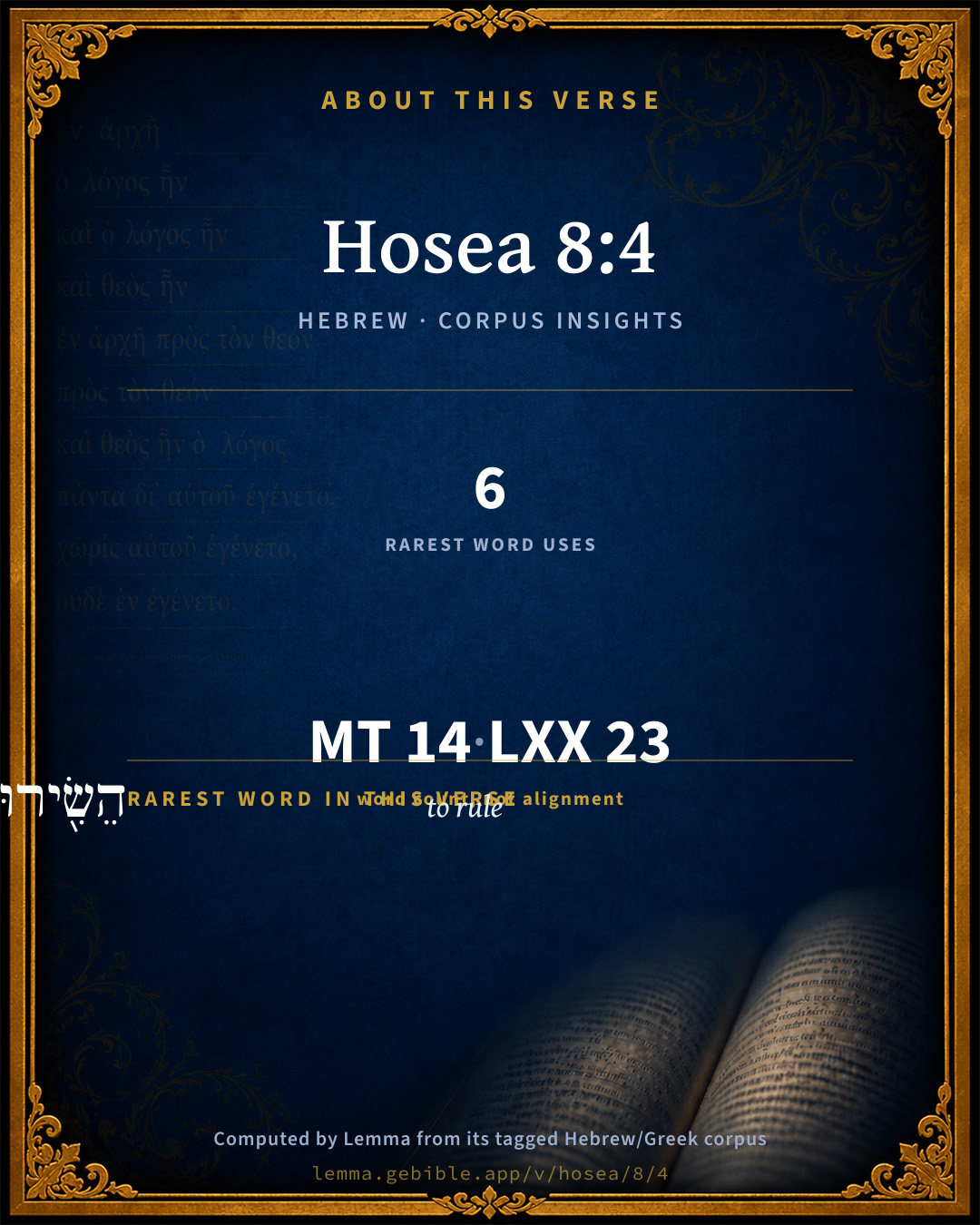
The rarest word here is הֵשִׂ֖ירוּ to rule H8323 — appearing just 6 times in the whole Hebrew Bible.

Shared distinctive vocabulary

הֵשִׂ֖ירוּ to rule H8323 occurs in 5 verses of the Hebrew Bible. Also found in:

Grammatical profile

  • 5 verbs
  • 3 nouns
  • 1 pronoun
  • 3 prepositions
  • 2 particles

Verb forms

  • הִמְלִיכוּ֙ Hiphil · Perfect
  • הֵשִׂ֖ירוּ Hiphil · Perfect
  • יָדָ֑עְתִּי Qal · Perfect
  • עָשׂ֤וּ Qal · Perfect
  • יִכָּרֵֽת Niphal · Imperfect

Repetition

A word recurs within this verse — often emphatic in Hebrew:

  • וְלֹ֣א not H3808 ×2

Hebrew & Septuagint length

In English translation the verse runs 34 words from the Hebrew and 39 from the Septuagint (LXX English) — closely comparable.

A rough comparison of the two English renderings, which tokenize alike — not a word-level alignment.

Word counts can differ between the Hebrew and the Greek without any difference in meaning — e.g. the Hebrew direct-object marker אֵת has no separate Greek word, and Greek often adds the article ὁ.

In the original languages it is 14 Hebrew tokens and 23 Greek tokens — but the two are counted differently (Hebrew bundles its prefixes and suffixes into one token; the Greek is in lemma form), so that isn’t a like-for-like length.

Cross-references

15

Topical passages linked to Hosea 8:4 in the Treasury of Scripture Knowledge — connected by theme and wording, ordered by reader-vote popularity; previews shown in the World English Bible.

  • 2 Kings 15:10–30 Shallum the son of Jabesh conspired against him, and struck him before the people, and killed him, and reigned in his place.
  • Hosea 13:9–10 You are destroyed, Israel, because you are against me, Against your help.
  • 1 Kings 12:16–20 When all Israel saw that the king didn't listen to them, the people answered the king, saying, What portion have we in David? neither have we inheritance in the son of Jesse: to your tents, Israel: now see to your own house, David. So Israel departed to their tents.
  • 1 Kings 16:31 It happened, as if it had been a light thing for him to walk in the sins of Jeroboam the son of Nebat, that he took as wife Jezebel the daughter of Ethbaal king of the Sidonians, and went and served Baal, and worshiped him.
  • Hosea 2:8 For she did not know that I gave her the grain, the new wine, and the oil, And multiplied to her silver and gold, which they used for Baal.
  • Hosea 13:2 Now they sin more and more, And have made themselves molten images of their silver, Even idols according to their own understanding, All of them the work of the craftsmen. They say of them, "They offer human sacrifice and kiss the calves."
  • John 10:14 I am the good shepherd. I know my own, and I'm known by my own;
  • 1 Kings 12:28 Whereupon the king took counsel, and made two calves of gold; and he said to them, It is too much for you to go up to Jerusalem: see your gods, Israel, which brought you up out of the land of Egypt.
  • Luke 13:25 When once the master of the house has risen up, and has shut the door, and you begin to stand outside, and to knock at the door, saying, 'Lord, Lord, open to us!' then he will answer and tell you, 'I don't know you or where you come from.'
  • Galatians 4:9 But now that you have come to know God, or rather to be known by God, why do you turn back again to the weak and miserable elements, to which you desire to be in bondage all over again?
  • 1 Kings 13:34 This thing became sin to the house of Jeroboam, even to cut it off, and to destroy it from off the surface of the earth.
  • Jeremiah 44:7–8 Therefore now thus says Yahweh, the God of hosts, the God of Israel: Why commit you [this] great evil against your own souls, to cut off from you man and woman, infant and suckling, out of the midst of Judah, to leave you none remaining;
  • Ezekiel 18:31 Cast away from you all your transgressions, in which you have transgressed; and make you a new heart and a new spirit: for why will you die, house of Israel?
  • Matthew 25:12 But he answered, 'Most assuredly I tell you, I don't know you.'
  • Luke 13:27 He will say, 'I tell you, I don't know where you come from. Depart from me, all you workers of iniquity.'

Cross-references courtesy of OpenBible.info (CC BY 4.0).

Hebrew and Greek witnesses Masoretic Hebrew ↔ Greek Septuagint

The same verse in the two great witnesses to the Old Testament, shown verse-for-verse.

These are two independent witnesses, not word-aligned to each other, and the Septuagint is shown in lemma (dictionary) form.

Hebrew Hosea 8:4 Masoretic · Westminster Leningrad Codex

הֵ֤ם הִמְלִיכוּ֙ וְלֹ֣א מִמֶּ֔נִּי הֵשִׂ֖ירוּ וְלֹ֣א יָדָ֑עְתִּי כַּסְפָּ֣ם וּזְהָבָ֗ם עָשׂ֤וּ לָהֶם֙ עֲצַבִּ֔ים לְמַ֖עַן יִכָּרֵֽת

They have set up kings, but not by me. They have made princes, and I didn't approve. Of their silver and their gold they have made themselves idols, That they may be cut off.

World English Bible · Public Domain

Greek LXX Hosea 8:4 Septuagint · lemma form

ἑαυτοῦ βασιλεύω καί οὐ διά ἐγώ ἄρχω καί οὐ γνωρίζω ἐγώ ὁ ἀργύριον αὐτός καί ὁ χρυσίον αὐτός ποιέω ἑαυτοῦ εἴδωλον ὅπως ἐκὀλεθρεύω

They have made kings for themselves, but not by me: they have ruled, but they did not make it known to me: of their silver and their gold they have made images to themselves, that they might be destroyed.

LXX2012 (modern English Septuagint) · Public Domain

On this verse, Trapp's Complete Commentary discusses the Septuagint’s reading. Read the note in Commentary ↓

Hebrew: Westminster Leningrad Codex (CC BY 4.0). Greek: Septuagint (public domain); English from LXX2012 (modern English Septuagint) (Public Domain). How the Septuagint differs from the Hebrew →

Targum (Aramaic paraphrase)

1

The Targum is the ancient Jewish Aramaic paraphrase of the Hebrew Scriptures — an interpretive translation, not the Hebrew text itself. Onkelos (literal) and Pseudo-Jonathan (expansive) render the Torah, and Jonathan the Prophets. Coverage is partial: where no permissively-licensed English translation exists for a verse, only the Aramaic is shown. This is verse-level text, not a word-by-word alignment to the Hebrew.

  1. Targum Jonathan Prophets (Joshua–Malachi)
    אִינוּן אַמְלִיכוּ וְלָא מִמֵימְרִי רַבִּיאוּ וְלָא מַרְעוּתִי כַּסְפְּהוֹן וּדְהַבְהוֹן דְאַסִיקוּ לְהוֹן מִמִצְרַיִם עֲבָדוּ לְהוֹן טַעֲוָן בְּדִיל דְיִשְׁתֵּיצוּן:

    (no public-domain English translation for this verse)

    Targum Jonathan — Aramaic: “Mikraot Gedolot” (public domain). English: “Sefaria Community Translation” (CC0 1.0 (public-domain dedication)); “London "Chaldee Paraphrase," 1871” (public domain). Text via Sefaria.

Commentary

Notes on Hosea 8:4 from classic Christian and Jewish commentators (each source and its license shown beneath its notes). The classic Christian expositions comment on the surrounding passage and are grouped to its opening verse, so a note may address several verses; the Jewish commentaries on the Tanakh (Rashi and others) are per-verse, so they appear only where the commentator wrote on this verse.

Lemma curates 59 commentaries, every one of them public domain or Creative Commons licensed, each selected and text-cleaned for this edition rather than reprinted as found. About our sources →

Trapp's Complete Commentary

John Trapp

Hos 8:4 They have set up kings, but not by me: they have made princes, and I knew [it] not: of their silver and their gold have they made them idols, that they may be cut off.

Ver. 4. They have set up kings, but not by me, &c.] The Septuagint and Vulgate Latin render it, "They have reigned themselves"; like as St Paul telleth the haughty Corinthians, who, carried aloft by their waxen wings, domineered and despised others, "ye have reigned as kings without us," &c., 1Co 4:8. But our reading is according to the original; and so they are charged with a double defection; the one civil, from the house of David, "they have set up kings," &c.; the other ecclesiastical, from the sincere service of God, "they had made them idols." For the first, it was not their fault to set up kings; but to do it without God, without his license and approbation. They took counsel, but not of God; they covered with a covering, but not of his spirit, that they might add sin to sin, Isa 30:1. They went headlong to work, in setting up Jeroboam, the son of Nebat. For although the things were done by the determinate counsel and foreknowledge of God, as was likewise Christ’s crucifixion, Act 2:23, {see 1Ki 11:31; 1Ki 12:15; 1Ki 12:24} yet because the people were led by their own pride and ambition to choose a new king, without either asking God’s consent or eyeing his decree, they did it rashly and seditiously; neither aimed they at anything else, but at the easing of their burdens, and drawing to themselves the wealth of the kingdom. As for Jeroboam, it is before noted, that although he had it cleared to him, that God’s will was he should be king over the ten tribes, yet because it was a will of God’s decree, not of his command, as of a duty to be done by him; and because he did not as David, who when he had the promise of the kingdom (yea, was anointed king) yet invaded not the kingdom, but waited till he was lawfully exalted thereunto by God; therefore passeth he for a usurper. And the people are here worthily reprehended, since whatsoever is not of faith is sin; and it is obedience when men obey a divine precept; but not ever when they follow a divine instinct.

They have made princes, &c.] Some render it, They have removed princes (as if in the word Hasiru Sin were put for Samech, R. Sal. Jerki.), they have taken liberty to make and unmake princes at their pleasure; as the Roman army did emperors; and as that potent Earl of Warwick, in Henry VI’s time, who is said to have carried a king in his pocket. But because the former reading is confirmed by the Chaldee paraphrase, and the sense is agreeable to what went before, neither read we of any kings of Israel deposed by the people, we retain it as the better.

Of their silver and their gold have they made them idols] Of the guts and garbage of the earth had they made them terricula, fray-bugs (or spectres), or molestations ( Gnatsabim): terrorem enim et tristitiara duntaxat afferunt suis cultoribus, for they cause terror and heaviness only to those that worship them (Polan.). "Their sorrows shall be multiplied that hasten after another god," Psa 16:4. The Greek Churches, for instance, so set upon image worship, and therefore now subjected to the Turkish tyranny; a type whereof were these ten tribes carried captive by the Assyrian, without any return. Idols are called griefs, or sorrows, saith Peter Martyr, because they torment the mind and trouble the conscience; neither can they quiet or pacify it; so that idolaters must needs be always in doubt and despair, as Papists are, whose whole religion is a doctrine of desperation. Their penances and pilgrimages to such or such an idol might still their consciences for a while; but this was a truce rather than a peace; a palliate cure, which would not hold long; a corrupting of the sergeant, but not compounding with the creditor.

That they may be cut off] Not their silver and gold, the matter of their idols, as some sense it; but the whole nation, princes and people together. Idolatry is a God-provoking and a land-desolating sin, as in this prophecy. Often it is not so much the enemies’ sword as the sin of idolatry that destroyeth cities and kingdoms, through the justice and jealousy of Almighty God.

John Trapp, A Commentary or Exposition upon All the Books of the Old and New Testament (1647–1656) — public domain. Text from a community e-Sword module.

Whedon's Commentary on the Bible

Daniel D. Whedon

ISRAEL’S POLITICAL AND RELIGIOUS PRACTICES; AN ABOMINATION TO JEHOVAH, Hos_8:4-14.

In Hos_8:4 the prophet renews his attack upon Israel. The political revolutions are rebellion against Jehovah (Hos_8:4); their idolatry is an abomination to him (Hos_8:4-6); they must reap what they have sown (Hos_8:7); their appeals to foreign nations will not save them (Hos_8:8-10). Once more he condemns their religious practices, and the section closes with a threat of judgment (Hos_8:11-14).

4. They have set up kings, but not by me — Some understand this passage as a condemnation of the kingship in general; others, of the division of the kingdom after the death of Solomon, which led to the election of kings not of the dynasty of David; still others connect it with the chaotic condition subsequent to the death of Jeroboam II, when royal assassinations became quite common. The last interpretation is the most probable, for the prophet seems to be concerned with the present and immediate past rather than with events which occurred centuries before his time. As in chapter 7, the prophet condemns the present condition of politics.

Princes — Nobles (Hos_3:4; Hos_7:3, etc.). It seems to have been customary in connection with the royal assassinations to make a clean sweep, to destroy the entire royal family and court. With the new king a new set of nobles came to the front.

Knew — The divine knowledge is not abstract; it involves approval or disapproval, loving care or abandonment; here equivalent to I did not approve (compare Psa_1:6; Job_9:21).

As their political practices are an abomination to Jehovah so also their religious practices, culminating in idolatry.

They made them idols — Though in Hos_8:5 the “calf of Samaria” is specified — the bulls set up by Jeroboam I in Beth-el and Dan (1Ki_12:28-29) — there can be no doubt that Hosea is condemning the idolatrous worship in general which was one result of the close contact between the Israelites and the Canaanites. Here for the first time in prophetic discourse we meet hostility to images. From the silence of the earlier prophets, Elijah, Elisha, and Amos, the inference has been drawn that they did not disapprove of them, and the further inference that the Decalogue, found in Exodus xx and Deuteronomy v, with its prohibition of image worship, was not known at or before this time. It is doubtful, however, whether these inferences are warranted. Every crisis in Israel called forth a prophet. Every prophet arose to meet a particular crisis. The earlier prophets were raised up to meet certain crises, serious in their own day and generation, and to these they gave exclusive attention. Their silence on other matters proves only that, with more important affairs in hand, they thought it wise to leave others for their successors. The earlier prophets were concerned with having Jehovah recognized as the supreme God; others might portray his nature and character. The representation of Jehovah by images was not a denial of his supremacy, though it was due to a misapprehension of his spiritual nature; the emphasis of the latter might well wait until the former was more generally recognized.

That they may be cut off — The Hebrew verb is in the singular; LXX. reads the plural, which may be original. Some interpret these words as referring to the people. Since Israel did know, or at least could have known, better, their idolatrous practices were evidence that they were determined upon their own destruction. It seems better, however, to understand the words as referring to the idols; they make them only to be destroyed again.

Daniel D. Whedon (gen. ed.), Commentary on the Old and New Testaments (1874–1909) — public domain. Text from a community e-Sword module.

Keil & Delitzsch

C. F. Keil & F. Delitzsch

The proof of Israel's renunciation of its God is to be found in the facts mentioned in Hos 8:4. "They have set up kings, but not from me, have set up princes, and I know it not: their silver and their gold they have made into idols, that it may be cut off." The setting up of kings and princes, not from Jehovah, and without His knowledge, i.e., without His having been asked, refers chiefly to the founding of the kingdom by Jeroboam I. It is not to be restricted to this, however, but includes at the same time the obstinate persistence of Israel in this ungodly attitude on all future occasions, when there was either a change or usurpation of the government. And the fact that not only did the prophet Ahijah foretel to Jeroboam I that he would rule over the ten tribes (Kg1 11:30.), but Jehu was anointed king over Israel by Elisha's command (2 Kings 9), and therefore both of them received the kingdom by the express will of Jehovah, is not at variance with this, so as to require the solution that we have a different view here from that which prevails in the books of Kings, - namely, one which sprang out of the repeated changes of government and anarchies in this kingdom (Simson). For neither the divine promise of the throne, nor the anointing performed by the command of God, warranted their forcibly seizing upon the government, - a crime of which both Jeroboam and Jehu rendered themselves guilty. The way in which both of them paved the way to the throne was not in accordance with the will of God, but was most ungodly (see at Kg1 11:40). Jeroboam was already planning a revolt against Solomon (Kg1 11:27), and led the gathering of the ten tribes when they fell away from the house of David 91 Kings Hos 12:2.). Of Jehu, again, it is expressly stated in Kg2 9:14, that he conspired against Joram. And the other usurpers, just like the two already named, opened the way to the throne by means of conspiracies, whilst the people not only rebelled against the rightful heir to the throne at Solomon's death, from pure dislike to the royal house of David, which had been appointed by God, and made Jeroboam king, but expressed their approval of all subsequent conspiracies as soon as they have been successful. This did not come from Jehovah, but was a rebellion against Him - a transgression of His covenant. To this must be added the further sin, viz., the setting up of the idolatrous calf-worship on the part of Jeroboam, to which all the kings of Israel adhered. It was in connection with this, that the application of the silver and gold to idols, by which Israel completely renounced the law of Jehovah, had taken place. It is true that silver was not used in the construction of the golden calves; but it was employed in the maintenance of their worship. למען יכּרת: that it (the gold and silver) may be destroyed, as more fully stated in Hos 8:6. למען describes the consequence of this conduct, which, though not designed, was nevertheless inevitable, as if it had been distinctly intended.

Keil & Delitzsch — Biblical Commentary on the Old Testament (1861–1891) — public domain (CC PDM 1.0). Text via the HelloAO Bible API. (Old Testament only.)

The Expositor's Bible

2. ARTIFICIAL KINGS AND ARTIFICIAL GODS

Hos_8:4-13

The curse of such a state of dissipation as that to which Israel had fallen is that it produces no men. Had the people had in them "the root of the matter," had there been the stalk and the fiber of a national consciousness and purpose, it would have blossomed to a man. In the similar time of her outgoings upon the world Prussia had her Frederick the Great, and Israel, too, would have produced a leader, a heaven-sent king, if the national spirit had not been squandered on foreign trade and fashions. But after the death of Jeroboam every man who rose to eminence in Israel, rose, not on the nation, but only on the fevered and transient impulse of some faction; and through the broken years one party monarch was lifted after another to the brief tenancy of a blood-stained throne. They were not from God, these monarchs; but man-made, and sooner or later man-murdered. With his sharp insight Hosea likens these artificial kings to the artificial gods, also the work of mens hands; and till near the close of his book the idols of the sanctuary and the puppets of the throne form the twin targets of his scorn.

"They have made kings, but not from Me; they have made princes, but I knew not. With their silver and their gold they have manufactured themselves idols, only that they may be cut off"-king after king, idol upon idol. "He loathes thy Calf, O Samaria," the thing of wood and gold which thou callest Jehovah. And God confirms this. "Kindled is Mine anger against them! How long will they be incapable of innocence?"-unable to clear themselves of guilt! The idol is still in his mind. "For from Israel is it also-as much as the puppet-kings"; a workman made it, and no god is it. Yea, splinters shall the Calf of Samaria become." Splinters shall everything in Israel become. "For they sow the wind, and the whirlwind shall they reap." Indeed like a storm Hoseas own language now sweeps along; and his metaphors are torn into shreds upon it. "Stalk it hath none: the sprout brings forth no grain: if it were to bring forth, strangers would swallow it." Nay, "Israel hath let herself be swallowed up! Already are they becoming among the nations like a vessel there is no more use for." Heathen empires have sucked them dry. "They have gone up to Assyria like a runaway wild-ass. Ephraim hath hired lovers." It is again the note of their mad dissipation among the foreigners. "But if they" thus "give themselves away among the nations, I must gather them in, and" then "shall they have to cease a little from the anointing of a king and princes." This willful roaming of theirs among the foreigners shall be followed by compulsory exile, and all their unholy artificial politics shall cease. The discourse turns to the other target. For Ephraim hath multiplied altars-to sin; altars are his own-to sin. Were I to write for him by myriads My laws, as those of a stranger would they be accounted. They slay burnt-offerings for Me and eat flesh. Jehovah hath no delight in them. Now must He remember their guilt and make visitation upon their sin. They-to Egypt-shall return" Back to their ancient servitude must they go, as formerly He said He would withdraw them to the wilderness. {Hos_2:16}

William Robertson Nicoll, ed., The Expositor's Bible (London: Hodder & Stoughton, 1887–1910) — public domain. 65 of 66 books (1 Corinthians is not separately keyed, as that volume carries no machine-parseable verse references); section-level commentary keyed to the opening verse. Introductory and overview sections not keyed to a specific passage are excluded.

Tyndale Open Study Notes

Tyndale Open Resources

8:4 appointed kings without my consent: The Israelites quickly disposed of one king and appointed another if they thought it might save their nation (see 7:7). They did all of this without consulting their true king, the Lord.

Tyndale Open Study Notes — © Tyndale Open Resources, licensed CC BY-SA 4.0. Text via the HelloAO Bible API.

Geneva Bible (1599)

Geneva Bible translators

That is, Jeroboam by whom they sought their own liberty, and not to obey my will.

Geneva Bible (1599) marginal notes — public domain. Text via Bolls.life.

Jamieson, Fausset & Brown

Robert Jamieson, A. R. Fausset & David Brown

kings . . . not by me--not with My sanction (Kg1 11:31; Kg1 12:20). Israel set up Jeroboam and his successors, whereas God had appointed the house of David as the rightful kings of the whole nation.

I knew it not--I approved it not (Psa 1:6).

of . . . gold . . . idols-- (Hos 2:8; Hos 13:2).

that they may be cut off--that is, though warned of the consequences of idolatry, as it were with open eyes they rushed on their own destruction. So Jer 27:10, Jer 27:15; Jer 44:8.

Jamieson, Fausset & Brown — Commentary Critical and Explanatory on the Whole Bible (1871) — public domain (CC PDM 1.0). Text via the HelloAO Bible API.

Adam Clarke's Commentary

Verse 4. They have set up kings, but not by me] Properly speaking, not one of the kings of Israel, from the defection of the ten tribes from the house of David, was the anointed of the Lord.

I knew it not] It had not my approbation. In this sense the word know is frequently understood.

That they may be cut off.] That is, They shall be cut off in consequence of their idolatry.

Adam Clarke's Commentary on the Bible (1810–1826) — public domain. Text from a community e-Sword/MySword module.

John Calvin's Commentaries

The Prophet here notices two things, with respect to which he reprobates the perfidy and impious perverseness of the people, — they had, against the will of God, framed a religion for themselves, — and they had instituted a new kingdom. The salvation of that people, we know, was, as it were, founded on a certain kingdom and priesthood; and by these two things God testified that he was allied to the children of Abraham. We know where the happiness of the godly is deposited, even in Christ; for Christ is to us the fulness of a blessed life, because he is a king and a priest. Hence I have said, that through a certain kingdom and priesthood did the favor of God towards the people then shine forth. Now when the Israelites overturned the kingdom, which God by his own authority instituted, and when they corrupted and adulterated the priesthood, did they not, as it were, designedly extinguish the favor of God, and strive to annihilate whatever was needful for their salvation? This then is what the Prophet now speaks of, that is, that the Israelites in changing the kingdom and priesthood had undermined the whole appointment of God, and openly showed that they were unwilling to be ruled by God’s hand; for they would have never dared to turn asides even in the least degree, from the kingdom of David, nor would they have dared to set up a new and spurious priesthood, if any particle of the fear of God had prevailed in their hearts.

We now perceive the design of the Prophet, which interpreters have not sufficiently considered; for some refer this to the covenants, as it seemed strange to them, that the Israelites should be so severely reproved for setting up Jeroboam as their king, since Ahijah the Shilonite had already declared by God’s command, that it would be so. But they attend not sufficiently to what the Prophet had in view; for, as I have already said, when God instituted the priesthood, there shone forth in it the image of Christ the Mediator, whose office it is, to intercede with God that he might reconcile him to men; and then in the person of David shone forth also the kingdom of Christ. Now when the people tumultuously chose a new king for themselves without any command from God, and when they built for themselves a new temple and altar contrary to what the law prescribed, and when they divided the priesthood, was not all this a manifest corruption, a denial of religion? It is hence evident that the Israelites were in both these respects apostates; for they forsook God in two ways, — first, by separating from the house of David, — and then by forming for themselves a strange worship, which God had not commanded in his law.

With regard to the first, he says, They have caused to reign, but not through me; they have instituted a government, and I knew it not, that is, without my consent; for God is said not to know what he does not approve, or that concerning which he is not consulted. But some one may object and say, that God knew of the new kingdom since he was the founder of it. To this the answer is, that God so works, that this pretext does not yet excuse the ungodly, since they aim at something else, rather than to execute his purpose. As for instance, God designed to prove the patience of his servant Job: the robbers who took away his property, were they excusable? By no means. For what was their object, but to enrich themselves by injustice and plunder? Since then they purchased their advantage at the expense of another, and unjustly robbed a man who had never injured them, they were destitute of every excuse. The Lord, however, did in the meantime execute by them what he had appointed, and what he had already permitted Satan to do. He intended, as it has been said, that his servant should be plundered; and Satan, who influenced the robbers, could not himself move a finger except by the permission of God; nay, except it was commanded him. At the same time, the Lord had nothing in common or in connection with the wicked, because his purpose was far apart from their depraved lust. So also it must be said of what is said here by the Prophet. As God intended to punish Solomon, so he took away the ten tribes. He indeed suffered Solomon to reign to the end of his days, and to retain the government of the kingdom; but Rehoboam, who succeeded him, lost the ten tribes. This did not happen by chance; for God had so decreed; yea, he had declared that it would be so. He sent Ahijah the Shilonite to offer the kingdom to Jeroboam, who had dreamt of nothing of the kind. God then ruled the whole by his own secret counsel, that the ten tribes should desert their allegiance to Rehoboam, and that Jeroboam, being made king, should possess the greater part of the kingdom. This, I say, was done by God’s decree: but yet the people did not think that they were obeying God in revolting from Rehoboam, for they desired some relaxation, when they saw that the young king wished tyrannically to oppress them; hence they chose to themselves a new king. But they ought to have endured every wrong rather than to deprive themselves of that inestimable blessing, of which God gave them a symbol and pledge in the kingdom of David; for David, as it has been said, did not reign as a common king, but was a type of Christ, and God had promised his favor to the people as long as his kingdom flourished, as though Christ did then dwell in the midst of the people. When therefore the people shook off the yoke of David, it was the same as if they had rejected Christ himself because Christ in his type was despised.

We hence see how base was the conduct of the people in joining themselves to Jeroboam. For that sedition was not merely a proof of levity, as some people do often rashly upset the state of things; it was not merely a rash levity, but an impious denial of God’s favor, the same as if they had rejected Christ himself. They had also, in this way, torn themselves from the body of the Church; and though the kingdom of Israel surpassed the kingdom of Judah in wealth and power, it yet became like a putrid member, for the whole soundness depended on the head, from which the ten tribes had cut themselves off. We now then see why the Prophet so sharply expostulates with the Israelites for setting up a kingdom, but not through God; and solved also is the question, how God here declares that was not through him, which yet he had determined and testified by the mouth of his prophet, Ahijah the Shilonite; that is, that God, as it has been said, had not given a command to the people, nor permitted the people to withdraw themselves from their allegiance to Rehoboam. God then denies that kingdom, with respect to the people, was set up by his decree; and he says that what was done was this, — that the people made a king without consulting him; for the people ought to have attended to what pleased him, to what the Lord himself conceded; this they did not, but suddenly followed their own blind impulse.

And this place is worthy of being observed; for we hence learn that the same thing is done and not done by the Lord. Foolish men at this day, not versed in the Scripture, excite great commotions among us about the providence of God; yea, there are many rabid dogs who bark at us, because we say, (what even Scripture teaches everywhere,) that nothing is done except by the ordination and secret counsel of God, and that whatever is carried on in this world is governed by his hand. “How so? Is God, then a murderer? Is God, then a thief? Or, in other words, are slaughters, thefts, and all kinds of wickedness, to be imputed to him?” These men show, while they would be deemed acute, how stupid they are, and also how absurd; nay, rather what mad wild beasts they are. For the Prophet here shows that the same thing was done and not done by the Lord, but in a different way. God here expressly denies that Jeroboam was created king by him; on the other hand, by referring to sacred history, it appears that Jeroboam was created king, not by the suffrages of the people, but by the command of God; for no such thing had yet entered the mind of the people, when Ahijah was bidden to go to Jeroboam; and he himself did not aspire to the kingdom, no ambition impelled him; he remained quiet as a private man, and the Lord stirred him up and said, “I will have thee to reign.” The people knew nothing of these things. After it was done, who could have denied but that Jeroboam was set on the throne, as it were, by the hand of God? All this is true; but with are regard to the people, he was not created by God a king. Why? Because the Lord had commanded David and his posterity to reign perpetually. We hence see that all things done in the world are so disposed by the secret counsel of God, that he regulates whatever the ungodly attempts and whatever even Satan tries to do, and yet he remains just; and it avails nothing to lessen the fault of evils when they say, that all things are governed by the secret counsel of God. With regard to themselves, they know what the Lord enjoins in his law; let them follow that rule: when they deviate from it, there is no ground for them to excuse themselves and say that they have obeyed God; for their design is ever to be regarded. We hence see how the Israelites appointed a king, but not by God; for it was sedition that impelled them, when, at the same time, the law enjoined that they should choose no one as a king except him who had been elected by God; and he had marked out the posterity of David, and designed that they should occupy the royal throne till the coming of Christ.

Then follows the other charge, — that they made to themselves idols from their gold and from their silver God here complains that his worship was not only fallen into decay, but that it was also wholly corrupted by superstitions. It was an impiety not to be borne, that the people had desired a new king for themselves; but it was the summit of all evils, when the Israelites converted their gold and their silver into idols. They have made, he says, their gold and silver idols; that is, “I destined the gold and the silver, with which they have been enriched, for very different purposes. When, therefore, I was liberal to them, they abused my kindness, and from their gold and their silver they made to themselves idols or gods.” Here, then, the Prophet, by implication, sharply reproves the blind madness of the people, that they made to themselves gods of corruptible things, which ought, in the meantime, to be serviceable to them; for to what purpose is money given us by the Lord, but for our daily use? Since, then, the Lord has destined gold and silver for our service, what frenzy it is when men work them into gods for themselves! But this main point must be ever remembered, that the Israelites, in all things, betrayed their own defection; for they hesitated not to overthrow the kingdom which God had instituted for their salvation, and they dared to pervert the whole worship of God, together with the priesthood, by introducing new superstitions.

Then follows a denunciation of punishment — Therefore Israel shall be cut off. Were any, indeed, to object and say that God was too rigid, there would be no reason for such an objection; for they had betrayed and violated their pledged faith, and by condemning and treading under foot both the kingdom and priesthood, they had rejected his favor. We hence see that the Prophet threatens them now with deserved destruction. Let us proceed —

John Calvin's Commentaries (1540-1563) — public domain. Text from the Calvin Translation Society English edition (1840s-50s) via the Christian Classics Ethereal Library (ccel.org). Calvin's coverage is partial (roughly two-thirds of the Bible); uncommented books and verses are honest gaps, never fabricated. The 19th-century editor's footnotes and remarks are omitted so the notes are faithfully Calvin's own voice.

Ellicott's Commentary for English Readers

(4) Set up kings.—It is possible that the prophet alludes to the history of the northern kingdom as a whole. Though the revolt of the Ten Tribes received Divine sanction (1Ki_11:9-11), it was obviously contrary to the Divine and prophetic idea which associated the growth of true religion with the line of David (Hos_3:5). But it is best to regard the passage as referring to the short reigns of usurpers and to the foul murders which disgraced the annals of the northern kingdom since the death of Jeroboam II. Jehovah repudiates all participation in their anarchy.

Knew it not.—Should be, knew them not—viz., the gold and silver splendours wherewith Israel had adorned its apostacy.

A Bible Commentary for English Readers, edited by Charles John Ellicott (1878–1897) — public domain. Text from a community e-Sword module.

The Cambridge Bible for Schools and Colleges

gen. ed. J. J. S. Perowne

4. Israel’s great offence—making a schism in the ‘theocratic’ community. Setting up idols was virtually rebellion against Jehovah; whatever Ahijah said (1Ki_11:31, &c.), or a lower class of prophets after him (comp. Amo_7:12-13), the great prophets, such as Hosea, could not sanction any of the N. Israelitish dynasties (see on Hos_1:11). See next note.

not by me] Rather, not from me. There is a verbal contradiction between these words and those ascribed to Shemaiah in 2 Kings 12:24. A prophet could only declare the will of God with regard to the particular case laid before him. The disunion of north and south was so great, that for the sake of peace it was better to separate. But when the moral and spiritual decay of N. Israel had reached such a point as in the time of Hosea, no prophet with any spiritual insight could fail to perceive that the usurping kings lacked the divine blessing.

that they may be cut off] The verb is in the singular, and the implied subject is the silver and gold which had been made into idols.

The Cambridge Bible for Schools and Colleges (gen. ed. J. J. S. Perowne; Cambridge University Press, 1878–1918) — public domain. Text from a community e-Sword module.

John Gill's Exposition

They have set up kings, but not by me,.... Not by his authority, order, and command; not by asking advice of him, or his leave, but of themselves, and of their own, accord: this refers to the case of Jeroboam their first king, after their separation from the house of David, and from the tribes of Judah and Benjamin; for though his becoming king of Israel was according to the secret will of God, and by his overruling providence; yet it was done without his express orders, and without asking counsel of him, or his consent, and of their own heads; and many of his successors were conspirators, and set up themselves with the consent of the people, to the dethroning of others, and upon the slaughter of them, as Shallum, Menahem, Pekah, and Hoshea: the people of Israel had no right to choose a king for themselves; the right was alone in the Lord; it was he that chose, appointed, and constituted their kings, Deu 17:15; thus Saul, David, and Solomon, were chose and appointed by him, Sa1 10:24; it was not the person of Jeroboam chosen God disliked; but their taking it upon them to choose and set him up without his leave;

they have made princes, and knew it not; that is, they set up subordinate governors, judges, civil magistrates, elders of the people, over them, without his approbation, and such as were very disagreeable to him; otherwise he knew what was done by them, as being the omniscient God, but he did not approve of what they did. Some observe, that in the word used, is put for and should be rendered, "they have removed", so Jarchi and Japhet; that is, they have set up kings, and they have removed them; they have took it upon them to make and pose kings at pleasure, without seeking the Lord about it, when this is his prerogative, who is King of kings, and Lord of lords, Dan 2:21; which sense makes a strong and beautiful antithesis;

of their silver and their gold have they made their idols; some of their idols were made of silver, others of gold; particularly the calves at Dan and Bethel, which are called the golden calves, because made of gold; as was the calf in the wilderness, Kg1 12:28; see Isa 46:6;

that they may be cut off: which denotes not the end, intentions, and design of making these idols of silver and gold, but the event thereof; namely, either the destruction of the idols themselves, which, for the sake of the silver and gold they were made of; were cut in pieces by a foreign enemy; or the gold and silver were cut off from the people, their riches and wealth were wasted by such means; or rather the people were cut off, everyone of them, because of their worship of them, or this would be the case.

John Gill's Exposition of the Whole Bible (1746–1763) — public domain (CC PDM 1.0). Text via the HelloAO Bible API.

Albert Barnes' Notes on the Bible

They have set up kings, but not by ME - God Himself foretold to Jeroboam by Ahijah the prophet, that He would “rend the kingdom out of the hands of Solomon, and give ten tribes” to him, “and” would “take” him, “and” he “should reign according to all that” his soul desired and” should “be king over Israel” 1Ki 11:31, 1Ki 11:37; and, after the ten tribes had made Jeroboam king, God said by Shemaiah the prophet to Rehoboam and the two tribes, “Ye shall not go up, nor fight against your brethren the children of Israel; return every man to his house, for this thing is from Me” 1Ki 12:22-24.

Yet although here, as everywhere, man’s self-will was overruled by God’s will, and fulfilled it, it was not the less self-will, both in the ten tribes and in Jeroboam. It was so in the ten tribes. For they cast off Rehoboam, simply of their own mind, because he would not lessen the taxes, as they prescribed. If he would have consented to their demands, they would have remained his subjects 1Ki 12:4. “They set up kings, but not by or through” God, whom they never consulted, nor asked His will about the rules of the kingdom, or about its relation to the kingdom of Judah, or the house of David. They referred these matters no more to God, than if there had been no God, or than if He interfered not in the affairs of man. It was self-will in Jeroboam himself, for he received the kingdom (which Ahijah told him, he “desired”) not from God, not requiring of him, how he should undertake it, nor anointed by Him, nor in any way acknowledging Him, but from the people. And as soon as he had received it, he set up rebellion against God, in order to establish his kingdom, which he founded in sin, whereby he made Israel to sin.

In like way, the Apostle says, “against Thy holy Child Jesus, whom Thou hast both Herod and Pontius Pilate, with the Gentiles and the people of Israel, were gathered together, for to do whatsoever Thy hand and Thy counsel determined before to be done” Act 4:27, Act 4:8. Yet not the less did they sin in this Deicide; and the Blood of Jesus has ever since, as they imprecated on themselves, been on the Jews and on their children, as many as did not repent.

As was the beginning of the kingdom of Israel, such was its course. “They made kings, but not from God.” Such were all their kings, except Jehu and his house. During 253 years, for which the kingdom of Israel lasted eighteen kings reigned over it, out of ten different families, and no family came to a close, save by a violent death. The like self-will and independence closed the existence of the Jewish people. The Roman Emperor being afar off, the Scribes and Pharisees hoped, under him, without any great control, to maintain their own authority over the people. They themselves, by their “God forbid!” Luk 20:16, owned that our Lord truly saw their thoughts and purpose, “This is the heir; come let us kill Him, that the inheritance may be ours.” They willed to reign without Christ, feared the Pagan Emperor less than the holiness of Jesus, and in the words, “We have no king but Caesar,” they deposed God, and shut themselves out from His kingdom.

And I knew it not - “As far as in them lay, they did it without His knowledge” Joh 8:54. They did not take Him into their counsels, nor desire His cognizance of it, or His approbation of it. If they could, they would have had Him ignorant of it, knowing it to be against His will. And so in His turn, God knew it not, owned it not, as He shall say to the ungodly, “I know you not” Mat 25:12.

Of their silver and their gold have they made them idols - God had multiplied them, (as He said before Hos 2:8), and they ungratefully abused to the dishonor of the Giver, what He gave them to be used to His glory.

That they may be cut off - Literally, “that he may be cut off.” The whole people is spoken of as one man, “one and all,” as we say. It is a fearful description of obstinate sin, that their very object in it seemed to be their own destruction. They acted with one will as one man, who had, in all he did, this one end - to perish. : “As if on set purpose they would provoke destruction, and obstinately run themselves into it, although forewarned thereof.” Holy Scripture speaks of that as people’s end, at which all their acts aim. “They see, not, nor know, that they may be ashamed” Isa 44:9; i. e., they blind themselves, as though their whole object were, what they will bring upon themselves, their own shame. “They prophesy a lie in My Name, that I might drive you out, and that ye might perish, ye, and the prophets that prophesy unto you” Jer 27:15. This was the ultimate end of those false prophecies. The false prophets of Judah filled them with false hopes; the real and true end of those prophecies, that in which they ended, was the ruin of those who uttered, and of those who listened to them. We ourselves say almost proverbially, “he goes the way to ruin himself;” not that such is the man’s own object, but that he obstinately chooses a course of conduct, which, others see, must end in utter ruin. So a man chooses destruction or hell, if he chooses those tilings which, according to God’s known law and word, end in it. Man bides from his own eyes the distant future, and fixes them on the nearer objects which he has at heart. God lifts the veil, and discovers to him the further end, at which he is driving, which he is, in fact, compassing, and which is in truth the end, for his own fleeting obiects perish in the using; this and this alone abides.

Albert Barnes' Notes on the Bible (1834–1885) — public domain. Text from a community e-Sword/MySword module.

Haydock's Catholic Bible Commentary

They. Jeroboam and Jehu were assured by the prophets that they should reign, yet this was not a sanction of their right. God condemned their ambition and wicked conduct. The successors of Zarharias had still less pretensions to the throne. God permits such things. The people had not consulted him in these changes. (Calmet) --- Kings were their own choice, 1 Kings xviii. Saul rose by their "error." (St. Jerome) --- Knew, or approved not, ver. 2., and Matthew xxv. 12. (Calmet) --- Perish. This was the effect, though contrary to their intention. (Haydock)

George Leo Haydock (1774–1849), Haydock's Catholic Family Bible and Commentary, 1859 edition — public domain. Excludes Psalms (Douay-Rheims chapter numbering differs from Protestant) and Deuterocanonical books (Catholic canon only).

Matthew Poole's English Annotations

They; Israel, the prevailing faction among them in Hosea’s time.

Have set up kings; Shallum, Menahem, Pekah, and Hoshea, who usurped the throne.

But not by me; not by my direction, or with my approbation; they neither prayed his blessing nor asked his leave. And this may be applied to the very first founding of the kingdom of Israel, divided from the house of David. They have made princes; rulers and magistrates, or nobles.

And I knew it not: he that will not approve any one evil, when his omniscience discerns all, is pleased to say he knew not what he did not approve.

They made them idols; heathen like, they have made them gods, and set up idolatry, so have perverted all in church and state settled by me.

That they may be cut off; as if they were resolved to cut themselves off from being a people. By this they thought to establish themselves, but it will be quite contrary, these sins will be their ruin.

Matthew Poole's English Annotations on the Holy Bible (1683–1685) — public domain. Text from a community e-Sword/MySword module.

The Pulpit Commentary

They have set up kings, but not by me: they have made princes, and I knew it not. Here was the first instance and evidence of Israel"s rejection of Jehovah. Their conduct was not guided by Divine direction, nor in obedience to the Divine will, nor with the Divine sanction. This state of things began with Israel"s revolt from the house of David, and rebellion against the son of Solomon their legitimate sovereign, and was repeated in subsequent usurpations. Perhaps we may go further back, even to the appointment of the first king of the yet undivided kingdom, when "the Lord said unto Samuel, Hearken unto the voice of the people in all that they say unto thee: for they have not rejected thee, but they have rejected me, that I should not reign over them." Usurpations such as those of Zimri, Omri, and Shallum at least are comprehended in the appointments referred to appointments on making which the people did not inquire of the Lord, nor act under his guidance, nor seek his sanction. Some go so far as to include all the kings of Israel that succeeded Jeroboam. Thus Cyril says, "He denies the kingdom of Israel and his successors on the throne of Israel." Aben Ezra also extends the statement to the kings of the northern kingdom from the days of Jeroboam: "They inquired not of God with respect to the making of Jeroboam king, although it is written, "Thou shalt in any wise set him king over thee whom the Lord thy God shall choose. A seeming contradiction here exists between the statement of the prophet here and that in 1Ki_11:37, where God promises by the Prophet Ahijah, "I will take thee, and thou shalt reign according to all that thy soul desireth, and shalt be king over Israel," and the fact of Jehu"s anointing being ordered by the Prophet Elisha, who sent one of the children of the prophets for that purpose with the words, "Thus saith the Lord, I have anointed thee king over Israel." The plotting of Jeroboam, and the conspiracy of Jehu against Joram, and the conspiracies of other usurpers, were things which God could not approve; and so we must distinguish between the permission and approval of Jehovah; in his government he permits many things which from his nature we know he does not and cannot approve. wry is usually and properly rendered, "they have made princes;" but Aben Ezra and Rashi translate it as wdysh equivalent to "they have removed;" while the Massora reckon wr in the number of those words which are written with shin but are read and explained with samech. Some manuscripts also of Kennicett and De Rossi have wrysh. Of their silver and their gold have they made them idols, that they (literally, it) may be cut off. This is a second proof of Israel"s renunciation of Jehovah. They used their gold in making the idolatrous calves, and their silver in supporting their idolatrous worship; or they made the idol-calves, some of silver, and others of gold. The consequence rather than the purpose is the destruction of it, namely, the gold and silver; or the ruin of the kingdom or of each member of it; or the cutting off of their name, according to Kimchi. The word ml, like ina in Greek, is generally relic, denoting "purpose;" nor is it ecbatic here, denoting "result," though, according to the Hebrew mode of thought, design and consequence often coincide. Its meaning here is well explained by Keil, yl describes the consequence of this conduct, which, though not designed, was nevertheless inevitable, as if it had been distinctly intended.

Vers. 4-8. The causes of the Divine judgments are more particularly specified.

The first sin which brought down the Divine displeasure was their civil apostasy, as it has been called, or change of civil government.

I NATURE OF THE FIRST SIN BY WHICH ISRAEL INCURRED DIVINE WRATH. By this we are not to understand, with some, the election of Saul, because this political offence, if we may rightly so term it, included the twelve tribes in common, whereas it is the ten tribes of the northern kingdom with which the prophet here deals; neither are we, according to others, to confine the sin with which Israel is here charged to certain usurpers who, by treachery, or conspiracy, or assassination, forced their way to the throne, for this was long after the disruption, and was the sin of a few individuals rather than of the whole people, though undoubtedly the whole people suffered by the transgression of these particular persons. It is to the separation of Israel from the Davidic dynasty and the southern kingdom in the days of Jeroboam that the prophet refers.

II THE SAME THING DONE AND NOT DONE BY GOD. An objection is sometimes urged against the severity with which Israel is reproved for the disruption of the kingdom of David, seeing that God had predestined and promised it.

1. It is true, indeed, that God had predicted the rending of the kingdom of Solomon; it is true he had promised ten tribes to Jeroboam by Ahijah the Shilonite; it is true also that he had even predetermined the whole. How, then, can it be maid to have taken place without God"s consent? Or why should Israel be so sharply rebuked for the sin? God had determined to punish Solomon by rending ten tribes from the kingdom of his son and successor, though he himself was allowed to retain the government of the whole till the end of his days, and by handing them over to Jeroboam. The part enacted by the people was not with the Divine knowledge, that is, the Divine consent, approval They did not consult God about the matter, or the manner of it, or the time of it; they did not wait for his command to do it; they did not seek his approbation in doing it; they were no way concerned about executing the Divine purpose nothing was further from their thoughts. They revolted from the house of David not in order to obey God; of this, as far as the history shows, they never thought. What they did was done from a spirit of sedition; what they aimed at was a relief from oppressive taxation. They had no regard to the Divine mind in the whole movement. They were bent on carrying out their own cherished project, and yet unwittingly, unintentionally, they were carrying out the purpose and promise of God, though without any reference to the mind and will of God.

2. The following illustration of this difficult subject is given by Calvin. "God," he says, "designed to prove the patience of his servant Job. The robbers who took away his property, were they excusable? By no means. For what was their object, but to enrich themselves by injustice and plunder? Since, then, they purchased their advantage at the expense of another, and unjustly robbed a man who had never injured them, they were destitute of every excuse. The Lord, however, did in the mean time execute by them what he had appointed, and what he had already permitted Satan to do. He intended that his servant should be plundered; and Satan, who influenced the robbers, could not himself move a finger except by the permission of God nay, except it was commanded him. At the same time, the Lord had nothing in common or in connection with the wicked, because his purpose was far apart from their depraved lust. So also it must be said of what is said here by the prophet.

III THE SECOND CAUSE OF DIVINE JUDGMENT. The second sin and cause of judgment was their religious apostasy in the worship of the calves.

1. The first sin, as so often happens, led to the second. The idolatry of the calves was intended by Jeroboam to help and uphold his usurped sovereignty. Not only had the national religion fallen into decay, but it had degenerated into superstitious will-worship. Next to the subversion of the Davidic kingdom came the perversion of the legitimate priesthood.

2. The sin of their apostasy was aggravated by their abuse of the wealth which God had given them. All they had they owed to God, and were in duty bound to employ it for his honor; instead of doing so, they dishonored him by making idols of their silver and gold. Men are sometimes found to be more lavish of their gold and silver in support of a false religion than in maintaining the pure worship of the true God. Israel might pretend that their calves of gold were only representations of Jehovah; but Jehovah refuses to be so represented, forbidding men to make any graven image of metal, or stone, or wood, standing out prominently and in high relief, or any likeness el anything on a fiat surface as a picture, for the purpose of doing it homage by worship or serving it by sacrifice. If, then, men neglect the Divine prohibitions or precepts, they must remember that God will not be mocked by their professions or pretences, but will estimate them by their practice in the light of his Law.

3. Israel was destroying himself by this sinful idolatry. "That he may be cut off;" such is the literal sense, as though it meant the whole nation as one man one and all. Such was the tendency of their conduct, though it was not their intention; such was the inevitable end of their course, though they were not aware of it. "So a man chooses destruction or hell, if he chooses those things which, according to God"s known Law and Word, end in it. Man hides from his own eyes the distant future, and fixes them on the nearer objects which he has at heart." Some take the clause to mean that the gold and silver so sadly misused and sinfully perverted would be cut off; it appears rather to refer to the persons who were the possessors thereof; in any case their money would perish, either passing out of their possession or along with the possessors.

IV THEIR SIN AND CONSEQUENT SUFFERING ARE INSISTED ON. The striking amplification of the same subject seems designed to impress on the people"s mind that they themselves, and no other, had wrought their ruin, and that they need not try to transfer the fault to others, or charge God foolishly. Nor is it necessary to suppose that a calf had been set up at Samaria, or that one of those at Dan and Bethel had been removed thither. Samaria was the metropolis of the northern kingdom, and as such took a leading part in the calf-worship and contributed largely and liberally to its support. Of the different renderings of the first clause of ver. 5, all tending pretty much in the same direction, we may safely adhere to that of the Authorized Version as affording a good sense. Israel, we read in ver. 3, "had cast off" God and goodness; now the calf which they had set up as their god had cast them off, left them in the lurch, or caused their removal to another and a foreign land; thus their sin and its punishment are linked together by the same word, "cast off" (hnr). The thing is represented in the past because sure of accomplishment; they had renounced God, and now the thing which they substituted for God had abandoned them. So shall it ever be; whatever object men make an idol of, and set it up in their heart instead of God, giving it that place in their affections which belongs to God alone, will one day assuredly cast them off, desert them in their sorest need, and leave them in distress. Is wealth our idol? Do we make gold our god, and fine gold our confidence? That calf of gold will cast us off; for fiches make themselves wings and fly away, as has been the sorrowful experience of thousands! Is fame the god we follow? Is popular applause the idol we worship? Are worldly greatness and its accompanying glory the idols, the objects, of our idolatry, and dear to us as the calves at Dan and Bethel were to Israel? This calf of vain-glory will surely cast us off; for fame is a bubble that bursts before it goes far along the stream of time; popularity is often false, always fickle as the breeze. The words of Wolsey prove with wondrous power how the calf of worldly glory casts off its worshippers. Farewell, a long farewell, to all my greatness! This is the state of man: Today he puts forth The tender leaves of hope, tomorrow blossoms, And bears his blushing honors thick upon him: The third day comes a frost, a killing freest; And, when he thinks, good easy man, full surely His greatness is a-ripening, nips his root, And then he falls, as I do. I have ventured, Like little wanton boys that swim on bladders, This ninny summers in a sea of glory; But far beyond my depth: my high-blown pride At length broke under me; and now has left me, Weary, and old with service, to the mercy Of a rude stream, that must for ever hide me. Vain pomp and glory of this world, I hate ye!

Do the pleasures of sin engross our affections, and are they the idol on which our heart dotes? Our idol will cast us off. The pleasures of sin are short-lived; they last but for a season, and that season is at most and best a short one; nor do they satisfy while they last. Is beauty the object of our idolatry? This calf, so greatly admired and much beloved, in a little while casts off and disappoints its many worshippers. For beauty is a fair but fleeting flower; it fades and fails. "All flesh is as grass, and all the glory of man as the flower of grass. The grass withereth, and the flower thereof falleth away." The heir to or actual owner of a large estate, with its broad acres and princely mansion, sets his heart on his splendid possessions; his magnificent property becomes his idol, but his calf casts him off. If only heir, he may never enter on the actual possession, and so he is disappointed of it; if already owner, he may in many ways be disappointed in it, or he may be deprived of it by force, or fraud, or casualty, or death; in either case the calf casts off the idolatrous worshipper. The hereditary estate, secure it as men will by deeds and settlements, shall change proprietorship and be taken away; there is no real fixity of tenure here on earth. The baronial residence shall in time become a ruin grey, round which the ivy twines.

1. But why does the calf of Samaria, or, generally speaking, men"s idol, prove so unsatisfactory, blighting men"s hopes and blasting their expectations, so that they are left a prey to disappointment, disgust, distress, or even despair? Just because God"s anger is kindled against it. God is a jealous God, and will not give his glory to another, or his praise to graven images. Whatever course of sin men pursue becomes like a conductor of electricity, and brings down the scathing lightning of the Divine wrath upon their guilty heads.

2. But the anger of God is not only kindled against them; it is aggravated and intensified by their obduracy of heart and persistent course of evil. "How long," asks God, "will it be ere they attain to innocency?" that is to say, how long will they persevere in their present evil ways, neither purging themselves from the sin of idolatry and putting away their idols, nor striving to attain to purity of life and uprightness of character? The omniscient One himself in asking this question seems surprised with reverence be it spoken at their suicidal obstinacy, as if bent on their own destruction and rushing on their own ruin. He waits to be merciful, but they repel the overtures of his grace; he stretches out his hand to receive and welcome them, but they refuse to return. No wonder our blessed Lord, during the days of his flesh, is reported in a certain place to have marveled because of men"s unbelief.

3. We are further shown in the following verse the justness of God"s indignation against those stupid calf-worshippers. This worship was no institution of God.; it was Israel"s invention. They could not lay the blame of it on others. Sinners sometimes feel a miserable satisfaction or even palliation in endeavoring to make others the scapegoat of their own iniquities. This is an old story. Adam laid the fault of his eating the forbidden fruit on Eve; Eve in turn transferred it to the serpent. No doubt a load is lightened when it is laid on the shoulders of several persons instead of a single individual. Not so with Israel in this case. No prophetic intimation induced Israel to adopt the calf-idolatry, neither could they find fault with their neighbors for seducing them into it. It was their own device, and had its origin with their king and themselves. How sad that Israel should make themselves so vile! that Israel, forgetful of their high lineage; that Israel, unmindful of their great progenitor, whose title of nobility was "prince with God;" that Israel, whom God had taken into covenant to be his peculiar people, and who at the foot of Sinai avouched the Lord to be their God, should prove so unspeakably sottish as to worship a man-made God, having "changed their glory into the similitude of an ox that eateth grass"! But those calves of Dan and Bethel, or this calf of Samaria, in its collective sense comprehending all and considered by them as a "sort of tutelary deity of the ten tribes," was as contemptible in its end as at its beginning. Made by man"s hand, it was to be unmade by the same; fashioned by man, it was doomed to be broken into fragments by man, and, like Aaron"s calf at Sinai, broken into pieces and ground to powder.

V A MORAL SEED-TIME AND ITS HARVEST. The account of Israel"s punishment is continued in two striking similitudes, one of which presents the positive side and the other the negative. The positive side is that of a man sowing the wind and. reaping the whirlwind, as if a person took immense pains, toiling and laboring like a husbandman when he sows his seed; but the seed sown is wind, a thing of naught and unsubstantial-mere empty sound, and nothing more or better; then when harvest comes, as might in such circumstances be expected, there is grievous disappointment, and not only disappointment, but destruction, utter destruction, represented by a fearful whirlwind (the double termination intensifying the meaning). "If it may be supposed," says Pococke, that a man should sow the wind and. cover it with earth, or keep it there for a while penned up, what could he expect but that it should be enforced by its being shut up, and the accession of what might increase its strength to break forth again in greater quantities with greater violence?" Israel expended gold and silver on their idols, and were assiduously laborious in their worship; but instead of reaping any benefit from them, or increasing their prosperity by them so as to equal the idolatrous nations around, they labored in vain and wearied themselves for very vanity. Nor was that all; they reaped ruin, being swept away by the whirlwind of Divine wrath. The negative side exhibits three degrees of development, or three stages of progress. They sow, and, as the husbandman expects a crop, so they look for a harvest of peace, plenty, and prosperity. But lo! the seed they sow never comes up, it has neither blade nor stalk; or if it should spring up, produce a stalk or standing corn and develop an ear, it never reaches maturity the ear does not fill, there is no ripe corn in the ear, and so the bud yields no meal; or suppose it to advance yet further, and to ripen and yield meal, it becomes a spoil to the enemy, for strangers swallow it up. How many every year, every month, every week, ay, every day, are sowing in this way foolishly and even fatally, being doomed to reap, not only disappointment, but destruction! The apostle tells us that they who sow to the flesh shall reap corruption. It is observable that in the passage referred (Gal_6:8) there is a distinction: the seed (ogarh ) and. the soil, or the field (eiv thrka ), and that which is sown in it. The field is the flesh, or sensuality in general: in that field some sow the seed of licentiousness, and they reap rottenness; some sow intemperance, and they reap corruption.

VI THE SAD SEQUEL OF ISRAEL"S SIN. The figure now resolves itself into a fact a threefold fact namely, Israel"s consumption, captivity, and contempt.

1. They are swallowed up as a victim is swallowed by a beast of prey, and consumed from being a nation. And yet this consumption is not annihilation, nor extinction, as we learn from the remainder of the verse. It is rather impoverishment their substance devoured by strangers, and the produce of their land eaten up. The expression may be paralleled by the HomericPriam and all his house and all his host Alive devour; then, haply, thou wilt rest.

More appropriate still is the Scripture parallel, "Have all the workers of iniquity no knowledge? who eat up my people as. they eat bread.

2. Their dispersion and captivity m Gentile lands were soon and certainly to come to pass. Driven from their own country, and deprived of those ordinances which, when they might have enjoyed and profited by them, were abused and despised, they shall ere long find themselves strangers in a foreign land and among heathen people; for now shall they be among the Gentiles.

3. In addition to captivity, they are doomed to contempt, like vessels put to the vilest use, and into which the filthiest things are poured. They have been vessels of dishonor, despised broken vessels, in which there is no pleasure. And has it not been so with Israel for nearly, or perhaps we might say for more than, two thousand years? Notwithstanding the eminence to which individuals of that race have risen in the different professions and in various walks of life, they have as a people, in the lands of their dispersion, been subject to outrage, treated with contumely, scorned and spoiled and peeled.

4. Though these calamities were peculiar to Israel in a special manner, yet less or more they have been common to sinners at all times and in all lands. Those that corrupt religion or contemn its privileges are not infrequently deprived of them; gospel-despisers are deprived of the gospel; those that dishonor God are dishonored by their fellow-men, for them that honor me," says God, "I will honor; and they that despise me shall be lightly esteemed."

The Pulpit Commentary (1880–1919), ed. H.D.M. Spence-Jones & Joseph S. Exell — public domain. Text from a community e-Sword module.

John Wesley's Explanatory Notes

They - Israel. Kings - Shallum, Menahem, Pekah, and Hosea. Not by me - Not by my direction. Knew it not - Did not approve of it.

John Wesley, Explanatory Notes Upon the Whole Bible (1754–1765) — public domain. Text via the GEBible commentary corpus.

unfoldingWord translationNotes

Door43 World Missions Community

General Information:

Yahweh is speaking.

but it was only so they might be cut off

This can be stated in active form. AT: "but the result will be that I will destroy the people" (See: Active or Passive)

Your calf has been rejected

Possible meanings are 1) this is the prophet speaking. AT: "Yahweh has rejected your calf" or 2) Yahweh is speaking. AT: "I myself have rejected your calf" (See: First, Second, or Third Person)

Your calf

The people worshiped an idol that looked like a calf, so Yahweh is speaking of their worship as if it were the calf itself. AT: "Because you worship your calf idol, your worship" (See: Metonymy)

My anger is burning against these people

Anger is often spoken of as if it were a fire. AT: "I am very angry with these people" (See: Metaphor)

For how long will they stay guilty?

Yahweh asks this question to express his anger about his people being impure. "I am angry with these people because they have no desire to be innocent." (See: Rhetorical Question)

translationWords

king

prince

know

false god

cut off

Samaria

unfoldingWord translationNotes — © Distant Shores Media and the Door43 World Missions Community, licensed CC BY-SA 4.0. Source: git.door43.org/Door43/en_tn.

Rashi

Rabbi Shlomo Yitzchaki (Rashi)

they removed Heb. הֵשִׁירוּ, they set up princes (שָּׂרִים). Another explanation: [הֵשִּׂירוּ is like הֵסִירוּ, they removed,] they removed this one from the throne and crowned this one, and in the book of the Masorah, this is proven, for he classified it in the Masorah of those written with a “shin” and read as a “samech,” bearing the meaning of the “samech.”

in order that it be cut off For they had much gold, and they caused for them that the wealth be cut off from them.

Rashi on the Tanakh — English translations: “The Judaica Press complete Tanach with Rashi, translated by A. J. Rosenberg” (CC BY 4.0); “Pentateuch with Rashi's commentary by M. Rosenbaum and A.M. Silbermann, 1929-1934” (public domain); “The Metsudah Tanach series, Lakewood, N.J” (CC BY 4.0); and “The Book of Joshua, Metsudah Publications, 1997” (CC BY 4.0). Text via Sefaria.

Lesson kit

Teaching starters — assembled from the data on this page, not authored interpretation. Every prompt links to the verse data it draws on. Edit before teaching.

Hosea, in the Prophets, opens this verse with 14 words (12 distinct Hebrew lemmas). Its most distinctive word is sârar (“to rule”). A historical commentator’s framing appears above. Read the whole chapter for the surrounding context.

Discussion questions

  1. The word sârar carries the sense “to rule.” How does it shape the verse?
  2. Numbers 16:13 shares the word «to rule» with this verse. How do the two illuminate each other?
  3. “not” occurs 2× in this one verse. What is the effect of the repetition?
  4. These translations render this verse differently; the difference is in the English rendering, not the original. What questions does that raise?
  5. The verb «הִמְלִיכוּ֙» is Hiphil Perfect. How does its form color the action?
  6. Reading how Trapp's Complete Commentary and Whedon's Commentary on the Bible read this verse, where do the two commentators agree and where do they part?

Things to notice

Reading settings

Reading text

Shown beneath each verse's original-language words.

Old Testament
Old Testament edition

Read the OT as the Masoretic Hebrew (MT) or the Greek Septuagint (LXX).

English shown for the Greek Septuagint (in the Hebrew ↔ Greek comparison).

Comparing translations? Open the Compare panel on any verse page to stack up to four side by side.