
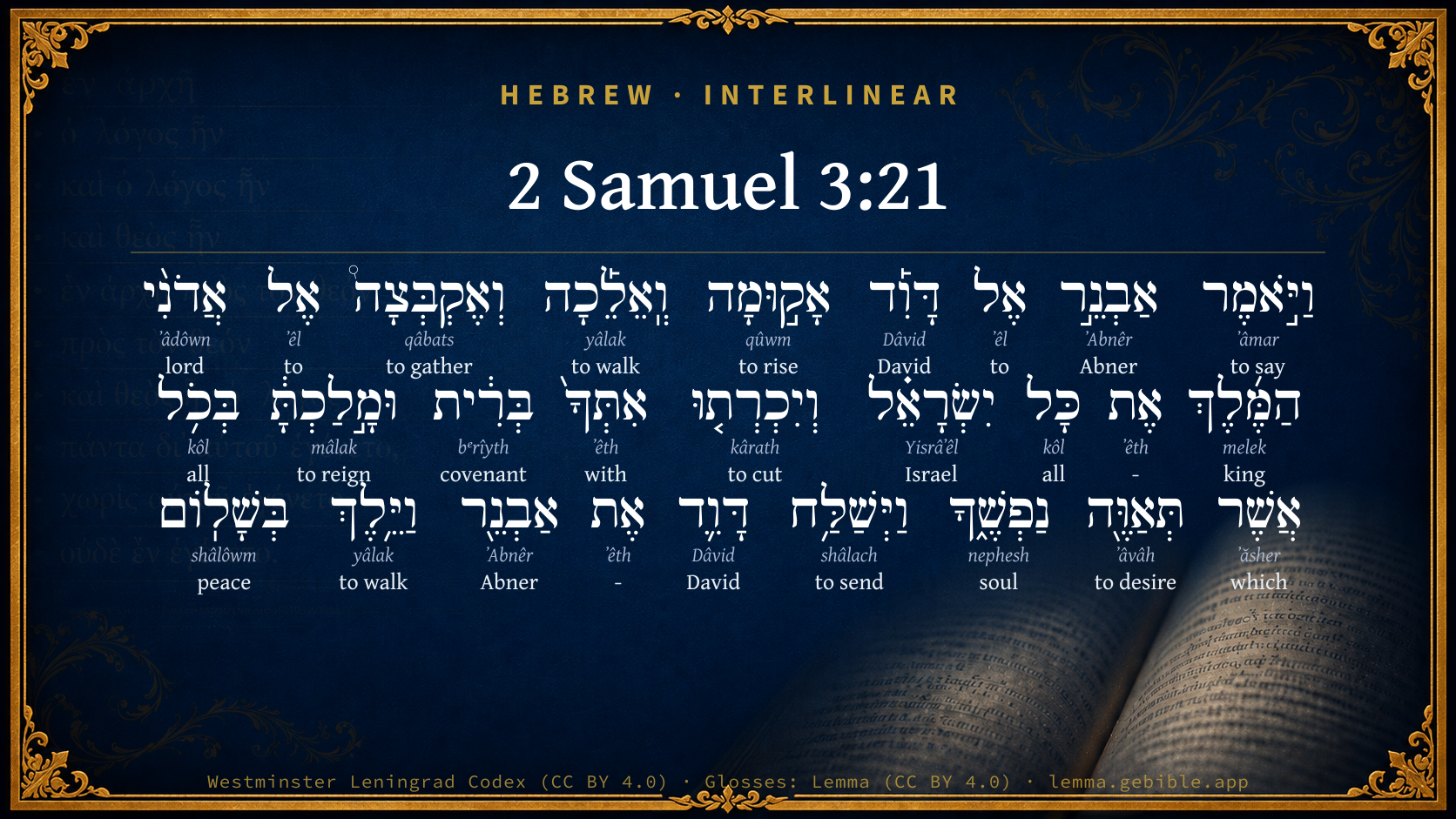
2 Samuel 3:21

Hebrew (Westminster Leningrad Codex) 2 Samuel 3:21 appears in the Hebrew Old Testament. The text above is from the Westminster Leningrad Codex. Each word links to its Strong’s number, a concise gloss, and parsing drawn from the Open Scriptures Hebrew Bible morphology. Click any word for its full Brown-Driver-Briggs (BDB) entry.
Download image
Cite this verse

2 Samuel 3:21 (World English Bible). Public Domain. Lemma interlinear Bible study tool, https://lemma.gebible.app/v/2-samuel/3/21.

Show BibTeX & RIS
BibTeX
RIS
English Translation
Abner said to David, I will arise and go, and will gather all Israel to my lord the king, that they may make a covenant with you, and that you may reign over all that your soul desires. David sent Abner away; and he went in peace.
World English Bible · Public Domain
Download a study sheet

One document with this verse’s original text, its word-by-word gloss line, the meaning frame, cross-references with their text, attributed commentary, and full source and license credits — printable, and it pastes into notes with its structure intact.

This verse Autodidact and up

Study sheet (.html) Plain text (.txt)

A passage Seminary Student

Up to 50 verses in one chapter. A passage sheet keeps up to 6 commentary sources and 12 cross-references per verse, in the order this page ranks them, and says so on the sheet whenever that leaves anything out. Ask for a single verse and you get the Autodidact verse sheet above.

Everything on this page stays free to read, with no account — the sheet is a download of what is already on screen, not access to it.

Want to remove ads? Support Godless Engineer
Compare translations 3

The same verse in 3 English versions, stacked beneath the original-language interlinear above. Click any original word for its lexicon entry.

Each is an independent rendering of the whole verse — the interlinear is not word-aligned to these translations.

Highlighted words mark where these versions differ — a whole-verse word diff, not a word-by-word alignment.

  • World English Bible Public Domain
    Abner said to David, I will arise and go, and will gather all Israel to my lord the king, that they may make a covenant with you, and that you may reign over all that your soul desires. David sent Abner away; and he went in peace.
  • King James Version Public Domain
    And Abner said unto David, I will arise and go, and will gather all Israel unto my lord the king, that they may make a league with thee, and that thou mayest reign over all that thine heart desireth. And David sent Abner away; and he went in peace.
  • unfoldingWord Literal Text CC BY-SA 4.0
    Then Abner said to David, “Let me arise and go and gather to my lord the king all of Israel so they may cut a covenant with you so you may reign over all that your soul desires.” And David sent Abner away, and he went in peace.

unfoldingWord Literal Text — © unfoldingWord, licensed CC BY-SA 4.0. Word-aligned USFM3 via Door43 (git.door43.org/unfoldingWord/en_ult).

Versions to compare (up to 4)

3 of 4 selected

Show all 18 translations

Every available English version of this verse, each an independent rendering of the whole verse.

  • World English Bible Public Domain
    Abner said to David, I will arise and go, and will gather all Israel to my lord the king, that they may make a covenant with you, and that you may reign over all that your soul desires. David sent Abner away; and he went in peace.
  • Berean Standard Bible Public Domain
    Then Abner said to David, “Let me go at once, and I will gather all Israel to my lord the king, that they may make a covenant with you, and that you may rule over all that your heart desires.” So David dismissed Abner, and he went in peace.
  • Majority Standard Bible Public Domain
    Then Abner said to David, “Let me go at once, and I will gather all Israel to my lord the king, that they may make a covenant with you, and that you may rule over all that your heart desires.” So David dismissed Abner, and he went in peace.
  • King James Version Public Domain
    And Abner said unto David, I will arise and go, and will gather all Israel unto my lord the king, that they may make a league with thee, and that thou mayest reign over all that thine heart desireth. And David sent Abner away; and he went in peace.
  • American Standard Version (1901) Public Domain
    And Abner said unto David, I will arise and go, and will gather all Israel unto my lord the king, that they may make a covenant with thee, and that thou mayest reign over all that thy soul desireth. And David sent Abner away; and he went in peace.
  • Revised Version (1885) Public Domain
    And Abner said unto David, I will arise and go, and will gather all Israel unto my lord the king, that they may make a covenant with thee, and that thou mayest reign over all that thy soul desireth. And David sent Abner away; and he went in peace.
  • Geneva Bible (1599) Public Domain
    Then Abner sayde vnto Dauid, I will rise vp, and goe gather all Israel vnto my lorde the King, that they may make a couenant with thee, and that thou mayest reigne ouer all that thine heart desireth. Then Dauid let Abner depart, who went in peace.
  • Douay-Rheims (1899) Public Domain
    And Abner said to David: I will rise, that I may gather all Israel unto thee my lord the king, and may enter into a league with thee, and that thou mayst reign over all as thy soul desireth. Now when David bad brought Abner on his way, and he was gone in peace,
  • Young's Literal Translation Public Domain
    And Abner saith unto David, `I arise, and go, and gather unto my lord the king the whole of Israel, and they make with thee a covenant, and thou hast reigned over all that thy soul desireth;' and David sendeth away Abner, and he goeth in peace.
  • Literal Standard Version CC BY-SA 4.0
    And Abner says to David, “I arise, and go, and gather the whole of Israel to my lord the king, and they make a covenant with you, and you have reigned over all that your soul desires”; and David sends Abner away, and he goes in peace.
  • Unlocked Literal Bible CC BY-SA 4.0
    Abner explained to David, “I will arise and gather all Israel to you, my master the king, so that they may make a covenant with you, so that you may reign over all that you desire.” So David sent Abner away, and Abner left in peace.
  • unfoldingWord Literal Text CC BY-SA 4.0
    Then Abner said to David, “Let me arise and go and gather to my lord the king all of Israel so they may cut a covenant with you so you may reign over all that your soul desires.” And David sent Abner away, and he went in peace.
  • Darby Bible Public Domain
    And Abner said to David, I will arise and go, and will gather all Israel to my lord the king, that they may make a covenant with thee, and that thou mayest reign over all that thy heart desires. And David sent Abner away; and he went in peace.
  • World Messianic Bible Public Domain
    Abner said to David, “I will arise and go, and will gather all Israel to my lord the king, that they may make a covenant with you, and that you may reign over all that your soul desires.” David sent Abner away; and he went in peace.
  • Webster's Bible Public Domain
    And Abner said to David, I will arise and go, and will gather all Israel to my lord the king, that they may make a league with thee, and that thou mayest reign over all that thy heart desireth. And David sent Abner away; and he went in peace.
  • Free Bible Version CC BY-SA 4.0
    Abner told David, “Let me go immediately and summon all of Israel to come together for my lord the king, so they may make an agreement with you, and that you may rule over all you would wish.” Then David sent Abner safely on his way.
  • Bible in Basic English Public Domain
    And Abner said to David, Now I will go, and make all Israel come to my lord the king, so that they may make an agreement with you, and your kingdom may be as wide as your heart's desire. Then David sent Abner away and he went in peace.
  • JPS Tanakh (1917) Public Domain
    And Abner said unto David: 'I will arise and go, and will gather all Israel unto my lord the king, that they may make a covenant with thee, and that thou mayest reign over all that thy soul desireth.' And David sent Abner away; and he went in peace.

Literal Standard Version (2020), Covenant Press — licensed CC BY-SA 4.0. Text via the HelloAO Bible API (eBible.org). Unlocked Literal Bible (unfoldingWord) — licensed CC BY-SA 4.0. Text via the HelloAO Bible API (eBible.org). unfoldingWord Literal Text — © unfoldingWord, licensed CC BY-SA 4.0. Word-aligned USFM3 via Door43 (git.door43.org/unfoldingWord/en_ult). Free Bible Version, Dr. Jonathan Gallagher — licensed CC BY-SA 4.0. Text via the HelloAO Bible API (eBible.org).

Word by word

More ways to search: Search by grammar → Find every occurrence → Compare this word →

Practice this passage: Drill this verse → Learn its vocabulary →

תְּאַוֶּ֖ה
ʼâvâh
H183
“to desire”
Verb, Piel, Imperfect, 3rd Person, Feminine, Singular
Part of Speech
Verb
Stem
Piel
Form
Imperfect
Person
3rd Person
Gender
Feminine
Number
Singular
Full BDB Definition

Origin: a primitive root

TWOT: 40

desire, incline, covet, wait longingly, wish, sigh, want, be greedy, prefer - (Piel) to desire, crave (food and drink) - (Hithpael) to desire, long for, lust after (of bodily appetites)
  1. וַיֹּ֣אמֶר ʼâmar H559 “and · to say” Conjunction + Verb, Qal, Sequential Imperfect, 3rd Person, Masculine, Singular
  2. אַבְנֵ֣ר ʼAbnêr H74 “Abner” Noun, Proper
  3. אֶל ʼêl H413 “to” Preposition
  4. דָּוִ֡ד Dâvid H1732 “David” Noun, Proper
  5. אָק֣וּמָה qûwm H6965 “to rise” Verb, Qal, Cohortative, 1st Person, Common, Singular
  6. וְֽאֵלֵ֡כָה yâlak H3212 “and · to walk” Conjunction + Verb, Qal, Cohortative, 1st Person, Common, Singular
  7. וְאֶקְבְּצָה֩ qâbats H6908 “and · to gather” Conjunction + Verb, Qal, Cohortative, 1st Person, Common, Singular
  8. אֶל ʼêl H413 “to” Preposition
  9. אֲדֹנִ֨י ʼâdôwn H113 “lord · my” Noun, Common, Masculine, Singular, Construct + Suffix, Personal, 1st Person, Common, Singular
  10. הַמֶּ֜לֶךְ melek H4428 “the · king” Particle, Definite Article + Noun, Common, Masculine, Singular, Absolute
  11. אֶת ʼêth H853 “-” Particle, Direct Object
  12. כָּל kôl H3605 “all of” Noun, Common, Masculine, Singular, Construct
  13. יִשְׂרָאֵ֗ל Yisrâʼêl H3478 “Israel” Noun, Proper
  14. וְיִכְרְת֤וּ kârath H3772 “and · to cut” Conjunction + Verb, Qal, Imperfect, 3rd Person, Masculine, Plural
  15. אִתְּךָ֙ ʼêth H854 “with · you” Preposition + Suffix, Personal, 2nd Person, Masculine, Singular
  16. בְּרִ֔ית bᵉrîyth H1285 “covenant” Noun, Common, Feminine, Singular, Absolute
  17. וּמָ֣לַכְתָּ֔ mâlak H4427 “and · to reign” Conjunction + Verb, Qal, Sequential Perfect, 2nd Person, Masculine, Singular
  18. בְּכֹ֥ל kôl H3605 “in/at · all” Preposition + Noun, Common, Masculine, Singular, Absolute
  19. אֲשֶׁר ʼăsher H834 “which” Particle, Relative
  20. נַפְשֶׁ֑ךָ nephesh H5315 “soul · your” Noun, Common, Both, Singular, Construct + Suffix, Personal, 2nd Person, Masculine, Singular
  21. וַיְּשַׁלַּ֥ח shâlach H7971 “and · to send” Conjunction + Verb, Piel, Sequential Imperfect, 3rd Person, Masculine, Singular
  22. דָּוִ֛ד Dâvid H1732 “David” Noun, Proper
  23. אֶת ʼêth H853 “-” Particle, Direct Object
  24. אַבְנֵ֖ר ʼAbnêr H74 “Abner” Noun, Proper
  25. וַיֵּ֥לֶךְ yâlak H3212 “and · to walk” Conjunction + Verb, Qal, Sequential Imperfect, 3rd Person, Masculine, Singular
  26. בְּשָׁלֽוֹם shâlôwm H7965 “in/at · peace” Preposition + Noun, Common, Masculine, Singular, Absolute

About this verse

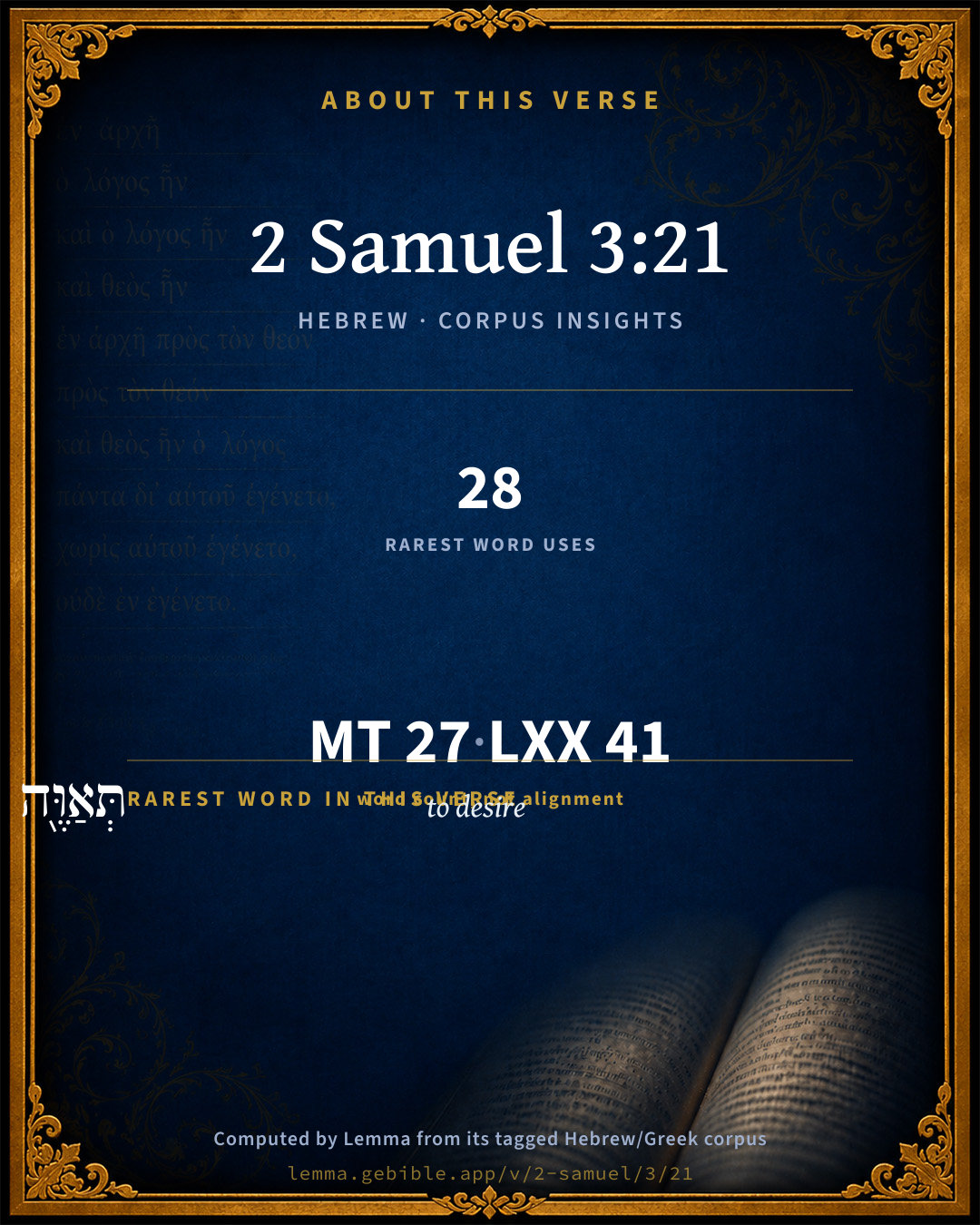
These counts appear in no published source. They are computed here, from the morphology-tagged text and Lemma’s own curated glosses. What Lemma adds →

27
words
21
distinct lemmas
Historical
section

Shared distinctive vocabulary

תְּאַוֶּ֖ה to desire H183 occurs in 25 verses of the Hebrew Bible. Also found in:

Grammatical profile

  • 9 verbs
  • 12 nouns
  • 3 prepositions
  • 3 particles

Verb forms

  • וַיֹּ֣אמֶר Qal · Sequential Imperfect
  • אָק֣וּמָה Qal · Cohortative
  • וְֽאֵלֵ֡כָה Qal · Cohortative
  • וְאֶקְבְּצָה֩ Qal · Cohortative
  • וְיִכְרְת֤וּ Qal · Imperfect
  • וּמָ֣לַכְתָּ֔ Qal · Sequential Perfect
  • תְּאַוֶּ֖ה Piel · Imperfect
  • וַיְּשַׁלַּ֥ח Piel · Sequential Imperfect
  • וַיֵּ֥לֶךְ Qal · Sequential Imperfect

Repetition

Words recur within this verse — often emphatic in Hebrew:

  • אַבְנֵ֣ר Abner H74 ×2
  • דָּוִ֡ד David H1732 ×2
  • וְֽאֵלֵ֡כָה to walk H3212 ×2
  • כָּל all H3605 ×2
  • אֶל to H413 ×2

Hebrew & Septuagint length

In English translation the verse runs 47 words from the Hebrew and 48 from the Septuagint (LXX English) — closely comparable.

A rough comparison of the two English renderings, which tokenize alike — not a word-level alignment.

Word counts can differ between the Hebrew and the Greek without any difference in meaning — e.g. the Hebrew direct-object marker אֵת has no separate Greek word, and Greek often adds the article ὁ.

In the original languages it is 27 Hebrew tokens and 41 Greek tokens — but the two are counted differently (Hebrew bundles its prefixes and suffixes into one token; the Greek is in lemma form), so that isn’t a like-for-like length.

Cross-references

6

Topical passages linked to 2 Samuel 3:21 in the Treasury of Scripture Knowledge — connected by theme and wording, ordered by reader-vote popularity; previews shown in the World English Bible.

  • 2 Samuel 3:12 Abner sent messengers to David on his behalf, saying, Whose is the land? saying [also], Make your league with me, and, behold, my hand shall be with you, to bring about all Israel to you.
  • 1 Kings 11:37 I will take you, and you shall reign according to all that your soul desires, and shall be king over Israel.
  • 2 Samuel 3:10 to transfer the kingdom from the house of Saul, and to set up the throne of David over Israel and over Judah, from Dan even to Beersheba.
  • 2 Samuel 2:9 and he made him king over Gilead, and over the Ashurites, and over Jezreel, and over Ephraim, and over Benjamin, and over all Israel.
  • Psalms 20:4 May He grant you your heart's desire, And fulfill all your counsel.
  • Philippians 2:21 For they all seek their own, not the things of Jesus Christ.

Cross-references courtesy of OpenBible.info (CC BY 4.0).

Hebrew and Greek witnesses Masoretic Hebrew ↔ Greek Septuagint

The same verse in the two great witnesses to the Old Testament, shown verse-for-verse.

These are two independent witnesses, not word-aligned to each other, and the Septuagint is shown in lemma (dictionary) form.

Hebrew 2 Samuel 3:21 Masoretic · Westminster Leningrad Codex

וַיֹּ֣אמֶר אַבְנֵ֣ר אֶל דָּוִ֡ד אָק֣וּמָה וְֽאֵלֵ֡כָה וְאֶקְבְּצָה֩ אֶל אֲדֹנִ֨י הַמֶּ֜לֶךְ אֶת כָּל יִשְׂרָאֵ֗ל וְיִכְרְת֤וּ אִתְּךָ֙ בְּרִ֔ית וּמָ֣לַכְתָּ֔ בְּכֹ֥ל אֲשֶׁר תְּאַוֶּ֖ה נַפְשֶׁ֑ךָ וַיְּשַׁלַּ֥ח דָּוִ֛ד אֶת אַבְנֵ֖ר וַיֵּ֥לֶךְ בְּשָׁלֽוֹם

Abner said to David, I will arise and go, and will gather all Israel to my lord the king, that they may make a covenant with you, and that you may reign over all that your soul desires. David sent Abner away; and he went in peace.

World English Bible · Public Domain

Greek LXX 2 Samuel 3:21 Septuagint · lemma form

καί εἶπον αβεννηρ πρός δαυίδ ἀναἵστημι δή καί πορεύομαι καί συνἀθροίζω πρός κύριος ἐγώ ὁ βασιλεύς πᾶς ἰσραήλ καί διατίθημι μετά σύ διαθήκη καί βασιλεύω ἐπί πᾶς ὅς ἐπιθυμέω ὁ ψυχή σύ καί ἀποστέλλω δαυίδ ὁ αβεννηρ καί πορεύομαι ἐν εἰρήνη

And Abenner said to David, I will arise now, and go, and gather to my lord the king all Israel; and I will make with him a covenant, and you shall reign over all whom your soul desires. And David sent away Abenner, and he departed in peace.

LXX2012 (modern English Septuagint) · Public Domain

Hebrew: Westminster Leningrad Codex (CC BY 4.0). Greek: Septuagint (public domain); English from LXX2012 (modern English Septuagint) (Public Domain). How the Septuagint differs from the Hebrew →

Targum (Aramaic paraphrase)

1

The Targum is the ancient Jewish Aramaic paraphrase of the Hebrew Scriptures — an interpretive translation, not the Hebrew text itself. Onkelos (literal) and Pseudo-Jonathan (expansive) render the Torah, and Jonathan the Prophets. Coverage is partial: where no permissively-licensed English translation exists for a verse, only the Aramaic is shown. This is verse-level text, not a word-by-word alignment to the Hebrew.

  1. Targum Jonathan Prophets (Joshua–Malachi)
    וַאֲמַר אַבְנֵר לְדָוִד אֵיקוּם וְאֵיזַל וְאֶכְנוֹשׁ לְוַת רִבּוֹנִי מַלְכָּא יַת כָּל יִשְׂרָאֵל וְיִגְזְרוּן עִמָךְ קְיָם וְתִמְלוֹךְ בְּכָל דְרַעֲוָא נַפְשָׁךְ וּשְׁלַח דָוִד יַת אַבְנֵר וַאֲזַל בִּשְׁלָם:

    (no public-domain English translation for this verse)

    Targum Jonathan — Aramaic: “Mikraot Gedolot” (public domain). English: “Sefaria Community Translation” (CC0 1.0 (public-domain dedication)); “London "Chaldee Paraphrase," 1871” (public domain). Text via Sefaria.

Commentary

Notes on 2 Samuel 3:21 from classic Christian and Jewish commentators (each source and its license shown beneath its notes). The classic Christian expositions comment on the surrounding passage and are grouped to its opening verse, so a note may address several verses; the Jewish commentaries on the Tanakh (Rashi and others) are per-verse, so they appear only where the commentator wrote on this verse.

Lemma curates 59 commentaries, every one of them public domain or Creative Commons licensed, each selected and text-cleaned for this edition rather than reprinted as found. About our sources →

Trapp's Complete Commentary

John Trapp

2Sa 3:21 And Abner said unto David, I will arise and go, and will gather all Israel unto my lord the king, that they may make a league with thee, and that thou mayest reign over all that thine heart desireth. And David sent Abner away; and he went in peace.

Ver. 21. I will arise and go, and will gather.] He doubted not but to do all this, as if the whole matter had lain in his hand. God is not in all his thoughts.

John Trapp, A Commentary or Exposition upon All the Books of the Old and New Testament (1647–1656) — public domain. Text from a community e-Sword module.

Joseph Benson's Commentary

2Sa 3:21-22. Abner said, I will gather all Israel unto my lord the king — How empty and ill founded are the purposes of vain man! Abner, who here promises kingdoms, soon found that he could not ensure to himself one hour of life. David had sent him away, and he departed in peace; but, Behold, the servants of David and Joab came from pursuing a troop — In those times of distraction between Judah and Israel, we may well think their neighbours, who were enemies to both, namely, the Philistines, Edomites, Moabites, and others, made many inroads upon the country to get spoil. Joab, however, and the valiant men about David, watched to prevent this, and at this time had overtaken a company of them, in their return home, and recovered a great booty from them.

Joseph Benson's Commentary on the Old and New Testaments (1811–1818) — public domain. Text from a community e-Sword module.

Tyndale Open Study Notes

Tyndale Open Resources

3:21 The narrator emphasized that David sent Abner safely on his way as a friend and an ally (restated in 3:22-23). David was at peace with Abner and was not involved in the renowned military leader’s murder (cp. 3:28-29). • Despite the murder of Abner (3:27), the northern tribes eventually did make a covenant with David to make him their king, just as Abner had promised (5:1-3).

Tyndale Open Study Notes — © Tyndale Open Resources, licensed CC BY-SA 4.0. Text via the HelloAO Bible API.

Geneva Bible (1599)

Geneva Bible translators

Or, without harm.

Geneva Bible (1599) marginal notes — public domain. Text via Bolls.life.

Adam Clarke's Commentary

Verse 21. He went in peace.] David dismissed him in good faith, having no sinister design in reference to him.

Adam Clarke's Commentary on the Bible (1810–1826) — public domain. Text from a community e-Sword/MySword module.

The Cambridge Bible for Schools and Colleges

gen. ed. J. J. S. Perowne

21. and will gather all Israel] A meeting of the national assembly or “congregation of Israel” was requisite to accept David as king. Cp. ch. 2Sa_5:1, and see note on 1Sa_10:17.

Abner] Observe the emphatic way in which Abner’s name is repeated in 2Sa_3:17-21, and not merely represented by pronouns. It concentrates attention on the personality of this man who treats as the agent for the transfer of a kingdom which his own energy has consolidated.

The Cambridge Bible for Schools and Colleges (gen. ed. J. J. S. Perowne; Cambridge University Press, 1878–1918) — public domain. Text from a community e-Sword module.

John Gill's Exposition

And Abner said to David, I will arise and go,.... Into the several parts of the land of Israel:

and will gather all Israel unto my lord the king; the princes of the several tribes, and the elders of the people, their heads and principal men:

that they may make a league with thee; come into the league and covenant now made with Abner, and those with him:

and that thou mayest reign over all that thine heart desireth: which he supposed reached to all the people of the house of Israel and of Judah, though David had not expressed any eager and impatient desire of government, but waited the Lord's time to be put into the possession of the whole kingdom of Israel:

and David sent Abner away, and he went in peace; with inward satisfaction of mind, pleased that things were so well settled and adjusted to the content of all parties, and with outward satiety of body, no insults or attempts being made upon him by any of David's men; which perhaps would not have been the case if Joab had been at court, as may be concluded from what follows.

John Gill's Exposition of the Whole Bible (1746–1763) — public domain (CC PDM 1.0). Text via the HelloAO Bible API.

Albert Barnes' Notes on the Bible

Abner repeats the offer 2Sa 3:12; and the condition of Michal’s return 2Sa 3:13 being now fulfilled, David accepts it, and the league between them was solemnly ratified at David’s board, amidst the rites of hospitality.

Albert Barnes' Notes on the Bible (1834–1885) — public domain. Text from a community e-Sword/MySword module.

Haydock's Catholic Bible Commentary

And may. Some Latin copies read with the Hebrew, "and it (Israel) may enter," ineat.

George Leo Haydock (1774–1849), Haydock's Catholic Family Bible and Commentary, 1859 edition — public domain. Excludes Psalms (Douay-Rheims chapter numbering differs from Protestant) and Deuterocanonical books (Catholic canon only).

Matthew Poole's English Annotations

All Israel, i.e. the elders and chieftains of all Israel, representing and ruling all the rest.

Matthew Poole's English Annotations on the Holy Bible (1683–1685) — public domain. Text from a community e-Sword/MySword module.

unfoldingWord translationNotes

Door43 World Missions Community

all Israel

This phrase means "all of the nation of Israel." (See: Metonymy)

So David sent Abner away

They parted as friends. David was not angry with Abner.

translationWords

raise

lord

covenant

reign

peace

unfoldingWord translationNotes — © Distant Shores Media and the Door43 World Missions Community, licensed CC BY-SA 4.0. Source: git.door43.org/Door43/en_tn.

Lesson kit

Teaching starters — assembled from the data on this page, not authored interpretation. Every prompt links to the verse data it draws on. Edit before teaching.

2 Samuel, in the Historical, opens this verse with 27 words (21 distinct Hebrew lemmas). Its most distinctive word is ʼâvâh (“to desire”). A historical commentator’s framing appears above. Read the whole chapter for the surrounding context.

Discussion questions

  1. What does “to desire” (ʼâvâh) contribute to the verse as a whole?
  2. How does Numbers 11:4, which shares the word «to desire», read alongside this verse?
  3. What does the repetition of “Abner” (2× in this one verse) do in this verse?
  4. These translations render this verse differently. What is at stake in choosing one wording over another?
  5. «וַיֹּ֣אמֶר» is a Qal Sequential Imperfect verb. How does that grammatical form shape the action described?
  6. Compare how Trapp's Complete Commentary and Joseph Benson's Commentary read this verse. Where do they agree or differ?

Things to notice

Reading settings

Reading text

Shown beneath each verse's original-language words.

Old Testament
Old Testament edition

Read the OT as the Masoretic Hebrew (MT) or the Greek Septuagint (LXX).

English shown for the Greek Septuagint (in the Hebrew ↔ Greek comparison).

Comparing translations? Open the Compare panel on any verse page to stack up to four side by side.