Psalms 101:8

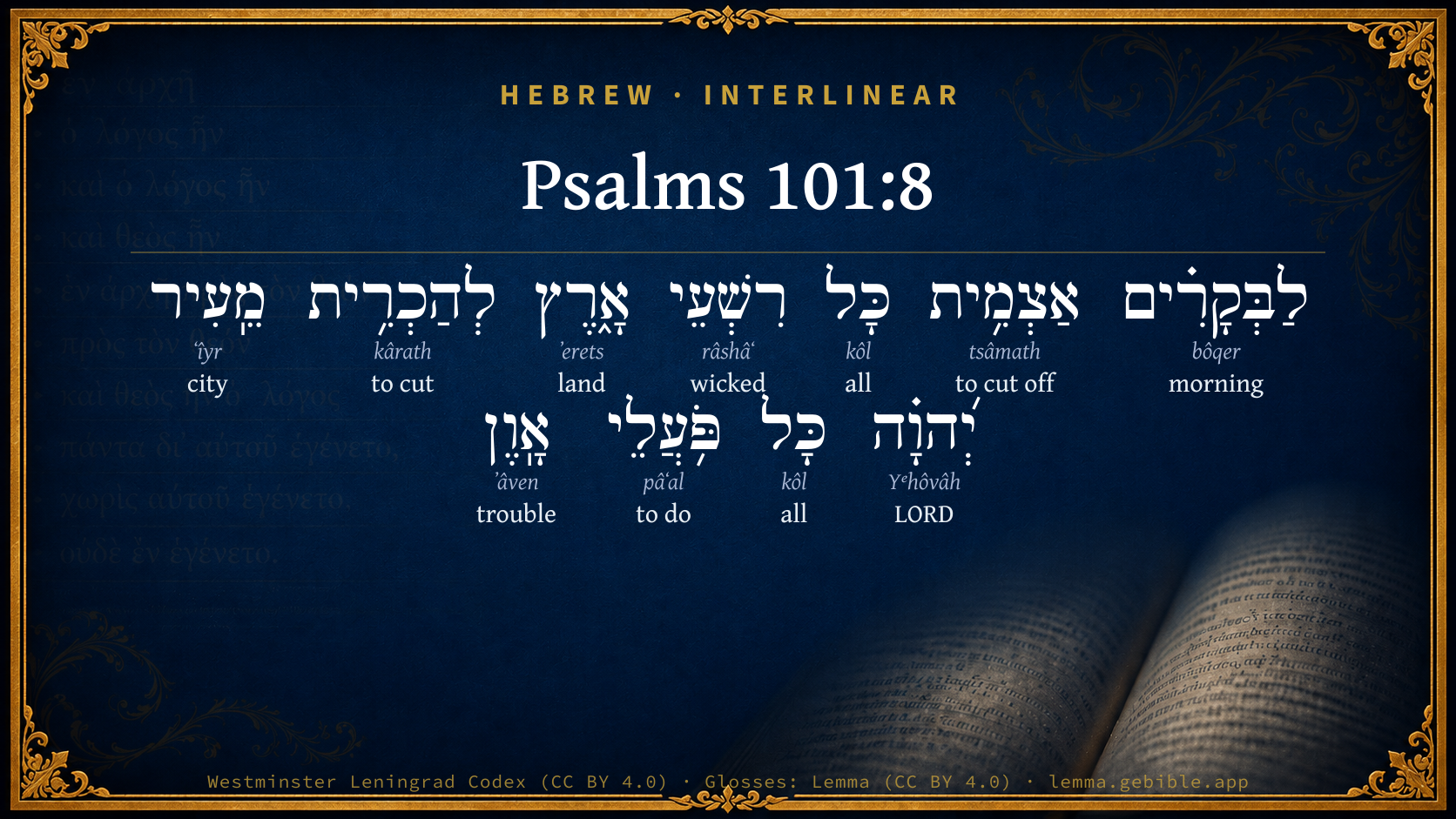
Hebrew (Westminster Leningrad Codex) Psalms 101:8 appears in the Hebrew Old Testament. The text above is from the Westminster Leningrad Codex. Each word links to its Strong’s number, a concise gloss, and parsing drawn from the Open Scriptures Hebrew Bible morphology. Click any word for its full Brown-Driver-Briggs (BDB) entry.
Download image
Cite this verse

Psalms 101:8 (World English Bible). Public Domain. Lemma interlinear Bible study tool, https://lemma.gebible.app/v/psalms/101/8.

Show BibTeX & RIS
BibTeX
RIS
English Translation
Morning by morning, I will destroy all the wicked of the land; To cut off all the workers of iniquity from Yahweh's city.
World English Bible · Public Domain
Download a study sheet

One document with this verse’s original text, its word-by-word gloss line, the meaning frame, cross-references with their text, attributed commentary, and full source and license credits — printable, and it pastes into notes with its structure intact.

This verse Autodidact and up

Study sheet (.html) Plain text (.txt)

A passage Seminary Student

Up to 50 verses in one chapter. A passage sheet keeps up to 6 commentary sources and 12 cross-references per verse, in the order this page ranks them, and says so on the sheet whenever that leaves anything out. Ask for a single verse and you get the Autodidact verse sheet above.

Everything on this page stays free to read, with no account — the sheet is a download of what is already on screen, not access to it.

Want to remove ads? Support Godless Engineer
Compare translations 3

The same verse in 3 English versions, stacked beneath the original-language interlinear above. Click any original word for its lexicon entry.

Each is an independent rendering of the whole verse — the interlinear is not word-aligned to these translations.

Highlighted words mark where these versions differ — a whole-verse word diff, not a word-by-word alignment.

  • World English Bible Public Domain
    Morning by morning, I will destroy all the wicked of the land; To cut off all the workers of iniquity from Yahweh's city.
  • King James Version Public Domain
    I will early destroy all the wicked of the land; that I may cut off all wicked doers from the city of the LORD.
  • unfoldingWord Literal Text CC BY-SA 4.0
    In the mornings I will destroy all the wicked of the land, to cut off all workers of evil from the city of Yahweh.

unfoldingWord Literal Text — © unfoldingWord, licensed CC BY-SA 4.0. Word-aligned USFM3 via Door43 (git.door43.org/unfoldingWord/en_ult).

Versions to compare (up to 4)

3 of 4 selected

Show all 18 translations

Every available English version of this verse, each an independent rendering of the whole verse.

  • World English Bible Public Domain
    Morning by morning, I will destroy all the wicked of the land; To cut off all the workers of iniquity from Yahweh's city.
  • Berean Standard Bible Public Domain
    Every morning I will remove all the wicked of the land, that I may cut off every evildoer from the city of the LORD.
  • Majority Standard Bible Public Domain
    Every morning I will remove all the wicked of the land, that I may cut off every evildoer from the city of the LORD.
  • King James Version Public Domain
    I will early destroy all the wicked of the land; that I may cut off all wicked doers from the city of the LORD.
  • American Standard Version (1901) Public Domain
    Morning by morning will I destroy all the wicked of the land; To cut off all the workers of iniquity from the city of Jehovah. Psalm 102 A Prayer of the afflicted, when he is overwhelmed, and poureth out his complaint before Jehovah.
  • Revised Version (1885) Public Domain
    Morning by morning will I destroy all the wicked of the land; to cut off all the workers of iniquity from the city of the LORD.
  • Geneva Bible (1599) Public Domain
    Betimes will I destroy all the wicked of the land, that I may cut off all the workers of iniquitie from the Citie of the Lord.
  • Douay-Rheims (1899) Public Domain
    In the morning I put to death all the wicked of the land: that I might cut off all the workers of iniquity from the city of the Lord.
  • Young's Literal Translation Public Domain
    At morning I cut off all the wicked of the land, To cut off from the city of Jehovah All the workers of iniquity!
  • Literal Standard Version CC BY-SA 4.0
    At morning I cut off all the wicked of the land, || To cut off from the city of YHWH || All the workers of iniquity!
  • Unlocked Literal Bible CC BY-SA 4.0
    Morning by morning I will destroy all the wicked from the land; I will remove all evildoers from the city of Yahweh.
  • unfoldingWord Literal Text CC BY-SA 4.0
    In the mornings I will destroy all the wicked of the land, to cut off all workers of evil from the city of Yahweh.
  • Darby Bible Public Domain
    Every morning will I destroy all the wicked of the land: to cut off all workers of iniquity from the city of Jehovah.
  • World Messianic Bible Public Domain
    Morning by morning, I will destroy all the wicked of the land, to cut off all the workers of iniquity from the LORD’s city.
  • Webster's Bible Public Domain
    I will early destroy all the wicked of the land; that I may cut off all who practice wickedness from the city of the LORD.
  • Free Bible Version CC BY-SA 4.0
    I work every day to silence the wicked in the land, to rid the city of the Lord of all who do evil.
  • Bible in Basic English Public Domain
    Morning by morning will I put to death all the sinners in the land, so that all evil-doers may be cut off from Jerusalem.
  • JPS Tanakh (1917) Public Domain
    Morning by morning will I destroy all the wicked of the land; to cut off all the workers of iniquity from the city of the LORD.

Literal Standard Version (2020), Covenant Press — licensed CC BY-SA 4.0. Text via the HelloAO Bible API (eBible.org). Unlocked Literal Bible (unfoldingWord) — licensed CC BY-SA 4.0. Text via the HelloAO Bible API (eBible.org). unfoldingWord Literal Text — © unfoldingWord, licensed CC BY-SA 4.0. Word-aligned USFM3 via Door43 (git.door43.org/unfoldingWord/en_ult). Free Bible Version, Dr. Jonathan Gallagher — licensed CC BY-SA 4.0. Text via the HelloAO Bible API (eBible.org).

Word by word

More ways to search: Search by grammar → Find every occurrence → Compare this word →

Practice this passage: Drill this verse → Learn its vocabulary →

אַצְמִ֥ית
tsâmath
H6789
“to cut off”
Verb, Hiphil, Imperfect, 1st Person, Common, Singular
Part of Speech
Verb
Stem
Hiphil
Form
Imperfect
Person
1st Person
Gender
Common
Number
Singular
Full BDB Definition

Origin: a primitive root

TWOT: 1932

to put an end to, cut off, destroy, exterminate, extirpate - (Qal) to put an end to, terminate - (Niphal) to be ended, be annihilated, be exterminated - (Piel) to put an end to - (Pilel) to be exterminated, be annihilated - (Hiphil) to exterminate, annihilate
  1. לַבְּקָרִ֗ים bôqer H1242 “to/for the · mornings” Preposition, Determined + Noun, Common, Masculine, Plural, Absolute
  2. כָּל kôl H3605 “all of” Noun, Common, Masculine, Singular, Construct
  3. רִשְׁעֵי râshâʻ H7563 “wicked of” Adjective, Adjective, Masculine, Plural, Construct
  4. אָ֑רֶץ ʼerets H776 “land” Noun, Common, Both, Singular, Absolute
  5. לְהַכְרִ֥ית kârath H3772 “to cut” Preposition + Verb, Hiphil, Infinitive Construct
  6. מֵֽעִיר ʻîyr H5892 “from · city of” Preposition + Noun, Common, Feminine, Singular, Construct
  7. יְ֝הוָ֗ה Yᵉhôvâh H3068 “LORD” Noun, Proper
  8. כָּל kôl H3605 “all of” Noun, Common, Masculine, Singular, Construct
  9. פֹּ֥עֲלֵי pâʻal H6466 “doing” Verb, Qal, Participle Active, Masculine, Plural, Construct
  10. אָֽוֶן ʼâven H205 “trouble” Noun, Common, Masculine, Singular, Absolute

About this verse

These counts appear in no published source. They are computed here, from the morphology-tagged text and Lemma’s own curated glosses. What Lemma adds →

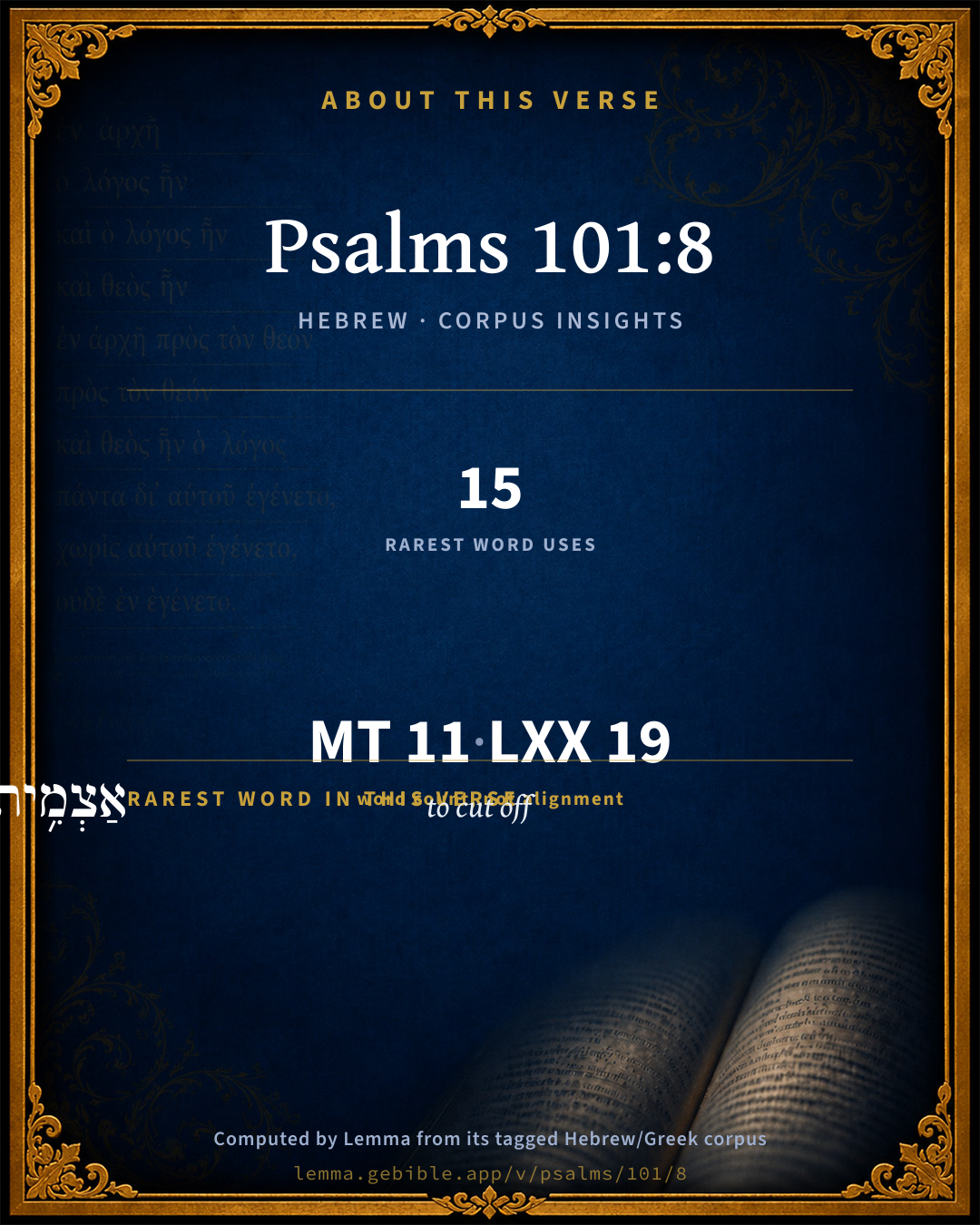
11
words
10
distinct lemmas
Wisdom
section

Notable vocabulary

The rarest word here is אַצְמִ֥ית to cut off H6789 — appearing just 15 times in the whole Hebrew Bible.

Shared distinctive vocabulary

אַצְמִ֥ית to cut off H6789 occurs in 14 verses of the Hebrew Bible. Also found in:

Grammatical profile

  • 3 verbs
  • 7 nouns
  • 1 adjective

Verb forms

  • אַצְמִ֥ית Hiphil · Imperfect
  • לְהַכְרִ֥ית Hiphil · Infinitive Construct
  • פֹּ֥עֲלֵי Qal · Participle Active

Repetition

A word recurs within this verse — often emphatic in Hebrew:

Hebrew & Septuagint length

In English translation the verse runs 23 words from the Hebrew and 25 from the Septuagint (LXX English) — closely comparable.

A rough comparison of the two English renderings, which tokenize alike — not a word-level alignment.

Word counts can differ between the Hebrew and the Greek without any difference in meaning — e.g. the Hebrew direct-object marker אֵת has no separate Greek word, and Greek often adds the article ὁ.

In the original languages it is 11 Hebrew tokens and 19 Greek tokens — but the two are counted differently (Hebrew bundles its prefixes and suffixes into one token; the Greek is in lemma form), so that isn’t a like-for-like length.

Cross-references

15

Topical passages linked to Psalms 101:8 in the Treasury of Scripture Knowledge — connected by theme and wording, ordered by reader-vote popularity; previews shown in the World English Bible.

  • Psalms 75:10 I will cut off all the horns of the wicked, But the horns of the righteous shall be lifted up.
  • Jeremiah 21:12 House of David, thus says Yahweh, Execute justice in the morning, and deliver him who is robbed out of the hand of the oppressor, lest my wrath go forth like fire, and burn so that none can quench it, because of the evil of your doings.
  • Proverbs 16:12 It is an abomination for kings to do wrong, For the throne is established by righteousness.
  • Psalms 48:8 As we have heard, so we have seen, In the city of Yahweh of Hosts, in the city of our God. God will establish it forever. Selah.
  • Psalms 46:4 There is a river, the streams of which make the city of God glad, The holy place of the tents of the Most High.
  • Proverbs 20:8 A king who sits on the throne of judgment Scatters away all evil with his eyes.
  • Proverbs 20:26 A wise king winnows out the wicked, And drives the threshing wheel over them.
  • Revelation 22:14–15 Blessed are those who do his commandments, that they may have the right to the tree of life, and may enter in by the gates into the city.
  • Psalms 48:2 Beautiful in elevation, the joy of the whole earth, Is Mount Zion, on the north sides, The city of the great King.
  • Hosea 9:3 They won't dwell in Yahweh's land; But Ephraim will return to Egypt, And they will eat unclean food in Assyria.
  • Micah 3:9 Please listen to this, you heads of the house of Jacob, And rulers of the house of Israel, Who abhor justice, And pervert all equity.
  • Revelation 21:27 There will in no way enter into it anything profane, or one who causes an abomination or a lie, but only those who are written in the Lamb's book of life.
  • Micah 2:8–10 But lately my people have risen up as an enemy. You strip the robe and clothing from those who pass by without a care, returning from battle.
  • Micah 3:1–4 I said, "Please listen, you heads of Jacob, And rulers of the house of Israel: Isn't it for you to know justice?
  • Psalms 118:10–12 All the nations surrounded me, But in the name of Yahweh, I cut them off.

Cross-references courtesy of OpenBible.info (CC BY 4.0).

Hebrew and Greek witnesses Masoretic Hebrew ↔ Greek Septuagint

The same verse in the two great witnesses to the Old Testament, shown verse-for-verse.

You’re reading Greek Psalm 100 (Hebrew Psalm 101). The Septuagint counts the superscription, so verse numbers can differ from the Hebrew — chapter-level alignment, not verse-by-verse. Numbering follows Rahlfs.

These are two independent witnesses, not word-aligned to each other, and the Septuagint is shown in lemma (dictionary) form.

Hebrew Psalms 101:8 Masoretic · Westminster Leningrad Codex

לַבְּקָרִ֗ים אַצְמִ֥ית כָּל רִשְׁעֵי אָ֑רֶץ לְהַכְרִ֥ית מֵֽעִיר יְ֝הוָ֗ה כָּל פֹּ֥עֲלֵי אָֽוֶן

Morning by morning, I will destroy all the wicked of the land; To cut off all the workers of iniquity from Yahweh's city.

World English Bible · Public Domain

Greek LXX Greek Psalm 100:8 Septuagint · lemma form

εἰς ὁ πρωία ἀποκτείνω πᾶς ὁ ἁμαρτωλός ὁ γῆ ὁ ἐκὀλεθρεύω ἐκ πόλις κύριος πᾶς ὁ ἐργάζω ὁ ἀνομία

Early did I kill all the sinners of the land, that I might destroy out of the city of the Lord all that work iniquity.

LXX2012 (modern English Septuagint) · Public Domain

Hebrew: Westminster Leningrad Codex (CC BY 4.0). Greek: Septuagint (public domain); English from LXX2012 (modern English Septuagint) (Public Domain). How the Septuagint differs from the Hebrew →

Commentary

Notes on Psalms 101:8 from classic Christian and Jewish commentators (each source and its license shown beneath its notes). The classic Christian expositions comment on the surrounding passage and are grouped to its opening verse, so a note may address several verses; the Jewish commentaries on the Tanakh (Rashi and others) are per-verse, so they appear only where the commentator wrote on this verse.

Lemma curates 59 commentaries, every one of them public domain or Creative Commons licensed, each selected and text-cleaned for this edition rather than reprinted as found. About our sources →

Trapp's Complete Commentary

John Trapp

Psa 101:8 I will early destroy all the wicked of the land; that I may cut off all wicked doers from the city of the LORD.

Ver. 8. I will early destroy all the wicked of the land] All, without partiality, and betimes, in matutinis, without delay, making it my morning’s work to do justice; for then was judgment executed, Jer 21:12. Or, I will do it daily, and as duly as the house is swept. See Lam 3:23, Indesinenter regnum, regiam Ecclesiamque purgabo a male (Trem.).

That I may cut off all wicked doers from the city of God] All the notorious debuchers from the Church; that I may weed out those wicked ones, those trouble towns, those desperadoes, the botches of human society. And here David describeth the utmost and chief end of civil government (that which the philosophers never dreamed of), viz. That God may be purely and sincerely served in his city, that is, in his Church.

John Trapp, A Commentary or Exposition upon All the Books of the Old and New Testament (1647–1656) — public domain. Text from a community e-Sword module.

The Biblical Illustrator

Joseph S. Exell

Psa_101:8

I will set no wicked thing before mine eyes.

In the minds eye

On one occasion Sir Thomas Lawrence, the great painter, then President of the Royal Academy, visited the studio of a struggling young artist. He had noticed the young mans work, and thought it had some promise; but when he saw the sketches tacked up on the walls of the bare little room, he shook his head. They were rough, clever examples of the Flemish school, striking but coarse. If I were you, said the great painter to the beginner, I would not allow my eye to be familiarized with any but the highest forms of art. If you cannot afford to buy oil paintings, buy good engravings of great pictures. If you allow your eye to become familiar with what is vulgar in conception, however free and dashing the handling, and however excellent the feeling for colour, your taste will insensibly become depraved; whereas, if you habituate your eye to look only upon what is pure and grand, or refined and lovely, your taste will insensibly be elevated. It was sound artistic advice, and the young painter profited by it. It remains, also, sound moral advice for all young people. Our minds eye needs training as much as our physical vision. If we hang pictures in the halls of our brain that are not elevating, our moral perceptions will become lowered. The best thoughts are within our reach. Why should we choose, instead, thoughts that are flippant, vulgar, or worse? Every time we put an undesirable picture in our minds eye, where it will be often in view, we deprave our own understanding. As a man thinketh in his heart, so is he. If we wish to elevate and strengthen our souls, we must be careful in our choice of habitual thoughts. Whatsoever things are true, etc. It is well-known advice--but can it be bettered? (Free Church Record.)

I hate the work of them that turn aside.

Turning aside

I. Describe their character. The phrase, turn aside, denotes three things--

1. That there exists a way, path, or road in which we have to go.

2. That we have been in that way.

3. That there has been an awful departure from it.

(1) Some turn aside cowardly (Num_21:4).

(2) Some turn aside incautiously (1Sa_12:23). Bunyans Pilgrim, with his companion Hopeful, wandered into the grounds of Giant Despair, and ultimately found themselves in the dungeons of Doubting Castle. He discovered a stile which led into a meadow, where was a footpath that seemed to run parallel with the high-road; into this path he went, thinking that it would prove easier for his feet. Let this illustrate what is meant to be conveyed by the term turning aside incautiously.

(3) Others turn aside courteously and complaisantly.

(4) Some turn aside through unwatchfulness (Mat_26:41).

II. Illustrate their work.

1. An evil work (Jer_2:19).

2. A disgraceful and dishonourable work (Pro_14:34). What a disgraceful reflection it is upon the wisdom and economy of a man who begins to build, and is not able to finish! (Luk_14:28-30). How scandalous to forsake God, and associate with the devil; to exchange Christ for Belial, light for darkness, truth for error, liberty for bondage, heaven for hell!

3. It is a diabolical work; because it displays more of the devil than any other engagement pertaining to earth. It is following the example which apostate fiends have set. What was their original transgression but turning aside?

4. It is a ruinous work (Heb_10:28-29).

III. Exhibit the abhorrence of the psalmist.

1. Our hatred of this work should be sincere.

2. It should be publicly professed. Though the Christian ought to avoid the very appearance of ostentation, there are times when silence or neutrality would be highly criminal.

3. It should be constantly and cordially cherished. Pray that you may increase in the love of God; for in proportion as you love God, you will hate evil. Meditate also on the tremendous consequences which will not fail to follow.

4. It should be practically exemplified. Do not forget how possible it is for those who now profess to detest the evil, by slow, and almost, imperceptible, degrees to become familiarized with it, and ultimately being led to practise that which now they hate. David fell into this snare. Also Peter. How frail is human nature! Exemplify your detestation of the evil in question, by attending to the injunction of the apostle (Php_3:16). Persevere in the good way. (R. Treffry.)

The Biblical Illustrator, edited by Joseph S. Exell (c. 1880s–1900s) — public domain. Text from a community e-Sword module.

The Treasury of David

Charles H. Spurgeon

Ver. 8. I will early destroy all the wicked of the land. At the very outset of his government he would promptly deal out justice to the worthless, he would leave them no rest, but make them leave their wickedness or feel the lash of the law. The righteous magistrate "beareth not the sword in vain." To favour sin is to discourage virtue; undue leniency to the bad is unkindness to the good. When our Lord comes in judgment, this verse will be fulfilled on a large scale; till then he sinks the judge in the Saviour, and bids men leave their sins and find pardon. Under the gospel we also are bidden to suffer long, and to be kind, even to the unthankful and the evil; but the office of the magistrate is of another kind, and he must have a sterner eye to justice than would be proper in private persons. Is he not to be a terror to evil doers?

That I may cut off all the wicked doers from the city of the Lord. Jerusalem was to be a holy city, and the psalmist meant to be doubly careful in purging it from ungodly men. Judgment must begin at the house of God. Jesus reserves his scourge of small cords for sinners inside the temple. How pure ought the church to be, and how diligently should all those who hold office therein labour to keep out and chase out men of unclean lives. Honourable offices involve serious responsibilities; to trifle with them will bring our own souls into guilt, and injure beyond calculation the souls of others. Lord, come to us, that we, in our several positions in life, may walk before thee with perfect hearts.

Ver. 8. That I may cut off all wicked doers from the city of the LORD. As the kingdom of David was only a faint image of the kingdom of Christ, we ought to set Christ before our view; who, although he may bear with many hypocrites, yet as he will be the judge of the world, will at length call them all to on account, and separate the sheep from the goats. And if it seems to us that he tarries too long, we should think of that morning which will suddenly dawn, that all filthiness being purged away, true purity may shine forth. John Calvin.

Ver. 8. Early. From some incidental notices of Scripture (2Sa 15:2 Ps 101:8 Je 21:12), it has been inferred that judges ordinarily held their sessions in the morning. In a climate like that of Palestine, such a custom would be natural and convenient. It is doubtful, however, whether this passage expresses anything more than the promptness and zeal which a righteous judge exercises in the discharge of his duty. E.P. Barrows, in "Biblical Geography and Antiquities".

Ver. 8. The holy vow "to destroy all the wicked of the lands": and to "cut off all wicked doers from the city of the Lord, "must begin at our own hearts as his sanctuary, the temple of the Holy Ghost. Alfred Edersheim.

Ver. 8. The work of the great King when he comes in judgment.

In CHANDLER's "Life of David", Vol. II, pp. 16-20, there is an Exposition of this Psalm. "King David's Vow for Reformation of Himselfe, his Family, his Kingdome. Delivered in twelve sermons before the Prince his Highhesse vpon Psalme 101. By GEORGE HAKEWlLL, Dr. in Diuinity. London 1622".

Charles H. Spurgeon's The Treasury of David (1869–1885) — public domain. Psalms only. Text from a community e-Sword/MySword module.

Joseph Benson's Commentary

Psa 101:8. I will early destroy all the wicked — That is, all that are discovered and convicted; the law shall have its course against them; and incorrigible offenders shall suffer as it directs. That I may cut off all wicked doers from the city of the Lord — “I will use my utmost diligence to reform the whole nation; but especially the place of my peculiar residence, which ought to be an example to the rest of my kingdom: taking care that all offenders be severely punished in the courts of justice; and, if there be no other remedy, cutting off those evil members, who have got an incurable habit of acting wickedly.” So Bishop Patrick. Dr. Chandler considers this last clause as an evident proof that David was now king over all Israel, and in possession of Jerusalem, styled by him the city of the Lord, because it was now the place where the Lord was peculiarly present, David having lodged the ark in the tabernacle prepared there for its reception. It is justly observed by the same judicious divine, that “this Psalm affords an admirable lesson for princes, to direct themselves in the administration of their affairs in public and private life. They should be the patrons of religion and virtue, and encourage them by their own example and practice. Those of their households, their servants, ministers, and particularly their favourites and friends, should be of unblameable characters, and, if possible, eminent for every thing that is excellent and praiseworthy. Subtle and fraudulent men, back-biters, and slanderers, and private informers against others, they should detest, and show the utmost marks of displeasure at them. They should maintain the honour of the laws, and impartially punish all transgressors against them; and, instead of indulging ease, and being engrossed and dissipated by pleasure and amusement, they should consecrate a just portion of their time to the public service, and promoting the real happiness of their people. Thus they will be indeed truly patriot kings, honoured of God and esteemed and beloved of men.”

Joseph Benson's Commentary on the Old and New Testaments (1811–1818) — public domain. Text from a community e-Sword module.

J. A. Alexander on Psalms

Joseph Addison Alexander

8. (Psa 101:8) In the morning will I destroy all he wicked of the land, (so as) to cut off from the city of Jehovah all workers of iniquity. The first phrase literally means at the mornings, and may be int nded to suggest the twofold idea of early and constantly, in the morning and every morning. See above, on Psa 73:14, and compare Jer 21:12. The last clause serves to skew, or to remind the reader, that this rigou was not simply prudential or political, but religious. It had reference not merely to Jerusalem as a city, but as the city of Jehovah, his earthly residence, the centre of the theocracy, the temporary seat of the true religion. See above, on Psa 46:4; Psa 48:1; Psa 87:3. Under the peculiar institutions of the old economy, the safety of the theocratic state required peculiar vigilance and rigour, in exer cising even those powers which are common to all governments.

Joseph Addison Alexander, The Psalms Translated and Explained (1850) — public domain. Text from a community e-Sword module.

Geneva Bible (1599)

Geneva Bible translators

Magistrates must immediately punish vice, lest it grow to further inconvenience: and if heathen magistrates are bound to do this, how much more they that have the charge of the Church of God?

Geneva Bible (1599) marginal notes — public domain. Text via Bolls.life.

Adam Clarke's Commentary

Verse 8. I will early destroy] I will take the first opportunity of destroying all the wicked of the land. I will purify my court, purge Jerusalem, and cleanse the whole land of every abomination and abominable person; so that the city of my God, where holiness alone should dwell, shall indeed become the Holy City; that the state may be made prosperous, and the people happy. Such an administration must have been a good one, where such pious caution was used in choosing all the officers of the state.

ANALYSIS OF THE HUNDRED AND FIRST PSALM

There are two parts of this Psalm: -

I. The sum, with the dedication of it, Ps 101:1.

II. The full explanation of mercy and judgment, and how practiced: -

1. Towards himself, Ps 101:2-5.

2. Towards ungodly men, Ps 101:4-5; Ps 101:7-8.

3. Towards all good men, Ps 101:6.

I. The sum of the Psalm, mercy and judgment, the two great virtues of a king.

1. Mercy in countenancing, giving audience, judging, and rewarding the good.

2. Judgment in discountenancing, being a terror to and punishing the evil doers.

II. He begins with his own reformation and that of his house, that he may set a godly example to his kingdom.

1. "I will behave myself wisely:" most act foolishly; I shall be guided by Divine wisdom.

2. "I am in a perfect way:" I have professed to believe in the God of Israel, and I must walk suitably to this profession.

3. "When wilt thou come unto me?" I am sincere in my resolves; but without thee I can do nothing. Stand by me, and I will walk uprightly.

In his house he resolves, "I will walk within my house with a perfect heart."

1. "I will walk:" it shall be my constant employment.

2. "I will walk in my house:" I will see that my family fear God.

3. "I will walk with a perfect heart:" I shall do nothing for show; all shall be sincere and pious.

In order to walk in this perfect way, he promises, -

1. "I will set no wicked thing before my eyes:" evil desires enter more frequently into the soul by the eye than by any of the other senses.

2. "I hate the work of them that turn aside:" he that would leave sin must hate and abhor it: he that leaves God is an object of abhorrence.

3. "It shall not cleave to me:" it will cleave to him who cleaves to it. He who does not hate it, will cleave to it.

He shows what he will be towards the ungodly.

1. "A froward heart shall depart from me:" the headstrong, stubborn, and refractory.

2. "I will not know the wicked:" I shall not only not approve of such, but I will cultivate no acquaintance with them.

These wicked persons he particularizes. They are,

1. Slanderers: "Him that slandereth his neighbour I will cut off."

2. The ambitious: "Him that hath a high look," who wants influence and honour.

3. The proud: the haughty, who thinks all born to be his vassals.

How he will treat the godly.

1. "His eye shall be upon the faithful." Of them he will take especial care; he shall dwell with me.

2. The truly religious, "he that walks in a perfect way," shall be employed by himself. "He shall serve me."

He farther states what he will do in reference to the ungodly.

1. No fraudulent person shall dwell in his house: "He that worketh deceit," c.

2. Liars shall be banished out of his sight.

In this work he tells us how he would proceed.

1. "I will early destroy." I will make despatch, that the land be not polluted.

2. The end, in reference to the Church: "I will cut off the wicked from the city of the Lord." The city, the seat of government, the place of God's altars, must be kept pure. There must be a thorough, a radical reform. No corruption or abuse, either in things political, domestic, or religious, shall be tolerated. All must be holy, as he who has called us is holy. This was a reformation according to God's word not according to the caprice of the multitude.

Adam Clarke's Commentary on the Bible (1810–1826) — public domain. Text from a community e-Sword/MySword module.

John Calvin's Commentaries

8 Early will I destroy all the wicked of the land The Psalmist at length concludes by asserting, that he will endeavor to the utmost of his power to purge the land from infamous and wicked persons. He affirms that he will do this early; for if princes are supine and slothful, they will never seasonably remedy the evils which exist. They must therefore oppose the beginnings of evil. The judge, however, must take care not to yield to the influence of anger, nor must he act precipitately and without consideration. The original word for early is in the plural number, (it being properly at the mornings,) which denotes unremitted exertion. It were not enough that a judge should punish the wicked sharply and severely in one or two instances: he must continue perseveringly in that duty. By this word is condemned the slothfulness of princes, when, upon seeing wicked men daringly break forth into the commission of crime, they connive at them from day to day, either through fear or an ill-regulated lenity. Let kings and magistrates then remember, that they are armed with the sword, that they may promptly and unflinchingly execute the judgments of God. David, it is true, could not purge the land from all defilements, however courageously he might have applied himself to the task. This he did not expect to be able to do. He only promises, that without respect of persons he will show himself an impartial judge, in cutting off all the wicked. Timidity often hinders judges from repressing with sufficient rigor the wicked when they exalt themselves. It is consequently necessary for them to be endued with a spirit of invincible fortitude, that relying upon Divine aid, they may perform the duties of the office with which they are invested. Moreover, ambition and favor sometimes render them pliant, so that they do not always punish offenses alike, where this ought to be done. Hence we learn that the strictness, which is not carried to excess, is highly pleasing to God; and, on the other hand, that he does not approve of the cruel kindness which gives loose reins to the wicked; as, indeed, there cannot be a greater encouragement to sin than for offenses to be allowed to pass unpunished. What Solomon says should therefore be remembered, (Proverbs 17:15) “He that justifieth the wicked, and he that condemneth the just, even they both are abomination to the Lord.” What David adds, That I may cut off all the workers of iniquity from the city of God, is also emphatic. If even heathen kings are commanded in common to punish crimes, David well knew that he was under obligations of a more sacred kind to do so, since the charge of the Church of God had been committed to him. And certainly if those who hold a situation so honorable do not exert themselves to the utmost of their power to remove all defilements, they are chargeable with polluting as much as in them lies the sanctuary of God; and they not only act unfaithfully towards men by betraying their welfare, but also commit high treason against God himself. Now as the kingdom of David was only a faint image of the kingdom of Christ, we, ought to set Christ before our view; who, although he may bear with many hypocrites, yet as he will be the judge of the world, will at length call them all to an account, and separate the sheep from the goats. And if it seems to us that he tarries too long, we should think of that morning which will suddenly dawn, that all filthiness being purged away, true purity may shine forth.

John Calvin's Commentaries (1540-1563) — public domain. Text from the Calvin Translation Society English edition (1840s-50s) via the Christian Classics Ethereal Library (ccel.org). Calvin's coverage is partial (roughly two-thirds of the Bible); uncommented books and verses are honest gaps, never fabricated. The 19th-century editor's footnotes and remarks are omitted so the notes are faithfully Calvin's own voice.

Ellicott's Commentary for English Readers

(8) Early.—Literally, in the morning: referring, as Perowne observes, to the Oriental custom of holding courts of law in the early morning (Jer_21:12; 2Sa_15:2; Luk_22:66; Joh_18:28).

City of the Lord.—For similar expressions, see Psa_46:4; Psa_48:2; Psa_48:8. The city must bear out its name in its character.

A Bible Commentary for English Readers, edited by Charles John Ellicott (1878–1897) — public domain. Text from a community e-Sword module.

The Cambridge Bible for Schools and Colleges

gen. ed. J. J. S. Perowne

8. Morning by morning will I destroy all the wicked of the land;

That I may cut off all workers of iniquity from the city of Jehovah.

Day by day the king will hold his court of justice in the morning (2Sa_15:2; Jer_21:12), that he may purge Jerusalem of evil and make it a holy city, worthy of its high title ‘the city of Jehovah.’ Cp. Psa_46:4; Psa_48:1; Psa_48:8; Isa_1:26.

The Cambridge Bible for Schools and Colleges (gen. ed. J. J. S. Perowne; Cambridge University Press, 1878–1918) — public domain. Text from a community e-Sword module.

John Gill's Exposition

I will early destroy all the wicked of the land, Of the land of Israel, signifying that he would make a general reformation throughout the kingdom; that as soon as wicked men were discovered in any part of the land, he would cut them off, would take the first opportunity of punishing them as the law directs: or he would do it "in morning" (s), as in the Hebrew text; that is, every morning, constantly and continually;

(s) "in matutinis", Montanus, Vatablus, Junius & Tremellius, Piscator, Cocceius; so Ainsworth.

Next: Psalms Chapter 102

John Gill's Exposition of the Whole Bible (1746–1763) — public domain (CC PDM 1.0). Text via the HelloAO Bible API.

Albert Barnes' Notes on the Bible

I will early destroy ... - Hebrew, “In the mornings I will destroy.” That is, It shall be my first business as I enter upon the day. Possibly, also, by the use of the plural here - “in the mornings” - there may be the idea that this would be his constant rule of conduct: he would do it every day; he would do it morning by morning. He would on no day - at no time - allow the wicked to be in his service. This rule would be unvarying. It would extend through his life. The word “destroy” here may refer not only to his conduct as a man, and as the head of a family, but to the act of a magistrate; and the idea may be, that the rule which he prescribed for himself in his own house was a rule which he would carry with him into public: that is, as the psalm was composed by David, that, as a king and sovereign, it should be his aim to carry those principles to the throne; that, in respect to the state, he would do what he purposed to do in his home-relations. The strict and stern regard for truth, sincerity, honesty, fidelity, which he would evince in the one case he would evince in the other; carrying to the high employments of public life, where there were so many temptations to a contrary course, the inflexible virtues which were needful for peace, for happiness, and for success in domestic life.

That I may cut off - By discountenancing them; by punishing them if they are guilty.

All wicked doers - All violators of law.

From the city of the Lord - From Jerusalem, the place where God dwelt, and which was sacred to his service. See Psa 46:4, note; Psa 48:2, note; Psa 48:8, note. Happy is the man at the head of a family - happy is the magistrate - who adopts for himself, and who faithfully carries out the principles laid down by the author of this psalm - divinely inspired to adopt such rules for himself, and to suggest them for others in all ages.

Albert Barnes' Notes on the Bible (1834–1885) — public domain. Text from a community e-Sword/MySword module.

Matthew Poole's English Annotations

Early; speedily, and without delay, as soon as I arise in the morning, or as soon as I am seated in the throne, that so I may both prevent all that mischief which otherwise they might do, and hinder the infection of others by their evil example, and discourage and deter all my subjects from the like practices. Heb. in the mornings, i.e. every morning, as the same phrase is used also, Job 7:18; Psa 73:14; Isa 33:2. The morning was the time allotted for the exercise of judgment. See Jer 21:12.

From the city of the Lord; either,

1. From Jerusalem, which, though now in the hands of the Jebusites, he looks upon by an eye of faith as if he had it in possession; which he designed for the chief and royal city of his kingdom, and for the seat of the ark and worship of God. And therefore this place above all others was to be purged and preserved from wickedness and wicked men. Or,

2. From the whole nation or commonwealth of Israel; for David did intend and was obliged to reform, not only that one city, but his whole kingdom, which also may come under the name of a city, as being combined and united under one government; for which reason the name of city is given both to the whole church of Christ, Isa 26:1; Heb 12:22; Rev 20:9 and to the great anti-church, the kingdom of mystical Babylon, Rev 11:8,17,18.

Matthew Poole's English Annotations on the Holy Bible (1683–1685) — public domain. Text from a community e-Sword/MySword module.

Whedon's Commentary on the Bible

Daniel D. Whedon

8. I will early destroy—Literally, In the mornings I will cut off. The plural form of the noun denotes a recurrence, or repetition, of the act, as often as occasion requires; and the figurative sense of the Hebrew word morning— namely, early, speedily—expresses the promptness with which he designs to execute the laws against the wicked. “Day by day will he execute his work of righteous judgment, purging out all ungodliness from the holy city.”—Perowne. But the allusion is supposed, by some, to be to the oriental custom of holding judicial courts in the morning. See Jer_21:12; and compare Luk_22:16, and Joh_18:28.

Wicked doers— This is the class which David would cut off: not simply men devoid of heart piety, but men actively engaged to introduce practices subversive of the religion of Jehovah, and hence enemies of the state as well. The government of the Hebrews was a theocracy; God was their real king and lawgiver. He had called and organized them, and appointed their laws and rulers. Their existence was a provision of God in the historical development of redemption, and what was against his laws was against the commonwealth, and the far reaching ends of providence. Such rebellion against God was treason as well. No similar government has ever been known upon the earth.

The city of the Lord—As Jehovah was the true sovereign, so it should be the height of David’s ambition to make his city worthy of his abode. The New Testament prototype of this city—the “New Jerusalem,” the “Jerusalem which is above… the mother of us all,” (Gal_4:26,)—is given Rev_21:27.

Daniel D. Whedon (gen. ed.), Commentary on the Old and New Testaments (1874–1909) — public domain. Text from a community e-Sword module.

The Pulpit Commentary

I will early destroy all the wicked of the land; literally, each morn will I root out all the wicked of the land; i.e. "day after day I will make it my endeavour, not only to keep my palace free from evil doers, but to cleanse the whole land of them." David is determined to exercise that just severity which is a part of the duty of kings, (Rom_13:4) and not to be that curse to a country a weak and over-indulgent ruler (see Calvin, ad loc. ). That I may cut off all wicked doers from the city of the Lord. So long as there were "wicked doers" in the land, they would be sure to flock to Jerusalem, since the capital always attracts the criminal classes. David is especially anxious that Jerusalem, which he has made "the city of the Lord", (2Sa_6:12-19) shall be kept free from the pollutions of evil doers, but, to effect this object, he must purge the whole land. The spirit breathed is that of Psa_15:1-5.

The Pulpit Commentary (1880–1919), ed. H.D.M. Spence-Jones & Joseph S. Exell — public domain. Text from a community e-Sword module.

John Wesley's Explanatory Notes

Early - Speedily; as soon as I am seated in the throne.

John Wesley, Explanatory Notes Upon the Whole Bible (1754–1765) — public domain. Text via the GEBible commentary corpus.

Rashi

Rabbi Shlomo Yitzchaki (Rashi)

Betimes I cut down Every day, I cut down the wicked of Israel little by little, those who are condemned to death.

Rashi on the Tanakh — English translations: “The Judaica Press complete Tanach with Rashi, translated by A. J. Rosenberg” (CC BY 4.0); “Pentateuch with Rashi's commentary by M. Rosenbaum and A.M. Silbermann, 1929-1934” (public domain); “The Metsudah Tanach series, Lakewood, N.J” (CC BY 4.0); and “The Book of Joshua, Metsudah Publications, 1997” (CC BY 4.0). Text via Sefaria.

Lesson kit

Teaching starters — assembled from the data on this page, not authored interpretation. Every prompt links to the verse data it draws on. Edit before teaching.

Psalms, in the Wisdom, opens this verse with 11 words (10 distinct Hebrew lemmas). Its most distinctive word is tsâmath (“to cut off”). A historical commentator’s framing appears above. Read the whole chapter for the surrounding context.

Discussion questions

  1. The word tsâmath carries the sense “to cut off.” How does it shape the verse?
  2. 2 Samuel 22:41 shares the word «to cut off» with this verse. How do the two illuminate each other?
  3. “all” occurs 2× in this one verse. What is the effect of the repetition?
  4. The translations on this page render this verse differently — a whole-verse word diff, not a word-by-word alignment. What might account for the different wordings?
  5. The verb «אַצְמִ֥ית» is Hiphil Imperfect. How does its form color the action?
  6. Reading how Trapp's Complete Commentary and The Biblical Illustrator read this verse, where do the two commentators agree and where do they part?

Things to notice

Reading settings

Reading text

Shown beneath each verse's original-language words.

Old Testament
Old Testament edition

Read the OT as the Masoretic Hebrew (MT) or the Greek Septuagint (LXX).

English shown for the Greek Septuagint (in the Hebrew ↔ Greek comparison).

Comparing translations? Open the Compare panel on any verse page to stack up to four side by side.