
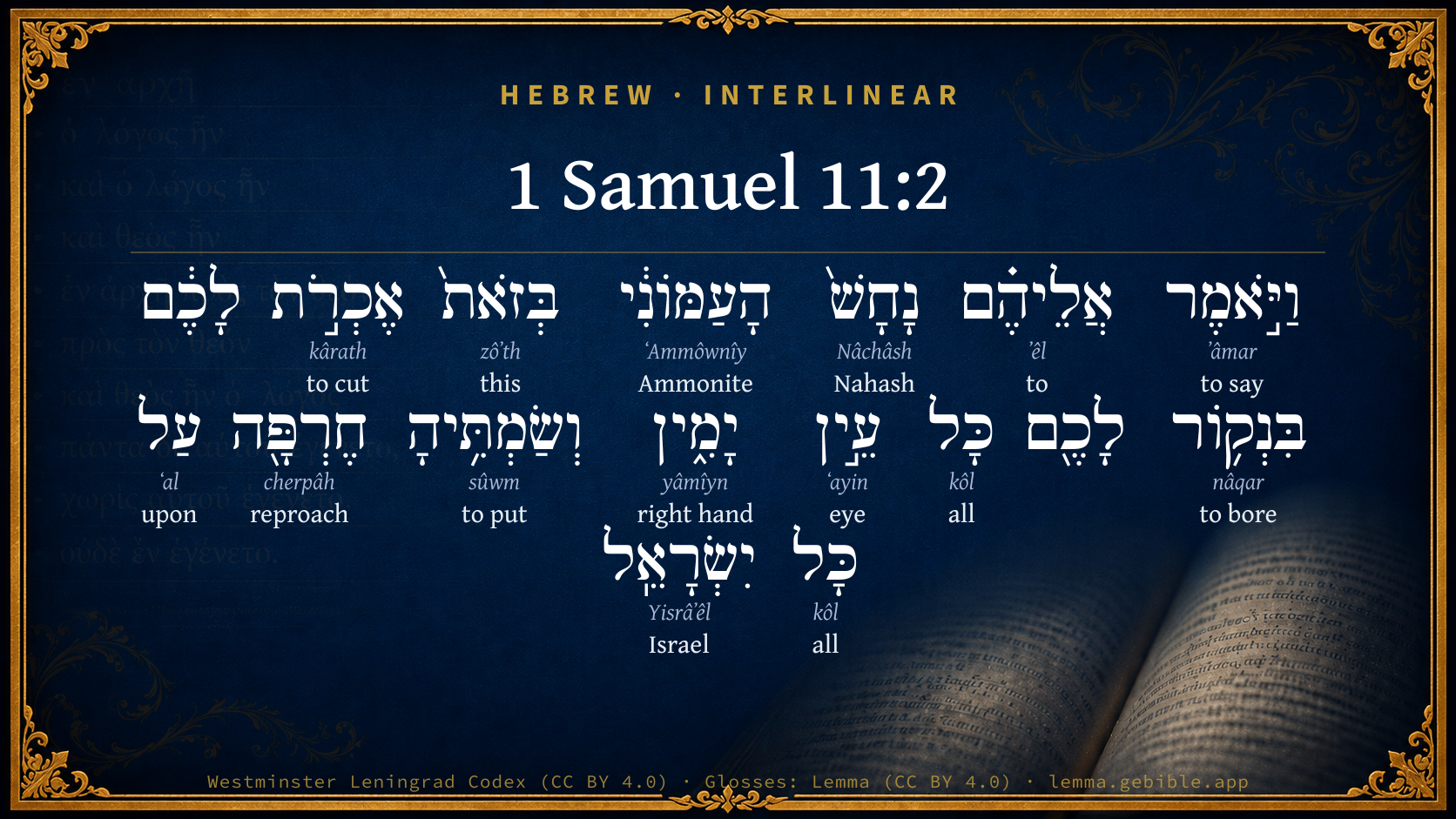
1 Samuel 11:2

Hebrew (Westminster Leningrad Codex) 1 Samuel 11:2 appears in the Hebrew Old Testament. The text above is from the Westminster Leningrad Codex. Each word links to its Strong’s number, a concise gloss, and parsing drawn from the Open Scriptures Hebrew Bible morphology. Click any word for its full Brown-Driver-Briggs (BDB) entry.
Download image
Cite this verse

1 Samuel 11:2 (World English Bible). Public Domain. Lemma interlinear Bible study tool, https://lemma.gebible.app/v/1-samuel/11/2.

Show BibTeX & RIS
BibTeX
RIS
English Translation
Nahash the Ammonite said to them, On this condition will I make it with you, that all your right eyes be put out; and I will lay it for a reproach on all Israel.
World English Bible · Public Domain
Download a study sheet

One document with this verse’s original text, its word-by-word gloss line, the meaning frame, cross-references with their text, attributed commentary, and full source and license credits — printable, and it pastes into notes with its structure intact.

This verse Autodidact and up

Study sheet (.html) Plain text (.txt)

A passage Seminary Student

Up to 50 verses in one chapter. A passage sheet keeps up to 6 commentary sources and 12 cross-references per verse, in the order this page ranks them, and says so on the sheet whenever that leaves anything out. Ask for a single verse and you get the Autodidact verse sheet above.

Everything on this page stays free to read, with no account — the sheet is a download of what is already on screen, not access to it.

Want to remove ads? Support Godless Engineer
Compare translations 3

The same verse in 3 English versions, stacked beneath the original-language interlinear above. Click any original word for its lexicon entry.

Each is an independent rendering of the whole verse — the interlinear is not word-aligned to these translations.

Highlighted words mark where these versions differ — a whole-verse word diff, not a word-by-word alignment.

  • World English Bible Public Domain
    Nahash the Ammonite said to them, On this condition will I make it with you, that all your right eyes be put out; and I will lay it for a reproach on all Israel.
  • King James Version Public Domain
    And Nahash the Ammonite answered them, On this condition will I make a covenant with you, that I may thrust out all your right eyes, and lay it for a reproach upon all Israel.
  • unfoldingWord Literal Text CC BY-SA 4.0
    And Nahash the Ammonite said to them, “By this I will cut for you, in the gouging of every right eye of you. And I will set it a disgrace against all of Israel.”

unfoldingWord Literal Text — © unfoldingWord, licensed CC BY-SA 4.0. Word-aligned USFM3 via Door43 (git.door43.org/unfoldingWord/en_ult).

Versions to compare (up to 4)

3 of 4 selected

Show all 18 translations

Every available English version of this verse, each an independent rendering of the whole verse.

  • World English Bible Public Domain
    Nahash the Ammonite said to them, On this condition will I make it with you, that all your right eyes be put out; and I will lay it for a reproach on all Israel.
  • Berean Standard Bible Public Domain
    But Nahash the Ammonite replied, “I will make a treaty with you on one condition, that I may put out everyone’s right eye and bring reproach upon all Israel.”
  • Majority Standard Bible Public Domain
    But Nahash the Ammonite replied, “I will make a treaty with you on one condition, that I may put out everyone’s right eye and bring reproach upon all Israel.”
  • King James Version Public Domain
    And Nahash the Ammonite answered them, On this condition will I make a covenant with you, that I may thrust out all your right eyes, and lay it for a reproach upon all Israel.
  • American Standard Version (1901) Public Domain
    And Nahash the Ammonite said unto them, On this condition will I make it with you, that all your right eyes be put out; and I will lay it for a reproach upon all Israel.
  • Revised Version (1885) Public Domain
    And Nahash the Ammonite said unto them, On this condition will I make it with you, that all your right eyes be put out; and I will lay it for a reproach upon all Israel.
  • Geneva Bible (1599) Public Domain
    And Nahash ye Ammonite answered them, On this condition will I make a couenant with you, that I may thrust out all your right eies, and bring that shame vpon all Israel.
  • Douay-Rheims (1899) Public Domain
    And Naas the Ammonite answered them: On this condition will I make a covenant with you, that I may pluck out all your right eyes, and make you a reproach in all Israel.
  • Young's Literal Translation Public Domain
    And Nahash the Ammonite saith unto them, `For this I covenant with you, by picking out to you every right eye -- and I have put it a reproach on all Israel.'
  • Literal Standard Version CC BY-SA 4.0
    And Nahash the Ammonite says to them, “For this I cut [a covenant] with you, in picking out every right eye of yours—and I have set it [for] a reproach on all Israel.”
  • Unlocked Literal Bible CC BY-SA 4.0
    Nahash the Ammonite replied, “On this condition will I make a treaty with you, that I gouge out all of your right eyes, and in this way bring disgrace on all Israel.”
  • unfoldingWord Literal Text CC BY-SA 4.0
    And Nahash the Ammonite said to them, “By this I will cut for you, in the gouging of every right eye of you. And I will set it a disgrace against all of Israel.”
  • Darby Bible Public Domain
    And Nahash the Ammonite said to them, On this [condition] will I treat with you, that I thrust out all your right eyes, and lay it for a reproach upon all Israel.
  • World Messianic Bible Public Domain
    Nahash the Ammonite said to them, “On this condition I will make it with you, that all your right eyes be gouged out. I will make this dishonor all Israel.”
  • Webster's Bible Public Domain
    And Nahash the Ammonite answered them, On this condition will I make a covenant with you, that I may thrust out all your right eyes, and lay it for a reproach upon all Israel.
  • Free Bible Version CC BY-SA 4.0
    But Nahash the Ammonite responded, “I'll make a peace treaty with you on one condition: that I gouge out everyone's right eye to bring shame on all Israelites.”
  • Bible in Basic English Public Domain
    And Nahash the Ammonite said to them, I will make an agreement with you on this condition, that all your right eyes are put out; so that I may make it a cause of shame to all Israel.
  • JPS Tanakh (1917) Public Domain
    And Nahash the Ammonite said unto them: 'On this condition will I make it with you, that all your right eyes be put out; and I will lay it for a reproach upon all Israel.'

Literal Standard Version (2020), Covenant Press — licensed CC BY-SA 4.0. Text via the HelloAO Bible API (eBible.org). Unlocked Literal Bible (unfoldingWord) — licensed CC BY-SA 4.0. Text via the HelloAO Bible API (eBible.org). unfoldingWord Literal Text — © unfoldingWord, licensed CC BY-SA 4.0. Word-aligned USFM3 via Door43 (git.door43.org/unfoldingWord/en_ult). Free Bible Version, Dr. Jonathan Gallagher — licensed CC BY-SA 4.0. Text via the HelloAO Bible API (eBible.org).

Word by word

More ways to search: Search by grammar → Find every occurrence → Compare this word →

Practice this passage: Drill this verse → Learn its vocabulary →

בִּנְק֥וֹר
nâqar
H5365
“in/at · to bore”
Preposition + Verb, Qal, Infinitive Construct
Part of Speech
Preposition + Verb
Stem
Qal
Form
Infinitive Construct
Full BDB Definition

Origin: a primitive root

TWOT: 1418

to bore, pick, dig, pick out - (Qal) to bore, pick, dig - (Piel) to bore out - (Pual) to be dug out
  1. וַיֹּ֣אמֶר ʼâmar H559 “and · to say” Conjunction + Verb, Qal, Sequential Imperfect, 3rd Person, Masculine, Singular
  2. אֲלֵיהֶ֗ם ʼêl H413 “to · them” Preposition + Suffix, Personal, 3rd Person, Masculine, Plural
  3. נָחָשׁ֙ Nâchâsh H5176 “Nahash” Noun, Proper
  4. הָעַמּוֹנִ֔י ʻAmmôwnîy H5984 “the · Ammonite” Particle, Definite Article + Noun, Gentilic, Masculine, Singular, Absolute
  5. בְּזֹאת֙ zôʼth H2063 “in/at · this” Preposition + Pronoun, Demonstrative, Feminine, Singular
  6. אֶכְרֹ֣ת kârath H3772 “to cut” Verb, Qal, Imperfect, 1st Person, Common, Singular
  7. כָּל kôl H3605 “all of” Noun, Common, Masculine, Singular, Construct
  8. עֵ֣ין ʻayin H5869 “eye of” Noun, Common, Both, Singular, Construct
  9. יָמִ֑ין yâmîyn H3225 “right hand” Noun, Common, Feminine, Singular, Absolute
  10. וְשַׂמְתִּ֥יהָ sûwm H7760 “and · to put · her” Conjunction + Verb, Qal, Sequential Perfect, 1st Person, Common, Singular + Suffix, Personal, 3rd Person, Feminine, Singular
  11. חֶרְפָּ֖ה cherpâh H2781 “reproach” Noun, Common, Feminine, Singular, Absolute
  12. עַל ʻal H5921 “upon” Preposition
  13. כָּל kôl H3605 “all of” Noun, Common, Masculine, Singular, Construct
  14. יִשְׂרָאֵֽל Yisrâʼêl H3478 “Israel” Noun, Proper

About this verse

These counts appear in no published source. They are computed here, from the morphology-tagged text and Lemma’s own curated glosses. What Lemma adds →

17
words
14
distinct lemmas
Historical
section

Notable vocabulary

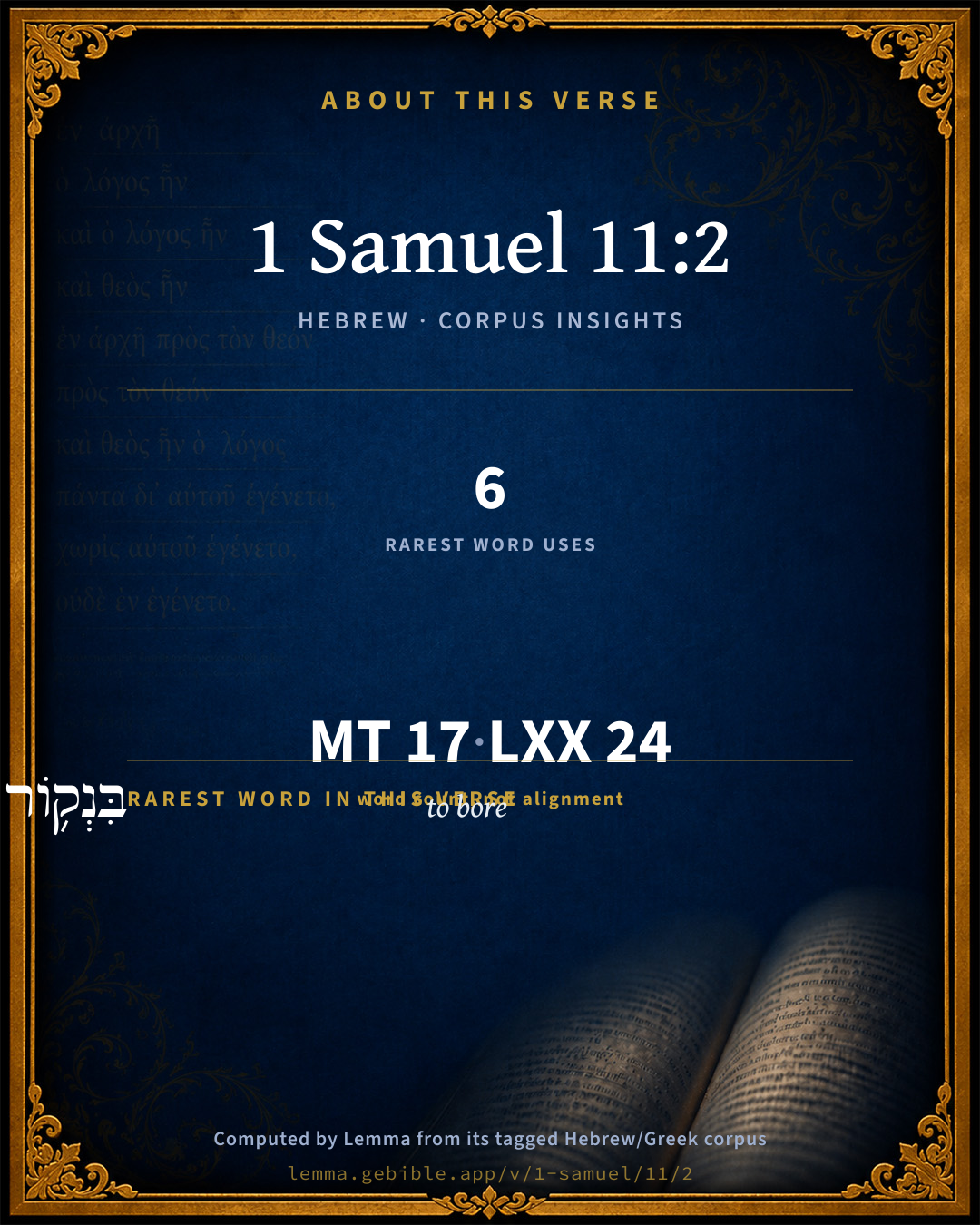
The rarest word here is בִּנְק֥וֹר to bore H5365 — appearing just 6 times in the whole Hebrew Bible.

Shared distinctive vocabulary

בִּנְק֥וֹר to bore H5365 occurs in 6 verses of the Hebrew Bible. Also found in:

Grammatical profile

  • 4 verbs
  • 8 nouns
  • 1 pronoun
  • 4 prepositions

Verb forms

  • וַיֹּ֣אמֶר Qal · Sequential Imperfect
  • אֶכְרֹ֣ת Qal · Imperfect
  • בִּנְק֥וֹר Qal · Infinitive Construct
  • וְשַׂמְתִּ֥יהָ Qal · Sequential Perfect

Repetition

A word recurs within this verse — often emphatic in Hebrew:

Hebrew & Septuagint length

In English translation the verse runs 34 words from the Hebrew and 33 from the Septuagint (LXX English) — closely comparable.

A rough comparison of the two English renderings, which tokenize alike — not a word-level alignment.

Word counts can differ between the Hebrew and the Greek without any difference in meaning — e.g. the Hebrew direct-object marker אֵת has no separate Greek word, and Greek often adds the article ὁ.

In the original languages it is 17 Hebrew tokens and 24 Greek tokens — but the two are counted differently (Hebrew bundles its prefixes and suffixes into one token; the Greek is in lemma form), so that isn’t a like-for-like length.

Cross-references

8

Topical passages linked to 1 Samuel 11:2 in the Treasury of Scripture Knowledge — connected by theme and wording, ordered by reader-vote popularity; previews shown in the World English Bible.

  • 1 Samuel 17:26 David spoke to the men who stood by him, saying, What shall be done to the man who kills this Philistine, and takes away the reproach from Israel? for who is this uncircumcised Philistine, that he should defy the armies of the living God?
  • Genesis 34:14 and said to them, "We can't do this thing, to give our sister to one who is uncircumcised; for that is a reproach to us.
  • Numbers 16:14 Moreover you haven't brought us into a land flowing with milk and honey, nor given us inheritance of fields and vineyards: will you put out the eyes of these men? we won't come up.
  • Exodus 3:6 Moreover he said, "I am the God of your father, the God of Abraham, the God of Isaac, and the God of Jacob." Moses hid his face; for he was afraid to look at God.
  • Judges 16:21 The Philistines laid hold on him, and put out his eyes; and they brought him down to Gaza, and bound him with fetters of brass; and he did grind in the prison-house.
  • 2 Kings 18:31 Don't listen to Hezekiah: for thus says the king of Assyria, Make your peace with me, and come out to me; and eat you everyone of his vine, and everyone of his fig tree, and everyone drink the waters of his own cistern;
  • Proverbs 12:10 A righteous man regards the life of his animal, But the tender mercies of the wicked are cruel.
  • Jeremiah 39:7 Moreover he put out Zedekiah's eyes, and bound him in fetters, to carry him to Babylon.

Cross-references courtesy of OpenBible.info (CC BY 4.0).

Hebrew and Greek witnesses Masoretic Hebrew ↔ Greek Septuagint

The same verse in the two great witnesses to the Old Testament, shown verse-for-verse.

These are two independent witnesses, not word-aligned to each other, and the Septuagint is shown in lemma (dictionary) form.

Hebrew 1 Samuel 11:2 Masoretic · Westminster Leningrad Codex

וַיֹּ֣אמֶר אֲלֵיהֶ֗ם נָחָשׁ֙ הָעַמּוֹנִ֔י בְּזֹאת֙ אֶכְרֹ֣ת לָכֶ֔ם בִּנְק֥וֹר לָכֶ֖ם כָּל עֵ֣ין יָמִ֑ין וְשַׂמְתִּ֥יהָ חֶרְפָּ֖ה עַל כָּל יִשְׂרָאֵֽל

Nahash the Ammonite said to them, On this condition will I make it with you, that all your right eyes be put out; and I will lay it for a reproach on all Israel.

World English Bible · Public Domain

Greek LXX 1 Samuel 11:2 Septuagint · lemma form

καί εἶπον πρός αὐτός ναας ὁ αμμανίτης ἐν οὗτος διατίθημι σύ διαθήκη ἐν ὁ ἐκὀρύσσω σύ πᾶς ὀφθαλμός δεξιός καί τίθημι ὄνειδος ἐπί ἰσραήλ

Naas the Ammanite said to them, On these terms will I make a covenant with you, that I should put out all your right eyes, and I will lay a reproach upon Israel.

LXX2012 (modern English Septuagint) · Public Domain

Hebrew: Westminster Leningrad Codex (CC BY 4.0). Greek: Septuagint (public domain); English from LXX2012 (modern English Septuagint) (Public Domain). How the Septuagint differs from the Hebrew →

Targum (Aramaic paraphrase)

1

The Targum is the ancient Jewish Aramaic paraphrase of the Hebrew Scriptures — an interpretive translation, not the Hebrew text itself. Onkelos (literal) and Pseudo-Jonathan (expansive) render the Torah, and Jonathan the Prophets. Coverage is partial: where no permissively-licensed English translation exists for a verse, only the Aramaic is shown. This is verse-level text, not a word-by-word alignment to the Hebrew.

  1. Targum Jonathan Prophets (Joshua–Malachi)
    וַאֲמַר לְהוֹן נָחָשׁ מַלְכָּא דִבְנֵי עַמוֹן בְּהָדָא אֶגְזַר לְכוֹן בְּמֵיקַר לְכוֹן כָּל עֵינָא דְיַמִינָא וַאֲשַׁוִינָה חִיסוּדָא עַל כָּל יִשְׂרָאֵל:

    (no public-domain English translation for this verse)

    Targum Jonathan — Aramaic: “Mikraot Gedolot” (public domain). English: “Sefaria Community Translation” (CC0 1.0 (public-domain dedication)); “London "Chaldee Paraphrase," 1871” (public domain). Text via Sefaria.

Commentary

Notes on 1 Samuel 11:2 from classic Christian and Jewish commentators (each source and its license shown beneath its notes). The classic Christian expositions comment on the surrounding passage and are grouped to its opening verse, so a note may address several verses; the Jewish commentaries on the Tanakh (Rashi and others) are per-verse, so they appear only where the commentator wrote on this verse.

Lemma curates 59 commentaries, every one of them public domain or Creative Commons licensed, each selected and text-cleaned for this edition rather than reprinted as found. About our sources →

Trapp's Complete Commentary

John Trapp

1Sa 11:2 And Nahash the Ammonite answered them, On this [condition] will I make [a covenant] with you, that I may thrust out all your right eyes, and lay it [for] a reproach upon all Israel.

Ver. 2. On this condition will I make a covenant.] Slaves he would make them, and perpetually so, - stigmatical slaves, utterly disabled to deliver themselves out of his hands.

That I may thrust out all your right eyes.] This was most inhuman and insolent. The devil - as another Nahash, which signifieth a serpent - would likewise put out the right eye of faith, and leave us only the left eye of reason; look to him narrowly. Those that would deprive the people of the Scriptures, and muzzle them in ignorance, do the like.

And lay it for a reproach upon all Israel.] For a base people that would live upon any terms; that boasted also of an almighty God, but durst not confide in him.

John Trapp, A Commentary or Exposition upon All the Books of the Old and New Testament (1647–1656) — public domain. Text from a community e-Sword module.

Joseph Benson's Commentary

1Sa 11:2. And lay it for a reproach upon all Israel — That is, disgrace the whole Hebrew nation, by serving some of their people in this opprobrious manner; for it must necessarily have reflected great dishonour upon the whole state, that they should suffer any of their people to be served so. He probably meant also to disable them for war, in which the right eye was of most use, their shields, which they carried in their left hands, in a great measure covering their left eyes. He proposes, however, to leave them one eye, that they might be fit to serve in any mean and base office.

Joseph Benson's Commentary on the Old and New Testaments (1811–1818) — public domain. Text from a community e-Sword module.

Tyndale Open Study Notes

Tyndale Open Resources

11:2 gouge out the right eye: Mutilation of captured soldiers was a common practice in the ancient Near East. These disfigured soldiers would have lost all depth perception, seriously curtailing their potential for fighting in a revolt.

Tyndale Open Study Notes — © Tyndale Open Resources, licensed CC BY-SA 4.0. Text via the HelloAO Bible API.

Geneva Bible (1599)

Geneva Bible translators

This declareth that the more near the tyrants are to their destruction, the more cruel they are.

Geneva Bible (1599) marginal notes — public domain. Text via Bolls.life.

Jamieson, Fausset & Brown

Robert Jamieson, A. R. Fausset & David Brown

thrust out all your right eyes--literally, "scoop" or "hollow out" the ball. This barbarous mutilation is the usual punishment of usurpers in the East, inflicted on chiefs; sometimes, also, even in modern history, on the whole male population of a town. Nahash meant to keep the Jabeshites useful as tributaries, whence he did not wish to render them wholly blind, but only to deprive them of their right eye, which would disqualify them for war. Besides, his object was, through the people of Jabesh-gilead, to insult the Israelitish nation.

Jamieson, Fausset & Brown — Commentary Critical and Explanatory on the Whole Bible (1871) — public domain (CC PDM 1.0). Text via the HelloAO Bible API.

Adam Clarke's Commentary

Verse 2. I may thrust out all your right eves] This cruel condition would serve at once as a badge of their slavery, and a means of incapacitating them from being effective warriors. Theodoret observes, "He who opposes his shield to the enemy with his left hand, thereby hides his left eye, and looks at his enemy with his right eye; he therefore who plucks out that right eye makes men useless in war." Josephus gives the same reason.

Adam Clarke's Commentary on the Bible (1810–1826) — public domain. Text from a community e-Sword/MySword module.

Ellicott's Commentary for English Readers

(2) On this condition.—The horrible cruelty of this scornful proposal gives us an insight into the barbarous customs of this imperfectly civilised age. Indeed, many of the crimes we read of in these books—crimes which, to modern ears, justly sound shocking and scarcely credible—are referable to the fact that civilisation and its humanizing influences had made but little way as yet among the nations of the world.

The object of Nahash’s cruelty was to incapacitate the inhabitants of Jabesh from ever further assisting his enemies in war; they would henceforth be blinded in the right eye, while the left eye would be concealed by the shield which fighting-men were in the habit of holding before them.

A Bible Commentary for English Readers, edited by Charles John Ellicott (1878–1897) — public domain. Text from a community e-Sword module.

The Cambridge Bible for Schools and Colleges

gen. ed. J. J. S. Perowne

2. that I may thrust out all your right eyes] Such barbarities are not unknown in the East even now. Vambéry describes the blinding of prisoners as a regular practice at Khiva. Travels in Central Asia, p. 138. The savage character of the Ammonites is attested by Amo_1:13. The loss of the right eye was intended to disable them for war, the left eye being covered by the shield, as the amputation of his thumbs and great toes (Jdg_1:7-8) was designed to incapacitate a man for the use of the bow and destroy his swiftness of foot.

The Cambridge Bible for Schools and Colleges (gen. ed. J. J. S. Perowne; Cambridge University Press, 1878–1918) — public domain. Text from a community e-Sword module.

John Gill's Exposition

And Nahash the Ammonite answered them,.... In a very haughty and scornful manner:

on this condition will I make a covenant with you, that I may thrust out all your right eyes; some Jewish writers go into a mystical and allegorical sense of these words, as that Nahash ordered the book of the law to be brought, which was their right eye, that he might erase out of it these words:

an Ammonite or Moabite shall not enter into the congregation of the Lord; others understand it of the sanhedrim, which were the eyes of Israel; and others, which come a little nearer to the sense, of the slingers and archers, the desire of the eyes of Israel; and who, by having their right eyes thrust out, would be in a great measure spoiled for taking aim; for the words are to be understood literally; the intention of Nahash was to disable them for war, and that they might become quite unfit for it, as Josephus observes (r); the left eye being under the shield, as it usually was in war, and the right eye plucked out, they would be as blind men: he did not choose to have both their eyes thrust out, for then they could have been of no use and service to him as slaves or tributaries:

and lay it for a reproach upon all Israel; that they did not come up to the relief of their brethren, and defend them, and signifying that they must all expect the same treatment from him.

(r) Antiqu. l. 6. c. 5. sect. 1.

John Gill's Exposition of the Whole Bible (1746–1763) — public domain (CC PDM 1.0). Text via the HelloAO Bible API.

Haydock's Catholic Bible Commentary

Eyes: strange proposal! He would not render them quite blind, that he might not be deprived of their service. But he wished to render them unfit for war, (Calmet) as the buckler covers the left eye; (Josephus) and people who shoot with bow and arrow, keep it closed. (Calmet)

George Leo Haydock (1774–1849), Haydock's Catholic Family Bible and Commentary, 1859 edition — public domain. Excludes Psalms (Douay-Rheims chapter numbering differs from Protestant) and Deuterocanonical books (Catholic canon only).

Matthew Poole's English Annotations

That I may thrust out all your right eyes; partly for a reproach, as it here follows; and partly to disable them from managing offensive weapons in battle; for their left eye served only or chiefly for defence, being covered by those large shields which then they used, and held in their left hand. He leaves them one eye, that they might be fit to serve him in any mean and base office.

Matthew Poole's English Annotations on the Holy Bible (1683–1685) — public domain. Text from a community e-Sword/MySword module.

Whedon's Commentary on the Bible

Daniel D. Whedon

2. Thrust out all your right eyes — This would incapacitate them for war, because the shield was carried on the left arm, and would thus partially be in the way of the left eye; but this loss of one eye would not render them unfit for other service, and the conqueror might still use them as slaves.

A reproach upon all Israel — Because they were unable to defend a part of their nation from such a barbarous treatment; and also to remind Israel that the Ammonites still claimed, as they did in the days of Jephthah, that a part of their land had been unjustly taken from them. Jdg_11:13.

Daniel D. Whedon (gen. ed.), Commentary on the Old and New Testaments (1874–1909) — public domain. Text from a community e-Sword module.

John Wesley's Explanatory Notes

Thrust out, &c. - Partly for a reproach, as it here follows; and partly, to disable them. He leaves them one eye, that they might be fit to serve in any mean and base office.

John Wesley, Explanatory Notes Upon the Whole Bible (1754–1765) — public domain. Text via the GEBible commentary corpus.

Rashi

Rabbi Shlomo Yitzchaki (Rashi)

Each right eye. Explain it literally. But the Midrash Aggadah [explains it figuratively, that he said,] "Bring me your Torah scroll which was given by the right hand [of God], and I will burn it, because He wrote in it, "Neither an Ammonite nor a Moavite may enter [into Adonoy's community]."

A sign of shame. An insult.

Rashi on the Tanakh — English translations: “The Judaica Press complete Tanach with Rashi, translated by A. J. Rosenberg” (CC BY 4.0); “Pentateuch with Rashi's commentary by M. Rosenbaum and A.M. Silbermann, 1929-1934” (public domain); “The Metsudah Tanach series, Lakewood, N.J” (CC BY 4.0); and “The Book of Joshua, Metsudah Publications, 1997” (CC BY 4.0). Text via Sefaria.

Lesson kit

Teaching starters — assembled from the data on this page, not authored interpretation. Every prompt links to the verse data it draws on. Edit before teaching.

1 Samuel, in the Historical, opens this verse with 17 words (14 distinct Hebrew lemmas). Its most distinctive word is nâqar (“to bore”). A historical commentator’s framing appears above. Read the whole chapter for the surrounding context.

Discussion questions

  1. How does “to bore” (nâqar) shape what this verse is saying?
  2. Numbers 16:14 shares the word «to bore» with this verse. How do the two illuminate each other?
  3. “all” occurs 2× in this one verse. What is the effect of the repetition?
  4. These translations render this verse differently; the difference is in the English rendering, not the original. What questions does that raise?
  5. The verb «וַיֹּ֣אמֶר» is Qal Sequential Imperfect. How does its form color the action?
  6. Reading how Trapp's Complete Commentary and Joseph Benson's Commentary read this verse, where do the two commentators agree and where do they part?

Things to notice

Reading settings

Reading text

Shown beneath each verse's original-language words.

Old Testament
Old Testament edition

Read the OT as the Masoretic Hebrew (MT) or the Greek Septuagint (LXX).

English shown for the Greek Septuagint (in the Hebrew ↔ Greek comparison).

Comparing translations? Open the Compare panel on any verse page to stack up to four side by side.