
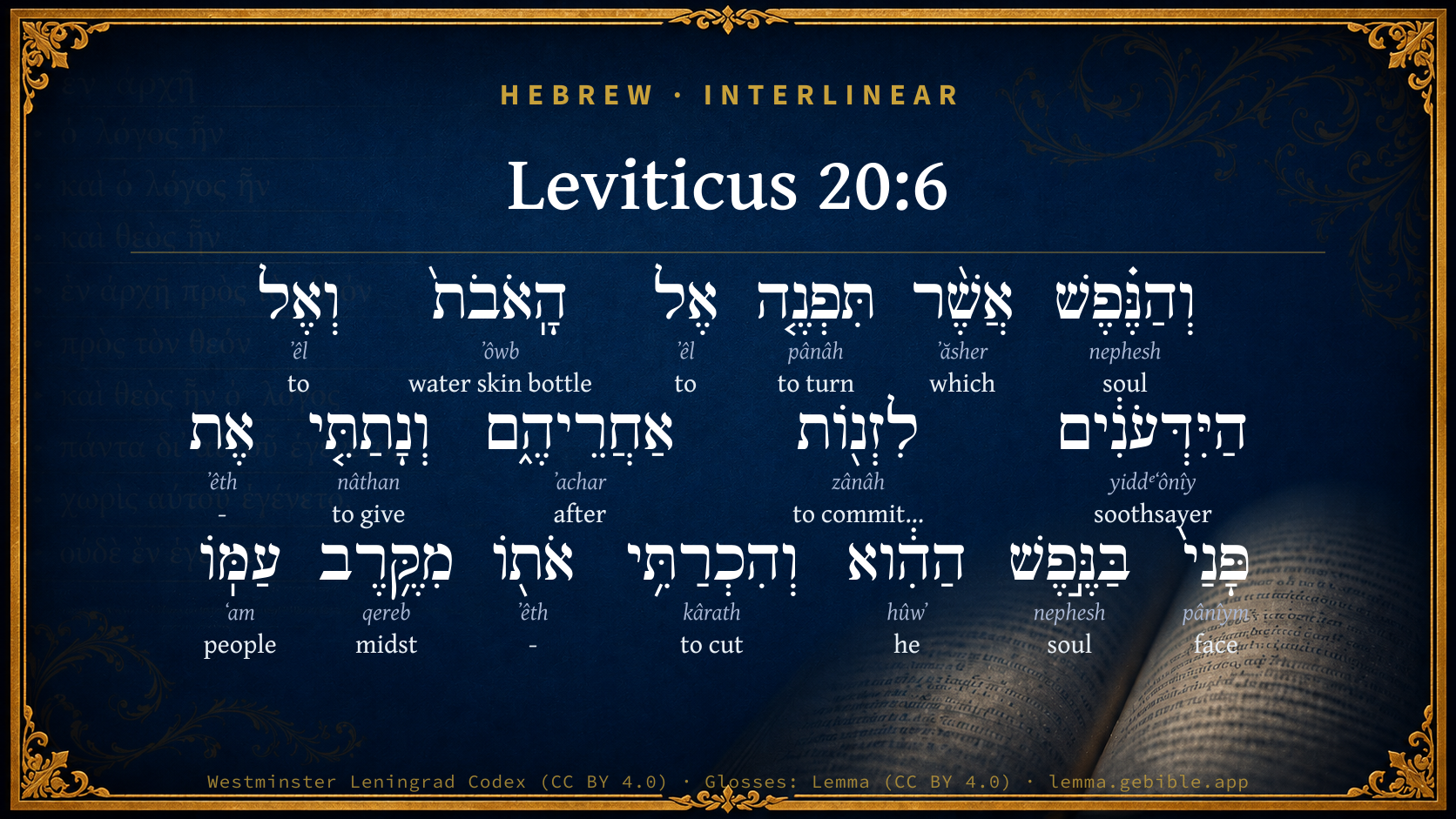
Leviticus 20:6

Hebrew (Westminster Leningrad Codex) Leviticus 20:6 appears in the Hebrew Old Testament. The text above is from the Westminster Leningrad Codex. Each word links to its Strong’s number, a concise gloss, and parsing drawn from the Open Scriptures Hebrew Bible morphology. Click any word for its full Brown-Driver-Briggs (BDB) entry.
Download image
Cite this verse

Leviticus 20:6 (World English Bible). Public Domain. Lemma interlinear Bible study tool, https://lemma.gebible.app/v/leviticus/20/6.

Show BibTeX & RIS
BibTeX
RIS
English Translation
"'The person that turns to those who are mediums, and to the wizards, to play the prostitute after them, I will even set my face against that person, and will cut him off from among his people.
World English Bible · Public Domain
Download a study sheet

One document with this verse’s original text, its word-by-word gloss line, the meaning frame, cross-references with their text, attributed commentary, and full source and license credits — printable, and it pastes into notes with its structure intact.

This verse Autodidact and up

Study sheet (.html) Plain text (.txt)

A passage Seminary Student

Up to 50 verses in one chapter. A passage sheet keeps up to 6 commentary sources and 12 cross-references per verse, in the order this page ranks them, and says so on the sheet whenever that leaves anything out. Ask for a single verse and you get the Autodidact verse sheet above.

Everything on this page stays free to read, with no account — the sheet is a download of what is already on screen, not access to it.

Want to remove ads? Support Godless Engineer
Compare translations 3

The same verse in 3 English versions, stacked beneath the original-language interlinear above. Click any original word for its lexicon entry.

Each is an independent rendering of the whole verse — the interlinear is not word-aligned to these translations.

Highlighted words mark where these versions differ — a whole-verse word diff, not a word-by-word alignment.

  • World English Bible Public Domain
    "'The person that turns to those who are mediums, and to the wizards, to play the prostitute after them, I will even set my face against that person, and will cut him off from among his people.
  • King James Version Public Domain
    And the soul that turneth after such as have familiar spirits, and after wizards, to go a whoring after them, I will even set my face against that soul, and will cut him off from among his people.
  • unfoldingWord Literal Text CC BY-SA 4.0
    And the person who turns to the mediums or to the spiritists to practice prostitution after them—I will set my face against that person. And I will cut him off from among his people.

unfoldingWord Literal Text — © unfoldingWord, licensed CC BY-SA 4.0. Word-aligned USFM3 via Door43 (git.door43.org/unfoldingWord/en_ult).

Versions to compare (up to 4)

3 of 4 selected

Show all 18 translations

Every available English version of this verse, each an independent rendering of the whole verse.

  • World English Bible Public Domain
    "'The person that turns to those who are mediums, and to the wizards, to play the prostitute after them, I will even set my face against that person, and will cut him off from among his people.
  • Berean Standard Bible Public Domain
    Whoever turns to mediums or spiritists to prostitute himself with them, I will also set My face against that person and cut him off from his people.
  • Majority Standard Bible Public Domain
    Whoever turns to mediums or spiritists to prostitute himself with them, I will also set My face against that person and cut him off from his people.
  • King James Version Public Domain
    And the soul that turneth after such as have familiar spirits, and after wizards, to go a whoring after them, I will even set my face against that soul, and will cut him off from among his people.
  • American Standard Version (1901) Public Domain
    And the soul that turneth unto them that have familiar spirits, and unto the wizards, to play the harlot after them, I will even set my face against that soul, and will cut him off from among his people.
  • Revised Version (1885) Public Domain
    And the soul that turneth unto them that have familiar spirits, and unto the wizards, to go a whoring after them, I will even set my face against that soul, and will cut him off from among his people.
  • Geneva Bible (1599) Public Domain
    If any turne after such as worke with spirits, and after soothsayers, to go a whoring after them, then will I set my face against that person, and will cut him off from among his people.
  • Douay-Rheims (1899) Public Domain
    The soul that shall go aside after magicians, and soothsayers, and shall commit fornication with them, I will set my face against that soul, and destroy it out of the midst of its people.
  • Young's Literal Translation Public Domain
    `And the person who turneth unto those having familiar spirits, and unto the wizards, to go a-whoring after them, I have even set My face against that person, and cut him off from the midst of his people.
  • Literal Standard Version CC BY-SA 4.0
    And the person who turns to those having familiar spirits, and to the wizards, to go whoring after them, I have even set My face against that person, and cut him off from the midst of his people.
  • Unlocked Literal Bible CC BY-SA 4.0
    The person who turns to those who talk with the dead, or to those who talk with spirits so as to prostitute themselves with them, I will set my face against that person; I will cut him off from among his people.
  • unfoldingWord Literal Text CC BY-SA 4.0
    And the person who turns to the mediums or to the spiritists to practice prostitution after them—I will set my face against that person. And I will cut him off from among his people.
  • Darby Bible Public Domain
    -- And the soul that turneth unto necromancers and unto soothsayers, to go a whoring after them, I will set my face against that soul, and will cut him off from among his people.
  • World Messianic Bible Public Domain
    “‘The person that turns to those who are mediums and wizards, to play the prostitute after them, I will even set my face against that person, and will cut him off from among his people.
  • Webster's Bible Public Domain
    And the soul that turneth after such as have familiar spirits, and after wizards, to go astray after them, I will even set my face against that soul, and will cut him off from among his people.
  • Free Bible Version CC BY-SA 4.0
    I will also disown and expel from their people anyone who goes to mediums or spiritists and in this way commits spiritual prostitution with them.
  • Bible in Basic English Public Domain
    And whoever goes after those who make use of spirits and wonder-workers, doing evil with them, against him will my face be turned, and he will be cut off from among his people.
  • JPS Tanakh (1917) Public Domain
    And the soul that turneth unto the ghosts, and unto the familiar spirits, to go astray after them, I will even set My face against that soul, and will cut him off from among his people.

Literal Standard Version (2020), Covenant Press — licensed CC BY-SA 4.0. Text via the HelloAO Bible API (eBible.org). Unlocked Literal Bible (unfoldingWord) — licensed CC BY-SA 4.0. Text via the HelloAO Bible API (eBible.org). unfoldingWord Literal Text — © unfoldingWord, licensed CC BY-SA 4.0. Word-aligned USFM3 via Door43 (git.door43.org/unfoldingWord/en_ult). Free Bible Version, Dr. Jonathan Gallagher — licensed CC BY-SA 4.0. Text via the HelloAO Bible API (eBible.org).

Word by word

More ways to search: Search by grammar → Find every occurrence → Compare this word →

Practice this passage: Drill this verse → Learn its vocabulary →

הַיִּדְּעֹנִ֔ים
yiddᵉʻônîy
H3049
“the · soothsayers”
Particle, Definite Article + Noun, Common, Masculine, Plural, Absolute
Part of Speech
Particle + Noun
Type
Common
Gender
Masculine
Number
Plural
State
Absolute
Full BDB Definition

Origin: from H3045

TWOT: 848d

a knower, one who has a familiar spirit - a familiar spirit, soothsayer, necromancer (metonymy)
  1. וְהַנֶּ֗פֶשׁ nephesh H5315 “and · the · soul” Conjunction + Particle, Definite Article + Noun, Common, Both, Singular, Absolute
  2. אֲשֶׁ֨ר ʼăsher H834 “which” Particle, Relative
  3. תִּפְנֶ֤ה pânâh H6437 “to turn” Verb, Qal, Imperfect, 3rd Person, Feminine, Singular
  4. אֶל ʼêl H413 “to” Preposition
  5. הָֽאֹבֹת֙ ʼôwb H178 “the · water skin bottles” Particle, Definite Article + Noun, Common, Masculine, Plural, Absolute
  6. וְאֶל ʼêl H413 “and · to” Conjunction + Preposition
  7. לִזְנ֖וֹת zânâh H2181 “to commit fornication” Preposition + Verb, Qal, Infinitive Construct
  8. אַחֲרֵיהֶ֑ם ʼachar H310 “after · them” Preposition + Suffix, Personal, 3rd Person, Masculine, Plural
  9. וְנָתַתִּ֤י nâthan H5414 “and · to give” Conjunction + Verb, Qal, Sequential Perfect, 1st Person, Common, Singular
  10. אֶת ʼêth H853 “-” Particle, Direct Object
  11. פָּנַי֙ pânîym H6440 “face(s) · my” Noun, Common, Both, Plural, Construct + Suffix, Personal, 1st Person, Common, Singular
  12. בַּנֶּ֣פֶשׁ nephesh H5315 “in/at the · soul” Preposition, Determined + Noun, Common, Both, Singular, Absolute
  13. הַהִ֔וא hûwʼ H1931 “the · he” Particle, Definite Article + Pronoun, Personal, 3rd Person, Feminine, Singular
  14. וְהִכְרַתִּ֥י kârath H3772 “and · to cut” Conjunction + Verb, Hiphil, Sequential Perfect, 1st Person, Common, Singular
  15. אֹת֖וֹ ʼêth H853 “- · him” Particle, Direct Object + Suffix, Personal, 3rd Person, Masculine, Singular
  16. מִקֶּ֥רֶב qereb H7130 “from · midst of” Preposition + Noun, Common, Masculine, Singular, Construct
  17. עַמּֽוֹ ʻam H5971 “people · his” Noun, Common, Masculine, Singular, Construct + Suffix, Personal, 3rd Person, Masculine, Singular

About this verse

These counts appear in no published source. They are computed here, from the morphology-tagged text and Lemma’s own curated glosses. What Lemma adds →

18
words
15
distinct lemmas
Pentateuch
section

Notable vocabulary

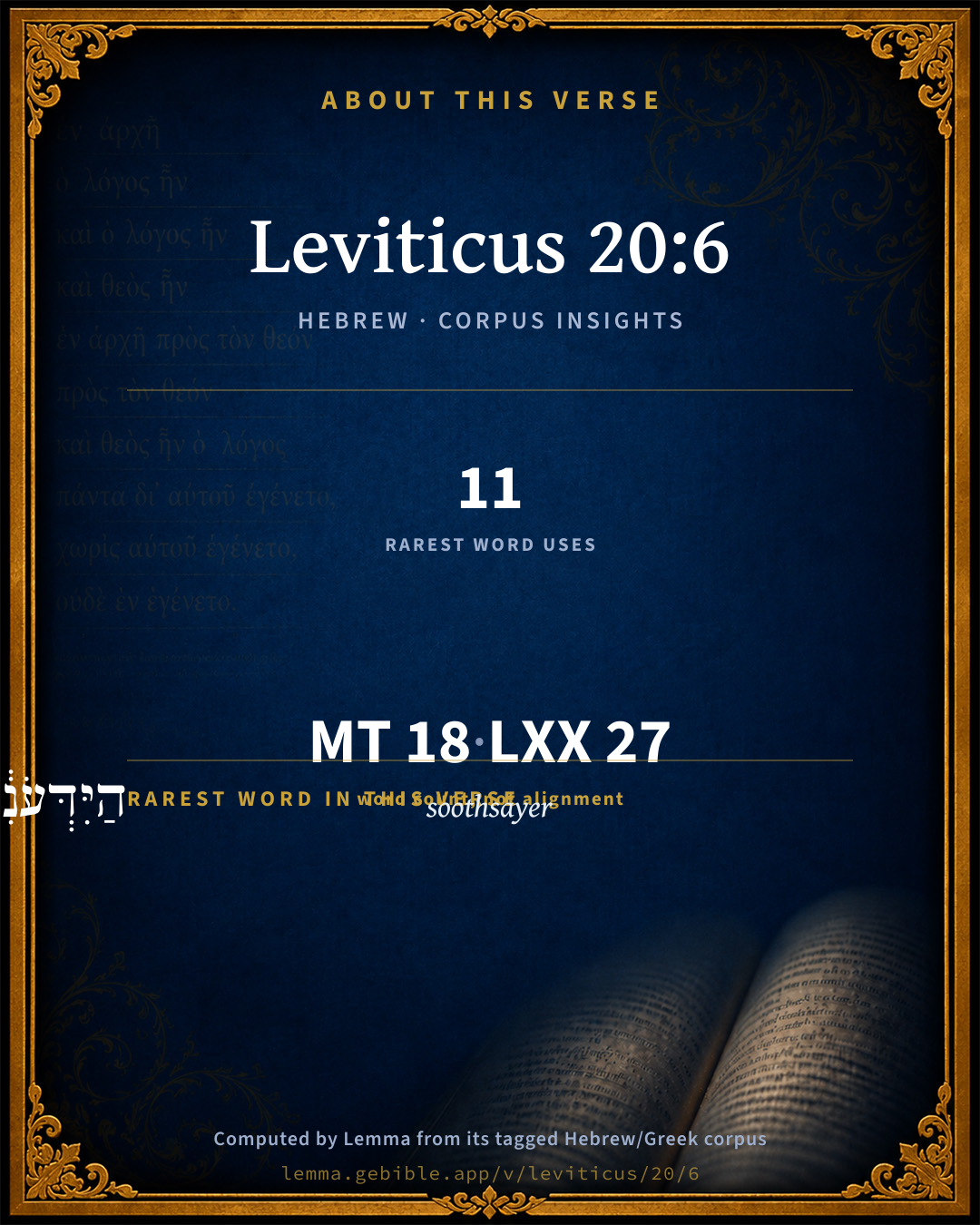
The rarest word here is הַיִּדְּעֹנִ֔ים soothsayer H3049 — appearing just 11 times in the whole Hebrew Bible.

Shared distinctive vocabulary

הַיִּדְּעֹנִ֔ים soothsayer H3049 occurs in 11 verses of the Hebrew Bible. Also found in:

Grammatical profile

  • 4 verbs
  • 7 nouns
  • 1 pronoun
  • 3 prepositions
  • 3 particles

Verb forms

  • תִּפְנֶ֤ה Qal · Imperfect
  • לִזְנ֖וֹת Qal · Infinitive Construct
  • וְנָתַתִּ֤י Qal · Sequential Perfect
  • וְהִכְרַתִּ֥י Hiphil · Sequential Perfect

Repetition

Words recur within this verse — often emphatic in Hebrew:

  • וְהַנֶּ֗פֶשׁ soul H5315 ×2
  • אֶל to H413 ×2

Hebrew & Septuagint length

In English translation the verse runs 37 words from the Hebrew and 39 from the Septuagint (LXX English) — closely comparable.

A rough comparison of the two English renderings, which tokenize alike — not a word-level alignment.

Word counts can differ between the Hebrew and the Greek without any difference in meaning — e.g. the Hebrew direct-object marker אֵת has no separate Greek word, and Greek often adds the article ὁ.

In the original languages it is 18 Hebrew tokens and 27 Greek tokens — but the two are counted differently (Hebrew bundles its prefixes and suffixes into one token; the Greek is in lemma form), so that isn’t a like-for-like length.

Cross-references

11

Topical passages linked to Leviticus 20:6 in the Treasury of Scripture Knowledge — connected by theme and wording, ordered by reader-vote popularity; previews shown in the World English Bible.

  • Leviticus 19:31 "'Don't turn to those who are mediums, nor to the wizards. Don't seek them out, to be defiled by them. I am Yahweh your God.
  • Isaiah 8:19 When they shall tell you, "Consult with those who have familiar spirits and with the wizards, who chirp and who mutter:" shouldn't a people consult with their God? on behalf of the living [should they consult] with the dead?
  • Leviticus 20:27 "'A man or a woman that is a medium, or is a wizard, shall surely be put to death: they shall stone them with stones; their blood shall be upon them.'"
  • Deuteronomy 18:10–14 There shall not be found with you anyone who makes his son or his daughter to pass through the fire, one who uses divination, one who practices sorcery, or an enchanter, or a sorcerer,
  • 1 Chronicles 10:13–14 So Saul died for his trespass which he committed against Yahweh, because of the word of Yahweh, which he didn't keep; and also because he asked counsel of one who had a familiar spirit, to inquire [thereby],
  • Exodus 34:15–16 Don't make a covenant with the inhabitants of the land, lest they play the prostitute after their gods, and sacrifice to their gods, and one call you and you eat of his sacrifice;
  • Leviticus 19:26 "'You shall not eat any meat with the blood still in it; neither shall you use enchantments, nor practice sorcery.
  • Numbers 15:39 and it shall be to you for a fringe, that you may look on it, and remember all the commandments of Yahweh, and do them; and that you not follow after your own heart and your own eyes, after which you use to play the prostitute;
  • Psalms 73:27 For, behold, those who are far from you shall perish. You have destroyed all those who are unfaithful to you.
  • Ezekiel 6:9 Those of you that escape shall remember me among the nations where they shall be carried captive, how that I have been broken with their lewd heart, which has departed from me, and with they eyes, which play the prostitute after their idols: and they shall loathe themselves in their own sight for the evils which they have committed in all their abominations.
  • Hosea 4:12 My people consult with their wooded idol, And answer to a stick of wood. Indeed the spirit of prostitution has led them astray, And they have been unfaithful to their God.

Cross-references courtesy of OpenBible.info (CC BY 4.0).

Hebrew and Greek witnesses Masoretic Hebrew ↔ Greek Septuagint

The same verse in the two great witnesses to the Old Testament, shown verse-for-verse.

These are two independent witnesses, not word-aligned to each other, and the Septuagint is shown in lemma (dictionary) form.

Hebrew Leviticus 20:6 Masoretic · Westminster Leningrad Codex

וְהַנֶּ֗פֶשׁ אֲשֶׁ֨ר תִּפְנֶ֤ה אֶל הָֽאֹבֹת֙ וְאֶל הַיִּדְּעֹנִ֔ים לִזְנ֖וֹת אַחֲרֵיהֶ֑ם וְנָתַתִּ֤י אֶת פָּנַי֙ בַּנֶּ֣פֶשׁ הַהִ֔וא וְהִכְרַתִּ֥י אֹת֖וֹ מִקֶּ֥רֶב עַמּֽוֹ

"'The person that turns to those who are mediums, and to the wizards, to play the prostitute after them, I will even set my face against that person, and will cut him off from among his people.

World English Bible · Public Domain

Greek LXX Leviticus 20:6 Septuagint · lemma form

καί ψυχή ὅς ἐάν ἐπιἀκολουθέω ἐγγαστρίμυθος ἤ ἐπαοιδός ὥστε ἐκπορνεύω ὀπίσω αὐτός ἐπιἵστημι ὁ πρόσωπον ἐγώ ἐπί ὁ ψυχή ἐκεῖνος καί ἀποὀλλύω αὐτός ἐκ ὁ λαός αὐτός

And the soul that shall follow those who have in them divining spirits, or enchanters, so as to go a whoring after them; I will set my face against that soul, and will destroy it from among its people.

LXX2012 (modern English Septuagint) · Public Domain

Hebrew: Westminster Leningrad Codex (CC BY 4.0). Greek: Septuagint (public domain); English from LXX2012 (modern English Septuagint) (Public Domain). How the Septuagint differs from the Hebrew →

Targum (Aramaic paraphrase)

2

The Targum is the ancient Jewish Aramaic paraphrase of the Hebrew Scriptures — an interpretive translation, not the Hebrew text itself. Onkelos (literal) and Pseudo-Jonathan (expansive) render the Torah, and Jonathan the Prophets. Coverage is partial: where no permissively-licensed English translation exists for a verse, only the Aramaic is shown. This is verse-level text, not a word-by-word alignment to the Hebrew.

  1. Targum Onkelos Torah (Genesis–Deuteronomy)
    וֶאֱנַשׁ דִי יִתְפְּנֵי בָּתַר בִּדִין וּדְכוּרוּ לְמִטְעֵי בַתְרֵיהוֹן וְאֶתֵּן יָת רוּגְזִי בַּאֲנָשָׁא הַהִיא וֶאֱשֵׁיצֵי יָתֵהּ מִגוֹ עַמֵהּ

    (no public-domain English translation for this verse)

    Targum Onkelos — Aramaic: “Onkelos Genesis” (public domain); “Onkelos Exodus” (public domain); “Onkelos Leviticus” (public domain); “Onkelos Numbers” (public domain); “Onkelos Deuteronomy” (public domain). English: “Sefaria Community Translation” (CC0 1.0 (public-domain dedication)); “J.W. Etheridge. The Targums of Onkelos and Jonathan Ben Uzziel on the Pentateuch. London: Longmans, Green, 1862” (public domain). Text via Sefaria.

  2. Targum Pseudo-Jonathan Torah (Genesis–Deuteronomy)
    וּבַר נַשׁ דְיִסְטֵי בָּתַר שַׁאֲלֵי בִּידִין וּמַסְקֵי זְכוּרוּ וְתַבְעֵי גְרַם יְדוֹעַ לְמִטְעֵי בַּתְרֵיהוֹן וְאֶתֵּן פְּנִיוּתָא לְמֶעֱסוֹק בְּבַר נְשָׁא הַהוּא וְאֵישֵׁיצֵי יָתֵיהּ בְּמוֹתָנָא מִגוֹ עַמֵיהּ

    And the man who turns aside to inquire of the impostors, or to seek to bring up the dead, or to inquire by the bone of Jeddua, to go astray after them, I will appoint a reverse to punish that man, and will destroy him by a plague from among his people.

    Targum Pseudo-Jonathan — Aramaic: “Targum Jonathan on Genesis” (public domain); “Targum Jonathan on Exodus” (public domain); “Targum Jonathan on Leviticus” (public domain); “Targum Jonathan on Numbers” (public domain); “Targum Jonathan on Deuteronomy” (public domain). English: “The Targum of Jonathan ben Uzziel, trans. J. W. Etheridge, London, 1862” (public domain). Text via Sefaria.

Commentary

Notes on Leviticus 20:6 from classic Christian and Jewish commentators (each source and its license shown beneath its notes). The classic Christian expositions comment on the surrounding passage and are grouped to its opening verse, so a note may address several verses; the Jewish commentaries on the Tanakh (Rashi and others) are per-verse, so they appear only where the commentator wrote on this verse.

Lemma curates 59 commentaries, every one of them public domain or Creative Commons licensed, each selected and text-cleaned for this edition rather than reprinted as found. About our sources →

Trapp's Complete Commentary

John Trapp

Lev 20:6 And the soul that turneth after such as have familiar spirits, and after wizards, to go a whoring after them, I will even set my face against that soul, and will cut him off from among his people.

Ver. 6. And will cut him off.] Nemo cum serpente securus ludit, nemo cum diabolo iocatur impune. {a}

{a} Chrysolog., Serm. 155.

John Trapp, A Commentary or Exposition upon All the Books of the Old and New Testament (1647–1656) — public domain. Text from a community e-Sword module.

Joseph Benson's Commentary

Lev 20:6. To go a whoring — To seek counsel or help from them.

Joseph Benson's Commentary on the Old and New Testaments (1811–1818) — public domain. Text from a community e-Sword module.

Geneva Bible (1599)

Geneva Bible translators

To esteem sorcerers or conjurers is spiritual whoredom, or idolatry.

Geneva Bible (1599) marginal notes — public domain. Text via Bolls.life.

Adam Clarke's Commentary

Verse 6. Familiar spirits] See Clarke on Le 19:31; and "Ex 22:18".

Adam Clarke's Commentary on the Bible (1810–1826) — public domain. Text from a community e-Sword/MySword module.

Ellicott's Commentary for English Readers

(6) And the soul that turneth after such as have familiar spirits.—The same punishment will be visited upon the man who consults necromancers. For the nature of this sin, see Lev_19:31, and for the execution of this sentence see 1Ch_10:13-14. The soothsayers themselves were stoned to death by the community. (See Lev_20:27.)

A Bible Commentary for English Readers, edited by Charles John Ellicott (1878–1897) — public domain. Text from a community e-Sword module.

The Cambridge Bible for Schools and Colleges

gen. ed. J. J. S. Perowne

6. familiar spirits … wizards] See on Lev_19:31.

The Cambridge Bible for Schools and Colleges (gen. ed. J. J. S. Perowne; Cambridge University Press, 1878–1918) — public domain. Text from a community e-Sword module.

John Gill's Exposition

The soul that turneth after such as have familiar spirits,.... The man or woman that has respect unto them, seeks after them, and inquires of them, in order to get knowledge of things:

and after wizards who pretend to tell fortunes, and discover lost and stolen goods; see Gill on Lev 19:31,

to go a whoring after them; for to consult them is to forsake the Lord, and have recourse to Satan and his instruments; to relinquish their trust in God, and put confidence in them, and attribute such things to them as only belong to God, even the knowledge of things future; and this is to commit idolatry, which is spiritual adultery:

I will even set my face against that soul; show like resentment and indignation as at him that gives his seed to Molech:

and will cut him off from among his people; in case his people do not bear witness against him, but hide their eyes, and wink at his crimes, or the civil magistrate does not condemn and punish him; the Targum of Jonathan is,"I will destroy him by the pestilence.''

John Gill's Exposition of the Whole Bible (1746–1763) — public domain (CC PDM 1.0). Text via the HelloAO Bible API.

Haydock's Catholic Bible Commentary

Them. To have recourse to them, is to deal with the devil and commit idolatry. See chap. xix. 31.

George Leo Haydock (1774–1849), Haydock's Catholic Family Bible and Commentary, 1859 edition — public domain. Excludes Psalms (Douay-Rheims chapter numbering differs from Protestant) and Deuterocanonical books (Catholic canon only).

Matthew Poole's English Annotations

To go a whoring after them; to seek knowledge, or counsel, or help from them.

Matthew Poole's English Annotations on the Holy Bible (1683–1685) — public domain. Text from a community e-Sword/MySword module.

Whedon's Commentary on the Bible

Daniel D. Whedon

6. Familiar spirits — See Lev_19:31, note. The tendency to resort to necromancy among the Hebrews demonstrates their belief in the existence and activity of disembodied spirits, so that Sadducism is refuted in the Pentateuch. There is nothing in either of these chapters which can be quoted in proof of the reality of the sorcerer’s communications with the spirits of the dead. On the statute books of England there are now laws against an imaginary crime, the pretence of power to bewitch, claimed by designing negroes in Jamaica for the purpose of controlling, terrifying, and blackmailing their superstitious countrymen.

Wizards — See Lev_19:31, note.

Daniel D. Whedon (gen. ed.), Commentary on the Old and New Testaments (1874–1909) — public domain. Text from a community e-Sword module.

The Pulpit Commentary

God will also himself cut off from among his people any that, not content with lawful and godly knowledge, turn after such as have familiar spirits, and after wizards, to go a whoring after them.

Vers. 6, 27. The pursuit of knowledge by right means

is one of the highest and noblest occupations of the intellect of man, but the seeking after knowledge by unlawful means is so criminal as to lead God to cut off the presumptuous seeker from among his people. It was grasping after a forbidden knowledge by unrighteous means that brought death into the world. (Gen_3:6) All dealing in necromancy and witchcraft involves this sin on the part of the inquirer into futurity, whether those whom they consult be merely deceivers or not.

Credulity and faith.

This, also, is an injunction which Moses had given before, and which he was instructed to repeat. (see Lev_19:31) Our thought may be directed to

I THE PREVALENCE OF IMPOSTURE. There has never been a time nor a land without its "familiar spirits," its "wizards," or impostors of some kind and name. Men have claimed the power of gaining extraordinary access to the spiritual world, or superhuman knowledge of the future, and they have imposed on the ungoverned curiosity of their simple neighbours. The presence of such workers in magic is almost universal. The love of power and the love of money will account for it. So must it be while there is

II THE CORRESPONDING PREVALENCE OF CREDULITY. The number of "the simple" is very large everywhere. Men and women are always to be found, in pitiful abundance, who will respond to any claim made upon their belief. There is hardly an absurdity too glaring, a falsehood too palpable to be discredited by all. Let the impostor only he confident and pretentious enough, and he will find a number who will listen with eagerness and believe without question or proof.

III ITS UTTER DELUSIVENESS. The entire system is false and rotten throughout; it is a mass of trickery, delusion, and disappointment.

1. Those who practice it soon impose upon themselves; they come to believe that they are really admitted to the secrets of the other world, and they are the victims of their own roguery. Sin tests no one so hard as the sinner himself; its rebound is terrible and deadly. He who, with guilty selfishness, would deceive his fellows, will soon entangle his foot in his own net and perish in his own snare. (Psa_7:15 Psa_9:15)

2. They also grossly deceive their neighbours. They who listen to their voice believe that they are holding intercourse with heaven, or are gaining instruction from those supernaturally endowed, when the truth is they are only dealing with men who are unusually wicked, and who should only be heard to be disregarded or denounced.

IV ITS SINFULNESS IN THE SIGHT OF GOD. Resort to imposture is positively wrong. In this book God uttered and repeated his Divine prohibition, and he strengthened his law by attaching the heaviest penalties to disobedience: "I will even set my face against that soul, and will cut him off," etc. The heinousness of the practice probably lay in the fact that it was a deliberate departure from the Lord himself. There was his house, and there were his prophets to resort unto; to pass these by in order to consult pretenders and impostors was to forsake God and to go "a whoring" after other beings and other things. And thus our thought is directed to

V THE EXCELLENCY OF A REASONABLE FAITH. The children of Israel had such access to the spiritual world and such knowledge of the future as it was good for men to have. Was not God himself, in manifested presence and in revealing grace, in their camp? Was he not speaking to them as to the future that was before them? Was he not ready to give them prophets who would not impose on them with shameful lies, but guide them with the word of truth? We, too, have all we need without having recourse to subtle and spiritualistic arts. We have:

1. The Word of God upon our tables and in our minds.

2. The devout counsels of wise and holy men.

3. The promised guidance of the Spirit of God.

Fictitious arts are sinful and delusive. The wisdom that is from God is not only sound bat sufficient. That which is more than this "cometh of evil. C.

The Pulpit Commentary (1880–1919), ed. H.D.M. Spence-Jones & Joseph S. Exell — public domain. Text from a community e-Sword module.

John Wesley's Explanatory Notes

To go a whoring - To seek counsel or help from them.

John Wesley, Explanatory Notes Upon the Whole Bible (1754–1765) — public domain. Text via the GEBible commentary corpus.

Keil & Delitzsch

C. F. Keil & F. Delitzsch

He would also do the same to every soul that turned to familiar spirits and necromantists (Lev 19:31, cf. Exo 22:17), "to go a whoring after them," i.e., to make himself guilty of idolatry by so doing, such practices being always closely connected with idolatry.

Keil & Delitzsch — Biblical Commentary on the Old Testament (1861–1891) — public domain (CC PDM 1.0). Text via the HelloAO Bible API. (Old Testament only.)

unfoldingWord translationNotes

Door43 World Missions Community

so as to prostitute themselves with them

This phrase compares the unfaithful people to prostitutes. AT: "by doing that, they seek advice from the spirits rather than from me" (See: Metaphor)

I will set my face against that person

This idiom means he "firmly decided." AT: "I have made up my mind that I will oppose that person" (See: Idiom)

will set my face against

"will stare angrily at"

translationWords

turn

die

spirit

prostitute

face

cut off

people group

consecrate

holy

Yahweh

God

unfoldingWord translationNotes — © Distant Shores Media and the Door43 World Missions Community, licensed CC BY-SA 4.0. Source: git.door43.org/Door43/en_tn.

Lesson kit

Teaching starters — assembled from the data on this page, not authored interpretation. Every prompt links to the verse data it draws on. Edit before teaching.

Leviticus, in the Pentateuch, opens this verse with 18 words (15 distinct Hebrew lemmas). Its most distinctive word is yiddᵉʻônîy (“soothsayer”). A historical commentator’s framing appears above. Read the whole chapter for the surrounding context.

Discussion questions

  1. How does “soothsayer” (yiddᵉʻônîy) shape what this verse is saying?
  2. Leviticus 19:31 shares the word «soothsayer» with this verse. How do the two illuminate each other?
  3. “soul” occurs 2× in this one verse. What is the effect of the repetition?
  4. These translations render this verse differently; the difference is in the English rendering, not the original. What questions does that raise?
  5. The verb «תִּפְנֶ֤ה» is Qal Imperfect. How does its form color the action?
  6. Reading how Trapp's Complete Commentary and Joseph Benson's Commentary read this verse, where do the two commentators agree and where do they part?

Things to notice

Reading settings

Reading text

Shown beneath each verse's original-language words.

Old Testament
Old Testament edition

Read the OT as the Masoretic Hebrew (MT) or the Greek Septuagint (LXX).

English shown for the Greek Septuagint (in the Hebrew ↔ Greek comparison).

Comparing translations? Open the Compare panel on any verse page to stack up to four side by side.