
Genesis 26:28

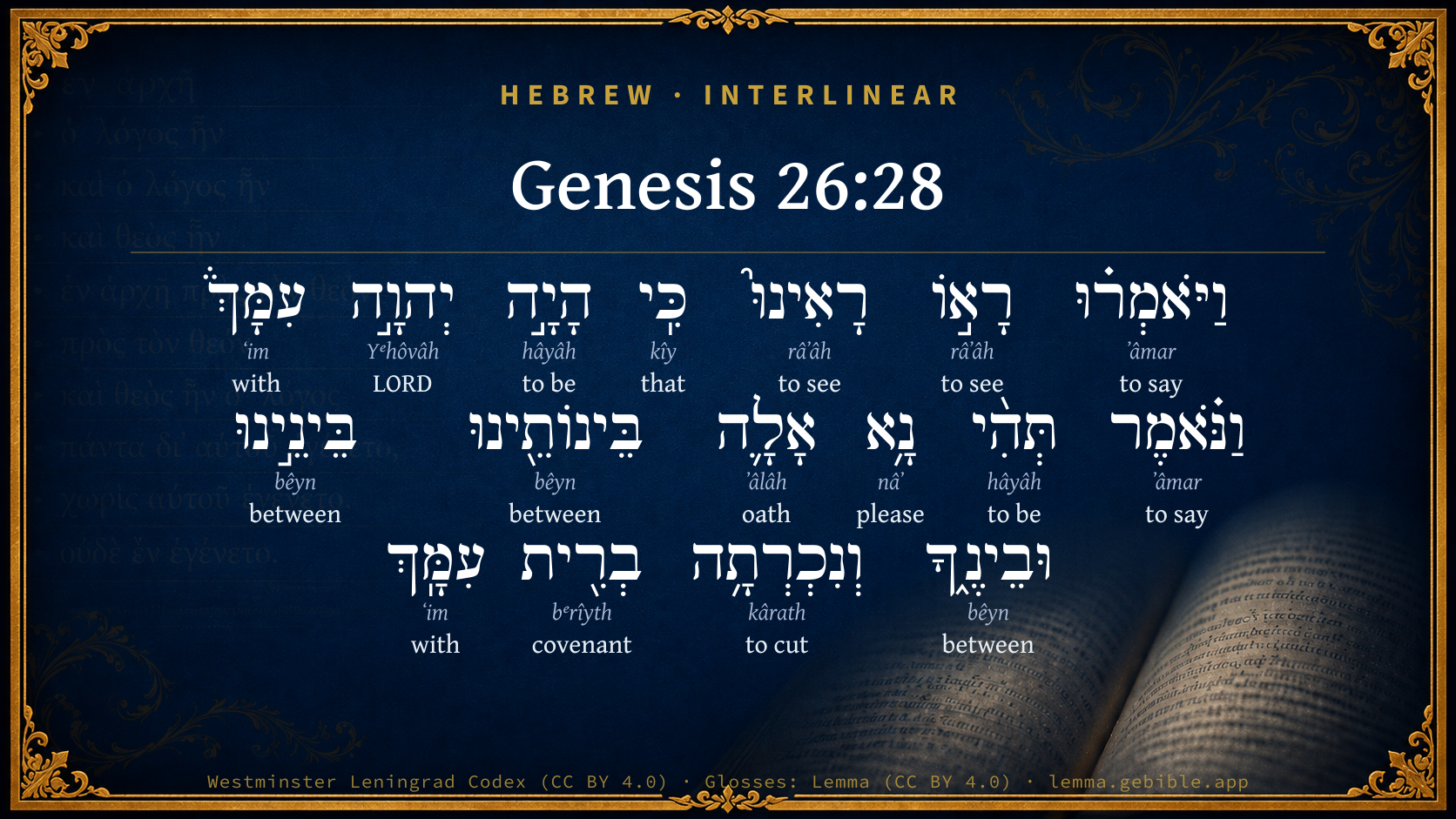
Hebrew (Westminster Leningrad Codex) Genesis 26:28 appears in the Hebrew Old Testament. The text above is from the Westminster Leningrad Codex. Each word links to its Strong’s number, a concise gloss, and parsing drawn from the Open Scriptures Hebrew Bible morphology. Click any word for its full Brown-Driver-Briggs (BDB) entry.
Download image
Cite this verse

Genesis 26:28 (World English Bible). Public Domain. Lemma interlinear Bible study tool, https://lemma.gebible.app/v/genesis/26/28.

Show BibTeX & RIS
BibTeX
RIS
English Translation
They said, "We saw plainly that Yahweh was with you. We said, 'Let there now be an oath between us, even between us and you, and let us make a covenant with you,
World English Bible · Public Domain
Download a study sheet

One document with this verse’s original text, its word-by-word gloss line, the meaning frame, cross-references with their text, attributed commentary, and full source and license credits — printable, and it pastes into notes with its structure intact.

This verse Autodidact and up

Study sheet (.html) Plain text (.txt)

A passage Seminary Student

Up to 50 verses in one chapter. A passage sheet keeps up to 6 commentary sources and 12 cross-references per verse, in the order this page ranks them, and says so on the sheet whenever that leaves anything out. Ask for a single verse and you get the Autodidact verse sheet above.

Everything on this page stays free to read, with no account — the sheet is a download of what is already on screen, not access to it.

Want to remove ads? Support Godless Engineer
Compare translations 3

The same verse in 3 English versions, stacked beneath the original-language interlinear above. Click any original word for its lexicon entry.

Each is an independent rendering of the whole verse — the interlinear is not word-aligned to these translations.

Highlighted words mark where these versions differ — a whole-verse word diff, not a word-by-word alignment.

  • World English Bible Public Domain
    They said, "We saw plainly that Yahweh was with you. We said, 'Let there now be an oath between us, even between us and you, and let us make a covenant with you,
  • King James Version Public Domain
    And they said, We saw certainly that the LORD was with thee: and we said, Let there be now an oath betwixt us, even betwixt us and thee, and let us make a covenant with thee;
  • unfoldingWord Literal Text CC BY-SA 4.0
    And they said, “We have clearly seen that Yahweh has been with you, so we said, ‘There should be an oath between us’—between us and you. So let us cut a covenant with you,

unfoldingWord Literal Text — © unfoldingWord, licensed CC BY-SA 4.0. Word-aligned USFM3 via Door43 (git.door43.org/unfoldingWord/en_ult).

Versions to compare (up to 4)

3 of 4 selected

Show all 18 translations

Every available English version of this verse, each an independent rendering of the whole verse.

  • World English Bible Public Domain
    They said, "We saw plainly that Yahweh was with you. We said, 'Let there now be an oath between us, even between us and you, and let us make a covenant with you,
  • Berean Standard Bible Public Domain
    “We can plainly see that the LORD has been with you,” they replied. “We recommend that there should now be an oath between us and you. Let us make a covenant with you
  • Majority Standard Bible Public Domain
    “We can plainly see that the LORD has been with you,” they replied. “We recommend that there should now be an oath between us and you. Let us make a covenant with you
  • King James Version Public Domain
    And they said, We saw certainly that the LORD was with thee: and we said, Let there be now an oath betwixt us, even betwixt us and thee, and let us make a covenant with thee;
  • American Standard Version (1901) Public Domain
    And they said, We saw plainly that Jehovah was with thee. And we said, Let there now be an oath betwixt us, even betwixt us and thee, and let us make a covenant with thee,
  • Revised Version (1885) Public Domain
    And they said, We saw plainly that the LORD was with thee: and we said, Let there now be an oath betwixt us, even betwixt us and thee, and let us make a covenant with thee;
  • Geneva Bible (1599) Public Domain
    Who answered, Wee sawe certainely that the Lord was with thee, and wee thought thus, Let there be nowe an othe betweene vs, euen betweene vs and thee, and let vs make a couenant with thee.
  • Douay-Rheims (1899) Public Domain
    And they answered: We saw that the Lord is with thee, and therefore we said: Let there be an oath between us, and let us make a covenant,
  • Young's Literal Translation Public Domain
    And they say, `We have certainly seen that Jehovah hath been with thee, and we say, `Let there be, we pray thee, an oath between us, between us and thee, and let us make a covenant with thee;
  • Literal Standard Version CC BY-SA 4.0
    And they say, “We have certainly seen that YHWH has been with you, and we say, Now let there be an oath between us, between us and you, and let us make a covenant with you;
  • Unlocked Literal Bible CC BY-SA 4.0
    Then they said, “We have clearly seen that Yahweh has been with you. So we decided that there should be an oath between us, yes, between us and you. So let us make a covenant with you,
  • unfoldingWord Literal Text CC BY-SA 4.0
    And they said, “We have clearly seen that Yahweh has been with you, so we said, ‘There should be an oath between us’—between us and you. So let us cut a covenant with you,
  • Darby Bible Public Domain
    And they said, We saw certainly that Jehovah is with thee; and we said, Let there be then an oath between us -- between us and thee, and let us make a covenant with thee,
  • World Messianic Bible Public Domain
    They said, “We saw plainly that the LORD was with you. We said, ‘Let there now be an oath between us, even between us and you, and let’s make a covenant with you,
  • Webster's Bible Public Domain
    And they said, We saw certainly that the LORD was with thee: and we said, Let there be now an oath betwixt us, even betwixt us and thee, and let us make a covenant with thee;
  • Free Bible Version CC BY-SA 4.0
    “Now we realize that the Lord is with you,” they replied. “So we agreed that we should make a sworn agreement with you.
  • Bible in Basic English Public Domain
    And they said, We saw clearly that the Lord was with you: so we said, Let there be an oath between us and you, and let us make an agreement with you;
  • JPS Tanakh (1917) Public Domain
    And they said: 'We saw plainly that the LORD was with thee; and we said: Let there now be an oath betwixt us, even betwixt us and thee, and let us make a covenant with thee;

Literal Standard Version (2020), Covenant Press — licensed CC BY-SA 4.0. Text via the HelloAO Bible API (eBible.org). Unlocked Literal Bible (unfoldingWord) — licensed CC BY-SA 4.0. Text via the HelloAO Bible API (eBible.org). unfoldingWord Literal Text — © unfoldingWord, licensed CC BY-SA 4.0. Word-aligned USFM3 via Door43 (git.door43.org/unfoldingWord/en_ult). Free Bible Version, Dr. Jonathan Gallagher — licensed CC BY-SA 4.0. Text via the HelloAO Bible API (eBible.org).

Word by word

More ways to search: Search by grammar → Find every occurrence → Compare this word →

Practice this passage: Drill this verse → Learn its vocabulary →

אָלָ֛ה
ʼâlâh
H423
“oath”
Noun, Common, Feminine, Singular, Absolute
Part of Speech
Noun
Type
Common
Gender
Feminine
Number
Singular
State
Absolute
Full BDB Definition

Origin: from H422

TWOT: 91a

oath - oath of covenant - curse - from God - from men - execration
  1. וַיֹּאמְר֗וּ ʼâmar H559 “and · to say” Conjunction + Verb, Qal, Sequential Imperfect, 3rd Person, Masculine, Plural
  2. רָא֣וֹ râʼâh H7200 “to see” Verb, Qal, Infinitive Absolute
  3. רָאִינוּ֮ râʼâh H7200 “to see” Verb, Qal, Perfect, 1st Person, Common, Plural
  4. כִּֽי kîy H3588 “that” Conjunction
  5. הָיָ֣ה hâyâh H1961 “to be” Verb, Qal, Perfect, 3rd Person, Masculine, Singular
  6. יְהוָ֣ה Yᵉhôvâh H3068 “LORD” Noun, Proper
  7. עִמָּךְ֒ ʻim H5973 “with · you” Preposition + Suffix, Personal, 2nd Person, Feminine, Singular
  8. וַנֹּ֗אמֶר ʼâmar H559 “and · to say” Conjunction + Verb, Qal, Sequential Imperfect, 1st Person, Common, Plural
  9. תְּהִ֨י hâyâh H1961 “to be” Verb, Qal, Jussive, 3rd Person, Feminine, Singular
  10. נָ֥א nâʼ H4994 “please” Particle, Exhortation
  11. בֵּינוֹתֵ֖ינוּ bêyn H996 “between · us” Preposition + Suffix, Personal, 1st Person, Common, Plural
  12. בֵּינֵ֣ינוּ bêyn H996 “between · us” Preposition + Suffix, Personal, 1st Person, Common, Plural
  13. וּבֵינֶ֑ךָ bêyn H996 “and · between · you” Conjunction + Preposition + Suffix, Personal, 2nd Person, Masculine, Singular
  14. וְנִכְרְתָ֥ה kârath H3772 “and · to cut” Conjunction + Verb, Qal, Cohortative, 1st Person, Common, Plural
  15. בְרִ֖ית bᵉrîyth H1285 “covenant” Noun, Common, Feminine, Singular, Absolute
  16. עִמָּֽךְ ʻim H5973 “with · her” Preposition + Suffix, Personal, 3rd Person, Feminine, Singular

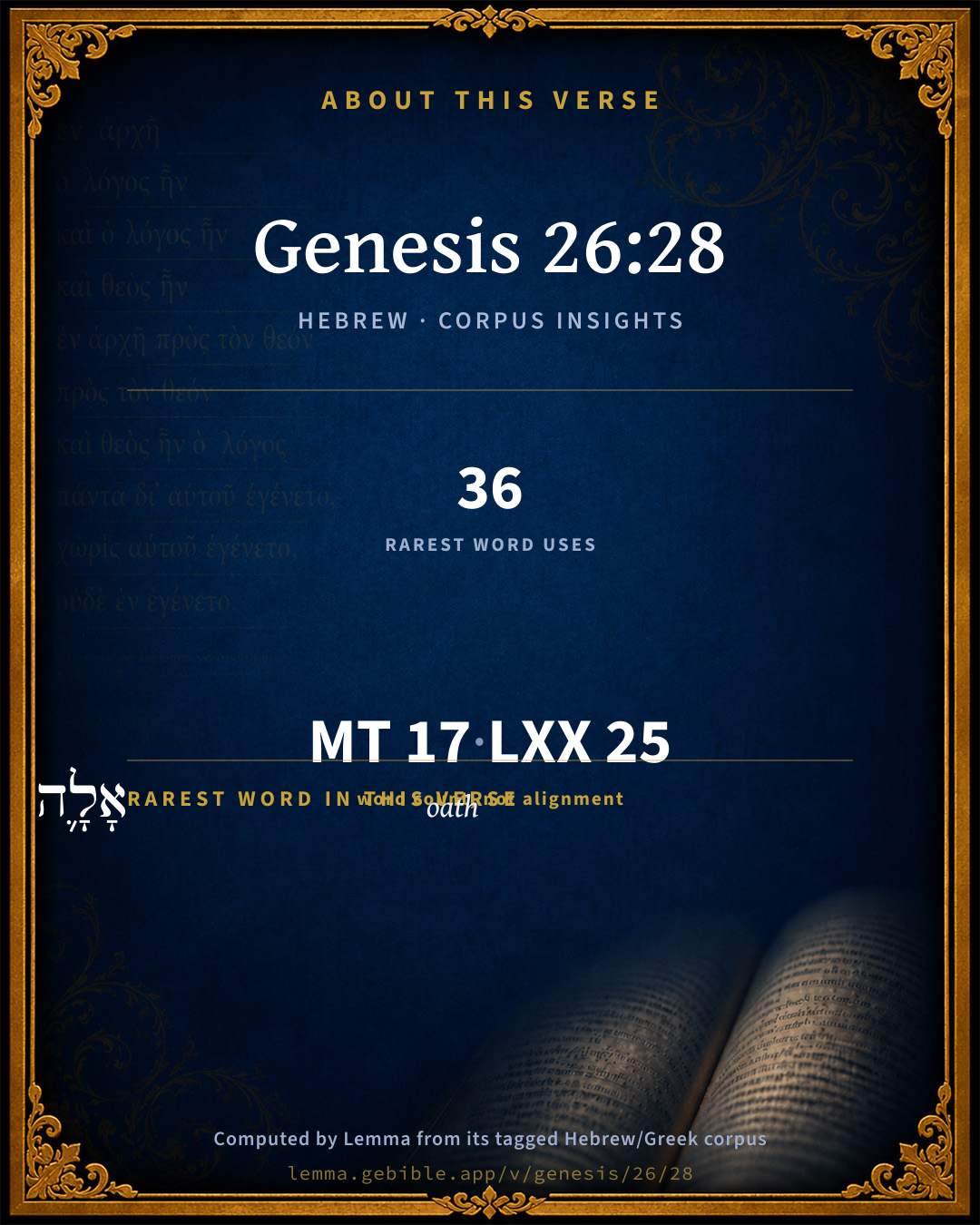
About this verse

These counts appear in no published source. They are computed here, from the morphology-tagged text and Lemma’s own curated glosses. What Lemma adds →

17
words
11
distinct lemmas
Pentateuch
section

Shared distinctive vocabulary

אָלָ֛ה oath H423 occurs in 32 verses of the Hebrew Bible. Also found in:

Grammatical profile

  • 7 verbs
  • 3 nouns
  • 5 prepositions
  • 1 conjunction
  • 1 particle

Verb forms

  • וַיֹּאמְר֗וּ Qal · Sequential Imperfect
  • רָא֣וֹ Qal · Infinitive Absolute
  • רָאִינוּ֮ Qal · Perfect
  • הָיָ֣ה Qal · Perfect
  • וַנֹּ֗אמֶר Qal · Sequential Imperfect
  • תְּהִ֨י Qal · Jussive
  • וְנִכְרְתָ֥ה Qal · Cohortative

Repetition

Words recur within this verse — often emphatic in Hebrew:

  • בֵּינוֹתֵ֖ינוּ between H996 ×3
  • וַיֹּאמְר֗וּ to say H559 ×2
  • רָא֣וֹ to see H7200 ×2
  • הָיָ֣ה to be H1961 ×2
  • עִמָּךְ֒ with H5973 ×2

Hebrew & Septuagint length

In English translation the verse runs 33 words from the Hebrew and 33 from the Septuagint (LXX English) — the same length.

A rough comparison of the two English renderings, which tokenize alike — not a word-level alignment.

Word counts can differ between the Hebrew and the Greek without any difference in meaning — e.g. the Hebrew direct-object marker אֵת has no separate Greek word, and Greek often adds the article ὁ.

In the original languages it is 17 Hebrew tokens and 25 Greek tokens — but the two are counted differently (Hebrew bundles its prefixes and suffixes into one token; the Greek is in lemma form), so that isn’t a like-for-like length.

Cross-references

16

Topical passages linked to Genesis 26:28 in the Treasury of Scripture Knowledge — connected by theme and wording, ordered by reader-vote popularity; previews shown in the World English Bible.

  • Genesis 21:22–23 It happened at that time, that Abimelech and Phicol the captain of his host spoke to Abraham, saying, "God is with you in all that you do.
  • Genesis 21:31–32 Therefore he called that place Beersheba, because they both swore there.
  • Genesis 39:5 It happened from the time that he made him overseer in his house, and over all that he had, that Yahweh blessed the Egyptian's house for Joseph's sake; and the blessing of Yahweh was on all that he had, in the house and in the field.
  • Joshua 3:7 Yahweh said to Joshua, This day will I begin to magnify you in the sight of all Israel, that they may know that, as I was with Moses, so I will be with you.
  • Isaiah 45:14 Thus says Yahweh: "The labor of Egypt, and the merchandise of Ethiopia, and the Sabeans, men of stature, shall come over to you, and they shall be yours. They shall go after you. In chains they shall come over; and they shall fall down to you. They shall make supplication to you: 'Surely God is in you; and there is none else, there is no other god.
  • Isaiah 61:9 Their seed shall be known among the nations, and their offspring among the peoples; all who see them shall acknowledge them, that they are the seed which Yahweh has blessed.
  • Genesis 24:3 I will make you swear by Yahweh, the God of heaven and the God of the earth, that you shall not take a wife for my son of the daughters of the Canaanites, among whom I live.
  • Genesis 24:41 Then will you be clear from my oath, when you come to my relatives. If they don't give her to you, you shall be clear from my oath.'
  • Genesis 31:49–53 and Mizpah, for he said, "Yahweh watch between me and you, when we are absent one from another.
  • 2 Chronicles 1:1 Solomon the son of David was strengthened in his kingdom, and Yahweh his God was with him, and magnified him exceedingly.
  • Isaiah 60:14 The sons of those who afflicted you shall come bending to you; and all those who despised you shall bow themselves down at the soles of your feet; and they shall call you The city of Yahweh, The Zion of the Holy One of Israel.
  • Isaiah 61:6 But you shall be named the priests of Yahweh; men shall call you the ministers of our God: you shall eat the wealth of the nations, and in their glory shall you boast yourselves.
  • 1 Corinthians 14:25 And thus the secrets of his heart are revealed. So he will fall down on his face and worship God, declaring that God is among you indeed.
  • Hebrews 6:16 For men indeed swear by a greater one, and in every dispute of theirs the oath is final for confirmation.
  • Hebrews 13:5 Be free from the love of money, content with such things as you have, for he has said, "I will in no way leave you, neither will I in any way forsake you."
  • Romans 8:31 What then shall we say about these things? If God is for us, who can be against us?

Cross-references courtesy of OpenBible.info (CC BY 4.0).

Hebrew and Greek witnesses Masoretic Hebrew ↔ Greek Septuagint

The same verse in the two great witnesses to the Old Testament, shown verse-for-verse.

These are two independent witnesses, not word-aligned to each other, and the Septuagint is shown in lemma (dictionary) form.

Hebrew Genesis 26:28 Masoretic · Westminster Leningrad Codex

וַיֹּאמְר֗וּ רָא֣וֹ רָאִינוּ֮ כִּֽי הָיָ֣ה יְהוָ֣ה עִמָּךְ֒ וַנֹּ֗אמֶר תְּהִ֨י נָ֥א אָלָ֛ה בֵּינוֹתֵ֖ינוּ בֵּינֵ֣ינוּ וּבֵינֶ֑ךָ וְנִכְרְתָ֥ה בְרִ֖ית עִמָּֽךְ

They said, "We saw plainly that Yahweh was with you. We said, 'Let there now be an oath between us, even between us and you, and let us make a covenant with you,

World English Bible · Public Domain

Greek LXX Genesis 26:28 Septuagint · lemma form

καί εἶπον ὁράω ὁράω ὅτι εἰμί κύριος μετά σύ καί εἶπον γίγνομαι ἀρά ἀνά μέσος ἐγώ καί ἀνά μέσος σύ καί διατίθημι μετά σύ διαθήκη

And they said, We have surely seen that the Lord was with you, and we said, Let there be an oath between us and you, and we will make a covenant with you,

LXX2012 (modern English Septuagint) · Public Domain

Hebrew: Westminster Leningrad Codex (CC BY 4.0). Greek: Septuagint (public domain); English from LXX2012 (modern English Septuagint) (Public Domain). How the Septuagint differs from the Hebrew →

Targum (Aramaic paraphrase)

2

The Targum is the ancient Jewish Aramaic paraphrase of the Hebrew Scriptures — an interpretive translation, not the Hebrew text itself. Onkelos (literal) and Pseudo-Jonathan (expansive) render the Torah, and Jonathan the Prophets. Coverage is partial: where no permissively-licensed English translation exists for a verse, only the Aramaic is shown. This is verse-level text, not a word-by-word alignment to the Hebrew.

  1. Targum Onkelos Torah (Genesis–Deuteronomy)
    וַאֲמָרוּ מֶחֱזָא חֲזֵינָא אֲרֵי הֲוָה מֵימְרָא דַּיְיָ בִּסַעְדָּךְ וַאֲמַרְנָא תִּתְקַיַּם כְּעַן מוֹמָתָא דִּהֲוָה בֵין אֲבָהָתָנָא בֵּינָנָא וּבֵינָךְ וְנִגְזַר קְיָם עִמָּךְ

    (no public-domain English translation for this verse)

    Targum Onkelos — Aramaic: “Onkelos Genesis” (public domain); “Onkelos Exodus” (public domain); “Onkelos Leviticus” (public domain); “Onkelos Numbers” (public domain); “Onkelos Deuteronomy” (public domain). English: “Sefaria Community Translation” (CC0 1.0 (public-domain dedication)); “J.W. Etheridge. The Targums of Onkelos and Jonathan Ben Uzziel on the Pentateuch. London: Longmans, Green, 1862” (public domain). Text via Sefaria.

  2. Targum Pseudo-Jonathan Torah (Genesis–Deuteronomy)
    וַאֲמָרוּ מַחְמָא חֲמִינָא אֲרוּם הֲוָה מֵימְרָא דַיְיָ בְּסַעֲדָךְ דְבִזְכוּתָךְ הֲוַות לָן כָּל טַבְתָא וּכְדוּ נְפַקְתָּא מִן אַרְעָן יַבִּישׁוּ בֵירָן וְאִילָנָא לָא עָבְדוּ פֵירִין וְאָמַרְנָא נְהַדְרִינֵיהּ לְוָותָנָא וְתִתְקַיֵים כְּדוֹן מוֹמָתָא דַהֲוָות בֵּינָן וּמְבָכִין תְּהֵי בֵּינָן וּבֵינָךְ וְנִגְזוֹר קְיָם עִמָךְ

    And they answered, Seeing, we have seen, that the Word of the Lord is for thy help, and for thy righteousness' sake all good hath been to us; but when thou wentest forth from our land the wells dried up, and our trees made no fruit; then we said, We will cause him to return to us. And now let there be an oath established between us, and kindness between us and thee, and we will enter into a covenant with thee,

    Targum Pseudo-Jonathan — Aramaic: “Targum Jonathan on Genesis” (public domain); “Targum Jonathan on Exodus” (public domain); “Targum Jonathan on Leviticus” (public domain); “Targum Jonathan on Numbers” (public domain); “Targum Jonathan on Deuteronomy” (public domain). English: “The Targum of Jonathan ben Uzziel, trans. J. W. Etheridge, London, 1862” (public domain). Text via Sefaria.

Commentary

Notes on Genesis 26:28 from classic Christian and Jewish commentators (each source and its license shown beneath its notes). The classic Christian expositions comment on the surrounding passage and are grouped to its opening verse, so a note may address several verses; the Jewish commentaries on the Tanakh (Rashi and others) are per-verse, so they appear only where the commentator wrote on this verse.

Lemma curates 59 commentaries, every one of them public domain or Creative Commons licensed, each selected and text-cleaned for this edition rather than reprinted as found. About our sources →

Trapp's Complete Commentary

John Trapp

Gen 26:28 And they said, We saw certainly that the LORD was with thee: and we said, Let there be now an oath betwixt us, [even] betwixt us and thee, and let us make a covenant with thee;

Ver. 28. Let there be now an oath.] See here, saith Chrysostom, {a} how great the power of virtue is, and the might of meekness. For they that lately drove him out from among them, now come to him in courtesy, though a forlorn foreigner; and not only give him satisfaction, but seek his friendship. Thus "when a man’s ways please the Lord, he maketh his enemies to be at peace with him". {Pro 16:7}

{a} Quanta virtutis potentia, quantum mansuetudinis robur, &c. - Chrysost. Hom. quinta.

John Trapp, A Commentary or Exposition upon All the Books of the Old and New Testament (1647–1656) — public domain. Text from a community e-Sword module.

Joseph Benson's Commentary

Gen 26:28. The Lord is with thee, and thou art the blessed of the Lord — As if he had said, Be persuaded to overlook the injuries offered thee, for God has abundantly made up to thee the damage thou receivedst. Those whom God blesses and favours have reason enough to forgive those that hate them, since the worst enemy they have cannot do them any real hurt. Let there be an oath betwixt us — Whatever some of his envious subjects might mean, he and his prime minister, whom he had now brought with him, designed no other but a cordial friendship. Perhaps Abimelech had received by tradition the warning God gave to his predecessor, not to hurt Abraham; (Gen 20:7;) and that made him stand in such awe of Isaac, who appeared to be as much the favourite of Heaven as Abraham was. It appears from this verse that a strong sense still prevailed, in that part of the world, of God’s superintending providence, and of his ordering the affairs of men so that blessings might come on the righteous. These Philistines not only observe this with regard to Isaac, but desire to enter into a covenant with him on that account. Would to God there was as much faith in general in regard to thin point in our days, as there seems to have been then, even among the Philistines!

Joseph Benson's Commentary on the Old and New Testaments (1811–1818) — public domain. Text from a community e-Sword module.

Adam Clarke's Commentary

Verse 28. Let there be now an oath betwixt us] Let us make a covenant by which we shall be mutually bound, and let it be ratified in the most solemn manner.

Adam Clarke's Commentary on the Bible (1810–1826) — public domain. Text from a community e-Sword/MySword module.

John Calvin's Commentaries

28. We saw certainly that the Lord was with thee. By this argument they prove that they desired a compact with Isaac, not insidiously, but in good faith, because they acknowledge the favor of God towards him. For it was necessary to purge themselves from this suspicion, seeing that they now presented themselves so courteously to one against whom they had before been unreasonably opposed. This confession of theirs, however, contains very useful instruction. Profane men in calling one, whose affairs all succeed well and prosperously, the blessed of the Lord, bear testimony that God is the author of all good things, and that from him alone flows all prosperity. Exceedingly base, therefore, is our ingratitude, if, when God acts kindly towards us, we pass by his benefits with closed eyes. Again, profane men regard the friendship of one whom God favors, as desirable for themselves; considering that there is no better or holier commendation than the love of God. Perversely blind, therefore, are they, who not only neglect those whom God declares to be dear unto him, but also iniquitously vex them. The Lord proclaims himself ready to execute vengeance on any one who may injure those whom he takes under his protection; but the greater part, unmoved by this most terrible denunciation, still wickedly afflict the good and the simple. We here, however, see that the sense of nature dictated to unbelievers, what we scarcely credit when spoken by the mouth of God himself. Still it is surprising that they should be afraid of an inoffensive man; and should require from him an oath that he would do them no injury. They ought to have concluded, from the favor which God had showed him, that he was a just man, and therefore there could be no danger from him; yet because they form their estimate of him from their own disposition and conduct, they also distrust his probity. Such perturbation commonly agitates unbelievers, so that they are inconsistent with themselves; or at least waver and are tossed between conflicting sentiments, and have nothing fixed and equable. For those principles of right judgment, which spring up in their breasts, are soon smothered by depraved affections. Hence it happens, that what is justly conceived by them vanishes; or is at least corrupted, and does not bring forth good fruit.

John Calvin's Commentaries (1540-1563) — public domain. Text from the Calvin Translation Society English edition (1840s-50s) via the Christian Classics Ethereal Library (ccel.org). Calvin's coverage is partial (roughly two-thirds of the Bible); uncommented books and verses are honest gaps, never fabricated. The 19th-century editor's footnotes and remarks are omitted so the notes are faithfully Calvin's own voice.

Ellicott's Commentary for English Readers

(28, 29) Let there be now an oath.—The word literally signifies a curse. Each side uttered an imprecation, with the prayer that it might fall upon himself if he broke the terms of the covenant.

Let us make a covenant.—Heb., cut. (See Note on Gen_15:10; Gen_15:18; where also see the explanation of this use of the word curse.)

The Lord was with thee . . . blessed of the Lord.—This use of the word “Lord,” that is, Jehovah, is very remarkable. In Gen_21:22-23 Abimelech uses the term Elohim, God, in accordance with the careful discrimination in the use of the names of the Deity often previously referred to. By the long residence, first of Abraham and then of Isaac, in their territory, the Philistines would indeed have become better acquainted with the religion of the patriarchs; but as Jehovah was not their special title for the Deity (Exo_6:3), we must conclude, with Rosenmüller, that it was Moses who wrote Jehovah in the place of the word actually employed by Abimelech. We gather, however, that the king did not use any generic or heathen names of the Deity, but that whereby the patriarchs worshipped their covenant God, and his so doing was probably intended as an act of homage to Him.

A Bible Commentary for English Readers, edited by Charles John Ellicott (1878–1897) — public domain. Text from a community e-Sword module.

The Cambridge Bible for Schools and Colleges

gen. ed. J. J. S. Perowne

28. an oath] A compact sealed by an oath. Cf. Deu_29:12; Neh_10:29.

covenant] See on this word (b’rîth) the note on Gen_15:18.

The Cambridge Bible for Schools and Colleges (gen. ed. J. J. S. Perowne; Cambridge University Press, 1878–1918) — public domain. Text from a community e-Sword module.

John Gill's Exposition

And he made them a feast,.... Made a feast like a king, for the king and his grandees; he treated them in a generous way, according to their dignity, and agreeable to his own disposition and substance:

and they did eat and drink; freely, cheerfully, and in a friendly manner; for both having spoken their minds, they agreed to bury all former things oblivion, and live in peace and friendship; though this feast was not on account of the covenant made between them, as is observed by some interpreters, but as an hospitable act, and a token of good will; for the covenant and the oath confirming it seem to be made next morning, as follows:

John Gill's Exposition of the Whole Bible (1746–1763) — public domain (CC PDM 1.0). Text via the HelloAO Bible API.

Whedon's Commentary on the Bible

Daniel D. Whedon

28. We saw certainly — The signal favour bestowed on Isaac, (Gen_26:12,) and the memory of his father, convinced these Philistine lords that their God Jehovah was mighty to help his worshippers. Twice in this address the name Jehovah is used, showing that Isaac’s piety had magnified that name among the heathen.

Daniel D. Whedon (gen. ed.), Commentary on the Old and New Testaments (1874–1909) — public domain. Text from a community e-Sword module.

The Pulpit Commentary

And they said, We saw certainly literally, seeing we saw, i.e. we assuredly perceived, or, we have indeed discovered (vide Ewald"s "Hebrews Synt.," Abimelech and his ministers first explain the motive which has impelled them to solicit a renewal of the old alliancethat the Lord was with thee: the use of Jehovah instead of Elohim, as Gen_21:22, does not prove that this is a Jehovistic elaboration of the earlier legend. Neither is it necessary to suppose that the term Jehovah is a Mosaic translation of the epithet employed by Abimelech (Rosenm The long-continued residence of Abraham in Gemr and Beersheba afforded ample opportunity for Abimelech becoming acquainted with the patriarch"s God. The introduction of Jehovah into the narrative may be noted as a third point of dissimilarity between this and the previous accountand we said, Let there he now an oath i.e. a treaty secured by an oath or self-imprecation on the transgressor (cf. Deu_29:11, Deu_29:13) betwixt us, even betwixt us and thee, a farther particularization of the parties to the covenant for the sake of emphasisand let us make a covenant with thee. The phrase "to cut a covenant," here used in a so-called Jehovistic portion of the history, occurs in Gen_21:27, Gen_21:32, which confessedly belongs to the fundamental document.

The Pulpit Commentary (1880–1919), ed. H.D.M. Spence-Jones & Joseph S. Exell — public domain. Text from a community e-Sword module.

John Wesley's Explanatory Notes

The Lord is with thee, and thou art the blessed of the Lord, q.d. Be persuaded to overlook the injuries offered thee, for God has abundantly made up to thee the damage thou receivedst. Those whom God blesseth and favours, have reason enough to forgive those that hate them, since the worst enemy they have cannot do them any real hurt. Let there be an oath betwixt us - Whatever some of his envious subjects might mean, he and his prime ministers, whom he had now brought with him, designed no other but a cordial friendship. Perhaps Abimelech had received by tradition the warning God gave to his predecessor not to hurt Abraham, chap. xx, 7, and that made him stand in such awe of Isaac, who appeared to be as much the favourite of heaven as Abraham was.

John Wesley, Explanatory Notes Upon the Whole Bible (1754–1765) — public domain. Text via the GEBible commentary corpus.

unfoldingWord translationNotes

Door43 World Missions Community

they said

This refers to Abimelech, Ahuzzath, and Phicol. One of them spoke and the other two agreed with what he said. It does not mean they all spoke at the same time. AT: "one of them said"

We have clearly seen

"We know" or "We are certain"

So let us make a covenant

"So we want to make a covenant"

and as we have treated you well

This can also be translated as the beginning of a new sentence. "We have done only good to you"

you are blessed by Yahweh

This can be stated in active form. AT: "Yahweh has blessed you" (See: Active or Passive)

translationWords

Yahweh

oath

covenant

peace

bless

unfoldingWord translationNotes — © Distant Shores Media and the Door43 World Missions Community, licensed CC BY-SA 4.0. Source: git.door43.org/Door43/en_tn.

Rashi

Rabbi Shlomo Yitzchaki (Rashi)

ראו ראינו WE SAW PLAINLY (literally, seeing we have seen) — We saw it in the case of your father and we see it in the case of yourself (Genesis Rabbah 64:10).

‘תהי נא אלה בינותינו וגו means LET THE OATH that has existed BETWEEN US since the days of your father CONTINUE NOW BETWEEN US AND YOU.

Rashi on the Tanakh — English translations: “The Judaica Press complete Tanach with Rashi, translated by A. J. Rosenberg” (CC BY 4.0); “Pentateuch with Rashi's commentary by M. Rosenbaum and A.M. Silbermann, 1929-1934” (public domain); “The Metsudah Tanach series, Lakewood, N.J” (CC BY 4.0); and “The Book of Joshua, Metsudah Publications, 1997” (CC BY 4.0). Text via Sefaria.

Radak

Rabbi David Kimhi (Radak)

ראו, the letter ו at the end instead of the customary letter ה as the last letter of the root is not unique, we encounter it also in Isaiah 6,9 or as בכו לא תבכה, in Isaiah 30,19. There are other parallel verses in Scripture.

תהי נא אלה בינותינו, a reference to all the people of his country having sworn to keep this agreement with Yitzchok, to be confirmed by an oath between the two representatives of the parties concerned, i.e. Avimelech and Yitzchok.

Radak on the Tanakh — English translations: “Sefaria Community Translation” (CC0 1.0 (public-domain dedication)); “Eliyahu Munk, HaChut Hameshulash” (CC BY 4.0); “Rabbi Mike Feuer, Jerusalem Anthology” (CC BY 4.0); and “R. David Kimhi on the first book of Psalms, Translated by R.G. Finch, London, 1919” (public domain). Text via Sefaria.

Lesson kit

Teaching starters — assembled from the data on this page, not authored interpretation. Every prompt links to the verse data it draws on. Edit before teaching.

Genesis, in the Pentateuch, opens this verse with 17 words (11 distinct Hebrew lemmas). Its most distinctive word is ʼâlâh (“oath”). A historical commentator’s framing appears above. Read the whole chapter for the surrounding context.

Discussion questions

  1. How does “oath” (ʼâlâh) shape what this verse is saying?
  2. Genesis 24:41 shares the word «oath» with this verse. How do the two illuminate each other?
  3. “between” occurs 3× in this one verse. What is the effect of the repetition?
  4. These translations render this verse differently; the difference is in the English rendering, not the original. What questions does that raise?
  5. The verb «וַיֹּאמְר֗וּ» is Qal Sequential Imperfect. How does its form color the action?
  6. Reading how Trapp's Complete Commentary and Joseph Benson's Commentary read this verse, where do the two commentators agree and where do they part?

Things to notice

Reading settings

Reading text

Shown beneath each verse's original-language words.

Old Testament
Old Testament edition

Read the OT as the Masoretic Hebrew (MT) or the Greek Septuagint (LXX).

English shown for the Greek Septuagint (in the Hebrew ↔ Greek comparison).

Comparing translations? Open the Compare panel on any verse page to stack up to four side by side.