
2 Chronicles 2:8

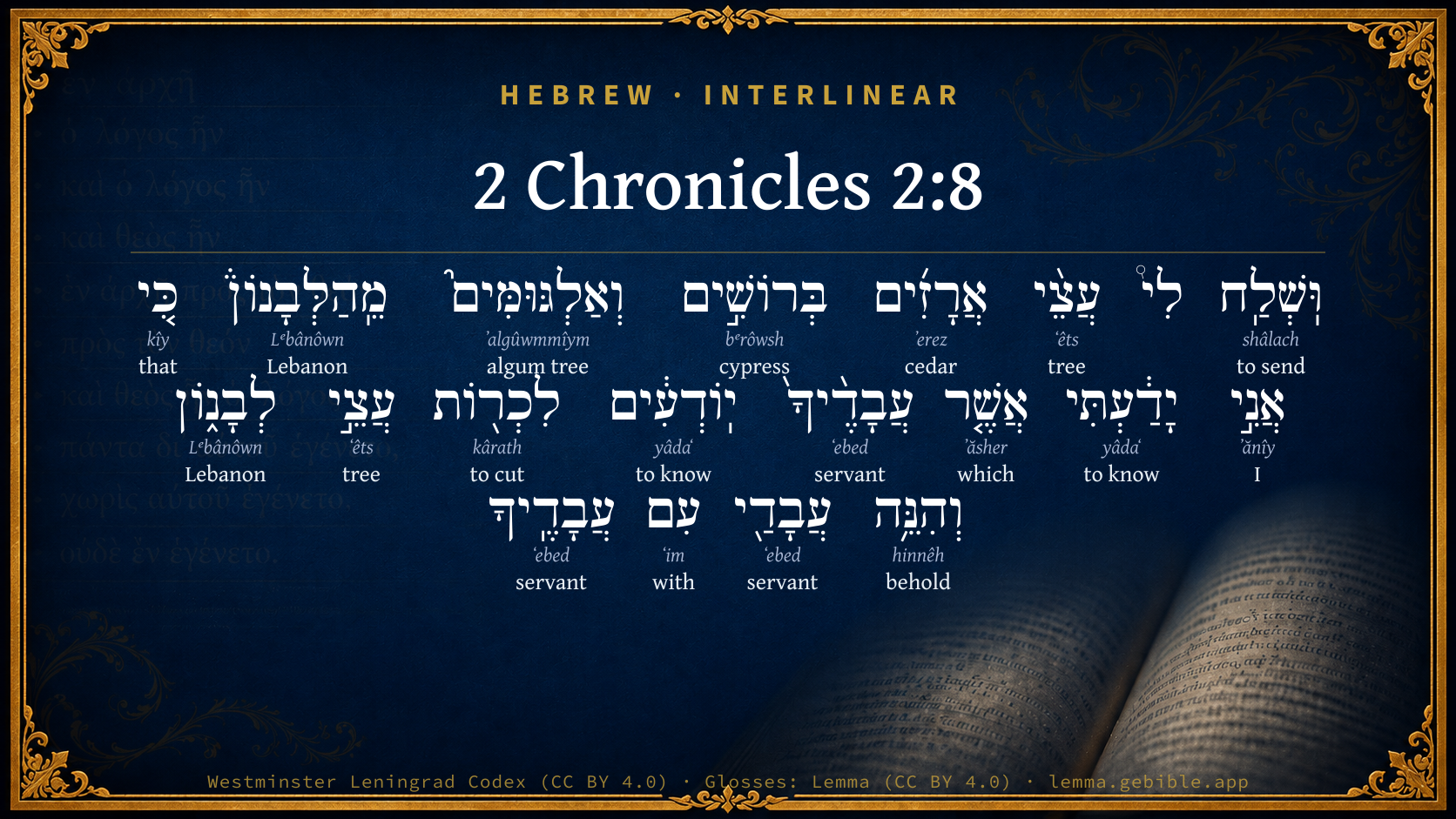
Hebrew (Westminster Leningrad Codex) 2 Chronicles 2:8 appears in the Hebrew Old Testament. The text above is from the Westminster Leningrad Codex. Each word links to its Strong’s number, a concise gloss, and parsing drawn from the Open Scriptures Hebrew Bible morphology. Click any word for its full Brown-Driver-Briggs (BDB) entry.
Download image
Cite this verse

2 Chronicles 2:8 (World English Bible). Public Domain. Lemma interlinear Bible study tool, https://lemma.gebible.app/v/2-chronicles/2/8.

Show BibTeX & RIS
BibTeX
RIS
English Translation
Send me also cedar trees, fir trees, and algum trees, out of Lebanon; for I know that your servants know how to cut timber in Lebanon: and, behold, my servants shall be with your servants,
World English Bible · Public Domain
Highlights
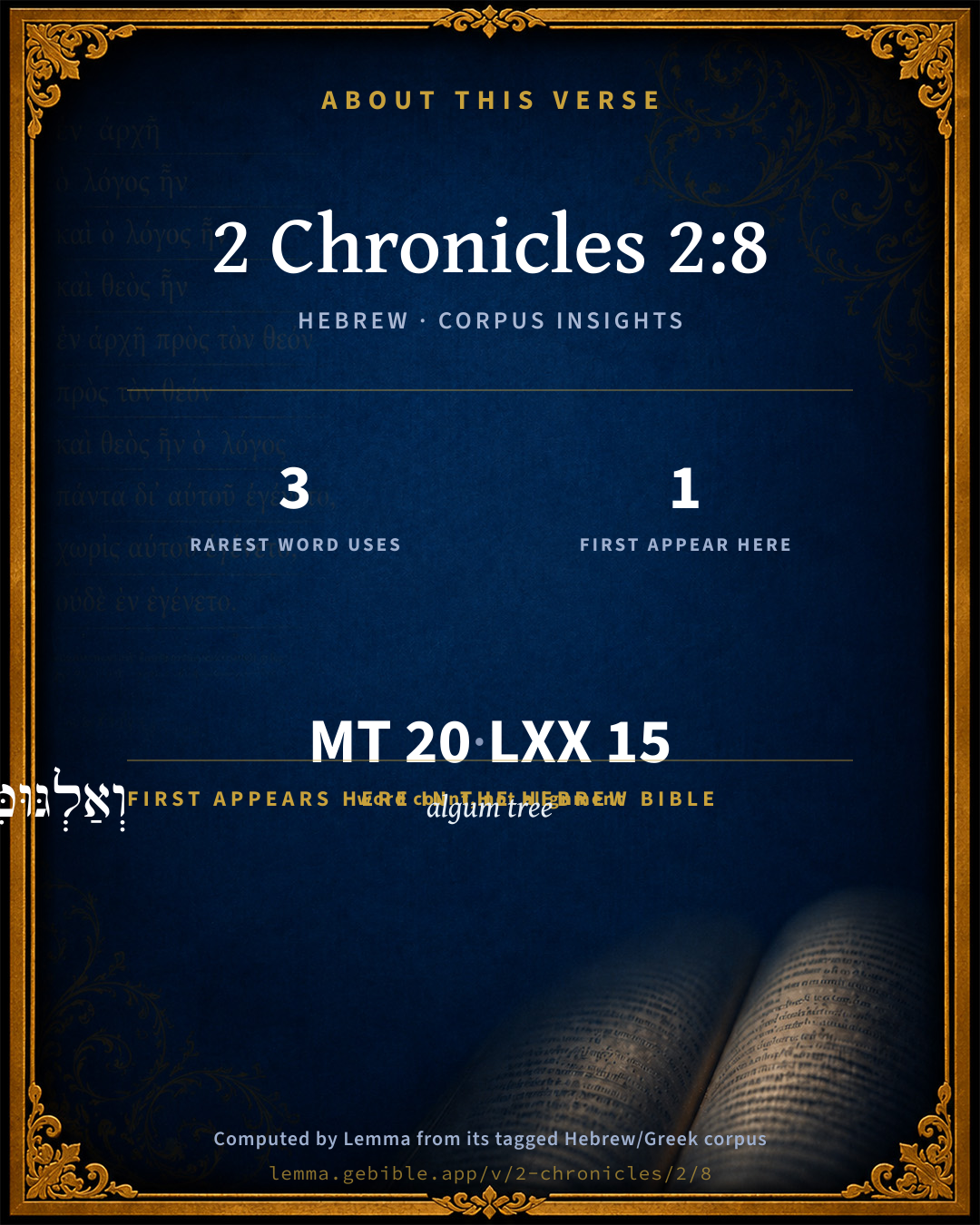
  • 1 first appearance in the Hebrew Bible
Full analysis ↓
Download a study sheet

One document with this verse’s original text, its word-by-word gloss line, the meaning frame, cross-references with their text, attributed commentary, and full source and license credits — printable, and it pastes into notes with its structure intact.

This verse Autodidact and up

Study sheet (.html) Plain text (.txt)

A passage Seminary Student

Up to 50 verses in one chapter. A passage sheet keeps up to 6 commentary sources and 12 cross-references per verse, in the order this page ranks them, and says so on the sheet whenever that leaves anything out. Ask for a single verse and you get the Autodidact verse sheet above.

Everything on this page stays free to read, with no account — the sheet is a download of what is already on screen, not access to it.

Want to remove ads? Support Godless Engineer
Compare translations 3

The same verse in 3 English versions, stacked beneath the original-language interlinear above. Click any original word for its lexicon entry.

Each is an independent rendering of the whole verse — the interlinear is not word-aligned to these translations.

Highlighted words mark where these versions differ — a whole-verse word diff, not a word-by-word alignment.

  • World English Bible Public Domain
    Send me also cedar trees, fir trees, and algum trees, out of Lebanon; for I know that your servants know how to cut timber in Lebanon: and, behold, my servants shall be with your servants,
  • King James Version Public Domain
    Send me also cedar trees, fir trees, and algum trees, out of Lebanon: for I know that thy servants can skill to cut timber in Lebanon; and, behold, my servants shall be with thy servants,
  • unfoldingWord Literal Text CC BY-SA 4.0
    And send to me trees of cedar, cypress, and algum from Lebanon, for I myself know that your servants know how to cut trees of Lebanon. And behold, my servants will be with your servants,

unfoldingWord Literal Text — © unfoldingWord, licensed CC BY-SA 4.0. Word-aligned USFM3 via Door43 (git.door43.org/unfoldingWord/en_ult).

Versions to compare (up to 4)

3 of 4 selected

Show all 18 translations

Every available English version of this verse, each an independent rendering of the whole verse.

  • World English Bible Public Domain
    Send me also cedar trees, fir trees, and algum trees, out of Lebanon; for I know that your servants know how to cut timber in Lebanon: and, behold, my servants shall be with your servants,
  • Berean Standard Bible Public Domain
    Send me also cedar, cypress, and algum logs from Lebanon, for I know that your servants have skill to cut timber there. And indeed, my servants will work with yours
  • Majority Standard Bible Public Domain
    Send me also cedar, cypress, and algum logs from Lebanon, for I know that your servants have skill to cut timber there. And indeed, my servants will work with yours
  • King James Version Public Domain
    Send me also cedar trees, fir trees, and algum trees, out of Lebanon: for I know that thy servants can skill to cut timber in Lebanon; and, behold, my servants shall be with thy servants,
  • American Standard Version (1901) Public Domain
    Send me also cedar-trees, fir-trees, and algum-trees, out of Lebanon; for I know that thy servants know how to cut timber in Lebanon: and, behold, my servants shall be with thy servants,
  • Revised Version (1885) Public Domain
    Send me also cedar trees, fir trees, and algum trees, out of Lebanon: for I know that thy servants can skill to cut timber in Lebanon; and, behold, my servants shall be with thy servants,
  • Geneva Bible (1599) Public Domain
    Sende mee also cedar trees, firre trees and Algummim trees from Lebanon: for I knowe that thy seruants can skill to hewe timber in Lebanon: and beholde, my seruantes shalbe with thine,
  • Douay-Rheims (1899) Public Domain
    Send me also cedars, and fir trees, and pine trees from Libanus: for I know that thy servants are skilful in cutting timber in Libanus, and my servants shall be with thy servants,
  • Young's Literal Translation Public Domain
    and send to me cedar-trees, firs, and algums from Lebanon, for I have known that thy servants know to cut down trees of Lebanon, and lo, my servants `are' with thy servants,
  • Literal Standard Version CC BY-SA 4.0
    and send to me cedar-trees, firs, and algums from Lebanon, for I have known that your servants know to cut down trees of Lebanon, and behold, my servants [are] with your servants,
  • Unlocked Literal Bible CC BY-SA 4.0
    Send me also cedar, cypress, and algum trees from Lebanon,for I know that your servants know how to cut timber in Lebanon. See, my servants will be with your servants,
  • unfoldingWord Literal Text CC BY-SA 4.0
    And send to me trees of cedar, cypress, and algum from Lebanon, for I myself know that your servants know how to cut trees of Lebanon. And behold, my servants will be with your servants,
  • Darby Bible Public Domain
    Send me also cedar-trees, cypress-trees, and sandal-wood trees, out of Lebanon; for I know that thy servants are experienced in cutting timber in Lebanon; and behold, my servants shall be with thy servants,
  • World Messianic Bible Public Domain
    “Send me also cedar trees, cypress trees, and algum trees out of Lebanon, for I know that your servants know how to cut timber in Lebanon. Behold, my servants will be with your servants,
  • Webster's Bible Public Domain
    Send me also cedar trees, fir trees, and algum trees out of Lebanon: for I know that thy servants have skill to cut timber in Lebanon; and behold, my servants shall be with thy servants,
  • Free Bible Version CC BY-SA 4.0
    Also send me cedar, cypress, and algum timber from Lebanon, for I know that your workers are skillful in cutting down the trees of Lebanon. I will send men to help your workers
  • Bible in Basic English Public Domain
    And send me cedar-trees, cypress-trees and sandal-wood from Lebanon, for, to my knowledge, your servants are expert wood-cutters in Lebanon; and my servants will be with yours,
  • JPS Tanakh (1917) Public Domain
    (2-7) Send me also cedar-trees, cypress-trees, and sandal-wood, out of Lebanon; for I know that thy servants have skill to cut timber in Lebanon; and, behold, my servants shall be with thy servants,

Literal Standard Version (2020), Covenant Press — licensed CC BY-SA 4.0. Text via the HelloAO Bible API (eBible.org). Unlocked Literal Bible (unfoldingWord) — licensed CC BY-SA 4.0. Text via the HelloAO Bible API (eBible.org). unfoldingWord Literal Text — © unfoldingWord, licensed CC BY-SA 4.0. Word-aligned USFM3 via Door43 (git.door43.org/unfoldingWord/en_ult). Free Bible Version, Dr. Jonathan Gallagher — licensed CC BY-SA 4.0. Text via the HelloAO Bible API (eBible.org).

Word by word

More ways to search: Search by grammar → Find every occurrence → Compare this word →

Practice this passage: Drill this verse → Learn its vocabulary →

וְאַלְגּוּמִּים֮
ʼalgûwmmîym
H418
“and · algum trees”
Conjunction + Noun, Common, Masculine, Plural, Absolute
Part of Speech
Conjunction + Noun
Type
Common
Gender
Masculine
Number
Plural
State
Absolute
Full BDB Definition

Origin: by transposition for H484

TWOT: 89b

a tree (from Lebanon), algum trees
  1. וּֽשְׁלַֽח shâlach H7971 “and · send” Conjunction + Verb, Qal, Imperative, 2nd Person, Masculine, Singular
  2. עֲצֵ֨י ʻêts H6086 “trees of” Noun, Common, Masculine, Plural, Construct
  3. אֲרָזִ֜ים ʼerez H730 “cedars” Noun, Common, Masculine, Plural, Absolute
  4. בְּרוֹשִׁ֣ים bᵉrôwsh H1265 “cypresses” Noun, Common, Masculine, Plural, Absolute
  5. מֵֽהַלְּבָנוֹן֒ Lᵉbânôwn H3844 “from · the · Lebanon” Preposition + Particle, Definite Article + Noun, Proper
  6. כִּ֚י kîy H3588 “that” Conjunction
  7. אֲנִ֣י ʼănîy H589 “I” Pronoun, Personal, 1st Person, Common, Singular
  8. יָדַ֔עְתִּי yâdaʻ H3045 “to know” Verb, Qal, Perfect, 1st Person, Common, Singular
  9. אֲשֶׁ֤ר ʼăsher H834 “which” Particle, Relative
  10. עֲבָדֶ֨יךָ֙ ʻebed H5650 “servants · your” Noun, Common, Masculine, Plural, Construct + Suffix, Personal, 2nd Person, Masculine, Singular
  11. יֽוֹדְעִ֔ים yâdaʻ H3045 “knowing” Verb, Qal, Participle Active, Masculine, Plural, Absolute
  12. לִכְר֖וֹת kârath H3772 “to cut” Preposition + Verb, Qal, Infinitive Construct
  13. עֲצֵ֣י ʻêts H6086 “trees of” Noun, Common, Masculine, Plural, Construct
  14. לְבָנ֑וֹן Lᵉbânôwn H3844 “Lebanon” Noun, Proper
  15. וְהִנֵּ֥ה hinnêh H2009 “and · behold” Conjunction + Particle, Demonstrative
  16. עֲבָדַ֖י ʻebed H5650 “servants · my” Noun, Common, Masculine, Plural, Construct + Suffix, Personal, 1st Person, Common, Singular
  17. עִם ʻim H5973 “with” Preposition
  18. עֲבָדֶֽיךָ ʻebed H5650 “servants · your” Noun, Common, Masculine, Plural, Construct + Suffix, Personal, 2nd Person, Masculine, Singular

About this verse

These counts appear in no published source. They are computed here, from the morphology-tagged text and Lemma’s own curated glosses. What Lemma adds →

20
words
14
distinct lemmas
Historical
section

Notable vocabulary

The rarest word here is וְאַלְגּוּמִּים֮ algum tree H418 — appearing just 3 times in the whole Hebrew Bible.

First appearance in Scripture

This word makes its first canonical appearance in the Hebrew Bible here:

  • וְאַלְגּוּמִּים֮ algum tree H418

Shared distinctive vocabulary

וְאַלְגּוּמִּים֮ algum tree H418 occurs in 3 verses of the Hebrew Bible. Also found in:

Grammatical profile

  • 4 verbs
  • 10 nouns
  • 1 pronoun
  • 2 prepositions
  • 1 conjunction
  • 2 particles

Verb forms

  • וּֽשְׁלַֽח Qal · Imperative
  • יָדַ֔עְתִּי Qal · Perfect
  • יֽוֹדְעִ֔ים Qal · Participle Active
  • לִכְר֖וֹת Qal · Infinitive Construct

Repetition

Words recur within this verse — often emphatic in Hebrew:

  • עֲבָדֶ֨יךָ֙ servant H5650 ×3
  • עֲצֵ֨י tree H6086 ×2
  • מֵֽהַלְּבָנוֹן֒ Lebanon H3844 ×2
  • יָדַ֔עְתִּי to know H3045 ×2

Hebrew & Septuagint length

In English translation the verse runs 35 words from the Hebrew and 35 from the Septuagint (LXX English) — the same length.

A rough comparison of the two English renderings, which tokenize alike — not a word-level alignment.

Word counts can differ between the Hebrew and the Greek without any difference in meaning — e.g. the Hebrew direct-object marker אֵת has no separate Greek word, and Greek often adds the article ὁ.

In the original languages it is 20 Hebrew tokens and 15 Greek tokens — but the two are counted differently (Hebrew bundles its prefixes and suffixes into one token; the Greek is in lemma form), so that isn’t a like-for-like length.

Cross-references

3

Topical passages linked to 2 Chronicles 2:8 in the Treasury of Scripture Knowledge — connected by theme and wording, ordered by reader-vote popularity; previews shown in the World English Bible.

  • 1 Kings 5:6 Now therefore command you that they cut me cedar trees out of Lebanon; and my servants shall be with your servants; and I will give you hire for your servants according to all that you shall say: for you know that there is not among us any who knows how to cut timber like the Sidonians.
  • 1 Kings 10:11 The navy also of Hiram, that brought gold from Ophir, brought in from Ophir great plenty of almug trees and precious stones.
  • 2 Chronicles 9:10–11 The servants also of Huram, and the servants of Solomon, who brought gold from Ophir, brought algum trees and precious stones.

Cross-references courtesy of OpenBible.info (CC BY 4.0).

Hebrew and Greek witnesses Masoretic Hebrew ↔ Greek Septuagint

The same verse in the two great witnesses to the Old Testament, shown verse-for-verse.

These are two independent witnesses, not word-aligned to each other, and the Septuagint is shown in lemma (dictionary) form.

Hebrew 2 Chronicles 2:8 Masoretic · Westminster Leningrad Codex

וּֽשְׁלַֽח לִי֩ עֲצֵ֨י אֲרָזִ֜ים בְּרוֹשִׁ֣ים וְאַלְגּוּמִּים֮ מֵֽהַלְּבָנוֹן֒ כִּ֚י אֲנִ֣י יָדַ֔עְתִּי אֲשֶׁ֤ר עֲבָדֶ֨יךָ֙ יֽוֹדְעִ֔ים לִכְר֖וֹת עֲצֵ֣י לְבָנ֑וֹן וְהִנֵּ֥ה עֲבָדַ֖י עִם עֲבָדֶֽיךָ

Send me also cedar trees, fir trees, and algum trees, out of Lebanon; for I know that your servants know how to cut timber in Lebanon: and, behold, my servants shall be with your servants,

World English Bible · Public Domain

Greek LXX 2 Chronicles 2:8 Septuagint · lemma form

πορεύομαι ἑτοιμάζω ἐγώ ξύλον εἰς πλῆθος ὅτι ὁ οἶκος ὅς ἐγώ οἰκοδομέω μέγας καί ἔνδοξος

And send me from Libanus cedar wood, and wood of juniper, and pine; for I know that your servants are skilled in cutting timber in Libanus: and, behold, your servants shall go with my servants,

LXX2012 (modern English Septuagint) · Public Domain

On this verse, Haydock's Catholic Bible Commentary discusses the Septuagint’s reading. Read the note in Commentary ↓

Hebrew: Westminster Leningrad Codex (CC BY 4.0). Greek: Septuagint (public domain); English from LXX2012 (modern English Septuagint) (Public Domain). How the Septuagint differs from the Hebrew →

Commentary

Notes on 2 Chronicles 2:8 from classic Christian and Jewish commentators (each source and its license shown beneath its notes). The classic Christian expositions comment on the surrounding passage and are grouped to its opening verse, so a note may address several verses; the Jewish commentaries on the Tanakh (Rashi and others) are per-verse, so they appear only where the commentator wrote on this verse.

Lemma curates 59 commentaries, every one of them public domain or Creative Commons licensed, each selected and text-cleaned for this edition rather than reprinted as found. About our sources →

Trapp's Complete Commentary

John Trapp

2Ch 2:8 Send me also cedar trees, fir trees, and algum trees, out of Lebanon: for I know that thy servants can skill to cut timber in Lebanon; and, behold, my servants [shall be] with thy servants,

Ver. 8. Send me also cedar trees.] Which are strong, longlasting, and odoriferous.

Fir trees, and algum trees.] See on 1Ki 5:8.

My servants shall be with thy servants.] See on 1Ki 5:6.

John Trapp, A Commentary or Exposition upon All the Books of the Old and New Testament (1647–1656) — public domain. Text from a community e-Sword module.

Tyndale Open Study Notes

Tyndale Open Resources

2:8 The cedar is Cedrus libani (“cedar of Lebanon”), a tree renowned for its beauty, impressive height (sometimes reaching 100 feet), and fragrant wood. Kings from Egypt, Phoenicia, Assyria, Babylon, Persia, and Greece used cedar timber from Lebanon for building temples and palaces. • Red sandalwood was used to make supports for the Temple (possibly pillars or balustrades) as well as musical instruments (see 1 Kgs 10:11). Often mentioned in ancient writings, the exact identity of this hard, reddish-brown wood is uncertain.

Tyndale Open Study Notes — © Tyndale Open Resources, licensed CC BY-SA 4.0. Text via the HelloAO Bible API.

Geneva Bible (1599)

Geneva Bible translators

Or, Almuggim.

Some take it for Brasil, or the wood called Ebenum, others for coral.

Geneva Bible (1599) marginal notes — public domain. Text via Bolls.life.

Jamieson, Fausset & Brown

Robert Jamieson, A. R. Fausset & David Brown

Send me . . . cedar trees, &c.--The cedar and cypress were valued as being both rare and durable; the algum or almug trees (likewise a foreign wood), though not found on Lebanon, are mentioned as being procured through Huram (see on Kg1 10:11).

Jamieson, Fausset & Brown — Commentary Critical and Explanatory on the Whole Bible (1871) — public domain (CC PDM 1.0). Text via the HelloAO Bible API.

Ellicott's Commentary for English Readers

(8) Fir trees.—The word bĕrôshîm is now often rendered cypresses. But Professor Robertson Smith has well pointed out that the Phoenician Ebusus (the modern Iviza) is the “isle of bĕrôshîm,” and is called in Greek Πετυου̑σαι, i.e., “Pine islets.” Moreover a species of pine is very common on the Lebanon.

Algum trees.—Sandal wood; Heb. ’algummîm, which appears a more correct spelling of the native Indian word (valgûka) than the ’almuggîm of 1Ki_10:11. (See Note on 2Ch_10:10.)

Out of Lebanon.—The chronicler knew that sandal wood came from Ophir, or Abhîra, at the mouth of the Indus (2Ch_10:10; comp. 1Ki_10:11). The desire to be concise has betrayed him into an inaccuracy of statement. Or must we suppose that Solomon himself believed that the sandal wood, which he only knew as a Phoenician export, really grew, like the cedars and firs, on the Lebanon? Such a mistake would be perfectly natural; but the divergence of this account from the parallel in 1 Kings leaves it doubtful whether we have in either anything more than an ideal sketch of Solomon’s message.

For I know that thy servants . . .—Comp. the words of Solomon as reported in 1Ki_5:6.

A Bible Commentary for English Readers, edited by Charles John Ellicott (1878–1897) — public domain. Text from a community e-Sword module.

The Cambridge Bible for Schools and Colleges

gen. ed. J. J. S. Perowne

8. fir trees] R.V. mg., cypress trees (which however are not now indigenous on Lebanon).

algum trees] called almug trees in 1Ki_10:11-12 and there described as coming from Ophir. According to 1Ki_5:8 Solomon asked for cedar and “fir” only; so that the mention of algum trees here is probably incorrect. Algum is perhaps sandal wood.

The Cambridge Bible for Schools and Colleges (gen. ed. J. J. S. Perowne; Cambridge University Press, 1878–1918) — public domain. Text from a community e-Sword module.

John Gill's Exposition

Even to prepare me timber in abundance,.... Since he would want a large quantity for raftering, cieling, wainscoting, and flooring the temple:

for the house which I am about to build shall be wonderful great; as to its structure and ornaments.

John Gill's Exposition of the Whole Bible (1746–1763) — public domain (CC PDM 1.0). Text via the HelloAO Bible API.

Haydock's Catholic Bible Commentary

Pine. Hebrew algum, which rather denotes a species of fir, than the juniper-tree; though the domestic kind was tall, and used in edifices. (Calmet) --- Arceuthina, "juniper," is taken from the Septuagint. (Du Hamel)

George Leo Haydock (1774–1849), Haydock's Catholic Family Bible and Commentary, 1859 edition — public domain. Excludes Psalms (Douay-Rheims chapter numbering differs from Protestant) and Deuterocanonical books (Catholic canon only).

The Pulpit Commentary

Algum trees, out of Lebanon. These trees are called algum in the three passages of Chronicles in which the tree is mentioned, viz. here 2Ch_9:10, 2Ch_9:11, but in the three passages of Kings, almug, 1Ki_10:11, 12 bis. As we read in 1Ki_10:11; 2Ch_9:10, 2Ch_9:11, that they were exports from Ophir, we are arrested by the expression, "out of Lebanon," here. If they were accessible in Lebanon, it is not on the face of it to be supposed they would be ordered from such a distance as Ophir. Lastly, there is very great difference of opinion as to what the tree was in itself. In Smith"s "Bible Dictionary," vol. 3. appendix, p. 6., the subject is discussed more fully than it can be here, and with someof its scientific technicalities. Celsius has mentioned fifteen woods for which the honour has been claimed. More modern disputants have suggested five, of these the red sandalwood being considered, perhaps, the likeliest. So great an authority as Dr. Hooker pronounces that it is a question quite undetermined. But inasmuch as it is so undetermined, it would seem possible that, if it were a precious wood of the smaller kind (as e.g. ebony with us), and, so to say, of shy growth in Lebanon, it might be that it did grow in Lebanon, but that a very insufficient supply of it there was customarily supplemented by the imports received from Ophir. Or, again, it may be that the words, "out of Lebanon," are simply misplaced, (1Ki_5:8) and should follow the words, "fir trees." The rendering "pillars" in 1Ki_10:12 for "rails" or "props" is unfortunate, as the other quoted uses of the wood for "harps" and "psalteries" would all betoken a small as well as very hard wood. Lastly, it is a suggestion of Canon Rawlinson that, inasmuch as the almug wood of Ophir came via Phoenicia and Hiram, Solomon may very possibly have been ignorant that "Lebanon" was not its proper habitat. Thy servants can skill to cut timber. This same testimony is expressed yet more strongly in 1Ki_5:6, "There is not any among us that can skill to hew timber like the Sidoniaus." Passages like 2Ki_19:23; Isa_14:8 Isa_37:24, go to show that the verb employed in our text is rightly rendered "hew," as referring to the felling rather than to any subsequent dressing and sawing up of the timber. It is, therefore, rather more a point of interest to learn in what the great skill consisted which so threw Israelites into the shade, while distinguishing Hiram"s servants. It is, of course, quite possible that the "hewing," or "felling," may be taken to infer all the subsequent cutting, dressing, etc. Perhaps the skill intended will have included the best selection of trees, as well as the neatest and quickest laying of them prostrate, and if beyond this it included the sawing and dressing and shaping of the wood, the room for superiority of skill would be ample. My servants (so vers. 2, 18; 1Ki_5:15)

The Pulpit Commentary (1880–1919), ed. H.D.M. Spence-Jones & Joseph S. Exell — public domain. Text from a community e-Sword module.

unfoldingWord translationNotes

Door43 World Missions Community

Connecting Statement:

This continues Solomon's message to Hiram, the king of Tyre.

cedar, cypress, and algum trees

These are different types of tress. (See: Translate Unknowns)

twenty thousand cors

A cor is 220 liters. Twenty thousand cors equals 4,400 kiloliters. (See: Biblical Volume)

twenty thousand

"20,000" (See: Numbers)

ground wheat

"wheat flour"

twenty thousand baths

A bath is 22 liters. Twenty thousand baths equals 440 kiloliters. (See: Biblical Volume)

translationWords

Lebanon

servant

amazed

wheat

barley

wine

oil

unfoldingWord translationNotes — © Distant Shores Media and the Door43 World Missions Community, licensed CC BY-SA 4.0. Source: git.door43.org/Door43/en_tn.

Lesson kit

Teaching starters — assembled from the data on this page, not authored interpretation. Every prompt links to the verse data it draws on. Edit before teaching.

2 Chronicles, in the Historical, opens this verse with 20 words (14 distinct Hebrew lemmas). Its most distinctive word is ʼalgûwmmîym (“algum tree”). A historical commentator’s framing appears above. Read the whole chapter for the surrounding context.

Discussion questions

  1. The word ʼalgûwmmîym carries the sense “algum tree.” How does it shape the verse?
  2. The word “algum tree” first appears here in Scripture. What is being introduced at this debut?
  3. 2 Chronicles 9:10 shares the word «algum tree» with this verse. How do the two illuminate each other?
  4. “servant” occurs 3× in this one verse. What is the effect of the repetition?
  5. These translations render this verse differently; the difference is in the English rendering, not the original. What questions does that raise?
  6. The verb «וּֽשְׁלַֽח» is Qal Imperative. How does its form color the action?
  7. Reading how Trapp's Complete Commentary and Tyndale Open Study Notes read this verse, where do the two commentators agree and where do they part?

Things to notice

Reading settings

Reading text

Shown beneath each verse's original-language words.

Old Testament
Old Testament edition

Read the OT as the Masoretic Hebrew (MT) or the Greek Septuagint (LXX).

English shown for the Greek Septuagint (in the Hebrew ↔ Greek comparison).

Comparing translations? Open the Compare panel on any verse page to stack up to four side by side.