
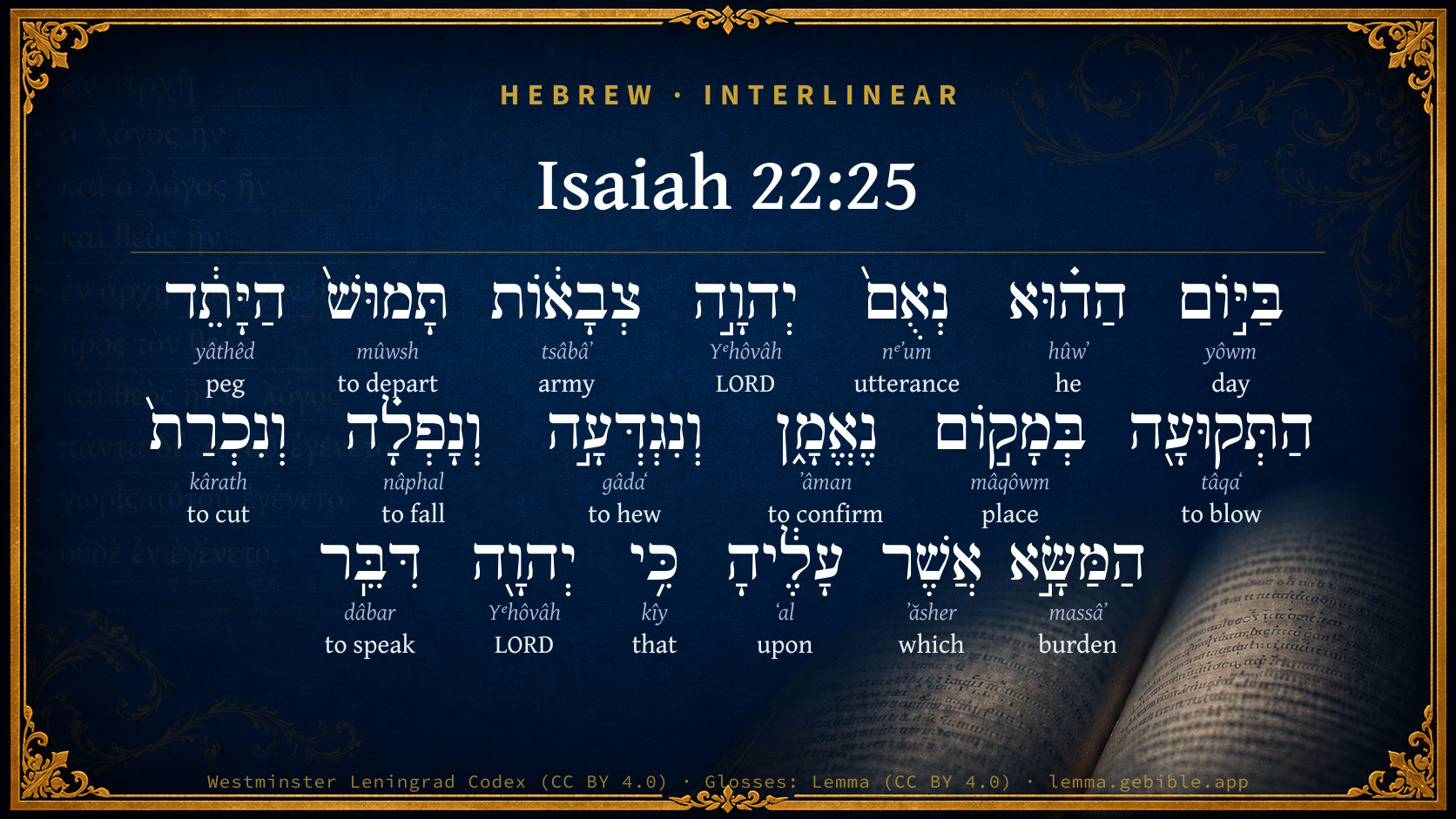
Isaiah 22:25

Hebrew (Westminster Leningrad Codex) Isaiah 22:25 appears in the Hebrew Old Testament. The text above is from the Westminster Leningrad Codex. Each word links to its Strong’s number, a concise gloss, and parsing drawn from the Open Scriptures Hebrew Bible morphology. Click any word for its full Brown-Driver-Briggs (BDB) entry.
Download image
Cite this verse

Isaiah 22:25 (World English Bible). Public Domain. Lemma interlinear Bible study tool, https://lemma.gebible.app/v/isaiah/22/25.

Show BibTeX & RIS
BibTeX
RIS
English Translation
In that day, says Yahweh of hosts, shall the nail that was fastened in a sure place give way; and it shall be hewn down, and fall; and the burden that was on it shall be cut off; for Yahweh has spoken it.
World English Bible · Public Domain
Download a study sheet

One document with this verse’s original text, its word-by-word gloss line, the meaning frame, cross-references with their text, attributed commentary, and full source and license credits — printable, and it pastes into notes with its structure intact.

This verse Autodidact and up

Study sheet (.html) Plain text (.txt)

A passage Seminary Student

Up to 50 verses in one chapter. A passage sheet keeps up to 6 commentary sources and 12 cross-references per verse, in the order this page ranks them, and says so on the sheet whenever that leaves anything out. Ask for a single verse and you get the Autodidact verse sheet above.

Everything on this page stays free to read, with no account — the sheet is a download of what is already on screen, not access to it.

Want to remove ads? Support Godless Engineer
Compare translations 3

The same verse in 3 English versions, stacked beneath the original-language interlinear above. Click any original word for its lexicon entry.

Each is an independent rendering of the whole verse — the interlinear is not word-aligned to these translations.

Highlighted words mark where these versions differ — a whole-verse word diff, not a word-by-word alignment.

  • World English Bible Public Domain
    In that day, says Yahweh of hosts, shall the nail that was fastened in a sure place give way; and it shall be hewn down, and fall; and the burden that was on it shall be cut off; for Yahweh has spoken it.
  • King James Version Public Domain
    In that day, saith the LORD of hosts, shall the nail that is fastened in the sure place be removed, and be cut down, and fall; and the burden that was upon it shall be cut off: for the LORD hath spoken it.
  • unfoldingWord Literal Text CC BY-SA 4.0
    “In that day”—the declaration of Yahweh of Armies—”the peg driven into a place made firm will depart, and it will be cut down and fall, and the burden that on it will be cut off”—for Yahweh has spoken.

unfoldingWord Literal Text — © unfoldingWord, licensed CC BY-SA 4.0. Word-aligned USFM3 via Door43 (git.door43.org/unfoldingWord/en_ult).

Versions to compare (up to 4)

3 of 4 selected

Show all 17 translations

Every available English version of this verse, each an independent rendering of the whole verse.

  • World English Bible Public Domain
    In that day, says Yahweh of hosts, shall the nail that was fastened in a sure place give way; and it shall be hewn down, and fall; and the burden that was on it shall be cut off; for Yahweh has spoken it.
  • Berean Standard Bible Public Domain
    In that day, declares the LORD of Hosts, the peg driven into a firm place will give way; it will be sheared off and fall, and the load upon it will be cut down.” Indeed, the LORD has spoken.
  • Majority Standard Bible Public Domain
    In that day, declares the LORD of Hosts, the peg driven into a firm place will give way; it will be sheared off and fall, and the load upon it will be cut down.” Indeed, the LORD has spoken.
  • King James Version Public Domain
    In that day, saith the LORD of hosts, shall the nail that is fastened in the sure place be removed, and be cut down, and fall; and the burden that was upon it shall be cut off: for the LORD hath spoken it.
  • American Standard Version (1901) Public Domain
    In that day, saith Jehovah of hosts, shall the nail that was fastened in a sure place give way; and it shall be hewn down, and fall; and the burden that was upon it shall be cut off; for Jehovah hath spoken it.
  • Revised Version (1885) Public Domain
    In that day, saith the LORD of hosts, shall the nail that was fastened in a sure place give way; and it shall be hewn down, and fall, and the burden that was upon it shall be cut off; for the LORD hath spoken it.
  • Geneva Bible (1599) Public Domain
    In that day, sayeth the Lord of hostes, shall the naile, that is fastned in the sure place, depart and shall be broken, and fall: and the burden, that was vpon it, shall bee cut off: for the Lord hath spoken it.
  • Young's Literal Translation Public Domain
    In that day -- an affirmation of Jehovah of Hosts, Moved is the nail that is fixed In a stedfast place, Yea, it hath been cut down, and hath fallen, And cut off hath been the burden that `is' on it, For Jehovah hath spoken!'
  • Literal Standard Version CC BY-SA 4.0
    In that day—a declaration of YHWH of Hosts, || The nail that is fixed is moved || In a steadfast place, || Indeed, it has been cut down, and has fallen, || And the burden that [is] on it has been cut off, || For YHWH has spoken!”
  • Unlocked Literal Bible CC BY-SA 4.0
    On that day—this is the declaration of Yahweh of hosts—the peg driven in a firm place will give way, break off, and fall, and the weight that was on it will be cut off—for Yahweh has spoken.
  • unfoldingWord Literal Text CC BY-SA 4.0
    “In that day”—the declaration of Yahweh of Armies—”the peg driven into a place made firm will depart, and it will be cut down and fall, and the burden that on it will be cut off”—for Yahweh has spoken.
  • Darby Bible Public Domain
    In that day, saith Jehovah of hosts, shall the nail that is fastened in a sure place be removed, and be cut down, and fall; and the burden that was upon it shall be cut off: for Jehovah hath spoken.
  • World Messianic Bible Public Domain
    “In that day,” says the LORD of Hosts, “the nail that was fastened in a sure place will give way. It will be cut down and fall. The burden that was on it will be cut off, for the LORD has spoken it.”
  • Webster's Bible Public Domain
    In that day, saith the LORD of hosts, shall the nail that is fastened in the sure place be removed, and be cut down, and fall; and the burden that was upon it shall be cut off: for the LORD hath spoken it.
  • Free Bible Version CC BY-SA 4.0
    So the time will come, declares the Lord Almighty, when the nail will come out of the wall, even though it was hammered in securely. It will break off and fall down, and everything hanging on it will fall down too. The Lord has spoken.’”
  • Bible in Basic English Public Domain
    In that day, says the Lord of armies, will the nail fixed in a safe place give way; and it will be cut down, and in its fall the weight hanging on it will be cut off, for the Lord has said it.
  • JPS Tanakh (1917) Public Domain
    In that day, saith the LORD of hosts, shall the peg that was fastened in a sure place give way; and it shall be hewn down, and fall, and the burden that was upon it shall be cut off; for the LORD hath spoken it.

Literal Standard Version (2020), Covenant Press — licensed CC BY-SA 4.0. Text via the HelloAO Bible API (eBible.org). Unlocked Literal Bible (unfoldingWord) — licensed CC BY-SA 4.0. Text via the HelloAO Bible API (eBible.org). unfoldingWord Literal Text — © unfoldingWord, licensed CC BY-SA 4.0. Word-aligned USFM3 via Door43 (git.door43.org/unfoldingWord/en_ult). Free Bible Version, Dr. Jonathan Gallagher — licensed CC BY-SA 4.0. Text via the HelloAO Bible API (eBible.org).

Word by word

More ways to search: Search by grammar → Find every occurrence → Compare this word →

Practice this passage: Drill this verse → Learn its vocabulary →

תָּמוּשׁ֙
mûwsh
H4185
“to depart”
Verb, Qal, Imperfect, 3rd Person, Feminine, Singular
Part of Speech
Verb
Stem
Qal
Form
Imperfect
Person
3rd Person
Gender
Feminine
Number
Singular
Full BDB Definition

Origin: a primitive root [perhaps rather the same as H4184 through the idea of receding by contact]

TWOT: 1167

to depart, remove - (Qal) - to depart - to remove - to be removed (of inanimate objects) - (Hiphil) to remove, depart
  1. בַּיּ֣וֹם yôwm H3117 “in/at the · day” Preposition, Determined + Noun, Common, Masculine, Singular, Absolute
  2. הַה֗וּא hûwʼ H1931 “the · he” Particle, Definite Article + Pronoun, Personal, 3rd Person, Masculine, Singular
  3. נְאֻם֙ nᵉʼum H5002 “utterance of” Noun, Common, Masculine, Singular, Construct
  4. יְהוָ֣ה Yᵉhôvâh H3068 “LORD” Noun, Proper
  5. צְבָא֔וֹת tsâbâʼ H6635 “armies” Noun, Common, Both, Plural, Absolute
  6. הַיָּתֵ֔ד yâthêd H3489 “the · peg” Particle, Definite Article + Noun, Common, Feminine, Singular, Absolute
  7. הַתְּקוּעָ֖ה tâqaʻ H8628 “the · blown” Particle, Definite Article + Verb, Qal, Participle Passive, Feminine, Singular, Absolute
  8. בְּמָק֣וֹם mâqôwm H4725 “in/at · place” Preposition + Noun, Common, Masculine, Singular, Absolute
  9. נֶאֱמָ֑ן ʼâman H539 “confirming” Verb, Niphal, Participle Active, Masculine, Singular, Absolute
  10. וְנִגְדְּעָ֣ה gâdaʻ H1438 “and · to hew” Conjunction + Verb, Niphal, Sequential Perfect, 3rd Person, Feminine, Singular
  11. וְנָפְלָ֗ה nâphal H5307 “and · to fall” Conjunction + Verb, Qal, Sequential Perfect, 3rd Person, Feminine, Singular
  12. וְנִכְרַת֙ kârath H3772 “and · to cut” Conjunction + Verb, Niphal, Sequential Perfect, 3rd Person, Masculine, Singular
  13. הַמַּשָּׂ֣א massâʼ H4853 “the · burden” Particle, Definite Article + Noun, Common, Masculine, Singular, Absolute
  14. אֲשֶׁר ʼăsher H834 “which” Particle, Relative
  15. עָלֶ֔יהָ ʻal H5921 “upon · her” Preposition + Suffix, Personal, 3rd Person, Feminine, Singular
  16. כִּ֥י kîy H3588 “that” Conjunction
  17. יְהוָ֖ה Yᵉhôvâh H3068 “LORD” Noun, Proper
  18. דִּבֵּֽר dâbar H1696 “to speak” Verb, Piel, Perfect, 3rd Person, Masculine, Singular

About this verse

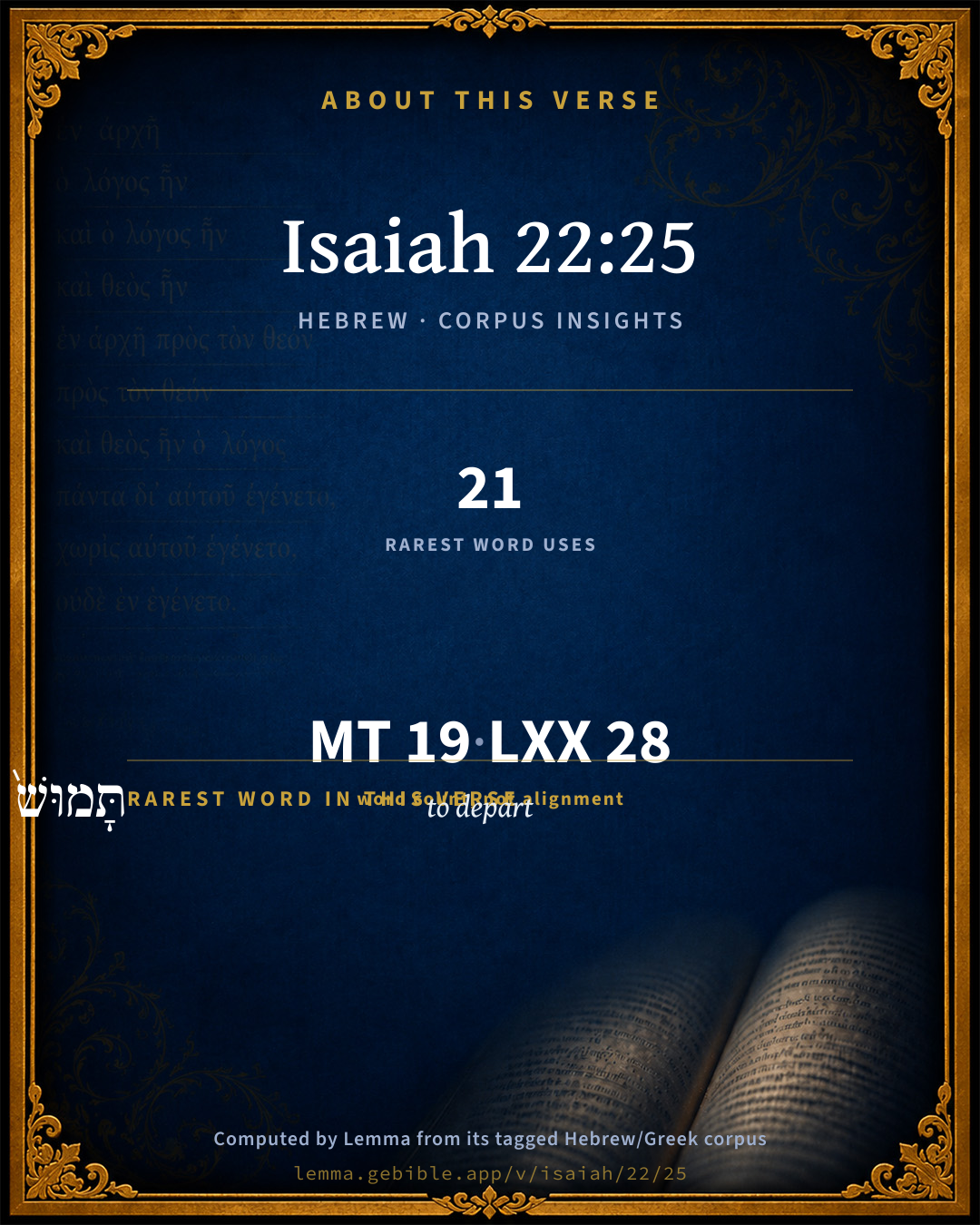
These counts appear in no published source. They are computed here, from the morphology-tagged text and Lemma’s own curated glosses. What Lemma adds →

19
words
18
distinct lemmas
Prophets
section

Notable vocabulary

The rarest word here is תָּמוּשׁ֙ to depart H4185 — appearing just 21 times in the whole Hebrew Bible.

Shared distinctive vocabulary

תָּמוּשׁ֙ to depart H4185 occurs in 19 verses of the Hebrew Bible. Also found in:

Grammatical profile

  • 7 verbs
  • 8 nouns
  • 1 pronoun
  • 1 preposition
  • 1 conjunction
  • 1 particle

Verb forms

  • תָּמוּשׁ֙ Qal · Imperfect
  • הַתְּקוּעָ֖ה Qal · Participle Passive
  • נֶאֱמָ֑ן Niphal · Participle Active
  • וְנִגְדְּעָ֣ה Niphal · Sequential Perfect
  • וְנָפְלָ֗ה Qal · Sequential Perfect
  • וְנִכְרַת֙ Niphal · Sequential Perfect
  • דִּבֵּֽר Piel · Perfect

Repetition

A word recurs within this verse — often emphatic in Hebrew:

  • יְהוָ֣ה LORD H3068 ×2

Hebrew & Septuagint length

In English translation the verse runs 43 words from the Hebrew and 42 from the Septuagint (LXX English) — closely comparable.

A rough comparison of the two English renderings, which tokenize alike — not a word-level alignment.

Word counts can differ between the Hebrew and the Greek without any difference in meaning — e.g. the Hebrew direct-object marker אֵת has no separate Greek word, and Greek often adds the article ὁ.

In the original languages it is 19 Hebrew tokens and 28 Greek tokens — but the two are counted differently (Hebrew bundles its prefixes and suffixes into one token; the Greek is in lemma form), so that isn’t a like-for-like length.

Cross-references

14

Topical passages linked to Isaiah 22:25 in the Treasury of Scripture Knowledge — connected by theme and wording, ordered by reader-vote popularity; previews shown in the World English Bible.

  • Isaiah 46:11 calling a ravenous bird from the east, the man of my counsel from a far country; yes, I have spoken, I will also bring it to pass; I have purposed, I will also do it.
  • Esther 9:24–25 because Haman the son of Hammedatha, the Agagite, the enemy of all the Jews, had plotted against the Jews to destroy them, and had cast Pur, that is the lot, to consume them, and to destroy them;
  • Psalms 146:3 Don't put your trust in princes, Each a son of man in whom there is no help.
  • Isaiah 22:23 I will fasten him as a nail in a sure place; and he shall be for a throne of glory to his father's house.
  • Jeremiah 17:5–6 Thus says Yahweh: Cursed is the man who trusts in man, and makes flesh his arm, and whose heart departs from Yahweh.
  • Micah 4:4 But they will sit every man under his vine and under his fig tree; And no one will make them afraid: For the mouth of Yahweh of Hosts has spoken.
  • Esther 9:5–14 The Jews struck all their enemies with the stroke of the sword, and with slaughter and destruction, and did what they would to those who hated them.
  • Psalms 52:5 God will likewise destroy you forever. He will take you up, and pluck you out of your tent, And root you out of the land of the living. Selah.
  • Isaiah 22:15–16 Thus says the Lord, Yahweh of Hosts, Go, get yourself to this treasurer, even to Shebna, who is over the house, [and say],
  • Isaiah 48:15 I, even I, have spoken; yes, I have called him; I have brought him, and he shall make his way prosperous.
  • Jeremiah 4:28 For this shall the earth mourn, and the heavens above be black; because I have spoken it, I have purposed it, and I have not repented, neither will I turn back from it.
  • Ezekiel 5:13 Thus shall my anger be accomplished, and I will cause my wrath toward them to rest, and I shall be comforted; and they shall know that I, Yahweh, have spoken in my zeal, when I have accomplished my wrath on them.
  • Ezekiel 5:15 So it shall be a reproach and a taunt, an instruction and an astonishment, to the nations that are round about you, when I shall execute judgments on you in anger and in wrath, and in wrathful rebukes; (I, Yahweh, have spoken it;)
  • Ezekiel 5:17 and I will send on you famine and evil animals, and they shall bereave you; and pestilence and blood shall pass through you; and I will bring the sword on you: I, Yahweh, have spoken it.

Cross-references courtesy of OpenBible.info (CC BY 4.0).

Hebrew and Greek witnesses Masoretic Hebrew ↔ Greek Septuagint

The same verse in the two great witnesses to the Old Testament, shown verse-for-verse.

These are two independent witnesses, not word-aligned to each other, and the Septuagint is shown in lemma (dictionary) form.

Hebrew Isaiah 22:25 Masoretic · Westminster Leningrad Codex

בַּיּ֣וֹם הַה֗וּא נְאֻם֙ יְהוָ֣ה צְבָא֔וֹת תָּמוּשׁ֙ הַיָּתֵ֔ד הַתְּקוּעָ֖ה בְּמָק֣וֹם נֶאֱמָ֑ן וְנִגְדְּעָ֣ה וְנָפְלָ֗ה וְנִכְרַת֙ הַמַּשָּׂ֣א אֲשֶׁר עָלֶ֔יהָ כִּ֥י יְהוָ֖ה דִּבֵּֽר

In that day, says Yahweh of hosts, shall the nail that was fastened in a sure place give way; and it shall be hewn down, and fall; and the burden that was on it shall be cut off; for Yahweh has spoken it.

World English Bible · Public Domain

Greek LXX Isaiah 22:25 Septuagint · lemma form

ἐν ὁ ἡμέρα ἐκεῖνος ὅδε λέγω κύριος σαβαωθ κινέω ὁ ἄνθρωπος ὁ στηρίζω ἐν τόπος πιστός καί πίπτω καί ἀποαἱρέω ὁ δόξα ὁ ἐπί αὐτός ὅτι κύριος λαλέω

Thus says the Lord of hosts, The man that is fastened in the sure place shall be removed and be taken away, and shall fall; and the glory that is upon him shall be utterly destroyed: for the Lord has spoken it.

LXX2012 (modern English Septuagint) · Public Domain

Hebrew: Westminster Leningrad Codex (CC BY 4.0). Greek: Septuagint (public domain); English from LXX2012 (modern English Septuagint) (Public Domain). How the Septuagint differs from the Hebrew →

Targum (Aramaic paraphrase)

1

The Targum is the ancient Jewish Aramaic paraphrase of the Hebrew Scriptures — an interpretive translation, not the Hebrew text itself. Onkelos (literal) and Pseudo-Jonathan (expansive) render the Torah, and Jonathan the Prophets. Coverage is partial: where no permissively-licensed English translation exists for a verse, only the Aramaic is shown. This is verse-level text, not a word-by-word alignment to the Hebrew.

  1. Targum Jonathan Prophets (Joshua–Malachi)
    בְּעִדָנָא הַהִיא אֲמַר יְיָ צְבָאוֹת יַעְדֵי אַמַרְכֶּל מְהֵימָן דִי מְשַׁמֵשׁ בַּאֲתַר קַיָם וְיִתְקַטֵף וְיִפוֹל וְתִבְטַל מְטַל נְבוּאֲתָא דִי עֲלוֹהִי אֲרֵי בְמֵימְרָא דַייָ גְזַר כֵּן:

    At that time, saith the Lord of hosts, there shall be removed the faithful chief governor, who ministered in a firm place, and he shall be cut off, and he shall fall: and there shall be accomplished the burden of prophecy, which was concerning him; because the WORD of the Lord hath so decreed it.

    Targum Jonathan — Aramaic: “Mikraot Gedolot” (public domain). English: “Sefaria Community Translation” (CC0 1.0 (public-domain dedication)); “London "Chaldee Paraphrase," 1871” (public domain). Text via Sefaria.

Commentary

Notes on Isaiah 22:25 from classic Christian and Jewish commentators (each source and its license shown beneath its notes). The classic Christian expositions comment on the surrounding passage and are grouped to its opening verse, so a note may address several verses; the Jewish commentaries on the Tanakh (Rashi and others) are per-verse, so they appear only where the commentator wrote on this verse.

Lemma curates 59 commentaries, every one of them public domain or Creative Commons licensed, each selected and text-cleaned for this edition rather than reprinted as found. About our sources →

Adam Clarke's Commentary

Verse 25. The nail that is fastened] This must be understood of Shebna, as a repetition and confirmation of the sentence above denounced against him.

WHAT is said of Eliakim the son of Hilkiah, Isa 22:20-24, is very remarkable; and the literal meaning is not easy to be understood. From Isa 9:6, and from Re 3:7, it seems to belong to our Lord alone. The removal of Shebna from being over the treasure of the Lord's house, Isa 22:19, and the investiture of Eliakim with his robe, girdle, office, and government, Isa 22:20, c., probably point out the change of the Jewish priesthood, and the proclaiming of the unchangeable priesthood of Christ. See Ps 110:4. Eliakim signifies The resurrection of the Lord or, My God, he shall arise. Hilkiah signifies The Lord my portion or lot. The key of David, shutting and opening, c., may intend the way of salvation through Christ alone. For the hope of salvation and eternal life comes only through Eliakim, the resurrection of Jesus Christ from the dead.

It is said, Isa 22:24, "They shall hang upon him all the glory of his father's house" - for, in Jesus Christ dwells all the fullness of the Godhead bodily and the offspring and the issue, הצאצאים hatstseetsaim from יצא yatsa, to go out, - the suckers from the root; the sideshoots, the apostles and primitive ministers of his word. The issue, הצפיעות hatstsephioth, probably means the issue's issue; so the Targum. The grandchildren, all those who believe on the Lord Jesus through their word.

"The nail that is fastened in the sure place shall be removed," Isa 22:25, Kimchi refers not to Eliakim, but to Shebna, Isa 22:17-19. By, "They shall hang upon him all vessels of small quantity and large quantity," has been understood the dependence of all souls, of all capacities, from the lowest in intellect to the most exalted, on the Lord Jesus, as the only Saviour of all lost human spirits.

As the literal interpretation of this prophecy has not been found out, we are justified from parallel texts to consider the whole as referring to Jesus Christ, and the government of the Church, and the redemption of the world by him. Nor are there many prophecies which relate to him more clearly than this, taken in the above sense.

Adam Clarke's Commentary on the Bible (1810–1826) — public domain. Text from a community e-Sword/MySword module.

Trapp's Complete Commentary

John Trapp

Isa 22:25 In that day, saith the LORD of hosts, shall the nail that is fastened in the sure place be removed, and be cut down, and fall; and the burden that [was] upon it shall be cut off: for the LORD hath spoken [it].

Ver. 25. Shall the nail that is fastened.] So Shebna once seemed to be, but now it shall appear to be otherwise; for he shall fall, and with him all his dependants shall be ruined.

John Trapp, A Commentary or Exposition upon All the Books of the Old and New Testament (1647–1656) — public domain. Text from a community e-Sword module.

The Biblical Illustrator

Joseph S. Exell

Isa_22:25

In that day, saith the Lord of hosts, shall the nail that is fastened in the sure place be removed

Elevation is only held on good character

Even God who drove in the nail can take it out again.

No nail once driven in can do without God, saying, I am driven in now, so I care not what may happen. The highest lives in obedience; the strongest man becomes weaker than the weakest when he ceases to pray. Genius cannot keep a man in a high moral elevation. His genius will soon be discovered to be but cleverness, not the blooming out of a life that is hidden in the very mystery of God. Leader of the people! even thou mayest be dispossessed of thy leadership. Great statesmen are in the hands of God. Journalists, thinkers, the advance guard of every name, all these hold their position on their good conduct. Let them be good and faithful servants; let there be no selfishness in their ambition, no vain conceit because of the influence with which God hath clothed them; even the nail that is fastened in the sure place may be removed, the very beam in which it finds a place may be cut in two and burned in unquenchable fire. So, then, we are nothing but in God. (J. Parker, D. D.)

Nepotism

Eliakim comes to ruin in the exorcise of the plenary power attaching to his office by giving way to nepotism. His family makes a wrong use of him, and with an unwarrantable amount of good nature he makes a wrong use of his official position for their benefit. He therefore comes down headlong, and with him all the heavy burden which the peg sustains, i.e., all his relations, who, by being far too eager to make the most of their good fortune, have brought him to ruin. (F. Delitzsch.)

Eliakim and Shebna: a couple of tragedies

We have not one, but a couple of tragedies. Eliakim, the son of Hilkiah, follows Shebna, the son of Nobody. The fate of the overburdened nail is as grievous as that of the rolling stone. It is easy to pass this prophecy over as a trivial incident; but when we have carefully analysed each verse, restored to the words their exact shade of signification, and set them in their proper contrasts, we perceive the outlines of two social dramas, which it requires very little imagination to invest with engrossing moral interest. (Prof. G. A. Smith, D. D.)

.

The Biblical Illustrator, edited by Joseph S. Exell (c. 1880s–1900s) — public domain. Text from a community e-Sword module.

Keil & Delitzsch

C. F. Keil & F. Delitzsch

We will refer to this again. But in the meantime the impression is an irresistible one; and the Targum, Jerome, Hitzig, and others, are therefore right in assuming that Eliakim is the peg which, however glorious its beginning may have been, comes at last to the shameful end described in Isa 22:25 : "In that day, saith Jehovah of hosts, will the peg that is fastened in a sure place be removed, and be cast down, and fall; and the burden that it bore falls to the ground: for Jehovah hath spoken." The prophet could not express in clearer terms the identity of the peg threatened here with Eliakim himself; for how is it conceivable that the prophet could turn all that he has predicated of Eliakim in Isa 22:23, Isa 22:24, into predicates of Shebna? What Umbreit says - namely, that common sense must refer Isa 22:25 to Shebna - is the very reverse of correct. Eliakim himself is also brought down at last by the greatness of his power, on account of the nepotism to which he has given way. His family makes a wrong use of him; and he is more yielding than he ought to be, and makes a wrong use of his office to favour them! He therefore falls, and brings down with him all that hung upon the peg, i.e., all his relations, who have brought him to ruin through the rapacity with which they have grasped at prosperity.

Hitzig maintains that Isa 22:24, Isa 22:25 form a later addition. But it is much better to assume that the prophet wrote down Isa 22:15-25 at one sitting, after the predicted fate of the two great ministers of state, which had been revealed to him at two different times, had been actually fulfilled. We know nothing more about them than this, that in the fourteenth year of Hezekiah it was not Shebna, but Eliakim, "who was over the house" (Isa 36:3, Isa 36:22; Isa 37:2). But Shebna also filled another office of importance, namely that of sōpher. Was he really taken prisoner and carried away (a thing which is perfectly conceivable even without an Assyrian captivity of the nation generally)? Or did he anticipate the threatened judgment, and avert it by a penitential self-abasement? To this and other questions we can give no reply. One thing alone is certain - namely, that the threefold prediction of Shebna's fall, of Eliakim's elevation, and of Eliakim's fall, would not stand where it does, if there were any reason whatever to be ashamed of comparing the prophecy with its fulfilment.

Keil & Delitzsch — Biblical Commentary on the Old Testament (1861–1891) — public domain (CC PDM 1.0). Text via the HelloAO Bible API. (Old Testament only.)

Tyndale Open Study Notes

Tyndale Open Resources

22:25 I will pull out the nail: Even godly Eliakim would not be able to save Judah or David’s dynasty from God’s judgment. The people of Judah would go into exile more than a century later (39:6-7).

Tyndale Open Study Notes — © Tyndale Open Resources, licensed CC BY-SA 4.0. Text via the HelloAO Bible API.

Geneva Bible (1599)

Geneva Bible translators

He meaneth Shebna, who in man’s judgment should never have fallen.

Geneva Bible (1599) marginal notes — public domain. Text via Bolls.life.

Jamieson, Fausset & Brown

Robert Jamieson, A. R. Fausset & David Brown

nail . . . fastened--Shebna, who was supposed to be firmly fixed in his post.

burden . . . upon it--All that were dependent on Shebna, all his emoluments and rank will fail, as when a peg is suddenly "cut down," the ornaments on it fall with it. Sin reaches in its effects even to the family of the guilty (Exo 20:5).

MENANDER, the historian, notices a siege of Tyre by Shalmaneser, about the time of the siege of Samaria. Sidon, Acco, and Old Tyre, on the mainland, were soon reduced; but New Tyre, on an island half a mile from the shore, held out for five years. Sargon probably finished the siege. Sennacherib does not, however, mention it among the cities which the Assyrian kings conquered (thirty-sixth and thirty-seventh chapters). The expression, "Chaldeans" (Isa 23:13), may imply reference to its siege under Nebuchadnezzar, which lasted thirteen years. Alexander the Great destroyed New Tyre after a seven months' siege.

Next: Isaiah Chapter 23

Jamieson, Fausset & Brown — Commentary Critical and Explanatory on the Whole Bible (1871) — public domain (CC PDM 1.0). Text via the HelloAO Bible API.

Ellicott's Commentary for English Readers

(25) Shall the nail that is fastened in a sure place be removed . . .—There is, the prophet says, a judgment for the misuse of power portrayed in the previous verse. The “nail” that seems so firmly fixed should be removed, i.e., Eliakim should cease to hold his high office, and with his fall should come that of all his kindred and dependents. Here, as in the case of Shebna, we have no record of the fulfilment of the prediction, but it is a natural inference, from its remaining in the collected prophecies of Isaiah, either that it was fulfilled, or that it did its work as a warning, and that the penalty was averted by a timely reformation.

A Bible Commentary for English Readers, edited by Charles John Ellicott (1878–1897) — public domain. Text from a community e-Sword module.

The Cambridge Bible for Schools and Colleges

gen. ed. J. J. S. Perowne

25. The fall of Eliakim’s house, described under the same metaphor. It is not necessarily implied that the minister himself lived to see this reverse of fortune; living or dead, his name was the “peg” of the family’s nobility, and when the crash came, it might truly be said that the “peg fastened in a sure place” had been removed.

The Cambridge Bible for Schools and Colleges (gen. ed. J. J. S. Perowne; Cambridge University Press, 1878–1918) — public domain. Text from a community e-Sword module.

John Gill's Exposition

In that day, saith the Lord of hosts,.... That Shebna is deposed, and Eliakim put in his place:

shall the nail that is fastened in the sure place be removed, and be cut down, and fall; meaning, not Eliakim before spoken of, who really was a nail fastened in a sure place, and not to be removed; but Shebna, who thought himself to be as a nail in a sure place, being put into it by the king, and supported by his authority, and courted by his friends and flatterers; for to him the whole preceding prophecy is directed, which is carried down to this verse; for all that is said of the glory and usefulness of his successor Eliakim was to be told to him, which would make it still the more grievous to him, to be degraded and disgraced as he would be, signified by his being removed, cast down, and falling:

and the burden that was upon it shall be cut off; those that were dependent upon him, his family, his flatterers, and friends, such whom he had raised by his influence and authority to considerable places, and whom he supported in them; these would fall with him, as is usual when a royal favourite, or prime minister of state, falls into disgrace, and is removed; an instance of this may be seen in Haman, whose family and friends were involved in the same ruin with him, Est 9:12 and it may be observed, that many dependents, which a minister of state always has, are a burden to him. The Targum interprets this of the burden of prophecy; and Jarchi says, that some explain it thus,

"the prophecy, which thou prophesiest, concerning it, shall be confirmed;''

as follows:

for the Lord hath spoken it; and therefore it shall come to pass;

as the Targum,

"for, so it is decreed by the word of the Lord.''

Next: Isaiah Chapter 23

John Gill's Exposition of the Whole Bible (1746–1763) — public domain (CC PDM 1.0). Text via the HelloAO Bible API.

Albert Barnes' Notes on the Bible

In that day shall the nail - Not Eliakim, but Shebna. Eliakim was to be fastened, that is, confirmed in office. But Shebna was to be removed.

That is fastened in the sure place - Or, that was once fastened, or was supposed to be fastened - a phrase appropriate to an office which the incumbent supposed to be firm or secure. It here refers to Shebna. He was regarded as haying a permanent hold on the office, and was making provisions for ending his days in it.

Be removed - To a distant land Isa 22:17-18, or simply taken down.

And be cut down, and fall - As a spike, pin, or peg would be taken away from the wall of a house.

And the burden that was upon it - All that it sustained - as the spikes in the wall of a house sustained the cups of gold, the raiment, or the armor that belonged to the family. Here it means, all that was dependent on Shebna - the honor of his family, his emoluments, his hope of future fame, or of an honored burial. All these would fail as a matter of course, when he was removed from his office. This is one instance of the usual mode of the divine administration. The errors of a man entrusted with office entail poverty, disgrace, and misery on all who are connected with him. Not only is his own name disgraced, but his sin “diffuses itself,” as it were, on all connected wit him. It involves them in want, and shame, and tears; and the design is to deter those in office from sin, by the fact that their crimes and errors “will” thus involve the innocent in calamiry, and shed disgrace and woe on those whom they love.

Albert Barnes' Notes on the Bible (1834–1885) — public domain. Text from a community e-Sword/MySword module.

Haydock's Catholic Bible Commentary

Fall. Sobna shall lose all his employments, and ruin others. (Calmet)

George Leo Haydock (1774–1849), Haydock's Catholic Family Bible and Commentary, 1859 edition — public domain. Excludes Psalms (Douay-Rheims chapter numbering differs from Protestant) and Deuterocanonical books (Catholic canon only).

Matthew Poole's English Annotations

The nail that is fastened in the sure place; Shebna, who seemed to be so, both in his own eyes, and in the eyes of others. The burden that was upon it; all those wicked officers that were advanced and supported by his power.

Matthew Poole's English Annotations on the Holy Bible (1683–1685) — public domain. Text from a community e-Sword/MySword module.

Whedon's Commentary on the Bible

Daniel D. Whedon

25. Shall the nail… fall — Delitzsch, of course, supposes the reference here is to Eliakim, and grammatical considerations are on his side. But the altogether better logical view is, that of an abrupt return (not without like examples with Isaiah) to the treasurer, who was a failure in the government, a heathen, without doubt, smuggled into office probably by the heathenish Ahaz, and unfortunately retained in office by pious Hezekiah, till, in the order of divine providence, he was ignominiously thrust out.

Daniel D. Whedon (gen. ed.), Commentary on the Old and New Testaments (1874–1909) — public domain. Text from a community e-Sword module.

The Pulpit Commentary

SEQUEL OF THE PROPHECY CONCERNING ELIAKIM. This verse has been truly called "an enigma" (Kay). It is impossible to understand it of Shebna. "The nail that was fastened in a sure place" can only refer to the nail said to have been so fastened in ver. 23. Are we, then, to understand that Eliakim too will experience a reverse of fortune? But then all the force of the contrast between him and Shebna would be gone. Is it not possible that the prophet, seeing in Eliakim a type of the Messiah, and becoming more and more Messianic in his utterances, has ended by forgetting the type altogether, and being absorbed in the thought of the antitype? He, the nail, so surely fixed in his eternal place, would nevertheless be "removed" for a time, and then "he cut down and fall". (Isa_52:14 Isa_53:8) At the same time would be "cut off" the burden which Messiah bore. (Isa_53:12, "He bare the sin of many

In that day. Not the day of Shebna"s fall, certainly (ver. 20), but some ether. Is not the day that of Christ"s earthly mission, when it seemed as if his people were about to acknowledge him, (Mat_21:1-11 Mar_11:1-10 Luk_19:29-40) and his throne to be established, but suddenly Messiah was "cut off" (Dan_9:26) stricken for the transgression of his people? (Isa_53:8) The burden that was upon it shall be cut off. The great burden upon the Messiah was the load of human sin which he had to bear. "He himself bare our sins in his own body on the tree". (1Pe_2:24) By his death this burden was "cut off". (1Jn_2:2 2Co_5:19 Eph_2:16 Col_2:14) For the Lord hath spoken it. The double attestation, at the beginning and at the end of the verse, is a mark of the vast importance of the announcement contained in it, which is, in fact, the germ of the great doctrine of the atonement.

Messiah"s burden and Messiah"s death.

How Christ"s death atones for sin we know not, and need not too curiously inquire. But, if plain words have a plain meaning, it is impossible to doubt that this is the teaching of Scripture. "By his stripes we are healed"; (Isa_53:5) "He is the Propitiation for our sins"; (1Jn_2:2) "One died for all". (2Co_5:14) It is quite possible that there is something in the nature of things, which we cannot fathom, that made it impossible for man"s sins to be forgiven unless God died for them. Our wisdom is to avoid curious speculation, and to view the matter on its practical side. Thus viewed, it manifestly calls on us for three things.

I INTENSE HATRED OF SIN, ON ACCOUNT OF ITS HAVING CAUSED MESSIAH"S DEATH. If an animate, or even an inanimate, thing has caused the death of one we loved, how bitterly we detest it! Often we cannot bear to look upon it, nay, even to see a thing of the same kind. How, then, should we hate sin hateful in itself, hateful in its effects, hateful in its origin, most hateful in that it caused the death of the one Man who alone of all that have ever lived did not deserve to die! And he, moreover, One who dearly loved us, who came down from heaven for us, lived a life of privation and suffering for us, at last died for our sakes.

II INTENSE LOVE OF CHRIST, ON ACCOUNT OF HIS HAVING DIED FOR US. "Greater love hath no man than this, that a man lay down his life for his friends." But Christ died for his enemies. Sin is an insuperable barrier between God and man, sets them at variance, makes them adversaries. And till Christ died man could not be forgiven. So he died for those with whom he was at enmity! And died by what a death!

1. More painful probably than any other.

2. Considered at the time more disgraceful.

3. Aggravated by the insults of lookers-on.

4. Regarded as bringing a man under a curse.

III INTENSE LOVE OF GOD THE FATHER, ON ACCOUNT OF HIS GIVING HIS SON TO DIE FOR US. We cannot realize the love of the Father for the Son; but we cannot doubt that it transcends any love known on earth. Yet he gave him to suffer all that he suffered and why? For us. Because he loved us. As our Lord himself says, "God so loved the world, that he gave his only begotten Son, that whosoever believeth in him should not perish, but have everlasting life". (Joh_3:16) If the knowledge of this fact fail to stir up love towards the Father in our souls, we must be "past feeling", (Eph_4:19) utterly dead to any high motive, scarcely better than "brute beasts". (Jud_1:10)

The Pulpit Commentary (1880–1919), ed. H.D.M. Spence-Jones & Joseph S. Exell — public domain. Text from a community e-Sword module.

John Wesley's Explanatory Notes

The nail - Shebna, who seemed to be so. The burden - All those wicked officers that were advanced and supported by his power.

John Wesley, Explanatory Notes Upon the Whole Bible (1754–1765) — public domain. Text via the GEBible commentary corpus.

J. A. Alexander on Isaiah

Joseph Addison Alexander

“In that day, saith Jehovah of Hosts, shall the nail fastened in a sure place be removed, and be cut down, and fall, and the burden which was on it shall be cut off, for Jehovah speaks.” The most natural and obvious application of these words is to Eliakim, who had just been represented as a nail in a sure place. But as this would predict his fall, without the slightest intimation of the reason, and in seeming contradiction to the previous context, most interpreters reject this exposition as untenable. Most writers seem to be agreed, that the twenty-fifth verse relates to Shebna, and that the Prophet, after likening Eliakim to a nail fastened in a sure place, tacitly applies the same comparison to Shebna, and declares that the nail which now seems to be securely fastened shall soon yield to make way for the other. Those who refer the verse to Eliakim suppose his fall to have been occasioned by his nepotism or excessive patronage of his relations, a conjectural inference from v. 24. The partial fulfillment of this prophecy is commonly supposed to be recorded in Isa 36:3, where Eliakim actually fills the place here promised to him, and Shebna appears in the inferior character of a scribe or secretary. Some indeed suppose two persons of the name of Shebna, which is not only arbitrary in itself, but rendered more improbable by this consideration, that Shebna is probably a foreign name, and certainly occurs only in these and the parallel places, whereas Hilkiah is of frequent occurrence, and yet is admitted upon all hands to denote the same person. It seems improbable no doubt that Shebna, after such a threatening, should be transferred to another office. But the threatening may not have been public, and the transfer may have been merely the beginning of his degradation. But even supposing that the Shebna of Isa 36:3 is a different person, and that the execution of this judgment is nowhere explicitly recorded, there is no need of concluding that it was revoked or that it was meant to be conditional, much less that it was falsified by the event. It is a common usage of the Scriptures, and of this book in particular, to record a divine command and not its execution, leaving the latter to be inferred from the former as a matter of course. Of this we have had repeated examples, such as Isa 7:4 and Isa 8:1. Nay in this very case, we are merely told what Isaiah was commanded to say to Shebna, without being told that he obeyed the order. If the execution of this order may be taken for granted, so may the fulfillment of the prophecy. If it had failed, it would not have been recorded or preserved among the prophecies.

Joseph Addison Alexander, The Prophecies of Isaiah (1846–1847; New York: Scribner, 1870–1878) — public domain. Text from a community e-Sword module.

unfoldingWord translationNotes

Door43 World Missions Community

General Information:

This continues the imagery from the previous verses. (See: Isaiah 22:23-24)

On that day

"At that time"

this is the declaration of Yahweh of hosts

Yahweh speaks of himself by name to express the certainty of what he is declaring. Translate as in Isaiah 14:22. AT: "this is what Yahweh of hosts has declared" or "this is what I, Yahweh of hosts, have declared" (See: First, Second, or Third Person)

the peg driven in a firm place ... will be cut off

Yahweh causing Shebna to lose his authority in the king's palace is spoken of as if Shebna were a peg in the wall that breaks off and falls to the ground. This emphasizes that Shebna thought his authority was secure but God will remove him. (See: Metaphor)

the weight that was on it will be cut off

Here "weight" represents Shebna's power and authority. It is spoken of as if it were an object hanging on the peg that represents Shebna. Yahweh causing Shebna to lose his power and authority is spoken of as if someone were to cut off the object that was hanging on the peg. (See: Metonymy and Metaphor)

translationWords

Yahweh of hosts

unfoldingWord translationNotes — © Distant Shores Media and the Door43 World Missions Community, licensed CC BY-SA 4.0. Source: git.door43.org/Door43/en_tn.

Rashi

Rabbi Shlomo Yitzchaki (Rashi)

shall the peg...move (This alludes to) the greatness of Shebna.

and the burden which is upon it shall be cut off His family members and his company who depend on him and who hang upon him the vessels of their glory. And since he likened him to a peg, he likened those who boast about him and rely on him, to a burden loaded on the peg. Some interpret it: And the prophecy prophesied about him shall be fulfilled.

Rashi on the Tanakh — English translations: “The Judaica Press complete Tanach with Rashi, translated by A. J. Rosenberg” (CC BY 4.0); “Pentateuch with Rashi's commentary by M. Rosenbaum and A.M. Silbermann, 1929-1934” (public domain); “The Metsudah Tanach series, Lakewood, N.J” (CC BY 4.0); and “The Book of Joshua, Metsudah Publications, 1997” (CC BY 4.0). Text via Sefaria.

Ibn Ezra

Rabbi Abraham ibn Ezra

The nail, etc. Shebna, who thought himself a nail fixed in a strong place.

The burden that is upon it. The supporters of his government.

Ibn Ezra on the Tanakh — English translations: “Sefaria Community Translation” (CC0 1.0 (public-domain dedication)); “Yalkut, Sifsei Chachomim Chumash, Metsudah Publications, 2009” (CC BY 4.0); and “Commentary of Ibn Ezra on Isaiah - trans. by M. Friedlander, 1873” (public domain). Text via Sefaria.

Lesson kit

Teaching starters — assembled from the data on this page, not authored interpretation. Every prompt links to the verse data it draws on. Edit before teaching.

Isaiah, in the Prophets, opens this verse with 19 words (18 distinct Hebrew lemmas). Its most distinctive word is mûwsh (“to depart”). A historical commentator’s framing appears above. Read the whole chapter for the surrounding context.

Discussion questions

  1. What does “to depart” (mûwsh) contribute to the verse as a whole?
  2. Exodus 13:22 shares the word «to depart» with this verse. How do the two illuminate each other?
  3. “LORD” occurs 2× in this one verse. What is the effect of the repetition?
  4. These translations render this verse differently; the difference is in the English rendering, not the original. What questions does that raise?
  5. The verb «תָּמוּשׁ֙» is Qal Imperfect. How does its form color the action?
  6. Reading how Adam Clarke's Commentary and Trapp's Complete Commentary read this verse, where do the two commentators agree and where do they part?

Things to notice

Reading settings

Reading text

Shown beneath each verse's original-language words.

Old Testament
Old Testament edition

Read the OT as the Masoretic Hebrew (MT) or the Greek Septuagint (LXX).

English shown for the Greek Septuagint (in the Hebrew ↔ Greek comparison).

Comparing translations? Open the Compare panel on any verse page to stack up to four side by side.