1 Samuel 20:16

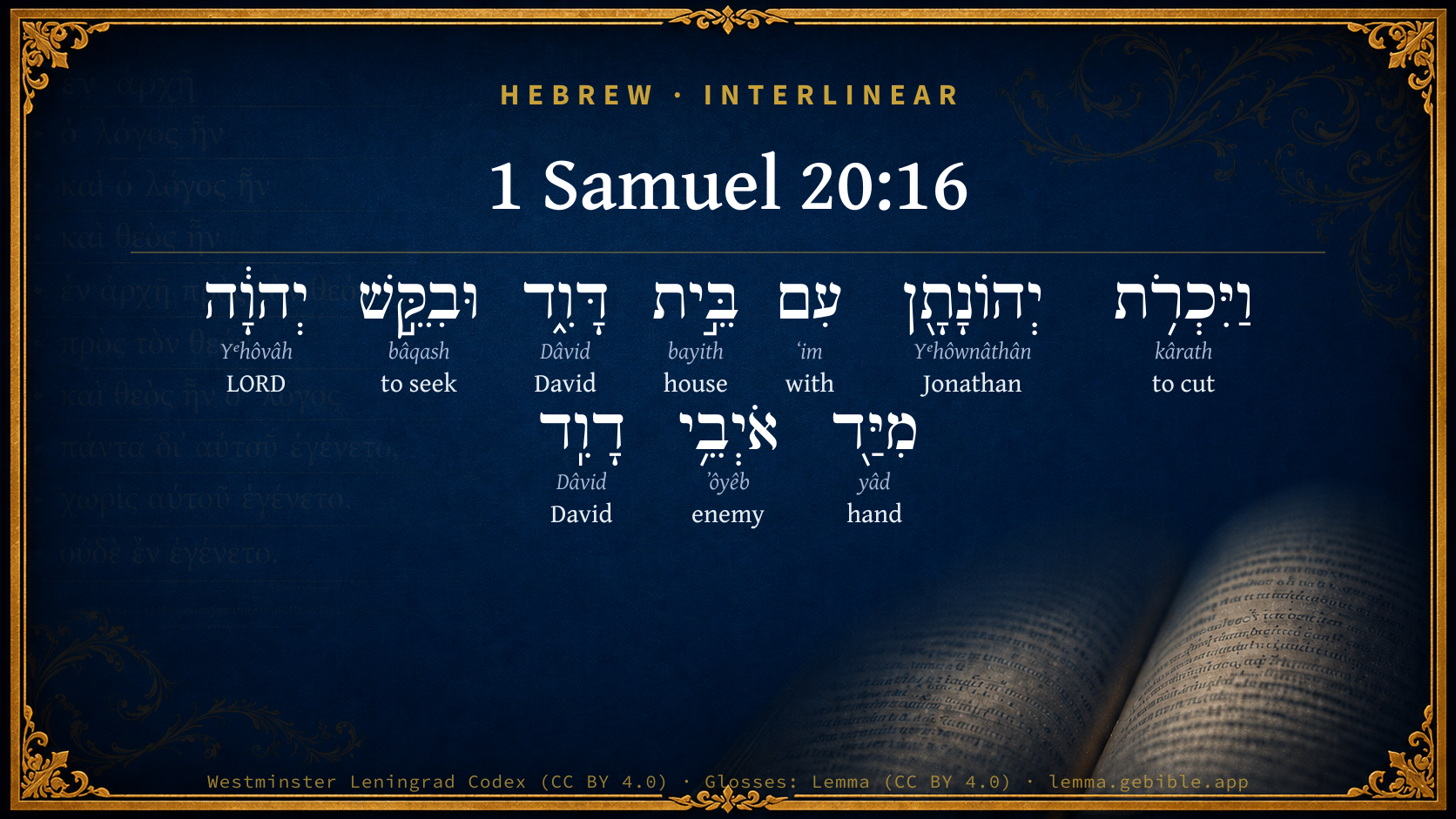
Hebrew (Westminster Leningrad Codex) 1 Samuel 20:16 appears in the Hebrew Old Testament. The text above is from the Westminster Leningrad Codex. Each word links to its Strong’s number, a concise gloss, and parsing drawn from the Open Scriptures Hebrew Bible morphology. Click any word for its full Brown-Driver-Briggs (BDB) entry.
Download image
Cite this verse

1 Samuel 20:16 (World English Bible). Public Domain. Lemma interlinear Bible study tool, https://lemma.gebible.app/v/1-samuel/20/16.

Show BibTeX & RIS
BibTeX
RIS
English Translation
So Jonathan made a covenant with the house of David, [saying], Yahweh will require it at the hand of David's enemies.
World English Bible · Public Domain
Download a study sheet

One document with this verse’s original text, its word-by-word gloss line, the meaning frame, cross-references with their text, attributed commentary, and full source and license credits — printable, and it pastes into notes with its structure intact.

This verse Autodidact and up

Study sheet (.html) Plain text (.txt)

A passage Seminary Student

Up to 50 verses in one chapter. A passage sheet keeps up to 6 commentary sources and 12 cross-references per verse, in the order this page ranks them, and says so on the sheet whenever that leaves anything out. Ask for a single verse and you get the Autodidact verse sheet above.

Everything on this page stays free to read, with no account — the sheet is a download of what is already on screen, not access to it.

Want to remove ads? Support Godless Engineer
Compare translations 3

The same verse in 3 English versions, stacked beneath the original-language interlinear above. Click any original word for its lexicon entry.

Each is an independent rendering of the whole verse — the interlinear is not word-aligned to these translations.

Highlighted words mark where these versions differ — a whole-verse word diff, not a word-by-word alignment.

  • World English Bible Public Domain
    So Jonathan made a covenant with the house of David, [saying], Yahweh will require it at the hand of David's enemies.
  • King James Version Public Domain
    So Jonathan made a covenant with the house of David, saying, Let the LORD even require it at the hand of David's enemies.
  • unfoldingWord Literal Text CC BY-SA 4.0
    And Jonathan cut with the house of David, “And may Yahweh seek from the hand of the enemies of David!”

unfoldingWord Literal Text — © unfoldingWord, licensed CC BY-SA 4.0. Word-aligned USFM3 via Door43 (git.door43.org/unfoldingWord/en_ult).

Versions to compare (up to 4)

3 of 4 selected

Show all 18 translations

Every available English version of this verse, each an independent rendering of the whole verse.

  • World English Bible Public Domain
    So Jonathan made a covenant with the house of David, [saying], Yahweh will require it at the hand of David's enemies.
  • Berean Standard Bible Public Domain
    So Jonathan made a covenant with the house of David, saying, “May the LORD hold David’s enemies accountable.”
  • Majority Standard Bible Public Domain
    So Jonathan made a covenant with the house of David, saying, “May the LORD hold David’s enemies accountable.”
  • King James Version Public Domain
    So Jonathan made a covenant with the house of David, saying, Let the LORD even require it at the hand of David's enemies.
  • American Standard Version (1901) Public Domain
    So Jonathan made a covenant with the house of David, `saying', And Jehovah will require it at the hand of David's enemies.
  • Revised Version (1885) Public Domain
    So Jonathan made a covenant with the house of David, saying, And the LORD shall require it at the hand of David’s enemies.
  • Geneva Bible (1599) Public Domain
    So Ionathan made a bond with the house of Dauid, saying, Let the Lord require it at the hands of Dauids enemies.
  • Douay-Rheims (1899) Public Domain
    Jonathan therefore made a covenant with the house of David: and the Lord required it at the hands of David's enemies.
  • Young's Literal Translation Public Domain
    And Jonathan covenanteth with the house of David, and Jehovah hath sought `it' from the hand of the enemies of David;
  • Literal Standard Version CC BY-SA 4.0
    So Jonathan cuts [a covenant] with the house of David, and YHWH has sought [it] from the hand of the enemies of David;
  • Unlocked Literal Bible CC BY-SA 4.0
    So Jonathan made a covenant with the house of David and said, “May Yahweh require an accounting from the hand of the enemies of David.”
  • unfoldingWord Literal Text CC BY-SA 4.0
    And Jonathan cut with the house of David, “And may Yahweh seek from the hand of the enemies of David!”
  • Darby Bible Public Domain
    And Jonathan made [a covenant] with the house of David, [saying,] Let Jehovah even require [it] at the hand of David's enemies!
  • World Messianic Bible Public Domain
    So Jonathan made a covenant with David’s house, saying, “The LORD will require it at the hand of David’s enemies.”
  • Webster's Bible Public Domain
    So Jonathan made a covenant with the house of David, saying, Let the LORD even require it at the hand of David's enemies.
  • Free Bible Version CC BY-SA 4.0
    Jonathan made a solemn agreement with the family of David, saying, “May the Lord impose retribution on David's enemies.”
  • Bible in Basic English Public Domain
    And if it comes about that the name of Jonathan is cut off from the family of David, the Lord will make David responsible.
  • JPS Tanakh (1917) Public Domain
    So Jonathan made a covenant with the house of David: 'The LORD even require it at the hand of David's enemies.'

Literal Standard Version (2020), Covenant Press — licensed CC BY-SA 4.0. Text via the HelloAO Bible API (eBible.org). Unlocked Literal Bible (unfoldingWord) — licensed CC BY-SA 4.0. Text via the HelloAO Bible API (eBible.org). unfoldingWord Literal Text — © unfoldingWord, licensed CC BY-SA 4.0. Word-aligned USFM3 via Door43 (git.door43.org/unfoldingWord/en_ult). Free Bible Version, Dr. Jonathan Gallagher — licensed CC BY-SA 4.0. Text via the HelloAO Bible API (eBible.org).

Word by word

More ways to search: Search by grammar → Find every occurrence → Compare this word →

Practice this passage: Drill this verse → Learn its vocabulary →

יְהוֹנָתָ֖ן
Yᵉhôwnâthân
H3083
“Jonathan”
Noun, Proper
Part of Speech
Noun
Type
Proper
Full BDB Definition

Origin: from H3068 and H5414

TWOT: None

Jonathan or Jehonathan = "Jehovah has given" - a son of king Saul and a friend of David - a son of the high priest Abiathar and the last descendant of Eli of whom we hear - a nephew of David who like David slew a giant of Gath - an uncle of David - one of David's mighty warriors - one of David's treasurers - a scribe in the time of Jeremiah - a Levite and father of Zechariah, a priest who blew the trumpet at the dedication of the wall - a son or descendant of Gershom, the son of Moses, and a priest to the tribe of Dan - a son of Kareah and a brother of Johanan; a Judaite captain after the fall of Jerusalem - another Judaite father of Peleth - father of Ebed in the time of Ezra - son of Asahel in the time of Ezra - a priest of the family of Melicu in the time of Nehemiah - son of Joiada and his successor to the high priesthood in the time of Nehemiah
  1. וַיִּכְרֹ֥ת kârath H3772 “and · to cut” Conjunction + Verb, Qal, Sequential Imperfect, 3rd Person, Masculine, Singular
  2. עִם ʻim H5973 “with” Preposition
  3. בֵּ֣ית bayith H1004 “house of” Noun, Common, Masculine, Singular, Construct
  4. דָּוִ֑ד Dâvid H1732 “David” Noun, Proper
  5. וּבִקֵּ֣שׁ bâqash H1245 “and · to seek” Conjunction + Verb, Piel, Perfect, 3rd Person, Masculine, Singular
  6. יְהוָ֔ה Yᵉhôvâh H3068 “LORD” Noun, Proper
  7. מִיַּ֖ד yâd H3027 “from · hand of” Preposition + Noun, Common, Both, Singular, Construct
  8. אֹיְבֵ֥י ʼôyêb H341 “enemy” Verb, Qal, Participle Active, Masculine, Plural, Construct
  9. דָוִֽד Dâvid H1732 “David” Noun, Proper

About this verse

These counts appear in no published source. They are computed here, from the morphology-tagged text and Lemma’s own curated glosses. What Lemma adds →

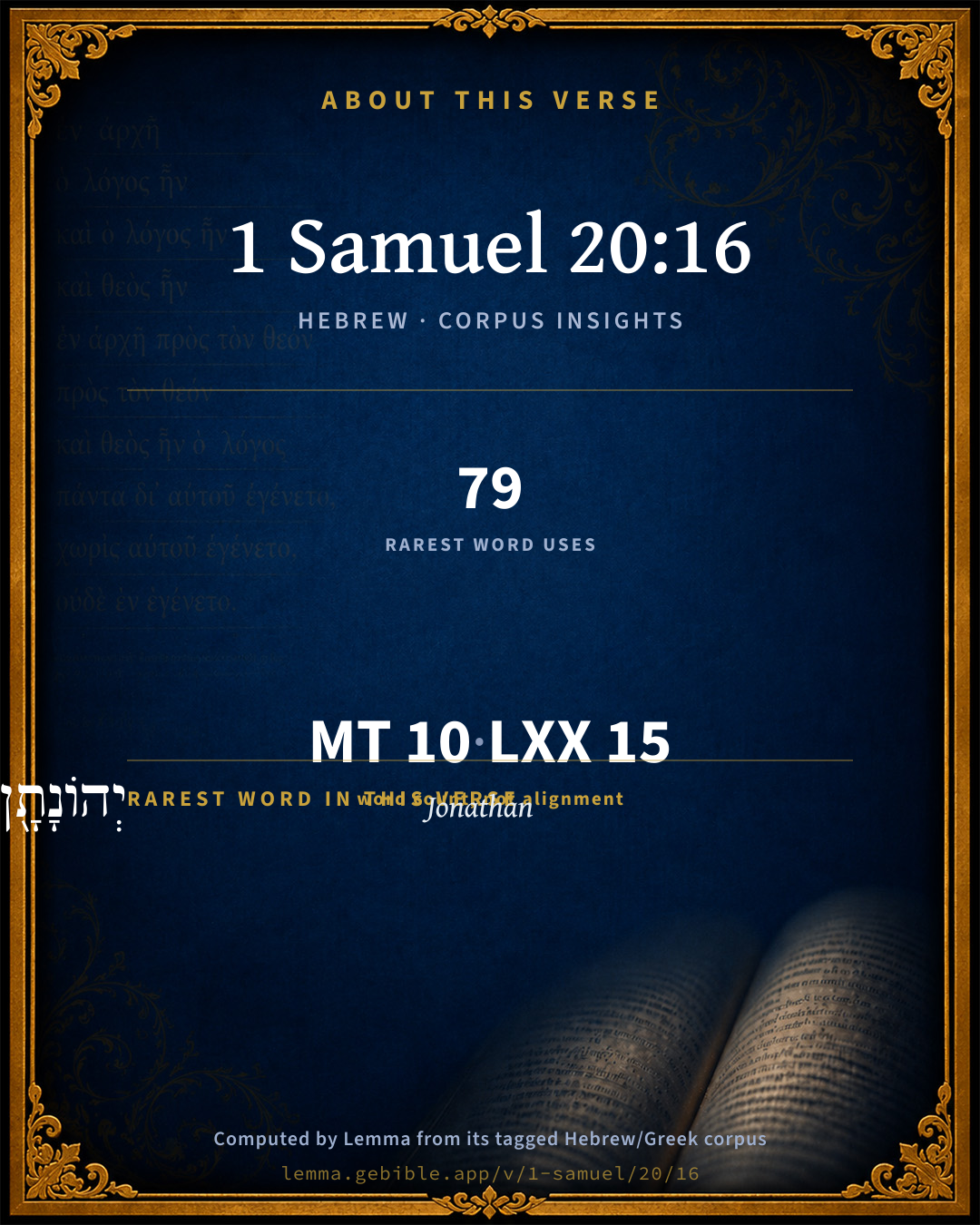
10
words
9
distinct lemmas
Historical
section

Grammatical profile

  • 3 verbs
  • 6 nouns
  • 1 preposition

Verb forms

  • וַיִּכְרֹ֥ת Qal · Sequential Imperfect
  • וּבִקֵּ֣שׁ Piel · Perfect
  • אֹיְבֵ֥י Qal · Participle Active

Repetition

A word recurs within this verse — often emphatic in Hebrew:

  • דָּוִ֑ד David H1732 ×2

Hebrew & Septuagint length

In English translation the verse runs 21 words from the Hebrew and 25 from the Septuagint (LXX English) — closely comparable.

A rough comparison of the two English renderings, which tokenize alike — not a word-level alignment.

Word counts can differ between the Hebrew and the Greek without any difference in meaning — e.g. the Hebrew direct-object marker אֵת has no separate Greek word, and Greek often adds the article ὁ.

In the original languages it is 10 Hebrew tokens and 15 Greek tokens — but the two are counted differently (Hebrew bundles its prefixes and suffixes into one token; the Greek is in lemma form), so that isn’t a like-for-like length.

Cross-references

6

Topical passages linked to 1 Samuel 20:16 in the Treasury of Scripture Knowledge — connected by theme and wording, ordered by reader-vote popularity; previews shown in the World English Bible.

  • 1 Samuel 25:22 God do so to the enemies of David, and more also, if I leave of all that belongs to him by the morning light so much as one man-child.
  • 1 Samuel 18:3 Then Jonathan and David made a covenant, because he loved him as his own soul.
  • Genesis 15:18 In that day Yahweh made a covenant with Abram, saying, "To your seed have I given this land, from the river of Egypt to the great river, the river Euphrates:
  • 1 Samuel 31:2 The Philistines followed hard on Saul and on his sons; and the Philistines killed Jonathan, and Abinadab, and Malchishua, the sons of Saul.
  • 2 Samuel 4:7–8 Now when they came into the house, as he lay on his bed in his bedchamber, they struck him, and killed him, and beheaded him, and took his head, and went by the way of the Arabah all night.
  • 2 Samuel 21:8 But the king took the two sons of Rizpah the daughter of Aiah, whom she bore to Saul, Armoni and Mephibosheth; and the five sons of Michal the daughter of Saul, whom she bore to Adriel the son of Barzillai the Meholathite:

Cross-references courtesy of OpenBible.info (CC BY 4.0).

Hebrew and Greek witnesses Masoretic Hebrew ↔ Greek Septuagint

The same verse in the two great witnesses to the Old Testament, shown verse-for-verse.

These are two independent witnesses, not word-aligned to each other, and the Septuagint is shown in lemma (dictionary) form.

Hebrew 1 Samuel 20:16 Masoretic · Westminster Leningrad Codex

וַיִּכְרֹ֥ת יְהוֹנָתָ֖ן עִם בֵּ֣ית דָּוִ֑ד וּבִקֵּ֣שׁ יְהוָ֔ה מִיַּ֖ד אֹיְבֵ֥י דָוִֽד

So Jonathan made a covenant with the house of David, [saying], Yahweh will require it at the hand of David's enemies.

World English Bible · Public Domain

Greek LXX 1 Samuel 20:16 Septuagint · lemma form

ἐκαἴρω ὁ ὄνομα ὁ ιωναθαν ἀπό ὁ οἶκος δαυίδ καί ἐκζητέω κύριος ἐχθρός ὁ δαυίδ

should it happen that the name of Jonathan be revealed by the house of David, then let the Lord seek out the enemies of David.

LXX2012 (modern English Septuagint) · Public Domain

On this verse, Haydock's Catholic Bible Commentary discusses the Septuagint’s reading. Read the note in Commentary ↓

Hebrew: Westminster Leningrad Codex (CC BY 4.0). Greek: Septuagint (public domain); English from LXX2012 (modern English Septuagint) (Public Domain). How the Septuagint differs from the Hebrew →

Targum (Aramaic paraphrase)

1

The Targum is the ancient Jewish Aramaic paraphrase of the Hebrew Scriptures — an interpretive translation, not the Hebrew text itself. Onkelos (literal) and Pseudo-Jonathan (expansive) render the Torah, and Jonathan the Prophets. Coverage is partial: where no permissively-licensed English translation exists for a verse, only the Aramaic is shown. This is verse-level text, not a word-by-word alignment to the Hebrew.

  1. Targum Jonathan Prophets (Joshua–Malachi)
    וּגְזַר יְהוֹנָתָן קְיָם עִם בֵּית דָוִד וְאִתְפְּרַע לֵיהּ יְיָ מִיַד סַנְאֵי דָוִד:

    (no public-domain English translation for this verse)

    Targum Jonathan — Aramaic: “Mikraot Gedolot” (public domain). English: “Sefaria Community Translation” (CC0 1.0 (public-domain dedication)); “London "Chaldee Paraphrase," 1871” (public domain). Text via Sefaria.

Commentary

Notes on 1 Samuel 20:16 from classic Christian and Jewish commentators (each source and its license shown beneath its notes). The classic Christian expositions comment on the surrounding passage and are grouped to its opening verse, so a note may address several verses; the Jewish commentaries on the Tanakh (Rashi and others) are per-verse, so they appear only where the commentator wrote on this verse.

Lemma curates 59 commentaries, every one of them public domain or Creative Commons licensed, each selected and text-cleaned for this edition rather than reprinted as found. About our sources →

The Cambridge Bible for Schools and Colleges

gen. ed. J. J. S. Perowne

16. So Jonathan, &c.] (1) The E. V. treats this as a remark of the historian: and apparently understands Jonathan’s words “Let the Lord, &c.” to mean “Let the Lord exact vengeance from David by the hand of his enemies if he fails to fulfil the covenant.” But this involves an unusual construction. We should expect, “Let the Lord require it at the hand of David,” if he fails to fulfil the covenant (cp. Deu_23:21): and possibly “David’s enemies” is an euphemism for “David,” substituted by a scribe in later times. Cp. note on 1Sa_25:22. (2) The Sept. points to a text making the whole of 1Sa_20:16 part of Jonathan’s speech: “And when the Lord hath cut off, &c. let not the name of Jonathan be cut off from the house of David, and may the Lord take vengeance on the enemies of David.”

The Cambridge Bible for Schools and Colleges (gen. ed. J. J. S. Perowne; Cambridge University Press, 1878–1918) — public domain. Text from a community e-Sword module.

Trapp's Complete Commentary

John Trapp

1Sa 20:16 So Jonathan made [a covenant] with the house of David, [saying], Let the LORD even require [it] at the hand of David’s enemies.

Ver. 16. Let the Lord even require it at the hands of David’s enemies.] And more especially at my hands, if I keep not touch with thee, and do all the offices of a faithful friend towards thee.

John Trapp, A Commentary or Exposition upon All the Books of the Old and New Testament (1647–1656) — public domain. Text from a community e-Sword module.

Joseph Benson's Commentary

1Sa 20:16-17. So Jonathan made a covenant — The covenant which before was personal, he now extends to the whole house of David, expecting a reciprocal enlargement of it on David’s side, which doubtless he obtained. At the hand of David’s enemies — If either I, or any of my house, shall prove enemies to David or to his house, let the Lord, the witness of this covenant, severely punish the violators of it. Jonathan caused David to swear again — Hebrew, and Jonathan added or proceeded to swear; that is, having himself sworn to David, or adjured David, in the foregoing verse, he here requires David’s oath to him, by way of restipulation or confirmation. For he loved him, &c. — The greatness of his love to him induced him to use every means in his power to secure David’s friendship to himself and his posterity, and to ensure the inviolable observance of this covenant through all their generations.

Joseph Benson's Commentary on the Old and New Testaments (1811–1818) — public domain. Text from a community e-Sword module.

Ellicott's Commentary for English Readers

(16) So Jonathan made a covenant.—It is not necessary to supply (as in the English Version) “saying,” but it is better to understand this verse as a remark interposed in the dialogue by the narrator, and to translate the Hebrew literally, “So Jonathan made a covenant with the house of David, and Jehovah required it at the hand of David’s enemies.”

A Bible Commentary for English Readers, edited by Charles John Ellicott (1878–1897) — public domain. Text from a community e-Sword module.

John Gill's Exposition

So Jonathan made a covenant with the house of David,.... Not with David himself only, which was now renewed, but with his family also:

saying, let the Lord even require it at the hand of David's enemies; take vengeance on Jonathan, or on any of his posterity, should they break this covenant, by showing themselves enemies to David, and his crown; and, on the other hand, also on David, and his posterity, should they not show kindness to Jonathan and his seed, according to the tenor of this covenant.

John Gill's Exposition of the Whole Bible (1746–1763) — public domain (CC PDM 1.0). Text via the HelloAO Bible API.

Haydock's Catholic Bible Commentary

Enemies. This seems to be a second translation of the former sentence, with a small variation. --- Required may be expressed in the future, as an imprecation made by the two friends against those who should attempt to break the covenant, or to oppose David’s reign. Septuagint omit this verse entirely, and translate the following, (17) "and Jonathan continued to swear to David, inasmuch as he loved him, because he loved the soul of the man who loved him." He had such an affection for David, that he extended his love to all his friends. Protestants, "so Jonathan made a covenant with....David, saying: Let the Lord even require it at," &c. (Haydock) --- He did so in due time, and the covenant between these two had its effect. (Calmet)

George Leo Haydock (1774–1849), Haydock's Catholic Family Bible and Commentary, 1859 edition — public domain. Excludes Psalms (Douay-Rheims chapter numbering differs from Protestant) and Deuterocanonical books (Catholic canon only).

Matthew Poole's English Annotations

The covenant which before was personal, he now extends to the whole house of David, expecting a reciprocal enlargement of it on David’s side, which doubtless he obtained.

Let the Lord even require it at the hand of David’s enemies; if either I or any of my house shall break this covenant, and shall prove enemies to David, or to his house, let the Lord, the witness of this covenant, severely punish the violators of it, whoever they are. Others thus, Let the Lord require and punish the breach of this covenant in David, if he break it. But because it was ominous and reproachful to suppose such a thing of David, by a figure called euphemismus, he names David’s enemies for David; as they also expound 1Sa 25:22. But the former sense seems more probable, because this verse contains only Jonathan’s stipulation or covenant with David and his house, which being expressed in the former part of it, is in this latter part confirmed by the usual form of imprecation; and the restipulation or covenant of David to Jonathan and his house is mentioned in the next verse. Yet may that other sense stand well enough; taking these words for Jonathan’s adjuration of David to be kind to him, confirmed with an imprecation in case he do otherwise; as if he should say, I adjure thee, as thou hopest to escape such a mischief, (which I had rather might befall thine enemies than thee,) that thou deal not so ungratefully with me or my house: which adjuration of Jonathan David seconds by an oath in the next verse, at the request of Jonathan.

Matthew Poole's English Annotations on the Holy Bible (1683–1685) — public domain. Text from a community e-Sword/MySword module.

The Pulpit Commentary

This verse also is very difficult, hut it is probably to be taken as an insertion of the narrator: "So Jonathan made a covenant with the house of David that is, so as to bind his descendants Let Jehovah require it at the hand of David"s enemies." These last words probably are an euphemism, and mean David himself. So Rashi explains the words. The courtesy of an Oriental forbade his saying, May Jehovah punish David for it, but he prays that God would requite it on some one. But if the Divine anger visits even David"s enemies for it, how much more the guilty perjurer himself.

The Pulpit Commentary (1880–1919), ed. H.D.M. Spence-Jones & Joseph S. Exell — public domain. Text from a community e-Sword module.

John Wesley's Explanatory Notes

A covenant - The covenant which before was personal, he now extends to the whole house of David, expecting a reciprocal enlargement of it on David's side, which doubtless he obtained. Enemies - If either I or any of my house shall break this covenant, and shall prove enemies to David or to his house, let the Lord, the witness of this covenant, severely punish the violators of it.

John Wesley, Explanatory Notes Upon the Whole Bible (1754–1765) — public domain. Text via the GEBible commentary corpus.

Rashi

Rabbi Shlomo Yitzchaki (Rashi)

May Adonoy exact punishment. Of this covenant.

From Dovid's enemies. Scripture euphemized. Its real meaning is that the The Holy One, Blessed is He, demanded the punishment of the transgression from Dovid. When he transgressed the covenant, and said to Mefiboshes, "You and Tziva shall divide the field," a bas kol came forth, and said, 'Rechavam and Yorovom shall divide the kingdom.' And so did Targum Yonoson render, 'and Adonoy took retribution from Dovid's enemies.'

Rashi on the Tanakh — English translations: “The Judaica Press complete Tanach with Rashi, translated by A. J. Rosenberg” (CC BY 4.0); “Pentateuch with Rashi's commentary by M. Rosenbaum and A.M. Silbermann, 1929-1934” (public domain); “The Metsudah Tanach series, Lakewood, N.J” (CC BY 4.0); and “The Book of Joshua, Metsudah Publications, 1997” (CC BY 4.0). Text via Sefaria.

Lesson kit

Teaching starters — assembled from the data on this page, not authored interpretation. Every prompt links to the verse data it draws on. Edit before teaching.

1 Samuel, in the Historical, opens this verse with 10 words (9 distinct Hebrew lemmas). Its most distinctive word is Yᵉhôwnâthân (“Jonathan”). A historical commentator’s framing appears above. Read the whole chapter for the surrounding context.

Discussion questions

  1. What does “Jonathan” (Yᵉhôwnâthân) contribute to the verse as a whole?
  2. How does 1 Samuel 25:22, which shares this passage’s theme, read alongside this verse?
  3. What does the repetition of “David” (2× in this one verse) do in this verse?
  4. The translations on this page render this verse differently — a whole-verse word diff, not a word-by-word alignment. What might account for the different wordings?
  5. «וַיִּכְרֹ֥ת» is a Qal Sequential Imperfect verb. How does that grammatical form shape the action described?
  6. Compare how The Cambridge Bible for Schools and Colleges and Trapp's Complete Commentary read this verse. Where do they agree or differ?

Things to notice

Reading settings

Reading text

Shown beneath each verse's original-language words.

Old Testament
Old Testament edition

Read the OT as the Masoretic Hebrew (MT) or the Greek Septuagint (LXX).

English shown for the Greek Septuagint (in the Hebrew ↔ Greek comparison).

Comparing translations? Open the Compare panel on any verse page to stack up to four side by side.