
Genesis 41:36

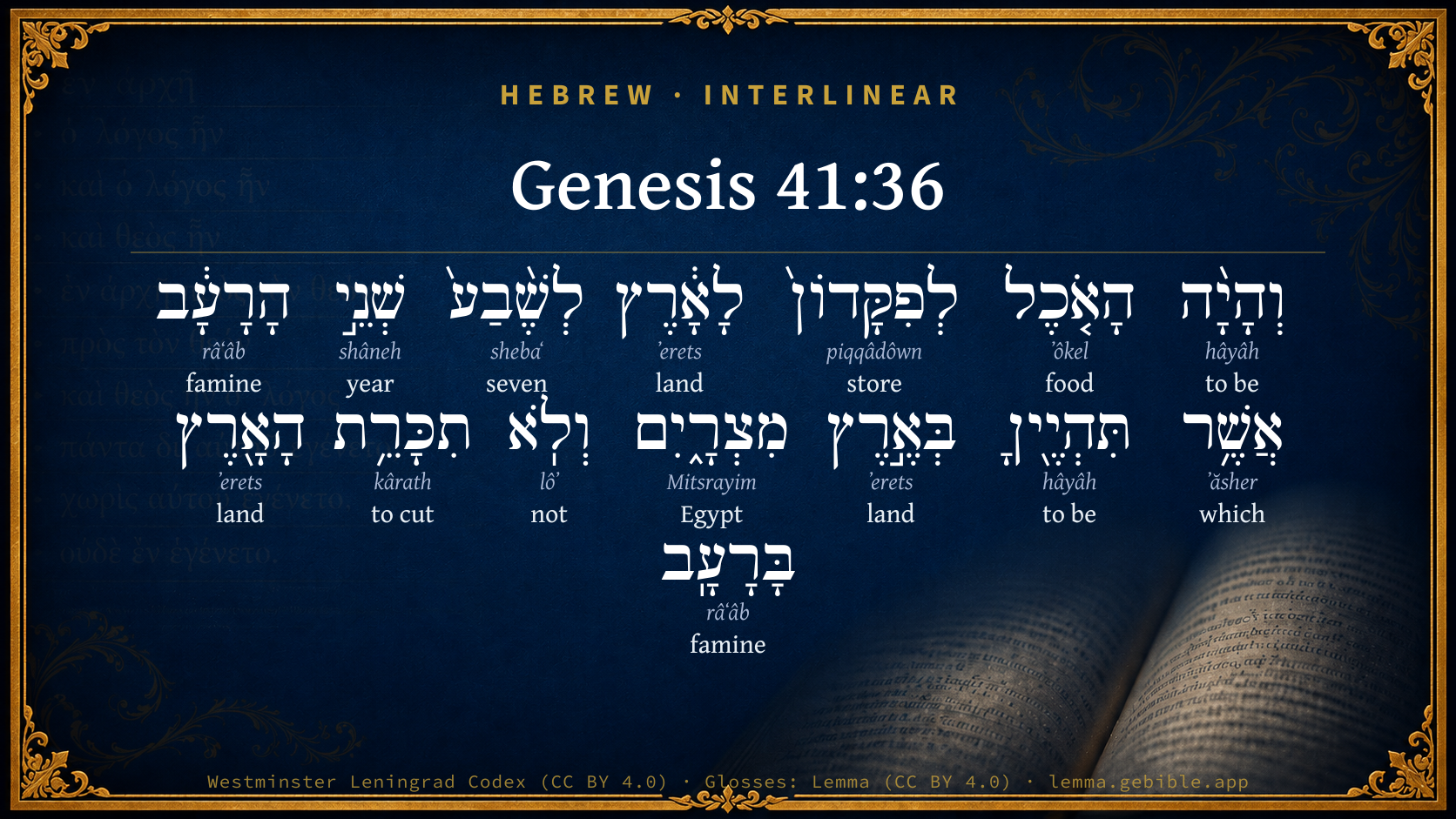
Hebrew (Westminster Leningrad Codex) Genesis 41:36 appears in the Hebrew Old Testament. The text above is from the Westminster Leningrad Codex. Each word links to its Strong’s number, a concise gloss, and parsing drawn from the Open Scriptures Hebrew Bible morphology. Click any word for its full Brown-Driver-Briggs (BDB) entry.
Download image
Cite this verse

Genesis 41:36 (World English Bible). Public Domain. Lemma interlinear Bible study tool, https://lemma.gebible.app/v/genesis/41/36.

Show BibTeX & RIS
BibTeX
RIS
English Translation
The food will be for a store to the land against the seven years of famine, which will be in the land of Egypt; that the land not perish through the famine."
World English Bible · Public Domain
Highlights
  • 1 first appearance in the Hebrew Bible
Full analysis ↓
Download a study sheet

One document with this verse’s original text, its word-by-word gloss line, the meaning frame, cross-references with their text, attributed commentary, and full source and license credits — printable, and it pastes into notes with its structure intact.

This verse Autodidact and up

Study sheet (.html) Plain text (.txt)

A passage Seminary Student

Up to 50 verses in one chapter. A passage sheet keeps up to 6 commentary sources and 12 cross-references per verse, in the order this page ranks them, and says so on the sheet whenever that leaves anything out. Ask for a single verse and you get the Autodidact verse sheet above.

Everything on this page stays free to read, with no account — the sheet is a download of what is already on screen, not access to it.

Want to remove ads? Support Godless Engineer
Compare translations 3

The same verse in 3 English versions, stacked beneath the original-language interlinear above. Click any original word for its lexicon entry.

Each is an independent rendering of the whole verse — the interlinear is not word-aligned to these translations.

Highlighted words mark where these versions differ — a whole-verse word diff, not a word-by-word alignment.

  • World English Bible Public Domain
    The food will be for a store to the land against the seven years of famine, which will be in the land of Egypt; that the land not perish through the famine."
  • King James Version Public Domain
    And that food shall be for store to the land against the seven years of famine, which shall be in the land of Egypt; that the land perish not through the famine.
  • unfoldingWord Literal Text CC BY-SA 4.0
    And the food should be in reserve for the land for the seven years of famine that will come on the land of Egypt, so that the land will not be cut off by the famine.” Joseph Is Appointed as the Governor of Egypt and Stores Up Grain 41:37-57

unfoldingWord Literal Text — © unfoldingWord, licensed CC BY-SA 4.0. Word-aligned USFM3 via Door43 (git.door43.org/unfoldingWord/en_ult).

Versions to compare (up to 4)

3 of 4 selected

Show all 18 translations

Every available English version of this verse, each an independent rendering of the whole verse.

  • World English Bible Public Domain
    The food will be for a store to the land against the seven years of famine, which will be in the land of Egypt; that the land not perish through the famine."
  • Berean Standard Bible Public Domain
    This food will be a reserve for the land during the seven years of famine to come upon the land of Egypt. Then the country will not perish in the famine.”
  • Majority Standard Bible Public Domain
    This food will be a reserve for the land during the seven years of famine to come upon the land of Egypt. Then the country will not perish in the famine.”
  • King James Version Public Domain
    And that food shall be for store to the land against the seven years of famine, which shall be in the land of Egypt; that the land perish not through the famine.
  • American Standard Version (1901) Public Domain
    And the food shall be for a store to the land against the seven years of famine, which shall be in the land of Egypt; that the land perish not through the famine.
  • Revised Version (1885) Public Domain
    And the food shall be for a store to the land against the seven years of famine, which shall be in the land of Egypt; that the land perish not through the famine.
  • Geneva Bible (1599) Public Domain
    So the foode shall be for the prouision of the lande, against the seuen yeeres of famine, which shalbe in the lande of Egypt, that the land perish not by famine.
  • Douay-Rheims (1899) Public Domain
    That he may appoint overseers over all the countries: and gather into barns the fifth part of the fruits, during the seven fruitful years,
  • Young's Literal Translation Public Domain
    and the food hath been for a store for the land, for the seven years of famine which are in the land of Egypt; and the land is cut off by the famine.'
  • Literal Standard Version CC BY-SA 4.0
    and the food has been for a store for the land, for the seven years of famine which are in the land of Egypt; and the land is cut off by the famine.”
  • Unlocked Literal Bible CC BY-SA 4.0
    The food will be a supply for the land for the seven years of famine which will be in the land of Egypt. In this way the land will not be devastated by the famine.”
  • unfoldingWord Literal Text CC BY-SA 4.0
    And the food should be in reserve for the land for the seven years of famine that will come on the land of Egypt, so that the land will not be cut off by the famine.” Joseph Is Appointed as the Governor of Egypt and Stores Up Grain 41:37-57
  • Darby Bible Public Domain
    And let the food be as store for the land for the seven years of famine, which will be in the land of Egypt, that the land perish not through the famine.
  • World Messianic Bible Public Domain
    The food will be to supply the land against the seven years of famine, which will be in the land of Egypt; so that the land will not perish through the famine.”
  • Webster's Bible Public Domain
    And that food shall be for store to the land against the seven years of famine, which shall be in the land of Egypt; that the land may not perish through the famine.
  • Free Bible Version CC BY-SA 4.0
    This will be a food reserve for the country during the seven years of famine so that the people won't die of starvation.”
  • Bible in Basic English Public Domain
    And let that food be kept in store for the land till the seven bad years which are to come in Egypt; so that the land may not come to destruction through need of food.
  • JPS Tanakh (1917) Public Domain
    And the food shall be for a store to the land against the seven years of famine, which shall be in the land of Egypt; that the land perish not through the famine.'

Literal Standard Version (2020), Covenant Press — licensed CC BY-SA 4.0. Text via the HelloAO Bible API (eBible.org). Unlocked Literal Bible (unfoldingWord) — licensed CC BY-SA 4.0. Text via the HelloAO Bible API (eBible.org). unfoldingWord Literal Text — © unfoldingWord, licensed CC BY-SA 4.0. Word-aligned USFM3 via Door43 (git.door43.org/unfoldingWord/en_ult). Free Bible Version, Dr. Jonathan Gallagher — licensed CC BY-SA 4.0. Text via the HelloAO Bible API (eBible.org).

Word by word

More ways to search: Search by grammar → Find every occurrence → Compare this word →

Practice this passage: Drill this verse → Learn its vocabulary →

לְפִקָּדוֹן֙
piqqâdôwn
H6487
“to/for · store”
Preposition + Noun, Common, Masculine, Singular, Absolute
Part of Speech
Preposition + Noun
Type
Common
Gender
Masculine
Number
Singular
State
Absolute
Full BDB Definition

Origin: from H6485

TWOT: 1802f

deposit, store, supply
  1. וְהָיָ֨ה hâyâh H1961 “and · to be” Conjunction + Verb, Qal, Sequential Perfect, 3rd Person, Masculine, Singular
  2. הָאֹ֤כֶל ʼôkel H400 “the · food” Particle, Definite Article + Noun, Common, Masculine, Singular, Absolute
  3. לָאָ֔רֶץ ʼerets H776 “to/for the · land” Preposition, Determined + Noun, Common, Both, Singular, Absolute
  4. לְשֶׁ֨בַע֙ shebaʻ H7651 “to/for · seven” Preposition + Adjective, Cardinal number, Feminine, Singular, Absolute
  5. שְׁנֵ֣י shâneh H8141 “year” Adjective, Cardinal number, Masculine, Dual, Construct
  6. הָרָעָ֔ב râʻâb H7458 “the · famine” Particle, Definite Article + Noun, Common, Masculine, Singular, Absolute
  7. אֲשֶׁ֥ר ʼăsher H834 “which” Particle, Relative
  8. תִּהְיֶ֖יןָ hâyâh H1961 “to be” Verb, Qal, Imperfect, 3rd Person, Feminine, Plural
  9. בְּאֶ֣רֶץ ʼerets H776 “in/at · land of” Preposition + Noun, Common, Both, Singular, Construct
  10. מִצְרָ֑יִם Mitsrayim H4714 “Egypt” Noun, Proper
  11. וְלֹֽא lôʼ H3808 “and · not” Conjunction + Particle, Negative
  12. תִכָּרֵ֥ת kârath H3772 “to cut” Verb, Niphal, Imperfect, 3rd Person, Feminine, Singular
  13. הָאָ֖רֶץ ʼerets H776 “the · land” Particle, Definite Article + Noun, Common, Both, Singular, Absolute
  14. בָּרָעָֽב râʻâb H7458 “in/at the · famine” Preposition, Determined + Noun, Common, Masculine, Singular, Absolute

About this verse

These counts appear in no published source. They are computed here, from the morphology-tagged text and Lemma’s own curated glosses. What Lemma adds →

15
words
11
distinct lemmas
Pentateuch
section

Notable vocabulary

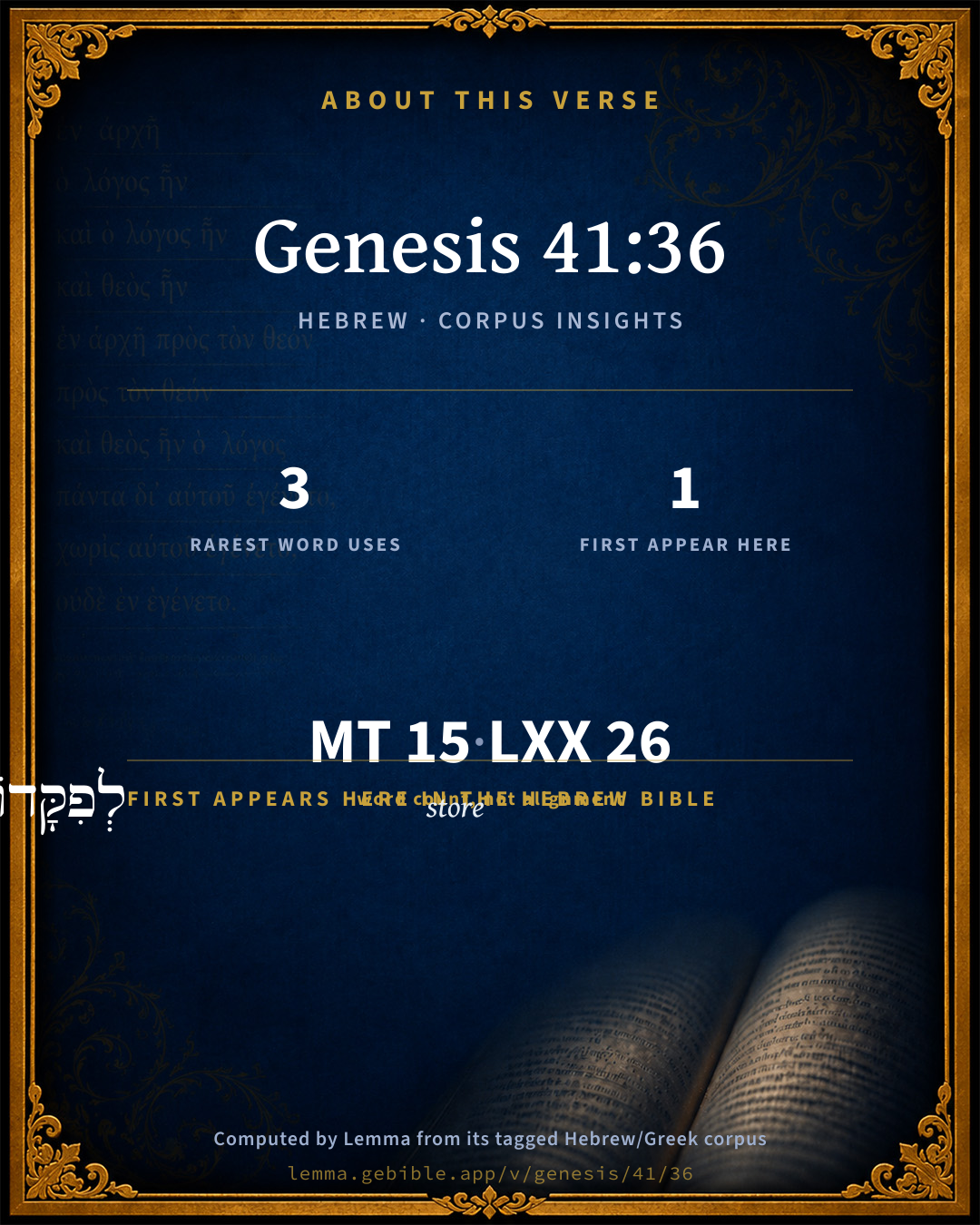
The rarest word here is לְפִקָּדוֹן֙ store H6487 — appearing just 3 times in the whole Hebrew Bible.

First appearance in Scripture

This word makes its first canonical appearance in the Hebrew Bible here:

  • לְפִקָּדוֹן֙ store H6487

Shared distinctive vocabulary

לְפִקָּדוֹן֙ store H6487 occurs in 3 verses of the Hebrew Bible. Also found in:

Grammatical profile

  • 3 verbs
  • 8 nouns
  • 2 adjectives
  • 2 particles

Verb forms

  • וְהָיָ֨ה Qal · Sequential Perfect
  • תִּהְיֶ֖יןָ Qal · Imperfect
  • תִכָּרֵ֥ת Niphal · Imperfect

Repetition

Words recur within this verse — often emphatic in Hebrew:

  • לָאָ֔רֶץ land H776 ×3
  • וְהָיָ֨ה to be H1961 ×2
  • הָרָעָ֔ב famine H7458 ×2

Hebrew & Septuagint length

In English translation the verse runs 32 words from the Hebrew and 34 from the Septuagint (LXX English) — closely comparable.

A rough comparison of the two English renderings, which tokenize alike — not a word-level alignment.

Word counts can differ between the Hebrew and the Greek without any difference in meaning — e.g. the Hebrew direct-object marker אֵת has no separate Greek word, and Greek often adds the article ὁ.

In the original languages it is 15 Hebrew tokens and 26 Greek tokens — but the two are counted differently (Hebrew bundles its prefixes and suffixes into one token; the Greek is in lemma form), so that isn’t a like-for-like length.

Cross-references

1

Topical passages linked to Genesis 41:36 in the Treasury of Scripture Knowledge — connected by theme and wording, ordered by reader-vote popularity; previews shown in the World English Bible.

  • Genesis 47:13–25 There was no bread in all the land; for the famine was very severe, so that the land of Egypt and the land of Canaan fainted by reason of the famine.

Cross-references courtesy of OpenBible.info (CC BY 4.0).

Hebrew and Greek witnesses Masoretic Hebrew ↔ Greek Septuagint

The same verse in the two great witnesses to the Old Testament, shown verse-for-verse.

These are two independent witnesses, not word-aligned to each other, and the Septuagint is shown in lemma (dictionary) form.

Hebrew Genesis 41:36 Masoretic · Westminster Leningrad Codex

וְהָיָ֨ה הָאֹ֤כֶל לְפִקָּדוֹן֙ לָאָ֔רֶץ לְשֶׁ֨בַע֙ שְׁנֵ֣י הָרָעָ֔ב אֲשֶׁ֥ר תִּהְיֶ֖יןָ בְּאֶ֣רֶץ מִצְרָ֑יִם וְלֹֽא תִכָּרֵ֥ת הָאָ֖רֶץ בָּרָעָֽב

The food will be for a store to the land against the seven years of famine, which will be in the land of Egypt; that the land not perish through the famine."

World English Bible · Public Domain

Greek LXX Genesis 41:36 Septuagint · lemma form

καί εἰμί ὁ βρῶμα φυλάσσω ὁ γῆ εἰς ὁ ἑπτά ἔτος ὁ λιμός ὅς εἰμί ἐν γῆ αἴγυπτος καί οὐ ἐκτρίβω ὁ γῆ ἐν ὁ λιμός

And the stored food shall be for the land against the seven years of famine, which shall be in the land of Egypt; and the land shall not be utterly destroyed by the famine.

LXX2012 (modern English Septuagint) · Public Domain

Hebrew: Westminster Leningrad Codex (CC BY 4.0). Greek: Septuagint (public domain); English from LXX2012 (modern English Septuagint) (Public Domain). How the Septuagint differs from the Hebrew →

Targum (Aramaic paraphrase)

2

The Targum is the ancient Jewish Aramaic paraphrase of the Hebrew Scriptures — an interpretive translation, not the Hebrew text itself. Onkelos (literal) and Pseudo-Jonathan (expansive) render the Torah, and Jonathan the Prophets. Coverage is partial: where no permissively-licensed English translation exists for a verse, only the Aramaic is shown. This is verse-level text, not a word-by-word alignment to the Hebrew.

  1. Targum Onkelos Torah (Genesis–Deuteronomy)
    וִיהֵי עִיבוּרָא גְּנִיז (לְעַמָּא דְ) לְאַרְעָא לִשְׁבַע שְׁנֵי כַפְנָא דִּי תְהֶוְיָן בְּאַרְעָא דְמִצְרָיִם וְלָא תִשְׁתֵּיצֵי עַמָּא דְאַרְעָא בְּכַפְנָא

    (no public-domain English translation for this verse)

    Targum Onkelos — Aramaic: “Onkelos Genesis” (public domain); “Onkelos Exodus” (public domain); “Onkelos Leviticus” (public domain); “Onkelos Numbers” (public domain); “Onkelos Deuteronomy” (public domain). English: “Sefaria Community Translation” (CC0 1.0 (public-domain dedication)); “J.W. Etheridge. The Targums of Onkelos and Jonathan Ben Uzziel on the Pentateuch. London: Longmans, Green, 1862” (public domain). Text via Sefaria.

  2. Targum Pseudo-Jonathan Torah (Genesis–Deuteronomy)
    וִיהֵי עִיבּוּרָא גְנִיז בִּמְעַרְתָּא בְּאַרְעָא לְמִזַן מִנֵיהּ בְּשֶׁבַע שְׁנֵי כַפְנָא דִיתִיהֶוְיַן בְּאַרַע דְמִצְרַיִם וְלָא יִשְׁתֵּצֵי עַמָא דְאַרְעָא בְּכַפְנָא

    and there will be provision laid up (as) in a cavern in the earth, that therefrom they may take in the years of famine which come upon the land of Mizraim, that the people of the land perish not through the famine.

    Targum Pseudo-Jonathan — Aramaic: “Targum Jonathan on Genesis” (public domain); “Targum Jonathan on Exodus” (public domain); “Targum Jonathan on Leviticus” (public domain); “Targum Jonathan on Numbers” (public domain); “Targum Jonathan on Deuteronomy” (public domain). English: “The Targum of Jonathan ben Uzziel, trans. J. W. Etheridge, London, 1862” (public domain). Text via Sefaria.

Commentary

Notes on Genesis 41:36 from classic Christian and Jewish commentators (each source and its license shown beneath its notes). The classic Christian expositions comment on the surrounding passage and are grouped to its opening verse, so a note may address several verses; the Jewish commentaries on the Tanakh (Rashi and others) are per-verse, so they appear only where the commentator wrote on this verse.

Lemma curates 59 commentaries, every one of them public domain or Creative Commons licensed, each selected and text-cleaned for this edition rather than reprinted as found. About our sources →

Trapp's Complete Commentary

John Trapp

Gen 41:36 And that food shall be for store to the land against the seven years of famine, which shall be in the land of Egypt; that the land perish not through the famine.

Ver. 36. For store.] He not only foretelleth Egypt’s misery, but showeth the means to mitigate it. This is the right method, and must be made use of.

John Trapp, A Commentary or Exposition upon All the Books of the Old and New Testament (1647–1656) — public domain. Text from a community e-Sword module.

The Cambridge Bible for Schools and Colleges

gen. ed. J. J. S. Perowne

36. for a store] i.e. a reserve. The Hebrew narrative is proud to attribute to Joseph the origination of the granaries, which formed part of the elaborate organization of the Egyptian kingdom, and must have profoundly impressed the simpler Israelite people.

The Cambridge Bible for Schools and Colleges (gen. ed. J. J. S. Perowne; Cambridge University Press, 1878–1918) — public domain. Text from a community e-Sword module.

John Gill's Exposition

And Pharaoh said unto Joseph,.... After his servants had agreed to his being the man: at least Pharaoh had declared his mind that he should be the person; which if any of them disliked, as probably might be the case of some through envy, and as desirous of the post themselves, yet durst not make any opposition to it:

forasmuch as God hath shewed thee all this; the interpretation of his dreams, what would be hereafter for fourteen years to come, what was advisable to be done for the good of the nation, and had proposed a plan so well contrived and formed:

there is none so discreet and wise as thou art; and consequently none so fit for this business, since he was so divinely qualified; and Justin, the Heathen writer (r), observes that he had such knowledge and experience of things, that his answers seemed to be given not from men, but from God.

(r) E. Trogo, l. 36. c. 32.

John Gill's Exposition of the Whole Bible (1746–1763) — public domain (CC PDM 1.0). Text via the HelloAO Bible API.

Whedon's Commentary on the Bible

Daniel D. Whedon

36. That the land perish not — That is, the inhabitants of the land.

Daniel D. Whedon (gen. ed.), Commentary on the Old and New Testaments (1874–1909) — public domain. Text from a community e-Sword module.

Rashi

Rabbi Shlomo Yitzchaki (Rashi)

והיה האכל — means AND THE FOOD that is stored up SHALL BE AS ANY other DEPOSIT (פקדון) that is held in reserve for the maintenance of the people of the land.

Rashi on the Tanakh — English translations: “The Judaica Press complete Tanach with Rashi, translated by A. J. Rosenberg” (CC BY 4.0); “Pentateuch with Rashi's commentary by M. Rosenbaum and A.M. Silbermann, 1929-1934” (public domain); “The Metsudah Tanach series, Lakewood, N.J” (CC BY 4.0); and “The Book of Joshua, Metsudah Publications, 1997” (CC BY 4.0). Text via Sefaria.

Ramban (Nachmanides)

Rabbi Moshe ben Nachman (Ramban / Nachmanides)

AND THE FOOD SHALL SERVE AS A RESERVE FOR THE LAND. Joseph said that the food should be kept in reserve under the charge of Pharaoh’s officers for the needs of the land during the seven years of famine, and they should not be used for other purposes lest the land be consumed by the famine just as the cows in the dream did not die on account of their leanness.

Ramban (Nachmanides) on the Tanakh — English translation: “Commentary on the Torah by Ramban (Nachmanides). Translated and annotated by Charles B. Chavel. New York, Shilo Pub. House, 1971-1976” (CC BY 4.0). Text via Sefaria.

Radak

Rabbi David Kimhi (Radak)

לפקדון, as an insurance to have handy in time of need. Even though the people who had turned in that part of their harvest would in due course be forced to buy it back, this arrangement would be good for them as at least they would insure that when needed it would be available.

Radak on the Tanakh — English translations: “Sefaria Community Translation” (CC0 1.0 (public-domain dedication)); “Eliyahu Munk, HaChut Hameshulash” (CC BY 4.0); “Rabbi Mike Feuer, Jerusalem Anthology” (CC BY 4.0); and “R. David Kimhi on the first book of Psalms, Translated by R.G. Finch, London, 1919” (public domain). Text via Sefaria.

Lesson kit

Teaching starters — assembled from the data on this page, not authored interpretation. Every prompt links to the verse data it draws on. Edit before teaching.

Genesis, in the Pentateuch, opens this verse with 15 words (11 distinct Hebrew lemmas). Its most distinctive word is piqqâdôwn (“store”). A historical commentator’s framing appears above. Read the whole chapter for the surrounding context.

Discussion questions

  1. The word piqqâdôwn carries the sense “store.” How does it shape the verse?
  2. The word “store” first appears here in Scripture. What is being introduced at this debut?
  3. Leviticus 6:2 shares the word «store» with this verse. How do the two illuminate each other?
  4. “land” occurs 3× in this one verse. What is the effect of the repetition?
  5. The translations on this page render this verse differently — a whole-verse word diff, not a word-by-word alignment. What might account for the different wordings?
  6. The verb «וְהָיָ֨ה» is Qal Sequential Perfect. How does its form color the action?
  7. Reading how Trapp's Complete Commentary and The Cambridge Bible for Schools and Colleges read this verse, where do the two commentators agree and where do they part?

Things to notice

Reading settings

Reading text

Shown beneath each verse's original-language words.

Old Testament
Old Testament edition

Read the OT as the Masoretic Hebrew (MT) or the Greek Septuagint (LXX).

English shown for the Greek Septuagint (in the Hebrew ↔ Greek comparison).

Comparing translations? Open the Compare panel on any verse page to stack up to four side by side.