
Ezekiel 16:4

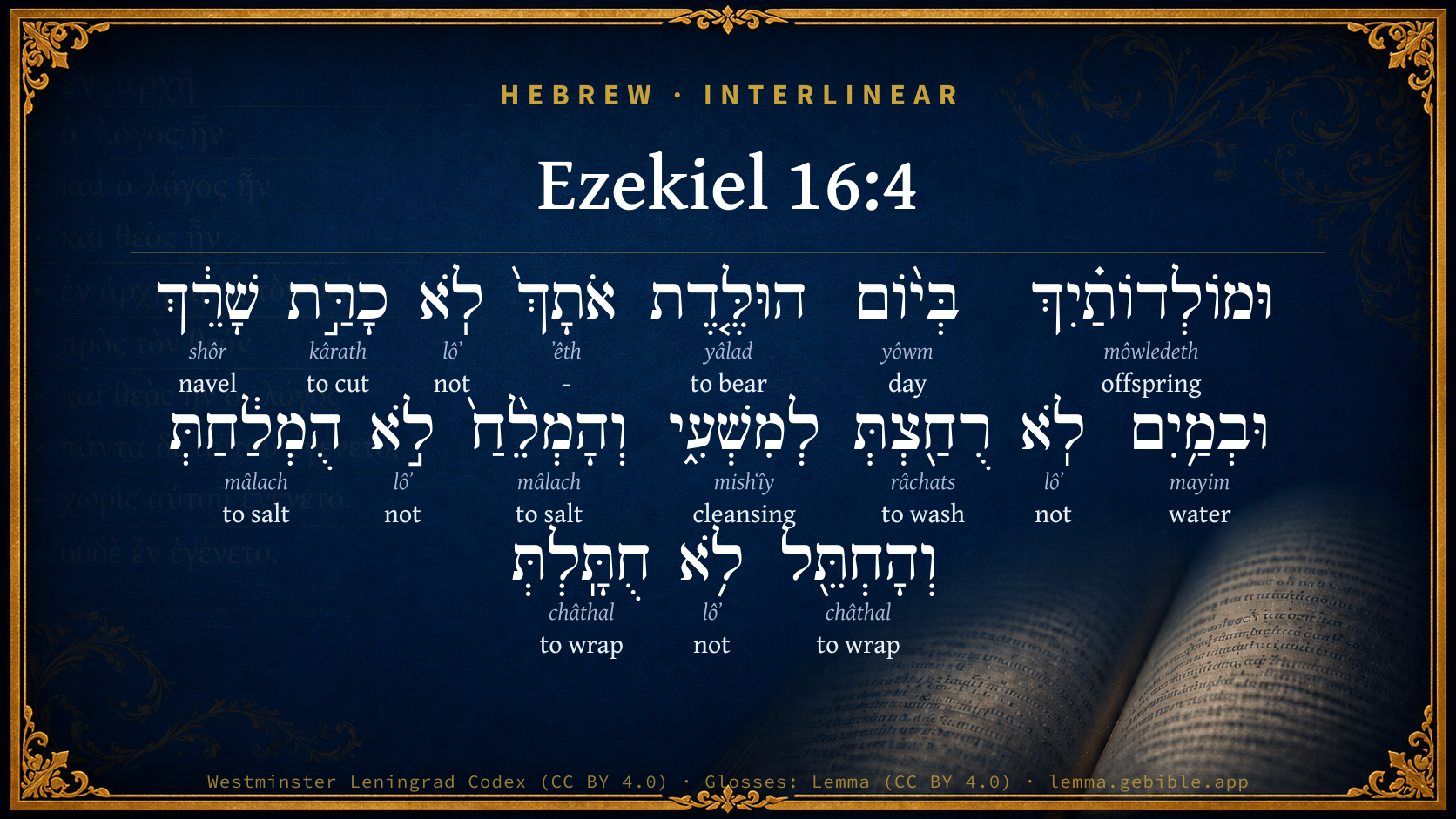
Hebrew (Westminster Leningrad Codex) Ezekiel 16:4 appears in the Hebrew Old Testament. The text above is from the Westminster Leningrad Codex. Each word links to its Strong’s number, a concise gloss, and parsing drawn from the Open Scriptures Hebrew Bible morphology. Click any word for its full Brown-Driver-Briggs (BDB) entry.
Download image
Cite this verse

Ezekiel 16:4 (World English Bible). Public Domain. Lemma interlinear Bible study tool, https://lemma.gebible.app/v/ezekiel/16/4.

Show BibTeX & RIS
BibTeX
RIS
English Translation
As for your birth, in the day you were born your navel was not cut, neither were you washed in water to cleanse you; you weren't salted at all, nor swaddled at all.
World English Bible · Public Domain
Highlights
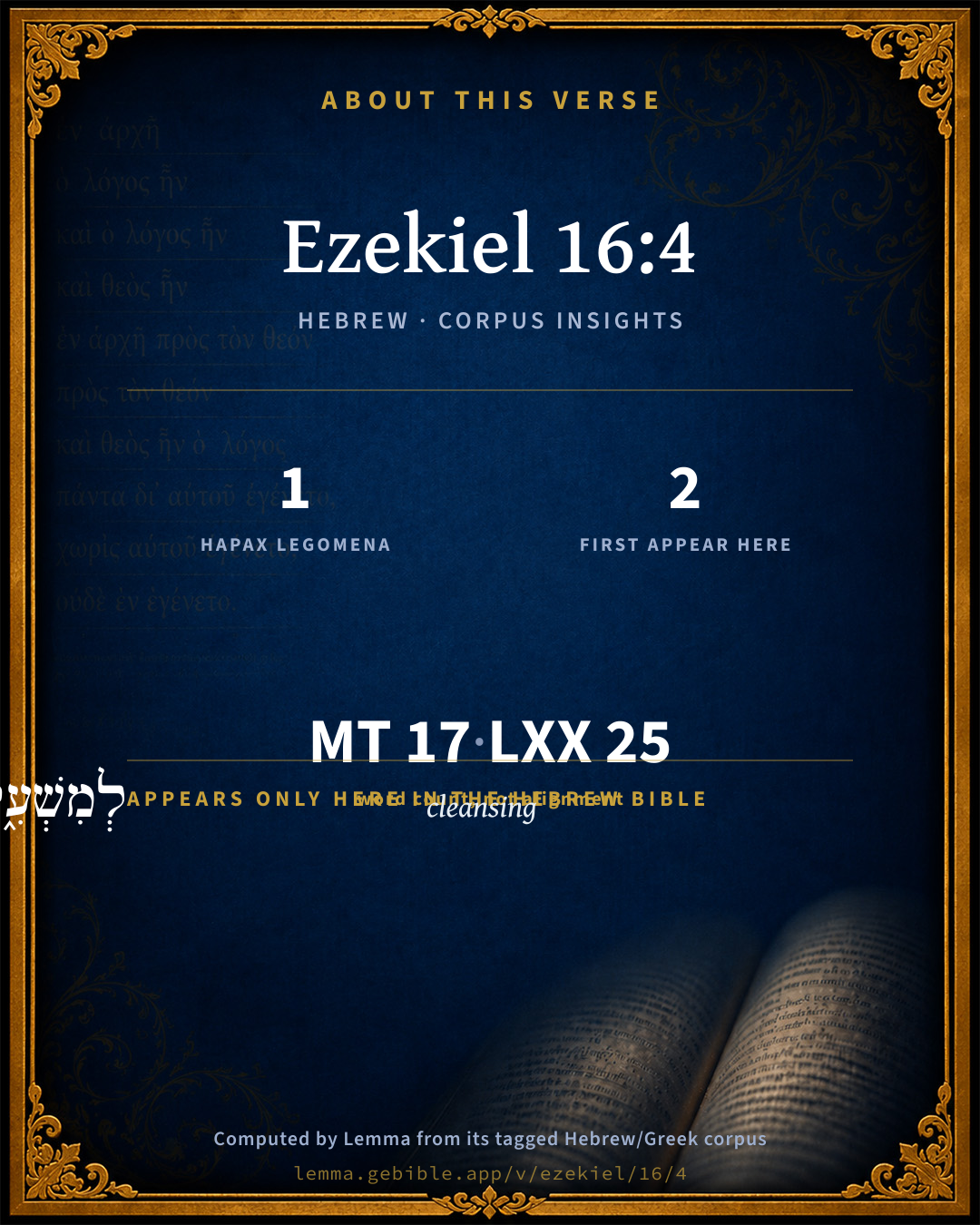
  • 1 hapax legomenon — only here in the Hebrew Bible
  • 2 first appearances in the Hebrew Bible
Full analysis ↓
Download a study sheet

One document with this verse’s original text, its word-by-word gloss line, the meaning frame, cross-references with their text, attributed commentary, and full source and license credits — printable, and it pastes into notes with its structure intact.

This verse Autodidact and up

Study sheet (.html) Plain text (.txt)

A passage Seminary Student

Up to 50 verses in one chapter. A passage sheet keeps up to 6 commentary sources and 12 cross-references per verse, in the order this page ranks them, and says so on the sheet whenever that leaves anything out. Ask for a single verse and you get the Autodidact verse sheet above.

Everything on this page stays free to read, with no account — the sheet is a download of what is already on screen, not access to it.

Want to remove ads? Support Godless Engineer
Compare translations 3

The same verse in 3 English versions, stacked beneath the original-language interlinear above. Click any original word for its lexicon entry.

Each is an independent rendering of the whole verse — the interlinear is not word-aligned to these translations.

Highlighted words mark where these versions differ — a whole-verse word diff, not a word-by-word alignment.

  • World English Bible Public Domain
    As for your birth, in the day you were born your navel was not cut, neither were you washed in water to cleanse you; you weren't salted at all, nor swaddled at all.
  • King James Version Public Domain
    And as for thy nativity, in the day thou wast born thy navel was not cut, neither wast thou washed in water to supple thee; thou wast not salted at all, nor swaddled at all.
  • unfoldingWord Literal Text CC BY-SA 4.0
    On the day of your birth, your mother did not cut your navel, nor did she purify you in water or rub you down with salt, or wrap cloth around you.

unfoldingWord Literal Text — © unfoldingWord, licensed CC BY-SA 4.0. Word-aligned USFM3 via Door43 (git.door43.org/unfoldingWord/en_ult).

Versions to compare (up to 4)

3 of 4 selected

Show all 18 translations

Every available English version of this verse, each an independent rendering of the whole verse.

  • World English Bible Public Domain
    As for your birth, in the day you were born your navel was not cut, neither were you washed in water to cleanse you; you weren't salted at all, nor swaddled at all.
  • Berean Standard Bible Public Domain
    On the day of your birth your cord was not cut, nor were you washed with water for cleansing. You were not rubbed with salt or wrapped in cloths.
  • Majority Standard Bible Public Domain
    On the day of your birth your cord was not cut, nor were you washed with water for cleansing. You were not rubbed with salt or wrapped in cloths.
  • King James Version Public Domain
    And as for thy nativity, in the day thou wast born thy navel was not cut, neither wast thou washed in water to supple thee; thou wast not salted at all, nor swaddled at all.
  • American Standard Version (1901) Public Domain
    And as for thy nativity, in the day thou wast born thy navel was not cut, neither wast thou washed in water to cleanse thee; thou wast not salted at all, nor swaddled at all.
  • Revised Version (1885) Public Domain
    And as for thy nativity, in the day thou wast born thy navel was not cut, neither wast thou washed in water to cleanse thee; thou wast not salted at all, nor swaddled at all.
  • Geneva Bible (1599) Public Domain
    And in thy natiuitie whe thou wast borne, thy nauell was not cut: thou wast not washed in water to soften thee: thou wast not salted with salt, nor swadled in cloutes.
  • Douay-Rheims (1899) Public Domain
    And when thou wast born, in the day of thy nativity thy navel wits not cut, neither wast thou washed with water for thy health, nor salted with salt, nor swaddled with clouts.
  • Young's Literal Translation Public Domain
    As to thy nativity, in the day thou wast born, Thou -- thy navel hath not been cut, And in water thou wast not washed for ease, And thou hast not been salted at all, And thou hast not been swaddled at all.
  • Literal Standard Version CC BY-SA 4.0
    As for your nativity, in the day you were born, || Your navel has not been cut, || And you were not washed in water for ease, || And you have not been salted at all, || And you have not been swaddled at all.
  • Unlocked Literal Bible CC BY-SA 4.0
    On the day of your birth, your mother did not cut your navel, nor did she purify you in water or rub you down with salt, or wrap cloth around you.
  • unfoldingWord Literal Text CC BY-SA 4.0
    On the day of your birth, your mother did not cut your navel, nor did she purify you in water or rub you down with salt, or wrap cloth around you.
  • Darby Bible Public Domain
    And as for thy nativity, in the day thou wast born thy navel was not cut, neither wast thou washed in water for cleansing; thou wast not rubbed with salt at all, nor swaddled at all.
  • World Messianic Bible Public Domain
    As for your birth, in the day you were born your navel was not cut. You weren’t washed in water to cleanse you. You weren’t salted at all, nor wrapped in blankets at all.
  • Webster's Bible Public Domain
    And as for thy nativity, in the day thou wast born thy navel was not cut, neither wast thou washed in water to supple thee; thou wast not salted at all, nor swaddled at all.
  • Free Bible Version CC BY-SA 4.0
    On the day you were born your cord was not cut, and you weren't washed to clean you up, you weren't rubbed with salt, and you weren't wrapped in cloths.
  • Bible in Basic English Public Domain
    As for your birth, on the day of your birth your cord was not cut and you were not washed in water to make you clean; you were not salted or folded in linen bands.
  • JPS Tanakh (1917) Public Domain
    And as for thy nativity, in the day thou wast born thy navel was not cut, neither wast thou washed in water for cleansing; thou was not salted at all, nor swaddled at all.

Literal Standard Version (2020), Covenant Press — licensed CC BY-SA 4.0. Text via the HelloAO Bible API (eBible.org). Unlocked Literal Bible (unfoldingWord) — licensed CC BY-SA 4.0. Text via the HelloAO Bible API (eBible.org). unfoldingWord Literal Text — © unfoldingWord, licensed CC BY-SA 4.0. Word-aligned USFM3 via Door43 (git.door43.org/unfoldingWord/en_ult). Free Bible Version, Dr. Jonathan Gallagher — licensed CC BY-SA 4.0. Text via the HelloAO Bible API (eBible.org).

Word by word

More ways to search: Search by grammar → Find every occurrence → Compare this word →

Practice this passage: Drill this verse → Learn its vocabulary →

לְמִשְׁעִ֑י
mishʻîy
H4935
“to/for · cleansing”
Preposition + Noun, Common, Feminine, Singular, Absolute
Part of Speech
Preposition + Noun
Type
Common
Gender
Feminine
Number
Singular
State
Absolute
Full BDB Definition

Origin: probably from H8159

TWOT: 1260a

cleansing
  1. וּמוֹלְדוֹתַ֗יִךְ môwledeth H4138 “and · offspring · your” Conjunction + Noun, Common, Feminine, Plural, Construct + Suffix, Personal, 2nd Person, Feminine, Singular
  2. בְּי֨וֹם yôwm H3117 “in/at · day of” Preposition + Noun, Common, Masculine, Singular, Construct
  3. הוּלֶּ֤דֶת yâlad H3205 “to bear” Verb, Hophal, Infinitive Construct
  4. אֹתָךְ֙ ʼêth H853 “- · you” Particle, Direct Object + Suffix, Personal, 2nd Person, Feminine, Singular
  5. לֹֽא lôʼ H3808 “not” Particle, Negative
  6. כָרַּ֣ת kârath H3772 “to cut” Verb, Pual, Perfect, 3rd Person, Masculine, Singular
  7. שָׁרֵּ֔ךְ shôr H8270 “navel · your” Noun, Common, Masculine, Singular, Construct + Suffix, Personal, 2nd Person, Feminine, Singular
  8. וּבְמַ֥יִם mayim H4325 “and · in/at · water(s)” Conjunction + Preposition + Noun, Common, Masculine, Plural, Absolute
  9. לֹֽא lôʼ H3808 “not” Particle, Negative
  10. רֻחַ֖צְתְּ râchats H7364 “to wash” Verb, Pual, Perfect, 2nd Person, Feminine, Singular
  11. וְהָמְלֵ֨חַ֙ mâlach H4414 “and · to salt” Conjunction + Verb, Hophal, Infinitive Absolute
  12. לֹ֣א lôʼ H3808 “not” Particle, Negative
  13. הֻמְלַ֔חַתְּ mâlach H4414 “to salt” Verb, Hophal, Perfect, 2nd Person, Feminine, Singular
  14. וְהָחְתֵּ֖ל châthal H2853 “and · to wrap” Conjunction + Verb, Hophal, Infinitive Absolute
  15. לֹ֥א lôʼ H3808 “not” Particle, Negative
  16. חֻתָּֽלְתְּ châthal H2853 “to wrap” Verb, Pual, Perfect, 2nd Person, Feminine, Singular

About this verse

These counts appear in no published source. They are computed here, from the morphology-tagged text and Lemma’s own curated glosses. What Lemma adds →

17
words
12
distinct lemmas
Prophets
section

Notable vocabulary

1 hapax legomenon — a word that appears only here in the entire Hebrew Bible:

  • לְמִשְׁעִ֑י cleansing H4935

First appearance in Scripture

These words make their first canonical appearance in the Hebrew Bible here:

  • לְמִשְׁעִ֑י cleansing H4935
  • וְהָחְתֵּ֖ל to wrap H2853

Shared distinctive vocabulary

שָׁרֵּ֔ךְ navel H8270 occurs in 2 verses of the Hebrew Bible. Also found in:

Grammatical profile

  • 7 verbs
  • 5 nouns
  • 5 particles

Verb forms

  • הוּלֶּ֤דֶת Hophal · Infinitive Construct
  • כָרַּ֣ת Pual · Perfect
  • רֻחַ֖צְתְּ Pual · Perfect
  • וְהָמְלֵ֨חַ֙ Hophal · Infinitive Absolute
  • הֻמְלַ֔חַתְּ Hophal · Perfect
  • וְהָחְתֵּ֖ל Hophal · Infinitive Absolute
  • חֻתָּֽלְתְּ Pual · Perfect

Repetition

Words recur within this verse — often emphatic in Hebrew:

  • וְהָמְלֵ֨חַ֙ to salt H4414 ×2
  • וְהָחְתֵּ֖ל to wrap H2853 ×2
  • לֹֽא not H3808 ×4

Hebrew & Septuagint length

In English translation the verse runs 33 words from the Hebrew and 37 from the Septuagint (LXX English) — closely comparable.

A rough comparison of the two English renderings, which tokenize alike — not a word-level alignment.

Word counts can differ between the Hebrew and the Greek without any difference in meaning — e.g. the Hebrew direct-object marker אֵת has no separate Greek word, and Greek often adds the article ὁ.

In the original languages it is 17 Hebrew tokens and 25 Greek tokens — but the two are counted differently (Hebrew bundles its prefixes and suffixes into one token; the Greek is in lemma form), so that isn’t a like-for-like length.

Cross-references

16

Topical passages linked to Ezekiel 16:4 in the Treasury of Scripture Knowledge — connected by theme and wording, ordered by reader-vote popularity; previews shown in the World English Bible.

  • Hosea 2:3 Lest I strip her naked, And make her bare as in the day that she was born, And make her like a wilderness, And set her like a dry land, And kill her with thirst.
  • Genesis 15:13 He said to Abram, "Know for sure that your seed will live as foreigners in a land that is not theirs, and will serve them. They will afflict them four hundred years.
  • Exodus 5:16–21 No straw is given to your servants, and they tell us, 'Make brick!' and, behold, your servants are beaten; but the fault is in your own people."
  • Deuteronomy 15:15 You shall remember that you were a bondservant in the land of Egypt, and Yahweh your God redeemed you: therefore I command you this thing today.
  • Joshua 24:2 Joshua said to all the people, Thus says Yahweh, the God of Israel, Your fathers lived of old time beyond the River, even Terah, the father of Abraham, and the father of Nahor: and they served other gods.
  • Exodus 2:23–24 It happened in the course of those many days, that the king of Egypt died, and the children of Israel sighed because of the bondage, and they cried, and their cry came up to God because of the bondage.
  • Deuteronomy 5:6 "I am Yahweh your God, who brought you out of the land of Egypt, out of the house of bondage.
  • Luke 2:7 She brought forth her firstborn son, and she wrapped him in bands of cloth, and laid him in a feeding trough, because there was no room for them in the inn.
  • Luke 2:12 This is the sign to you: you will find a baby wrapped in strips of cloth, lying in a feeding trough."
  • Acts 7:6–7 God spoke in this way: that his seed would live as aliens in a strange land, and that they would be enslaved and mistreated for four hundred years.
  • Nehemiah 9:7–9 You are Yahweh the God, who did choose Abram, and brought him forth out of Ur of the Chaldees, and gave him the name of Abraham,
  • Lamentations 2:20 Look, Yahweh, and see to whom you have done thus! Shall the women eat their fruit, the children that are dandled in the hands? Shall the priest and the prophet be killed in the sanctuary of the Lord?
  • Lamentations 2:22 You have called, as in the day of a solemn assembly, my terrors on every side; There was none that escaped or remained in the day of Yahweh's anger: Those that I have dandled and brought up has my enemy consumed.
  • Ezekiel 20:8 But they rebelled against me, and would not listen to me; they did not every man cast away the abominations of their eyes, neither did they forsake the idols of Egypt. Then I said I would pour out my wrath on them, to accomplish my anger against them in the midst of the land of Egypt.
  • Exodus 1:11–14 Therefore they set taskmasters over them to afflict them with their burdens. They built storage cities for Pharaoh: Pithom and Raamses.
  • Ezekiel 20:13 But the house of Israel rebelled against me in the wilderness: they didn't walk in my statutes, and they rejected my ordinances, which if a man keep, he shall live in them; and my Sabbaths they greatly profaned. Then I said I would pour out my wrath on them in the wilderness, to consume them.

Cross-references courtesy of OpenBible.info (CC BY 4.0).

Hebrew and Greek witnesses Masoretic Hebrew ↔ Greek Septuagint

The same verse in the two great witnesses to the Old Testament, shown verse-for-verse.

These are two independent witnesses, not word-aligned to each other, and the Septuagint is shown in lemma (dictionary) form.

Hebrew Ezekiel 16:4 Masoretic · Westminster Leningrad Codex

וּמוֹלְדוֹתַ֗יִךְ בְּי֨וֹם הוּלֶּ֤דֶת אֹתָךְ֙ לֹֽא כָרַּ֣ת שָׁרֵּ֔ךְ וּבְמַ֥יִם לֹֽא רֻחַ֖צְתְּ לְמִשְׁעִ֑י וְהָמְלֵ֨חַ֙ לֹ֣א הֻמְלַ֔חַתְּ וְהָחְתֵּ֖ל לֹ֥א חֻתָּֽלְתְּ

As for your birth, in the day you were born your navel was not cut, neither were you washed in water to cleanse you; you weren't salted at all, nor swaddled at all.

World English Bible · Public Domain

Greek LXX Ezekiel 16:4 Septuagint · lemma form

καί ὁ γένεσις σύ ἐν ὅς ἡμέρα τίκτω οὐ δέω ὁ μαστός σύ καί ἐν ὕδωρ οὐ λούω οὐδέ ἅλς ἁλίζω καί σπάργανον οὐ σπαργανόω

And as for your birth in the day wherein you were born, you did not bind your breasts, and you were not washed in water, neither was you salted with salt, neither was you swathed in swaddling-bands.

LXX2012 (modern English Septuagint) · Public Domain

Hebrew: Westminster Leningrad Codex (CC BY 4.0). Greek: Septuagint (public domain); English from LXX2012 (modern English Septuagint) (Public Domain). How the Septuagint differs from the Hebrew →

Targum (Aramaic paraphrase)

1

The Targum is the ancient Jewish Aramaic paraphrase of the Hebrew Scriptures — an interpretive translation, not the Hebrew text itself. Onkelos (literal) and Pseudo-Jonathan (expansive) render the Torah, and Jonathan the Prophets. Coverage is partial: where no permissively-licensed English translation exists for a verse, only the Aramaic is shown. This is verse-level text, not a word-by-word alignment to the Hebrew.

  1. Targum Jonathan Prophets (Joshua–Malachi)
    וְאַף כַּד נְחָתוּ אֲבָהַתְכוֹן לְמִצְרַיִם תּוֹתָבִין בְּאַרְעָא דְלָא דִילְהוֹן מְשַׁעְבְּדִין וּמְעַנַן לְהוֹן הֲוַת כְּנִשְׁתָּא דְיִשְׂרָאֵל דַמְיָא לְוַלְדָא דִי רְטִישׁ עַל אַפֵּי בָרָא דְלָא אִתְפְּסַק שׁוֹרֵיהּ וּבְמַיָא לָא אִשְׁתְּטִיף לְאִתְנַקָאָה וּבִמְלַח לָא אִתְמְלַח וּבְאִיסוּרִין לָא אִתְאֲסָר:

    But when your ancestors went down to Egypt, dwelling in a land not theirs, enslaved and afflicted was the congregation of Israel, like a child abandoned by the mouth of a pit, with uncut cord, unwashed in water for cleaning, and not rubbed with salt, nor swaddled in swaddling.

    Targum Jonathan — Aramaic: “Mikraot Gedolot” (public domain). English: “Sefaria Community Translation” (CC0 1.0 (public-domain dedication)); “London "Chaldee Paraphrase," 1871” (public domain). Text via Sefaria.

Commentary

Notes on Ezekiel 16:4 from classic Christian and Jewish commentators (each source and its license shown beneath its notes). The classic Christian expositions comment on the surrounding passage and are grouped to its opening verse, so a note may address several verses; the Jewish commentaries on the Tanakh (Rashi and others) are per-verse, so they appear only where the commentator wrote on this verse.

Lemma curates 59 commentaries, every one of them public domain or Creative Commons licensed, each selected and text-cleaned for this edition rather than reprinted as found. About our sources →

Trapp's Complete Commentary

John Trapp

Eze 16:4 And [as for] thy nativity, in the day thou wast born thy navel was not cut, neither wast thou washed in water to supple [thee]; thou wast not salted at all, nor swaddled at all.

Ver. 4. Thy navel was not cut.] None was so courteous as to do any of these necessary good offices for thee, a poor, forlorn, helpless wretch. No creature is so shiftless as a newly born babe, which, cast out and left to the wide world, must needs perish. {a}

{a} Plut., lib. De Amore Prolis.

John Trapp, A Commentary or Exposition upon All the Books of the Old and New Testament (1647–1656) — public domain. Text from a community e-Sword module.

Joseph Benson's Commentary

Eze 16:4. As for thy nativity, &c. — “Jerusalem is here represented under the image of an exposed infant, whom God preserved from destruction, brought up, espoused and exalted in sovereignty. But she proved faithless and abandoned; and therefore God threatens her with severe vengeance, but graciously promises that afterward he would fulfil his early covenant with her. The allegory is easily understood; and has much force, liveliness, and vehemence of eloquent amplification. The images are adapted to a people immersed in sensuality.” — Bishop Newcome. Thy navel was not cut — The navel-string, by which thou wast held to the body of thy mother, none took care to cut. By this and the other metaphorical expressions in this and the next verse, the prophet hints how despised a people Israel was, and in what a forlorn condition when they went first into Egypt. Neither wast thou washed in water to supple thee — Hebrew, למשׁעי, ad aspectum meum, as Buxtorf renders it, that is, when I first beheld thee, or, ut jucunda aspectu esses, that thou mightest be pleasant to behold. Some render it, To make thee shine. The meaning is, to cleanse thee from the pollutions of thy birth. Thou wast not salted at all — It seems it was then customary to rub new-born infants over with salt; probably to dry up the humours of their bodies. All the expressions here used allude to the custom observed by the eastern nations at the birth of their children; and “the design of the prophet is to mark out that state of impurity wherein the Hebrews were found in Egypt, plunged in idolatry and ignorance, and oppressed with cruel servitude.”

Joseph Benson's Commentary on the Old and New Testaments (1811–1818) — public domain. Text from a community e-Sword module.

Tyndale Open Study Notes

Tyndale Open Resources

16:4-5 Jerusalem’s parents were heartless and did not perform the usual obstetrical practices. Ordinarily, someone cut the umbilical cord, washed the infant, smeared salt and oil over her body, and swaddled her tightly in cloth. Instead, as was common with baby girls in the ancient world, Jerusalem was abandoned: dumped in a field and left to die.

Tyndale Open Study Notes — © Tyndale Open Resources, licensed CC BY-SA 4.0. Text via the HelloAO Bible API.

Geneva Bible (1599)

Geneva Bible translators

When I first brought thee out of Egypt, and planted thee in this land to be my Church.

Geneva Bible (1599) marginal notes — public domain. Text via Bolls.life.

Jamieson, Fausset & Brown

Robert Jamieson, A. R. Fausset & David Brown

Israel's helplessness in her first struggling into national existence, under the image of an infant (Hos 2:3) cast forth without receiving the commonest acts of parental regard. Its very life was a miracle (Exo 1:15-22).

navel . . . not cut--Without proper attention to the navel cord, the infant just born is liable to die.

neither . . . washed in water to supple thee--that is, to make the skin soft. Rather, "for purification"; from an Arabic root [MAURER]. GESENIUS translates as the Margin, "that thou mightest (be presented to thy parents to) be looked upon," as is customary on the birth of a child.

salted--Anciently they rubbed infants with salt to make the skin firm.

Jamieson, Fausset & Brown — Commentary Critical and Explanatory on the Whole Bible (1871) — public domain (CC PDM 1.0). Text via the HelloAO Bible API.

Adam Clarke's Commentary

Verse 4. As for thy nativity, c.] This verse refers to what is ordinarily done for every infant on its birth. The umbilical cord, by which it received all its nourishment while in the womb, being no longer necessary, is cut at a certain distance from the abdomen: on this part a knot is tied, which firmly uniting the sides of the tubes, they coalesce, and incarnate together. The extra part of the cord on the outside of the ligature, being cut off from the circulation by which it was originally fed, soon drops off, and the part where the ligature was is called the navel. In many places, when this was done, the infant was plunged into cold water in all cases washed, and sometimes with a mixture of salt and water, in order to give a greater firmness to the skin, and constringe the pores. The last process was swathing the body, to support mechanically the tender muscles till they should acquire sufficient strength to support the body. But among savages this latter process is either wholly neglected, or done very slightly: and the less it is done, the better for the infant; as this kind of unnatural compression greatly impedes the circulation of the blood, the pulsation of the heart, and the due inflation of the lungs; respiration, in many cases, being rendered oppressive by the tightness of these bandages.

Adam Clarke's Commentary on the Bible (1810–1826) — public domain. Text from a community e-Sword/MySword module.

John Calvin's Commentaries

Here the Prophet metaphorically describes that most miserable state in which God found the Jews. For we know that scarcely any nation was ever so cruelly and disgracefully oppressed. For when they were all driven to servile labor without reward, the edict went forth that their males should be cut off. (Exodus 1:16, 22.) No species of disgrace was omitted, and their life was worse than a hundred deaths. This, then, is the reason why God says that the Jews were so cast forth on the face of the earth without any supply of the common necessaries of life. He takes these figures from customary usage; for it is usual to cut the navel-string of infants: for the navel affords them nourishment in their mothers’ womb, and mother and child would both perish unless a separation took place; and if the navel-string were not tied the child would perish; for all the blood flows through that organ, as the child received its sustenance through it: and this is the midwife’s chief care as soon as the child is born, to cut away what must afterwards be restored to its place, and to bind up the part, and to do it, as I have said, with the greatest care, as the infant’s life depends upon it.

But God says, that the navel-string of the Jews is not cut off. Why so? because they were cast, says he, on the surface of the earth; that is, they were deserted and exposed, — using but a single word. He now adds, they were not washed with water: for we know how young infants require ablution; and unless it be performed immediately, they will perish. Hence he says, they were not washed with water. He adds, to soften or refresh, or “fettle” them, as the common phrase is; for water softens and smoothes the skin, though others translate it in the sense of causing it to shine: but we understand the Prophet’s meaning sufficiently. He afterwards adds, they were not rubbed with salt; for salt is sprinkled on the body of an infant to harden the flesh, while care must be taken not to render it too hard; and this moderate hardness is effected by the sprinkling of salt. The full meaning is, that the Jews at their birth were cast out with such contempt, that they were destitute of the necessary care which life requires. He adds, No eye pitied thee, so as to discharge any of these duties, and to show thee pity: and this is sufficiently evident, since the Israelites would have been destroyed had no one taken compassion on them; for they were in some sense buried in the land of Egypt; for we know how cruel was the conspiracy of the whole land against them. No wonder, then, if God here relates that they were cast upon the surface of the land, so that no eye looked upon them and showed them pity. He adds, they were cast to the loathing of their life. He simply means, that they were so despicable that they had no standing among men; for loathing of life means the same as rejection. It now follows —

John Calvin's Commentaries (1540-1563) — public domain. Text from the Calvin Translation Society English edition (1840s-50s) via the Christian Classics Ethereal Library (ccel.org). Calvin's coverage is partial (roughly two-thirds of the Bible); uncommented books and verses are honest gaps, never fabricated. The 19th-century editor's footnotes and remarks are omitted so the notes are faithfully Calvin's own voice.

Ellicott's Commentary for English Readers

(4) Washed in water to supple thee.—The various particulars of this and the following verse describe a child cast out into the field immediately upon its birth, unpitied by any one, and in a condition in which it must soon have perished. Neither the text nor the margin seems to have hit upon the sense of the word translated “to supple,” the probable meaning of which is “to cleanse.” The rubbing of the body of the new-born infant with salt, a custom still prevailing in some parts of the east, probably had a symbolical, as well as a supposed physical effect; and is recommended for the latter reason by Galen (De Sanit. i. 7). The wrapping the body tightly in swaddling-bands (Comp. Luk_2:7) is still common, even in Italy. The time here referred to in the life of Israel is that in which it passed from its embryonic state in the family of the patriarchs to a nation in the bondage of Egypt. Despised, oppressed, and enslaved, no other people ever became a nation under such circumstances. Humanly speaking, national life was an impossibility for them.

A Bible Commentary for English Readers, edited by Charles John Ellicott (1878–1897) — public domain. Text from a community e-Sword module.

The Cambridge Bible for Schools and Colleges

gen. ed. J. J. S. Perowne

4. as for thy nativity] The circumstances of thy birth were these, as follows. The family of Israel, represented by Jerusalem, is compared to an exposed infant, for whom the things absolutely necessary to preserve its life were not done. The reference is to the history of the family in Canaan, and in its descent to Egypt, when it was feeble, unprotected and in danger of perishing.

to supple thee] The word is otherwise unknown. Targ. “for purification,” probably guessed, but some such sense is required. Fried. Del. refers to an Assyrian root signifying to wash.

wast not salted at all] An ancient custom was to rub the newborn infant with salt—“tenera infantium corpora … solent ab obstetricibus sale contingi ut sicciora sint et restringantur,” Jerome. The ceremony was probably partly religious as well as healthful.

The Cambridge Bible for Schools and Colleges (gen. ed. J. J. S. Perowne; Cambridge University Press, 1878–1918) — public domain. Text from a community e-Sword module.

John Gill's Exposition

None eye pitied thee, to do any of these unto thee, to have compassion upon thee,.... Or, "one of these" (k); not so much as one of them: sad must be the case of an infant, when it meets with no tender heart or kind hand from midwife, nurse, or mother, to do these things for it: this is expressive of the helpless, forlorn, and unpitied state of the Israelites in Egypt; who, when their lives were made bitter with hard bondage, had no mercy shown them by Pharaoh and his taskmasters, Exo 1:14. So the Targum,

"the eye of Pharaoh did not spare you to do one good thing for you, to give you rest from your bondage, to have mercy on you:''

but thou wast cast out in the open field; alluding to infants exposed by their unnatural parents, or unkind nurses, and left in an open field, or any desert place, to perish for want, unless some kind providence appears for them: this open field may design the land of Egypt, whither Jacob and his posterity were, being driven out of Canaan by a famine; and where, after the death of Joseph, they were exposed to the hardships and cruelties of the Egyptians; and who, commanding their male children to be slain, doubtless occasioned the exposing of many of them, as well as Moses, to which some reference may be had; and so the Targum paraphrases it,

"and he (Pharaoh) decreed a full decree to cast your male children into the river, to destroy you when you were in Egypt:''

to the loathing of thy person, in the day that thou wast born; the Israelites were loathsome to the Egyptians, as every shepherd was an abomination to them, and such were they, Gen 46:34; and all this may be applied to the state and condition of men by nature, even of God's elect, whose extraction is from fallen man; descend immediately from unclean parents; are conceived in sin, and shapen in iniquity; can have no communication of grace from their parents, or others; by whom they cannot be washed from their sins, or sanctified, or clothed, or made righteous; but are in a hopeless and helpless condition; and are loathsome and abominable to God, and to themselves too, when they come to see the state they are in.

(k) "unum ex istis", Junius & Tremellius, Piscator, Polanus; "unum ex his", Pagninus, Montanus, Starckius.

John Gill's Exposition of the Whole Bible (1746–1763) — public domain (CC PDM 1.0). Text via the HelloAO Bible API.

Albert Barnes' Notes on the Bible

To supple thee - i. e., to cleanse thee.

Albert Barnes' Notes on the Bible (1834–1885) — public domain. Text from a community e-Sword/MySword module.

Haydock's Catholic Bible Commentary

Cut. By this the infant received nourishment in the womb. Now it seems to be exposed by its parents. (Calmet) --- The Jews in Egypt were abandoned to idolatry and distress. (Theodoret, in Canticle of Canticles) --- Health. Many plunged the infant in cold water to brace its nerves, (Calmet) or to wash it. Salt was also used to dry up the humidity and stop the pores, (St. Jerome) or it was mixed with water to harden the skin and navel. (Avicen. Gall. San. i. 7.) --- Clouts, to keep the body straight. The negroes who neglect this are stronger and better proportioned, (Calmet) and too much restraint is known to be detrimental to the tender limbs. (Haydock)

George Leo Haydock (1774–1849), Haydock's Catholic Family Bible and Commentary, 1859 edition — public domain. Excludes Psalms (Douay-Rheims chapter numbering differs from Protestant) and Deuterocanonical books (Catholic canon only).

Matthew Poole's English Annotations

In the day thou wast born; either in the day I called Abraham to leave his idolatry; or when in Egypt you began to multiply into a nation; or when you were brought out of Egyptian bondage. Or whether you fix any other time, it was a helpless and miserable state they were in.

Thy navel was not cut: as the new-born infant cannot do this for its own preservation, and as there is great danger if not carefully and skilfully done, as it is the early care of the hand that delivers the child, so was the care and love of God towards this people when they could not, and others would not, help them, and this will be declared in a continued allegory. The preventing mercy of God was showed in this.

Washed in water. Born in blood, unpleasant to behold, thou must have weltered therein, and perished; none washed thee, that thou mightest be handled, but I; I purged away the blood and uncleanness of thy birth, took thee up, nursed, provided for, and disposed of thee.

Thou wast not salted: salt is of a drying, abstersive, and cleansing nature, and was used to purge, dry, and strengthen the new-born child, to make it the more lovely and lively.

Nor swaddled: this usage for the continued preservation of the infant, for strengthening it, setting its limbs, and keeping them in their right and orderly posture, is most necessary to be observed, and yet there was none that would do this for this infant: so forlorn was the state of the Jews in their birth, without beauty, weltering in blood, without strength, new-born, without friend that might act the mother’s or midwife’s office.

Matthew Poole's English Annotations on the Holy Bible (1683–1685) — public domain. Text from a community e-Sword/MySword module.

Whedon's Commentary on the Bible

Daniel D. Whedon

4. As for thy nativity — The Hebrew nation, notwithstanding its boastfulness and contempt for the heathen (goyem) is here declared to have come of heathen stock, with no original spiritual beauty or native endowment above other peoples. The ancestors of the Hebrews were idolaters, and in the Hebrew babyhood, first in Ur and then in Canaan, their parents gave them no spiritual culture or cleansing or training above their other children.

To supple — R.V., “to cleanse.”

Not salted at all — It was supposed in ancient times that to rub the newborn babe with salt was a healthful precaution. This is still done in Syria and Palestine. A native mother said of a European child, “Poor thing! It was not salted at all.” Dr. Fradenburgh makes it seem quite probable that this was a symbolic rite intended to consecrate the new life and bring it into visible covenant relationship with the tribe. All similar passages where salt is referred to in the Old Testament (see, for example, Num_18:19) are connected with covenant making, covenant confirming, consecrating, or devoting. (See Fradenburgh, in Methodist Review, November, 1898.)

Daniel D. Whedon (gen. ed.), Commentary on the Old and New Testaments (1874–1909) — public domain. Text from a community e-Sword module.

The Pulpit Commentary

As for thy nativity, etc. We ask, as we interpret the parable, of what period in the history of Israel Ezekiel speaks. Abraham, Isaac, and Jacob are ignored by him, and he starts from a time of misery and shame. It is obvious that the only period which corresponds to this is that of the sojourn of Israel as an oppressed and degraded people in the land of Goshen. He paints, with a Dantesque minuteness, the picture of a child just born, abandoned by its mother and neglected by all others from the very moment of its birth. It lies unwashed and foul to look upon. No woman"s care does for it the commonest offices of motherhood. For to supple, read, with the Revised Version, to cleanse. The practice still met with in the East of rubbing the newborn child with salt may have rested partly on sanitary grounds (Jerome, in loc. Galen, "De San.," 1:7), partly on its symbolic meaning. (Num_18:19) When this was done, the child was wrapt in swaddling clothes, (Luk_2:7) but these too were wanting in the picture which Ezekiel draws. The whole scene may have been painted from the life. Such a birth may well have been witnessed during the march of the exiles, when the brutality of their Chaldean drivers allowed no halt, and the child was left to perish of neglect, and the thought may then have flashed across Ezekiel"s mind that the pity which he felt for the deserted infant was a faint shadow of that which Jehovah had felt for Israel in the degradation of their heathen bondage.

The Pulpit Commentary (1880–1919), ed. H.D.M. Spence-Jones & Joseph S. Exell — public domain. Text from a community e-Sword module.

John Wesley's Explanatory Notes

In the day - In the day I called Abraham to leave his idolatry. Salted - Salt was used to purge, dry, and strengthen the new-born child. Nor swaddled - So forlorn was the state of the Jews in their birth, without beauty, without strength, without friend.

John Wesley, Explanatory Notes Upon the Whole Bible (1754–1765) — public domain. Text via the GEBible commentary corpus.

unfoldingWord translationNotes

Door43 World Missions Community

General Information:

Yahweh continues to speak about Jerusalem as if the city were an infant. The city represents the people who live there. (See: Metaphor and Metonymy)

your mother did not cut your navel

Here "navel" refers to the umbilical cord that is attached to the navel. AT: "you mother did not cut your umbilical cord" (See: Synecdoche)

No eye had compassion for you

Here the word "eye" represents the person who sees. AT: "Nobody who saw you had compassion for you" (See: Synecdoche)

with loathing for your life

"because your parents hated you"

you were thrown out into the open field

This can be stated in active form. AT: "your parents threw you out into the open field" (See: Active or Passive)

translationWords

pure

compassion

life

unfoldingWord translationNotes — © Distant Shores Media and the Door43 World Missions Community, licensed CC BY-SA 4.0. Source: git.door43.org/Door43/en_tn.

Rashi

Rabbi Shlomo Yitzchaki (Rashi)

on the day you were born Heb. הוּלֶדֶת, fus nee in French. When I chose you in Egypt, you were without any preparation, and because he compares the matter to birth, he mentions here the preparations of the newborn.

your navel Heb. שָּׁרֵך, like שָּׁרְרֵך.

for cleansing Heb. לְמִשְּׁעִי, to make smooth, [as] (below 24:7),”the smoothness of the rock (צְחִיחַ סֶלַע)” is translated שְּׁעִיעוּתכֵּיפָא, apla[ni] ment in Old French, clearing, smoothing. Menachem (p. 177) associates it to the word for dandling (שַּׁעַשּׁוּעַ).

nor were you salted From here it is derived that we salt the newborn so that his flesh hardens.

nor swaddled Heb. וְהָחְתֵּל, a word denoting enwrapping with garments, and likewise (Job 38: 9): “and the dark cloud its wrapping (חֲתֻלָּתוֹ)” It is [the cloth with] which they swathe the infant.

Rashi on the Tanakh — English translations: “The Judaica Press complete Tanach with Rashi, translated by A. J. Rosenberg” (CC BY 4.0); “Pentateuch with Rashi's commentary by M. Rosenbaum and A.M. Silbermann, 1929-1934” (public domain); “The Metsudah Tanach series, Lakewood, N.J” (CC BY 4.0); and “The Book of Joshua, Metsudah Publications, 1997” (CC BY 4.0). Text via Sefaria.

Lesson kit

Teaching starters — assembled from the data on this page, not authored interpretation. Every prompt links to the verse data it draws on. Edit before teaching.

Ezekiel, in the Prophets, opens this verse with 17 words (12 distinct Hebrew lemmas). Its most distinctive word is mishʻîy (“cleansing”). A historical commentator’s framing appears above. Read the whole chapter for the surrounding context.

Discussion questions

  1. The word mishʻîy carries the sense “cleansing.” How does it shape the verse?
  2. This verse holds 1 word here found nowhere else in the Hebrew Bible. What might the rare word draw attention to?
  3. 2 words here appear for the first time in Scripture. What is being introduced at this debut?
  4. Proverbs 3:8 shares the word «navel» with this verse. How do the two illuminate each other?
  5. “to salt” occurs 2× in this one verse. What is the effect of the repetition?
  6. The translations on this page render this verse differently — a whole-verse word diff, not a word-by-word alignment. What might account for the different wordings?
  7. The verb «הוּלֶּ֤דֶת» is Hophal Infinitive Construct. How does its form color the action?
  8. Reading how Trapp's Complete Commentary and Joseph Benson's Commentary read this verse, where do the two commentators agree and where do they part?

Things to notice

  • 1 word in this verse appears nowhere else in the Hebrew Bible.
  • 2 words make their first canonical appearance in Scripture here.
  • This verse counts 17 Hebrew ↔ 25 Greek words.
  • These translations choose different wording for 21 words in this verse.
  • “to salt” occurs 2× in this single verse.

Reading settings

Reading text

Shown beneath each verse's original-language words.

Old Testament
Old Testament edition

Read the OT as the Masoretic Hebrew (MT) or the Greek Septuagint (LXX).

English shown for the Greek Septuagint (in the Hebrew ↔ Greek comparison).

Comparing translations? Open the Compare panel on any verse page to stack up to four side by side.