Exodus 4:25

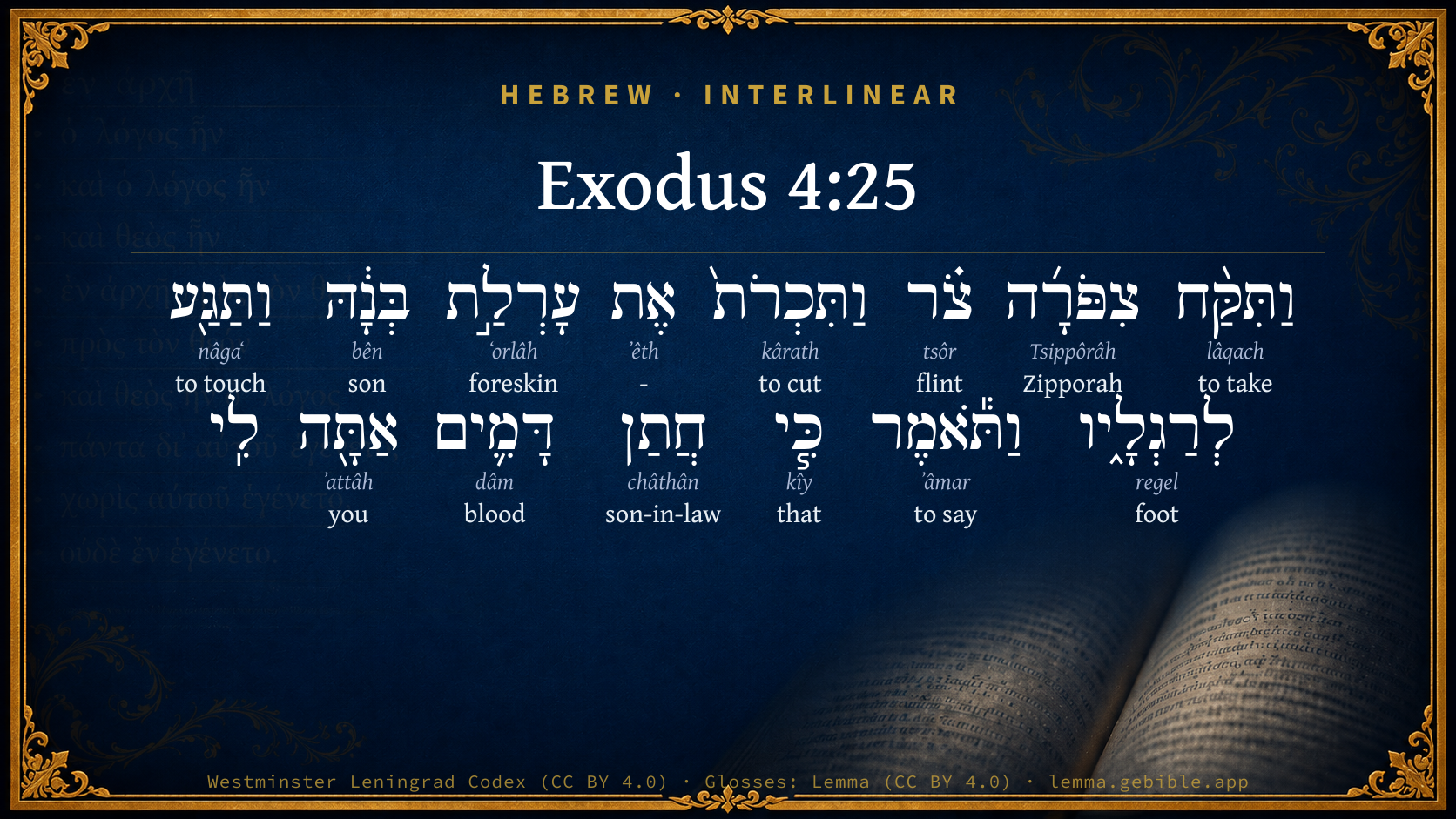
Hebrew (Westminster Leningrad Codex) Exodus 4:25 appears in the Hebrew Old Testament. The text above is from the Westminster Leningrad Codex. Each word links to its Strong’s number, a concise gloss, and parsing drawn from the Open Scriptures Hebrew Bible morphology. Click any word for its full Brown-Driver-Briggs (BDB) entry.
Download image
Cite this verse

Exodus 4:25 (World English Bible). Public Domain. Lemma interlinear Bible study tool, https://lemma.gebible.app/v/exodus/4/25.

Show BibTeX & RIS
BibTeX
RIS
English Translation
Then Zipporah took a flint, and cut off the foreskin of her son, and cast it at his feet; and she said, "Surely you are a bridegroom of blood to me."
World English Bible · Public Domain
Highlights
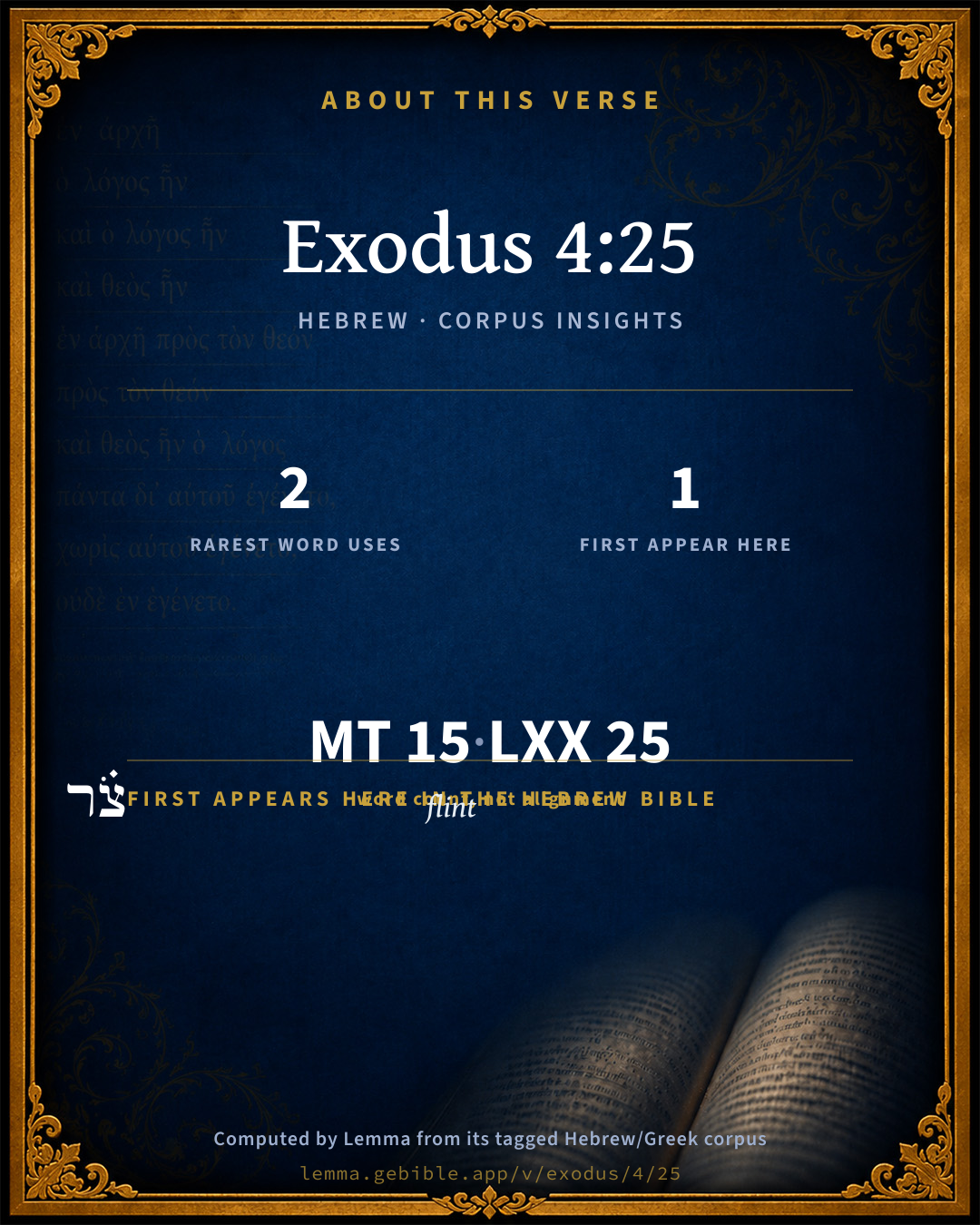
  • 1 first appearance in the Hebrew Bible
Full analysis ↓
Download a study sheet

One document with this verse’s original text, its word-by-word gloss line, the meaning frame, cross-references with their text, attributed commentary, and full source and license credits — printable, and it pastes into notes with its structure intact.

This verse Autodidact and up

Study sheet (.html) Plain text (.txt)

A passage Seminary Student

Up to 50 verses in one chapter. A passage sheet keeps up to 6 commentary sources and 12 cross-references per verse, in the order this page ranks them, and says so on the sheet whenever that leaves anything out. Ask for a single verse and you get the Autodidact verse sheet above.

Everything on this page stays free to read, with no account — the sheet is a download of what is already on screen, not access to it.

Want to remove ads? Support Godless Engineer
Compare translations 3

The same verse in 3 English versions, stacked beneath the original-language interlinear above. Click any original word for its lexicon entry.

Each is an independent rendering of the whole verse — the interlinear is not word-aligned to these translations.

Highlighted words mark where these versions differ — a whole-verse word diff, not a word-by-word alignment.

  • World English Bible Public Domain
    Then Zipporah took a flint, and cut off the foreskin of her son, and cast it at his feet; and she said, "Surely you are a bridegroom of blood to me."
  • King James Version Public Domain
    Then Zipporah took a sharp stone, and cut off the foreskin of her son, and cast it at his feet, and said, Surely a bloody husband art thou to me.
  • unfoldingWord Literal Text CC BY-SA 4.0
    And Zipporah took a flint, and she cut off the foreskin of her son, and she touched it to his feet, and she said, “Surely you are a bridegroom of blood to me.”

unfoldingWord Literal Text — © unfoldingWord, licensed CC BY-SA 4.0. Word-aligned USFM3 via Door43 (git.door43.org/unfoldingWord/en_ult).

Versions to compare (up to 4)

3 of 4 selected

Show all 18 translations

Every available English version of this verse, each an independent rendering of the whole verse.

  • World English Bible Public Domain
    Then Zipporah took a flint, and cut off the foreskin of her son, and cast it at his feet; and she said, "Surely you are a bridegroom of blood to me."
  • Berean Standard Bible Public Domain
    But Zipporah took a flint knife, cut off her son’s foreskin, and touched it to Moses’ feet. “Surely you are a bridegroom of blood to me,” she said.
  • Majority Standard Bible Public Domain
    But Zipporah took a flint knife, cut off her son’s foreskin, and touched it to Moses’ feet. “Surely you are a bridegroom of blood to me,” she said.
  • King James Version Public Domain
    Then Zipporah took a sharp stone, and cut off the foreskin of her son, and cast it at his feet, and said, Surely a bloody husband art thou to me.
  • American Standard Version (1901) Public Domain
    Then Zipporah took a flint, and cut off the foreskin of her son, and cast it at his feet; and she said, Surely a bridegroom of blood art thou to me.
  • Revised Version (1885) Public Domain
    Then Zipporah took a flint, and cut off the foreskin of her son, and cast it at his feet; and she said, Surely a bridegroom of blood art thou to me.
  • Geneva Bible (1599) Public Domain
    Then Zipporah tooke a sharpe knife, and cut away the foreskinne of her sonne, and cast it at his feete, and said, Thou art indeede a bloody husband vnto me.
  • Douay-Rheims (1899) Public Domain
    Immediately Sephora took a very sharp stone, and circumcised the fore skin of her son, and touched his feet and said: A bloody spouse art thou to me.
  • Young's Literal Translation Public Domain
    and Zipporah taketh a flint, and cutteth off the foreskin of her son, and causeth `it' to touch his feet, and saith, `Surely a bridegroom of blood `art' thou to me;'
  • Literal Standard Version CC BY-SA 4.0
    and Zipporah takes a flint, and cuts off the foreskin of her son, and causes [it] to touch his feet, and says, “You [are] surely a bridegroom of blood to me”;
  • Unlocked Literal Bible CC BY-SA 4.0
    Then Zipporah took a flint knife and cut off the foreskin of her son, and touched it to his feet. Then she said, “Surely you are a bridegroom to me by blood.”
  • unfoldingWord Literal Text CC BY-SA 4.0
    And Zipporah took a flint, and she cut off the foreskin of her son, and she touched it to his feet, and she said, “Surely you are a bridegroom of blood to me.”
  • Darby Bible Public Domain
    Then Zipporah took a stone and cut off the foreskin of her son, and cast it at his feet, and said, A bloody husband indeed art thou to me!
  • World Messianic Bible Public Domain
    Then Zipporah took a flint, and cut off the foreskin of her son, and cast it at his feet; and she said, “Surely you are a bridegroom of blood to me.”
  • Webster's Bible Public Domain
    Then Zipporah took a sharp stone, and cut off the foreskin of her son, and cast it at his feet, and said, Surely a bloody husband art thou to me.
  • Free Bible Version CC BY-SA 4.0
    However, Zipporah used a flint knife to cut off her son's foreskin. She touched his feet with it, and said to him, “You are a blood-husband to me.”
  • Bible in Basic English Public Domain
    Then Zipporah took a sharp stone, and cutting off the skin of her son's private parts, and touching his feet with it, she said, Truly you are a husband of blood to me.
  • JPS Tanakh (1917) Public Domain
    Then Zipporah took a flint, and cut off the foreskin of her son, and cast it at his feet; and she said: 'Surely a bridegroom of blood art thou to me.'

Literal Standard Version (2020), Covenant Press — licensed CC BY-SA 4.0. Text via the HelloAO Bible API (eBible.org). Unlocked Literal Bible (unfoldingWord) — licensed CC BY-SA 4.0. Text via the HelloAO Bible API (eBible.org). unfoldingWord Literal Text — © unfoldingWord, licensed CC BY-SA 4.0. Word-aligned USFM3 via Door43 (git.door43.org/unfoldingWord/en_ult). Free Bible Version, Dr. Jonathan Gallagher — licensed CC BY-SA 4.0. Text via the HelloAO Bible API (eBible.org).

Word by word

More ways to search: Search by grammar → Find every occurrence → Compare this word →

Practice this passage: Drill this verse → Learn its vocabulary →

צֹ֗ר
tsôr
H6864
“flint”
Noun, Common, Masculine, Singular, Absolute
Part of Speech
Noun
Type
Common
Gender
Masculine
Number
Singular
State
Absolute
Full BDB Definition

Origin: from H6696

TWOT: 1975b

flint, hard pebble - used as a knife
  1. וַתִּקַּ֨ח lâqach H3947 “and · to take” Conjunction + Verb, Qal, Sequential Imperfect, 3rd Person, Feminine, Singular
  2. צִפֹּרָ֜ה Tsippôrâh H6855 “Zipporah” Noun, Proper
  3. וַתִּכְרֹת֙ kârath H3772 “and · to cut” Conjunction + Verb, Qal, Sequential Imperfect, 3rd Person, Feminine, Singular
  4. אֶת ʼêth H853 “-” Particle, Direct Object
  5. עָרְלַ֣ת ʻorlâh H6190 “foreskin of” Noun, Common, Feminine, Singular, Construct
  6. בְּנָ֔הּ bên H1121 “son · her” Noun, Common, Masculine, Singular, Construct + Suffix, Personal, 3rd Person, Feminine, Singular
  7. וַתַּגַּ֖ע nâgaʻ H5060 “and · to touch” Conjunction + Verb, Hiphil, Sequential Imperfect, 3rd Person, Feminine, Singular
  8. לְרַגְלָ֑יו regel H7272 “to/for · feet · his” Preposition + Noun, Common, Feminine, Dual, Construct + Suffix, Personal, 3rd Person, Masculine, Singular
  9. וַתֹּ֕אמֶר ʼâmar H559 “and · to say” Conjunction + Verb, Qal, Sequential Imperfect, 3rd Person, Feminine, Singular
  10. כִּ֧י kîy H3588 “that” Conjunction
  11. חֲתַן châthân H2860 “son-in-law of” Noun, Common, Masculine, Singular, Construct
  12. דָּמִ֛ים dâm H1818 “blood” Noun, Common, Masculine, Plural, Absolute
  13. אַתָּ֖ה ʼattâh H859 “you” Pronoun, Personal, 2nd Person, Masculine, Singular

About this verse

These counts appear in no published source. They are computed here, from the morphology-tagged text and Lemma’s own curated glosses. What Lemma adds →

15
words
14
distinct lemmas
Pentateuch
section

Notable vocabulary

The rarest word here is צֹ֗ר flint H6864 — appearing just 2 times in the whole Hebrew Bible.

First appearance in Scripture

This word makes its first canonical appearance in the Hebrew Bible here:

Shared distinctive vocabulary

צֹ֗ר flint H6864 occurs in 2 verses of the Hebrew Bible. Also found in:

Grammatical profile

  • 4 verbs
  • 7 nouns
  • 1 pronoun
  • 1 preposition
  • 1 conjunction
  • 1 particle

Verb forms

  • וַתִּקַּ֨ח Qal · Sequential Imperfect
  • וַתִּכְרֹת֙ Qal · Sequential Imperfect
  • וַתַּגַּ֖ע Hiphil · Sequential Imperfect
  • וַתֹּ֕אמֶר Qal · Sequential Imperfect

Hebrew & Septuagint length

In English translation the verse runs 31 words from the Hebrew and 30 from the Septuagint (LXX English) — closely comparable.

A rough comparison of the two English renderings, which tokenize alike — not a word-level alignment.

Word counts can differ between the Hebrew and the Greek without any difference in meaning — e.g. the Hebrew direct-object marker אֵת has no separate Greek word, and Greek often adds the article ὁ.

In the original languages it is 15 Hebrew tokens and 25 Greek tokens — but the two are counted differently (Hebrew bundles its prefixes and suffixes into one token; the Greek is in lemma form), so that isn’t a like-for-like length.

Cross-references

3

Topical passages linked to Exodus 4:25 in the Treasury of Scripture Knowledge — connected by theme and wording, ordered by reader-vote popularity; previews shown in the World English Bible.

  • Joshua 5:2–3 At that time Yahweh said to Joshua, Make you flint knives, and circumcise again the children of Israel the second time.
  • Genesis 17:14 The uncircumcised male who is not circumcised in the flesh of his foreskin, that soul shall be cut off from his people. He has broken my covenant."
  • 2 Samuel 16:7 Thus said Shimei when he cursed, Be gone, be gone, you man of blood, and base fellow:

Cross-references courtesy of OpenBible.info (CC BY 4.0).

Hebrew and Greek witnesses Masoretic Hebrew ↔ Greek Septuagint

The same verse in the two great witnesses to the Old Testament, shown verse-for-verse.

These are two independent witnesses, not word-aligned to each other, and the Septuagint is shown in lemma (dictionary) form.

Hebrew Exodus 4:25 Masoretic · Westminster Leningrad Codex

וַתִּקַּ֨ח צִפֹּרָ֜ה צֹ֗ר וַתִּכְרֹת֙ אֶת עָרְלַ֣ת בְּנָ֔הּ וַתַּגַּ֖ע לְרַגְלָ֑יו וַתֹּ֕אמֶר כִּ֧י חֲתַן דָּמִ֛ים אַתָּ֖ה לִֽי

Then Zipporah took a flint, and cut off the foreskin of her son, and cast it at his feet; and she said, "Surely you are a bridegroom of blood to me."

World English Bible · Public Domain

Greek LXX Exodus 4:25 Septuagint · lemma form

καί λαμβάνω σεπφωρα ψῆφος περιτέμνω ὁ ἀκροβυστία ὁ υἱός αὐτός καί προςπίπτω πρός ὁ πούς καί εἶπον ἵστημι ὁ αἷμα ὁ περιτομή ὁ παιδίον ἐγώ

and Sepphora having taken a stone cut off the foreskin of her son, and fell at his feet and said, The blood of the circumcision of my son is staunched:

LXX2012 (modern English Septuagint) · Public Domain

On this verse, Joseph Benson's Commentary discusses the Septuagint’s reading. Read the note in Commentary ↓

Hebrew: Westminster Leningrad Codex (CC BY 4.0). Greek: Septuagint (public domain); English from LXX2012 (modern English Septuagint) (Public Domain). How the Septuagint differs from the Hebrew →

Targum (Aramaic paraphrase)

2

The Targum is the ancient Jewish Aramaic paraphrase of the Hebrew Scriptures — an interpretive translation, not the Hebrew text itself. Onkelos (literal) and Pseudo-Jonathan (expansive) render the Torah, and Jonathan the Prophets. Coverage is partial: where no permissively-licensed English translation exists for a verse, only the Aramaic is shown. This is verse-level text, not a word-by-word alignment to the Hebrew.

  1. Targum Onkelos Torah (Genesis–Deuteronomy)
    וּנְסֵיבַת צִפּוֹרָה טִנָרָא וּגְזָרַת יָת עָרְלַת בְּרַהּ וּקְרִיבַת לָקֳדָמוֹהִי וַאֲמֶ רֶת אֲרֵי בִדְמָא דִמְהֻלְתָּא הָדֵין אִתְיְהֵב חַתְנָא לָנָא:

    (no public-domain English translation for this verse)

    Targum Onkelos — Aramaic: “Onkelos Genesis” (public domain); “Onkelos Exodus” (public domain); “Onkelos Leviticus” (public domain); “Onkelos Numbers” (public domain); “Onkelos Deuteronomy” (public domain). English: “Sefaria Community Translation” (CC0 1.0 (public-domain dedication)); “J.W. Etheridge. The Targums of Onkelos and Jonathan Ben Uzziel on the Pentateuch. London: Longmans, Green, 1862” (public domain). Text via Sefaria.

  2. Targum Pseudo-Jonathan Torah (Genesis–Deuteronomy)
    וּנְסִיבַת צִפּוֹרָה טִינְרָא וּגְזָרַת יַת עוּרְלַת גֵרְשׁוֹם בְרָהּ וְאַקְרִיבַת יַת גְזֵירַת מָהוּלְתָּא לְרַגְלוֹי דְמַלְאָךְ חַבָּלָא וַאֲמָרַת חַתְנָא בְּעָא לְמִיגְזוֹר וְחָמוֹי עַכִּיב וּכְדוֹן אֲדָם גְזוּרְתָּא הָדֵין יְכַפֵּר עַל חַתְנָא דִילִי

    And Zipporah took a stone, and circumcised the foreskin of Gershom her son, and brought the severed part to the feet of the angel, the Destroyer, and said, The husband sought to circumcise, but the father-in-law obstructed him; and now let this blood of the circumcision atone for my husband.

    Targum Pseudo-Jonathan — Aramaic: “Targum Jonathan on Genesis” (public domain); “Targum Jonathan on Exodus” (public domain); “Targum Jonathan on Leviticus” (public domain); “Targum Jonathan on Numbers” (public domain); “Targum Jonathan on Deuteronomy” (public domain). English: “The Targum of Jonathan ben Uzziel, trans. J. W. Etheridge, London, 1862” (public domain). Text via Sefaria.

Commentary

Notes on Exodus 4:25 from classic Christian and Jewish commentators (each source and its license shown beneath its notes). The classic Christian expositions comment on the surrounding passage and are grouped to its opening verse, so a note may address several verses; the Jewish commentaries on the Tanakh (Rashi and others) are per-verse, so they appear only where the commentator wrote on this verse.

Lemma curates 59 commentaries, every one of them public domain or Creative Commons licensed, each selected and text-cleaned for this edition rather than reprinted as found. About our sources →

Trapp's Complete Commentary

John Trapp

Exo 4:25 Then Zipporah took a sharp stone, and cut off the foreskin of her son, and cast [it] at his feet, and said, Surely a bloody husband [art] thou to me.

Ver. 25. Surely a bloody husband.] A peevish wife, whose frowardness is either tollenda or toleranda, cured or carried patiently, ne coniugium fiat coniurgium. She was not so hot, but Moses was as meek.

John Trapp, A Commentary or Exposition upon All the Books of the Old and New Testament (1647–1656) — public domain. Text from a community e-Sword module.

Joseph Benson's Commentary

Exo 4:25. Zipporah took a sharp stone — Or a knife made of flint, a species of knives commonly used, as ancient writers assure us, in those days; and cut off the foreskin of her son — She perceived, it seems, the danger of her husband, and the cause of it, and he being disabled from performing the office, whether by some stroke of affliction, or the terror of so dreadful and unexpected an appearance, and a delay in a matter of such moment being dangerous, she immediately performed the work herself. And now, the cause being removed, God’s anger ceased, and Moses was permitted to pursue his journey. Surely a bloody husband art thou to me — The words in the original are short and ambiguous. As here translated, they imply that she passionately reprobated both him and his religion, which required this bloody ceremony, as if she had said, This I have for marrying a Hebrew. But the words may be understood as expressing great affection, and signifying that she had now espoused him afresh by circumcising her son, the blood of that rite having been the means of restoring him to her again, or that her child was now espoused to God by the covenant of circumcision, as some read it. The Septuagint renders the passage, Zipporah, having taken a sharp knife, circumcised her son, and fell down at his (Moses’s) feet, and said, The blood of the circumcision of my child is stopped, and she went away from him; that is, she and her children went home to Midian, when she found the child was out of danger, and able to travel. It is at least probable, that on this occasion she went back to her father with the children, and that Moses consented to this that they might not create him any further uneasiness. When we have any special service to do for God, we should remove as far from us as we can whatsoever is likely to be our hinderance. Let the dead bury their dead, but follow thou me.

Joseph Benson's Commentary on the Old and New Testaments (1811–1818) — public domain. Text from a community e-Sword module.

Tyndale Open Study Notes

Tyndale Open Resources

4:25 a bridegroom of blood: The context suggests that this statement was part of the circumcision ritual of that time. Perhaps it reflects a practice among some Semites (as among certain African groups today) of performing circumcision when the child had attained puberty.

Tyndale Open Study Notes — © Tyndale Open Resources, licensed CC BY-SA 4.0. Text via the HelloAO Bible API.

Geneva Bible (1599)

Geneva Bible translators

This act was extraordinary: for Moses was sore sick, and God even then required it.

Geneva Bible (1599) marginal notes — public domain. Text via Bolls.life.

Ellicott's Commentary for English Readers

(25) A sharp stone.—On the use of stone knives by the Egyptian paraschistœ see Herod. ii. 86. They were regarded as more pure than metal knives. From Jos_5:2 it would seem that stone knives were in the early ages commonly employed for circumcision by the Israelites.

At his feet.—Moses’ feet, undoubtedly. The action was petulant and reproachful. Zipporah regarded the bloody rites of her husband’s religion as cruel and barbarous, and cast the foreskin of her son at his feet, as though he were a Moloch requiring a bloody offering.

A bloody husband.—Heb., a husband of bloods A husband, i.e., who causes the blood of his children to be shed unnecessarily for some unintelligible reason.

A Bible Commentary for English Readers, edited by Charles John Ellicott (1878–1897) — public domain. Text from a community e-Sword module.

The Cambridge Bible for Schools and Colleges

gen. ed. J. J. S. Perowne

25. a flint] in accordance with the oldest custom (cf. Jos_5:2-3; Jos_24:30 LXX.); because the practice of circumcision originate among peoples, or in an age, in which metal knives were either not yet in use, or used but rarely (Di.).

and made it touch his feet] to connect him with what she had done, and make her son’s circumcision count as her husband’s. For the Heb., cf. Isa_6:7, Jer_1:9.

a blood-bridegroom] Originally the expression may have denote the bridegroom, as one who (see below) was himself circumcised. Here however it is used in the sense of a bridegroom secured to his wife by the circumcision of his son.

The Cambridge Bible for Schools and Colleges (gen. ed. J. J. S. Perowne; Cambridge University Press, 1878–1918) — public domain. Text from a community e-Sword module.

John Gill's Exposition

So he let him go,.... That is, the Lord let Moses go; suffered him to go on his journey without any further interruption; as the Targums, "it", the angel, ceased from him, or left him; or the disease and trembling departed from him, as Aben Ezra, and he was quite well and easy; though Grotius, after Lyra, understands it of Zipporah, she departed from him, that is, from Moses, and returned to Midian again, as it seems she did; but this the grammatical construction of the words will not bear, being masculine, though sometimes the masculine is used of women, as in Exo 1:21,

then she said, a bloody husband thou art because of the circumcision; this is repeated, partly to give the reason of her calling him a bloody husband, because of the circumcision, and partly because of her great joy on occasion of her husband's restoration to her by this means.

John Gill's Exposition of the Whole Bible (1746–1763) — public domain (CC PDM 1.0). Text via the HelloAO Bible API.

Albert Barnes' Notes on the Bible

Sharp stone - Not “knife,” as in the margin. Zipporah used a piece of flint, in accordance with the usage of the patriarchs. The Egyptians never used bronze or steel in the preparation of mummies because stone was regarded as a purer and more sacred material than metal.

Cast it at his feet - Showing at once her abhorrence of the rite, and her feeling that by it she had saved her husband’s life.

A bloody husband - Literally, “a husband of blood,” or “bloods.” The meaning is: The marriage bond between us is now sealed by blood. By performing the rite, Zipporah had recovered her husband; his life was purchased for her by the blood of her child.

Albert Barnes' Notes on the Bible (1834–1885) — public domain. Text from a community e-Sword/MySword module.

Haydock's Catholic Bible Commentary

Stone, like a flint. Such stones are very common in Egypt, and are used by the embalmers to open the side of the deceased. The Galli priests make themselves eunuchs without danger, by means of sharp stones. (Pliny, Natural History xxxv. 12.) Josue circumcises with the like, Josue v. But any instrument will suffice. (Calmet) --- Sephora seized the first thing that came in her way, to save the life of her husband, with whom God was displeased for this neglect of complying with the law, whatever might be his pretext. It was not fit that he should be a legislator, who was not a pattern of obedience. (Tirinus) --- Spouse. I have redeemed thee from destruction, by shedding the blood of my son; therefore I will deem this a ratification of our marriage. Never forget our union, which costs me so much, and which has placed you in such imminent danger. The Hebrew mothers style their newly circumcised infants bloody spouses, in imitation of Sephora, who on this occasion perhaps addresses the words to Eliezer. The Septuagint read, "Sephora....fell at his feet, and said, the blood of my son’s circumcision has ceased to flow," &c., which is not very easy to understand.

George Leo Haydock (1774–1849), Haydock's Catholic Family Bible and Commentary, 1859 edition — public domain. Excludes Psalms (Douay-Rheims chapter numbering differs from Protestant) and Deuterocanonical books (Catholic canon only).

Matthew Poole's English Annotations

Perceiving the danger of her husband, and the cause of it, and her husband being disenabled from performing that work, whether by some stroke or sickness, or by the terror of so dismal and unexpected an apparition to him, and delays being highly dangerous, she thought it better to do it herself as well as she could, rather than put it off a moment longer; whether because the administration of that sacrament was not confined to any kind or order of persons, or because, if it was so, she did not apprehend it to be so, or because she thought this was the least of two evils, and that it was safer to commit a circumstantial error, than to continue in a substantial fault.

A sharp stone, which she took as next at hand in that stony country. Let none think this strange, for not only this work, but the cutting off of that part, which some used to do, was commonly performed with a flint, or a sharp stone, as is expressly affirmed by Herodotus, 1. 2; Plin. 35. 12. See also Juvenal, Sat. 6. and Martial. Epigram. 3. 18. But the word may be rendered, a sharp knife. See Jos 5:2,3. Cast it at his feet: the words are very short, and therefore ambiguous, and may be rendered, either thus, she cast herself at his feet; either,

1. At the feet of the angel, as a supplicant for her husband’s life. But it is most probable that she directs this action and her following speech to the same person. Or,

2. The feet of her husband, to make request to him, that she and her Children might depart from him, and return to her father, which also he granted. But neither was she of so humble a temper, nor at this time in so mild a frame, as to put herself into such a lowly posture to her husband; nor was she likely to present her humble supplication to him, to whom at the same time she showed such scorn and indignation. Or rather thus, she cast it at his, i.e. her husband’s, feet: it, either the child; but that being tender, and now in great pain, she would not use it so roughly: or rather the foreskin cut off, or at least the blood which came from it; which she did in spite and anger against her husband, as the cause of so much pain to the child, and grief to herself.

A bloody husband art thou to me: this some think she spake to the child, whom she calls her spouse, as some late rabbins affirm the infant used to be called, when it was circumcised, though they bring no competent proof for this usage; or her son, as the Hebrew word chathan signifies. But indeed that signifies only a son-in-law, as 1Sa 18:18, which is not true nor proper here. Yet some make these to be the form or solemn words used in circumcision, Thou art a spouse, or a son of bloods, to me, i.e. made so to me by the blood of circumcision. But it doth not appear that this was the usual form. Nor was it likely that she, being a Midianitish, not a Hebrew woman, and doing this suddenly, and in a rage, should be so expert to know, and so punctual to use, the right form of words, when she did not use a fit and decent carriage in the action, as appears by her casting it at his feet. It is therefore more probable she spoke thus to her husband. And because she durst not accuse God, the author of this work, she falls foul upon her husband as the occasion of it, and as a costly and bloody husband to her, whose endangered life she was forced to redeem with blood, even the blood of her little child, by which as he received a new life after a sort, so she did anew, and the second time, espouse him; whence she calls him chathah, which properly signifies a spouse, not a husband.

Matthew Poole's English Annotations on the Holy Bible (1683–1685) — public domain. Text from a community e-Sword/MySword module.

The Pulpit Commentary

Zipporah took a sharp stone. Literally "a stone." Stone knives were commonly used in Egypt for making the incisions necessary when bodies were embalmed, and were regarded as purer than iron or bronze ones. Joshua ordered the preparation of stone knives for the circumcision of those born in the wilderness; (Jos_5:2) and the Jews seem to have used stone for circumcision for many ages, though before the compilation of the Talmud they had changed their practice. Cast it at his feet. Not, certainly, the child"s feet, but her husband"s, to whom at the same moment she addresses herself. A bloody husband. Literally, "a bridegroom of blood." The words are clearly a reproach; and the gist of the reproach seems to be that Moses was a husband who cost her dear, causing the blood of her sons to be shed in order to keep up a national usage which she regarded as barbarous.

The Pulpit Commentary (1880–1919), ed. H.D.M. Spence-Jones & Joseph S. Exell — public domain. Text from a community e-Sword module.

Rashi

Rabbi Shlomo Yitzchaki (Rashi)

ותגע לרגליו AND CAST IT AT HIS FEET — i. e. she cast it before Moses’ feet (Talmud Yerushalmi Nedarim 3:9).

ותאמר AND SHE SAID, referring to her son:

כי חתן דמים אתה לי which means, thou hast brought it about that my bridegroom (Moses) was on the point of being killed because of thee: thou hast been to me my husband’s murderer.

Rashi on the Tanakh — English translations: “The Judaica Press complete Tanach with Rashi, translated by A. J. Rosenberg” (CC BY 4.0); “Pentateuch with Rashi's commentary by M. Rosenbaum and A.M. Silbermann, 1929-1934” (public domain); “The Metsudah Tanach series, Lakewood, N.J” (CC BY 4.0); and “The Book of Joshua, Metsudah Publications, 1997” (CC BY 4.0). Text via Sefaria.

Lesson kit

Teaching starters — assembled from the data on this page, not authored interpretation. Every prompt links to the verse data it draws on. Edit before teaching.

Exodus, in the Pentateuch, opens this verse with 15 words (14 distinct Hebrew lemmas). Its most distinctive word is tsôr (“flint”). A historical commentator’s framing appears above. Read the whole chapter for the surrounding context.

Discussion questions

  1. What does “flint” (tsôr) contribute to the verse as a whole?
  2. This is the first place “flint” appears in Scripture (first appears here). What does its debut here establish?
  3. How does Ezekiel 3:9, which shares the word «flint», read alongside this verse?
  4. These translations render this verse differently. What is at stake in choosing one wording over another?
  5. «וַתִּקַּ֨ח» is a Qal Sequential Imperfect verb. How does that grammatical form shape the action described?
  6. Compare how Trapp's Complete Commentary and Joseph Benson's Commentary read this verse. Where do they agree or differ?

Things to notice

Reading settings

Reading text

Shown beneath each verse's original-language words.

Old Testament
Old Testament edition

Read the OT as the Masoretic Hebrew (MT) or the Greek Septuagint (LXX).

English shown for the Greek Septuagint (in the Hebrew ↔ Greek comparison).

Comparing translations? Open the Compare panel on any verse page to stack up to four side by side.